Harvard University’s courageous refusal to obey the demands of the Trump administration—and its subsequent filing of a lawsuit this week seeking restoration of its federal funding—has inspired praise across academia. But there has been less attention to just how terrible those demands were. No government entity in the United States has ever proposed such repressive measures against a college. By making outrageous demands a condition of federal funding—and freezing $2.2 billion in funds because Harvard refused to obey—the Trump administration is setting a precedent for threatening the same authoritarian measures against every college in America.
The April 11 letter to Harvard from Trump administration officials proposed a staggering level of control over a private college. Although at least one of the authors reported that the letter was sent in error while negotiations were still ongoing, this mistake didn’t stop the Trump administration from punishing Harvard for refusing to accept its dictates.
After Harvard rejected the demands, Trump himself posted further threats to Harvard’s tax-exempt status on social media, even though federal law bars presidents from directly or indirectly requesting Internal Revenue Service investigations against specific targets: “Perhaps Harvard should lose its Tax Exempt Status and be Taxed as a Political Entity if it keeps pushing political, ideological, and terrorist inspired/supporting ‘Sickness?’” Of course, if Harvard obeyed the Trump regime’s orders to silence political speech, it would be pushing a right-wing ideological agenda.
Among the stipulations in the April 11 letter, the Trump administration demanded the power to compel hiring based on political views to, in effect, give almost complete preference to political conservatives: “Every department or field found to lack viewpoint diversity must be reformed by hiring a critical mass of new faculty within that department or field who will provide viewpoint diversity; every teaching unit found to lack viewpoint diversity must be reformed by admitting a critical mass of students who will provide viewpoint diversity.” Since most people who enter academia are liberal, as are most current academics, this demand for ideological balance would effectively ban the hiring of liberal professors in virtually all departments for many years.
Decisions on how to measure the presence or lack of viewpoint diversity would be made by “an external party” hired by Harvard with the approval of the federal government (meaning Trump). Government-imposed discrimination based on viewpoint would also apply to students, since the letter requires the “external party … to audit the student body, faculty, staff, and leadership for viewpoint diversity, such that each department, field, or teaching unit must be individually viewpoint diverse.” If every department “must be individually viewpoint diverse,” then students with underrepresented viewpoints (Nazis, perhaps?) must receive special preferences in admissions. This concept that every department’s students, faculty and staff must match the distribution of viewpoints of the general population is both repressive and crazy to imagine.
The Trump administration letter also ordered Harvard to commission a Trump-approved consultant to report on “individual faculty members” who “incited students to violate Harvard’s rules following October 7”—and asserted that Harvard must “cooperate” with the federal government to “determine appropriate sanctions” for these professors. Retroactively punishing professors who violated no rules for allegedly encouraging student protesters is an extraordinary abuse of government power.
Not to stop there, the Trump administration letter seeks to suppress the right to protest: “Discipline at Harvard must include immediate intervention and stoppage of disruptions … including by the Harvard police when necessary to stop a disruption.” Since the Trump administration seems to regard every protest as a “disruption” (and Harvard itself has wrongly banned silent protests), this could require immediate police intervention to stop a broad range of actions.
The Trump administration also demanded unprecedented control over Harvard’s disciplinary system to order punishments of student protesters without due process. Among other specific steps, the Trump administration ordered Harvard to ban five specific student groups, including Students for Justice in Palestine and the National Lawyers Guild, and “discipline” all “active members of those student organizations,” including by banning them from serving as officers in any other student groups. And Harvard would be compelled to implement government-imposed punishments by “permanently expelling the students involved in the October 18 assault of an Israeli Harvard Business School student and suspending students involved in occupying university buildings.”
Shared governance is another target of Trump and his minions. The Trump administration’s demands for Harvard included “reducing the power held by students and untenured faculty” and “reducing the power held by faculty (whether tenured or untenured) and administrators more committed to activism than scholarship.” It’s bizarre to imagine that a university could be forced by the government to determine whether a professor is committed to “activism” before banning them from any position of power such as a department chair or committee member. The letter also demands “removing or reforming institutional bodies and practices that delay and obstruct enforcement [of campus rules governing protests], including the relevant Administrative Boards and FAS Faculty Council.”
Not surprisingly, the Trump administration’s letter also demands a complete ban on diversity programs: “The University must immediately shutter all diversity, equity, and inclusion (DEI) programs, offices, committees, positions, and initiatives, under whatever name.” This repression not only interferes with the ability of universities to run their own operations, but it is also designed to suppress speech on a massive scale by banning all programs anywhere in the university that address issues of diversity and equity, with no exceptions for academic programs.
There’s more. Harvard would be forced to share “all hiring and related data” to permit endless ideological “audits.” A requirement that “all existing and prospective faculty shall be reviewed for plagiarism” could be used to purge controversial faculty. Perhaps the most ironic part of the letter to Harvard is its command for ideological control over foreign students: “the University must reform its recruitment, screening, and admissions of international students to prevent admitting students hostile to the American values and institutions inscribed in the U.S. Constitution and Declaration of Independence.” Trump’s regime is undermining the Constitution and shredding the Bill of Rights, while demanding that foreign students prove their devotion to the very documents that the Trump administration is destroying.
The Trump administration’s letter to Harvard should shock and appall even those conservatives who previously expressed some sympathy with the desire to punish elite universities by any means necessary. This is fascism, pure and simple. It portends an effort to assert total government control over all public and private universities to compel them to obey orders about their hiring, admissions, discipline and other policies. It is an attempt to control virtually every aspect of colleges to suppress free expression, ban protests and impose a far-right agenda.
It’s tempting to hope that the Trump administration merely wanted to target Harvard alone and freeze its funding by proposing a long series of absurdly evil demands, knowing that no college could possibly agree to obey.
But the reality is that the letter to Harvard is a fascist blueprint for total control of all colleges in America, public and private. The demand for authoritarian control by the Trump administration is an assault on higher education and free speech in general. If Trump officials can impose repression on any college they target, then private corporations (as the assaults on private law firms have indicated) and state and local governments will soon follow.
The government repression that began with Columbia University will not end with Harvard or the Ivy League institutions. These are the first volleys in a war against academic freedom, with the clear aim of suppressing free expression on campus or destroying colleges in the battle.
In the latest episode of The Key, Inside Higher Ed’s news and analysis podcast, two economists highlight opportunities that college and universities can grab to improve engagement with their local communities, create greater access for first-generation students and increase transparency around pricing.
David Hummels, professor of economics and dean emeritus, and Jay Akridge, trustee chair in teaching and learning excellence, professor of agricultural economics and former provost, both at Purdue University, are co-authors of a Substack newsletter on higher education, Finding Equilibrium.
They join Sara Custer, editor in chief of Inside Higher Ed, and this episode’s host, Colleen Flaherty, Inside Higher Ed’s editor for special content, to analyze the findings from the Inside Higher Ed/Hanover Research 2025 Survey of College and University Presidents.
In response to two-thirds of presidents having some serious doubts about the value of tenure, Hummels cautions that not offering faculty tenure means institutions are “going to have to pay faculty the way they’re paid in industry or you won’t be able to attract anyone.”
Tenure is similar to executive stock options in the private sector, he argues: “It causes faculty to invest far more than they otherwise would in critical functions—like developing curriculum, hiring, developing and evaluating other faculty—because their tenure is going to be a lot more valuable if they’re part of a thriving institution,” he says.
Akridge agrees with the 50 percent of survey respondents who say higher ed has a real affordability problem, even if his research shows that the value of college remains high and the debt students take on is overblown.
“The sticker price and the debt they take on becomes how they think about cost. And that’s real,” he says. “Part of the fear for us is, who hears that message? Students with means and whose parents went to college are going to go to college. The evidence is quite clear that lifetime earnings, wage premiums, quality of life, even life span are better for those that go to college, and these families know that. Students that are first generation, that are maybe lower income, maybe underserved—I think they’re quite susceptible to that message and may write off college as perhaps their ticket to a better life, and that’s concerning from an equity standpoint.”
A mere 3 percent of surveyed presidents said that higher ed has been very or extremely effective at responding to the diploma divide that is increasingly predictive of voter behavior. In response, Custer encourages colleges and universities to take accountability for, and be responsive to, valid critiques of higher education as a sector, while building on the confidence that many communities retain in their local institutions. She shared an example of a messaging campaign by one regional college that highlighted how graduates are contributing to the local area in everyday but fundamental ways. “‘We are putting really valuable people back into the community who are supporting you and your families and making it possible for you to live here,’” she summarizes.
Hummels also stresses the importance of making the case for academic research, currently under threat. “Science broadly is essential to the competitiveness of the economy, to our firms and to the success of our students. It’s not just this cute thing faculty do in their spare time. We do it because it is central to who we want to be as a country and what our firms want to become. And I think we have been neglectful about maintaining awareness of how important this is.”
Uncertainty is unavoidable. Whether it relates to relatively minor topics such as today’s traffic and weather or potentially life-altering issues such as our health and employment, coping with an unknown future is part of our daily lives. At the same time, we are living in a moment of extraordinary uncertainty, with numerous changes to the landscape of higher education and increasing economic instability.
If you are in a leadership role—whether that means leading an academic unit or leading a research lab or classroom—you may be feeling the weight not only of managing uncertainty for yourself, but also of guiding those you lead through uncertain terrain. In doing so, you are likely to encounter situations where those you lead are looking for definitive information around questions that you are not able to answer.
How do you lead in these situations? I’m a firm believer that leaders can always do something even when it is not the specific thing that people are hoping for. In this case, I propose that even when we can’t provide answers or predict what the future will hold, we can offer something that might be even more valuable—the skills needed to manage uncertainty.
Empowering others in the face of uncertainty is a complex and nuanced process, and your approach will differ depending on each individual and context. However, some steps that are likely to be helpful are:
Acknowledge the challenge. As a leader, you may feel an urge to avoid talking about issues that you’re not able to solve. However, this does not make those issues any less real for those you lead. Start by validating what is at stake for an individual, whether this is job stability, research funding or admission to graduate school. You can also acknowledge the broader challenge that uncertainty brings and how it taxes us mentally and emotionally. Acknowledging challenges does not mean that you are taking the blame for their existence or that you will not advocate to uphold the rights of individuals and shared values of your institution. However, openly recognizing the reality of a situation can go a long way in building trust with those you lead.
Reflect on past resilience. Every person you lead is a unique individual with their own way of managing adversity. You can offer some general strategies, such as focusing on purpose and impact and leaning on community for support. Even more helpful is to empower each person by encouraging them to reflect on challenges they have faced in the past and think about what strategies and supports enabled them to manage those situations. Helping someone remember that they have overcome difficult situations in the past provides guidance as to how they can do so again and builds their self-confidence to do exactly that.
Focus on what you can control. One of the many things that uncertainty robs us of is our sense of self-determination. A natural response is to place the greatest focus on the areas where we have the least amount of control. Effectively managing uncertainty or adversity can require that we do the opposite. Importantly, our domain of control includes both what we do and how we do it. You can offer guidance to an individual on how to create a plan and take actions that are within their domain of control, while also reinforcing that they are the one in control of the values and ethics that will guide the choice and implementation of those actions.
Create space for self-care. When the challenges we face may stretch over weeks, months or even years, self-care is more critical than ever in sustaining ourselves for what is to come. Just as you can help each person you lead reflect on their unique coping strategies, you can help them make a plan for self-care activities that will provide the greatest benefit to their mental health. This might include time spent doing activities they enjoy alongside people they care about. It can also mean checking out for a set time and playing video games or streaming a show where the only value is entertainment.
Depending on your leadership role, simply managing your current responsibilities may already feel overwhelming. Adding in the task of helping others manage uncertainty may seem impossible. You may also feel unprepared to navigate a topic for which you haven’t received specific training. Those are very real challenges, but they do not have to prevent you from taking action.
The principles outlined above can be woven into everyday meetings and email discussions and thus reap benefit without increasing workload. You can also lean on existing resources and expertise to disseminate helpful ideas in a time-efficient manner. For example, consider sharing an article or podcast on resilience, uncertainty or self-care with your team and setting aside 15 to 20 minutes at your next meeting to discuss the advice offered by experts. Or for a deeper dive, you can choose a book and work through each chapter together over a monthly sack lunch.
As a leader, there is always something that you can do. And even when you don’t have all of the answers, you can have a powerful positive impact by mindfully guiding yourself and others through uncertainty.
Jen Heemstra is the Charles Allen Thomas Professor of Chemistry and chair of the Department of Chemistry at Washington University in St. Louis. Her research is focused on harnessing biomolecules for applications in medicine and the environment, and she is the author of the forthcoming book Labwork to Leadership (Harvard University Press, August 2025)
Peter Scott is Emeritus Professor of Higher Education Studies at UCL and was Vice-Chancellor of Kingston University between 1998 and 2010.
Freedom of speech and academic freedom are difficult enough to define and police. The task has become more difficult because they have got caught up in the two most toxic issues of the moment – Palestinian rights and anti-Zionism (seen as shading into anti-semitism) on the one hand and support for the Israeli Government on the other; and women’s and trans rights and transphobia. Never has it been more true that hard cases make bad law.
This seems to have been lost on the Office for Students with its recent decision on the Kathleen Stock case, whose gender-critical views had led to protests and demonstrations by trans activists, to fine the University of Sussex more than £500,000 (with the threat that fines could be even higher for universities which, in the eyes of the OfS, fail to protect free speech and academic freedom in a similar way). Unsurprisingly, that decision is being challenged by Sussex on a number of grounds, including the OfS’s refusal to meet the University’s representatives face-to-face before reaching it, a curious decision in the light of normal proceedings in legal and quasi-legal cases. Remember the lawyers’ old Latin tag audi alteram partem.
The Stock case was one of three recent high-profile free speech cases. The two others were the case of David Miller, the University of Bristol professor who won an employment tribunal case after his dismissal by the University for his anti-Zionist views and that of Jo Phoenix, the Open University (OU) professor who won a similar case for constructive dismissal following the University’s failure to support her when attacked for her gender critical views.
The same two toxic issues were in play in all three cases. It is difficult to see how, from the OfS’s perspective, Bristol and the OU were not as much in breach as Sussex of the OfS’s regulatory condition E1 for failing to uphold the relevant public interest governance principles (ensuring staff have the freedom ‘to question and test received wisdom’ and ‘to put forward new ideas and unpopular opinions’ without placing themselves in jeopardy). Two separate employment tribunals found that this is exactly what happened to Professors Miller and Phoenix, although in the first case through gritted teeth. Constructive dismissal and dismissal certainly count as being placed ‘in jeopardy’.
The OfS opened its investigation into ‘free speech matters’ at Sussex under the general powers it had under its regulatory framework. The fine was assessed within the same framework. The Higher Education (Freedom of Speech) Act, which has given the OfS extra powers to investigate individual complaints, had not yet been passed. In any case, the incoming Labour Government chose last year not to implement some key provisions in that Act. So, when it launched the Sussex enquiry, the OfS did not yet have the power to investigate individual cases. Officially, it did not do so in the case of Kathleen Stock, although it appears she was interviewed as part of the investigation.
So it remains a mystery why the OfS decided not to investigate the Miller and Phoenix cases which, on the face of it, raised the same issues and, as a result, should have led to the same concern – and similar fines? Surely not because of the political and media firestorm that the Stock case set off. Instead, the OU was allowed to ‘mark its own homework’ by setting up the Dandridge review, which failed to placate Professor Phoenix. Bristol publicly expressed its ‘disappointment’ at the tribunal’s findings, so no regrets and no acknowledgement that free speech had been an issue. The involvement of employment tribunals was no bar to an OfS investigation. Any differences between the three cases cannot explain why Sussex was picked out, because the OfS did not carry out investigations into the other two cases and so could not be aware of any differences.
The OfS report is a curious document. It is largely context-free, in the sense that Professor Stock’s case is so briefly sketched that anyone unfamiliar with the case would find it difficult to understand what had happened. The formal reason for this context-lite brevity is that the OfS was not investigating what had happened to Professor Stock. Officially there was no Stock case. But a more substantial reason surely is that this absence of context was necessary in the light of its claim, in the words of the Director for Freedom of Speech and Academic Freedom, Professor Arif Ahmed, that ‘The OfS will continue to focus on a protection and promotion of lawful speech – irrespective of the views expressed. We will continue to be impartial and viewpoint neutral in our regulation and decisions’.
In truth, free speech and academic freedom, even within the law, can never be absolute. This is explicit in section 43 of the Education (No. 2) Act of 1986 which states that universities ‘must take such steps as are reasonably practical to ensure that freedom of speech within the law is secured’. ’As are reasonably practical’ is an essential phrase, to which I will return. There will always be views which it is lawful to express but nevertheless are highly objectionable in the eyes of many people, and especially of those who feel they are threatened.
Nor can they really be ‘viewpoint neutral’. The two toxic issues under discussion demonstrate this clearly. The expression of anti-Israeli and anti-Zionist views, because it is sometimes in danger of shading into anti-Semitism, is treated as beyond the pale. Gender-critical views, in contrast, despite the fact that they may be perceived to be transphobic, are firmly within it. The former, therefore, deserve to be banned and universities that tolerate their expression stigmatised or punished; the latter to be protected and universities that do not do so punished – as Sussex has been with its hefty fine. To be clear, I am not expressing an opinion about these viewpoints, just highlighting how they are treated differently.
Why? Both Jewish and trans people, rightly or wrongly, feel threatened by what for them are hostile views. That is not sufficient in itself to override freedom of speech or academic freedom which, remember, are expected to be ‘unpopular’. This difference in treatment can only be explained with reference to history and politics. But, if the definition, and protection, of free speech and academic freedom are essentially political, the ‘viewpoint neutrality’ espoused by the OfS is an illusion. Its own decision to investigate Sussex was clearly partisan. The 2023 Act, which gave the OfS the mandate to investigate individual complaints, arose in a particular political context. It reflected the belief that conservative viewpoints were unwelcome in universities and therefore needed to be protected. Protecting liberal views was never the game.
If free speech and academic freedom are context-specific, two questions arise. The first is practical. If that context is to be assessed and common sense applied – or, in the phrase in the 1986 Act, steps ‘as are reasonably practical’ defined – who is best placed to do that? In short, who is competent to make these complex decisions in which competing, and passionate, differences must be balanced? The effective choice is between officials in a State agency who are likely to have limited experience at the sharp end of university management, and vice-chancellors, their senior colleagues and university communities at large who know the people and personalities and real-world contexts. Free speech cases will not always be straightforward. They may contain multiple strands – breakdowns in professional relationships, complaints by students (ostensibly sovereign ‘customers’), even underperformance.
The second question is one of principle, and much more important. In a liberal democracy that aspires to be an open society, should the State, or State agencies, ever be allowed to decide these delicate issues, particularly with regard to academic freedom, in the process invading and inevitably reducing the autonomy of universities? Of course, authoritarian and totalitarian States routinely behave in this way. They have no interest in academic freedom. But in a democracy, a foundational principle of academic freedom is surely that it is not defined or policed by the political authorities.
The only conceivable justification for State intervention in a free society is that, if universities do not protect freedom of speech, they must be made to do so, as the partially implemented 2023 Act prescribes. There are two answers to this.
First, during the modern era, the practice has always been to trust universities to protect academic freedom because they understand it best. When I was a member of the board of the former Higher Education Funding Council for England two decades ago, no one would have suggested that HEFCE should have the power to fine universities for failing to uphold free speech. What is truly chilling is the erosion of institutional autonomy, with remarkably little protest or pushback. It is interesting how the political right, while believing passionately in a small State in the context of public services, economic regulation and taxation, believes equally passionately in a very strong State in the context of ideological surveillance.
Second, is there really a problem here – or, more accurately, a new problem? There is little evidence that universities have become less trustworthy in terms of protecting academic freedom. Of course, there have always been issues with ‘viewpoint diversity’ (in the phrase used by the US Government to justify its assault on Harvard – I’m coming on to Trump next…). In Economics departments dominated by econometricians behavioural economists are not always welcome. Some education departments may have ‘coloniality’ on the brain. Even peer review or the Research Excellence Framework may have ‘chilling effects’ in certain circumstances. But overall universities have always known, better than politicians, that intellectual creativity and productivity depend on a variety and diversity of ideas and of people.
… which brings me finally to Trump and Harvard. In a crooked sense, we should be grateful to President Trump for his brutish honesty. No serious attempt to disguise partisanship beneath a cloak of dispassionately protecting all free speech and academic freedom, just the driving desire to punish America’s greatest universities for refusing to toe the MAGA line in an extraordinary spasm of national self-harm. Harvard has been asked, and bravely refused, to allow the US Government to carry out ‘audits’ of departments suspected of being ‘woke’, to influence admissions, to vet academic appointments, to have access to lists of students, especially international students, who have taken part in demonstrations against Israel’s actions in Gaza, and outlaw all policies designed to promote diversity, equity and inclusion.
The US example is important for two reasons, however little the OfS may appreciate being bracketed with Trump. First, the political focus on free speech, in the current form of the ‘war on woke’, has all the marks of being ‘made in America’, ideology borrowing rather than truly home-grown. Now we have been shown the future, and it stinks. Do we really want to go there? Second, the same politically partisan focus has actually made it more difficult to have a measured debate about free speech and academic freedom which, very sadly, is badly needed in a world from which reason, trust and mutual respect appear to have fled – and online abuse, fake news and AI have arrived. The OfS report on Sussex, and its disproportionate fine, are – in effect – a blow against rather than a blow in favour of free speech in higher education.
Something has been happening on college campuses that’s as surprising as it is dramatic: The number of women enrolled has overtaken the number of men.
Women now outnumber men by about 60 percent to 40 percent, and that gaps keep getting wider. And men who do enroll are also more likely to drop out.
There are a lot of reasons for this. Boys get lower grades than girls, on average, in elementary and middle schools. They’re more likely to be held back or face disciplinary actions. They’re less likely to graduate from high school. And more men than women go into the skilled trades, instead of getting college degrees.
Among the results: Universities and colleges now tip the scales for men in admission to try to keep the genders even.
But as things keep falling out of balance, there are impacts on the financial success for men and on economic growth for everybody.
We’ll hear from men and women students about what that’s like right now, and from colleges about what they’re trying to do about it.
[Kirk] This is College Uncovered. I’m Kirk Carapezza …
[Jon] …and I’m Jon Marcus.
[sound of referee] Climbers ready? Contestants ready? One, two, go!
[Jon] This is the sound of one of the most unusual extracurricular activities at the University of Montana: running up a fallen tree with careful footwork, and neatly sawing off the end of it.
[sound of club member] So really what we’re trying to do is keep the tradition of antique logger sports alive by bringing in new generations to doing activities that they did hundreds of years ago. I mean, we’re using cross-cut saws that they used to cut down giant redwoods.
[Jon] That might seem like a throwback, but the University of Montana Woodsmen team has an important new purpose. Promoting programs such as forestry has become part of the university’s new strategy to attract an increasingly important type of student.
[Kelly Nolin] There are definitely some efforts that are happening at the institution to help men find their community and to find a space.
[Jon] That’s Kelly Nolin. She’s director of admissions at the University of Montana.
[Kelly Nolin] Our gender split is about 42 percent male, 56 percent female. So it’s definitely widening, and it’s clearly a concern for a variety of reasons. And so that’s why we decided to look into opportunities to recruit more male students.
[Jon] What Nolan says she’s trying to solve is a really big problem that most people don’t know is even happening: The proportion of men who are going to college is falling way behind the proportion of women who are going.
Nationwide, women now outnumber men by about 60 percent to 40 percent, and that gap keeps getting wider. Far more young women than young men who graduate from high school are going to college, and men who do enroll are also more likely to drop out.
We’ll tell you how this might actually be creating an advantage for men in the admissions process, and even how it affects even the dating scene on campuses — which, let’s face it, is a big part of college to a lot of students.
Take it from Amber Turner. She’s a freshman at Nova Southeastern University in South Florida, which is now more than 70 percent women.
[Amber Turner] It’s a lot more women than men and the men usually have a lot more options, whereas the women have disgusting options because there aren’t many of them. I have a boyfriend, personally, but I saw with my friends that it’s kind of like nobody here for them.
[Jon] But fewer men in college has really serious implications for not only colleges that need to fill seats — or, for that matter, students frustrated by the dating pool. It affects the prospects of financial success for men, and of economic growth for everybody.
This is College Uncovered, from GBH News and The Hechinger Report — a podcast pulling back the ivy to reveal how colleges really work. I’m Jon Marcus of The Hechinger Report …
[Kirk] … and I’m Kirk Carapezza with GBH. Colleges don’t want you to know how they operate, so GBH …
[Jon] … in collaboration with The Hechinger Report, is here to show you.
Today on the podcast: ‘The Missing Men.’
[Kirk] This season, we’ve been talking about the demographic cliff. That’s the decline that’s starting in the number of 18-year-olds, and how it will affect colleges and the economy.
Now here’s a related milestone you might not have heard about. The number of college-educated women in the workforce has for the first time overtaken the number college-educated men. That’s because more women than men have been going to college.
There are a lot of reasons for this. Boys in elementary and middle school get lower grades than girls. They’re more likely to be held back or face disciplinary action. And they’re less likely to graduate from high school. Jon, you and I have talked to high school senior boys about all of this.
[Jon] Right, Kirk, and a lot of them were worried that they don’t have the confidence to tackle college.
[Abdukadir Abdullahi] I feel like there’s more distractions for guys to get, like, the best grades because every school, like, the guy is always the class clown, and stuff like that.
[Jon] That’s Abdukadir Abdullahi. He’s the son of a single father and just didn’t see himself in college. Neither did Pedro Hidalgo, even though he actually wanted to go.
[Pedro Hidalgo] College was something I always wanted to reach and I always wanted to be accepted to, but I never had that belief within myself that I could do it.
[Jon] Men are more likely than women to go into the skilled trades, which is faster and cheaper than paying for what seems to them to be an endless and expensive stretch of time in college. That’s what Abdullahi was planning to do.
[Kirk] Back when you thought college wasn’t for you, what was the alternative? You were planning to just go straight to work or join the military or did you have an alternative plan?
[Abdukadir Abdullahi] I was going to, like, be a plumber or something like that, like where you could have to go to school, but you could make a decent amount of money.
[Kirk] In the end, he and the rest of these guys did end up going to college. But a lot of other high school boys feel like they need to get jobs right away, especially if they come from families that need help with their finances.
Here’s Hidalgo’s classmate, Debrin Adon. His parents immigrated to the United States from the Dominican Republic.
[Debrin Adon] I’m not going to speak for every man, but at least for young men like my classmates and I, we’re more focused on like money, you know? Like, getting money — getting that paycheck.
[Kirk] That’s right. So a lot of them get jobs right out of high school and then they buy a car and maybe get married and by that point, it’s almost certain that they’ll never go to college.
This is Kellie Becker. She’s the college counselor at the school where Abdullahi went.
[Kellie Becker] A lot of young men are working. They’re working for their families. Like, they’re the man of the house. They are providing their entire family with one paycheck and they get a little taste of that where they, some of them, have to do it or some of them want to do it because they’re getting that money.
[Kirk] These are just a few of the reasons we’ve ended up here. Fifty years ago, the gender divide was exactly the reverse, and there were far more men than women in college. Since then, there’s been a lot of work to encourage women to get degrees. But much less of that kind of thing is targeted at men. Women also disproportionately work in fields that require degrees, such as social work and teaching. And we’ve already heard how boys don’t do as well as girls in lower grades, how young men feel responsible for helping their families right out of high school and how many of them go into the trades. The decline is even steeper for Black men. Their numbers went way down during the pandemic. Even at historically Black colleges, Black men now make up only about a quarter of the students.
[Michael Sinclair] Money is one of the main factors. A lot of our young men are looking for opportunities to earn a living, but they need the money now.
[Kirk] That’s Michael Sinclair. He’s an associate professor at Morgan State University, and he points out that this becomes a vicious cycle.
[Michael Sinclair] There’s a statement that my father once told me: You can’t be what you can’t see. And if you’re not seeing Black men on college campuses, a lot of young people don’t think that that’s for them.
[Kirk] This mismatch between men and women is starting to create an odd divide on many college campuses.
[Jon] Exactly, Kirk. I visited another big university, the University of Vermont. It’s already 64 percent female. I went to the student union, where Melinda Wetzel told me what it was like to be a woman student there.
[Melinda Wetzel] Oh, yeah, I do have one small class that there is only one guy. I do undergraduate research and when I’m in the medical building, I feel like I hardly ever see men. I feel I’m walking around and it’s just, like, a bunch of ladies.
[Jon] This extends to areas on campus you might not expect.
[Melinda Wetzel] I was at the gym the other day and, like, if you think about going to a gym, you think of, like, oh, no, like, there’s going to be a lot of scary guys there. I looked around and I actually pointed out to my friend, like, ‘Whoa, look at all the girls here. This is great.’
[Jon] Now, some men on campus also think it’s great that there are more women.
[Pete Azan] So in our class we have, like, 83 girls and like 30 guys. They told us that like the first day of school. So we were all shocked.
[Jon] Pete Azan is studying dental medicine down at Nova Southeastern. More women than men are going into dentistry these days, too — not only there, but nationwide. He’s okay with that, though.
[Pete Azan] I love it. I go to class every day the happiest man, because I get to be around beautiful women all day.
[Jon] And however you might feel about that, there’s another potential advantage for men to this little-noticed trend:
[Kirk] To keep the gender mix more evenly balanced, a lot of universities are making it easier for men to get in. That’s become especially important as they start to topple over that demographic cliff that’s coming, in the number of students of any gender.
Sourav Guha used to work in university admissions. He saw how men got an edge so colleges could keep the genders balanced. Now Guha is executive director of the Consortium on Higher Achievement and Success. It supports students who are already enrolled in college.
[Sourav Guha] I’d put it this way: There were a lot of high school girls who, in terms of credentials, looked as good as or better than some of the boys we admitted, but the girls ended up either wait-listed or rejected. It’s not that the students we were taking were not qualified or capable of being there, but certainly they had credentials, like, maybe a lower GPA, sort of different classes, different levels of high school achievement.
[Kirk] So listen to what he’s saying there, Jon. At some schools, the odds that men will get in are now better than the odds that women will.
[Jon] Right, Kirk. And it’s absolutely true. We looked it up. A lot of prestigious universities are accepting more of their male applicants than their female applicants. Boston University, Brown, Vanderbilt, the University of Chicago, the University of Miami, the University of Southern California — all of them took at least slightly more male than female applicants.
[Kirk] Now, that might keep the genders balanced for a while at those selective colleges and universities, even if it is at the expense of women who apply to them. But the problem isn’t going away, and some experts are warning that the repercussions are significant.
[Jon] Right, Kirk. Richard Reeves researched this phenomenon of men not going to college and became so alarmed about it that he founded an organization to study and address it, the American Institute for Boys and Men.
[Richard Reeves] Now, there are lots of good organizations ringing the alarm bells when there are gaps facing women and girls, and that is great, and they do a great job of it. But it hasn’t really been anyone’s job to wake up every day and ring the alarm bell around declining male enrollment in colleges.
[Jon] Reeves says this should matter to everyone.
[Richard Reeves] We’re leaving too much male talent on the table as a result of the failure of our education system to serve men as well as women. And as a result, those men are not doing as well in the economy as they could. That’s bad for the economy. It’s also bad for the women that they will end up with. And so this is, in the end, bad for everybody.
[Jon] Colleges are trying lots of things to appeal to men. The University of Vermont has started running an entrepreneurship competition for high school students. It’s open to anyone, but more boys than girls have entered. That’s what the university expected, based on focus groups that showed that men liked entrepreneurship programs. The grand prize is a full-tuition scholarship.
Like a lot of schools, Vermont is also using its athletic programs to attract men.
Now, you’d think more women getting college degrees would be translating into higher pay and more promotions. But while there may be more of them in college, the degrees they tend to get are often in lower-paying fields. Men still outnumber women in disciplines such as engineering and business, which have a bigger payoff.
Sourav Guha explains.
[Sourav Guha] If you look at the top two fields for women, it’s still nursing and teaching. You know, for men, it’s software development. So women are going to college and the economic returns they’re getting from college are not the same that men are getting.
[Kirk] But Richard Reeves says men who don’t get degrees at all will generally be worse off.
[Richard Reeves] One of the myths that is really important to nail here is the idea that, well, men don’t need college degrees because there are lots of jobs — well-paid, good jobs that men can go and do even if they don’t have higher educations. That is not true anymore.
[Kirk] However they’re approaching it, and for whatever reasons, colleges are laser-focused on this issue. As we’ve been saying all this season, they need all the students they can get right now.
[Jon] Yeah, Kirk, and Reeves is worried about a new reason men are finding to not go to college: politics.
[Kirk] Right. As colleges continue to be targets in the culture wars, Reeves says some men consider them not only woke, but anti-male.
[Richard Reeves] I’m worried that not only does higher education seem like it’s more female and coded a bit more female, but also coded left, progressive and maybe even somewhat intolerant toward men, and particularly perhaps conservative men from, say, rural areas, right? I think if you want to find someone who’s pretty skeptical about higher education, it may well be a conservative white guy living in a rural area. And turns out that is one of the groups that we’re really seeing a big decline in enrollment.
[Jon] This concern isn’t lost on colleges. We already heard from University of Montana admissions director Kelly Nolin. Among the ways her university has tried to win back men is by inviting conservative speakers such as Turning Point USA founder Charlie Kirk.
[Charlie Kirk] And I’m going to make a case, and I don’t know if it’ll be persuasive to do, why I think DEI is unbiblical. …
[Kelly Nolin] And regardless of how you feel about his political views, it was an important moment for people in our state to see that as a liberal arts college, we were willing and able to bring a conservative person to campus, but also somebody who appeals to a lot of men. And so just sharing those different perspectives, trying to break some of the stereotypes of how people in our state or maybe outside of our state view us, that’s some of work that we’re doing right now.
[Jon] That’s on top of pushing its forestry school and that Woodsmen Club and other things, based on what it learned from focus groups of male students.
[Kelly Nolin] They really felt, in their experience, that we needed to focus more on the attractive nature of our location. So some of the activities that are available to students very easily — things like fly-fishing, hiking, skiing, hunting — those were important to these students. And they weren’t things that we were really highlighting in our brochures.
[Jon] Kirk, you and I got to go to the University of Montana on assignment, and it is a really beautiful natural setting, although, as I recall, I beat you to the top of Mount Sentinel when we hiked it.
[Kirk] I was taking in the scenery, Jon. But, yes, those are the kinds of things the university is now using to market itself to men.
[Kelly Nolin] We sent an email with a link to our wild sustenance class, which is a class about hunting that really focuses on not just the mechanics of hunting, but the conservation purpose behind hunting that could appeal to a wide range of people from a wide variety of political affiliations.
[Kirk] Yeah, Jon, and just as an aside, that email had an unexpected effect.
[Kelly Nolin] I will tell you that somebody saw that ad and they came to visit. And when they were asked why they were looking at the University of Montana for college — they were from Virginia — they said they wanted to come someplace where they had rugged men.
[Kirk] She’s laughing because that person was a woman.
[Jon] Right. But colleges are taking this deadly seriously. As we’ll continue to discuss this season, they are facing down that demographic cliff and every student counts.
This is College Uncovered. I’m Jon Marcus from The Hechinger Report.
[Kirk] And I’m Kirk Carapezza from GBH. This episode was produced and written by Jon Marcus …
[Jon] … and Kirk Carapezza.
If you want to see whether a college accepts more male than female applicants, we’ve linked in the show notes to the federal government website where you can find that.
[Kirk] We had help on this episode from Liam Elder-Connors of Vermont Public and reporter Yvonne Zum Tobel in South Florida. Our sound of the Woodsmen Club came from the University of Montana student newspaper.
This episode was edited by Jonathan A. Davis. Our executive editor is Jennifer McKim. Our fact-checker is Ryan Alderman.
[Jon] Mixing and sound design by David Goodman and Gary Mott. All of our music is by college bands. Our theme song and original music is by Left Roman out of MIT.
Mei He is our project manager and head of GBH podcasts is Devin Maverick Robbins.
[Kirk] College Uncovered is made possible by Lumina Foundation. It’s produced by GBH News and The Hechinger Report and distributed by PRX.
Thanks so much for listening.
More information about the topics covered in this episode:
To see the acceptance rates of men vs. women applicants at any college or university, go here, enter the name of the institution, and click on ADMISSIONS.
The Hechinger Report provides in-depth, fact-based, unbiased reporting on education that is free to all readers. But that doesn’t mean it’s free to produce. Our work keeps educators and the public informed about pressing issues at schools and on campuses throughout the country. We tell the whole story, even when the details are inconvenient. Help us keep doing that.
CLEVELAND — In a public school cafeteria here, 6- and 7-year olds were taking turns sketching their ideas for a building made of toothpicks and gummy bears. Their task: to design a structure strong enough to support a single subject notebook.
It was a challenge meant to test their abilities to plan ahead, work as a team and overcome setbacks. But first, they had to resist the urge to eat the building materials.
Zayden Barnes, a first grader at Clara E. Westropp School of the Arts, picked up a blue gummy bear and sniffed it. “That smells good,” he said, licking his lips.
Mia Navarro, another first grader, held a green gummy bear to her nose and inhaled deeply. “I can’t stop smelling them!” she exclaimed. “I just want to eat it, but I can’t!”
The lesson in engineering and self-control was part of an after-school program run by the nonprofit Horizon Education Centers. It’s one of a dwindling number of after-school options in a city with one of the highest child poverty rates of any large urban area in the country.
Last year, Horizon and other nonprofit after-school providers reached more than 7,000 students in Cleveland public schools, buoyed by $17 million in pandemic recovery aid. But when the money ran out at the end of that school year, nonprofits here had to drop sites, shed staff and shrink enrollment. Horizon, which was in five public schools last year, is now in just one.
Similar setbacks can be seen across the country, as after-school programs struggle to replace billions in federal relief money. While a few states are helping to fill the gap, Ohio isn’t among them. And many providers fear more cuts are coming, as the Trump administration continues its campaign to slash government spending and end “equity-related” grants and contracts.
The after-school sector plays a critical role in the nation’s economy, providing close to 8 million students, or nearly 14 percent of all school-aged children, with a safe place to go while their parents work. It offers homework help, enriching activities, healthy snacks and physical exercise — often for a fee, but sometimes for free.
Done well, after-school programs can strengthen students’ social and emotional skills, increase their engagement with and attendance in school, and reduce their risk of substance abuse or criminal activity. In some cases, they can help improve grades and test scores, too.
Yet the sector, which has existed for more than 100 years, has long been hobbled by inadequate funding, staffing shortages and uneven quality. There are long waitlists for many programs, and low-income families often struggle to find affordable options.
In a recent survey by the nonprofit Afterschool Alliance, more than 80 percent of program leaders said they were concerned about their program’s future, and more than 40 percent said they worried they’d have to close permanently.
“The state of afterschool in America feels very grim,” said Alison Black, executive director of the Cleveland affiliate of America Scores, a nonprofit that teaches soccer and poetry to students in 13 cities across North America.
Students build a gummy bear structure in an after-school program run by Horizon Education Centers, in Cleveland. Credit: Grace McConnell for The Hechinger Report
After-school programs emerged in the second half of the 19th century, in philanthropic settlement houses that provided English courses and health care to the children of immigrants, according to a Rand Corporation report. They multiplied after Congress passed child labor laws in the 1930s, and again during World War II, when women entered the workforce in large numbers.
In those early days, the programs functioned mostly as child care, offering a solution to the problem of the “latchkey kid.” But they began to take on a broader role in the 1960s, when the programs started to be seen as a way to both reduce youth crime and provide kids with positive role models, according to Rand.
In the 1980s and 1990s, policymakers and funders began demanding that after-school programs play a part in closing the academic gaps between wealthier and poorer kids. High-poverty schools began setting aside some of their Title I funds to provide after-school programs.
But it wasn’t until 1998 that the federal government offered targeted support to after-school programs, in the form of competitive grants awarded by the states through the newly created 21st Century Community Learning Centers Program. The first year, Congress appropriated $40 million for the program; by 2002, that number had swelled to $1 billion.
Today, the after-school sector is made up of a mix of programs providing academic support, enrichment (sports, theater and the like) or some combination. Their goals and funding streams vary, from public dollars to philanthropic and corporate gifts. Many survive by stitching together multiple sources of funding.
The 21st Century program remains the only dedicated federal funding stream for after-school and summer learning, providing $1.3 billion in support to 10,000 centers serving close to a fifth of students in 2023.
After-school programs are popular among parents, and demand for slots far exceeds the supply. For every child in an after-school program, there are three more who would participate if an affordable, accessible option was available to their families, according to surveys by the Afterschool Alliance.
Gina Warner, CEO of the National Afterschool Association, says afterschool is a space where kids can try new things and take risks they wouldn’t take at school, where the stakes are higher. “Afterschool is still a place where kids can fail” without consequence, she said.
The programs also connect students with positive adult role models who aren’t their teachers or caregivers, said Jodi Grant, executive director of the Afterschool Alliance. “Our biggest strength, when it gets down to it, is relationships,” Grant said.
But sustaining those connections can be difficult in a sector with low pay and limited opportunities for advancement. Turnover rates are high, and when staff don’t stick around, “You’re missing one of the best benefits of afterschool,” said Warner.
Students practice a dance routine at the Downtown Boxing Gym, in Detroit. Credit: Kelly Field for The Hechinger Report
For a sector accustomed to scraping by, the American Rescue Plan Act of 2021 was like a winning lottery ticket.
Over three years, after-school programs received roughly $10 billion in ARPA aid — money they used to add staff, improve pay and benefits and expand enrollment, according to the Afterschool Alliance. It estimates that programs were able to serve 5 million more kids as a result.
But the money has mostly been spent, and late last month, Education Secretary Linda McMahon told districts that their time to use any remaining funds was over. In Cleveland, which spent almost $28 million on out-of-school time programs between fiscal 2022 and 2024, Horizon and other nonprofits formed a coalition to try to convince the district to continue at least a portion of the aid. They held rallies, secured media coverage and brought parents to testify before the school board. But the district wouldn’t budge, said David Smith, Horizon’s executive director.
“There’s no opportunity to go back to the scale we were at during the pandemic, and we still have the same problems,” said Smith. “Kids are getting in trouble after school, and they still need the extra academic help.”
The Cleveland Metropolitan School District made significant gains under its last CEO, Eric Gordon, whose Cleveland Plan was credited with improved student outcomes, including a 25 percentage point increase in the high school graduation rate. But the pandemic erased some of those gains and Cleveland, like many districts, is still recovering.
The district’s new CEO, Warren Morgan, has defended his decision not to fund the nonprofit providers, noting that the district offers after-school sports and an arts program. But those extracurriculars vary by day and by school, and after-school advocates say many schools have been left without the consistent, comprehensive care working parents depend on.
“Our city is focused on workforce development without thinking about who cutting this care hurts,” said Black, of America Scores Cleveland.
Without continued support from the district, Black’s organization has had to dip into its rainy-day fund and drop fall soccer for middle schoolers. Serving elementary students feels more essential, she explained, since younger kids can’t stay home alone.
Other nonprofits have been harder hit. The Greater Cleveland Neighborhood Centers Association, or NCA, has closed half of its locations in the district, leaving programs in seven schools. The Boys and Girls Clubs of Northeast Ohio, which lost $3 million in pandemic relief dollars and other federal support this academic year, has shuttered 17 sites.
Dorothy Moulthrop, chief executive officer of Open Doors Academy, another nonprofit, thinks the losses might have been less severe if the after-school coalition had been able to show strong results for the federal money. Though individual programs handed over reams of data to the district, Moulthrop wasn’t able to get its leaders to share the data in a form that would allow providers to study their collective impact.
“We needed to be able to demonstrate our return on investment and we were not able to,” she said.
Students in a poetry class run by America Scores Cleveland. Credit: Grace McConnell for The Hechinger Report
Questions about whether after-school programs are a good investment of public dollars have dogged the sector since the early 2000s, when Mathematica Policy Research began publishing the results of an evaluation that found the 21st Century program had little impact on student outcomes.
The study, which is often cited by politicians seeking to gut after-school spending, was controversial at the time, and remains so. Defenders of afterschool argue the evaluation was methodologically flawed and point to other research that found that students who regularly attended high-quality programs saw significant gains. But one of the study’s two authors, Susanne James-Burdumy, said in an interview that it was the most rigorous of its time.
In the 20 years since the Mathematica reports were published, hundreds of dissertations and program evaluations have added to the evidence base for both sides of the debate. But large-scale, rigorous evaluations of after-school programs remain rare, and their findings are mixed, James-Burdumy and other researchers say.
Though some analyses have found after-school programs can boost reading and math achievement, promote positive social behaviors and reduce negative ones, other studies have shown little growth in those and other areas.
Some of that inconsistency likely stems from differences in the quality of programs, researchers and advocates say. When funding is tight, after-school programs tend to focus their dollars on services, rather than professional development or program evaluation.
“Quality often feels like an extra,” said Jessie Kerr-Vanderslice, a consultant at the American Institutes for Research who focuses on out-of-school time programs.
Advocates also note a misalignment between program goals and outcome measures: While after-school programs often prioritize relationships and social and emotional skill-building, their funders frequently focus on academic gains.
One variable that seems to matter in student outcomes is attendance: Studies have found that students who attend regularly reap greater benefits than those who show up sporadically.
Yet more than half of students who participated in programs paid for with 21st Century grants in 2022-23 attended for less than 90 hours, a program evaluation shows. That works out to just 30 days for a three-hour program.
At Clara E. Westropp Elementary in Cleveland, where Horizon Education Centers has been able to continue its after-school program with a 21st Century grant, 73 students are enrolled, but average daily attendance is less than half that.
Students descend the stairs during an after-school program run by America Scores Cleveland. Credit: Grace McConnell for The Hechinger Report
On the other side of Lake Erie, at Detroit’s Downtown Boxing Gym, students are required to attend at least three days a week. To keep them coming, the program offers a huge range of activities, from cooking to coding (but ironically, not boxing).
Inside the large building that houses the program, there’s a lab with a flight simulator and 3D printer, and a music studio paid for and built by one of Eminem’s former producers.
Outside, on a turf field where the program plans to build an addition that will enable it to double enrollment, a group of middle school majorettes was preparing for an upcoming dance performance.
Debra Beal, who became the caregiver to her niece’s two young sons when she was in her 50s, says the program saved her life — and theirs. It kept the boys, now 19 and 20, off the streets while she worked, provided them with exercise and tutoring, and even served them dinner. The staff became like family, supporting her when she struggled as a parent and offering to pay for counseling when one son lost his father and uncle from fentanyl overdoses on the same day.
“What they’re doing is life-changing,” said Beal, whose long denim coat had the word “Blessed” written in sequins on the back.
Financially, the Downtown Boxing Gym is on surer footing than its counterparts in Cleveland. The Michigan Legislature has provided $50 million in funding for after-school programs in each of the last two years, and the program recently received $3 million in funds from the state.
That doesn’t mean the program isn’t being pinched by the Trump administration’s cost-cutting campaign and purge of diversity, equity and inclusion programs, said Jessica Hauser, its executive director. Corporations the program was counting on for seven-figure gifts for the addition and program expansion are reconsidering their pledges, and a promised federal earmark now seems unlikely.
Hauser is also worried about potential cuts to federal child nutrition programs and student aid, which the program depends on for meals and college student tutors.
Back in Cleveland, the coalition Smith formed to fight for after-school funding has expanded to include the city, the county and a local foundation, which hired a consultant to come up with the cost to deliver quality after-school programming. To longtime advocates like Smith and Allison Wallace, executive director of the NCA, it feels like the sector is having to prove itself, yet again.
“They’re revisiting conversations we had 15 years ago, around best practices and identifying quality,” Wallace said. “We keep going over the same things, and we’re not getting any traction.”
Things could get even tougher in the next couple years, as the district shifts the costs of providing security and custodial services for after-school programs onto the nonprofit providers. Wallace estimates that the change will cost providers tens of thousands per site.
And future federal funding is far from guaranteed. Though the 21st Century program enjoys bipartisan support in Congress, Trump sought to eliminate it in every budget proposal he issued in his first term and is expected to do so again.
For now, though, after-school programs are still providing kids in Cleveland with caring staff, a safe place to spend the hours after school, and engaging activities like gummy bear construction.
The teams had 10 minutes to build structures that could support a notebook. When the timer went off, the structure built by Zayden and Mia’s group resembled a two-story house with a caved-in roof. Zayden wasn’t feeling optimistic.
“I think it’s going to fall,” he said.
“Think positive,” said Kathy Thome, a program administrator who is helping the group.
Ian Welch, the program’s site coordinator for Clara E. Westropp, picked up a notebook and approached the table. He reminded the teams that failure is part of the scientific method. If their structures collapse, they can try again, he said.
“It’s going to squish down,” Mia predicted.
She was right. But the flattened structure still held the notebook aloft. The kids jumped up and down, and Zayden did a little boogie.
“We’re so happy — we did it!” he said.
Welch rewarded their effort with some fresh gummy bears, and the kids, proud and hopped up on sugar, waited for their parents to pick them up.
Contact editor Caroline Preston at 212-870-8965, on Signal at CarolineP.83 or via email at [email protected].
This story was produced with support from the Education Writers Association Reporting Fellowship program.
The Hechinger Report provides in-depth, fact-based, unbiased reporting on education that is free to all readers. But that doesn’t mean it’s free to produce. Our work keeps educators and the public informed about pressing issues at schools and on campuses throughout the country. We tell the whole story, even when the details are inconvenient. Help us keep doing that.
In a recent flurry of executive orders, former President Donald Trump has escalated his administration’s long-running war on American higher education, targeting college accreditation processes, foreign donations to universities, and elite institutions like Harvard and Columbia. Framed as a campaign for accountability and meritocracy, these actions are in reality part of a broader effort to weaponize public distrust, reinforce ideological purity tests, and strong-arm colleges into political obedience.
But even if Trump’s crusade were rooted in good faith—which it clearly is not—his chosen mechanism for “fixing” higher education, the accreditation system, is already deeply flawed. It’s not just that Trump is using a broken tool for political ends—it’s that the tool itself has long been part of the problem.
Accreditation: Already a Low Bar
Accreditation in U.S. higher education is often mistaken by the public as a sign of quality. In reality, it’s often a rubber stamp—granted by private agencies funded by the very schools they evaluate. “Yet in practice,” write economists David Deming and David Figlio, “accreditors—who are paid by the institutions themselves—appear to be ineffectual at best, much like the role of credit rating agencies during the recent financial crisis.”
As a watchdog of America’s subprime colleges and a monitor of the ongoing College Meltdown, the Higher Education Inquirer has long reported that institutional accreditation is no sign of academic quality. Worse, it is frequently used by subprime colleges as a veneer of legitimacy to mask predatory practices, inflated tuition, and low academic standards.
The Higher Learning Commission (HLC), the nation’s largest accreditor, monitors nearly a thousand institutions—ranging from prestigious schools like the University of Chicago and University of Michigan to for-profit, scandal-plagued operations such as Colorado Technical University, DeVry University, University of Phoenix, and Walden University. These subprime colleges receive billions annually in federal student aid—money that flows through an accreditation pipeline that’s barely regulated and heavily compromised.
On the three pillars of accreditation—compliance, quality assurance, and quality improvement—the Higher Learning Commission often fails spectacularly when it comes to subprime institutions. That’s not just a bug in the system; it’s the system working as designed.
Who Watches the Watchers?
Accreditors like the HLC receive dues from member institutions, giving them a vested interest in keeping their customers viable, no matter how exploitative their practices may be. Despite objections from the American Association of University Professors, the HLC has accredited for-profit colleges since 1977 and ethically questionable operations for nearly two decades.
As Mary A. Burgan, then General Secretary of the AAUP, put it bluntly in 2000:
“I really worry about the intrusion of the profit motive in the accreditation system. Some of them, as I have said, will accredit a ham sandwich…”
[Image: From CHEA: Higher Learning Commission dues for member colleges. Over the last 30 years, HLC has received millions of dollars from subprime schools like the University of Phoenix.]
The Council for Higher Education Accreditation (CHEA), which oversees accreditors, acts more like a trade association than a watchdog. Meanwhile, the U.S. Department of Education—the only federal entity with oversight responsibility—has done little to ensure quality or accountability. Under the Trump-DeVos regime, the Department actively dismantled what little regulatory framework existed, rolling back Obama-era protections that aimed to curb predatory schools and improve transparency.
In 2023, an internal investigation revealed that the Department of Education was failing to properly monitor accreditors—yet Trump’s solution is to hand even more power to this broken apparatus while demanding it serve political ends.
Harvard: Not a Victim, But a Gatekeeper of the Elite
While Trump’s attacks on Harvard are rooted in personal and political animus, it’s important not to portray the university as a defenseless bastion of the common good. Harvard is already deeply entrenched in elite power structures—economically, socially, and politically.
The university’s admissions policies have long favored legacy applicants, children of donors, and the ultra-wealthy. It has one of the largest endowments in the world—over $50 billion—yet its efforts to serve working-class and marginalized students remain modest in proportion to its vast resources.
Harvard has produced more Wall Street bankers, U.S. presidents, and Supreme Court justices than any other institution. Its graduates populate the upper echelons of the corporate, political, and media elite. In many ways, Harvard is the establishment Trump claims to rail against—even if his own policies often reinforce that very establishment.
Harvard is not leading a revolution in equity or access. Rather, it polishes the credentials of those already destined to lead, reinforcing a hierarchy that leaves most Americans—including working-class and first-generation students—on the outside looking in.
The Silence on Legacy Admissions
While Trump rails against elite universities in the name of “meritocracy,” there is a glaring omission in the conversation: the entrenched unfairness of legacy admissions. These policies—where applicants with familial ties to alumni receive preferential treatment—are among the most blatant violations of meritocratic ideals. Yet neither Trump’s executive orders nor the broader political discourse dare to address them.
Legacy admissions are a quiet but powerful engine of privilege, disproportionately benefiting white, wealthy students and preserving generational inequality. At institutions like Harvard, Yale, and Princeton, legacy applicants are admitted at significantly higher rates than the general pool, even when controlling for academic credentials. This practice rewards lineage over talent and undermines the very idea of equal opportunity that higher education claims to uphold.
Despite bipartisan rhetoric about fairness and access, few politicians—Democratic or Republican—have challenged the legitimacy of legacy preferences. It’s a testament to how deeply intertwined elite institutions are with the political and economic establishment. And it’s a reminder that the war on higher education is not about fixing inequalities—it’s about reshaping the system to serve different masters.
A Hypocritical Power Grab
Trump’s newfound concern with educational “results” is laced with hypocrisy. The former president’s own venture into higher education—Trump University—was a grift that ended in legal disgrace and financial restitution to defrauded students. Now, Trump is posing as the savior of academic merit, while promoting an ideologically-driven overhaul of the very system that allowed scams like his to thrive.
By focusing on elite universities, Trump exploits populist resentment while ignoring the real scandal: that billions in public funds are siphoned off by institutions with poor student outcomes and high loan default rates—many of them protected by the very accrediting agencies he now claims to reform.
Conclusion: Political Theater, Not Policy
Trump’s latest actions are not reforms—they’re retribution. His executive orders target symbolic elites, not systemic rot. They turn accreditation into a partisan tool while leaving the worst actors untouched—or even empowered.
Meanwhile, elite institutions like Harvard remain complicit in maintaining a class hierarchy that benefits the powerful, even as they protest their innocence in today’s political battles.
Real accountability in higher education would mean cracking down on predatory schools, reforming or replacing failed accreditors, and restoring rigorous federal oversight. But this administration isn’t interested in cleaning up the swamp—it’s repurposing the muck for its own ends.
The Higher Education Inquirer remains committed to pulling back the curtain on these abuses—no matter where they come from or how well they are disguised.
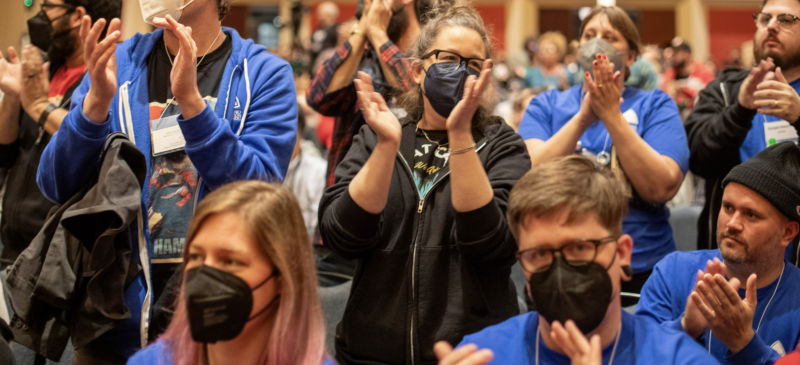
More than 2,000 members from across the United States, Canada and the Caribbean spent four days charting the future of our union and recommitting themselves to the solidarity that powers the union at the USW’s triennial constitutional convention earlier this month.
International President David McCall opened the convention by calling on union members to fight back against wealthy elites who want to silence workers across North America.
“To turn back the tide of economic injustice and corporate greed, we need to truly be all in,” McCall said. “We can hold nothing back, and we need every member to join in the fight – for as long as it takes.”
In debating resolutions ranging from fair trade to civil and human rights, delegates shared their struggles and victories in the fight against corporate greed. They also heard from trade unionists from other countries and a panel of federal workers who warned of broad attacks on workers’ rights coming out of Washington, D.C.
While billionaires like Elon Musk may be emboldened under the current administration, AFL-CIO President Liz Shuler declared that with 71% of Americans supportive of unions, union members are in a “generational moment” to build the labor movement. AFL-CIO Secretary-Treasurer Fred Redmond reminded delegates that “we know the way forward.”
The way forward is going all in on solidarity. Delegates demonstrated what that looks like by taking action right from the convention floor by calling their members of Congress to demand passage of the bipartisan Protect America’s Workforce Act.
Delegates left Las Vegas fired up and ready to carry that energy forward into their workplaces and communities.
“Being all in isn’t a one-time action – and it isn’t a bet,” McCall said. “It’s our way of operating, 24 hours a day, 365 days a year.”
You can find full coverage of our convention, including photos, videos, resolutions, and more, on the USW website.
President Donald Trump has declared war on America’s colleges and universities, demanding they bow to his demands on what they can teach and whom they can admit or hire. Trump’s illegal and autocratic actions are tantamount to a war on knowledge intended to make schools bend the knee to his ideology and chill free speech and academic pursuit. In her latest column, AFT President Randi Weingarten debunks the lie that Trump’s punitive behavior toward universities and students has anything to do with fighting antisemitism.
Science benefits everyone; cuts hurt us all
In early March the Trump administration froze $400 million in federal funding for scientific research at Columbia University, citing antisemitism and referencing pro-Palestinian protests on campus. The AFT has members at Columbia, but the implications are far broader as other institutions are also targeted. The AFT and the American Association of University Professors have filed a lawsuit to stop interference with academic freedom and research. This AFT Voices post features three professors who are affected by the funding cuts. “Trump’s administration has terminated and taken hostage our grants, igniting frictions around issues of free speech and discrimination,” writes one, though academic activism is giving her hope.
Celebrating new affiliates and contracts in higher ed
The AFT’s higher education affiliates have been generating a flurry of activity: This fast-growing sector of our union has two brand-new affiliates, at Ohio University and Nevada State University, and five affiliates that are celebrating groundbreaking contracts. In a landscape that includes relentless attacks on higher education funding and academic freedom, these gains are especially significant and show the importance and promise of union solidarity. Above, United Faculty of Illinois State University members show their strike authorization ballots, one step on their way to their new contract. Read more here.
Protesters say, ‘Hands Off!’ and ‘Kill the Cuts’
On April 5, hundreds of thousands of people flooded the streets in more than 1,300 “Hands Off!” peaceful protests in cities across all 50 states. The message was clear and thunderous: Enough is enough. Protesters demanded an end to the escalating authoritarianism and attacks on everyday Americans led by President Donald Trump and Elon Musk. Then on April 8, thousands more—many of them associated with colleges and universities—stood up to say “Kill the Cuts” to education and scientific research. Turnout—including AFT members from coast to coast—signaled a growing, powerful movement ready to defend democracy, civil rights, public education and academic freedom. Above, unionists march in Los Angeles. Photo: AAUP.
Weingarten breaks it down: New tariffs create chaos
This month, President Donald Trump announced the highest and most wide-ranging tariffs—taxes on goods that Americans buy—since President Herbert Hoover’s Smoot-Hawley Tariff Act, which made the Great Depression worse. Trump’s tariffs apply to every one of our nation’s trading partners. And the chaos has come quickly: stock markets in freefall, business confidence at the lowest level since the 2008 financial crisis, respected economists warning that a recession is likely, and higher prices for Americans. What explains this seemingly self-destructive attack on our nation’s economy? Read this AFT Voices post by AFT President Randi Weingarten and Damon Silvers for understanding and a way forward.
Teacher prep program axed despite shortage
Just when the teacher shortage is at its worst, university programs that prepare new teachers to fill the gap have been shuttered by the Trump administration: In February, the Department of Education abruptly axed $600 million in Teacher Quality Partnership and Supporting Effective Educator Development grants established by Congress specifically to bolster the teacher workforce. Read this AFT Voices account from faculty members who are feeling the cuts and teachers experiencing staff shortages in their North Florida schools.
If institutions won’t stand up to the Trump administration, then it’s up to academic workers, students, communities, and citizens to stand up for them. Because we have the strongest levers of power over our local institutions.
While international students have become the first target on campuses, it’s important to remember that a portion of faculty (and in particular contingent faculty who are more precarious), administration, and campus service workers are also vulnerable to ICE. The consequences of these actions could have far-reaching effects. Due process of the law is not for specific groups. We all have it or no one has it.
This absolutely is an attempt to silence dissent in the country, especially on college campuses.
This absolutely is authoritarianism.
This absolutely is in line with the current attacks on higher education which were laid out in Project 2025. And in line with the crackdown on student protests before Trump took office.
And what’s worse is that many of our institutions are refusing to stand up for students.
Thankfully, unions are already responding.
We have to rise to this moment or higher education will never be the same.