Blog

  • What Betty Crocker can teach us about using AI – Campus Review

    What Betty Crocker can teach us about using AI – Campus Review

    HP education ambassador Brett Salakas piqued the interest of a crowd of educators on Thursday when he walked onto a stage with a carton of eggs, a litre of milk, butter, a bowl, a wooden spoon and a packet of Betty Crocker cake mix.

    Please login below to view content or subscribe now.

    Membership Login

    Source link

  • Fixing university reputations: Commentary – Campus Review

    Fixing university reputations: Commentary – Campus Review

    CommentaryOn Campus

    How we conduct our institutions impacts perception, value and reflects on leadership, one expert writes

    Universities have reputations whether they know it or not. Most of us believe our own PR, but we seldom take the opportunity to pause and ask how others view us.

    Please login below to view content or subscribe now.

    Membership Login

    Source link

  • From playground to lecture hall – working with schools to support wellbeing throughout education

    From playground to lecture hall – working with schools to support wellbeing throughout education

    Higher education institutions are increasingly acknowledging the importance of wellbeing in shaping meaningful and sustainable learning experiences. However, the wellbeing of students and staff is often treated as a separate or secondary issue, addressed through isolated initiatives rather than embedded into the fabric of university life.

    I propose adopting a lifelong approach to wellbeing in education grounded in appreciating that schools and universities are not distinct spheres. Rather, they are stages on a continuous educational journey. The way we foster wellbeing in schools must inform, and align with, our practices in higher education.

    Foundations for wellbeing

    The foundations laid in schools play a crucial role in shaping how learners experience their transition into university. When educational environments nurture emotional resilience, social connection, and inclusive responses to academic pressures, learners arrive in higher education with a stronger base of support. In contrast, when wellbeing is not prioritised earlier in the educational journey, the structural and emotional demands of university life can amplify existing challenges. This underscores the need for continuity and care across the educational continuum, rather than placing responsibility on individuals to adapt alone.

    In many school systems, wellbeing is increasingly recognised as integral to education. A holistic, strengths-based approach helps ensure that wellbeing is supported through curriculum design, teaching practices, and whole-school approaches and policies. Programmes focused on social and emotional learning are embedded, and collaboration across sectors – education, health, and community – creates a network of support that extends beyond the classroom.

    In higher education, this picture is evolving. The work on wellbeing spearheaded by Universities UK in recent years has helped universities to become more attuned to the importance of wellbeing, yet academic culture often remains shaped by competitiveness, performance metrics, and output-driven models. This dynamic also influences schools in some contexts, particularly where high stakes testing and narrow accountability frameworks dominate. However, there tends to be greater acceptance within schools that wellbeing and learning are deeply interconnected.

    In the university context, structural pressures, including institutional expectations and the demands of competitive academic cultures, continue to affect both students and staff, contributing to stress, burnout, and mental health difficulties. Although there is growing attention to student wellbeing in policy and strategy, support for staff wellbeing remains less visible, despite its clear influence on teaching quality and the wider learning environment. There is a need for a joined-up, systemic approach recognising the interdependence of student and staff wellbeing.

    Whole institution approaches

    A whole-university approach, as promoted by Universities UK, is a strategic, institution-wide commitment to embedding wellbeing into every dimension of university life, echoing the well-established whole-school model in many primary and secondary education systems. Just as whole-school approaches integrate wellbeing into teaching, leadership, curriculum, and engagement with families and communities, a whole-university approach ensures that wellbeing is not confined to support services or stand-alone initiatives. It becomes a shared responsibility, woven into the ethos, governance, and daily practices of the institution.

    Rather than relying on reactive services, this model positions wellbeing as a core value that shapes leadership, curriculum, pedagogy, and institutional relationships. It calls for cultural transformation, redefining success to focus not solely on outcomes, but on flourishing. This includes embedding wellbeing in teaching and assessment, professional development, work-life balance, and inclusive, compassionate organisational values. It requires systems that promote flexibility, equity, and psychological safety as the norm.

    Universities must be understood as ecosystems. When this ecosystem is well, everyone within it is more likely to thrive. This involves designing curricula that support engagement and wellbeing, adopting inclusive policies, and nurturing cultures of trust, care, and belonging in both academic and administrative contexts.

    Higher education can also learn from the progress made in schools. Many school systems have already developed comprehensive frameworks for promoting wellbeing – such as the Health Promoting Schools model – which successfully embed wellbeing into governance, pedagogy, and wider school life. Higher education has much to gain from adapting these models to its own settings, helping to ensure continuity of support as learners move between sectors.

    Embedding wellbeing through national frameworks

    Aligning approaches across schools and universities creates a more cohesive experience for learners and reduces the sense of disorientation that often accompanies educational transitions. It also enables valuable exchange between sectors, where shared learning can lead to better outcomes for all.

    Within this context, and especially given the significance of the transition from school to university, national leadership is essential in embedding wellbeing consistently across education systems. The move into higher education is more than a change of setting; it is a profound developmental shift, often marked by increased autonomy, identity exploration, and academic complexity. While this transition can be exciting, it also brings vulnerability and emotional strain. Maintaining wellbeing support across this bridge is therefore not optional; it is essential. Yet it is precisely at this stage that inconsistencies and gaps often emerge. National policies that intentionally bridge sectors can ensure wellbeing remains a continuous thread throughout a learner’s journey.

    One crucial aspect of national leadership is the development of robust policy and strategy relating to wellbeing, both within institutions and at a broader, systemic level. Country-wide initiatives create coherence, consistency, and a shared vision – particularly important when seeking to strengthen the links between schools and universities. Ireland, for instance, has implemented a national policy and strategy around mental health that spans multiple sectors, not just education. This kind of joined-up approach exemplifies how public policy can help to sustain cultural change across the education system and beyond.

    The wellbeing of our educational communities is not a peripheral concern. It is central to the very purpose of education. By embedding wellbeing across every level – through policy, pedagogy, leadership, and institutional culture – we not only support individuals to succeed, but also help to build resilient, compassionate institutions where everyone can flourish.


    Source link

  • Higher Education: 10 Questions from a Year 10

    Higher Education: 10 Questions from a Year 10

    1. How much harder are university courses than school? Do you have to be naturally gifted to excel at university? For example, can you do well in scientific or mathematical degrees through just hard work, or is there more to it? Do some courses require complex skills that you may not have from school, such as high levels of intricate practical skills for medicine or engineering, which you may not have needed for your GCSE or A-Level exams?
    2. How are lectures or seminars different to typical school lessons? How are you taught at university? How much of the learning process is taking notes, doing activities, researching, and so on? What is the environment like? For example, what are the class sizes like?
    3. How are you assessed at university? Most assessments at school nowadays are done in an exam at the end of the course. How different is the process at a university? For example, how much of it is exams, and how much is marked work throughout the course? Does this vary with the course?
    4. How do I pick the right course? Some people know exactly which career path they want to take, and this can be quite an easy decision for them, but many have no idea. What factors are the most important when picking a university and subject to study? Does a university’s prestige always correspond to its value to a student? 
    5. How do different courses vary from each other? Many seem to believe that some courses are easier or require less work than others, or some are much more enjoyable. Is this the case? How do contact hours with your professors differ from course to course?
    6. What are the advantages of different types of degrees? How do hands-on qualifications such as apprenticeships compare to standard degrees? What are the benefits of part-time degrees or ‘sandwich’ courses?
    7. What is life at a university like? What are the pros and cons of living in student accommodation? How much space and freedom do you have? Is it easy to get distracted from your studies when living amongst all your friends? What are the most important factors when choosing accommodation?
    8. What is the work-life balance at university like? I would assume that university courses require a lot more effort than GCSEs or A-Levels. Is that always true? How much more (or less) time do you spend studying than at school? Do you have to sacrifice a social life to get good grades? Can you easily get burnt out at university? Does this vary with the course? 
    9. Are campus or non-campus universities better? What are the advantages of each? Are they better for different types of people, or the different courses that they take? Are there noticeably different atmospheres between them? For example, do you get a better sense of community at a campus university, or do you grow more independent at a non-campus university?
    10. Is studying abroad a good idea? Most people stay in their home country to study. Is looking at universities in other countries a good idea, especially when doing a course such as languages? What are the advantages of studying abroad? Are single years abroad or exchanges a better alternative to this?

    * To declare an interest, Ben Hillman is the son of Nick Hillman, HEPI’s Director.

    Source link

  • State Department Unveils Student and Exchange Visitor Visa Social Media Vetting Guidance – CUPA-HR

    State Department Unveils Student and Exchange Visitor Visa Social Media Vetting Guidance – CUPA-HR

    by CUPA-HR | June 24, 2025

    On June 18, the Department of State issued a cable to all U.S. diplomatic and consular posts formally expanding the screening and vetting process for applicants of F, M and J (FMJ) nonimmigrant visas. The State Department guidance resumes FMJ appointment scheduling after a previous announcement from the agency paused all student visa interviews as they prepared for the new social media screening and vetting guidance.

    Background

    At the end of May, the State Department announced that U.S. embassies and consular sections were pausing new student visa interviews as they awaited further guidance on new social media screening and vetting requirements. CUPA-HR joined the American Council on Education and other higher education associations on a letter to Secretary of State Marco Rubio requesting the agency quickly implement the new vetting measures to ensure new student visas could be efficiently processed before the 2025-2026 academic year. No further guidance was publicly announced between the announced pausing of student visa interviews and the cable sent out to all diplomatic and consular posts.

    New Screening and Vetting Guidance

    The cable directs consular sections to resume scheduling FMJ appointments after implementing the new vetting procedures. The guidance requires officers to conduct “a comprehensive and thorough vetting of all FMJ applicants, including online presence, to identify applicants who bear hostile attitudes toward our citizens, culture, government, institutions, or founding principles; who advocate for, aid, or support designated foreign terrorists and other threats to U.S. national security; or who perpetrate unlawful antisemitic harassment or violence.” The posts are directed to implement the new guidance within five business days.

    As explained in the cable, consular officers are directed to conduct intake and interviews in accordance with standard procedures, but once an FMJ applicant is otherwise eligible for the requested nonimmigrant status, officers must temporarily refuse the case under Section 221(g) of the Immigration and Nationality Act (INA). After refusing the case, officers must request the applicant set all social media accounts to “public,” after which the officer must examine “the applicant’s entire online presence — not just social media activity — using any appropriate search engines or other online resources.”

    The new vetting procedures could limit the consular officers’ ability to process student visa applications quickly and efficiently as the cable also mentions that consular sections should “consider the effect of this guidance on workload” when resuming the scheduling of FMJ appointments. Even with these concerns, the cable does request expedited appointments for certain FMJs, including J-1 physicians and F-1 students seeking to study at U.S. institutions where the international student body constitutes 15 percent or less of the total student population.

    While much of the advocacy from interested stakeholders on this issue revolves around students, individuals seeking J-1 visas to participate in cultural and educational exchange programs to conduct research or teach at institutions could be subject to an enhanced level of scrutiny. CUPA-HR will continue to monitor for updates related to the FMJ vetting processes.


    Source link

  • Starbucks Workers United Spreading Like Wildfire (Starbucks Workers United)

    Starbucks Workers United Spreading Like Wildfire (Starbucks Workers United)

    We’re on day 4 of our 5 days of ULP strikes, and the SBWU strike lines keep spreading! Baristas are fired up and ready to fight for a fair contract and protest hundreds of unfair labor practices – and as each day passes, more and more workers are walking off the job.

    Today, we’re out in 3 new cities: Boston, Portland, and Dallas! Here are the 13 cities we’re holding anchor pickets in:

    • LA:  10am PST @ 3241 N Figueroa Street, Los Angeles, CA

    • Seattle: 1pm PST @ 1124 Pike St, Seattle WA

    • Chicago: 12pm CST @ 5964 N Ridge Ave, Chicago, IL

    • Denver: 12pm MST @ 2700 S Colorado Blvd, Denver, CO

    • Columbus: 12pm EST @ 7176 N High St, Worthington, OH

    • Pittsburgh: 8am EST @ 5932 Penn Cir S. Pittsburgh, PA

    • St. Louis: 12pm CST @ 8023 Dale Ave, Richmond Heights MO

    • Philadelphia: 9am EST @ 1528 Walnut St, Philadelphia, PA

    • Brooklyn: 9am EST @ 325 Lafayette, Brooklyn, NY

    • Long Island: 1pm EST @ 914 Old Country Rd, Garden City, NY

    • Dallas: 11am CST @ 1445 West University Drive, Denton TX

    • Portland: 10am PST @ 9350 SW Beaverton Hillsdale Hwy, Beaverton OR

    • Boston: 10am EST @ 470 Washington St, Brighton MA

    If you’re able to join your local picket line, workers would love supplies like: hand-warmers, food, water, hot beverages, and energetic vibes! Don’t forget to bring your own picket sign!

    Don’t live near a picket line? We still need you! Striking baristas are calling on allies to flyer as many not-yet union Starbucks as possible. Workers across the country are infuriated over the paltry 2% raise, and SBWU gives not-yet union baristas a path to increase their wages. But in order to win, we need not-yet union stores to get in the fight. We’re asking allies to flyer these stores and talk to baristas about the union.

    Show us your solidarityregister your canvassing event, attend an anchor strike line near you, and DO NOT cross the picket line!

    Onward,

    Lilly

    Source link

  • Senate Introduces Legislation to Increase Federal Minimum Wage to $15 per Hour – CUPA-HR

    Senate Introduces Legislation to Increase Federal Minimum Wage to $15 per Hour – CUPA-HR

    by CUPA-HR | June 24, 2025

    On June 10, Senators Josh Hawley (R-MO) and Peter Welch (D-VT) introduced the Higher Wages for American Workers Act (S. 2013). The Higher Wages for American Workers Act would amend the Fair Labor Standards Act (FLSA), raising the federal minimum wage to $15 per hour and directing the secretary of labor to adjust the minimum wage annually based on inflation.

    Higher Wages for American Workers Act

    The bill proposes to increase the federal minimum wage from $7.25 to $15 per hour beginning January 1 of the first year after enactment. Each year after, the secretary of labor is directed to increase the minimum wage annually by “the percentage increase, if any, in the Consumer Price Index for Urban Wage Earners and Clerical Workers.”

    Although the federal minimum wage has not been increased since 2009, several states have increased their state minimum wage above the current $7.25 per hour. As of January 1, 2025, 30 states and the District of Columbia have minimum wage laws set above the federal level, and 10 states and the District of Columbia have a minimum wage of $15 per hour or higher. All other states must follow the minimum wage set by Congress through the FLSA.

    Looking Ahead

    While legislation has been introduced in recent years to increase the federal minimum wage, calls to increase the level to $15 per hour have mostly come from Congressional Democrats. It is therefore notable that Republican Senator Josh Hawley is leading efforts on this issue. It remains to be seen if enough Republicans in the Senate will also support this effort to give the legislation the chance to receive 60 votes to bypass the filibuster and whether House Republicans will take up similar legislation.

    CUPA-HR will keep members apprised of further developments related to federal minimum wage laws.


    Source link

  • Associate Director at Yale’s Poorvu Center

    Associate Director at Yale’s Poorvu Center

    Yale’s Poorvu Center for Teaching and Learning is a pioneering organization in the development of the integrated CTL. Founded in 2014, Poorvu integrates faculty development, educational technology, digital learning and many other instruction-related services within a high-performing organization. When I learned about Poorvu’s search for a new associate director within the Teaching Development and Initiatives team, I knew I wanted to learn more. Julie McGurk, Yale’s director of teaching development and initiatives, who is leading the search at Poorvu, generously agreed to answer my questions about the role.

    If you are recruiting for a role at the intersection of learning, technology and organizational change, please reach out.

    Q: What is the university’s mandate behind this role? How does it help align with and advance the university’s strategic priorities?

    A: There isn’t a mandate per se, but given the advancement of data science, machine learning and quantitative methods across disciplinary fields, the Poorvu Center is looking for someone from a quantitative field. We understand the unique challenges of teaching students quantitative literacy skills, including the social and emotional histories with quantitative fields that students bring to the classroom.

    Yale’s emphasis on rigorous teaching, which requires students to quickly dive into disciplinary skills, has motivated us to structure our team across disciplinary domains. This structure allows us to have conversations grounded in the language and culture of the fields, as well as how students experience the discipline. This also allows us to form deeper relationships with faculty, graduate students and postdocs in those related fields at Yale, since someone from the humanities or social sciences will most often work with our team members focused on those disciplines.

    While this search will require expertise in quantitative fields, our ideal candidate will also have a good understanding of teaching in other fields to introduce practices that might not be as common but are potentially useful in quantitative fields. We facilitate a lot of interdisciplinary discussions of pedagogy in our day-to-day work.

    Q: Where does the role sit within the university structure? How will the person in this role engage with other units and leaders across campus?

    A: The Poorvu Center for Teaching and Learning is under the provost’s office, under the leadership of the associate provost for academic initiatives and executive director of the Poorvu Center, Jenny Frederick. Our team works with instructors and future instructors across the entire university, including the 13 professional schools, focusing on supporting effective teaching practices at Yale and the development of graduate students, postdocs and others who are often preparing to teach elsewhere. We work closely with the other teams at the Poorvu Center, who support undergraduate learning and writing, graduate writing, educational technology, program assessment, and online teaching. We also work closely with departments, schools and other offices across campus, such as Student Accessibility Services, Yale wellness resources, the Center for Language Study, Yale libraries and collections, among many others.

    Q: What would success look like in one year? Three years? Beyond?

    A: Success in the first year is mainly about getting to know Yale, the Poorvu Center and our team and forming foundational connections around these various groups. Success in three years looks like having deeper connections across the university, particularly within quantitative fields and a strong portfolio of work on programs, services and initiatives. Beyond three years, I would expect the person in this role to contribute to the strategic vision and leadership of the Poorvu Center and the team in a way that aligns with their own career goals.

    Q: What kinds of future roles would someone who took this position be prepared for?

    Someone in this position would be well prepared to take on leadership roles in teaching centers and other university groups that facilitate professional development or cultural change.

    Source link

  • Second Straight Quarter of Stabilised International Student Demand for a UK Study Visa

    Second Straight Quarter of Stabilised International Student Demand for a UK Study Visa

    The latest UK study visa application data, released in late May, shows that demand from main applicants recovered in calendar Q1 2025 (January through March). Applications from this cohort increased by 32% over Q1 2024 levels.[1] This is an encouraging signal of sector recovery, as applications in Q4 2024 were up 9% over Q4 2023, suggesting renewed student confidence in the UK as a study destination.

    UK Study Visa Applications and Issuances Up For Main Applicants in Q1 2025

    Nearly 47,000 main applicants submitted a UK study visa application in Q1 2025. This represents a 32% increase over Q1 2024:

    These gains build on the year-on-year growth seen in Q4 2024, suggesting that the UK international education sector is experiencing a broader rebound and stabilisation, rather than a one-off peak in Q4.

    Still, Q1 has historically made up just 8% to 10% of total annual applications from main applicants. With the bulk of applications and issuances typically occurring in Q3, the sector still has work to do to sustain renewed student confidence. Attention is especially important around addressing concerns and dispelling misconceptions stemming from the 2025 Immigration White Paper—a topic we will explore further below.

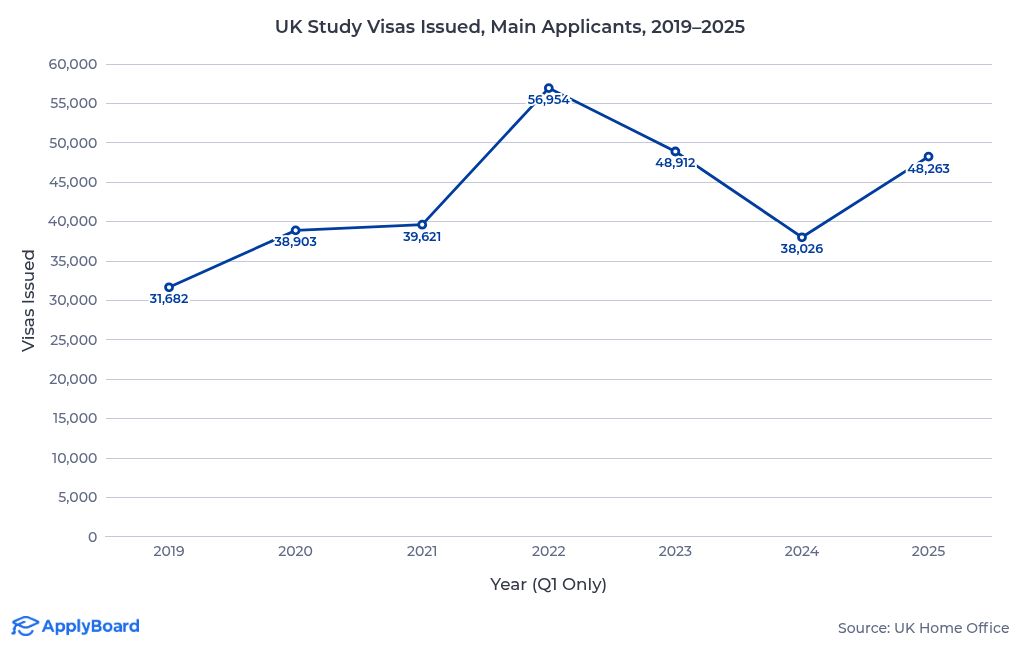
    As with applications, main applicant student visa issuances likewise rose in Q1 2025:

    chart visualization

    Over 48,000 international students were issued a study visa in Q1 2025, representing a growth of 27% over Q1 2024. The issuance rate in both of these quarters was 88%, meaning the increased number of issued visas reflects stronger demand rather than changes in approval rates.

    That said, tuition fees, visa charges, and the NHS surcharge have all risen in recent years, driving up the overall cost of studying in the UK. The White Paper’s proposed 6% levy on international tuition fee income risks adding to that burden, especially as institutions may need to pass the new financial pressures onto students. 83.5% of respondents in a recent survey cited cost of study as a top priority when choosing a destination, highlighting the potential impact of additional cost pressures. The Government’s own analysis projects an immediate drop of 14,000 international students, with a sustained decline of around half that figure over time.

    Also, due to the raised Basic Compliance Assessment (BCA) thresholds proposed in the 2025 White Paper, institutions will likely need to enhance their vetting processes moving forward before issuing confirmation of acceptance of studies. Likewise, institutions may look to diversify within lower-risk countries to minimise exposure to visa refusals.

    Where Did Demand Stabilise in Q1 2025?

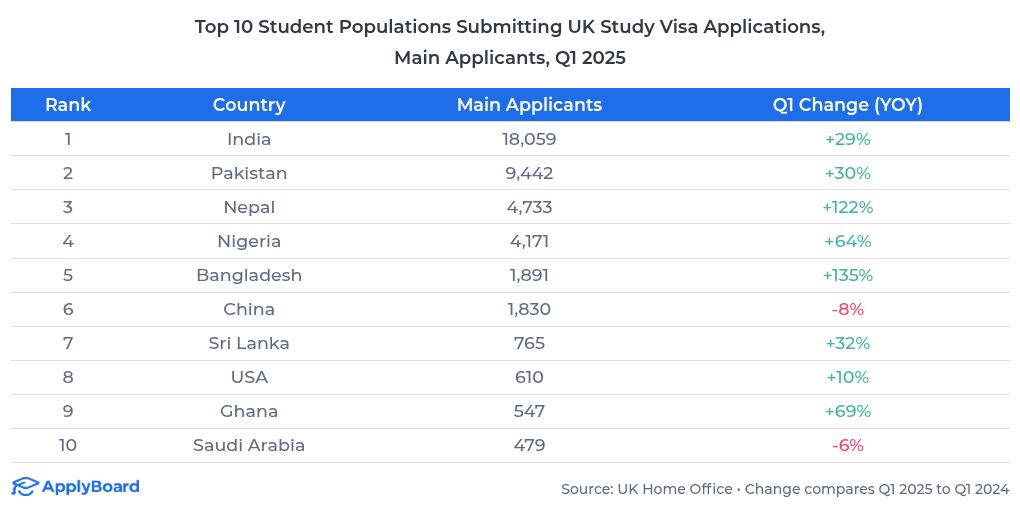
    A closer look at what made Q1 2025 a strong quarter reveals that the uptick in study visa applications was not limited to a handful of markets. Instead, demand recovered across a broad range of source countries. Of the 22 countries with 100 or more main applicants, 14 saw year-on-year growth—an encouraging sign that renewed student interest in the UK is present across multiple regions.

    table visualization

    India accounted for over 18,000 main applicant study visa submissions in Q1 2025, marking a 29% increase from the same period last year and making it the UK’s top source market that quarter. This recovery is particularly promising given that Indian student demand had softened across all four major English-speaking destinations in the latter half of 2023 and throughout 2024.

    This momentum may be bolstered by recent developments in the UK–India relationship. In May, the UK and India signed a long-anticipated Free Trade Agreement that, while not directly altering student visa policy, introduced mutual recognition of academic qualifications and greater clarity around post-study employment pathways. These developments could reinforce the UK’s appeal among Indian students, as long-term career prospects form an important part of prospective students’ decision-making process.

    Elsewhere, the 64% jump in Nigerian applications marks an encouraging recovery. Nigeria faces unprecedented economic challenges, and was also arguably the most affected by the UK’s dependant visa restrictions. However, Nigeria was among several countries, along with Pakistan and Sri Lanka, two other drivers of sustained demand this past quarter, where nationals may face increased scrutiny due to past asylum claim rates. This added layer of caution from UK authorities could temper future demand from these markets, especially if students perceive a higher risk of visa refusal or changing entry conditions despite their qualifications.

    What Student Populations Drove the Upward Visa Issuance Trend in Q1 2025?

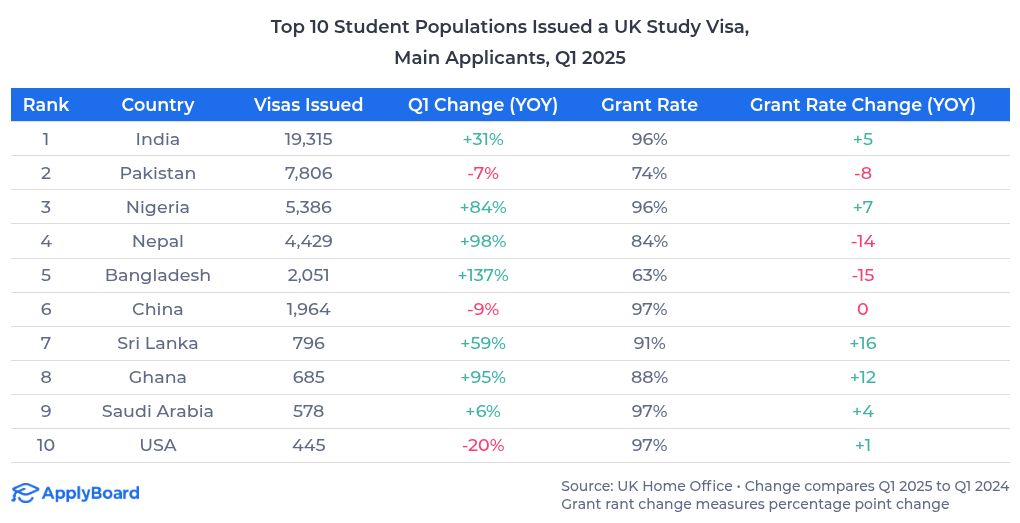
    Issuance trends offer additional insight into which student populations are successfully converting interest into study visas. These trends help us understand short-term momentum and assess key markets’ longer-term enrolment potential.

    table visualization

    The 19,300 Indian students issued a main applicant study visa in Q1 2025 represented a 31% increase over Q1 2024. Their grant rate also rose to 96%, an increase of five percentage points which is especially significant given the scale of the incoming Indian student population.

    Several other markets also demonstrated notable growth in UK study visa issuances this past quarter. The number of visas issued to main applicants from Nigeria increased by 84% compared to Q1 2024, with the grant rate rising by seven percentage points to 96%. Similarly, Sri Lanka and Ghana saw significant increases in visa issuances, with grant rates improving to 91% and 88%, respectively. These trends may reflect successful adjustments to new UK visa requirements and effective outreach efforts by institutions in these countries.

    Conversely, main applicants from Pakistan experienced a 7% decline in student visa issuances. Their 74% grant rate represents a year-on-year drop of eight percentage points. Nepalese and Bangladeshi main applicants also saw grant rates decline in Q1 2025—down 14 and 15 percentage points respectively—though issuances doubled for both student populations.

    Sustaining Momentum in the UK’s International Student Recovery

    Strong Q1 2025 results are a welcome sign for the UK’s international education sector, especially as they build on the encouraging Q4 2024. Together, these quarters point to a potential turning point in student sentiment, possibly signalling a broader recovery in demand if institutions and the wider international education community remain aligned, and if geopolitical relationships remain relatively cooperative.

    However, that stability is not guaranteed. With the release of the 2025 Immigration White Paper, institutions must proactively clarify recent policy changes and dispel myths that may deter prospective students.

    Two areas of particular concern within the White Paper are the proposed reduction of the Graduate Route’s duration from two years to 18 months, and the proposed 6% levy. These changes could impact the UK’s competitiveness in attracting international students, as post-study work opportunities are a significant factor in students’ decision-making processes. Moving forward, it will; be critical for institutions to emphasise that this post-study work pathway remains accessible for all eligible students and is a key differentiator for the UK in an increasingly competitive global landscape.


    [1] All data courtesy of the UK Home Office, unless otherwise stated. All timeframes in this article are by calendar year (January–December).

    Source link

  • Higher education and the industrial strategy priority areas

    Higher education and the industrial strategy priority areas

    There have been industrial strategies before, but the extent to which they have shaped the provision of higher education is questionable.

    Past exercises of selecting scientific or technological priorities have undoubtedly had effects on the national research ecosystem, though constant chopping and changing of policy over the last decade and more has hindered this from reaching its fullest extent. But in terms of influencing what educational provision exists, and what qualifications are achieved – and where – it would not be unduly controversial to say that industrial strategy and the longer-term graduate pipeline have never really meshed.

    Could this time be different? This government has certainly wanted to present its different policy agendas – on industrial strategy and skills, but also on migration, and devolution – as complementary and cohesive. And there are plenty of reasons to think that the industrial strategy will be Labour’s key reforming principle for higher education and its position within the wider tertiary sphere.

    How HE shows up

    Let’s begin with what has already emerged. Government guidance to the Office for Students has set out the fact that high cost subject funding in England (via the Strategic Priorities Grant, or SPG) will be refocused towards the industrial strategy from 2026–27 – a review is underway behind the scenes.

    And even in the current year, the (rather meagre) £84m in SPG capital funding available in England includes £72.75m in a bidding process, where one of the two criteria to assess bids will be the extent to which the project supports Skills England’s priorities, or local economic needs. Skills England’s priority areas are the eight industrial strategy “growth-driving sectors” (which we are now expected to refer to as the IS-8) plus health and social care as well as construction.

    Whether these two pots of money remain significant enough to really drive changes to HE provision – as opposed to rhetorical game-playing where the words “industrial” and “strategy” get appended to everything that institutions were already planning to do – remains an open question. The size of both recurrent and capital SPG in future years remains to be seen, but you wouldn’t bet on substantial increases.

    If this were the end of it, you might think the industrial strategy’s impact on higher education would remain restricted to research and innovation – with lip service to government priorities in how the (shrinking) state contribution to teaching gets doled out. But with today’s publication of the industrial strategy in full, various other agendas begin to come into focus.

    First up, the Lifelong Learning Entitlement. A more substantive announcement on the policy and legislative details is still pending, but there’s a rather significant detail in today’s strategy:

    From January 2027 we will launch the Lifelong Learning Entitlement which will enable individuals to learn, upskill and retrain across their working lives. The first modular courses for approval will support progression into the IS-8.

    It’s been on the cards for a while – since being re-written under Labour, the current LLE policy paper has anticipated that Skills England and the government’s skills priorities would form an important part of the LLE’s development – but here we get confirmation that the module approval process will be guided by the industrial strategy priority areas. The professional services sector plan also references a role for the LLE in helping learners take up courses relevant to that specific sector.

    And it’s a similar story for the LLE’s awkward doppelganger, the growth and skills levy, which will allow employers to spend levy contributions on short courses rather than apprenticeships.

    These levy reforms, which were a key pillar of Labour’s approach to skills while it was in opposition, have gone a bit quiet since, with changes at lower and foundation levels prioritised. The fact that the spending review gave the defunding of most level 7 apprenticeships as an example of DfE savings and efficiencies, rather than a way of freeing up cash for short courses, was a little ominous.

    But the industrial strategy policy paper makes a link with the IS-8 sectors, giving examples of short courses in digital, AI, and engineering. April 2026 is floated as the date for rollout, though there is more to be done in development:

    We will work with Skills England to determine the courses which will be prioritised in the first wave of rollout and subsequent waves, and how those sit alongside apprenticeships and other training routes. We will work with Skills England to introduce these short courses and consider how to prioritise investment across the programme.

    Universities with expertise in professional and executive education – and those who are rethinking apprenticeship provision in light of changes to level 7 – will be keeping a careful eye on how this comes together.

    Finally, the forthcoming post-16 education and skills strategy, including its plans for reforming the higher education sector, is described within one of the sector plans as setting out a framework “for how the skills system will support growth-driving sectors” – that is, the IS-8.

    So, while all the details may not have come into focus yet, there’s a strong case to be made for the industrial strategy playing a key role in all kinds of areas crucial to higher education: the LLE, levy-funded short courses, high-cost subject funding in HE – plus such capital funding as still exists – and potentially the post-16 strategy as whole. It’s therefore worth the sector looking in detail at what the government, and Skills England, have said so far about the eight specific industrial strategy areas, in terms of skills needs, priority industries, and place.

    New frontiers

    The industrial strategy green paper in the autumn identified eight high-level sectors:

    • Advanced manufacturing
    • Clean energy industries
    • Creative industries
    • Defence
    • Digital and technologies
    • Financial services
    • Life sciences
    • Professional and business services.

    These were the areas where the government saw the greatest potential for growth – the “picking of winners” that has characterised industrial strategies over the years. The eight that were chosen were less STEM-heavy than previous iterations of the strategy.

    Over the consultation period that followed, the government sought input on what subsectors should feature in the finalised plan, and in what places – “all economic activity occurs somewhere,” as the technical annex puts it. These subsectors have now been rebranded as “frontier industries” within each sector – “those parts of each sector that best met the Industrial Strategy’s goal of long-term, sustainable, regionally balanced, and resilient growth.”

    There’s much more in the annex on what respondents said, and how the frontier industries were identified – but at the end of the day, it’s more picking of winners, and plenty of areas will feel they have been unfairly overlooked. The results of the process can be seen on page 22 – for example, for the creative industries, the chosen “frontier” areas are advertising and marketing, film and TV, music, performing and visual arts, and video games.

    Data definition fans will also be keen to see that this has all been mapped to Standard Industrial Classification (SIC) codes, to the extent that it is possible to do so. The technical annex highlights further revisions and improvements to occupational classifications in the future.

    What’s the plan?

    For each of the IS-8, there is a sector plan going deeper into what’s being proposed. We get five of them today – the financial services one is due on 15 July, the defence sector plan (also badged as the defence industrial strategy) is forthcoming, as is the life sciences plan.

    Each of the published sector plans has a helpful map, usually towards the end, which tracks the specific frontier industries onto the city regions and clusters which the government has identified. For example, advanced manufacturing has ten areas selected – see page 55 on. So in the northeast England region, the focus is on automotive, batteries, and space, whereas in Wrexham and Flintshire, it’s concentrated on aerospace, automotive, advanced materials, and agri-tech. Each identified geographical area has its own specific strengths – or areas for potential growth – picked for it by the government.

    Six city regions are identified for professional and business services (page 55). For the creative industries (pages 61 to 62), Dundee is spotlighted for video games and design, while for Greater Manchester it’s film and TV, music, advertising, and market research. And so on.

    Each sector plan also has some more specifics on workforce and skills planning. These largely draw together things we already knew were in train – so for the creative industries for example, this encompasses everything from the ongoing curriculum and assessment review to a refreshed creative careers service.

    Earlier this month, Skills England published sector skills needs assessments for each of the IS-8, along with construction and health. The new skills quango was clear – perhaps concerningly so – that at the time of writing it wasn’t privy to what exactly the industrial strategy would stipulate in each area. But the data analysis and accounts of employer engagement for each sector give us an indication of what kind of interventions might be welcomed in each.

    For one thing, in many of the sectors it’s clear that there are higher-level skills needs. Clean energy industries, the quango found, will need more civil, mechanical, electrical, chemical, and environmental engineers – roles which require qualifications at level 6 and above – as well as managerial roles from levels 3 to 8. The creative industries stakeholder engagement saw a demand for more mid-career training, with the current training system “felt to overemphasise entry-level positions.” Life sciences is another “highly qualified sector.” For professional and business services, we get a direct rejection of DfE’s focus on foundation-level apprenticeships, which “do not align with the roles employers want to recruit or develop.”

    In more or less all of the Skills England assessments, employers are said to want more flexible and modular training – a reiteration of the oft-expressed desire for more freedom to spend the levy on shorter courses rather than apprenticeships. The needs of the current workforce, as opposed to the pipeline, are prominent.

    The upshot

    It’s clear that higher education provision is vital to the success of many if not most of the industrial strategy frontier industries – but the immediate interventions and funding announcements packaged up within the industrial strategy are largely focused at lower levels. It’s well rehearsed by this point that the higher education sector’s ongoing financial turmoil is risking the loss of expertise and capacity in subject areas which the government surely wants to prioritise.

    The strategy makes specific calls about what industries should be supported and in which places – but it doesn’t appear that this mapping has extended to thinking about what provision is available currently in each, and what is at risk. This might be a job for the sector in making its case.

    We can see indications in the policy document, and in the background work that Skills England has been conducting, that the government will press ahead with its plans for short courses for upskilling and reskilling, whether through the levy or the LLE. Unpicking that tangle – the question of which courses are funded by which means, and why, and how to make employer or learner demand actually crystallise – is another area for universities and colleges to be coming up with concrete proposals for. Having specific industries linked to specific places should be an enormously helpful starting point.

    The specificity on offer in the finalised plan ought to be a clear indication that, for higher education institutions, demonstrating a link to the industrial strategy in one’s provision will not just be a case of talking up the volume of one’s life sciences provision, for example, and its international renown. There’s a need for – and now scope to provide – much more granular detail.

    The ambitions of the strategy, were they to be realised, include a recipe for a more differentiated sector, with concrete choices made around engagement with key local industries and contribution to their associated workforce pipelines. A read-across can be made to UKRI chief executive Ottoline Leyser’s comments last week about the future shape of the research landscape, with the need for “consolidation” and playing to one’s local strengths – you could make the same argument for educational provision.

    There’s a question about how much such change in the landscape of provision would be either desirable or practical, given the sector’s closely guarded autonomy, the fact that graduates are mobile and may change plans, the transferability of many if not most higher level skills, and the extremely short lifespan that previous industrial strategies have had. Another issue is how those institutions which do not find themselves in, near, or otherwise connected to the anointed clusters and growth regions should respond.

    But it remains a crucial agenda for higher education, even if a large-scale reorganisation of provision is problematic to pull off at a time of great financial strain. Some tweaks to how the Strategic Priorities Grant works in England are unlikely to make much headway by themselves, and it remains to be seen to what extent the devolved nations are up for steering their university sectors to better align with Westminster’s chosen priorities. For higher education, the question remains whether the government actually has the levers in place to incentivise this shift to happen – to say nothing of the political appetite to invest time and resources – or whether the subject choices of UK 17 year olds and international postgrads will continue to be the main determinant of the sector’s size and shape.

    Source link