By Professor Lisa-Dionne Morris, Professor of Public & Industry Understanding of Capability Driven Design in the School of Mechanical Engineering, and Engagement Champion for the EPSRC EDI Hub+ at the University of Leeds.
Preparing the next generation of female international design engineers requires more than the delivery of technical content. It necessitates a systemic, institution-wide approach that equips graduates with the attributes, knowledge, resources, skills, and confidence to navigate a professional landscape that is rapidly changing and, in many cases, still being defined for future careers. The increasing global demand for roles in areas like sustainable product design, AI-integrated manufacturing, inclusive user interface systems, and human-centred engineering is underpinned by the foundational importance of STEM, making the empowerment of women designers and engineers in these fields crucial for driving innovation and achieving sustainable development goals. These emerging sectors demand not only technical competence but also a blend of creativity, emotional intelligence, and social awareness that diverse females in STEM demonstrate.
Universities play a vital role as critical enablers and a resource. This extends beyond curricula to the people, processes, and environments that scaffold student growth, from technical staff and personal tutors to administrative teams and peer mentors. The university must therefore shift its conceptualisation of employability from curriculum-contained instruction to community-wide responsibility.
Barriers and Micro-inequities
For female design and engineering graduates, these ecosystems are even more consequential. While overt discrimination may be declining, micro-barriers, such as imposter syndrome, limited visibility of role models, cultural dissonance and inaccessible resources, continue to affect women disproportionately. The intersectionality of race, disability, and socioeconomic status further compounds these challenges.
Support mechanisms such as inclusive wellbeing services, financial assistance schemes, mentoring networks, and accessible technical environments serve as critical interventions. These do not merely reduce dropout risk; they transform educational experiences and enhance graduate outcomes.
Beyond KSA: Towards the ACRES Model
Traditional employability frameworks such as the KSA model (Knowledge, Skills, Abilities) focus primarily on individual traits. While helpful, such models risk overlooking the social, ethical, and emotional dimensions necessary for future engineering practice. In response, I propose the ACRES framework — a holistic model centred on:
A – Adaptability: Developing the capacity to respond flexibly to change
C – Collaboration: Cultivating skills in teamwork and interdisciplinary cooperation.
R – Resilience: Building psychological robustness through reflective learning
E – Empathy: Encouraging emotional intelligence through inclusive design challenges
S – Social Responsibility: Engaging students with ethical, civic, and sustainability issues.
These attributes are more than ideals; they represent the design specifications for the modern engineer.
Educational Practice in Action
Design engineering programmes across the UK are embedding these competencies through interdisciplinary projects, challenge-based learning, studio-based learning, sustainability modules, and community-based partnerships. At the University of Leeds, in the Faculty of Engineering and Physical Sciences, for example, students engage in industry-informed design briefs, receive feedback from career mentors, and co-produce portfolios that reflect both technical ability and human-centred thinking.
Such practices are not incidental, they are fundamental. The preparation of women designers and engineers is a collective act; it is the result of intentional, inclusive, and collaborative university cultures that nurture talent through both “seen and unseen” interventions.
The university must function not only as a centre of instruction but as a dynamic support system, enabling intersectionality such as first-generation, women, disabled, and underrepresented female students to flourish in STEM to become graduates. When we invest in raising future-ready women designer and engineers, we are not merely producing graduates, we are shaping leaders, changemakers, and innovators for careers that, in many cases, are yet to be invented.
A torrent of controversy has erupted over the Trump administration’s decision to shutter the federal Department of Education. Critics howl that it will destroy public education in America. Supporters insist it will somehow make things better.
The only thing that’s clear is that our public education system is broken. It’s time for politicians to stop using education as a political football, with blue and red teams competing for control rather than sharing the responsibility to prepare our children for their futures.
The resulting chaos and confusion and rigid policies choke the joy out of learning and of working in our schools. Insufficient attention by leaders to education culture can result in fear and distrust, turf wars and a tendency to blame and make excuses for a lack of progress.
Such behaviors produce a toxicity that disables learning and disempowers leadership. Instead of increasing our nation’s economic prosperity, we’re deepening inequality, limiting opportunity and sadly wasting the potential of many children, on whose ability to thrive our country depends.
Poor work conditions, insufficient support, inadequate pay and limited career opportunities are among some of the reasons teachers are leaving and schools are struggling to attract top talent. Reductions in funding from the Great Recession through the present render our facilities dangerous in some instances and unwelcoming in others. Would you buy a house with barbed wire fencing and unkempt grounds that make you wonder whether the aim is to keep something out or in?
What should we do to change what is going on inside our schools?
We must first of all start working together to make our public schools great places to teach and learn.
Great places to work and learn are places that are well led, fueled by purpose and guided by shared, positive behaviors that advance learning goals and serve as “rules of the road” for how employees and students are expected to behave.
In great schools, employees, students and families are respected and valued. Leaders in great schools inspire their employees — all of them — to do more than they think they can. Employees align behind the purpose of enabling learning, which creates momentum and camaraderie for what they are working to attain together.
In great schools, leaders inspire their communities to join them in cheering for and supporting kids’ future successes. Families, no matter their socioeconomic status, feel a sense of belonging.
Problems are perceived as opportunities to get better, not sources of indiscriminate blame. Solutions are found by looking in the mirror first. External threats to learning, such as poverty or parents’ underemployment, are acknowledged and addressed. Schools don’t dodge their responsibility to educate all kids.
In great schools, kids are known by caring employees; they feel seen and heard and are deeply engaged and invested in their learning.
Every employee working in a great school district feels responsible for achieving the district’s mission, no matter whether they work inside or outside of the classroom.
When kids return after being absent, employees welcome them back, tell them they were missed and focus on catching them up. They do not judge the constraints of their families’ lives or mete out punishment as though missing school is a crime.
Great places to learn must also be great places to work. We must reframe our concept of schools as not just places where kids learn. Great places to work care about the needs of all the human beings in their care, including and especially their employees.
“To win in the marketplace, you must first win in the workplace,” Douglas R. Conant, former Campbell Soup Company CEO famously said. He knew what is becoming clearer within our public school systems — that unhappy, unfulfilled employees lead to high turnover, disengagement by students and staff and disaffected families turning to alternative educational offerings.
It is no secret that attracting and retaining top talent to work in our schools is increasingly difficult as employees seek more stability. Attracting younger workers is even more difficult.
Many of those who currently work in schools, especially teachers, are stressed, burned out and dissatisfied. Being stressed and burned out is not a normative experience; it’s a symptom of a weak culture, and an organizational problem to be solved. And employee turnover is no longer limited to teachers. There are increasing vacancies among principals, bus drivers and food service and facilities staff.
The quality of the experiences of employees working in our schools must be higher. Every point along the employee experience continuum, from applying for a job to choosing to leave, is an opportunity to deepen employee engagement and commitment to being a high performer.
We can fix what we have broken. Thinking differently about making our public schools great places to work and learn is a good place to start. No policy changes are required to demonstrate concern for the human beings the system employs and seeks to educate.
Etienne R. LeGrand is a thought leader, writer and culture-shaping strategist and adviser at Vivify Performance.
This story about school culture was produced by The Hechinger Report, a nonprofit, independent news organization focused on inequality and innovation in education. Sign up for Hechinger’s weekly newsletter.
The Hechinger Report provides in-depth, fact-based, unbiased reporting on education that is free to all readers. But that doesn’t mean it’s free to produce. Our work keeps educators and the public informed about pressing issues at schools and on campuses throughout the country. We tell the whole story, even when the details are inconvenient. Help us keep doing that.
Liberal arts education empowers individuals to become well-rounded to handle complexity, diversity, and change by providing broad knowledge of the world and in-depth study in a specific area. It fosters social responsibility, strong intellectual and practical skills, and the ability to think critically to apply knowledge in real-world settings, combining general education with specialized study (Barker, 2000). Today’s modern liberal education typically encompasses a general education curriculum that offers extensive learning across various multiple disciplines and perspectives, paired with focused study in a chosen major.
Liberal arts education has long been valued for its broad-based approach to learning, fostering critical thinking, creativity, and a well-rounded knowledge base. However, in an increasingly complex and interconnected world, there is a growing need to enhance this traditional model with innovative teaching methods (Barker, 2000). Systems thinking and learning-centered teaching are two such approaches that, when integrated, can significantly enrich the liberal arts educational experience (Forrester, 2016). Key learning outcomes from a Liberal Arts Curriculum include:
A liberal arts curriculum fosters a comprehensive understanding of human cultures and the physical and natural world through diverse fields such as sciences, mathematics, social sciences, humanities, histories, languages, and the arts. This knowledge is deepened by engaging with significant, both contemporary and enduring, real-world problems.
Additionally, it cultivates intellectual and practical skills, including inquiry and analysis, critical and creative thinking, written and oral communication, quantitative literacy, information literacy, teamwork, and problem-solving. These skills are honed extensively across the curriculum, within the context of increasingly challenging problems, projects, and performance standards.
Systems Thinking Principles and Framework for Liberal Arts Curriculum and Interdisciplinary Learning
Systems thinking is a powerful tool for promoting students’ holistic thinking, interdisciplinary learning, critical and creative thinking skills for problem solving (Meadows, 2008; Richmond, 1994, 2000). Systems thinking complements interdisciplinary learning. For example, environmental science applies systems thinking to study ecosystems and environmental sustainability, integrating ecological, economic, and social dimensions to address environmental challenges holistically. Economics utilizes systemic relationships and feedback loops in its models to analyse market dynamics, resource allocation, and the impact of economic policies on various sectors. Sociology examines social systems through their structures, functions, and interactions, using systems thinking to understand societal issues like inequality, social change, and community dynamics. This synergy between systems thinking and liberal arts curriculum enhances students’ learning and ability to:
Identify Patterns and Relationships: Systems thinking helps students recognize patterns and relationships across disciplines, fostering a deeper understanding of how various factors interact within a system.
Develop Holistic Solutions: By considering the broader context, students can develop more holistic and sustainable solutions to complex problems.
Enhance Critical Thinking: Systems thinking encourages critical analysis and the ability to see beyond surface-level issues, promoting a more nuanced and informed approach to problem-solving.
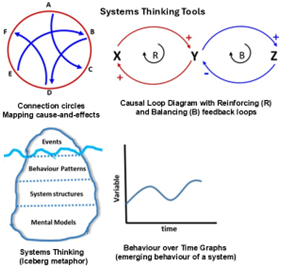
For this it is essential to introduce the concepts and principles of systems thinking (Figure 1). It is essential for students to learn a variety of systems thinking concepts and tools such as plotting dynamic behaviour patterns (behaviour over-time graphs, BOTGs), causal loops diagrams (CLDs) with reinforcing (R) and balancing (B) feedback loops, system archetypes for constructing models (see for example, Meadows, 2008; Richmond, 1994, 2000; Sterman, 2000).
Figure 1. Tools of systems thinking
Applying these systems thinking tools and concepts students will be able to make connections between disciplines to achieve the intended learning outcomes through integrated learning and problem-solving skills.
Purpose and System/Problem Boundary Identification
Purpose: In liberal arts, the purpose is to develop well-rounded individuals with critical thinking, problem-solving, and ethical reasoning skills. Systems thinking helps students understand the broader purpose of their education and how different disciplines interconnect.
System or Problem Boundary Identification: This involves defining what is included within the system and what is excluded. In liberal arts, this helps students delineate the scope of their studies and understand the limits of their knowledge.
Causation and Feedback Loops
Causation: Understanding cause-and-effect relationships is crucial in liberal arts. Systems thinking helps students analyze how different factors influence each other within a system.
Feedback loops: This involves recognizing how outputs of a system can loop back as inputs, influencing future behavior. In liberal arts, this principle helps students understand dynamic interactions and long-term consequences of actions.
Validity Criteria and Experiment Design for Validity
Validity Criteria: Establishing criteria to assess the validity of information and arguments is essential in liberal arts. Systems thinking provides tools to evaluate the reliability and relevance of data.
Experiment Design for Validity: Designing experiments or studies to test hypotheses and validate theories is a key skill. Systems thinking helps students create robust experimental designs to identify the policy levers that account for complex variables.
Policy Space and Experiment Design for Policy
Policy Space: This involves exploring different policy options and their potential impacts. In liberal arts, students learn to consider various perspectives and the broader implications of policies.
Experiment Design for Policy: Designing experiments to test policy interventions helps students understand the practical applications of their studies. Systems thinking aids in creating comprehensive policy experiments that consider multiple factors.
Integration of Systems Approach and Learner-Centered Teaching
Learner-centered teaching, as outlined by Weimer (Weimer 2010, 2013), fundamentally transforms the traditional classroom into dynamic, placing students at the heart of their educational journey. This approach not only involves students in the intricate process of learning but also empowers them to take charge of their educational experiences. By fostering reflection, collaboration, and explicit skill development, learner-centered teaching equips students with critical thinking and problem-solving skills essential for lifelong learning and success. When this approach is harmoniously integrated with essential pedagogical actions for engaging in activities that require independent work or collaboration, students have the chance to discover their preferred learning methods, solve problems, and explore concepts on their own or with peers. Thus, this holistic approach empowers learners to become active, self-directed participants in their educational journey, preparing them for the challenges of the modern world (Blumberg, 2019).
Liberal arts education faces several challenges, including the need to stay relevant in a rapidly changing world and to equip students with skills that are applicable across various fields. Integrating systems thinking and learning-centered teaching can address these challenges by making education more dynamic, interactive, and applicable to real-life situations (Forrester, 2016). For example, a history course might use systems thinking to analyze historical events within broader social, economic, and political contexts, while employing learning-centered techniques to encourage students to draw parallels with contemporary issues. Integrating systems thinking into liberal arts education can be achieved through various learner-centered strategies:
Interdisciplinary Courses: Designing courses that explicitly incorporate systems thinking and draw on multiple disciplines can help students see the connections between different fields of study.
Project-Based Learning: Encouraging students to work on projects that require interdisciplinary collaboration and systems thinking can enhance their problem-solving skills and real-world application of knowledge.
Collaborative Learning Environments: Creating learning environments that promote collaboration and dialogue among students from diverse academic backgrounds can foster a culture of interdisciplinary learning.
In conclusion, teaching in a liberal arts classroom, learner-centered environments empower students to build their own understanding by drawing on their prior knowledge, beliefs, and cultural practices. By incorporating systems thinking into the design and implementation of liberal arts curriculum and interdisciplinary course content, institutions can further enhance students’ holistic thinking and creative problem-solving skills.
Dr. Bellam Sreenivasulu earned his Ph.D. in Chemistry from the National University of Singapore. He has taught at NUS, SUTD, and MDIS, and co-taught with MIT faculty at SUTD in Singapore. Currently, he is a Senior Lecturer at Residential College 4, NUS. He specializes in Systems Thinking and System Dynamics (ST&SD) education, focusing on energy systems, sustainable energy production, energy supply and demand, energy security, and carbon emissions. He also teaches a course on sleep health using systems approach. Passionate about interdisciplinary and learner-centered teaching and research.
References
Blumberg, P. (2019).Making learning-centered teaching work: Practical strategies for implementation (2nd ed.) Stylus.
Barker, C.M. (2000). Liberal Arts Education for a Global Society. New York: Carnegie Corporation of New York.
Forrester, J. W. (2016). Learning through System Dynamics as Preparation for the 21st Century. System Dynamics Review, 32, 187−203
Meadows, D. (2008). Thinking in Systems: A Primer (Chelsea Green Publishing, Hartford, VT).
Richmond, B. (2000). The “Thinking” in Systems Thinking: Seven Essential Skills (Pegasus Communications, Waltham, MA).
Weimer, M. (2010). Inspired college teaching. San Francisco, CA: Jossey-Bass.
Weimer, M. (2013). Learner-centered teaching: Five key changes to practice (2nd ed.). San Francisco, CA: Jossey Bass.
Professor Shamit Saggar said this is a “wake-up call” for the sector. Picture: Kym Smith
A randomised control trial has found that early intervention support for highly disengaged first-year equity students does not necessarily lead to higher participation.
Please login below to view content or subscribe now.
Treasurer Jim Chalmers delivers his “Our Second Term Economic Agenda” address at the National Press Club in Canberra. Picture: Martin Ollman
Streamlining recognition of prior learning (RPL) is one way the tertiary education sector can boost the economy during the Albanese government‘s mission to tackle declining productivity.
Please login below to view content or subscribe now.
How do perceptions of artificial intelligence, online education, tertiary harmonisation, regulation and the skills agenda differ between Australia and the United Kingdom?
Please login below to view content or subscribe now.
It’s been a year since publication of the Behan review and six months since OfS promised to “transform” their approach to quality assessment in response. But it’s still far from clear what this looks like, or if the change is what the sector really needs.
In proposals for a new strategy published back in December OfS suggested a refocus of regulatory activity to concentrate on three strategic priorities of quality, the wider student experience and financial resilience. But while much of the mooted activity within experience and resilience themes felt familiar, when it came to quality, more radical change was clearly on the agenda.
The plans are heavily influenced by findings of last summer’s independent review (the Behan review). This critiqued what it saw as minimal interaction between assessment relating to baseline compliance and excellence, and recommended bringing these strands together to focus on general improvement of quality throughout the sector. In response OfS pledged to ‘transform’ quality assessment, retaining TEF at the core of an integrated approach and developing more routine and widespread activity.
Current concerns
Unfortunately, these bare bones proposals raised more questions about the new integrated approach than they answered and if OfS ‘recent blog update was a welcome attempt to do more in the way of delivering timely and transparent information to providers, it disappointed on detail. OfS have been discussing key issues such as the extent of integration, scope for a new TEF framework, and methods of assessment. But while a full set of proposals will be out for consultation in the autumn, in the meantime, there’s little to learn other than to expect a very different TEF which will probably operate on a rolling cycle (assessing all institutions over a four to five year period).
The inability to cement preparations for the next TEF will cause some frustration for providers. However, if as the tone of communications suggests, OfS is aiming for more disruptive integration above an expansion of the TEF proposals may present some bigger concerns for the sector.
A fundamental concern is whether an integrated approach aimed at driving overall improvement is the most effective way to tackle the sector’s current challenges around quality. Behan’s review warns against an overemphasis on baseline regulation, but below standard provision from a significant minority of providers is where the most acute risks to students, taxpayers and sector reputation lie (as opposed to failure to improve quality for the majority performing above the baseline). Regulation should support improvement across the board too of course.
However, it’s not clear how shifting focus away from the former, let alone moving it within a framework designed to assess excellence periodically, will usefully help OfS tackle stubborn pockets of poor provision and emerging threats within a dynamic sector.
There is also an obvious tension inherent in any attempt to bring baseline regulation within a rolling cycle which is manifest as soon as OfS find serious concerns about provider quality mid cycle. Here we should expect OfS to intervene with investigation and enforcement where appropriate to protect the student and wider stakeholder interest. But doing so would essentially involve regulating on minimum standards on top of a system that’s aiming to do that already as part of an integrated approach. Moreover, if whistle blowing and lead indictors which OfS seem keen to develop to alert them to issues operate effectively, and if OfS start looking seriously at franchise and potentially TNE provision, it’s easy to imagine this duplication becoming widespread.
There is also the issue of burden for both regulator and providers which should be recognised within any significant shift in approach. For OfS there’s a question of the extent to which developing and delivering an integrated approach is hindering ongoing quality assessment. Meanwhile, getting to grips with new regulatory processes, and aligning internal approaches to quality assurance and reporting will inevitably absorb significant provider resource. At a time when pressures are profound, this is likely to be particularly unwelcome and could detract significantly from the focus on delivery and students. Ironically it’s hard to see how transformative change might not hamper the improvements in quality across the board that Behan advocates and prove somewhat counter-productive to the pursuit of OfS’ other strategic goals.
The challenge
It’s crucial that OfS take time to consider how best to progress with any revised approach and sector consultation throughout the process is welcome. Nevertheless, development appears to be progressing slowly and somewhat at odds with OfS’ positioning as an agile and confident regulator operating in a dynamic landscape. Maybe this should tell us something about the difficulties inherent in developing an integrated approach.
There’s much to admire about the Behan review and OfS’ responsiveness to the recommendations is laudable. But while Behan looks to the longer term, I’m not convinced that in the current climate there’s much wrong with the idea of maintaining the incumbent framework.
Let’s not forget that this was established by OfS only three years ago following significant development and consultation to ensure a judicious approach.
I wonder if the real problem here is that, in contrast to a generally well received TEF (and as Behan highlights), OfS’ work on baseline quality regulation simply hasn’t progressed with the speed, clarity and bite that was anticipated and necessary to drive positive change above the minimum were needed. And I wonder if a better solution to pressing quality concerns would be for OfS to concentrate resources on improving operation of the current framework. There certainly feels room to deliver more, more responsive, more transparent and more impactful baseline investigations without radical change. At the same time, the feat of maintaining a successful and much expanded TEF seems much more achievable without bringing a significant amount of assurance activity within its scope.
We may yet see a less intrusive approach to integration proposed by OfS. I think this could be a better way forward – less burdensome and more suited to the sector’s current challenges. As the regulator reflects on their approach over the summer with a new chair at the helm who’s closer to the provider perspective and more distanced from the independent review, perhaps this is one which they will lean towards.
A decade since his passing, David Watson’s work remains a touchpoint of UK higher education analysis.
This reflects the depth and acuity of his analysis, but also his ability as a phrasemaker.
One of his phrases that has stood the test of time is the “quality wars” – his label for the convulsions in UK higher education in the 1990s and early 2000s over the assurance of academic quality and standards.
Watson coined this phrase in 2006, shortly after the 2001 settlement that brought the quality wars to an end. A peace that lasted, with a few small border skirmishes, until HEFCE’s launch of its review of quality assessment in 2015.
War never changes
I wasn’t there, but someone who was has described to me a meeting at that time involving heads of university administration and HEFCE’s chief executive. As told to me, at one point a registrar of a large and successful university effectively called out HEFCE’s moves on quality assessment urging HEFCE not to reopen the quality wars. I’ve no idea if the phrase Pandora’s box was used, but it would fit the tenor of the exchange as it was relayed to me.
Of course this warning was ignored. And of course (as is usually the case) the registrar was right. The peace was broken, and the quality wars returned to England.
The staging posts of the revived conflict are clear.
HEFCE’s Revised operating model for quality assessment was introduced in 2016. OfS was establishment two years later, leading to the B conditions mark I; followed later the same year by a wholesale re-write of the UK quality code that was reportedly largely prompted and/or driven by OfS. Only for OfS to decide by 2020 that it wasn’t content with this; repudiation of the UK quality code; and OfS implementing from 2022 the B conditions mark II (new, improved; well maybe not the latter, but definitely longer).
And a second front in the quality wars opened up in 2016, with the birth of the Teaching Excellence Framework (TEF). Not quite quality assessment in the by then traditional UK sense, but still driven by a desire to sort the sheep from the goats – identifying both the pinnacles of excellence and depths of… well, that was never entirely clear. And as with quality assessment, TEF was a very moveable feast.
There were three iterations of Old TEF between 2016 and 2018. The repeated insistence that subject level TEF was a done deal, leading to huge amounts of time and effort on preparations in universities between 2017 and early 2020 only for subject-level TEF to be scrapped in 2021. At which point New TEF emerged from ashes, embraced by the sector with an enthusiasm that was perhaps to be expected – particularly after the ravages of the Covid pandemic.
And through New TEF the two fronts allegedly became a united force. To quote OfS’s regulatory advice , the B conditions and New TEF formed part of an “overall approach” where “conditions of registration are designed to ensure a minimum level” and OfS sought “to incentivise providers to pursue excellence in their own chosen way … in a number of ways, including through the TEF”.
Turn and face the strange
So in less than a decade English higher education experienced: three iterations of quality assessment; three versions of TEF (one ultimately not implemented, but still hugely disruptive to the sector); and a rationalisation of the links between the two that required a lot of imagination, and a leap into faith, to accept the claims being made.
Pandora’s box indeed.
No wonder that David Behan’s independent review of OfS recommended “that the OfS’s quality assessment methodologies and activity be brought together to form a more integrated assessment of quality.” Last week we had the first indications from OfS of how it will address this recommendation, and there are two obvious questions: can we see a new truce emerging in the quality wars; and given where we look as though we may end up on this issue, was this round of the quality wars worth fighting?
Any assessment of where we are following the last decade of repeated and rapid change has to recognise that there have been some gains. The outcomes data used in TEF, particularly the approach to benchmarking at institutional and subject levels, is and always has been incredibly interesting and, if used wisely, useful data. The construction of a national assessment process leading to crude overall judgments just didn’t constitute wise use of the data.
And while many in the sector continue to express concern at the way such data was subsequently brought into the approach to national quality assessment by OfS, this has addressed the most significant lacuna of the pre-2016 approach to quality assurance. The ability to use this to identify specific areas and issues of potential concern for further, targeted investigation also addresses a problematic gap in previous approaches that were almost entirely focused on cyclical review of entire institutions.
It’s difficult though to conclude that these advances, important elements of which it appears will be maintained in the new quality assessment approach being developed by OfS, were worth the costs of the turbulence of the last 10 years.
Integration
What appears to be emerging from OfS’s development of a new integrated approach to quality assessment essentially feels like a move back towards central elements of the pre-2016 system, with regular cyclical reviews of all providers (with our without visits to be decided) against a single reference point (albeit the B conditions rather than UK Quality Code). Of course it’s implicit rather than explicit, but it feels like an acknowledgment that the baby was thrown out with the bathwater in 2016.
There are of course multiple reasons for this, but a crucial one has been the march away from the concept of co-regulation between universities and higher education providers. This was a conscious and deliberate decision, and one that has always been slightly mystifying. As a sector we recognise and promote the concept of co-creation of academic provision by staff and students, while being able to maintain robust assessment of the latter by the former. The same can and should be true of providers and regulators in relation to quality assurance and assessment, and last week’s OfS blog gives some hope that OfS is belatedly moving in this direction.
It’s essential that they do.
Another of David Watson’s memorable phrases was “controlled reputational range”: the way in which the standing of UK higher education was maintained by a combination of internal and external approaches. It is increasingly clear from recent provider failures and the instances of unacceptable practices in relation to some franchised provision that this controlled reputational range is increasingly at risk. And while this is down to developments and events in England, it jeopardises this reputation for universities across the UK.
A large part of the responsibility for this must sit with OfS and its approach to date to regulating academic quality and standards. There have also been significant failings on the part of awarding bodies, both universities and private providers. The answer must therefore lie in partnership working between regulators and universities, moving closer to a co-regulatory approach based on a final critical element of UK higher education identified by Watson – its “collaborative gene”.
OfS’s blog post on its developing approach to quality assessments holds out hope of moves in this direction. And if this is followed through, perhaps we’re on the verge of a new settlement in the quality wars.