A judge released a Harvard Medical School research associate and Russian native Thursday. She had been held in federal detention for nearly four months after she tried to re-enter the U.S.
Kseniia Petrova still faces a criminal charge for allegedly trying to smuggle frog embryos into the country through Boston’s Logan International Airport, where Customs and Border Protection detained her, but she’s been freed for now.
“I hear it’s sunny. Goodbye,” U.S. magistrate judge Judith G. Dein said after approving Petrova’s release, the Associated Press reported.
The AP wrote that Petrova, standing outside the John Joseph Moakley U.S. Courthouse in Boston, thanked her supporters, saying, “I never really felt alone any minute when I was in custody, and it’s really helped me very much.”
The court set a probable cause hearing in the case for next Wednesday.
Despite being detained Feb. 16 and transferred to Immigration and Customs Enforcement custody in Louisiana, it wasn’t until mid-May that prosecutors announced the smuggling charge. One of her lawyers, Gregory Romanovsky, has said that Petrova “was suddenly transferred from ICE to criminal custody” less than two hours after a judge set a hearing on her release.
On May 28, a U.S. District Court of Vermont judge said that Petrova’s immigration detention was unjustified and granted bail, but that didn’t immediately lead to her release, NBC News reported.
“It’s difficult to understand why someone like Kseniia needed to be jailed for four months,” Romanovsky said. “She poses no danger and has deep ties to her community. Her case is a reminder that immigration enforcement should be guided by law and common sense—and not deportation quotas.”
Before a federal judge blocked its plans, the Education Department reached a deal with the Department of Labor to hand over some of its career, technical and adult education grants, according to court records.
Under the agreement, reached May 21, the Labor Department would administer about $2.7 billion in grants, including the Perkins Grant program, which funds career and technical education at K–12 schools and community colleges, Politicofirst reported. But that plan is now on hold, as is an agreement with the Treasury Department regarding student loan collections, according to a status update in New York’s lawsuit challenging mass layoffs at the agency and President Donald Trump’s executive order to dismantle the department.
The Trump administration has asked the Supreme Court to overturn the lower court’s injunction so officials can proceed with the layoffs and other plans.
The department didn’t publicly announce the handover, which appears to be a first step toward Trump’s endgame of shutting down the agency. Education Secretary Linda McMahon has acknowledgedrepeatedly that only Congress can legally shutter the department, but she’s also made clear that she can transfer some responsibilities to other agencies. In addition to administering the funds, Labor officials agreed to oversee the implementation of career education programs and to monitor grant recipients for compliance.
Advance CTE and the Association for Career and Technical Education criticized the plan, saying the agreement “directly circumvents existing statutory requirements” related to the Perkins program and would cause confusion.
“We strongly oppose any efforts to move CTE administration away from the U.S. Department of Education given the disruption this would cause to the legislation’s implementation and services to students in schools across the country,” they said in a statement released Wednesday evening.
Shalini Randeria, president and rector of the Central European University, has warned that the Trump administration is working from the “playbook” of Hungarian prime minister Viktor Orbán, describing the legal uncertainty faced by U.S. universities as the government’s “intended outcome.”
Now based in Vienna, CEU was forced out of Budapest after Orbán’s Fidesz government implemented a series of legal measures in 2017, which the European Court of Justice later ruled were “incompatible with E.U. law.”
The 2020 ruling came too late for CEU, however, which had relocated to Austria the previous year. “That’s one of the problems of using law courts to stop the machinations of soft authoritarian regimes,” Randeria told Times Higher Education. “Courts are slow and unpredictable, even though we had a very strong case.”
“There was a lot of legal uncertainty created by Orbán, and this is exactly the same playbook which is being used by the Trump administration,” she said, pointing to the court battle between Harvard University and the government as an example.
“They introduce a flurry of laws and administrative measures that universities can then go to court against. It’s unclear what will happen at the end, and this chaos and unpredictability is really the intended outcome.”
Randeria described legal uncertainty as particularly problematic for organizations that work on “long-term cycles,” such as universities. “It makes any rational decision-making, any financial planning or academic planning, impossible,” she said.
“When we admit students now, we admit them to complete a four-year degree, or a two-year master’s, or a doctoral degree in five or six years. We are thinking and planning way ahead,” she said. “If you don’t know what the legal status of your institution will be in two years, you cannot in good faith advertise to and recruit students.”
Attracting faculty, too, requires long-term certainty, Randeria continued: “When you have this sword of Damocles hanging over your head, not knowing whether you’ll be able to run the university efficiently and fairly on a consistent basis, it’s very, very difficult to recruit faculty.”
After the “traumatic period” of forced relocation, CEU has “performed really well academically,” Randeria said, securing “competitive research funding both within Austria and, as usual, within Europe.”
Obtaining consortium grants, such as those awarded by the Austrian Science Fund, has “allowed us to anchor ourselves in Austria, not in competition with the very vibrant academic scene here and its research institutions and universities, but in partnership with them.” The university did not lose any faculty in the move, she noted, and “recruitment and admission numbers didn’t fall.”
Nevertheless, Orbán’s pursuit of the CEU—part of a larger campaign against its philanthropist founder, George Soros—has yet to run its course, Randeria said. Fidesz’s proposed “national sovereignty” law, which would allow the government to penalize or shut down organizations receiving “foreign funding,” “could be used against CEU’s continuing activities” in Budapest, she warned, namely, research conducted at the CEU Democracy Institute.
U.S. vice president JD Vance has expressed explicit admiration for Orbán’s higher education policy, calling his approach, which has also seen control of state universities transferred to government-aligned foundations, “the closest that conservatives have ever gotten to successfully dealing with left-wing domination of universities.”
“What right-wing populists all over have done is stamp universities as ivory towers of elite privilege, and this is not true,” Randeria said. In response, “we need to mobilize public support on a very large scale.”
“As institutions, we need to put a lot more focus on outreach and communication,” she told THE, with the goal of ensuring the public “really understand what universities do, and why they are the backbone of a functioning liberal democracy.”
U.S. universities must “not let themselves be divided one against the other,” Randeria advised. “I don’t think you can protect yourself as an institution on your own. It has to be a collective resistance against this kind of intervention into university autonomy and academic freedom.”
“One should be prepared for some very, very strong institutional solidarity of universities across the board.”
University governing boards are the black boxes of higher ed. As with marriages, the only people who know what they’re really like are the ones in the relationship. Sometimes not even them.
Like most faculty members, I knew almost nothing about the Board of Trustees at my regional public university, other than hearing my colleagues rail against their hiring decisions. In my nearly two decades on the faculty, we’ve had six presidents. That should tell you something.
After a no-confidence vote in a previous president, the board held a public Zoom session where faculty, students and community members gave them hell. I watched, embarrassed. At the board’s request for further comment, I wrote a letter explaining from my limited perspective how things had gotten so bad.
The next day, a trustee emailed to thank me and asked if I’d be willing to talk. I was. I knew some of my colleagues had go-out-drinking relationships with board members. I have never been cool, so I was, of course, flattered. (Frailty, thy name is Rachel.)
The trustee asked if there were other faculty members they could contact. I gave names. We kept in touch. Eventually, the board fired the president and hired someone new. The trustee would occasionally reach out. We’d talk about campus issues—but also books and dogs. Our conversations made me feel seen and valued—a rarity for me.
Only when I began writing a weekly newsletter for Inside Higher Ed, having confidential and off-the-record conversations with sitting presidents, did I realize that my friendly back channel might not have been entirely kosher. Recently, I finally looked at our board’s bylaws. They said, essentially, that trustees aren’t supposed to go around the president to make requests of university employees.
Oops.
That rule is there for a good reason. While it is theoretically great for trustees to be more knowledgeable about the institutions on whose boards they serve, their main functions are fiduciary and to hire and (increasingly often) fire the president, who is responsible in turn for educating them. Most faculty and staff will have plenty to say if asked (I sure did) but will have only a limited perspective on the administrative realities (which never stops us from opining). And some board members, like some of us faculty, just like to stir up shit.
That was not the case with the trustee at my university, who loved the institution, was smart and caring, and wanted only to understand and help make things better. But the reason for bylaws is because not everyone acts honorably. Or is even informed. One thing I’ve learned: Many board members (and some presidents) don’t pay much attention to those pesky board documents. And they’re rarely updated. I just heard from a current president that when he came into the job, the bylaws stated that documents were to be sent electronically. By telegram!
In the last two years, I’ve heard plenty of stories about good relationships between presidents and helpful boards working together to lead all sorts of different types of institutions. Those tales are happily dull.
Frequently, though, I’ve heard horror stories about board behavior. Trustees reliving their frat years, getting hammered and passing out on the president’s couch. Grabbing butts and commenting on legs. Weighing in on clothing and jewelry choices. But not all offenses are so blatant. More often, presidents tell me about covert alliances between trustees and executive team members who want to undermine the president—and get away with it because of personal relationships. Or the board members who go around the president to talk to faculty (um, right).
I have come to believe that many of the problems in higher ed are a result of the fact that there’s no real oversight of trustees, and often not even a shared understanding of what they’re supposed to be doing. There are associations and consultants, but the institutions that seek them out are the ones who already know they need help, and only because things are seriously messed up. Most “training” happens after everything goes pear-shaped and someone with a title and willingness to spend some coin brings in the consultants.
You’d think leaders would recognize a dysfunctional board. But as one of those consultants likes to say, when you’ve seen one board, you’ve seen one board. Many presidents don’t realize they are in an abusive relationship until they move on (by their own choice, or not) and realize that the next board isn’t like the last. That’s when it hits: Oh. That wasn’t normal.
Boards sometimes bring in a president to shake things up or solve a big problem (there’s no money in the budget). But when a place is used to doing things a certain way—especially if there’s been a long-serving president—the new person often ends up being blamed for making everyone feel uncomfortable. When trustees start hearing complaints from their golf buddies about how their alma mater is “changing too much” or faculty vote no confidence, guess who takes the hit?
Some say big boards are better—fewer people means fewer checks on the loudest voices. Most trustees are used to being in charge and seeing quick results. Higher ed doesn’t work that way. And we haven’t even started talking about shared governance. (That’s a whole other can of night crawlers.)
Presidents have to walk a fine line: Give the board enough information to fulfill their duties without overwhelming them. Some create board books of many hundreds of pages and hope no one reads too closely. Others spoon-feed just what’s needed so they can take advantage of the real expertise and wisdom of the board members. Good trustees are curious and thoughtful. But not all of them got the memo that this is a governing role, not a management one. (Same is true for shared governance.)
As with faculty development, those who are eager to get better at their jobs attend learning sessions and those who most need training rarely show up. The bullies call themselves “critical thinkers.” A former president–turned–consultant told me that in the old days, other board members would call out bad behavior. Now, she says, when the flamethrowers show up, everyone else suddenly finds their phones fascinating.
Good trustees know their role. One I’ve spoken to told his president, “If I ever feel like I’m running the place, I know it’s time to find a new president.” That’s what a good marriage sounds like—mutual trust, healthy boundaries, a sense of being on the same team without Monday-morning quarterbacking.
But like all relationships, presidencies can sour. Many presidents have had great relationships with strong, supportive board chairs. But then the chair rotates. Or a new crop of trustees arrives. Suddenly, everything changes. And there’s no way to explain what happened—only that it did.
That’s when we see the press release that says the president “resigned abruptly.” The board thanks them for their service, announces an interim and closes the door behind them. In a few recent cases, the interim is the board chair, who then takes over as president.
Which is why seasoned presidents negotiate their contracts like they’re signing a prenup. Because as with any marriage, you want to believe it’s forever—but you’d be wise to plan for the day one of you decides to walk away.
Rachel Toor is a contributing editor at Inside Higher Ed, where she writes and edits the Insider membership newsletter The Sandbox.
Prior research shows attendance is one of the best predictors of class grades and student outcomes, creating a strong argument for faculty to incentivize or require attendance.
Attaching grades to attendance, however, can create its own challenges, because many students generally want more flexibility in their schedules and think they should be assessed on what they learn—not how often they show up. A student columnist at the University of Washington expressed frustration at receiving a 20 percent weighted participation grade, which the professor graded based on exit tickets students submitted at the end of class.
“Our grades should be based on our understanding of the material, not whether or not we were in the room,” Sophie Sanjani wrote in The Daily, UW’s student paper.
Keenan Hartert, a biology professor at Minnesota State University, Mankato, set out to understand the factors affecting students’ performance in his own course and found that attendance was one of the strongest predictors of their success.
His finding wasn’t an aha moment, but reaffirmed his position that attendance is an early indicator of GPA and class community building. The challenge, he said, is how to apply such principles to an increasingly diverse student body, many of whom juggle work, caregiving responsibilities and their own personal struggles.
“We definitely have different students than the ones I went to school with,” Hartert said. “We do try to be the most flexible, because we have a lot of students that have a lot of other things going on that they can’t tell us. We want to be there for them.”
Who’s missing class? It’s not uncommon for a student to miss class for illness or an outside conflict, but higher rates of absence among college students in recent years are giving professors pause.
An analysis of 1.1 million students across 22 major research institutions found that the number of hours students have spent attending class, discussion sections and labs declined dramatically from the 2018–19 academic year to 2022–23, according to the Student Experience in the Research University (SERU) Consortium.
More than 30 percent of students who attended community college in person skipped class sometimes in the past year, a 2023 study found; 4 percent said they skipped class often or very often.
Students say they opt out of class for a variety of reasons, including lack of motivation, competing priorities and external challenges. A professor at Colorado State University surveyed 175 of his students in 2023 and found that 37 percent said they regularly did not attend class because of physical illness, mental health concerns, a lack of interest or engagement, or simply because it wasn’t a requirement.
A 2024 survey from Trellis Strategies found that 15 percent of students missed class sometimes due to a lack of reliable transportation. Among working students, one in four said they regularly missed class due to conflicts with their work schedule.
High rates of anxiety and depression among college students may also impact their attendance. More than half of 817 students surveyed by Harmony Healthcare IT in 2024 said they’d skipped class due to mental health struggles; one-third of respondents indicated they’d failed a test because of negative mental health.
A case study: MSU Mankato’s Hartert collected data on about 250 students who enrolled in his 200-level genetics course over several semesters.
Using an end-of-term survey, class activities and his own grade book information, Hartert collected data measuring student stress, hours slept, hours worked, number of office hours attended, class attendance and quiz grades, among other metrics.
Mapping out the various factors, Hartert’s case study modeled other findings in student success literature: a high number of hours worked correlated negatively with the student’s course grade, while attendance in class and at review sessions correlated positively with academic outcomes.
Data analysis by Keenan Hartert, a biology professor at Minnesota State University, Mankato, found student employment negatively correlated with their overall class grade.
Keenan Hartert
The data also revealed to Hartert some of the challenges students face while enrolled. “It was brutal to see how many students [were working full-time]. Just seeing how many were [working] over 20 [hours] and how many were over 30 or 40, it was different.”
Nationally, two-thirds of college students work for pay while enrolled, and 43 percent of employed students work full-time, according to fall 2024 data from Trellis Strategies.
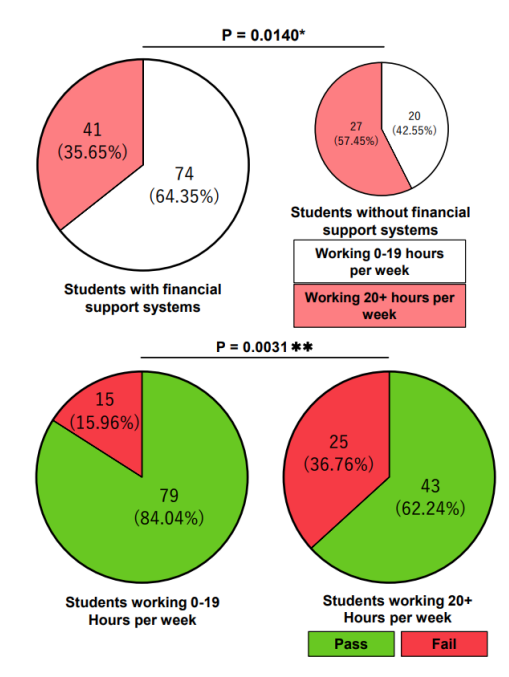
Hartert also asked students if they had any financial resources to support them in case of emergency; 28 percent said they had no fallback. Of those students, 90 percent were working more than 20 hours per week.
Data analysis of student surveys show students who are working are less likely to have financial resources to support them in an emergency.
The findings illustrated to him the challenges many students face in managing their job shifts while trying to meet attendance requirements.
A Faculty Aside
While some faculty may be less interested in using predictive analytics for their own classes, Hartert found tracking factors like how often a student attends office hours was beneficial to helping him achieve his own career goals, because he could include those measurements in his tenure review.
An interpersonal dynamic: A less measured factor in the attendance debate is not a student’s own learning, but the classroom environment they contribute to. Hartert framed it as students motivating their peers unknowingly. “The people that you may not know that sit around you and see you, if you’re gone, they may think, ‘Well, they gave up, why should I keep trying?’ Even if they’ve never spoken to you.”
One professor at the University of Oregon found that peer engagement positively correlated with academic outcomes. Raghuveer Parthasarathy restructured his general education physics course to promote engagement by creating an “active zone,” or a designated seating area in the classroom where students sat if they wanted to participate in class discussions and other active learning conversations.
Compared to other sections of the course, the class was more engaged across the board, even among those who didn’t opt to sit in the participation zone. Additionally, students who sat in the active zone were more likely to earn higher grades on exams and in the course over all.
Attending class can also create connections between students and professors, something students say they want and expect.
A May 2024 student survey by Inside Higher Ed and Generation Lab found that 35 percent of respondents think their academic success would be most improved by professors getting to know them better. In a separate question, 55 percent of respondents said they think professors are at least partly responsible for becoming a mentor.
The SERU Consortium found student respondents in 2023 were less likely to say a professor knew or had learned their name compared to their peers in 2013. Students were also less confident that they knew a professor well enough to ask for a letter of recommendation for a job or graduate school.
“You have to show up to class then, so I know who you are,” Hartert said.
Meeting in the middle: To encourage attendance, Hartert employs active learning methods such as creative writing or case studies, which help demonstrate the value of class participation. His favorite is a jury scenario, in which students put their medical expertise into practice with criminal cases. “I really try and get them in some gray-area stuff and remind them, just because it’s a big textbook doesn’t mean that you can’t have some creative, fun ideas,” Hartert said.
For those who can’t make it, all of Hartert’s lectures are recorded and available online to watch later. Recording lectures, he said, “was a really hard bridge to cross, post-COVID. I was like, ‘Nobody’s going to show up.’ But every time I looked at the data [for] who was looking at the recording, it’s all my top students.” That was reason enough for him to leave the recordings available as additional practice and resources.
Students who can’t make an in-person class session can receive attendance credit by sending Hartert their notes and answers to any questions asked live during the class, proving they watched the recording.
Hartert has also made adjustments to how he uses class time to create more avenues for working students to engage. His genetics course includes a three-hour lab section, which rarely lasts the full time, Hartert said. Now, the final hour of the lab is a dedicated review session facilitated by peer leaders, who use practice questions Hartert designed. Initial data shows working students who stayed for the review section of labs were more likely to perform better on their exams.
“The good news is when it works out, like when we can make some adjustments, then we can figure our way through,” Hartert said. “But the reality of life is that time marches on and things happen, and you gotta choose a couple priorities.”
Do you have an academic intervention that might help others improve student success? Tell us about it.
Gary Gillon is a lecturer in business and management at the University of the West of Scotland. Alan Martin is a lecturer in enterprise at the University of the West of Scotland. Dr Robert Crammond is a senior lecturer in enterprise at the University of the West of Scotland.
In its competitive market, the UK’s universities face growing pressure to be enterprising and produce graduates with real-world skills and innovative thinking. Employers frequently voice concerns about graduates lacking practical skills required in today’s workplace. At the same time, a new generation of students is more entrepreneurial and digitally agile than ever.
A 2023 survey published by the Association of Accounting Technicians found 64% of Generation Z (aged 16 – 25) have started or plan to start their own business, in addition to nearly 5,000 start-ups that were established in UK universities during the 2022-2023 academic session.
With regards to university students specifically, around 27% are managing a business (around 14.4% amongst graduates) or intend to do so. A good figure, but it represents a fraction of the overall student population: so what are universities missing?
Bridging this gap between academic learning and enterprise-ready skills is critical. One promising solution, which links universities and industry, lies in apprenticeships. Called Graduate Apprenticeships (GAs) in Scotland or Degree Apprenticeships (DAs) in England, these programmes combine university study with paid and relevant work experience.
By design, GAs or DAs place students in work-based projects from day one, nurturing an entrepreneurial mindset through hands-on problem-solving, collaboration with industry, and continuous skills development. Through this comprehensive work-integrated learning model, students simultaneously acquire practical expertise while pursuing a degree qualification.
Bridging Theory and Practice through Apprenticeships
Admired by politicians and desired by university management wishing to bolster their institutional offering, apprenticeships have become an integral policy instrument for addressing skills shortages in fields from STEM to digital technology.
Introduced in 2016, they have been central to Scotland’s efforts to reduce youth unemployment. The appeal of the GA pathway is clear: apprentices earn a wage, gain a degree, and directly apply academic theory to workplace projects. Government and industry bodies recognise the value of GAs for building a skilled, innovative workforce.
The Scottish Government’s Future Skills Action Plan (2019) highlights the role of work-based learning in addressing skills gaps and promoting economic growth. Similarly, the UK Innovation Strategy (2021) identifies apprenticeships as essential for creating an “innovation-ready workforce”.
In short, apprenticeships effectively bridge the gap between knowing and doing and naturally encourage an entrepreneurial way of thinking far better than traditional lecture-based university programmes, producing graduates who are work-ready and adept at translating theory into practice. In addition, they reward lifelong learning and lead to the gaining of new knowledge, experiencing varied modes of learning, and the acquisition of relevant skills development for today’s organisations and markets.
However, forms of apprenticeships have their critics. Equitable, structured accessibility and supportive routes towards the degree award, amidst low completion rates and arguable bureaucracy, remain particular challenges.
Therefore, drastic reform on regulation and administration, as well as an image change to increase the desirability of apprenticeships to meet demand, are needed.
This can be achieved through universities highlighting enterprising and business growth benefits as key outcomes of the apprenticeship programme.
Entrepreneurship in Action, Not Just in Theory
A common criticism of higher education, often expressed in media outlets, is that it teaches ‘about’ entrepreneurship rather than providing opportunities ‘for’ entrepreneurship. Apprenticeships flip this script. By spending most of their time on industry projects, apprenticeship students learn entrepreneurship by doing: identifying opportunities, testing ideas, implementing solutions and seeing results. This ‘learning by doing’ approach is far more effective than studying entrepreneurship only in theory, and apprenticeships exemplify its success.
Hands-on work-based learning projects allow students to generate original solutions to real needs and act on them even as conditions change. This is the essence of the entrepreneurial mindset. Crucially, the aim of apprenticeships is not to turn every student into a start-up founder, but to instil entrepreneurial thinking that applies in any context, including within established organisations.
Many apprentices initially see themselves as employees rather than ‘entrepreneurs’, so educators frame entrepreneurship as personal development, taking initiative, adapting to change, and solving problems on the job. By graduation, apprenticeship students may still pursue a conventional career but carry an entrepreneurial mindset that drives them to innovate and add value in any role. In essence, universities are creating intrapreneurs with the initiative and vision to act like entrepreneurs inside established companies.
Key Skills Developed on the Job
Fostering an entrepreneurial mindset requires developing a broad suite of skills and attributes. Apprenticeships are uniquely positioned to strengthen these through on-the-job learning.
These include:
opportunity recognition (spotting inefficiencies and identifying opportunities for improvement),
creative problem-solving (inventing solutions under real constraints),
comfort with uncertainty (making decisions with incomplete information and learning from failure),
self-direction (taking initiative and managing projects independently),
communication (building professional relationships), and
resilience (maintaining a work-life balance).
These are qualities employers seek in graduates. A national survey of hiring managers identified such traits as key markers of ‘work-ready’ graduates. By embedding these capabilities, Apprenticeships produce alumni who are not only academically qualified but also primed to drive innovation.
Developing an Entrepreneurial Culture for All Students
Maximising the impact of apprenticeships and making them more appealing requires universities to actively build a supportive entrepreneurial culture. This means going beyond isolated modules or one-off initiatives and making enterprise and innovation a core part of the learning experience.
The University of the West of Scotland (UWS) provides a compelling example. UWS has promoted an ‘entrepreneurial mentality’ across its Business Management portfolio. Initiatives include a Student Innovation Hub where students, staff and industry partners collaborate on projects to expand their knowledge and skills around innovation and entrepreneurship in one space that leads to industry recognition.
Other universities are taking similar steps, integrating entrepreneurship into curricula and extracurricular activities, leveraging alumni and partners to provide students with project opportunities. Some universities have set up innovation hubs or incubators accessible to all students, offering resources to help turn ideas into ventures. This inclusive approach ensures that even those who do not identify as ‘entrepreneurs’ can gain entrepreneurial experience – whether by launching a social initiative, improving a workplace process, or starting a side business.
By normalising entrepreneurial activity as a valued part of education, universities help students see it as a natural extension of their studies rather than a risky deviation. Combining this notion with apprenticeship offerings affirms the university as being at the service of its immediate community, transforming individuals and businesses, and contributing to local and regional economic growth.
Professional Insights and Recommendations
To fully realise the potential of apprenticeships in developing entrepreneurial mindsets, universities, employers and policymakers must work together. Here, we outline our recommendations:
Integration of entrepreneurship across the curriculum: embed entrepreneurial projects and assessments in all disciplines. National funding initiatives in Scotland already encourage such integration.
Empower and mentor educators: academic staff delivering apprenticeship programmes need targeted support and recognition. Well-supported educators can better guide apprentices in recognising opportunities, creating and building resilience.
Leverage alumni and industry networks: involve successful entrepreneurs and industry leaders in apprenticeship programmes as in-residence professionals or guest speakers. This gives apprentices expanded networks and firsthand insight into entrepreneurial careers.
Conclusion: Shaping an Entrepreneurial Generation
Universities appreciate that an entrepreneurial mindset is increasingly essential for creating value, whether someone is founding a company, driving change within an existing organisation, or thriving within an enterprise ecosystem. Apprenticeships provide a powerful model for contributing to this ecosystem by developing entrepreneurial mindsets and blending academic theory with practical application. This aligns higher education with the needs of a changing economy and with students’ aspirations for self-directed, innovative careers.
Embedding entrepreneurship in higher education requires a deliberate culture change, supportive structures, and community engagement – it will not happen automatically. Apprenticeships shed light on business and societal realities, which can aid in this endeavour.
But when achieved, the payoff is significant. Graduates leave university not only with a degree and work experience, but also with the ability to think and act entrepreneurially.
By championing apprenticeships and entrepreneurial mindsets for all students, UK universities can drive innovation from within and empower the next generation to shape their own futures beyond graduation.
I had the privilege of attending a nursing conference at Creighton University. From the moment the first keynote speaker began to share, I felt deeply inspired. Her words focused on the foundational role nursing theorists and their frameworks play in shaping our professional identity. As someone with more than 30 years in this field, her reflections stirred something meaningful in me. It reminded me that the journey to becoming a strong nurse—and an enthusiastic, confident educator—is never a solo effort. We are shaped and supported by those around us: our families, mentors, peers, administrators, and communities.
Our mentors model excellence and cheer us on, encouraging us to aim higher and trust our abilities. Our peers walk beside us, offering camaraderie, support, and shared wisdom. A strong administration gives us the resources, trust, and space to innovate—to build thoughtful curricula and design meaningful assessments. Together, they help us grow in ways we may not always recognize in the moment but deeply appreciate in hindsight.
Be an Advocate
One of my earliest mentors showed me that being an educator is about more than teaching content—it’s about showing up and being a reliable advocate. She was the first to model what it means to truly be there for students, during both their triumphs and their hardest moments. Her open-door policy wasn’t just a phrase—it was a way of life. Through her, I learned that advocacy means listening, guiding, and supporting with consistency and compassion. It’s a daily practice of presence and empathy, and it’s where true impact begins.
Set the Bar High
“Set the bar high, and students will strive to reach it.” Those words, shared with me by a mentor years ago, continue to guide my philosophy. She believed in the boundless potential of every student and taught me that high expectations, paired with strong support, yield incredible growth. I have seen this in action countless times. When we show students that we believe in their capabilities, they rise—not just to meet the challenge, but often to surpass it.
Be a Cheerleader
One of the most joyful lessons I learned from a mentor was to bring genuine enthusiasm into the classroom. A smile can shift the energy in a room. She encouraged me to use affirmations and call-and-response interactions to build confidence and connection. Small moments, like telling students, “You are capable, confident, and ready,” go a long way. With her influence, I learned to energize a room and help students believe in themselves through positivity and encouragement.
Be Innovative
I was lucky to be mentored by educators who challenged me to move beyond traditional teaching methods. They encouraged me to embrace active learning, to create space where students become participants rather than passive listeners. These mentors inspired me to design experiences that reflect the real world our students will step into—fast-paced, complex, and collaborative. They also reminded me to have fun, to bring my full self into the classroom, and to enjoy the creativity and spontaneity that comes with teaching.
Find Your Theme
One mentor encouraged me to find my scholarly “theme”—an area that aligned with my passion and values. She emphasized that impactful scholarship isn’t just about output; it’s about focus, authenticity, and purpose. Through her mentorship, I found my academic voice. She pushed me to take chances, refine my work, and stay aligned with what truly matters to me. Because of her, I continue to approach writing and research with purpose and pride.
Step Outside Your Comfort Zone
Growth often begins with discomfort, and one mentor was instrumental in helping me embrace that truth. She encouraged me to try new teaching strategies and take risks, even when they felt uncertain. Her example helped me see failure not as defeat, but as an essential part of learning. She taught me to model resilience and curiosity—traits I now pass along to my students.
Be Confident
Confidence as an educator doesn’t come overnight, and for me, a peer played a key role in building that. She guided me in designing exam questions that challenge critical thinking and reflect real-world application. Her belief in my abilities helped me believe in myself. Thanks to her, I now approach assessments as a vital, thoughtful part of the learning process.
Meaningful Connections
Over the years, I’ve formed lasting connections with peers who have become dear friends. Even while teaching at different institutions, our collaboration has remained strong. We share resources, brainstorm, and support each other. These partnerships are more than professional—they’re deeply personal, and they remind me how important it is to foster connection in our work.
Work-Life Balance
Recently, a peer helped me realize the value of setting boundaries and honoring my well-being. She taught me that time for rest, family, and joy is essential—not a luxury. Her example helped me reframe self-care as a necessity for sustained excellence. Today, I prioritize balance, and it’s made me a more effective, fulfilled educator.
Spirituality and Compassion
A mentor once reminded me that spirituality is an essential part of holistic nursing. She taught me that kindness, compassion, and a joyful heart—especially one filled with color (purple, in her case!)—are just as important as clinical skills. Her teachings helped me understand that healing involves the whole person, and that our energy, presence, and spirit deeply affect those we serve.
Joy and Motivation
One of my greatest sources of daily encouragement is my son. His love, his kind words, and his constant support fuel my motivation and joy. He reminds me to live fully, to stay grateful, and to appreciate each moment. Knowing he’s proud of me pushes me to be my best, every single day.
Without Limitation
A dear friend once told me that I deserve all the good things life has to offer—and that I should never doubt my worth. Her belief in me helped me overcome self-imposed limits. Because of her, I’ve stepped into new opportunities with courage, knowing I am capable and deserving.
Cultural Respect and Humility
One of the most impactful lessons I’ve learned came from a mentor who emphasized cultural humility. She taught me to approach every person as a unique individual, with their own story, values, and needs. In both education and care, respect and humility create space for genuine connection and better outcomes. I strive to carry this mindset into every classroom and clinical setting.
My Foundation
At the start of my journey, a mentor believed in me when I struggled to believe in myself. She urged me to pursue my graduate degree and never let me settle for less than my full potential. Her faith in me laid the foundation for the educator I’ve become. I carry her lessons with me daily and hope I’ve made her proud.
An Honor to Witness
Every day, I learn from my students. Their empathy, dedication, and curiosity inspire me. They cheer each other on, advocate for others, and bring fresh perspectives into the classroom. It’s an honor to witness their growth and to be part of their journey. They are already showing the compassion and leadership that will define their futures in nursing.
Future Leaders
The students I mentor often think I’m guiding them—but the truth is, they inspire me. Their passion and eagerness to become nurse educators push me to reflect, evolve, and reach higher. They remind me why I chose this path: to make a difference and help others do the same. They are the future of nursing education, and I’m proud to be a part of their development.
The Sigma conference was more than an event—it was a heartfelt reminder that growth in nursing and education is a shared journey. The keynote speaker’s message brought me back to the many people who have walked with me these past three decades. I am who I am today because of their mentorship, encouragement, and belief in me. As we move forward in our profession, may we all strive to lift others as we have been lifted—to teach, lead, and advocate with purpose, passion, and heart.
Dr. Maureen Hermann earned her BSN (1995), MSN (2011), and DNP (2016), with an emphasis in leadership, from Saint Francis Medical Center College of Nursing in Peoria, IL. Dr. Maureen Hermann is an Associate Professor at Creighton University, Omaha, Nebraska.
This audio is auto-generated. Please let us know if you have feedback.
Dive Brief:
The state of Tennessee and Students for Fair Admissionssued the U.S. Department of Education Wednesday over allegations the agency’s decades-long practice of designating federal grant funding for Hispanic-serving institutions is unconstitutional.
The plaintiffs argued that the department’s eligibility requirements for HSI grantsare discriminatory and undercut opportunities for all students, including those who are Hispanic and attend colleges that aren’t HSIs. To qualify as an HSI, a college must be nonprofit and enroll a full-time undergraduate student body that is at least 25% Hispanic.
Asserting that all colleges serve Hispanic students, Tennessee and SFFA are asking the federal court to strike down the HSI grant program’s ethnicity-based requirements and allow all institutions to apply for the grants “regardless of their ability to hit arbitrary ethnic targets.”
Dive Insight:
Edward Blum, president of SFFA, said the advocacy organization is suing to ensure equal opportunity for all, not “denying opportunity to any racial or ethnic group.”SFFA successfully challenged race-conscious admissions before the U.S. Supreme Court, getting the practice banned in 2023.
“This lawsuit challenges a federal policy that conditions the receipt of taxpayer-funded grants on the racial composition of a student body,” Blum said in a statement Wednesday. “No student or institution should be denied opportunity because they fall on the wrong side of an ethnic quota.”
HSI is a designation first established in 1992 as part of the Higher Education Act, and the federal government began distributing funds to qualifying institutions three years later.
The Education Department’s HSI division exists to distribute grant funding to “expand the educational opportunities for Hispanic Americans and other underrepresented populations,” according to its website.
Though a majority of states have at least one HSI, the institutions are clustered in areas with higher Hispanic populations.
Seven states — California, Texas, New York, Illinois, Florida, New Mexico and New Jersey — and Puerto Rico are home to 81% of HSIs,according to an analysis of federal data by the Hispanic Association of Colleges and Universities.
The Hispanic and Latino population is one of the fastest-growing minority groups in the country. In 2023, 65.2 million Hispanic and Latino people lived in the U.S., accounting for nearly a fifth of the population.The Hispanic population is expected to grow to roughly a quarter of the U.S. population by 2060, according to federal data.
In Tennessee, Hispanic students made up just over 8% of undergraduates in the 2023-24 academic year, according to HACU. The state has just one HSI — Southern Adventist University, a private nonprofit.
No public Tennessee college qualifies for HSI funding, despite all serving some population of Hispanic students, state officials said in Wednesday’s lawsuit. This puts public college students at a disadvantage and harms the institutions, they argued.
Tennessee Attorney General Jonathan Skrmetti alleged that the HSI grant system “openly discriminates against students based on ethnicity.”
“The HSI program perversely deprives even needy Hispanic students of the benefits of this funding if they attend institutions that don’t meet the government’s arbitrary quota,” he said in a Wednesday statement.
Both Skrmetti and Blum invoked the 2023 Supreme Court ruling on race-conscious college admissions in their statements. Blum argued the court “made clear” that federal funding practices like the HSI grant program are “patently unconstitutional.”
That interpretation of diversity-focused federal funding has yet to be tested judicially. The high court’s 2023 decision only addressed admissions practices. But since then, conservative policymakers and those opposed to diversity initiatives have sought to apply it to a wide range of college affairs, including scholarships and diversity programs for students.
Now, they are turning their attention to a long-standing federal program through this lawsuit, filed in U.S. District Court in Tennessee.
The Education Department did not immediately respond to a request for comment Thursday.
However, the department under Trump has already sought to apply the Supreme Court’s 2023 ruling against Harvard University and the University of North Carolina to diversity, equity and inclusion efforts at federally funded institutions.In February, the agency threatened to pull all funding from colleges and K-12 schools that considered race in their programs and policies.
On the first day of his second term, President Donald Trump issued an executive order repealing a Biden-era initiative aimed at boosting educational access via Hispanic-serving institutions. Among several goals, that program sought to expand the educational capacity of Hispanic-serving institutions through federal support.
Trump’s order — which revoked dozens of Biden-era executive actions — described the repealed policies as a move to “restore common sense” in the federal government.
Universities love to talk about innovation. Pedagogical innovation is framed as a necessity in an era of rapid change, yet those expected to enact it – academics – are caught in an identity crisis.
In our research on post-pandemic pedagogical innovation, we found that the decision to engage with or resist innovation is not just about workload, resources, or institutional strategy. It’s about identity – who academics see themselves as, how they are valued within their institutions, and what risks they perceive in stepping beyond the status quo.
Academics are asked to be both risk-taking pedagogical entrepreneurs and compliant employees within increasingly bureaucratic, metric-driven institutions. This paradox creates what we call the moral wiggle room of innovation – a space where educators justify disengagement, not necessarily because they oppose change, but because their institutional environment does not meaningfully reward it.
The paradox of pedagogical innovation
During the pandemic, universities celebrated those who embraced new digital tools, hybrid learning, and flexible teaching formats. “Necessity breeds innovation” became the dominant narrative. Yet, as the crisis has subsided, many of these same institutions have reverted to rigid processes, managerial oversight, and bureaucratic hurdles, making innovation feel like an uphill battle.
On paper, universities support innovation. Education strategies abound with commitments to “transformative learning experiences” and “sector-leading digital education.” However, in practice, academics face competing pressures – expectations to drive innovation while being weighed down by institutional inertia.
The challenge is not just about introducing innovation but sustaining it in ways that foster long-term change. While institutions may advocate for pedagogical innovation, the reality for many educators is a system that does not provide the necessary time, support, or recognition to make such innovation a viable, sustained effort.
The result? Many feel disillusioned. As one academic in our research put it:
I definitely think there’s a drive to be more innovative, but it feels like a marketized approach. It’s not tangible – I can’t say, ‘Oh, they’re really supporting me to be more innovative.’ There’s no clear pathway, no structured process. Academic at a post-92 university
For some, engaging in pedagogical innovation is a source of professional fulfilment. For others, it is a career gamble. Whether academics choose to innovate or resist depends largely on how their identity aligns with institutional structures, career incentives, and personal values.
Three identity tensions shaping pedagogical innovation
Regulated versus self-directed identity Institutions shape identity through expectations: teaching excellence frameworks, fellowship accreditations, and workload models dictate what “counts” in an academic career. Yet, many educators see their professional identity as self-driven – rooted in disciplinary expertise and a commitment to students. When institutional definitions of innovation clash with personal motivations, resistance emerges.
As one participant put it:
When you’re (personally) at the forefront of classroom innovation…you’re constantly looking outwards for ideas. Within the institution, there isn’t really anyone I can go to and say, ‘What are you doing differently?’ It’s more about stumbling upon people rather than having a proactive approach to being innovative. I think there’s a drive for PI, but it feels like a marketised approach. Academic at a post-92 university
For some, innovation is an extension of their identity as educators; for others, it is a compliance exercise – an expectation imposed from above rather than a meaningful pursuit.
This tension is explored in Wonkhe’s discussion of institutional silos, which highlights how universities often create structures that inadvertently restrict collaboration and cross-disciplinary innovation, making it harder for educators to engage with meaningful change.
Risk versus reward in academic careers Engaging in pedagogical innovation takes time and effort. For those on teaching and scholarship contracts, it is often an expectation. For research and scholarship colleagues, it is rarely a career priority.
Despite strategic commitments to pedagogical innovation, career incentives in many institutions still favour traditional research outputs over pedagogical experimentation. The opportunity cost is real – why invest in something that holds little weight in promotions or workload models?
As one academic reflected:
I prioritise what has immediate impact. Another teaching award isn’t a priority. Another publication directly benefits my CV.
Senior leader at a Russell Group university
Until pedagogical I is properly recognised in career progression, it will remain a secondary priority for many. As explored on Wonkhe here, the question is not just whether innovation happens but whether institutions create environments that allow it to spread. Without clear incentives, pedagogical innovation remains the domain of the few rather than an embedded part of academic practice.
Autonomy versus bureaucracy Academics value autonomy. It is one of the biggest predictors of job satisfaction in higher education. Yet pedagogical innovation is often entangled in institutional bureaucracy (perceived or real) through slow approval processes, administrative hurdles, and performance monitoring.
The pandemic showed that universities can be agile. But many educators now feel that flexibility has been replaced by managerialism, stifling creativity.
I’ve had people in my office almost crying at the amount of paperwork just to get an innovation through. People get the message: don’t bother.
Senior leader at a Russell Group university
To counteract this, as one educator put it:
It’s better to ask forgiveness afterwards than ask permission beforehand.
Senior leader at a Russell Group university
This kind of strategic rule-bending highlights the frustration many educators feel – a desire to innovate constrained by institutional red tape.
Mark Andrews, in a Wonkhe article here, argues that institutions need to focus on making education work rather than simply implementing digital tools for their own sake. The same logic applies to pedagogical innovation – if the focus is solely on regulation, innovation will always struggle to take root.
Beyond the rhetoric: what needs to change
If universities want sustained innovation, they must address these identity tensions. Pedagogical innovation needs to be rewarded in promotions, supported through streamlined processes, and recognised as legitimate academic work – not an optional extra.
The post-pandemic university is at a crossroads. Will pedagogical innovation be institutionalised in meaningful ways, or will it remain a talking point rather than a transformation? Academics are already navigating an identity crisis – caught between structural constraints, career incentives, and their own motivations. Universities must decide whether to ease that tension or allow it to widen.
It’s a commonplace that the University of Cambridge was founded by scholars fleeing Oxford. Today’s postcard comes from a university with a similar origin myth, albeit quite a lot less medieval.
And a lot newer too. We need to start in 1967, in May to be precise, when Dr John Paulley, an inveterate writer of letters to the times, had one published on the subject of university education. This included a call to action:
Is it not time to examine the possibility of creating at least one new university in this country on the pattern of those great private foundations in the USA, without whose stimulus and freedom of action the many excellent state universities in that country would be so much poorer?
And the call got a response. Three private conferences were held, two in 1968 and the third in early 1969, with plenty of disaffected Oxford academics attending. Preceding this latter conference was a declaration signed by 46 academics across the UK and Ireland, raising concerns about the influence of the state on university education. To quote from the Belfast Telegraph of Friday 3 January 1969:
Professor Gibson said today: ‘increasingly the universities are being told, usually very politely and often indirectly, at what rate they shall expand and in what directions, and most recently the relative emphasis that should be placed on teaching and research.’
He believed that this influence would increase and the power to exercise it, ‘because of the almost total financial dependence of the universities on the state.’
‘Furthermore I am convinced that centralised control of university education will in time weaken and perhaps destroy the international reputation of British universities,’ he added.
(Professor Gibson, by the way, was Norman J Gibson, financial economist and professor at the New University of Ulster – the local angle clearly caught the eye of the Belfast Telegraph.)
The argument was basically this: if the state pays for higher education, they will call the tune. And this is a bad thing, with deleterious effects for academic autonomy, for research and for quality and standards.
Now, to my mind this argument omits the social justice and economic benefits of expanding access to university education, but it is hard to deny the proposition that the current financially-dependent HE sector in the UK is not exactly brim-full with stable and autonomous universities.
So what happened as a result of the conferences? University College Buckingham, that’s what. It gained corporate form (as a non-profit charity) in 1973, started building works in 1974, and admitted its first students in 1976. Its first vice chancellor was Max Beloff, an Oxford professor.
Buckingham was different – its undergraduate degrees were offered over two years, not three, students started in January not September, and it sat outside the state’s funding apparatus, and outside the UCCA (the Universities’ Central Council on Admissions – along with its polytechnic counterpart, one of the precursors to UCAS). If my memory is correct, there was an external academic advisory committee, which mentored the new university college through its initial years. It gained university status in 1983, under Margaret Thatcher’s premiership. (Mrs Thatcher, as former education secretary in the 1970–74 government, and then leader of the Conservative Party, had also opened the university in 1976. It is safe to say that she was in favour of the project.)
Buckingham continued its journey parallel to the mainstream university sector (albeit still with an element of state support – see the below snippet from the Lincolnshire Standard and Boston Guardian in 1976) until 2001, when it subscribed to the QAA and joined in with the sector’s quality assurance system. From 2004 its students were able to access loan funding via the Student Loans Company, which enabled more students to attend: between 2007 and 2012 the university roughly doubled in size, although it was (and is) still relatively small.
With the coming of the Higher Education and Research Act and the establishment of the OfS in 2018, Buckingham opted to maintain a certain arm’s-length-ness from the state: it is an Approved provider, meaning that it does not get the full £9,250 fee, nor any form of grant support from the OfS; but nor are its fees capped at £9,250. Students can access fee support loans up to £6,000 (or thereabouts) but Buckingham can charge more. And it does, although total fees are comparable with a full-time fee at another English university. Overseas students pay more, but the premium looks to be less, to my eyes, than at other UK universities. So, the principal of autonomy from the state is protected, to some extent.
In 2015 the university opened the first private medical school in modern UK history, working with the Milton Keynes NHS Foundation Trust to provide clinical placements.
Buckingham’s alumni include Brandon Lewis, former Secretary of State for Northern Ireland; Pravind Jugnauth, former Mauritian Prime Minister and leader of that country’s Militant Socialist Movement; and Marc Gené, racing driver and winner of the Le Mans 24 hour race.
Before we finish, it is worth a pause for reflection on the Buckingham story. As an experiment in trying to create a university outside of the normal state apparatus it is, I would argue, an unequivocal success. It is coming up to 50 years since the first students were admitted; there must be at least 50,000 Buckingham graduates; the university has expanded into different subject areas. None of this will have been easy to achieve.
But perhaps the wider quest – to help create a private university, whose freedom of action would stimulate the other universities to innovate and improve – is at the very best a work in progress. One could point to the two-year degrees now available at some universities, as being a consequence of Buckingham. And this probably has some merit. Equally, the experiment shows that the degrees work for some specific student groups – for example, some mature students on courses with a specific professional orientation – but they’re not a panacea to all cost evils.
And maybe the quest is a chimera. The recent rows in the US about Harvard, the private university par excellence, show just how much state funding it receives. (The amount under threat is about $2 billion, which is about five per cent of the total turnover of all universities in the UK.) What I think, for what it is worth, is that the UK sector with a Buckingham is better that it would be without.
The postcard itself is not only of the university, although one of its building is shown top left, by the Great Ouse. The others are Buckingham scenes: the old gaol, the High Street, and the golden swan atop the old Town Hall.
Here’s a jigsaw of today’s card. Thanks to Harriet Dunbar-Morris, Pro Vice-Chancellor Academic and Provost of the university, and an old pal from 1994 Group days – for suggesting Buckingham. As always, if you have a request, please let me know. If I don’t have a postcard, I might enjoy tracking one down!