Blog

  • Podcast: Spending review, Tooling Up, REF, students at work

    Podcast: Spending review, Tooling Up, REF, students at work

    This week on the podcast we examine the government’s spending review and what it means for higher education. How will the £86bn R&D commitment translate into real-terms funding, and why was education notably absent from the Chancellor’s priorities?

    Plus we discuss the Post-18 Project’s call to fundamentally reshape HE policy away from market competition, the startling new REF rules, and the striking rise in student term-time working revealed by the latest Student Academic Experience Survey.

    With Stephanie Harris, Director of Policy at Universities UK, Ben Vulliamy, Executive Director at the Association of Heads of University Administration, Michael Salmon, News Editor at Wonkhe, and presented by Mark Leach, Editor-in-Chief at Wonkhe.

    Tooling up: Building a new economic mission for higher education

    Investing for the long term often loses out to pensioner power

    What’s in the spending review for higher education

    The student experience is beyond breaking point

    How to assess anxious, time-poor students in a mass age

    REF is about institutions not individuals

    Source link

  • North Carolina’s Guilford College scrambles for cash to keep its accreditation

    North Carolina’s Guilford College scrambles for cash to keep its accreditation

    Dive Brief:

    • Guilford College is scrambling to raise cash and balance its budget amid an anticipated decline in enrollment revenue. The college needs to provide a balanced fiscal 2026 budget by December in order to remain accredited.
    • Describing the institution as “between the proverbial rock and a hard place,Acting President Jean Bordewich said this week in a community message that the institution’s fiscal 2026 budget will “almost certainly” need cost cuts to meet a projected revenue dip. 
    • Bordewich also listed recent wins for the private North Carolina college, including fundraising progress and a June conservation agreement with the Piedmont Land Conservancy worth some $8.5 million.

    Dive Insight:

    Come December, Guilford will have been on probation with the Southern Association of Colleges and Schools Commission on Colleges for two years due to financial issues. That’s the maximum time allowed for an institution to be on probation with good cause, per the accreditor’s policy. 

    To stay accredited, the historically Quaker college must show it has the financial resources and ability to manage them to sustain its mission. That in part will require Guilford to submit a balanced budget for fiscal year 2026 to SACSCOC. Accreditation loss would mean Guilford would no longer be eligible to receive federal student aid funds.

    “Progress is being made, but we must plan for multiple contingencies,” Bordewich said this week. “Balancing the cash and accrual budgets is non-negotiable.”

    Given that, the college has been on the hunt for cash. The “For the Good of Guilford” fundraising campaign, launched in March, aims to raise $5 million in unrestricted cash to support the college’s operations. The college so far has raised just under $3.8 million toward the $5 million goal. But that still leaves some $1.2 million to go. 

    The same day Bordewich issued her message, Wess Daniels, director of Guilford’s Friends Center and Quaker Studies, published a plea to alumni, noting that their donations were “needed now more than ever.”

    Daniels drew a parallel between today’s “crisis” and a similar episode of financial distress for the college in 1918. 

    “Guilford’s current crisis mirrors 1918 in striking ways,” Daniels wrote. “Once again, the college faces financial uncertainty. Once again, we ask: Who gave us Guilford College? And more importantly: Who will ensure it continues?”

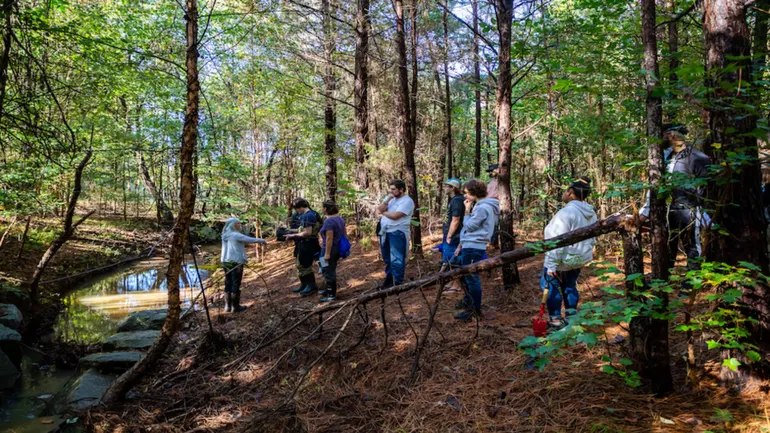
    Along with fundraising, Guilford’s agreement with Piedmont Land Conservancy is set to bring cash into its coffers. Under the memorandum of understanding, the college would retain ownership of 120 acres of land known as the Guilford Woods, while the conservation organization will purchase the development rights once it raises $8.5 million. 

    “The land will be permanently protected, Guilford College will receive vital financial support for its programs, and the public will gain official access to pristine green space in a rapidly growing part of Greensboro,” Mary Magrinat, incoming president of the conservancy, said in a statement. Bordewich described the land as one of the few large privately owned hardwood forests in Greensboro. 

    The proceeds from the agreement will likely be available by 2028, the college has said.

    Founded by North Carolina Quakers in 1837, Guilford has suffered from declining enrollment in recent years along with many other private liberal arts colleges. Between 2018 and 2023, fall headcount declined 23.4% to 1,208 students. And that number is down 57.3% from 2010. 

    With the shrinking student body has come financial struggle. In fiscal 2024, the college reported a total operating deficit of $2.4 million.

    As it tries to rein in its budget, the college is working toward a strategy to recruit students with less tuition discounting and to ramp up its adult education programs — which once reached 1,300 students but have diminished to serve just 50 — among other efforts. 

    In her message this week, Bordewich noted “positive news” in that the college is expecting a $2 million surplus for its fiscal year 2025 cash operating budget.

    Source link

  • Introducing Expression, FIRE’s official new Substack

    Introducing Expression, FIRE’s official new Substack

    We believe that the ability to speak your mind, question authority, and listen to opposing views is not just a basic right but the cornerstone of a free society.

    That’s why FIRE’s officially launching on Substack — to speak up, push back, and encourage debate. As a platform that deeply believes in free speech, Substack is a natural home for FIRE content.

    SIGN UP FOR FIRE’S SUBSTACK TODAY

    This will be a space for FIRE’s best commentary, analysis, and storytelling. Think of it as FIRE Magazine, curated from staff op-eds, explainers, and the pages of our Newsdesk.

    Our decision to launch on Substack has to do with a rapidly changing media landscape.

    Over 20% of Americans now regularly get their news from social media platforms. But there’s a catch:  Platforms, particularly X, punish users for sharing links in their posts, throttling traffic to other websites, including ours. Historically, FIRE’s website got a significant portion of its traffic from social media posts. Those days are long gone, and AI platforms don’t want you to click any links at all.

    Enter Substack.

    The newsletter platform, which has grown from a few million subscribers five years ago to over 35 million today, offers us a way to deliver important stories and analysis directly to your inbox. No need to go to FIRE’s homepage. Now the content will come directly to you.

    From breaking news analysis and legal battles to cultural trends, Expression is where we go beyond the headlines — taking you into the fight to defend the First Amendment and bringing you the stories that shape (and threaten) free speech in America.

    To get you started, we’ve already published a collection of posts:

    Whether you’re a die-hard free speech advocate, a curious skeptic, or someone who just wants to understand the stakes, this is your home for smart, principled, and fearless writing.

    Subscribe now to join the fight — and the conversation. Subscribing is free, but by upgrading to become a paid subscriber, you also become a FIRE Member.

    Membership benefits include invitations to exclusive events, a subscription to the FIRE Quarterly magazine, updates on free speech issues, and access to private events and interactions with FIRE staff. By becoming a member, your additional support helps us fight censorship, defend free thought, and protect your most basic and powerful freedom — expression.

    Source link

  • Promoting access to higher education worldwide

    Promoting access to higher education worldwide

    by Graeme Atherton

    The shift to the political right in many countries in the world, including it appears the UK now, presents a new set of challenges for equitable access and success to higher education. Not that it needed any new ones. Inequalities in participation in higher education are pervasive, entrenched and low on the list of priorities of most governments. Since the early 2010s we have been working with other organisations across the world including the World Bank and UNESCO to understand the extent and nature of these inequalities but more importantly to initiate activities to address them. In 2016 working with colleagues including the late, great Geoff Whitty I undertook a project to bring together as much secondary data we could on who participates in higher education by social background across the world.

    The Drawing the Global Access Map report found that in all the countries where we could find data (over 90%) higher education participation was unequal. The extent of this inequality differs but it binds together countries and higher education systems of all varieties. Following convening 2 global conferences on higher education access around the time of this report in an attempt to galvanise the global higher education community, we then launched World Access to Higher Education Day (WAHED) in 2018. The aim of WAHED was to create a vehicle that would enable universities to launch activities to address inequalities in access and success on the day in their own place. As the pandemic hit we also started a global online conference and up to 2022 over 1000 organisations from over 100 countries engaged in WAHED. We also produced research to mark the day including the All Around the World – Equity Policies Across the Globe report in 2018 which looked at policies on higher education equity in over 70 countries. The report found that only 32% of the countries surveyed have defined specific participation targets for any equity group and only 11% have formulated a comprehensive equity strategy.

    WAHED played an important role as a catalyst for activism, especially in contexts where individuals or departments felt that they were acting in isolation. However, progress will be limited if efforts are restricted just to an International Day of Action. Hence, in December 2024, working again with the World Bank, UNESCO as well as Equity Practitioners in Higher Education in Australasia (EPHEA), and a number of educational foundations, we launched the World Access to Higher Education Network (WAHEN). The aim of WAHEN is to construct an alliance for global, collective action on higher education equity and more information can be found here. It will focus on:

    •              Capacity Building via the sharing, professionalisation and enhancement of practice in learning, teaching and pre-HE outreach

    •              Collaboration – enabling organisations to formulate and deliver shared goals through a set of global communities of practice.

    •              Convening – bringing together those from across countries and sectors to affect change in higher education through World Access to Higher Education Day.

    •              Campaigning – advocating and working with policymakers and governments around the world producing research and evidence.

    •              Critical thinking – creating an online space where the knowledge based on ‘what works’ in equitable access and success can be developed & shared.

    It was because there was a national organisation that works to tackle inequalities in higher education in the UK, the National Education Opportunities Network (NEON), that I founded and led for 13 years, that WAHED and WAHEN happened. NEON led these efforts to build a global network. There remains a large way to go for WAHEN to be sustainable and impactful. We are working intently on how to position WAHEN and how it should focus its efforts. Inequalities in access and success are locally defined. They can’t be defined from a Euro-centric perspective, and they can also only be tackled through primarily work that is regional or national. The added value of international collaboration in this area needs to be articulated, it can’t be assumed. But at the same time, nor should the default assumption be that such a network or collaboration is less required where equitable access and success is concerned than in other parts of higher education. This assumption encapsulates the very problem at hand, ie the lack of willingness to recognise the extent of these inequalities and make the changes necessary to start to address them.

    The present challenges to higher education presented by the global shift to the right brings into sharp focus the consequences of a failure to deal with these inequalities. Universities and left leaning governments are unable to frame higher education as open and available to all with the potential to enter. The accusations of elitism and the threats to academic freedom etc then become an easier sell to electorates for whom higher education has never mattered, or those in their family/community. It is more important than ever then that something like WAHEN exists. It is essential that we develop the tools that give higher education systems across the world to become more equitable and to resist populist narratives, and that we do this now.

    Professor Graeme Atherton is Director of the World Access to Higher Education Network (WAHEN) and Vice Principal, Ruskin College, Oxford.

    Author: SRHE News Blog

    An international learned society, concerned with supporting research and researchers into Higher Education

    Source link

  • No gay rights without free expression

    No gay rights without free expression

    Three dates reliably bring me dread: the first Tuesday in November, April 15, and the day the Foundation for Individual Rights and Expression releases its annual College Free Speech Rankings.

    Each spring offers new reasons to despair, and this year’s report doesn’t disappoint. According to the poll of nearly 60,000 undergraduates at more than 250 schools across the country, the percentage of students who believe that it is at least “rarely” acceptable to shout down a speaker, block other students from hearing a speaker, or violently disrupt a speech has risen to 68%, 52% and 32% respectively. Majorities believe that speeches promoting six out of eight controversial propositions — “Transgender people have a mental disorder,” “Abortion should be completely illegal,” and “Black Lives Matter is a hate group” among them — should be banned from campus. (71%, meanwhile, say that speeches endorsing the genocidal call “From the river to the sea, Palestine will be free” should be allowed.) And while either half or the majority of students believe that 15 out of 17 types of student groups ranging from “Christian” to “Democrat” to “LGBTQ” should be eligible to receive student activity fees, only 40% say the same for “pro-Israeli” ones (49% say pro-Palestinian groups should be eligible to receive student activity fees).

    Five years of FIRE surveys demonstrate that the nation’s future leaders harbor a shocking degree of ignorance about America’s uniquely robust free speech principles, content neutrality foremost among them. To be sure, college students are like many other if not most Americans in this regard. Ask any random person on the street if they believe in free speech, and they’ll probably say “yes,” but dig down and you’ll discover that they adhere to the proposition, “free speech for me, but not for thee.” It’s all well and good to support the right to free speech of people with whom you concur; it’s the willingness to support the rights of those whose message you despise that is the true test of one’s commitment to the principle of free expression.

    Particularly disturbing to me in reading this year’s survey is a trend I’ve been monitoring for some time: the persistently lower support for free speech among LGBT students compared to their heterosexual peers. As in past surveys, this year’s poll found that students in eight categories ranging from Gay/Lesbian to Pansexual (essentially, anything other than “straight”) were more likely than their heterosexual classmates to support censorship. For instance, while 69% of heterosexual students believe it is “never” or “rarely” acceptable to shout down a speaker, that figure stands at 49% for gay and lesbian students and 39% for queer ones. Similarly, 80% of straights oppose blocking other students from hearing a speaker, but only 69% of gays and 68% of queers agree. And while 75% of queer students think that a speech arguing “Collateral damage in Gaza is justified for the sake of Israeli security” should “definitely” or “probably” be banned, a mere 13% say the same for a speech promoting the destruction of Israel.

    Put aside the monumental ignorance that leads some LGBT students, of all people, to take the side of murderous religious fanatics over the sole democracy in the Middle East. What makes these figures so tragic is that, were it not for the First Amendment and the robust protections it affords for free expression, none of these students would be enjoying the freedoms they so blithely take for granted today. For the legal equality and social acceptance that LGBT people now have is entirely a product of America’s free speech culture.

    Consider that, in postwar America, homosexuality was a crime in every state, a sin according to organized religion, and a mental disorder in the eyes of the medical establishment. Gay bars and other gathering places were routinely raided by police and gay men and women were subjected to horrific medical experiments in a sadistic attempt to “cure” them of their “disease.” When Senator Joe McCarthy launched his crusade against communists and homosexuals in the State Department, it was reported that three-fourths of the mail pouring into his office was primarily fixated on the latter scourge.

    In the 1950s, a small band of incredibly courageous people began a decades-long effort to change this state of affairs, and throughout it they did so by relying upon the Constitutional right to free expression. The first Supreme Court case to deal with the subject of homosexuality, ONE, Inc. vs. Olesen was a challenge to federal government censorship. Beginning in 1953, the U.S. Post Office and the Federal Bureau of Investigation launched a crusade against ONE, the country’s first widely circulated, national gay periodical. The following year, Los Angeles Postmaster Otto Olesen declared the magazine (which contained nary a racy photo or explicitly sexual article) as “obscene, lewd, lascivious and filthy” and therefore unmailable under the Comstock Act of 1873.

    The magazine brought a suit against the Postmaster in federal court in California. Ruling in favor of the defendant, the Court stated that “The suggestion advanced that homosexuals should be recognized as a segment of our people and be accorded special privilege as a class is rejected.” The case made its way to the Supreme Court, which in 1958 issued a brief per curiam decision overruling the lower court’s decision, effectively legalizing pro-gay political expression in the United States. In its first issue published after the ruling, ONE declared that “For the first time in American publishing history, a decision binding on every court now stands. … affirming in effect that it is in no way proper to describe a love affair between two homosexuals as constitut(ing) obscenity.”

    Several years later, in 1962, the right of gay people to express themselves as freely as their heterosexual countrymen was further advanced with the Supreme Court case MANual Enterprises vs. Day. MANual Enterprises was a publisher of “beefcake” magazines, publications whose images of scantily clad young men were no more prurient than those of the “pin-up” girls popular among American GIs during the Second World War. Following a campaign of government harassment similar to that endured by ONE, the company appealed its case to the Supreme Court. This time, the Court decided to hear the case. The government’s singling out homosexuals and denying them the right to receive certain publications through the mail, the company’s lawyer argued, “reduces a large segment of our society to second class citizenship.” It was a daring argument, utilizing a term popularized by the African American civil rights movement. “If we so-called normal people, according to our law, are entitled to have our pin-ups, then why shouldn’t the second-class citizens, the homosexual group . . . why shouldn’t they be allowed to have their pin-ups?”

    Writing for the majority in a 6–1 decision, Justice John Marshall Harlan II stated that while he personally found the magazines to be “dismally unpleasant, uncouth and tawdry . . . these portrayals of the male nude cannot fairly be regarded as more objectionable than many portrayals of the female nude that society tolerates.” However qualified by his expressions of personal distaste, Harlan’s argument that erotic images created for the titillation of homosexuals were not inherently more obscene than those designed to arouse their heterosexual fellow citizens recognized an important principle that laid the groundwork for further gay rights legal victories to come.

    Three years later, another instance of free expression in the furtherance of gay civil rights occurred outside the White House gates. A group of 10 men and women affiliated with the Mattachine Society of Washington, D.C., one of the first gay rights organizations in the country, formed a picket on the sidewalk across the street from Lafayette Square. Marching in an oval-like motion and dressed in business attire, they held signs declaring, “FIFTEEN MILLION U.S. HOMOSEXUALS PROTEST FEDERAL TREATMENT, GOVERNOR WALLACE MET WITH NEGROES, OUR GOVERNMENT WON’T MEET WITH US and “U.S. CLAIMS NO SECOND CLASS CITIZENS, WHAT ABOUT HOMOSEXUAL CITIZENS?” Four years before the much more famous Stonewall Riot erupted in Greenwich Village, this was the first organized public demonstration for gay rights in the United States.


    Though the protest garnered scant media attention, it inspired gay men and women across the country more than anything up to that time. “Nothing like these demonstrations has been seen before,” Eastern Mattachine Magazine, a publication of the Mattachine Society, enthused. “The most hated and despised of minority groups has shown its face to the crowds, and it is plain for all to see that they are not horrible monsters. They are ordinary looking, well-dressed human beings!” For one of the picketers, the event was “the most important day of my life” next to her marriage to her partner over two decades later.

    For the leader of the march, Mattachine Society co-founder Frank Kameny, free expression had been a vital tool since the federal government fired him for being gay. In 1957, the Harvard-trained Army Map Service astronomer was recalled from his observatory in Hawaii to Washington. Army officials had discovered an arrest record for “lewd and indecent acts” he allegedly committed in a police entrapment operation while visiting San Francisco. Kameny was fired on the spot and joined the ranks of the thousands of other patriotic American gay men and women rejected by their government solely because of their sexual orientation.

    What distinguished Kameny from the rest was that he had the courage to fight back, and the wherewithal to base his case for equality on the Declaration of Independence and the Constitution. He appealed to the Civil Service Commission (predecessor to the Office of Personnel Management), and when that failed, argued his case all the way to the Supreme Court. Not even the ACLU was willing to defend a homosexual in 1960, however, and so Kameny, who had no formal legal training, represented himself. In his petition to the Court, he wrote:

    The government’s entire set of policies and practices in this field is bankrupt, and needs a searching re-assessment and re-evaluation — a re-assessment and re-evaluation which will never occur until these matters are forced into the light of day by a full court hearing, such as is requested by this petition.

    Kameny was denied his opportunity to expose the irrationality of government discrimination against homosexuals in “the light of day” — the Court refused to hear his case. But the setback was only temporary. Kameny began a lifelong campaign for equality on all fronts that culminated with his receiving a formal apology from OPM Director John Berry — himself a gay man — in 2009.

    The most celebrated moment in the history of the gay rights movement, the Stonewall Riot of 1969, was, at its heart, a protest in defense of the First Amendment’s protection of freedom of association. As in many jurisdictions across the United States at the time, serving alcohol to homosexuals was illegal in New York City, as was dancing between two members of the same sex. This led to a situation in which the only gay bars allowed to operate were controlled by the mafia, who paid the police for the privilege. This arrangement, however, did not stop the police from regularly raiding the bars and carting out patrons for arrest and humiliation before tipped-off newspaper photographers.

    On the evening of June 28, 1969, a group of patrons at the Stonewall Inn said: Enough. According to the Constitution, all Americans have the freedom to associate with one another; nowhere does it state that this right is exclusive to heterosexuals or, for that matter, people with brown eyes or black hair. Patrons forcibly resisted arrest, the NYPD called in backup, and for almost a week, the police and gay people engaged in running street battles outside the Stonewall. The following June, New York City held the world’s first gay pride parade, a tradition that has now extended to an entire month of commemoration and celebration of the freedom to be oneself.

    So much of the widespread acceptance that LGBT people enjoy today is attributable to free expression. Social attitudes were gradually changed by films like 1972’s That Certain Summer, the first gay-themed TV-movie and one of the earliest positive portrayals of gay people, and TV shows like Will & Grace, which brought lovable gay characters into the homes of millions of people across America and around the world. (And which then-Vice President Joe Biden cited as playing a role in his own evolution on the issue, a gaffe that forced President Obama to declare that he, too, now supported marriage equality). The AIDS activism of the 1980s and 1990s, much of it confrontational, awakened the country to the devastating effects of a terrible disease. The decision by celebrities, athletes, politicians, and business leaders to come out continues to have an immeasurably positive impact on the way straight people treat their gay neighbors, colleagues, and family members. Indeed, coming out is itself an act of free expression; every gay person utilizes it when they acknowledge the truth about themselves to others.

    Considering this awe-inspiring history, the sort of thing that ought to make young people proud to be American, how is it that free speech is opposed by so many of the students who have benefitted from it most? One reason is power dynamics. While gay people desperately needed free expression to press their case when they were treated as criminals by their own government, today, pro-LGBT sentiment is widespread throughout corporate America, Hollywood, the non-profit sector, the business world, higher education, labor unions, and white-collar professions. Why, the college sophomore asks, should we allow bigots to challenge this hard-won consensus and potentially drag us back to the proverbial Stone Age? This dynamic is hardly exclusive to the LGBT movement; just look at all the right-wing critics of “woke” censoriousness who have gone silent since Donald Trump returned to the White House and launched an anti-free speech campaign against his critics. This is all the more reason to support content-neutral free speech policies: in a democracy, power changes hands, and smothering the speech of one’s adversaries creates a precedent for them to do the same once they’re in charge.

    Another reason is a total lack of knowledge about the history outlined in this essay. Young LGBT people today are far likelier to know about Marsha P. Johnson, a drag queen who has earned iconic status for “throwing the first brick” at Stonewall despite not even being there when it erupted, than they are Frank Kameny, Elaine Noble, Bayard Rustin, or Martina Navratilova. The early gay rights movement is too heavily composed of “cisgender” white men to serve today’s “intersectional” purposes. Working within the system, using the methods provided by the Constitution, trying to persuade those who disagree with you, all of these are forms of “respectability politics,” the strategy of sell-outs. In this narrative, Stonewall is given primacy, a riot against cops better suited to inspire a radical political agenda than the slow and steady work of lobbying, legislating and litigating.

    Finally, there’s the influence of academic queer theory and the proliferation of “queer” as not so much a sexual identity but a political one. Like other modes of critical theory, queer theory seeks to subvert hierarchies and challenge established knowledge, “queering” them such that they become totally unrecognizable in their original form. It’s through sophistry like this that constitutionally protected speech becomes “violence” to be suppressed. Tolerance, a word once esteemed by gay and lesbian activists seeking a place at the table in a pluralistic society, is now denigrated in the fashion of Herbert Marcuse’s concept of “repressive tolerance,” which argues that because the expression of conservative views is harmful to marginalized groups, it ought to be suppressed.

    As a gay writer who has reported from countries where gay people live under extreme social and legal subjugation, I have witnessed first-hand the inextricable connection between free expression and LGBT rights. Looking at a map of the world, it’s no coincidence that the countries most accepting of LGBT people are liberal democracies that, however imperfectly, ensure freedom of expression, and that by and large the world’s dictatorships and illiberal regimes either criminalize or harshly repress homosexuality. Just as there is no equality for gay people without free expression, the equality of gay people will not be ensured unless the right to free expression applies equally to everyone.

    Source link

  • No gay rights without free expression

    No gay rights without free expression

    Three dates reliably bring me dread: the first Tuesday in November, April 15, and the day the Foundation for Individual Rights and Expression releases its annual College Free Speech Rankings.

    Each spring offers new reasons to despair, and this year’s report doesn’t disappoint. According to the poll of nearly 60,000 undergraduates at more than 250 schools across the country, the percentage of students who believe that it is at least “rarely” acceptable to shout down a speaker, block other students from hearing a speaker, or violently disrupt a speech has risen to 68%, 52% and 32% respectively. Majorities believe that speeches promoting six out of eight controversial propositions — “Transgender people have a mental disorder,” “Abortion should be completely illegal,” and “Black Lives Matter is a hate group” among them — should be banned from campus. (71%, meanwhile, say that speeches endorsing the genocidal call “From the river to the sea, Palestine will be free” should be allowed.) And while either half or the majority of students believe that 15 out of 17 types of student groups ranging from “Christian” to “Democrat” to “LGBTQ” should be eligible to receive student activity fees, only 40% say the same for “pro-Israeli” ones (49% say pro-Palestinian groups should be eligible to receive student activity fees).

    Five years of FIRE surveys demonstrate that the nation’s future leaders harbor a shocking degree of ignorance about America’s uniquely robust free speech principles, content neutrality foremost among them. To be sure, college students are like many other if not most Americans in this regard. Ask any random person on the street if they believe in free speech, and they’ll probably say “yes,” but dig down and you’ll discover that they adhere to the proposition, “free speech for me, but not for thee.” It’s all well and good to support the right to free speech of people with whom you concur; it’s the willingness to support the rights of those whose message you despise that is the true test of one’s commitment to the principle of free expression.

    Particularly disturbing to me in reading this year’s survey is a trend I’ve been monitoring for some time: the persistently lower support for free speech among LGBT students compared to their heterosexual peers. As in past surveys, this year’s poll found that students in eight categories ranging from Gay/Lesbian to Pansexual (essentially, anything other than “straight”) were more likely than their heterosexual classmates to support censorship. For instance, while 69% of heterosexual students believe it is “never” or “rarely” acceptable to shout down a speaker, that figure stands at 49% for gay and lesbian students and 39% for queer ones. Similarly, 80% of straights oppose blocking other students from hearing a speaker, but only 69% of gays and 68% of queers agree. And while 75% of queer students think that a speech arguing “Collateral damage in Gaza is justified for the sake of Israeli security” should “definitely” or “probably” be banned, a mere 13% say the same for a speech promoting the destruction of Israel.

    Put aside the monumental ignorance that leads some LGBT students, of all people, to take the side of murderous religious fanatics over the sole democracy in the Middle East. What makes these figures so tragic is that, were it not for the First Amendment and the robust protections it affords for free expression, none of these students would be enjoying the freedoms they so blithely take for granted today. For the legal equality and social acceptance that LGBT people now have is entirely a product of America’s free speech culture.

    Consider that, in postwar America, homosexuality was a crime in every state, a sin according to organized religion, and a mental disorder in the eyes of the medical establishment. Gay bars and other gathering places were routinely raided by police and gay men and women were subjected to horrific medical experiments in a sadistic attempt to “cure” them of their “disease.” When Senator Joe McCarthy launched his crusade against communists and homosexuals in the State Department, it was reported that three-fourths of the mail pouring into his office was primarily fixated on the latter scourge.

    In the 1950s, a small band of incredibly courageous people began a decades-long effort to change this state of affairs, and throughout it they did so by relying upon the Constitutional right to free expression. The first Supreme Court case to deal with the subject of homosexuality, ONE, Inc. vs. Olesen was a challenge to federal government censorship. Beginning in 1953, the U.S. Post Office and the Federal Bureau of Investigation launched a crusade against ONE, the country’s first widely circulated, national gay periodical. The following year, Los Angeles Postmaster Otto Olesen declared the magazine (which contained nary a racy photo or explicitly sexual article) as “obscene, lewd, lascivious and filthy” and therefore unmailable under the Comstock Act of 1873.

    The magazine brought a suit against the Postmaster in federal court in California. Ruling in favor of the defendant, the Court stated that “The suggestion advanced that homosexuals should be recognized as a segment of our people and be accorded special privilege as a class is rejected.” The case made its way to the Supreme Court, which in 1958 issued a brief per curiam decision overruling the lower court’s decision, effectively legalizing pro-gay political expression in the United States. In its first issue published after the ruling, ONE declared that “For the first time in American publishing history, a decision binding on every court now stands. … affirming in effect that it is in no way proper to describe a love affair between two homosexuals as constitut(ing) obscenity.”

    Several years later, in 1962, the right of gay people to express themselves as freely as their heterosexual countrymen was further advanced with the Supreme Court case MANual Enterprises vs. Day. MANual Enterprises was a publisher of “beefcake” magazines, publications whose images of scantily clad young men were no more prurient than those of the “pin-up” girls popular among American GIs during the Second World War. Following a campaign of government harassment similar to that endured by ONE, the company appealed its case to the Supreme Court. This time, the Court decided to hear the case. The government’s singling out homosexuals and denying them the right to receive certain publications through the mail, the company’s lawyer argued, “reduces a large segment of our society to second class citizenship.” It was a daring argument, utilizing a term popularized by the African American civil rights movement. “If we so-called normal people, according to our law, are entitled to have our pin-ups, then why shouldn’t the second-class citizens, the homosexual group . . . why shouldn’t they be allowed to have their pin-ups?”

    Writing for the majority in a 6–1 decision, Justice John Marshall Harlan II stated that while he personally found the magazines to be “dismally unpleasant, uncouth and tawdry . . . these portrayals of the male nude cannot fairly be regarded as more objectionable than many portrayals of the female nude that society tolerates.” However qualified by his expressions of personal distaste, Harlan’s argument that erotic images created for the titillation of homosexuals were not inherently more obscene than those designed to arouse their heterosexual fellow citizens recognized an important principle that laid the groundwork for further gay rights legal victories to come.

    Three years later, another instance of free expression in the furtherance of gay civil rights occurred outside the White House gates. A group of 10 men and women affiliated with the Mattachine Society of Washington, D.C., one of the first gay rights organizations in the country, formed a picket on the sidewalk across the street from Lafayette Square. Marching in an oval-like motion and dressed in business attire, they held signs declaring, “FIFTEEN MILLION U.S. HOMOSEXUALS PROTEST FEDERAL TREATMENT, GOVERNOR WALLACE MET WITH NEGROES, OUR GOVERNMENT WON’T MEET WITH US and “U.S. CLAIMS NO SECOND CLASS CITIZENS, WHAT ABOUT HOMOSEXUAL CITIZENS?” Four years before the much more famous Stonewall Riot erupted in Greenwich Village, this was the first organized public demonstration for gay rights in the United States.


    Though the protest garnered scant media attention, it inspired gay men and women across the country more than anything up to that time. “Nothing like these demonstrations has been seen before,” Eastern Mattachine Magazine, a publication of the Mattachine Society, enthused. “The most hated and despised of minority groups has shown its face to the crowds, and it is plain for all to see that they are not horrible monsters. They are ordinary looking, well-dressed human beings!” For one of the picketers, the event was “the most important day of my life” next to her marriage to her partner over two decades later.

    For the leader of the march, Mattachine Society co-founder Frank Kameny, free expression had been a vital tool since the federal government fired him for being gay. In 1957, the Harvard-trained Army Map Service astronomer was recalled from his observatory in Hawaii to Washington. Army officials had discovered an arrest record for “lewd and indecent acts” he allegedly committed in a police entrapment operation while visiting San Francisco. Kameny was fired on the spot and joined the ranks of the thousands of other patriotic American gay men and women rejected by their government solely because of their sexual orientation.

    What distinguished Kameny from the rest was that he had the courage to fight back, and the wherewithal to base his case for equality on the Declaration of Independence and the Constitution. He appealed to the Civil Service Commission (predecessor to the Office of Personnel Management), and when that failed, argued his case all the way to the Supreme Court. Not even the ACLU was willing to defend a homosexual in 1960, however, and so Kameny, who had no formal legal training, represented himself. In his petition to the Court, he wrote:

    The government’s entire set of policies and practices in this field is bankrupt, and needs a searching re-assessment and re-evaluation — a re-assessment and re-evaluation which will never occur until these matters are forced into the light of day by a full court hearing, such as is requested by this petition.

    Kameny was denied his opportunity to expose the irrationality of government discrimination against homosexuals in “the light of day” — the Court refused to hear his case. But the setback was only temporary. Kameny began a lifelong campaign for equality on all fronts that culminated with his receiving a formal apology from OPM Director John Berry — himself a gay man — in 2009.

    The most celebrated moment in the history of the gay rights movement, the Stonewall Riot of 1969, was, at its heart, a protest in defense of the First Amendment’s protection of freedom of association. As in many jurisdictions across the United States at the time, serving alcohol to homosexuals was illegal in New York City, as was dancing between two members of the same sex. This led to a situation in which the only gay bars allowed to operate were controlled by the mafia, who paid the police for the privilege. This arrangement, however, did not stop the police from regularly raiding the bars and carting out patrons for arrest and humiliation before tipped-off newspaper photographers.

    On the evening of June 28, 1969, a group of patrons at the Stonewall Inn said: Enough. According to the Constitution, all Americans have the freedom to associate with one another; nowhere does it state that this right is exclusive to heterosexuals or, for that matter, people with brown eyes or black hair. Patrons forcibly resisted arrest, the NYPD called in backup, and for almost a week, the police and gay people engaged in running street battles outside the Stonewall. The following June, New York City held the world’s first gay pride parade, a tradition that has now extended to an entire month of commemoration and celebration of the freedom to be oneself.

    So much of the widespread acceptance that LGBT people enjoy today is attributable to free expression. Social attitudes were gradually changed by films like 1972’s That Certain Summer, the first gay-themed TV-movie and one of the earliest positive portrayals of gay people, and TV shows like Will & Grace, which brought lovable gay characters into the homes of millions of people across America and around the world. (And which then-Vice President Joe Biden cited as playing a role in his own evolution on the issue, a gaffe that forced President Obama to declare that he, too, now supported marriage equality). The AIDS activism of the 1980s and 1990s, much of it confrontational, awakened the country to the devastating effects of a terrible disease. The decision by celebrities, athletes, politicians, and business leaders to come out continues to have an immeasurably positive impact on the way straight people treat their gay neighbors, colleagues, and family members. Indeed, coming out is itself an act of free expression; every gay person utilizes it when they acknowledge the truth about themselves to others.

    Considering this awe-inspiring history, the sort of thing that ought to make young people proud to be American, how is it that free speech is opposed by so many of the students who have benefitted from it most? One reason is power dynamics. While gay people desperately needed free expression to press their case when they were treated as criminals by their own government, today, pro-LGBT sentiment is widespread throughout corporate America, Hollywood, the non-profit sector, the business world, higher education, labor unions, and white-collar professions. Why, the college sophomore asks, should we allow bigots to challenge this hard-won consensus and potentially drag us back to the proverbial Stone Age? This dynamic is hardly exclusive to the LGBT movement; just look at all the right-wing critics of “woke” censoriousness who have gone silent since Donald Trump returned to the White House and launched an anti-free speech campaign against his critics. This is all the more reason to support content-neutral free speech policies: in a democracy, power changes hands, and smothering the speech of one’s adversaries creates a precedent for them to do the same once they’re in charge.

    Another reason is a total lack of knowledge about the history outlined in this essay. Young LGBT people today are far likelier to know about Marsha P. Johnson, a drag queen who has earned iconic status for “throwing the first brick” at Stonewall despite not even being there when it erupted, than they are Frank Kameny, Elaine Noble, Bayard Rustin, or Martina Navratilova. The early gay rights movement is too heavily composed of “cisgender” white men to serve today’s “intersectional” purposes. Working within the system, using the methods provided by the Constitution, trying to persuade those who disagree with you, all of these are forms of “respectability politics,” the strategy of sell-outs. In this narrative, Stonewall is given primacy, a riot against cops better suited to inspire a radical political agenda than the slow and steady work of lobbying, legislating and litigating.

    Finally, there’s the influence of academic queer theory and the proliferation of “queer” as not so much a sexual identity but a political one. Like other modes of critical theory, queer theory seeks to subvert hierarchies and challenge established knowledge, “queering” them such that they become totally unrecognizable in their original form. It’s through sophistry like this that constitutionally protected speech becomes “violence” to be suppressed. Tolerance, a word once esteemed by gay and lesbian activists seeking a place at the table in a pluralistic society, is now denigrated in the fashion of Herbert Marcuse’s concept of “repressive tolerance,” which argues that because the expression of conservative views is harmful to marginalized groups, it ought to be suppressed.

    As a gay writer who has reported from countries where gay people live under extreme social and legal subjugation, I have witnessed first-hand the inextricable connection between free expression and LGBT rights. Looking at a map of the world, it’s no coincidence that the countries most accepting of LGBT people are liberal democracies that, however imperfectly, ensure freedom of expression, and that by and large the world’s dictatorships and illiberal regimes either criminalize or harshly repress homosexuality. Just as there is no equality for gay people without free expression, the equality of gay people will not be ensured unless the right to free expression applies equally to everyone.

    Source link

  • The Year the Money Ran Out: Global Higher Ed Review

    The Year the Money Ran Out: Global Higher Ed Review

    Hello everyone, and welcome to the World of Higher Education podcast. I’m Tiffany MacLennan, and if you’re a faithful listener, you know what it means when I’m the one opening the episode—this week, our guest is AU.

    We’re doing a year in review, looking at some of the global higher education stories that stood out in 2024—from massification to private higher education, from Trump’s international impact to the most interesting stories overall. But I’ll pass it over to Alex.


    The World of Higher Education Podcast
    Episode 3.35 | The Year the Money Ran Out: Global Higher Ed Review

    Transcript

    Tiffany MacLennan (TM): Alex, you’re usually the one asking the questions, but today you’re in our hot seat.

    Alex Usher (AU): It’s technically the same seat I’m always in.

    TM: Fair point. But today, you’re in the question seat. Let’s start with the global elephant in the room.

    Last week, we talked at length with Brendan Cantwell about the domestic effects of Donald Trump’s education policies. But what impacts are we seeing internationally? Are any countries or institutions actively trying to capitalize on the chaos in the U.S.? And if so, how serious are those efforts to poach talent and build their reputations?

    AU: There are lots of countries that think they’re in a position to capitalize on it—but almost none of them are serious.

    The question is: where is the real destruction happening in the United States? Where is the greatest danger? And the answer is in research funding. NIH funding is going to be down by a third next year. NSF funding is going to be down by more than 50%. So it’s the scientists working in STEM and health—those with the best labs in the world—who are suddenly without money to run programs.

    But what are they supposed to do? Are there alternatives to labs of that scale? Are there alternatives to the perks of being a top STEM or health researcher at an American university?

    Places like Ireland—well, Ireland has no research culture to speak of. The idea that Ireland is going to step in and be competitive? Or the Czech Republic? Or India, which keeps talking about this being their moment? Come on. Be serious. That’s not what’s happening here.

    There might be an exodus—but it’s more likely to be to industry than to other countries. It’s not clear to me that there will be a global redistribution of this talent.

    Now, the one group that might move abroad? Social scientists and humanities scholars. And you’ve already seen that happening—especially here in Toronto. The University of Toronto has picked up three or four high-profile American scholars just in the last little while.

    Why? Because you don’t need to build them labs. The American lead in research came from the enormous amounts of money spent on infrastructure: research hospitals, labs—facilities that were world-class, even in unlikely places. Birmingham, Alabama, for example, has 25 square blocks of cutting-edge health research infrastructure. How? Because America spent money on research like no one else.

    But they’re not doing that anymore. So I think a lot of that scientific talent just… disappears. It’s lost to academia, and it’s not coming back. And over the long term, that’s a real problem for the global economy.

    TM: Sticking with the American theme, are there other countries that have been taking, well, I hesitate to say lessons, but have been adopting policies inspired by the U.S. since Donald Trump came to power? Or has it gone the other way—more like a cautionary tale of what not to do if you want to strengthen your education sector?

    AU: I think the arrival of MAGA really made a lot of people around the world realize that, actually, having talented researchers in charge of things isn’t such a bad idea.

    We saw that reflected in elections—in Canada, in Australia—where center-left governments that were thought to be in trouble suddenly pulled off wins. Same thing in Romania.

    The one exception seems to be Poland. But even there, I’m not sure the culture war side of things was ever as intense as it was in the United States. In fact, the U.S. isn’t even the originator of a lot of this stuff—it’s Hungary. Viktor Orbán’s government is the model. The Project 2025 crew in the U.S. has made it pretty clear: they want American universities to look more like Hungarian ones.

    And the Hungarian Minister of Higher Education has been holding press conferences around the world, claiming that everyone’s looking at Hungary as a model.

    So, there’s definitely been a shift—America is moving closer to the Hungarian approach. But I don’t think anyone else is following them. Even in Poland, where there’s been political change, the opposition still controls the parliament, so it’s not clear anything dramatic will happen there either.

    So no—I don’t think we’re seeing widespread imitation of U.S. education policy right now. Doesn’t mean it couldn’t happen—but we’re not there yet.

    TM: One thing we’ve seen a lot of this year is talk—and action—around the massification of higher education. What countries do you think have made some of the most interesting moves in expanding access? And on the flip side, are there any countries that are hitting their capacity?

    AU: Everyone who’s making progress is also hitting their capacity. That’s the key thing. Massification isn’t just a matter of saying, “Hey, let’s build a new school here or there.” Usually, you’re playing catch-up with demand.

    The really interesting case for me is Uzbekistan. Over the past decade, the number of students has increased fivefold—going from about 200,000 to over a million. I’m not sure any country in the world has moved that fast before. That growth is driven by a booming population, rising wealth, and—crucially—a government that’s willing to try a wide range of strategies: working with domestic public institutions, domestic private institutions, international partners—whatever works. It’s very much a “throw spaghetti at the wall and see what sticks” approach.

    Dubai is another case. It’s up 30% this year, largely driven by international students. That’s a different kind of massification, but still significant.

    Then there’s Africa, where we’re seeing a lot of countries running into capacity issues. They’ve promised access to education, but they’re struggling to deliver. Nigeria is a standout—it opened 200 new universities this year. Egypt is another big one. And we’re starting to see it in Kenya, Tanzania, Ghana—places that have reached the level of economic development where demand for higher education takes off.

    But here’s the catch: it’s not always clear that universal access is a good idea from a public policy standpoint. At certain stages of economic development, you can support 70% participation rates. At others, you’re doing well to sustain 20%. It really depends where you are.

    And these are often countries with weak tax systems—low public revenue. So how do you fund it all? That’s a major challenge.

    What we’re seeing in many places is governments making big promises around massification—and now struggling to keep them. I think that tension—between rising demand and limited capacity—is going to be a major story in higher education for at least the next three or four years.

    TM: I think that leads nicely into my next question: what’s the role of private higher education in all of this?

    Private institutions have been popping up more and more, and the conversation around them has only grown. Sometimes they’re filling important gaps, and sometimes they’re creating problems. But this year, we also saw some pretty major regulatory moves—governments trying to reassert control over what’s become a booming sector.

    Do you see this as part of a broader shift? And what do you think it means for the future of private higher education?

    AU: I don’t see a big shift in private education in less industrialized countries. What you’re seeing there is more a case of the public sector being exhausted—it simply can’t keep up with demand. So private providers show up to fill the gap.

    The question is whether governments are regulating those providers in a way that ensures they contribute meaningfully to the economy, or if they’re just allowing bottom-feeders to flourish. And a lot of places struggle to get that balance right.

    That said, there are some positive examples. Malaysia, for instance, has done a pretty good job over the years of managing its private higher education sector. It’s a model that other countries could learn from.

    But I think the really interesting development is the growth of private higher education in Europe.

    Look at Spain—tuition is relatively cheap, yet 25% of the system is now private. France has free tuition, but still, 25% of its system is private. In Germany, where tuition is also free, the private share is approaching 20%.

    It’s a different kind of issue. Strong public systems can ossify—they stop adapting, stop responding to new needs. In Europe, there’s very little pressure on public universities to align with labor market demand. And rising labor costs can mean that public universities can’t actually serve as many students as they’d like.

    France is a good example. It’s one of the few countries in Europe where student numbers are still growing significantly. But the government isn’t giving public universities more money to serve those students. So students leave—they say, “This isn’t a quality education,” and they go elsewhere. Often, that means going to private institutions.

    We had a guest on the show at one point who offered a really interesting perspective on what private higher education can bring to the table. And I think that’s the fascinating part: you’d expect the private sector boom to be happening in a place like the U.S., with its freewheeling market. But it’s not. The big story right now is in Europe.

    TM: Are there any countries that are doing private higher education particularly well right now? What would you say is the “good” private higher ed story of the year?

    AU: That’s a tough one, because these things take years to really play out. But I’d say France and Germany might be success stories. They’ve managed to keep their top-tier public institutions intact while still allowing space for experimentation in the private sector.

    There are probably some good stories in Asia that we just don’t know enough about yet. And there are always reliable examples—like Tecnológico de Monterrey in Mexico, which I think is one of the most innovative institutions in the Americas.

    But I wouldn’t say there’s anything dramatically different about this year that marks a turning point. That said, I do think we need to start paying more attention to the private sector in a way we haven’t since the explosion of private higher education in Eastern Europe after the fall of the Berlin Wall.

    Back then, governments looked around and said, “Okay, we need to do something.” Their public universities—especially in the social sciences—were completely discredited after decades of Marxist orthodoxy. So they let the private sector grow rapidly, and then had to figure out how to rein it in over time.

    Some countries managed that fairly well. Romania and Poland, for instance, have built reasonably strong systems for regulating private higher education—though not without some painful moments. Romania in particular had some pretty chaotic years. If you look up Spiru Haret University, you’ll get a sense of just how bad it can get when you completely let the market rip.

    But now there are decent examples that other regions—especially Africa and Central Asia—can look to. These are areas where private education is going to be increasingly important in absorbing new demand.

    The real question is: how do you translate those lessons from one context to another?

    TM: Alex, when it comes to the least good stories of the year, it felt like the headlines were all the same: there’s no money. Budget cuts. Doom and gloom.

    What crisis stood out to you the most this year, and what made it different from what we’ve seen in other countries?

    AU: Well, I think Argentina probably tops the list. Since President Milei came into power, universities have seen their purchasing power drop by about 60%. It’s a huge hit.

    When Milei took office, inflation was already high, and his plan to fix it was to cut public spending—across the board. That meant universities had to absorb the remaining inflation, with no additional support to help cushion the blow. And on top of that, Milei sees universities as hotbeds of communism, so there’s no political will to help.

    It’s been brutal. So that’s probably the number one crisis just in terms of scale.

    Kenya is another big one. The country has been really ambitious about expanding access—opening new universities and growing the system. But they haven’t followed through with adequate funding. The idea was that students would pick up some of the slack financially, but it turns out most Kenyan families just aren’t wealthy enough to make that work.

    They tried to fill the gap with student loans, but the system couldn’t support it. And now there’s blame being placed on the funding formula. But the issue isn’t the formula—it’s the total amount of money being put into the system.

    There’s a common confusion: some people understand that a funding formula is about dividing money between institutions. Others mistakenly think it dictates how much money the government gives in total. Kenya’s leadership seems to have conflated the two—and that’s a real problem.

    Then you’ve got developed countries. In the UK, there have been lots of program closures. France has institutions running deficits. Canada has had its fair share of issues, and even in the U.S., problems were mounting before Trump came back into the picture.

    We’ve almost forgotten the extent to which international students were propping things up. They helped institutions on the way up, and they’re now accelerating the downturn. That’s been a global issue.

    And I know people are tired of hearing me say this, but here’s the core issue: around the world, we’ve built higher education systems that are bigger and more generous than anyone actually wants to pay for—whether through taxes or tuition.

    So yeah, we’ve created some great systems. But nobody wants to fund them. And that’s the underlying story. It shows up in different ways depending on the country, but it’s the same problem everywhere.

    TM: Do you think we’re heading into an era of global higher ed austerity, or are there some places that are bucking the trend?

    AU: It depends on what you mean by “austerity.”

    Take Nigeria or Egypt, for example—the issue there isn’t that they’re spending less on higher education. The issue is that demand is growing so fast that public universities simply can’t keep up. You see similar dynamics in much of the Middle East, across Africa, to some extent in Brazil, and in Central Asia. It’s not about cuts—it’s about the gap between what’s needed and what’s possible.

    Then you have a different set of challenges in places with more mature systems—places that already have high participation rates. There, the problem is maintaining funding levels while demographics start to decline. That’s the situation in Japan, Korea, Taiwan, and parts of Europe. The question becomes: can you sustain your system when there are fewer students?

    And then there’s a third category—countries that are still growing, but where governments just don’t want to spend more on higher education. That’s Canada, the United States, and the UK. Those systems aren’t necessarily shrinking, but they’re certainly under strain because of political choices.

    But keep in mind—those are also among the richest countries in the world, with some of the best-funded universities to begin with.

    In a way, what’s happening internationally mirrors what we saw in Canada with the province of Alberta. For many years, Alberta had post-secondary funding that was 40 to 50% above the national average. Then it started to come down toward the mean.

    I think that’s what we’re seeing globally now. Countries like the UK, U.S., and Canada—whose systems were well above the OECD average in terms of funding—are being pulled back toward that average.

    To us, it might feel like austerity. But if you’re in a country like Greece or Lithuania, and you look at how much money is still in the Canadian or UK system, you’d probably say, “I wish I had your problems.”

    So I’d say we’re seeing three different dynamics at play—not a single, uniform trend.

    TM:  One of the most fun things about working at HESA is that we get to read cool stories for a good chunk of the time. What was the coolest or most unexpected higher education story you came across this year?

    AU: I think my favorite was the story out of Vietnam National University’s business school. Someone there clearly read one of those studies claiming that taller people make more successful business leaders—you know, that there’s a correlation between CEO pay and height or something like that.

    Same idea applies to politicians, right? Taller politicians tend to beat shorter ones. Canada, incidentally, has a lot of short politicians right now. Anyway, I digress.

    At VNU in Hanoi, someone apparently took that research seriously enough that they instituted a minimum height requirement for admission to the business school. That was easily my favorite ridiculous higher ed story of the year—just completely ludicrous.

    There were others, too. Just the other day I saw a job posting at a university in China where credential inflation has gotten so bad that the director of the canteen position required a doctorate. That one stood out. And yet, people say there’s no unemployment problem in China…

    Now, in terms of more serious or long-term developments, one story that really caught my attention is about Cintana. They’re using an Arizona State University–approved curriculum and opening franchises across Asia. They’ve had some real success recently in Pakistan and Central Asia, and they’re now moving into South Asia as well.

    If that model takes off, it could significantly shape how countries in those regions expand access to higher education. That’s definitely one to watch.

    And of course, there’s the gradual integration of AI into universities—which is having all sorts of different effects. Those aren’t headline-grabbing curiosities like the Vietnam height requirement, but they’re the developments we’ll still be talking about in a few years.

    TM: That leads perfectly into my last question for you. What’s one trend or change we should be watching in the 2025–26 academic year? One globally, and one locally?

    AU: Globally, it’s always going to come back to the fact that nobody wants to pay for higher education. That’s the obvious answer.

    And I don’t mean that people in theory don’t want to support higher ed. It’s just that the actual amount required to run higher education systems at their current scale and quality is more than governments or individuals are willing to pay—through taxes or tuition.

    So I think in much of the Northern Hemisphere, you’re going to see governments asking: How do we make higher education cheaper? How do we make it leaner? How do we make it less staff-intensive? Not everyone’s going to like those conversations, but that’s going to be the dominant trend in many places.

    Not everywhere—Germany’s finances are still okay—but broadly, we’re heading into a global recession. Trump’s policies are playing a role in triggering that downturn. So even in countries where governments are willing to support higher education, they may not be able to.

    That means we’re going to see more cuts across the board. And for countries like Kenya and Nigeria—where demand continues to grow but capacity can’t keep up—it’s not going to get any easier.

    Unfortunately, a lot of the conversation next year will be about how to make ends meet.

    And then there’s what I call the “Moneyball” question in American science. U.S. science—particularly through agencies like NIH and NSF—has been the motor of global innovation. And with the huge cuts now underway, the whole world—not just the U.S.—stands to lose.

    In Moneyball, there’s that moment where Brad Pitt’s character says, “You keep saying we’re trying to replace Isringhausen. We can’t replace Isringhausen. But maybe we can recreate him statistically in the aggregate.”

    That’s the mindset we need. If all the stuff that was going to be done through NIH and NSF can’t happen anymore, we need to ask: How can we recreate that collective innovation engine in the abstract? Across Horizon Europe, Canada’s granting councils, the Australian Research Council, Japan—everyone. How do we come together and keep global science moving?

    That, I think, could be the most interesting story of the year—if people have the imagination to make it happen.

    TM: Alex, thanks for joining us today.

    AU: Thanks—I like being on this side. So much less work on this side of the microphone. Appreciate it.

    TM: And that’s it from us. Thank you to our co-producer, Sam Pufek, to Alex Usher, our host, and to you, our listeners, for joining us week after week. Next year, we won’t be back with video, but we will be in your inboxes and podcast feeds every week. Over the summer, feel free to reach out with topic ideas at [email protected]—and we’ll see you in September.

    *This podcast transcript was generated using an AI transcription service with limited editing. Please forgive any errors made through this service. Please note, the views and opinions expressed in each episode are those of the individual contributors, and do not necessarily reflect those of the podcast host and team, or our sponsors.

    This episode is sponsored by KnowMeQ. ArchieCPL is the first AI-enabled tool that massively streamlines credit for prior learning evaluation. Toronto based KnowMeQ makes ethical AI tools that boost and bottom line, achieving new efficiencies in higher ed and workforce upskilling. 

    Source link

  • With a passport, you should be able to vacation abroad. No?

    With a passport, you should be able to vacation abroad. No?

    On a weekday in Kampala, people line up early outside the embassies of European countries. Last year, almost 18,000 Ugandans joined these queues, according to an analysis by the Lago Collective. This year, I was one of them, folder in hand, hope in check. 

    Typically, those folders contain bank statements, proof of visa payment, job contracts, medical records, photos of family members, land titles, academic transcripts, flight reservations and detailed itineraries — each one meant to prove stability, legitimacy and belonging. 

    After paying to apply for a Schengen visa — which allows free travel between some 29 European countries for a limited time period — 36% of those Ugandans were rejected. Why? Mostly because embassy officials doubted the applicants would return home.

    Each applicant must pay €90. That added up to more than €1.6 million that Ugandans paid Schengen countries last year, more than half a million of which was from applicants who ended up rejected. 

    The collective wager lost by Ugandan applicants was part of an estimated €60 million spent in Africa last year on Schengen visa applications that led nowhere. In fact, Africa alone accounted for nearly half of the €130 million the world paid in failed bids to enter the Schengen zone.

    The Schengen gate

    Tucked behind those numbers lies a quieter cost: missed opportunities for work or travel and the often-overlooked spending on legal consultations or third-party agencies hired to improve one’s chances. But more tellingly, there is a perception problem — wrapped in geopolitics and sealed with a stamp of denial.

    “It’s like betting,” says Dr. Samuel Kazibwe, a Ugandan academic and policy analyst. “Nobody forces you to pay those fees, yet you know there are chances of rejection.”

    One such story belongs to Fred Mwita Machage, a Tanzanian executive based in Uganda as human resource director at the country’s transitioning electricity distribution company. Machage thought he was just booking a summer getaway — a chance not only to unwind, but to affirm that someone like him, who had worked in Canada, had traveled to the United States and Great Britain, and, if you checked his profile, was “not a desperate traveler,” could move freely in the world. That belief, like the visa itself, did not survive the process.

    He had planned a trip to France the past April. Round-trip tickets? Booked. Five-star hotel? Paid. Travel insurance? Secured. A $70,000 bank statement and a letter from his employer accompanied other documents in the application.

    “They said I had not demonstrated financial capability,” Machage recalled, incredulous. “With my profile? That bank balance? It felt like an attack on my integrity.”

    Worse, the rejection wasn’t delivered with civility: “The embassy staff were rude,” he said. “And they weren’t even European — they were African. One of the ladies looked like a Rwandan. It felt like being slapped by your own.”

    Banned from travel

    For Machage, the betrayal was not just bureaucratic — it seemed personal. He estimates his total loss at nearly $12,000, including tickets, hotel deposits, agent fees and visa costs. While he hopes for a refund, it’s understood that most travel agents don’t return payments; instead, they often suggest that you travel to a visa-free country.

    That will likely get more difficult to do. This month, U.S. President Donald Trump issued a sweeping travel ban targeting twelve countries — seven in Africa. Somalia, Sudan, Chad and Eritrea faced full bans; Burundi, Sierra Leone and Togo, partial restrictions. The official reasons included high visa overstays, poor deportation cooperation from the home countries and weak systems for internal screening. And it ordered all U.S. embassies to stop issuing visas for students to come to the United States for education, although U.S. courts are considering the legality of that order.

    For Machage, the rejection left him with a lingering sense of humiliation, though he found some small relief in a LinkedIn post where hundreds shared similar tales of visa rejection.

    “I realised I wasn’t alone,” he said, “But the process still left me feeling worthless. Sorry to mention, but it’s a disgusting ordeal.”

    I know exactly how Machage feels.

    How to prove you will return home?

    When I applied for a visa to the United Kingdom, I too was rejected. The refusal read: 

    “In light of all of the above, I am not satisfied as to your intentions in wishing to travel to the UK now. I am not satisfied that you are genuinely seeking entry for a purpose that is permitted by the visitor routes, not satisfied that you will leave the UK at the end of the visit.”

    The “I am” who issued the rejection did not sign their name. Perhaps they knew I’d write this article and mention them. How easily the “I am” dismissed my ties, my plans, my story. Meanwhile, my British friend who had invited me was livid. 

    “It felt like they were questioning my judgment — about who I can and cannot welcome into my own home,” she said. She was angry not just on my behalf, but because she felt disregarded by her own government.

    Captain Francis Babu, a former Ugandan minister and seasoned political commentator, doesn’t take visa rejections personally. He said the situation is shaped by global anxieties over the scale of emigration out of Africa into Europe that has taken place over the past decade. 

    “Because of the boat people going into Europe from Africa and many other countries and the wars in the Middle East, that has caused a little problem with immigration in most countries,” he said.

    Needing, but rejecting immigrants

    The issue is complicated. Babu said that these countries depend on the immigrants they are trying to keep out. In the United States, for example, farms depend on low-cost workers from South America. 

    “Most of those developed countries, because of their industries and having made money in the service industry, want people to do their menial jobs. So they bring people in and underpay them,” Babu said. 

    For Babu, even the application process feels unfair. “Even applying for the visa by itself is a tall order,” he said. “There are people here making money just to help you fill the form.” 

    While Babu highlights the systemic hypocrisies and challenges, others, like Kazibwe, see hope in a different approach — one rooted in political and economic organisation. Where people enjoy strong public services and can rely on a social safety net, there tends to be low emigration so countries are less hesitant to admit them.

    “That’s why countries like Seychelles are not treated the same,” he explains. “It’s rare to see someone from Seychelles doing odd jobs in Europe, yet back home they enjoy free social services.”

    For Kazibwe, the long-term fix is clear: “The solution lies in organising our countries politically and economically so that receiving countries no longer see us as flight risks,” he said.

    Perhaps that is the hardest truth. Visa rejection is not just an administrative outcome, it’s a mirror: a verdict not simply on the individual but on the nation that issued their passport.

    Back at the embassies, the queues remain. Young Ugandans, Ghanaians and Nigerians — some with degrees, others with desperation — wait in line, folders in hand, their hopes in check. And every rejection carries not just a denied trip, but a deeper question:

    What does it mean when the world sees your passport and turns you away?


    Questions to consider:

    1. Why are so many Ugandans getting denied travel visas to Europe?

    2. Why do some people think that the visa and immigration policies of many Western nations are hypocritical?

    3. If you were to travel abroad, how would you prove that you didn’t intend to stay permanently in that country?


    Source link

  • Existential Questions for Higher Education and the Nation

    Existential Questions for Higher Education and the Nation

    “Who are we? Where are we going? Where do we come from?” These existential questions are not luxuries in times of crisis—they are necessities. And as the storms of political, social, and environmental upheaval grow darker, they demand our full attention.

    For many in the United States, especially younger generations, the future feels bleak. Student loan debt weighs down tens of millions. Meaningless, low-wage, precarious employment—what anthropologist David Graeber called “bullsh*t jobs”—dominates the landscape, even for the college educated. Higher education, once touted as the great equalizer, has increasingly functioned as a sorting mechanism that reinforces class division rather than dismantling it.

    This is not accidental. It is the consequence of more than a half century of growing inequality, fueled by tax cuts for the wealthy, deregulation, union busting, and the privatization of public goods. Since the 1970s, wages for working people have stagnated, while the top one percent has consolidated unimaginable wealth and power. Higher education has both suffered from and contributed to this shift: as public funding declined, universities increasingly turned to corporate partnerships, tuition hikes, student loans, and contingent labor to survive. In doing so, they have often replicated the very inequalities they claim to challenge.

    Instead of building an informed and empowered citizenry, the modern university too often churns out debt-saddled consumers, precarious workers, and disillusioned graduates. The idea of education as a public good has been replaced by the logic of the market—branding, metrics, debt financing, and labor flexibility.

    Meanwhile, U.S. politics offers little solace. We are caught between the reactionary authoritarianism of Trumpism and the managerial neoliberalism of the Democratic establishment. Both forces have proven inadequate in confronting systemic inequality, environmental collapse, and imperial overreach. Instead, they compete to maintain the illusion of normalcy while conditions deteriorate.

    Internationally, the collapse of moral leadership is most evident in the ongoing genocide in Palestine. Backed by billions in U.S. aid and political cover, the Israeli military has killed tens of thousands of civilians in Gaza and displaced countless more. Hospitals, schools, and entire neighborhoods have been leveled. On college campuses across the U.S., students and faculty who dare to speak out against this atrocity have faced surveillance, censorship, arrests, and administrative repression. At a moment when moral clarity should be the minimum, too many institutions of higher learning have chosen complicity.

    This convergence of global injustice and domestic repression raises urgent questions for academia. What is the role of the university in a world marked by war, inequality, and ecological collapse? What values will guide us through the storm?

    The answer begins with honesty. We must recognize that higher education is not separate from society’s failures—it is entangled in them. But that also means it can be part of the solution. Colleges and universities can serve as spaces of resistance, reflection, and regeneration—but only if they reject their alignment with empire, capital, and white supremacy.

    Where do we come from? From resistance: from student uprisings, civil rights sit-ins, anti-apartheid divestment, labor organizing, and community building. From people who believed—and still believe—that education should serve justice, not profit.

    Where are we going? That depends on whether we are willing to confront power, abandon illusions, and build institutions that are democratic, transparent, and rooted in the needs of the many rather than the few.

    The future is uncertain. The storm is here. But history is not finished. A more humane and equitable society remains possible—if we have the courage to demand it.

    Source link

  • REF is about institutions not individuals

    REF is about institutions not individuals

    The updated guidance on Contributions to Knowledge and Understanding (CKU: formerly known as outputs) will be seen as the moment it became clear what REF is.

    REF is not about solely, or even mostly, measuring researcher performance. Its primary purpose is to assess how organisations measure research excellence.

    It is the release which signals that research may be produced by individuals but it is assessed at an institutional level and the only measure that matters is whether the institution was responsible for supporting the research that led to the output.

    2014 Redux

    It is worth rehashing how we got here.

    REF is the tool Research England and its devolved equivalents use to decide how much QR funding universities will receive. One thing it measures is the research output of universities. The research output of universities are the outputs of the researchers that work there (or a sample of the outputs.)

    The question that REF has always grappled with is whether to measure the quality of research or the quality of researchers. The latter would be quite a straightforward exercise and one that has been done in different formats over the years. Get a cross-sample of researchers to submit their best research at a given point in time and then ask a panel to rate its quality.

    Depending on the intended policy output the exercise might make every researcher submit some research to ensure a sample is truly representative. It might limit how much any one researcher can submit to ensure a sample is balanced. It might tweak measurements in any number of ways to change what a researcher can submit and when depending on the objectives of the exercise.

    The downside of this approach is that it is not an entirely helpful way to understand the quality of university research across an entire institution. It tells you how good researchers are within a specific field, like a Unit of Assessment, but it does not tell us how good the provider is at creating the conditions in which that research takes place. Unless you believe, and it is not an unreasonable belief, that there is no difference between the aggregate of individual research outputs and the overall quality of institutional research.

    Individuals and teams

    To look at it another way. Jude Bellingham looks very different playing for England than he does Real Madrid. He is still the same footballer with the same skills and same flaws. It is that for Real Madrid he is playing for a team with an ethos of excellence and a history of winning. And for England he is playing for a team that consistently fails to achieve anything of note.

    The only fair way to measure England is not to use Jude Bellingham as a proxy of their performance but to measure the performance of the England team over a defined period of time. In other words, to decouple Bellingham’s performance from England’s overall output.

    As put in a rather punchy blog by Head of REF Policy Jonathan Piotrowski,

    REF 2029 shifts our focus away from the individual and towards the environment where that output was created and how it was supported. This change in perspective is essential for two key reasons: first, to gather the right evidence to inform funding decisions that enable institutions to support more excellent research and second, to fundamentally recognise the huge variety of roles and outputs that contribute to the research ecosystem, including those whose names may not appear as authors and outputs that extend beyond traditional journal publications.

    Who does research?

    The philosophical questions are whether research is created by researchers, institutions, or both and to what degree. And in a complex system involving teams of researchers, businesses, and institutions, whether it is any easier or accurate to ascribe outputs to researchers than it is to institutions. The policy implication is that providers should be less concerned about who is doing research but the conditions in which research occurs. The upshot is that the research labour market will become less dynamic, there is less incentive to appoint people as they are “REFable”, which will have both winners and losers.

    The mechanism for decoupling in REF 2029 is to remove the link between staff and their outputs. The new guidance sets out precisely how this decoupling process will work.

    There will be no staff details submitted and outputs will not be submitted linked to a specific author. Instead, outputs are submitted to a Unit of Assessment. This is not a new idea. The 2016 review of the REF (known as the Stern Review) recommended that

    The non-portability of outputs when an academic moves institution should be helpful to all institutions including smaller institutions with strong teams in particular areas which have previously been potential targets for ‘poaching’.

    However, it is worth emphasising that this is an enormous change from previous practice. In REF 2014 the whole output was captured by whichever institution a researcher was at, at the REF census date. In REF 2021 if a researcher moved between institutions the output was captured by both. In REF 2029 the output will be captured by the institution where there is a “substantive link.”

    Substantive links

    A substantive link will usually be demonstrated by employment of a period of 12 months at least 0.2 FTE equivalent. The staff member does not have to be at the provider at the point the output is submitted. Other indicators may include

    evidence of internal research support (for example, funding for research materials, technical or research support, conference attendance) evidence of work in progress presentations (internally and externally) evidence of an external grant to support a relevant program of research.

    In effect, this means that the link between researchers and REF is that their research took place in a specific institution, but it is ultimately the institution that is being assessed. The thing that is being assessed is the relationship between the research environment and the creation of the output. Not the relationship between the output and the researcher.

    As the focus of assessment shifts so do the rules on what can or cannot be submitted. As we know from previous guidance there is no maximum or minimum submissions from staff members. There may be some researchers at, or who were at, a provider who find their work appears in an institution’s submissions a number of times, and maybe even across disciplines (there will no be now no inter-disciplinary flags but an output may be submitted to more than one UOA and receive different scores.)

    The obvious challenge here is that while providers should submit representative outputs the overriding temptation will be to submit what they believe to be their “best” and then work backwards to justify why it is representative. The REF team have anticipated this problem and the representativeness of a submission will be assessed through the disciplinary led evidence statements. The full guidance on what these contain is yet to be released but we know that

    The important issues of research diversity, demographics and career stages will be assessed as part of the wider disciplinary level evidence statements

    Research England’s position is that aligning outputs to where they are created, not who creates them is a better way to measure institutional research performance. This should also end the incentive for universities to recruit researchers and in doing so capture their REF output. The thinking is that this favours the larger universities that can afford to poach research staff.

    Debates had and debates to come

    In a previous piece for Wonkhe Maria Delgado, Nandini Das, and Miles Padgett made the case that portability is key to fairness in REF. The opposite argument that is being put forward by Research England. Maria, Nandini, and Miles made the case that whether we like it or not one of the ways in which academics secure better career prospects is by improving the REF performance of a provider’s UOA. Research England makes the case that

    The core motivation is to minimise the REFs ability to exert undue influence on people’s careers. To achieve this, institutional funding (remember, QR funding does not track to individuals or departments) should follow the institutions that have genuinely provided and invested in the environment in which research is successful. Environments that recognise the collaborative nature of research and the diverse roles involved, rather than simply rewarding institutions positioned to recruit researchers to get reward for their past output.

    It is possible that both arguments may be right. If outputs are tied to institutions the incentive for institutions who want to do well in REF is to capture a greater number of high quality outputs to include in their submission. The way to do this is to have more researchers supported to do high quality work. On the other hand, at an individual level and in a time of financial crisis for the sector, there are likely some researchers who benefit from being able to take their research output with them when they move institutions.

    In the comments of our initial portability piece it was flagged that researchers’ work could form part of an assessment where they had no relationship with the provider. This feels particularly egregious if they have been made redundant as part of wider cost saving. The message being that the research output is high quality but nonetheless it is necessary to remove your post. The REF team have considered this and

    Outputs where the substantive link occurred before the submitted output was made publicly available, will not be eligible for submission where the author was subject to compulsory redundancy.

    The guidance explains that there may be times where there is a substantive relationship but the research has not yet been published. On the face of it this seems a sensible compromise but if the logic is that a provider is the place where research outputs are created it seems contradictory (albeit kinder) to then limit the conditions through which that work can be assessed. It is possible there will be some outputs which were in the process of being published but not yet assessed which would fall into this clause.

    The guidance confirms a direction of travel that was established as far back as REF 2021 and made clear in the guidance so far for REF 2029. While the debate on who should be assessed in which circumstances continues the wider concern for many will be that there is still significant guidance outstanding, particularly on People Culture and Environment, and the submission window for REF closes in 30 months from now.

    A direction has been set. The sector needs to know the precise rules they are playing by if they are going to go along with it. There is undoubtedly a lot of good will around measuring research environments, culture, and the ways in which outputs are created more comprehensively. That good will, will evaporate if guidance is not timely, clear, or complete.

    Source link