Blog

  • Promoting Civic Action through Service Learning

    Promoting Civic Action through Service Learning

    ***HEPI and the UPP Foundation will host a free webinar tomorrow, Wednesday 4 June at 1pm on embedding employability and civic action into the curriculum. There is still time to register your place: Sign up here***

    • By Dr Ben Lishman, Associate Dean for Students, College of Technology and Environment, London South Bank University.

    London South Bank University (LSBU) launched its Energy Advice Centre (EAC) in January 2023. The concept was a simple one. The energy crisis of the previous year had seen average household gas and electricity bills increase by 54% in the spring and a further 27% that autumn. The University already had well-established legal and small business advice clinics, so why not expand the concept to have students in our College of Technology and Environment provide local residents with energy-saving advice?

    With grant funding from the UPP Foundation, we have created a database of advice and ideas, which we share through a website and a drop-in clinic where local residents can talk directly to our students. The students answer questions, make suggestions for domestic changes which will reduce bills, and remove layers of complexity around domestic energy. 

    One of Bridget Philipson’s five priorities for reform of the higher education system is that universities play a greater civic role in their communities. With 15% of our local borough affected by fuel poverty, the Energy Advice Centre (EAC) is making an active and meaningful contribution to LSBU’s civic mission and our commitment to reducing the university’s carbon use.

    Through the website, our Elephant and Castle drop-in clinic, and winter workshops held in Peckham, Camberwell and Canda water, our student advisors have, to date, provided bespoke and detailed advice to over two hundred and fifty homes, as well as schools and SMEs. By providing information and guidance on issues such as improving energy efficiency, fitting insulation, installing solar panels and applying for home improvement grants, we estimate that the Energy Advice Centre has enabled savings of £75,000 on energy bills so far – and much of the advice we’ve given should provide savings for years to come.

    The impact of our work has been noticed locally, with Southwark Council making the Energy Advice Centre its official Green Homes Service, providing funding that has allowed the centre to continue once the initial grant from the UPP Foundation had been spent.

    It’s not only local residents who benefit from the Centre. In addition to being paid for their time, working at the EAC provides students with the opportunity to engage in civic activities while developing work-ready skills through applying learning from the classroom into the real world. This has enabled a number of the thirty students who have worked for the EAC so far to get jobs in professional energy advice, net-zero buildings research, and jobs in sustainability across their sectors.

    I’m thrilled that the UPP Foundation, having seen evidence of the effectiveness of the model, has provided us with further funding to develop a toolkit, which provides guidance on how other universities can develop their own energy advice centres. We are now working with three initial partner universities – Wrexham University, University of Reading and Kingston University London – to set up their own centres. We think there’s a need for a national network of these centres, sharing good ideas, and we want to share what we’ve learned.

    If you would be interested in exploring how to set up an energy advice centre at your own institution, the toolkit is being made available on the UPP Foundation’s website. At 1pm on 4th June, HEPI is also holding a webinar on how initiatives such as the EAC can be used to embed employability and civic engagement in higher education.


    Source link

  • The economic cost of an unequal R&D workforce

    The economic cost of an unequal R&D workforce

    The argument for investment in R&D goes as follows.

    The more innovative an economy is the greater level of economic output it will produce. The more output an economy produces the wealthier a country will be and by extension its citizens will enjoy higher wages, better public services, and a greater quality of life.

    Innovation is dependent on two things. The first is the infrastructure to make innovation happen. The great universities, laboratories, equipment, and less prosaically the roads, broadband, and public transport, that facilitate the physical transfer of ideas. The second is human capital. The educated workforce that can turn the raw materials of our collective knowledge into new products and services which make the economy strong and society better.

    The ideal scenario has two major assumptions. The first is that the products of innovation will be widely felt in the economy to spur economic growth and these benefits will be felt by the workers who are not taking part in R&D intensive activities. In other words, private activities have a spill over benefit to the public at large. The second is that human capital will be allocated efficiently where the best people to do R&D will be placed in the best roles and the market will reward them for their time.

    This means that work in R&D should return higher wages through the input (people’s labour) and through its output (a more productive economy.) A new independent report for DSIT has raised questions on whether the benefits of R&D are felt evenly either by its producers or the population at large.

    Skill issue

    As the report highlights there is little empirical evidence on the kind of R&D workforce the UK needs. The evidence of which kinds of people in which kinds of roles will spur which kinds of R&D activity is poorly understood across geographies, it is poorly understood which specific skills are needed, and it is poorly understood which skills are needed to meet the R&D challenges of the future.

    This is surprising when we learn that 56 per cent of all business R&D spend is spent on staff and the number of people working in roles essential for R&D activity has grown by over a million in the past eleven years. Owing to changes in R&D accounting methodology it’s hard to suggest whether R&D activity or spending intensity has increased at the same rate. It is however true that there are regional imbalances in R&D spending, R&D intensive roles generally pay more, and despite an increase in the R&D workforce the UK’s overall productivity levels remains frustrating low.

    Successive government industrial strategies, incentives, and supply-side reforms, aimed at any kind of redistribution of the proceeds of R&D activity may not have been an effective counterweight to the incentives of business to simply invest where they will see the largest private returns.

    Imbalances

    There is a distinct problem that the R&D workforce is imbalanced. Some parts of the R&D economy, particularly roles like software, have an underrepresentation of women, a significant number of people with level four and above qualifications, and growth is rapid in London and the South East. There is both a demographic and geographic equality issue which means the benefits of R&D investment are not broadly felt across the UK population.

    This is bad on its own terms. It is not a good outcome for society that the public investment in R&D through subsidies, tax credits, capital investment, infrastructure, and the myriad of kinds of corporate welfare, is producing a workforce which has gendered earning inequalities amongst even the highest paid R&D workers (albeit this less than some parts of the labour market), where growing investment is concentrated in the most economically prosperous part of the country, and where there is significantly more instability for the least qualified workers.

    As the report points out, academic literature demonstrates that a more diverse workforce is good for economic growth, productivity, innovation, and entrepreneurship. The inequality of inputs limits the UK’s innovation potential, which in turn impacts how widely the benefits of R&D are felt. Compounding this innovation trap is the UK’s poor record at in work training, geographic inequalities in access to jobs, challenges with university pipelines into specific skills, and geographic imbalances in hard to fill vacancies.

    Universities

    The solution to a more dynamic R&D workforce does not fall exclusively at the door of universities. As the report highlights, universities are churning out large numbers of graduates in subjects aligned to the R&D intensive roles. However, there is a significant undermatching in those graduates then being able to deploy their skills in the labour market. There is also a significant gender imbalance in university recruitment into STEM programmes which then leads into the imbalances in the workforce.

    Interviewees for the report also suggested that university CPD for R&D industries could help close skills gaps and redefining their commercial approaches with SMEs could help with the workforce challenges. Yes, but it also doesn’t feel like universities should be responsible for the permanent reskilling of their graduates. Again, in work training in the UK is low.

    The labour market in R&D is the product of every step up to someone entering the workforce and then the conditions once they are in it. At the current trajectory the UK will have an ever large R&D workforce but the expansion in its size will not occur conterminously with a geographic or demographic expansion of its impacts.

    Universities are not factories that churn out graduates with neatly aligned skills to the ever changing demands of the labour market. However, this report does convincingly point out that the UK’s economy benefits from diverse firms and more diverse firms will only happen with more diverse graduates.

    Source link

  • Fixing the potholes in postgraduate funding

    Fixing the potholes in postgraduate funding

    A birds-eye view quickly reveals the inadequacy and complexity of UK postgraduate student finance, as four systems operate (and awkwardly overlap) in a world of high tuition fees and rising living costs.

    As practitioners, we have a much more ground level perspective: seeing how students struggle through these systems in practice and witnessing the winners and losers who result from a system that should, at least in principle, be equally useful to all.

    With the UK’s national funding agencies opening applications for 2025-26, now is the time to update our understanding of postgraduate loan options, and highlight anomalies. Doing so reminds us to spot the obstacles students may not see: the metaphorical potholes that can quite literally slow a student’s progress or stop them progressing at all.

    It also helps us ask whether some of these obstacles really need to be there.

    When moving to study reduces the amount you can borrow

    One major factor that prospective students often overlook is how changing their country of residence affects their eligibility for future funding – and how this can happen without them realising.

    Take this real-world example:

    • A student from England completed their bachelors and masters’ in Scotland
    • As many students do, they supplemented their Student Finance England (SFE) Masters loan with part-time work (at their university)
    • They chose to continue to a PhD, having found a supervisor and a place
    • However, their residency had been updated from England to Scotland… meaning they are no longer eligible for a SFE doctoral loan (despite having already received its UG and PGT support)
    • Because Student Awards Agency Scotland (SAAS) doesn’t offer doctoral loan, they were left in postgraduate funding limbo

    Whilst moving to study doesn’t affect residency status, moving to work does. This prevents people who have moved permanently to work from picking a preferred loan based on their address history. But it introduces perverse pitfalls that potentially incentivise against study mobility. And in some cases, like this one, it could hamper the chances of students from less affluent backgrounds – those who need to work while studying – from progressing to doctoral study.

    The easy solution here would be for each funding organisation to ensure that work during study doesn’t impact residency.

    When you better get it right first time

    Most of the PG loan systems restrict finance for candidates with equivalent or higher qualifications.

    Again, the design is fair in principle, but confusing in practice. Do students readily understand the difference between holding a postgraduate masters, an undergraduate integrated masters or a conferred “Oxbridge MA”?

    And is the principle actually practical? To take a slightly hypothetical example:

    Mark has an MA in Gothic Studies (yes, really). He paid for this himself almost 20 years ago (again – yes, really). He now wants to take an MSc in Data Analytics to support his work analysing prospective PG audience shifts at scale. A master’s loan would help him do so, but he can’t get one. Because he has a self-funded MA in Gothic Studies from 20 years ago.

    In an age of upskilling and reskilling, it’s worth asking if this is really what we want for the UK economy. And no, the LLE won’t help either.

    Should we allow access to the PG loan for courses in priority subjects, and/or where student finance hasn’t previously been awarded? It’s a conversation worth having, but there are no signs that the issue is top of anyone’s list of priorities.

    When the postgraduate student finance system penalises you for being… a postgraduate

    Postgraduate students are, by definition, older than undergraduates. As such, they’re also more likely to have children (or, indeed, other caring responsibilities).

    A childcare grant is offered in England to help support student-parents, but eligibility explicitly excludes anyone not receiving undergraduate student finance or receiving a postgraduate loan. This feels like a fairly difficult needle for a masters student to thread and a clear blocker to seeing more of the UK workforce taking advantage of postgraduate-level training (something Mark has drawn attention to before).

    Perhaps it is time to extend the existing Childcare Grant to postgraduates on similar age and earnings criteria.

    When you could borrow less but pay nothing back

    A more outlandish example, but one that also speaks to the unintended consequences of having multiple loan funding systems.

    Meet Ewan and Evan, two 59 year-olds, financially independent and planning to retire at 60. Both have enrolled on the same MSc History (Online, Part-time, 2 years) at The University of Edinburgh, starting September 2025 with a course fee of £17,100. Here’s where things differ:

    • Ewan is Scottish-resident and eligible for a SAAS loan of £7,000 which is paid directly to the university. He needs to find another £10,100 to cover the fees.
    • Evan, a Welsh-resident can access a SFW loan of up to £19,255, paid directly to him. After paying the course fees, he may have up to £2,155 remaining

    The likelihood is that neither will fully repay their loan given their age and the repayment thresholds. But whereas Ewan has had to find extra money, Evan has studied a masters “for free.

    While there’s no simple fix, it’s crucial that funding agencies continue to provide clarity on terms, conditions and eligibility criteria. Universities should also signpost where to find this definitive information and ideally clarify the difference in funding arrangements to help prospective students better understand their options.

    The importance of professional guidance

    Exploring the nuances of the loan system in this way may feel somewhat obscure, but it allows us to better understand the genuine confusion and frustration that prospective students often feel when navigating the complexities of postgraduate funding, particularly UK postgraduate loans.

    As professionals in the postgraduate space, our aim is not to encourage manipulation of the system, but we do need to understand how its unintended quirks can misdirect students and be ready to guide them when that occurs.

    We also need to stay updated on loan policies and repayment thresholds. That way, we can help students make informed decisions.

    The more we understand the nuances of postgraduate funding, the better equipped we all are to support students in their academic journeys.

    Source link

  • Leadership Matters During Crisis – EducationDynamics

    Leadership Matters During Crisis – EducationDynamics

    Over the past few weeks, we have heard from some accomplished communications and marketing professionals that these campus positions are being eliminated or entangled in budget battles. Those of us who have had the opportunity to work in this field for decades know that, especially during “challenging” times, this type of short-term thinking will have negative, long-term consequences. 

    Consider the state of affairs and public perception of higher education. If ever there was a time for colleges and universities to amplify and demonstrate an institution’s value, including reaching new audiences and those already in the fold, it is now. 

    For college and university presidents and chancellors, leadership includes watching the horizon and longer-term planning, even as the ground shifts more frequently today. There is no time to coast or risk needing to recover lost reputational ground. Yet that risk is absolute without a steady, if not bold, approach to the work of campus communications and marketing professionals focused on defining, elevating and protecting an institution’s reputation and thereby helping to drive revenue. Supporting student enrollment, engagement and retention is a given for these dedicated staff members. Add the internal communications (remember COVID messaging and how people’s lives were at stake?), issues management, crisis communications and fundraising-related needs to the new kid on the block for many: strengthening your institution’s advocacy-related communications. This work is all core to institutional competitiveness and resilience.

    Now that we have convinced you, here are suggestions for building on your team’s successes:

    • Keep your communications and marketing team resourced and motivated. Support professional development opportunities, such as conferences, webinars hosted by national higher education organizations, including the American Council on Education, inviting speakers to “Zoom in” or tapping existing on-campus expertise. This doesn’t need to be costly, and such investments pay off.
    • Agree to participate in local, regional and national visibility opportunities. Your words will matter, especially as president or chancellor, and can set a campus-wide tone. Coaching and editing counsel are readily available to you in advance of these opportunities.
    • Include campus communicators and marketers early and often in strategic decision-making. They see around corners and will be mindful of risk and reward. The best in this field will speak truth to power and steer effectively.
    • Encourage your team to connect with those whose communications and marketing efforts you’ve admired from afar. The higher ed communications and marketing professionals community, including groups such as PRSA’s Counselors to Higher Education and CASE, is generous and thoughtful, open to learning from each other’s successes and missteps.
    • Show up for your team. A few minutes of in-person appreciation go a long way for those not often recognized for the impact of their work.

    It boils down to this: How will anyone know just how impressive your students, faculty and staff are, the impact on your community and your institution’s groundbreaking research, if your institution does not have the structure and the best people to show and tell these stories in earned, owned and shared media channels? How do we expect to have the buy-in and build greater awareness and understanding of the value of higher education? Consider who you want to tell your institution’s stories and how, namely from an informed and experienced perspective, as you also consider the alternative during a tighter budget cycle. Finally, please know that we stand ready to partner with you and your team to help you make your mark.

    Source link

  • Texas lawmakers shelve SLAPP bills that would have allowed the rich and powerful to sue critics into silence

    Texas lawmakers shelve SLAPP bills that would have allowed the rich and powerful to sue critics into silence

    Good news for Texans who like their speech free. Three bills that would have gutted speech protections under the Texas Citizens Participation Act are officially dead in the water.

    At the start of the 2025 legislative session, FIRE teamed up with the Protect Free Speech Coalition — a broad coalition of civil liberties groups, news outlets, and other organizations that support free speech in Texas — to fight these bills. 

    The TCPA protects free speech by deterring frivolous lawsuits, or SLAPPs (strategic lawsuits against public participation), intended to silence citizens with the threat of court costs. 

    SLAPPs are censorship disguised as lawsuits. And laws like the TCPA are a vital defense against them.

    The first bill, HB 2988, would have eroded the TCPA by cutting its provision of mandatory attorney fees for speakers who successfully get a SLAPP dismissed. 

    That provision ensures two very important things.

    First, it makes potential SLAPP filers think twice before suing. The prospect of having to pay attorney’s fees for suing over protected speech causes would-be SLAPP filers to back off.

    Second, when a SLAPP is filed, mandatory fees ensure the victim can afford to defend their First Amendment rights. They no longer face the impossible choice between self-censorship and blowing their life savings on legal fees. Instead, they can fight back, knowing that they can recover their legal fees when they successfully defend their constitutionally protected expression against a baseless lawsuit.

    Even though the Constitution — and not one’s finances — guarantees the freedom to speak out about issues affecting their community and government, making TCPA fee-shifting discretionary would have undermined that freedom for all but the most deep-pocketed Texans. 

    FIRE’s own JT Morris testified in opposition to HB 2988 when it received a hearing in the Judiciary & Civil Jurisprudence committee.

    The other two bills — SB 336 and HB 2459 — would have made it easier for SLAPP filers to run up their victim’s legal bills before the case gets dismissed, thereby putting pressure on victims to settle and give up their rights. 

    Since last fall, FIRE has been working with the Protect Free Speech Coalition to oppose these bills. We’ve met with lawmakers, testified in committee, published commentary, and driven grassroots opposition.

    All three bills are now officially dead for the 2025 legislative session, which ends today. That means one of the strongest anti-SLAPP laws in the country remains intact and Texans can continue speaking freely without fear of ruinous litigation.

    Make no mistake: SLAPPs are censorship disguised as lawsuits. And laws like the TCPA are a vital defense against them. That defense still stands. And the First Amendment still protects you and your speech on important public issues — no matter how much money’s in your wallet.

    Source link

  • Last Week in Parliament: Three Takeaways

    Last Week in Parliament: Three Takeaways

    It was a busy week in Parliament last week.  The King came to Ottawa to deliver a Speech From the Throne.  His speech – almost exclusively a re-hash of Liberal promises from the April election – was deeply depressing for anyone who thinks the words “knowledge economy” have any meaning.   

    The main feature of the Speech from the Throne was that it spelled out, in excruciating detail, how the Liberals intend to double down on re-creating the Canadian economy of the 1960s.  Oh sure, the King uttered a line in there early on about how his government is committed to “building a new economy.”  But read the document: that sentiment was in no way followed up by anything resembling a commitment to any kind of new economy.  Instead, here are the major economic elements to which the government is committed:

    • Speeding up permits for major construction projects like roads and pipelines and whatnot: because natural resources have to get to the coasts somehow!
    • Building a lot of houses
    • Spending more on defense
    • Breaking down internal trade barriers
    • Er…
    • That’s it.

    Whatever you think of the merits of the various proposals here, this is not a new economy.  It is barely even a warmed-over version of the old economy.  At best, it is about finding new markets for old products, not developing any new products.  I am unsure if it is more that the Liberals have no sweet clue about how to create a new economy, or that they are uninterested in doing so.  But it’s one of those two.

    Now some might argue otherwise because look!  Evan Solomon!  Minister of Artificial Intelligence and Digital Innovation!  How New Economy is that?  All I can say is: please try not to be that person.  Solomon is a Minster without a department with a mandate which is completely undefined.  Is it an internally-facing ministry meant to diffuse digital innovation and AI throughout government?  Or an externally-facing ministry meant to diffuse these things across the economy?  Two weeks after Solomon was named Minister, we still have no clue.   And the Liberal Manifesto and the cabinet’s One Big Mandate Letter give conflicting impressions about the extent to which the Government sees its AI/digital strategy is about skill expansion/diffusion vs. handing money to techbros (the mandate letter reads like the former, the manifesto the latter). One would be forgiven for suspecting the Carney government is making things up as it goes along.

    Anyways, the point here is still: despite Carney’s globe-trotting central banker/Goldman Sachs reputation, this government seems to be staying as far away from a Davos/future industry agenda as humanly possible.  The Liberal “new economy” is all pretty much all construction and primary industries.  This is not a world which requires a lot of higher education.

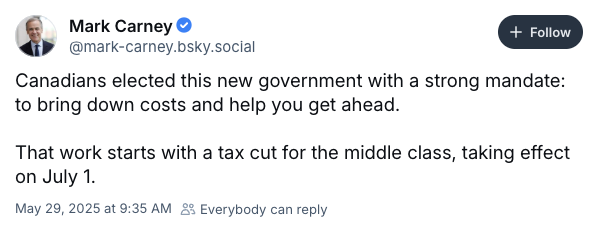
    Scared yet?  We’re just getting started.  Back on Thursday our new Prime Minister was seen to tweet:

    In other words, this government seems determined to continue in the tradition of both the former government – and the opposition parties for that matter – in framing the country’s ills as problems of costs to be solved by tax cuts and giveaways rather than problems of growth and the institutional investments required to generate it.  This way lies Peronism and perpetual stagnation. 

    And this is from our allegedly “serious” party.

    So, takeaway number one.  Universities need to throw away EVERYTHING in their playbooks for Government Relations.  Selling yourself as “the future” to a government that is desperately trying to reverse our economy into the 1960s is pointless.  This government and this Prime Minster Do. Not. Care.   Until they do, arguing for universities as “crucial” investments is a waste of time.  The real fight is over the shape of the Canadian economy.

    On to a more abstract point about budgeting.  One of the reasons we aren’t getting a budget before fall, despite the government just having been elected with a pretty detailed budget-ready manifesto and the Department of Finance being perfectly capable of putting together a set of Main Estimates for the House of Commons (as it showed on Thursday), is that Carney is trying to introduce a new set of rules with respect to public budgeting.  He spent part of this week insisting that he would balance the “operating budget” within three years, which sparked a lot of incredulity given that i) the economy is about to be in the tank and ii) the Liberals have ring-fenced most of the federal budget by saying they won’t touch transfers to provinces or transfers to institutions.  In theory, that means very significant cuts to program spending.  Like, say, research budgets.

    Except: there is currently no such thing as an “operating budget”.  What Carney wants to do is to exempt from the budget balance requirement anything that can be seen as “capital investment”, which means basically that the main game in Ottawa over the next few years is going to be how to get your favourite piece of spending classed as “capital” instead of “operating”.  And that’s a live issue because the definition the Liberals touted in the election campaign, to wit…

    …anything that builds an asset, held directly on the government’s own balance sheet, a company’s or another order of government’s.  This will include direct investments the government makes in machinery, equipment, land and buildings, as well as new incentives that support the formation of private capital (e.g. patents, plan and technology) or which meaningful raise private sector productivity.

    …is so loose you could drive a truck through it.  Will CFI spending count as capital?  Probably, but not necessarily since universities (in most provinces anyway) are neither a government nor a company.  Will tri-council spending?  Probably not, but that’s not going to stop folks claiming it supports capital formation/raises productivity, so who knows?  So, takeaway number two: get used to arguing distinctions between capital and operating because this might be the only place the sector gets traction in the next little while.

    A final point of importance is something that is not exactly new but has been given fresh salience by being in the Throne Speech, and that is the government’s commitment to limit temporary immigration – that is Temporary Foreign Workers (TFWs) plus international students – to below five percent of the population by 2027.  Or, to put it another way: every extra TFW is one international student less.  What the government has done here is set up a zero-sum game between institutions of higher education and people like the manager of the Kincardine Tim Horton’s whose business model simply cannot work if they are not allowed to employ foreign nationals at below-market rates. 

    This, my friends, is the fight post-secondary education needs to pick and needs to win.  It won’t be easy, because the captains of Canadian industry are largely clueless about competing on anything other than price, meaning low-wage labour is pretty dear to their hearts and they will fight hard for TFWs.  But it is the dilemma this country faces in a nutshell: should we use our scarce temporary immigration spots to make things cheaper in the short-term?  Or should we use them to develop a skilled workforce and build our scientific and technological talent base for the long term? 

    So, I know this won’t come easy to institutions but: screw Bay Street.  Light the torches.  Find the pitchforks.  Pick up anything you have handy and smash the windows of your local Tim Horton’s.  Fight for international students and against TFWs.  This is an existential contest: it decides whether Canada is going to be a country that gets wealthier based on investments in skills, education and science, or a country that bathes in mediocrity because we go mental if the price of a cruller goes up twenty-five cents. 

    And if the sector ducks this fight because direct confrontation with business is icky and makes some Board members uncomfortable?  Well, then the sector deserves everything it gets.  That’s the third, and most important takeaway of the last week.

    Source link

  • Federal Court Orders Reinstatement of Southern Education Foundation Grant After DEI Controversy

    Federal Court Orders Reinstatement of Southern Education Foundation Grant After DEI Controversy

    Raymond PierceThe Southern Education Foundation has secured a significant legal victory in its fight against the U.S. Department of Education, with a federal judge ordering the reinstatement of a key grant that was terminated earlier this year over allegations of illegal diversity, equity, and inclusion practices.

    On May 21, 2025, a judge in the U.S. District Court for the District of Columbia granted SEF’s motion for preliminary injunction, ordering the Department of Education to restore the organization’s Equity Assistance Center-South grant and reimburse all outstanding expenses. The grant, which had been terminated on February 13, 2025, enables SEF to provide technical assistance to public school districts and state agencies across 11 Southern states to help them comply with federal civil rights law.

    The court’s ruling was particularly pointed in its criticism of the Education Department’s decision to terminate the grant. 

    “In view of the history of race in America and the mission of SEF since the Civil War, the audacity of terminating its grants based on ‘DEI’ concerns is truly breathtaking,” the judge wrote in the opinion.

    The Southern Education Foundation, which has operated for more than 150 years with a mission to advance educational opportunities for Black students in the South, traces its origins to the late 1800s when it supported education for individuals recently emancipated from enslavement. The organization’s Equity Assistance Center represents a continuation of work that began with the original Desegregation Assistance Centers.

    “We are pleased with the Department of Education’s compliance with the court order by reinstating our grant,” said SEF President and CEO Raymond Pierce. “With the grant reinstated, SEF can move forward with developing the assistance needed to free school districts from policies and practices that remain from the dark era of lawful segregation which continue to hinder equal education opportunity for far too many children.”

    The preliminary injunction provides temporary relief while the case proceeds through the courts. The judge found that SEF was likely to succeed on the merits of its claim that the Department violated federal law in terminating the grant. However, the reinstatement is not yet permanent, pending the outcome of the full legal proceedings.

    The case highlights ongoing tensions around diversity, equity, and inclusion initiatives in education, particularly as they relate to organizations with deep historical roots in civil rights work. The Southern Education Foundation’s century-and-a-half commitment to educational equity predates modern DEI terminology by decades, making the Department’s allegations particularly contentious.

    The EAC-South serves a critical function in the region, providing technical assistance to help school districts navigate complex federal civil rights requirements. This support is particularly vital in states with histories of legal segregation, where legacy policies and practices can continue to create barriers to equal educational opportunity.

    The reinstatement allows SEF to resume its work immediately, though the organization will be watching closely as the legal case progresses. The preliminary nature of the court’s order means that while SEF can continue operating the program, the long-term resolution of the dispute remains uncertain.

    The case represents a broader debate about the role of equity-focused programming in education and the extent to which federal agencies can regulate or restrict such work. For the Southern Education Foundation, the stakes extend beyond a single grant to encompass the organization’s fundamental mission and its ability to continue serving communities that have historically faced educational inequities.

    Source link

  • Why Small Colleges Matter—Now More Than Ever – Edu Alliance Journal

    Why Small Colleges Matter—Now More Than Ever – Edu Alliance Journal

    June 2, 2025, by Dean Hoke: In the ongoing debate about the future of higher education, small colleges are often overlooked—yet they are indispensable. On May 21st, Higher Education Digest published my article, Small Colleges Are Essential to American Higher Education,” in which I make the case for why these institutions remain vital to our national educational fabric.

    Small colleges may not grab headlines, but they provide transformative experiences, especially for first-generation students, rural communities, and those seeking a deeply personal education. As financial pressures mount and demographic shifts continue, it’s easy to underestimate the impact of these campuses—but doing so comes at a cost. These schools are not only educators; they are regional economic engines, community partners, and laboratories for innovation.

    In the article, I outline key reasons why we need to support and strengthen small colleges, including their unique role in economic development, workforce provider, and civic engagement. I also explore the consequences of neglecting this sector and what we can do about it.

    I hope you’ll take a few minutes to read the whole piece and share it with your colleagues and networks. Read the article here.

    As always, I welcome your thoughts and reflections.


    Dean Hoke is Managing Partner of Edu Alliance Group, a higher education consultancy. He formerly served as President/CEO of the American Association of University Administrators (AAUA). With decades of experience in higher education leadership, consulting, and institutional strategy, he brings a wealth of knowledge on small colleges’ challenges and opportunities. Dean is the Executive Producer and co-host for the podcast series Small College America. 

    Source link