It’s a thankless job being a university governor at the best of times.
The structures and hierarchies – established over decades, even centuries – feel impenetrable.
You’re overwhelmed with papers and reading, never completely sure what’s going on at meetings.
Statutes and ordinances, rules and regulations, sub-committees and working groups. And all this you’re doing for free?
But during precarious times for the sector, the job gets even harder. Income lags further behind expenditure. The funding model seems loaded against you.
Doubt sets in. Have you really been holding institutional managers robustly to account? Are those course closures and staff redundancies really unavoidable?
Behind the seens
Governing bodies are the highest authorities in most institutions. Structures vary from one university to the next, as does the language of governance.
But in England, all boards are legally accountable to the sector regulator, the Office for Students, and hold significant powers, up to and including the authority to remove the vice chancellor if they so choose.
However, governing bodies remain a reticent and mostly unseen grouping. Students and staff may occasionally glimpse members at award ceremonies or public events, but closer forms of engagement tend to be discouraged (or carefully managed).
On policies that reshaped the sector in recent decades, like the 2012 fee rise, governors had little to say. During Covid, one commentator was moved to ask if anyone had seen the governing body.
Another had previously dismissed governors as “a small cadre talking amongst themselves.” Until a media exposé in 2018, almost all UK vice chancellors were members of the sub-committee that made recommendations on their own pay.
A 2019 investigation found “significant and systemic” failings in one governing body.
Yet many individual governors continue to invest substantial time and effort into their never-more-important role – lay members can bring vital external expertise to a sector that has too often been inward-looking and naïve, and staff and student members can help institutional managers see the campus from a ground-level perspective.
Last year, the Council for the Defence of British Universities (CDBU) conducted interviews with current or former governors at over forty English universities.
While most reported enjoying the opportunity to learn how universities operate, the same issues arose time and time again:
Membership was demographically and ideologically narrow, resulting in “business realist” discourses that privileged the university’s finance and estates over its educational purpose
Chairs were too close to senior managers to bring meaningful “challenge”;
Cliques had emerged, leading to some members’ views carrying more weight than others;
Power dynamics were problematic;
Meetings of the main board sometimes served as rubber-stamping exercises for decisions already taken;
Processes were reported to be opaque, with few governors understanding how the agenda was set, or knowing how to have an item added.
More worryingly, as OfS has increased the burden of regulatory and legal compliance, so governing bodies appear to have become more ideologically compliant. The logic of the market goes unchallenged, and the whims of policy-makers and the sector regulator courteously indulged.
Surprisingly, this critique emerged from lay members as strongly as from elected staff and student governors.
Relevant, useable and inclusive
Now the Council for the Defence of British Universities (CDBU) has launched a consultation for its new Code of Ethical University Governance. The sector already has a Higher Education Code of Governance, authored by the Committee of University Chairs (CUC Code) – the new Code supplements this, while presenting a vision of university governance that is more relevant, more useable and more inclusive.
Practical advice is offered to all members on what to expect from governance, how to navigate complex organisation structures, and – most crucially – how to impact decision-making processes.
The consultation is necessary so that the Code can be a co-produced document, capturing as many perspectives as possible. So please consider completing this short survey if you’re a current or former governor, a student, a university employee, someone with other connections to the higher education sector, or someone with no connections at all to the higher education sector.
So far, governing bodies have mostly avoided using their potentially formidable powers to intervene as the sector has been politicised and defunded. Over 10,000 campus jobs are currently at risk, and 40 per cent of universities face budget deficits.
But the aim of the Code is not to look backwards, let alone to apportion blame. It is to help give future generations of university governors the confidence and wherewithal to bring genuine, meaningful challenge.
At a time when higher education needs urgently to reclaim its status as a prized public asset, governing bodies have a duty to surpass the Nolan principles, and operate to the very highest standards.
The CDBU’s Code of Ethical University Governance may be the first step towards nudging governors beyond compliance, and empowering them to speak out. The long-term goal is for governing bodies to see their role as standing up for communities of students and staff, and for the value of higher education to everyone.
The draft Code can be found here, and the consultation here.
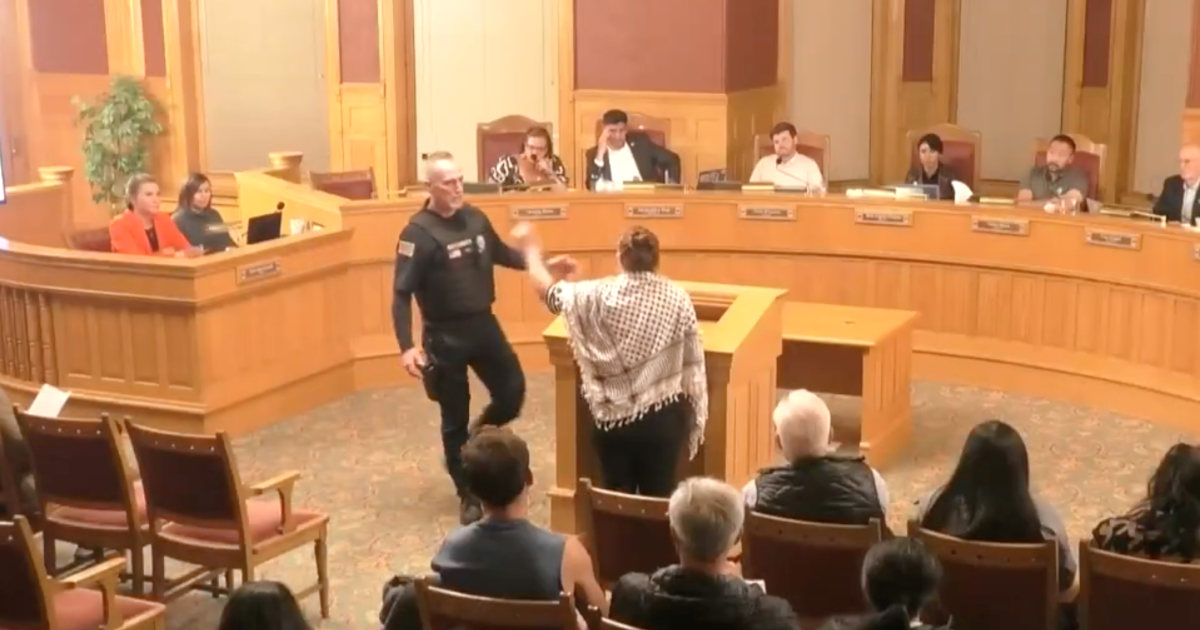
This month marks one year since Salt Lake City clocked possibly the shortest public comment in city council history when police removed activist Jenna Martin after only 20 seconds of speaking that began, “What the hell is wrong with you?”
Martin, who was wearing a keffiyeh pinned in the front like a shawl, then accused Mayor Erin Mendenhall of having police arrest local pro-Palestinian activist Michael Valentine on multiple occasions for “the most bullshit reasons.”
The council promptly ejected Martin, who could hardly be described as causing any type of disturbance given that she only had the floor for 20 seconds and her comments were entirely relevant to matters of public concern. But apparently, the council did not like people cursing in front of the mayor.
On Aug. 14, 2024, FIRE wrote the council, explaining that the First Amendment protects the public’s right to comment on matters related to the city and its leaders, even if the commentary is less than “respectful,” so long as the speaker is not disrupting the meeting. Pointed criticism is not the same as disruption.
Mandating respectful discourse is an example of unconstitutional viewpoint discrimination because the city is sure to enforce the rule only against criticism, not praise. It’s also vague because what qualifies as “respectful” is undefined, constitutes a matter of opinion, and falls to the complete discretion of the same elected officials who are often the subject of that very criticism. The law recognizes that you cannot have the fox guarding the hen house.
Although not pertinent to Martin’s case, FIRE also warned the council that its unqualified ban on “discriminatory” language is unconstitutional for the same reasons. After FIRE sent a second letter on Oct. 7, a city attorney acknowledged the council had no basis to eject Martin, confirmed the policy had been revised to comply with the First Amendment, and noted that the city implemented “First Amendment training after receiving FIRE’s notice and plans to continue to reinforce that training.”
Instead of vague and viewpoint-discriminatory categorical prohibitions on speech, the policy now encourages speakers to “avoid … intimidating or discriminatory language,” “profanity,” “threats,” and “personal attacks.” The policy also now explicitly acknowledges that speakers have free speech rights that the council cannot infringe upon:
The Council respects constitutional rights to free speech. It recognizes that some comments may be legally permissible under the U.S. and Utah Constitutions or other federal and state laws. However, the Council reserves the right to address behavior that creates disruption or safety risk or constitutes unprotected speech (such as true threats).
Salt Lake City’s previous decorum policy highlights a common misconception among elected officials across the country regarding the contours of the First Amendment. While they may encourage the public to be respectful, they absolutely cannot censor or eject a speaker on these grounds. The mere use of profanity does not justify censorship either. FIRE will watch to ensure the city actually enforces the new policy in line with the First Amendment.
Salt Lake City Council meetings are, at minimum, limited public forums. The U.S. Supreme Court has held that in limited public forums, towns can restrict speech only in a reasonable and viewpoint-neutral manner. For instance, Salt Lake City can decide when the public may speak, and may require comments to be relevant to city affairs — but it cannot cut off the public simply for using profanity or accusing the mayor of an abuse of power.
The First Amendment protects not just the content of speech but also the tone and intensity of that speech — an essential part of how people communicate opinions and ideas.
If Martin can’t hold the mayor accountable for a perceived abuse of authority at a city meeting, where can she voice her grievances? City meetings are supposed to encourage civic engagement and inform the public. Yet FIRE has had to repeatedly hold local government officials accountable for censoring public comments beyond constitutional bounds. Fortunately, we’ve recently secured a couple victories on that front.
We commend Salt Lake City for taking corrective action and realizing that salty speech is not a threat to democracy, but a sign of its good health.
FIRE defends the individual rights of all Americans to free speech and free thought — no matter their views. FIRE’s proven approach to advocacy has vindicated the rights of thousands of Americans through targeted media campaigns, correspondence with officials, open records requests, litigation, and other advocacy tactics. If you think your rights have been violated, submit your case to FIRE today.
Every few years, they pack up their lives, move across states—or oceans—and start over. New schools, new systems, new expectations.
For military learners, this isn’t a study abroad adventure or a career move; it’s a way of life. Yet while their reality is defined by mobility, too many of our systems in higher education still assume stability.
Military learners make up about five percent of the undergraduate population—roughly 820,000 students nationwide. But they aren’t a monolith. They’re active-duty service members juggling college coursework with operational demands like exercises, surprise inspections, and even deployments. They’re veterans navigating civilian life, often in isolation, and often while supporting a family. They’re National Guard and reserve members wearing multiple hats that opposing forces demand they change on command. And they’re spouses and dependents navigating new colleges, mid-degree or mid-semester, again and again, with each relocation.
Their stories are different, but the friction points are the same: staying on track academically while managing a life defined by mobility.
Unlike traditional students, military learners don’t choose when or where they go—on orders, deployments, or other permanent or temporary service-related relocations. And each move can derail progress. Credits don’t transfer, residency rules reset, tuition costs spike, and financial aid doesn’t always follow the same logic. These students bring resilience, discipline, and lived experience into our classrooms, but higher education hasn’t fully adjusted to meet them where they are.
The transfer tangle and financial aid maze
One of the biggest hurdles is transfer credit. While articulation agreements—formal arrangements for transferring credits between institutions—do exist, they often don’t reflect the realities of military learners, especially when it comes to military training or nontraditional learning experiences. Some accumulate credits from multiple institutions, only to be told their new school won’t accept them.
The result? Lost time, lost money, and unnecessary frustration.
Add to that the patchwork of residency rules. Even when learners are stationed in a state under military orders, they may not qualify for in-state tuition. While states like Virginia and Florida have implemented inclusive policies, others continue to lag, turning mobility into a penalty as well as a reality.
Financial aid adds another layer of complexity. Programs like tuition assistance and the GI Bill are essential, but they often fall short. Tuition assistance differs by branch and may not cover full tuition at private or out-of-state schools. The Post-9/11 GI Bill is a powerful benefit, but its eligibility rules and transfer limitations don’t always align with the unpredictable, stop-and-go nature of military life.
What states and institutions are doing right
There are promising models to build on. In Ohio, Military Transfer Assurance Guides standardize how public institutions accept military training as credit. Texas and New York offer additional tuition support for veterans, while Florida helps cover housing and textbook costs when GI Bill payments lapse between terms.
That’s not charity—that’s what equity looks like. When institutions commit, military learners succeed.
The power and promise of credit for prior learning
Credit for prior learning (CPL) may be one of the most powerful—and underused—tools to support military learners, who bring extensive work and life experience to their postsecondary studies that can be translated into credit.
CPL recognizes that learning happens outside the classroom: through military training, job experience, CLEP exams, or portfolio assessments. When applied effectively, it can shorten the path to graduation, reduce student debt, and boost confidence for learners who’ve already mastered real-world skills.
Tools like ACE’s Military Guide help institutions apply CPL consistently and responsibly. But here’s the problem: CPL isn’t consistently communicated, awarded, or valued. In some cases, it’s limited to elective credits rather than core degree requirements, undermining its purpose.
CPL isn’t just about transfer and awarding credit; it’s also about unlocking opportunity. Validated learning can, and should, play a role in admissions, satisfying prerequisites, waiving introductory or duplicative coursework, and advising military learners on the path that is best for them. When institutions fully embrace the broader utility of CPL, they open more doors for military learners to engage meaningfully with higher education from the very start of their journeys.
To change that, institutions need more than buy-in—they need system-wide strategies. CPL should be central to transfer reform conversations, especially when supporting learners who are older, more experienced, and balancing school with work or caregiving.
The role of advising and ecosystem support
Too often, military learners don’t get the tailored advice they need. On-base education centers can be vital entry points, but they need stronger bridges to campus advising teams who understand military culture, CPL, and transfer systems. Institutions sometimes resist broader CPL use over concerns about revenue loss or academic rigor, while students are left unaware of opportunities due to poor communication or advising gaps. Aligning on-base education centers with well-trained campus advisors is one step forward; improving internal communication across departments is another.
Student Veterans of America’s Success Hub, which includes the SVA Advising Center, supports all service members, veterans, and their families in making informed decisions about higher education opportunities and meaningful careers through the use of AI, success coaches, and expertise where the military, veterans, and higher education intersect.
Organizations like NACADA are doing the work to improve professional development in this area, but we need deeper, sustained collaboration. Cross-sector partnerships between colleges, employers, and the U.S. Department of Defense are where real impact happens.
Military learners aren’t asking for special treatment. They ask for systems to make sense for the lives they actually lead. With the right policy changes, institutional commitments, and collaborative frameworks, we can turn mobility from a barrier into a bridge.
But we also need better data, better pathways, and a better understanding of what success looks like for these students—not just access, but degree completion and career readiness. Military learners aren’t an exception. They are the future of an inclusive, prepared, and resilient workforce.
It’s time higher education met these students where they are because they’re already leading the way.
If you have any questions or comments about this blog post, please contact us.
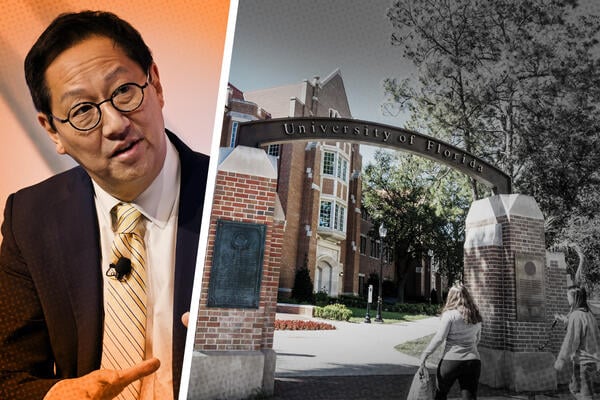
Despite mounting conservative criticism over Santa Ono’s stance on diversity, equity and inclusion, the University of Florida Board of Trustees on Tuesday overwhelmingly voted to hire the former University of Michigan president as its next leader.
Ono, who held three prior presidencies, was named the sole finalist for the top job at Florida in early May. As a traditional academic, Ono marks a break from the norm at Florida’s public universities, where the emphasis in the past few years has been on hiring former Republican lawmakers and others with political connections.
But his candidacy faced heavy criticism from conservative critics such as anti-DEI activist Chris Rufo, Heritage Foundation president Kevin Roberts and several Florida lawmakers, including Republican U.S. senator Rick Scott, who called for an investigation into the search that yielded Ono due to his past remarks on DEI. Some critics have claimed that Ono is a radical liberal academic who made an about-face on DEI due to careerist ambitions.
Ono, who made more than $1.3 million a year at Michigan, where he was under contract until 2032 before he stepped down to pursue the Florida job, could earn up to $3 million a year at UF, according to the salary range.
Ono’s Evolution on DEI
Rufo has led the charge among Ono’s conservative critics.
“Woke is threatening a return to power,” Rufo declared in an opinion piece in the conservative City Journal in which he argued that Ono’s noted past support of DEI policies was disqualifying.
(Although Rufo argued that Ono’s presidency would threaten to undo changes to education in the state driven by Republican Ron DeSantis, the governor has defended the pick.)
Prior to Tuesday’s meeting, Rufo circulated various videos of Ono speaking in favor of DEI policies and against systemic racism. While those videos gained traction on social media, the posts did not sway the UF Board of Trustees, which voted unanimously to hire Ono.
But Ono’s changing stances on DEI did hang over much of Tuesday’s meeting, popping up in multiple questions where Ono discussed his evolution on the issue and noted that he dismantled DEI initiatives at the University of Michigan after his perspective began to shift in late 2023.
“I did not come to bring DEI back; I came to make sure it never returns,” Ono told UF trustees.
Ono argued that while he initially agreed with the aims of DEI programs, while president of the University of Michigan he came to see that such initiatives were divisive and diverted resources from student success, leading to his decision to shutter the DEI office there earlier this year.
He argued that “large DEI bureaucracies” stifle open dialogue and erode trust on campus and that “it became clear to me through experience, not theory, that something had gone wrong.”
Ono sought to distance himself from his prior statements, arguing that what matters “is not what I said two to six years ago,” as depicted in the videos, but rather what he has done in the last 18 months, which includes winding down the DEI office at Michigan before he resigned last month. Although the move came after increased criticism of DEI spending at Michigan, Ono cast it as a move that grew out of conversations he began having in late 2023 in which he questioned the efficacy of such initiatives.
He also stressed again how his vision aligns with the goals of UF and DeSantis.
“I understand and support what Florida’s vision for higher education represents: a decisive move away from ideological bias and activist-driven culture that has come to define too many colleges and universities in this country and abroad,” Ono said. “The goal is not to replace one orthodoxy with another. It is to restore balance, to protect the pursuit of truth and create a university environment where all students can thrive, regardless of their viewpoint. Florida is showing the nation that it’s possible to elevate academic excellence without ideological indoctrination.”
While issues like faculty recruiting and retention, post-tenure review, college athletics, and other aspects of running the university were addressed in an almost three-hour public interview, much of that time, and the board’s questions, centered on DEI and campus protests.
For instance, Ono was asked multiple times about concerns of rising antisemitism on campus.
He responded that antisemitism is “a persistent threat, especially on college campuses” that “too often hides behind the language of political critique” and has been “normalized in the name of activism.” Ono also emphasized a commitment to keeping Jewish students safe at UF.
Asked about his decision to allow a pro-Palestinian encampment to remain at Michigan for 30 days, Ono said that the university did not want to escalate the situation and create an atmosphere of unrest close to commencement. He added that he spoke with Jewish students who were worried about how removing the encampment might disrupt commencement. Ono also said that Michigan subsequently updated its time, place and manner policies to prevent future encampment protests.
A Looming Battle?
Although the UF Board of Trustees approved the Ono hire, it’s not a done deal, as the Florida Board of Governors has the final say.
That board will meet in either mid-June or at a special meeting to consider Ono. That could provide another opportunity for Ono’s conservative critics to derail the hire if the Board of Governors comes out against the selection.
Florida representative Greg Steube, a Republican, immediately called for the board to block the hire.
“The @UF Board of Trustees has made a grave mistake. Today, Dr. Ono gave it his best ‘college try’ walking back his woke past, claiming he’s now ‘evolved.’ But I’m not sold. This role is too important to gamble on convenient conversions,” Steube wrote on social media Tuesday.
At least one member of the Board of Governors noted over the weekend that concerns about Ono will be addressed.
“The UF Board of Trustees is responsible for vetting the issues raised by concerned stakeholders, which their fiduciary obligations require they do, and which they need to do before making a decision. If/when the BOT acts, it will come to the Board of Governors, where the Board of Governors must agree to confirm the candidate for President of UF. The BOG takes this responsibility seriously, and issues will likely be fully reviewed and discussed publicly,” FLBOG member Alan Levine wrote in a Sunday social media post before Ono was hired.
While the Board of Governors does have the power to derail Ono’s selection, members could have done so earlier—and behind closed doors—if they had concerns. Under a policy established last year, the Board of Governors must sign off on a list of presidential finalists identified by search committees before those candidates can be considered by individual boards. So the board could’ve wielded that veto power of sorts to remove Ono before he was named as a sole finalist.
If confirmed, Ono will replace interim president Kent Fuchs, who came out of retirement after then-president Ben Sasse stepped down last July, weeks before a spending scandal emerged.
Elsewhere in the state, the University of West Florida tapped former Republican lawmaker and current Florida commissioner of education Manny Diaz Jr. as its interim president in a process some trustees argued was rushed and lacked transparency. As the fifth president hired to lead a public university in Florida this year (including those serving in an interim capacity), Ono is the only one who is not either a former Republican lawmaker or connected to the governor’s office.
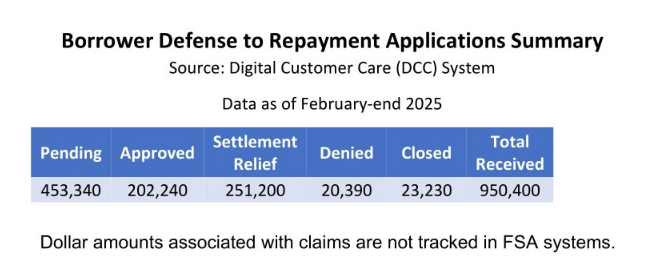
The Higher Education Inquirer has received information today from the US Department of Education about Borrower Defense to Repayment claims. Here are the results from ED FOIA 25-02047-F.
The opportunity to do something new within a sector that is challenged by legacy, tradition and archaic systems – and to drive real change. And to transform young people’s lives, of course…
Best work trip/Worst work trip?
Difficult, as there have been so many. Corny as it sounds, perhaps my best trip is the first trip I ever made – to Cyprus, the British Council Clearing Fair in August 2007. I had just started as Europe officer at London Metropolitan University, and it was my first time ever to travel for work. I can still remember walking into my poolside hotel room in the Hilton Park and pinching myself. I couldn’t believe my luck!
I met some great people that trip (again, poolside, and there may have been some cocktails involved) but mostly, it was a first realisation of how the work we do within this industry really matters. So I guess it was a trip of great promise – and in hindsight, one that cemented my subsequent career, and passion for what I do.
Worst – I could talk about being tear-gassed in Istanbul, stuck in a riot in the West Bank, ducking underneath the passenger seat of a car at a traffic light in Karachi for fear of standing out (as a blonde female) and being mugged, losing my luggage for a total of three months on a simple work trip to Berlin, being pushed against a wall by a frisky, groping male at a conference party who mistook my smile and friendliness for consent… but ultimately we are the sum of all our experiences and even the not-so-good ones make for good reflections and stories to tell.
If you could learn a language instantly, which would you pick and why?
Spanish. I am now at day 1,565 of Duolingo and still struggling. My husband and I got stuck in Spain during the pandemic and randomly ended up buying a house there, so we have been going back and forth a lot ever since. It would make my life a lot easier if I could instantly become fluent.
What makes you get up in the morning?
Birds singing outside my window. An over-enthusiastic dog named Ted Hilton. The sense of duty to complete my Spanish Duolingo lesson (see above).
Champion/cheerleader which we should all follow and why?
So many! In all honesty, I have met so many great people over the years, along the way – some of whom are now very close friends. I think all of us are doing our part in making a difference. But if I were to give one shoutout – one that’s only fitting considering this is The PIE – it’s Amy Baker. From humble beginnings around a kitchen table to what The PIE has grown into now, all with such grace, humility, great insight and kindness, and by building a kick-a*se team.
Best international ed conference and why
I loved the Innovative Universities Summit hosted in Korea by the New Challenge Foundation last year. Not only did it bring together some fascinating, passionate global leaders in the international higher education innovation space, the format was brilliant – intimate, lots of space for meaningful dialogue, and extra-curricular activities such as Makgeolli making and rainforest walks on the island of Jeju. It was possibly also the only four-day conference I ever attended where they gave us a weekend off in the middle to do our own thing. How civilised!
Worst conference food/beverage experience
I must admit, at any big conference such as NAFSA or ICEF or EAIE, I tend to sneak out for lunch. Not only do I despise the queues and the mediocre buffets, but I also like to take that moment in the day to NOT make small talk and find a nice place for lunch to enjoy a meal and glass of wine in silence.
Book or podcast recommendation for others in the sector?
I don’t really peruse any sector-related content, but I can recommend anyone to stick a copy of Alan Watts’ book of quotes There is never anything but the present in their travel bag. A reminder of how we can all benefit to pause and ground ourselves a little bit more in the here and now rather than rushing off to the next thing and find joy in the small things around us. To quote: “Instant coffee is a well-deserved punishment for being in a hurry to reach the future”. Amen.
Describe a project or initiative you’re currently working on that excites you
It’ll have to be The School of Innovation, an aspiring new university-in-the-making that I am currently consulting for as fractional co-CEO. An ambitious project aiming to launch with a first pilot cohort in the fall of 2025, TSOI is building a new university solely focused on the study, advancement and application of innovation.
The term ‘observations’ comes from the days trained weather observers recorded standard meteorological information. Now observations from radiosondes — attached to weather balloons rising to the upper stratosphere — collect data on temperature, humidity, air pressure and wind.
Automated surface-observing systems on land provide real-time data and satellites gather imagery and more data which is fed into supercomputers to provide forecasts.
So what are the benefits of accurate weather forecasts?
Staying prepared for the worst
Evan Thompson, the director of the Meteorological Service in Jamaica, has seen his island hit by extreme weather events as seasonal hurricanes have become more severe.
Thompson said that people need to know how to protect themselves from extreme weather such as tropical storms and hurricanes.
“Whether it means moving to higher ground in the moment or at least ensuring you don’t take chances crossing flooded roadways that are with waters moving fast, or rivers,” he said.
Thompson wants his country to be prepared for severe weather. “More data always means better observations which in turn leads to better forecasts.”
Over the last decades, the accuracy of weather forecasting in the United States has vastly increased what is known as storm resiliency, helped airlines reroute flights, farmers to plant crops at the optimal times and power companies to deal with demand from their customers.
Climate change intensifies weather.
Elsewhere, the World Meteorological Organisation (WMO) and the World Environmental Programme (WEP) have targeted the need for more observation stations in countries across the Middle East, Africa, South America and Pacific Island states, countries which are at risk of seeing economic progress wiped out by increasing impacts of climate change.
The WMO target is for weather observation to reach the levels of countries in Europe and the United States. But it may not be citing the United States as a model in the future. Since January, the United States has been reducing its capacity to provide weather data.
The cuts come at a time when the intensity and frequency of extreme weather events have increased due to climate change linked to human induced warming according to the Intergovernmental Panel on Climate Change report of August 2021. However, the Trump administration has taken a decision to eliminate the term “climate change” from federal websites.
Especially dependent on accurate forecasts are the construction industry, agriculture, power companies and aviation.
Fabio Venuti of the European Centre for Medium-Range Weather Forecasts inputs weather data into a supercomputer. “Global weather forecasting like ours can assimilate data then produce high resolution local forecasts for each country,” he said. “They can be more prepared.”
Information farmers can rely on
Fabio said that the ability to forecast rain and drought can help farmers and governments plan food crops. And it can help public health officials prepare for and lessen the spread of diseases, such as malaria, that are affected by environmental factors as insects transported by winds.
Thompson in Jamaica said that the policies and plans that governments take are affected by weather forecasting. “For example, building codes can be adjusted because we recognise more severe downpours in areas that don’t normally have flooding,” he said.
In the United States, the National Oceanic and Atmospheric Administration (NOAA), the parent agency of the National Weather Service, is tasked with daily weather forecasts, severe storm warnings and climate monitoring. In 2025 NOAA has already lost 800 employees and a further 500 have been offered buyouts.
According to the former heads of the National Weather Service, the proposed cuts of close to 30% for NOAA would essentially eliminate NOAA’s research function for weather.
Inger Anderson, executive director of the UN Environment Programme, said that accurate weather forecasting pays off in many ways — lives saved, improved disaster management, protecting livelihoods, biodiversity, food security, water supply and economic growth.
Besides cutting staffing, the Trump administration has also cut back on funds used to record tidal predictions and weather disasters such as heat waves, hurricanes, tornados, floods and wildfires. The U.S. National Centers for Environmental Information, the agency that collates historical meteorological records, will cease to update its Billion-Dollar Weather and Climate Disasters database beyond 2024. Previous records will be archived.
Jeff Masters, a meteorologist for Yale Climate Connections says the database is the “gold standard” used to evaluate the costs of extreme weather. “It’s a major loss, since it comes at a time when we need to better understand how much climate change is increasing disaster losses,” he said.
Weather forecasting can tell us more than whether to carry an umbrella, when to plan a picnic or plant flowers in the gardens. Accurate forecasting can save your life, your home and your livelihood.
Questions to consider:
1. How do you use weather forecasts?
2. Should politicians work more closely with scientists?
US higher education is exposed both to presidential and to state interference. Government powers to intervene in US HE reside in presidential control of federal funding, which may come with conditions. Trump cannot simply shut down the Department of Education by executive order but it seems he can direct that the Department’s grant- and loan-giving functions are taken on by another government department.
A letter to Harvard dated 11 April signed on behalf of the Department of Education and other federal agencies asserted that the United States had ‘invested in Harvard University’s operations’ because of ‘the value to the country’ of its work, but warned that ‘an investment is not an entitlement.’ This letter, if accepted, was to constitute ‘an agreement in principle’. Governance was to be ‘exclusively’ in the hands of those ‘tenured professors’ and ‘senior leadership’ who were ‘committed to the ‘changes indicated in this letter’. Its ‘hiring and related data’ and its student ‘admissions data’ were to be ‘shared with the federal Government’. International students ‘hostile to American values’ were not to be admitted and those already admitted were to be reported to federal authorities. Policies on diversity, equity and inclusion were to end and student protest restricted.
Harvard and other Ivy League Universities were indignant. Harvard in particular rode the headlines for some days, objecting to the Government demand that it immediately agree:
to implement the Trump administration’s demands to overhaul the University’s governance and leadership, academic programs, admissions system, hiring process, and discipline system—with the promise of more demands to come
and thus ‘overtly seek to impose on Harvard University political views and policy preferences advanced by the Trump administration and commit the University to punishing disfavored speech’. There were reports that US academics were seeking to escape to employment in Canada, the UK or Europe.
American institutions of higher learning have in common the essential freedom to determine, on academic grounds, whom to admit and what is taught, how, and by whom
and that such ‘American institutions of higher learning’ were ‘essential to American prosperity’.
It stressed a ‘longstanding collaboration between universities such as Harvard and the federal government dating back to the Second World War’. It pointed to Harvard’s success in using federal funding to achieving significant research outcomes. The recent ‘broad attack of Government’ on ‘universities across America’, not only on Harvard and the other Ivy League Universities listed, had affected the ‘critical funding partnerships’ that made this invaluable research possible.
This case was being brought because, it was argued, the Government had been using ‘the withholding of federal funding as leverage to gain control of academic decision making at Harvard’. Harvard cited the Government’s letter of 11 April as demanding governance reform and a ‘third-party’ audit ‘of the viewpoints of Harvard’s student body, faculty, and staff’, followed by the hiring of new Faculty and admission of students whose views were satisfactory to the Government. It had asserted that teaching should be ‘to the Government’s satisfaction as determined in the Government’s sole discretion’ and to that end Harvard should ‘terminate or reform its academic “programs” to the Government’s liking’. The Government had since ‘launched multiple investigations and other actions against Harvard’.
The Government had ‘within hours of the Freeze Order ‘ended ‘$2.2 billion in multiyear grants and $60M in multiyear contract value to Harvard University’ and Harvard began receiving ‘stop work orders’. In order to bring a case against the Government it was essential for Harvard to establish that the Government’s action constituted a breach of public law. To that end it stated that the ‘Court has jurisdiction over Harvard’s claims’ because the University did not ‘seek money damages or an order mandating specific performance of any contract’, but:
an order declaring unlawful and setting aside sweeping agency action taken in violation of Harvard’s constitutional rights under the First Amendment and its rights guaranteed by statute and regulation.
Harvard stressed that even though it is a private university its research is federally funded ‘through a grant process administered by federal agencies’. It cited Title VI of the Civil Rights Act of 1964 which requires ‘a detailed and mandatory statutory framework’ of procedures to be followed. Harvard had its own procedures, added to or created in August, September and November 2024. Specifically in March 2025, Harvard released updated “Frequently Asked Questions” clarifying that both Jewish and Israeli identities are covered by the University’s Non-Discrimination Policy.
Harvard explained that it had attempted ‘collaboration’ in the weeks following the government letter and the Federal Task Force’s press release announcing campus visits. It had sought to arrange a meeting on the campus and that was scheduled for late April 2025, yet on April 20 it was reported that the ‘Trump administration has grown so furious with Harvard University’ that ‘it is planning to pull an additional $1 billion of the school’s funding for health research.’
Trump’s threatened sanctions concerned the future of Harvard’s funding. Harvard has endowments of c$53 billion so any threat from Trump to reduce federal funding posed a limited risk to its future. However he made a further proposal on 18 April to remove Harvard’s exemption from Government tax on its income, which could have hit its normal operation harder.
The US counterpart to HMRC is its Internal Revenue Service (IRS). The IRS may grant tax-exempt status to a charitable, religious, scientific or literary organization, on condition that it refrains from campaigning or seeking to modify legislation. However, the President is not permitted to direct the IRS to conduct an investigation or audit. To that extent the counterbalancing of executive, legislative and judicial powers in the US seems to be holding.
Harvard was making its challenge at a time when the balance between the executive and the judiciary in the US had come into question in a number of cases where Trump’s executive orders sought to override the courts. It claimed that ‘the Freeze Order is part of a broader effort by the Government to punish Harvard for protecting its constitutional rights. … multiple news outlets have reported that the Internal Revenue Service is considering revoking its recognition of Harvard’s tax exempt status’. Representing 86 universities, the Presidents’ Alliance has filed an Amicus brief supporting the litigation.
Harvard sought in its litigation to have the Freeze Order declared unconstitutional and also the ‘unconstitutional conditions’ sought to be imposed in the April 3 and April 11 and any action taken under it so far, also banning any future orders in the same vein. It pleaded six Counts, first a violation of the First Amendment in that the letters had targeted the ‘academic content that Harvard professors “teach students”’. Count 2 was that ‘even if the prerequisites of review under the Administrative Procedure Act were not satisfied, federal courts have the “equitable power” to “enjoin unconstitutional actions by state and federal officers.”’ Count 3 was that Title VI does not permit wholesale freezing of a recipient’s federal financial assistance. Instead, it requires that a “refusal to grant or to continue assistance” be “limited in its effect to the particular program, or part thereof, in which . . . noncompliance has been so found.” Count 4 was the Government’s failure to ‘comply with their own regulations before freezing Harvard’s federal financial assistance’. Count 5 alleged that the action had been arbitrary and capricious and Count 6 that it had been ultra vires.
At Indiana University a professor of Germanic studies was recently investigated under a state law after a student accused him of speech in support of Palestine.
Could this happen in the UK?
English higher education providers have their autonomy protected by the Higher Education and Research Act (2017)s.2 [HERA]. This legislation created the Office for Students, a non-departmental public body, whose nearest US counterpart is the Higher Learning Commission, an independent agency founded in 1895 which accredits higher education institutions. The University of Michigan, for example seeks, renewal of its accreditation from the Higher Learning Commission every ten years.
The Office for Students is both regulator and funder, and distributes Government funding to higher education providers. This may take into account ‘particular policy areas and government priorities. Yet HERA outlaws any attempt by the OfS to impose the restrictions Trump sought to impose on the universities of the USA. English higher education providers must be free:
(i) to determine the content of particular courses and the manner in which they are taught, supervised and assessed,
(ii) to determine the criteria for the selection, appointment and dismissal of academic staff and apply those criteria in particular cases, and
(iii) to determine the criteria for the admission of students and apply those criteria in particular cases.
Academic staff in England also enjoy ‘freedom within the law’:
(i) to question and test received wisdom, and
(ii) to put forward new ideas and controversial or unpopular opinions,
without placing themselves in jeopardy of losing their jobs or privileges they may have at the providers.
There is some Government oversight. In protecting ‘the institutional autonomy of English higher e providers’, the Office for Students is subject to the ‘guidance’ of the Secretary of State, though Government requirements are held off by the legislative fencing. The guidance of a higher education provider by the Office for Students:
must not relate to—
(a) particular parts of courses of study,
(b) the content of such courses,
(c) the manner in which they are taught, supervised or assessed,
(d) the criteria for the selection, appointment or dismissal of academic staff, or how they are applied, or
(e) the criteria for the admission of students, or how they are applied.
The legislation adds that:
guidance framed by reference to a particular course of study must not guide the OfS to perform a function in a way which prohibits or requires the provision of a particular course of study.
This seems to place universities safely out of reach of the kind of restrictions Trump sought to impose on Harvard and other Ivy League Universities, but the Office for Students is potentially able not only to set its Government funding levels but also affect its students’ access to loans from the Student Loans Company. That can certainly be at risk, for example in the case of the Oxford Business College, whose funding (via franchise arrangements) was blocked in April 2025 when it was found to have abused the student loan system by admitting unqualified students.(US accreditors do hold a lot of power, because universities must be accredited by a federally recognized agency in order to access federal student aid.)
Access to Government funding through the OfS requires listing by the Office for Students on its Register as an approved provider. The Office for Students did not impose its Conditions of Registration on pre-existing universities before including them in 2018 on its first Register under HERA. It simply treated them as proven acceptable providers of higher education. Each university duly publishes an account of its compliance (eg at Oxford) with the requirements which enable it to remain on the Office for Students Register. What might happen if they were found not to have done so? Short of removal from its Register the OfS has been known to impose fines, notably of more than £500,000 in the recent case of the University of Sussex when it was alleged to have failed to follow its own procedures designed to protect academic freedom.
Government oversight of the work of HE providers may overlap with or sit uneasily beside forms of ‘accreditation’ and ’qualification’. The accreditation of qualifications in the UK may be the responsibility of a number of ‘agencies’ external to HE providers, some of which are bodies offering professional qualifications. For example the Solicitors Regulation Authority keeps its own register of qualified solicitors. A university degree may not constitute a ‘qualification’ without the completion of further recognised study, some of which may be provided by the university itself, for example the Postgraduate Certificate in Education.
An area of ‘accreditation’ undergoing significant reform and expansion in the UK covers ‘skills’, including apprenticeships. Not all universities offer their own apprenticeships, though they may recognise some of those available from other providers at Levels 4 and 5. Nevertheless ‘skills’ are potentially at risk of Government intervention. At the beginning of March 2025, the House of Lords was debating whether ‘skills’ might benefit from the establishment of a ‘new executive agency’.
It was recognised that there would need to be a report from the Secretary of State ‘containing draft proposals’ for an agency, ‘to be known as “Skills England”. Ian Sollom MPobjected that that that would represent ‘a significant centralising of power in the hands of the Secretary of State, without providing proper mechanisms for parliamentary oversight or accountability.’ A ‘statutory, departmental body would have more clout’, he argued.
It looks as though some universities, at least, are safe from any initiative to interfere from above with the right to self-government and to determine what to teach and research. Harvard records a ‘revenue base’ of $65billion, with ‘federal funding ‘ as its largest source of support for research. The research income of Oxford, for example, is £778m, with commercial research income of £148m. That cannot compare with Harvard, but at least Oxford and some others will remain free to choose how to use that income for its academic purposes.
This is a modified version of an article first published by the Oxford Magazine No 477 in May 2025, republished with the permission of the editor and author.
SRHE member GR Evans is Emeritus Professor of Medieval Theology and Intellectual History in the University of Cambridge.
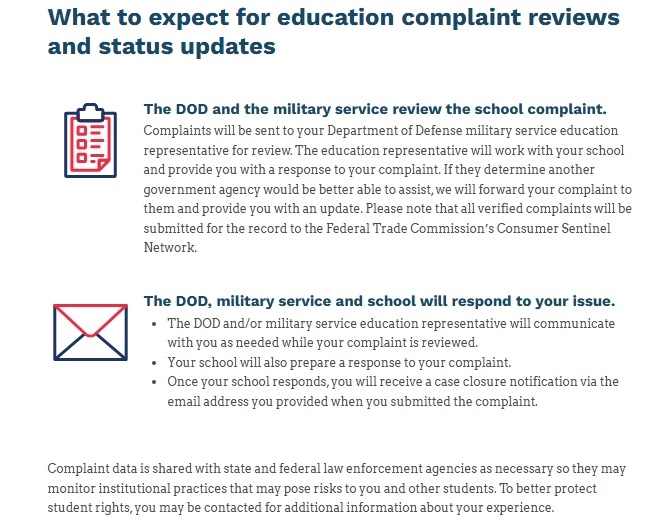
Is the US Department of Defense (DOD) actually handling complaints from service members and their spouses who are using DOD Tuition Assistance and MyTAA (the education program for spouses)? It’s difficult to tell, and it’s unlikely that they’ll tell us.
DD Form 2961 is used for servicemembers and their spouses to make complaints about schools. And it appears up to date. And on their website, DOD still claims to help consumers work with schools about their complaints.
What we do know is that DOD VOL ED and the DOD FOIA team have stonewalled us for eight years to get important information about their oversight. We also know that DOD VOL ED has allowed bad actor schools to violate DOD policies as they prey upon those who serve. Over the years we have notified a number of media outlets about these issues but few if any have shown interest.
This audio is auto-generated. Please let us know if you have feedback.
As momentum grows for registered teacher apprenticeships nationwide, advocates fear federal support for the workforce model is starting to wane.
Those concerns stem from the U.S. Department of Labor’s cancellation this month of a $12 million contract to support states and districts in rolling out their own registered educator apprenticeships. Specifically, the DOL contract funded the Educator Registered Apprenticeship Intermediary initiative, awarded to RTI International, a nonprofit research institution.
As of July 2023, DOL had funded registered apprenticeship intermediaries across industries ranging from early childhood education and healthcare to information technology and cybersecurity to accelerate the growth of apprenticeships nationwide.
It’s still unclear why DOL severed the ERA contract, and the department did not respond to a request to comment.
The workforce model has gained particular popularity among school districts and states as a way to address teacher shortages in critical areas, as it allows them to pay new educators as they work in classrooms under veteran teachers’ mentorship and earn teaching degrees or credentials.
Between 2022 and 2024, the number of participating states offering registered teacher apprenticeship programs surged from 3 to 47. On top of that, DOL data reveals the total number of teacher apprentices rose from 356 to 3,884 between fiscal years 2022 and 2025.
In a May 16 letter to U.S. Labor Secretary Lori Chavez-DeRemer, a group of universities, school districts, advocacy organizations and nonprofits called for the department to reconsider its decision to cancel the ERA contract. The letter also noted that “the growth and scale” of educator registered apprenticeship programs “would not have been possible without the support of the ERA contract,” which was awarded in July 2023.
Through the five-year contract, RTI has provided states and districts with free technical assistance to implement and design their own registered teacher apprenticeship programs. This support is also “paramount” for efforts to develop national standards for registered apprenticeships in education, the groups wrote in their letter.
“The sudden termination of this work will significantly halt meaningful progress and disrupt services that states and districts depend on to address urgent workforce needs,” the groups wrote. “We respectfully request that the Department restore the work within this administration’s priorities or identify an alternate pathway for this critical work to continue.”
Additionally, the group wrote that without the DOL funds, the quality of programs could worsen, administrative burden could grow for states and districts, and the department’s broader workforce priorities could slow down.
Supporters of registered teacher apprenticeship programs have also said the contract’s cancellation conflicts with the Trump administration’s push to establish 1 million new active apprentices. When President Donald Trump signed an executive order to “protect and strengthen” registered apprenticeships, advocates for the workforce model in education were initially optimistic.
Teacher apprenticeships are also a strong example of successfully giving local control to schools, said Amaya Garcia, director of pre-K-12 research and practice at New America, which partnered with RTI in implementing the ERA contract.
As Trump continues to call for the dismantling of the U.S. Department of Education, Garcia said, “it’s a little ironic that an administration that claims to want to bring education back in the hands of the states is pulling back on supporting states from essentially doing just that.”
The letter sent to Chavez-DeRemer said that the contract represents a bipartisan strategy to bolster the education workforce and address the “nonpartisan need for qualified educators.”
Those who signed the May 16 letter include the American Association of Colleges for Teacher Education, Deans for Impact, EdTrust, Vermont State University, the office of employer and apprenticeship services at Kentucky’s departments of labor and education, and Mississippi’s Jackson Public School District.
The cut comes at a time when the registered teacher apprenticeship model remains in its early stages, Garcia said.
“There’s still a lot for us to learn and to document about what’s actually happening in these programs and the impacts that they’re having on the communities that they’re in,” Garcia said.