Michael was terminated by Austin Peay State University in September.
csfotoimages/iStock/Getty Images
Nearly four months after he was terminated for reposting a news headline that quoted the late conservative commentator Charlie Kirk’s position on gun rights, Darren Michael has been reinstated as a professor of theater at Austin Peay State University, Clarksville Now reported.
Michael returned to the classroom in late December. The university will also pay him $500,000 and reimburse therapeutic counseling services as part of the settlement.
“APSU agrees to issue a statement acknowledging regret for not following the tenure termination process in connection with the Dispute,” the settlement agreement reads in part. “The statement will be distributed via email through APSU’s reasonable communication channels to faculty, staff, and students.”
Shortly after Kirk was shot and killed at a campus event in September, Michael shared a screenshot of a 2023 Newsweek headline on his personal social media account that read, “Charlie Kirk Says Gun Deaths ‘Unfortunately’ Worth it to Keep 2nd Amendment.” His repost was picked up by conservative social media accounts, and his personally identifying information was distributed. It also caught the attention of Tennessee Sen. Marsha Blackburn, who shared Michael’s post alongside his headshot and bio with the line “What do you say, @austinpeay?” Michael was terminated Sept. 12.
Michael did not respond to a request for comment Wednesday. A spokesperson for Austin Peay State declined to comment.
Join HEPI and Advance HE for a webinar on Tuesday, 13 January 2026, from 11am to 12pm, exploring what higher education can learn from leadership approaches in other sectors. Key topics will include innovative approaches to recruitment and diversity, and how to ensure future sector stability through effective leadership. Sign up hereto hear this and more from our speakers
This blog was kindly authored by Viggo Stacey, International Education & Policy Writer at QS Quacquarelli Symonds.
If 2026 is anything like last year, international education is in for another unpredictable 12 months.
Much of 2025 was interspersed with speculation in the press about whether degrees were no longer of value for graduate, in a new world of work. There was also recurring discussion about higher education in key study destinations losing reputational ground to emerging education hubs. Despite this, rumours of higher education’s decline have been exaggerated.
Across the global education landscape, competition for outstanding students continues to heat up. Despite policy changes in key study destinations designed to reduce the number of international students from arriving onshore; universities and governments continue to vie for the best international talent.
India
Canada’s longstanding diplomatic rift with India began to thaw in 2025, with Mark Carney and Narendra Modi agreeing to enhance diplomatic staffing levels and to strengthen people-to-people linkages when they met late last year.
Australia is already there. The country’s education minister, Jason Clare, has visited India three times in the three and a half years he has held the education portfolio. The latest visit in December saw him invited to dine privately with his counterpart, Minister Dharmendra Pradhan, at his home in New Delhi.
India is also top of mind for UK universities, with several announcing branch campuses, and many seeking dual degrees or research partnerships with Indian counterparts. Kier Starmer’s trade mission to Mumbai in 2025 focused on business and trade, with India’s demand for 70 million university places needed by 2035 noted as a ‘huge opportunity for UK universities seeking new funding streams’.
However, official government figures from the end of last year suggested that the numbers of higher education students from India studying abroad overall fell in 2025.
Beyond India
At QS, our projections for the total number of internationally mobile students globally are expected to hit 8.5 million by the end of the decade.
QS has already spoken about the Big four evolving into the Big 14, as the predicted growth rate in global international student numbers over the next five years rises by 4 per cent.
We also anticipate that the combined market share of the US, UK, Australia and Canada will continue to drop slowly in the next years, from the current 40 per cent towards the projected 35 per cent by the end of the decade.
If the current US administration continues on its unpredictable path (student visa appointments were paused for an extended period in 2025, before expanded social media vetting for students was announced in June), the UK, Australia, Canada, along with an array of places seeking to become international study hubs, could benefit.
The US’ new partial bans on student visas from countries such as Nigeria may also prove advantageous for the UK.
Figures from IIE in late 2025 showed that overall new international student numbers in the US fell by 7 per cent to 277,118. The picture is complicated however. While the number of new graduate students fell by 15 per cent, figures for new undergraduates actually grew by 5 per cent.
Our own analysis suggested that, if OPT (Optional Practical Training) numbers are outstripped from the total US numbers, international student figures in the US could decline to such an extent that the UK would become the number one destination for international students in the world by 2030.
In December 2025, the federal government in Canada announced more details of its $1.7 billion Canada Global Impact+ Research Talent Initiative. It follows European initiatives in seeking to recruit scientists, particularly from the US, in the face of funding cuts at home. China has also launched its own visa, seeking to attract talented scientists. This visa (the K-visa) gives applicants with a bachelor’s degree in a STEM field or those engaged in STEM research or education at a recognised institution flexible entry into the country, without the need for employer sponsorship.
Policies like these are designed to win talent that would otherwise be in the US, and the UK might also benefit among students and scholars who would previously have opted for the US.
A cap on numbers?
Canada’s new cap on international students, announced in November 2025, has seen cap numbers reduced from around 300,000 last year to 155,000 in 2026, but notably, it will not include master’s students. In Australia, some two dozen providers are already over the 80 per cent threshold of their New Overseas Student Commencement allocations for 2026.
Policies such as this could also end up benefiting the UK.
This all being said, the final impact of the international student levy, as well as the likely boost from re-association with Erasmus+ could alter the overall result for the UK in varied ways.
Ahead of rejoining the Erasmus+ programme by 2027, the new Basic Compliance Assessment rules on international applications in the UK could see universities punished for high visa refusal and completion rates. This is likely to damage the diversity of international cohorts on UK campuses – some institutions have already publicly said they will not recruit from ‘high risk’ countries in the next year in order to protect the integrity of the sector.
Australia’s minister Clare repeatedly decried the ‘shonks’ taking advantage of international students during Anthony Albanese and the Labor Party’s first term in Australia. Subsequently, the government brought in changes to ensure that prospective students are genuine students, avoiding those who are supposedly seeking ‘to cheat the system in order to enter Australia’. Clare’s speeches since the re-election in 2025 have been much more supportive.
International education advocates in other countries will hope that language such as this will be tempered in 2026, as the systems that study destinations have put in place begin to see results.
This year could well be the year that international education bounces back.
In 2023/24, 18 per cent of students in UK higher education reported having a disability. By 2027, projections suggest this could rise to one in four.
In some universities in the UK, the proportion is already approaching 40 per cent. These figures might suggest steady progress – more students feeling confident to share their disability, more support in place, and more inclusive campuses.
However, according to recent research, the picture is more complicated.
A study published in the British Educational Research Journal by Koutsouris et al. describes disability in UK universities as an “absent presence.” The research draws on interviews with staff from eight institutions across different types of universities.
While this is a relatively small sample given the size of the UK higher education sector, the authors argue that the patterns identified illustrate wider sector tendencies, even if the exact dynamics vary between institutions.
In their framing, disability is visible in statistics and policy documents, yet often missing from everyday campus life, leadership agendas, and core decision-making. The authors draw on Sara Ahmed’s concept of the “non-performative”, where institutions make commitments to diversity that look admirable on paper but do not necessarily translate into meaningful action.
The paradox in practice
The research is based on interviews with staff leading disability support services, in which they describe a sector in which disability is mentioned but rarely prioritised. In equality, diversity and inclusion discussions, it is often literally an afterthought – “and disability” – tagged on after race or LGBTQ+.
Some staff in the study described situations where policies were celebrated as inclusive, but the day-to-day practices told a different story. For example, universities might publish ambitious accessibility statements while lecture capture remains inconsistent, or launch inclusive teaching frameworks that rely on individual academic enthusiasm rather than clear expectations or resourcing.
There are signs of progress – the rates of students sharing a disability are rising, particularly for less visible disabilities – yet support services can be underfunded, placed in “out-of-the-way” locations, or merged into broader wellbeing structures. The authors state that in many cases, mental health initiatives have gained greater profile and investment than disability-specific commitments.
One student described how their university had been supportive while they received the Disabled Students’ Allowance, but once the funding ended, things changed.
“I was passed around because no one seemed sure what to do… It felt like I’d gone from being supported to being a problem.
Their experience highlights how easily responsibility for inclusion can shift when support depends on external funding. Accounts like this appear frequently in sector-wide research.
Organisations such as Disabled Students UK and several SUs have reported similar patterns, especially where support is fragmented or tied to short-term funding. Students often describe the same shift from clarity to uncertainty once their needs sit outside standard processes.
Why this matters now
With the projected increase of disabled students by 2027, the sector faces a test of whether its public commitments will be matched by practical action. Higher numbers mean greater demand for adjustments, accessible learning environments, and staff who understand how to implement them.
The pressure is already visible across the sector – many support teams report rising caseloads without matching investment, and some hold waiting lists even for routine adjustments. At the same time, changes to disability-related funding and continuing pressure on university budgets risk widening the gap between what universities promise and what they can deliver. Acting now is less about preparing for 2027 and more about meeting the needs of students who are already on campus.
The risk of continuing with non-performative inclusion – strategies that look good on paper but have limited effect – is the erosion of trust among disabled students and staff. The consequences, as the research notes, can be serious and long-lasting, and unfortunately, in some cases, have devastating consequences.
If universities fail to act, the effects are already visible – disabled students are less likely to complete their studies, and disabled staff continue to report barriers to progression and belonging. The sector risks normalising a system where inclusion depends on individual goodwill rather than institutional design, undermining both student confidence and staff culture.
What needs to change
The study points to several shifts that could help embed disability inclusion within university life:
Integrating disability into core institutional strategies, not only wellbeing plans.
Co-designing policies and services with disabled students.
Ensuring visibility of disabled people in leadership, teaching, and promotional materials.
Providing transparent, ring-fenced budgets for disability inclusion, with clear accountability.
It also calls for a cultural change – disability should not be treated only as a medical issue to “fix”, or hidden within generic “inclusion for all” approaches. While universal design principles are valuable, they need to be complemented by tailored support where needed.
From rhetoric to reality
Disability is more visible in higher education now than ever before. The question for the sector is whether to keep it marginal in culture and governance, or treat the rising disclosure rates as an opportunity for genuine transformation.
The “absent presence” described in the research is not inevitable. It reflects choices, and different choices are possible. Real inclusion will depend on whether universities choose to treat disability not as an afterthought but as a measure of how well they live up to their values. The sector has the knowledge and data – the next step is the will to act.
A new report by HEPI and Taylor & Francis explores the potential of AI to advance translational research and accelerate the journey from scientific discovery to real-world application.
Using Artificial Intelligence (AI) to Advance Translational Research (HEPI Policy Note 67), authored by Rose Stephenson, Director of Policy and Strategy at HEPI, and Lan Murdock, Senior Corporate Communications Manager at Taylor & Francis, draws on discussions at a roundtable of higher education leaders, researchers, AI innovators and funders, as well as a range of research case studies, to evaluate the future role of AI in translational research.
The report finds that AI has the potential to strengthen the UK’s translational research system, but that realising these benefits will require careful implementation, appropriate governance and sustained investment.
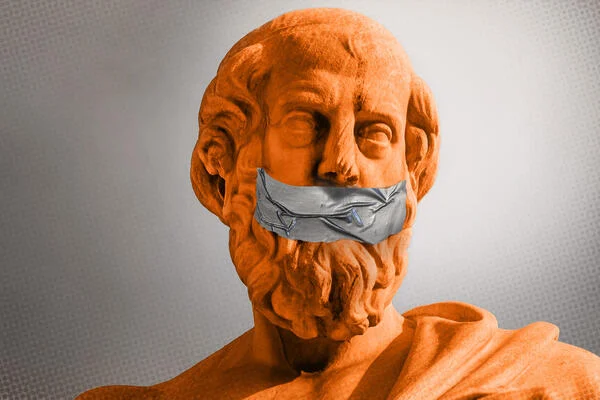
The censored Plato texts include passages from his Socratic dialogue Symposium that discuss patriarchy, masculinity, gender identity and the human condition.
Photo illustration by Justin Morrison/Inside Higher Ed | Nice_Media_PRO/iStock/Getty Images | rawpixel
At least 200 courses in the Texas A&M University College of Arts and Sciences have been flagged or canceled by university leaders for gender- or race-related content as the university undertakes its review of all course syllabi, faculty members told Inside Higher Ed.
This is just the beginning of the system board–mandated course-review process. Faculty were required to submit core-curriculum syllabi for review in December, and some faculty members have yet to receive feedback on their spring courses, scheduled to begin Monday.
So far, queer filmmakers, feminist writers and even ancient Western philosophers are on the chopping block. One faculty member—philosophy professor Martin Peterson, who is supposed to teach Contemporary Moral Problems this spring—was asked by university leadership to remove several passages by Plato from his syllabus.
In an email from department chair Kristi Sweet, Peterson was given two options: either remove “modules on race and gender ideology, and the Plato readings that may include these,” or be reassigned to teach a different philosophy course.
“Your decision to bar a philosophy professor from teaching Plato is unprecedented … You are making Texas A&M famous—but not for the right reasons,” Peterson said in his response to Sweet, which he shared with Inside Higher Ed. The Plato texts include passages from his Socratic dialogue Symposiumthat discuss patriarchy, masculinity, gender identity and the human condition. In one excerpt, the “Myth of the Androgyne,” the Greek playwright Aristophanes says, “First, you should learn the nature of humanity … for in the first place there were three kinds of human being and not two as nowadays, male and female. No, there was also a third kind, a combination of both genders.”
Peterson ultimately chose to revise his syllabus and replace the censored material with lectures on free speech and academic freedom. “I’m thinking of using this as a case study and [to] assign some of the texts written by journalists covering the story to discuss,” Peterson told Inside Higher Ed via text. “I want [students] to know what is being censored.”
Another censored class is Introduction to Race and Ethnicity. Students enrolled in the sociology course this spring were told via email Tuesday that the class was canceled because there was no way to bring it into compliance with the system policy. One professor, who wished to remain anonymous, was asked in the fall to remove content related to feminism and queer cinema from their History of Film class. The professor refused, and the dean resubmitted the syllabus as a noncore “special topics” class, which enrolled students were notified of Wednesday.
“I’m seeing the enrollment drops as we speak,” the professor said.
The enrollment declines could have the same result as the course review.
“The expectation is that a lot of those classes will ultimately be canceled, not because of content but because of underenrollment,” said another professor in the College of Arts and Sciences who wished to remain anonymous.
English faculty members received an email Tuesday from senior executive associate dean of the college Cynthia Werner telling them that literature with major plot lines that concern gay, lesbian or transgender identities should not be taught in core-curriculum classes.
In a follow-up email Wednesday, Werner said, “If a course includes eight books and only one has a main character who has an LGBTQ identity and the plot lines are not overly focused on sexual orientation (i.e. that is THE main plot line), I personally think it would be OK to keep the book in the course.” She also clarified that faculty may assign textbooks with chapters that cover transgender identity, so long as they do not talk about the material or include it on assignments or exam questions.
In November, the Texas A&M University System Board of Regents decided that courses that “advocate race or gender ideology, sexual orientation, or gender identity” would be subject to presidential approval and launched a systemwide, artificial intelligence–driven course-review process across all five campuses. Faculty members are still confused about who exactly is reviewing their syllabi.
“The university is doing different things in different departments and colleges. They’re interpreting these policies differently,” said Leonard Bright, a professor of government and public service at Texas A&M and president of the university’s American Association of University Professors chapter. “I’ve heard some say they were told that there are some committees [carrying out the review]. I’ve heard some say that it’s just the provost and his close affiliates. We really don’t have a real clear answer as to how these decisions are being made.”
It’s also unclear whether Texas A&M is violating a rule from the Texas Higher Education Coordinating Board that requires institutions to seek its approval before revising its core curriculum and “deleting courses.” A spokesperson for the university did not respond to Inside Higher Ed’s questions about the review Wednesday, including a question about how many total courses have been canceled so far.
The Texas A&M AAUP condemned the university’s decision to censor Plato in a statement Wednesday.
“At a public university, this action raises serious legal concerns, including viewpoint discrimination and violations of constitutionally protected academic freedom,” the AAUP chapter wrote. “Beyond the legal implications, the moral stakes are profound. Silencing 2,500-year-old ideas from one of the world’s most influential thinkers betrays the mission of higher education and denies students the opportunity to engage critically with the foundations of Western thought. A research university that censors Plato abandons its obligation to truth, inquiry, and the public trust—and should not be regarded as a serious institution of higher learning. We are deeply saddened to witness the decline of one of Texas’s great universities.”
The Foundation for Individual Rights and Expression also slammed the move.
“Texas A&M now believes Plato doesn’t belong in an introductory philosophy course,” Lindsie Rank, director of campus rights advocacy at FIRE, said in a statement. “This is what happens when the board of regents gives university bureaucrats veto power over academic content. The board didn’t just invite censorship, they unleashed it with immediate and predictable consequences. You don’t protect students by banning 2,400-year-old philosophy.”
by Nirvi Shah, The Hechinger Report January 7, 2026
About six years ago, an apprentice training to be a machinist in Washington state told her supervisor she would probably have to drop out of the training program after having her baby: She couldn’t find child care that accommodated her shift.
It was one of the first challenges Shana Peschek was tasked with solving when she became executive director of the Machinists Institute, which trains workers for jobs in the aerospace, manufacturing and automotive industries all over the state.
Peschek knew it was essential to do something for workers with young children.
“That worst shift, the new hires are going to get it. The new hires are generally younger people. They have little kids or they are going to want a little kid,” Peschek said.
“It’s beyond the cost of child care,” she said. “If they can’t find anywhere, we’re going to lose them.”
As Peschek worked on a way to address the situation, she also wondered how she could include apprenticeship in the solution. The answer: incorporating early educator apprenticeships into a custom-built child care center tailored to the trade union’s needs. Last month, The Hechinger Report wrote about San Francisco’s child care apprenticeship program.
“Apprenticeship is my jam,” said Peschek, who emphasized that apprenticeship is a mode of education, not limited to any specific profession. While the word apprentice is often associated with roles like machinists, it is just the term for an educational path that includes paid, on-the-job training. Early educator apprenticeships do just that, providing classes and training alongside paid work experience to help hopeful teachers earn required credentials and get full-time jobs. “I want that pathway available for our teachers and assistant teachers,” she said.
With a combination of institute money, grants and donations, the Machinists Institute bought land and is constructing Little Wings Early Learning Academy in Everett, Washington. Its name is inspired by the local economy, which is powered in part by a nearby Boeing factory. The center will serve workers in the trade union, who will be able to send their young children for care starting as early as 4 a.m. through as late as midnight. Care will also be available on weekends, to accommodate a range of shifts. It is scheduled to open this spring.
Machinists, maritime industry workers and other local tradespeople and apprentices will pay a discounted rate for child care, which will also be available to area residents to enroll their kids.
Peschek’s hopes are high, for all of the apprentices the center will involve.
That’s in part because of the experience some early educator apprentices have had. Apprenticeships have been a part of the trades for centuries, but they are relatively novel in education.
The option changed the course of Carlota Hernández de Cruz’s life. For years, with only an elementary school education from when she grew up in Mexico, she was the primary caregiver for her three children while her husband was the breadwinner. When her youngest child was still in child care, at a California Head Start program run by an area YMCA, she began working a few hours a day as a parent intern at the center.
She eventually encountered Pamm Shaw, who created one of the first early educator apprenticeship programs in the country for the YMCA of the East Bay, in California’s Alameda County. Shaw encouraged Hernández de Cruz to take classes and work toward becoming an early childhood teacher.
“I’m originally from Mexico,” Hernández de Cruz said, remembering her apprehension. “I came with zero English.” But Shaw was convincing.
Hernández de Cruz took classes, one or two at a time, balancing them with motherhood and homekeeping duties. Then her husband got sick and could no longer work. It took years, but she completed the courses for her associate degree. Just a few months before graduation, her husband died.
Hernández de Cruz, now 53, knew that although what she had accomplished was monumental, it wasn’t enough. Thanks to her apprenticeship, however, her bachelor’s degree coursework was paid for, even though it was sometimes a struggle to keep up with the requirements of online courses and lectures in English, while solo parenting and working.
In 2019, Hernández de Cruz earned that bachelor’s degree but turned down a job running a child care center. She wasn’t ready. When she was approached again in 2021 about a director role, at the center where she was working, she agreed. There have been ups and downs: That center closed and she was back to teaching for a while. But now she runs the Vera Casey Center, a Head Start site for infants and toddlers in Berkeley that is part of the YMCA of the East Bay.
“I feel I can say financially I’m stable,” Hernández de Cruz said, and she said she is proud of herself and her children. Her kids grew up watching their mother work and study hard and have had opportunities she didn’t when she was younger, even though she said they all faltered, and flunked a few classes, when their father died. Her younger daughter just graduated from a nursing program and her older daughter completed a bachelor’s degree in child development and is now pursuing a master’s degree. Both daughters live at home with her, as do her parents. (Her son, she said, is still taking classes and finding his way.) “I’m stable but he’s not here with us,” Hernández de Cruz said of her husband, but “being in the classroom with kids, it helped me to heal. That’s what I feel at work. I still feel happy every day.”
This <a target=”_blank” href=”https://hechingerreport.org/early-childhood-educator-apprenticeships-offer-an-answer-to-child-care-shortages/”>article</a> first appeared on <a target=”_blank” href=”https://hechingerreport.org”>The Hechinger Report</a> and is republished here under a <a target=”_blank” href=”https://creativecommons.org/licenses/by-nc-nd/4.0/”>Creative Commons Attribution-NonCommercial-NoDerivatives 4.0 International License</a>.<img src=”https://i0.wp.com/hechingerreport.org/wp-content/uploads/2018/06/cropped-favicon.jpg?fit=150%2C150&ssl=1″ style=”width:1em;height:1em;margin-left:10px;”>
This audio is auto-generated. Please let us know if you have feedback.
Dive Brief:
The University of Nebraska-Lincoln is under fire from faculty over a hefty monetary payout for its departing leader, Chancellor Rodney Bennett, as the campus braces for program and faculty cuts he put in place.
Bennett unexpectedly announced Monday that he would resign effective Jan. 12. A copy of his separation agreement obtained by local media through records requests details a one-time payment of $1.1 million.
On Tuesday, the UNL American Association of University Professors blasted the severance payment and called for a halt to all faculty cuts and reconsideration of the program eliminations approved by the University of Nebraska board of regents last month.
Dive Insight:
UNL has gone through a tumultuous few months under Bennett as he has tried to eliminate millions of dollars from the university’s budget in an effort to slash away at a structural deficit.
In September, he proposed axing six academic programs to cut costs. Faculty quickly condemned the plan and questioned its methodology. They also warned that Nebraska would suffer from losing subject-matter knowhow.
Critics also questioned the fiscal necessity of the program eliminations. An auditor hired by the AAUP voiced doubt the university was undergoing a budget crisis, finding historical budget surpluses and other markers of financial health.
Bennett would go on to reduce his proposal to cutting four academic programs and over 50 jobs, a move regents later approved. In November, UNL’s faculty senate voted no confidence in the chancellor — the first such vote in the university’s history.
The faculty body voted overwhelmingly for the measure, which alleged “failures in strategic leadership, fiscal stewardship, governance integrity, external relations, and personnel management.”
Less than two months later, Bennett resigned. His message to the UNL community focused on positives, including fundraising milestones and new records for six-year graduation rates and first-year student retention under his tenure.
“Your energy, your enthusiasm, your optimism, and your determination to do your part to make our communities, our state, and our world better are an inspiration to us all, and it has been my highest honor and privilege to have served as your Chancellor,” Bennett, who joined UNL as chancellor in 2023, wrote on Monday.
And then came the revelations about his severance, which was first unearthed by the Lincoln Journal Star.
The UNL AAUP pounced on the payment, arguing that it “demonstrates that substantial funds remain available for executive compensation even as entire academic units are dismantled and careers are disrupted, if not destroyed.”
“The university cannot credibly claim that it lacks the resources to sustain academic programs and faculty positions while simultaneously paying over a million dollars to a failed chancellor,” Sarah Zuckerman, president of the AAUP chapter, said in a statement. Zuckerman is a professor in UNL’s educational administration program, one of the departments set for elimination.
She added, “This payout exposes the administration’s financial crisis narrative as a matter of priorities, not necessity.”
Replacing Bennett in the interim is Kathy Ankerson, who served as an executive vice chancellor at UNL until her 2024 retirement. Ankerson and system President Jeffrey Gold plan to hold campus listening sessions in the coming months to take public input. As Gold put it in a public message, “The news about Chancellor Bennett is one change on top of many other changes” at UNL.
Search behavior in higher education is changing fast. With Google’s Search Generative Experience (SGE), prospective students and parents are no longer just scanning lists of links; they’re receiving direct, AI-generated answers at the top of the page. These summaries pull from multiple sources to deliver concise, conversational responses to complex questions about programs, costs, outcomes, and campus life.
For schools, the implication is clear: your content must be structured, authoritative, and context-rich to be surfaced by AI. If it isn’t, your institution may be invisible, regardless of how strong your traditional SEO once was.
This article explores Google SGE in education, explains what Google SGE means for higher education marketing, and how schools can adapt. We’ll cover why AI search matters, how generative AI changes content discovery, and the practical steps institutions can take, from content optimization to local SEO and reputation management, to remain visible in this new search landscape.
Need help refining your school search optimization strategy?
Discover how our specialized services can help you connect with and enroll more students.
What Is Google’s AI Search (SGE) and Why Does It Matter for Schools?
Google’s Search Generative Experience, now commonly surfaced as AI Overviews, represents a major shift in how search results are delivered. Instead of presenting users with a list of links, Google increasingly provides synthesized, AI-generated answers that pull information from multiple sources and present it as a concise, conversational summary.
Google SGE in education functions like an advanced featured snippet. For example, when a parent searches “best engineering programs in Ontario,” Google’s AI may generate a short comparison of several institutions, highlighting locations, strengths, and differentiators without requiring the user to click through to individual websites. This fundamentally changes how prospective students and families discover schools.
For institutions, the stakes are high. AI Overviews often answer questions about programs, admissions, outcomes, and comparisons directly in the search results. If your school is not referenced in that response, you may miss visibility at an important early decision-making moment. Visibility in AI-generated answers is quickly becoming as important as first-page rankings once were in traditional SEO.
There is also an opportunity. Early third-party studies suggest that Google’s AI Overviews may cite content beyond the top organic rankings, particularly when pages clearly and directly answer a user’s question. Well-structured, authoritative content that clearly answers a specific question can be surfaced even if it does not rank first in classic search. This creates room for smaller or lesser-known institutions to compete based on content quality and relevance rather than brand dominance alone.
SGE also changes user behavior. Search becomes conversational, with follow-up questions that refine intent and narrow comparisons. Schools must be prepared to show up for detailed, context-driven queries, supported by accurate content and complete institutional data across Google platforms.
Google’s AI search prioritizes clarity, authority, and usefulness. Schools that adapt to this shift gain visibility at critical moments. Those who do not risk being bypassed entirely.
How Can My School Improve Its Visibility in AI-Powered Search?
Achieving visibility in AI-driven search results requires a blend of traditional SEO best practices and newer approaches often referred to as Generative Engine Optimization. This means maintaining a strong SEO foundation so Google understands and trusts your site, while also optimizing your content and digital presence for how AI retrieves, synthesizes, and presents information.
Below are the key strategies schools should focus on to improve their chances of being featured in AI-powered search results.
1. Maintain a Strong SEO Foundation
First and foremost, SEO is not dead. It is the foundation on which AI search visibility is built. Google’s AI Overviews continue to rely on reliable, well-structured, and authoritative content, often drawing from pages that already follow SEO best practices.
Google has made it clear that content aligned with its established guidelines, including experience, expertise, authoritativeness, and trustworthiness, performs well in AI-driven results. Schools should continue to invest in core SEO fundamentals, including the following.
Keyword Optimization and Metadata Use clear, relevant keywords in page titles, headings, and meta descriptions so both traditional search algorithms and AI systems can quickly understand your content. A program page titled “MBA Program in Data Analytics | XYZ University” clearly communicates relevance and improves discoverability.
Logical Site Structure Organize your site navigation and URLs logically so search engines can easily crawl and contextualize content. A clean hierarchy helps AI retrieve specific details such as tuition, admissions requirements, or program outcomes by following your site’s structure.
Mobile-Friendly, Fast-Loading Pages Most prospective students search on mobile devices. Google prioritizes mobile usability and fast load times regardless of AI. A strong user experience encourages engagement and signals content quality to Google’s systems.
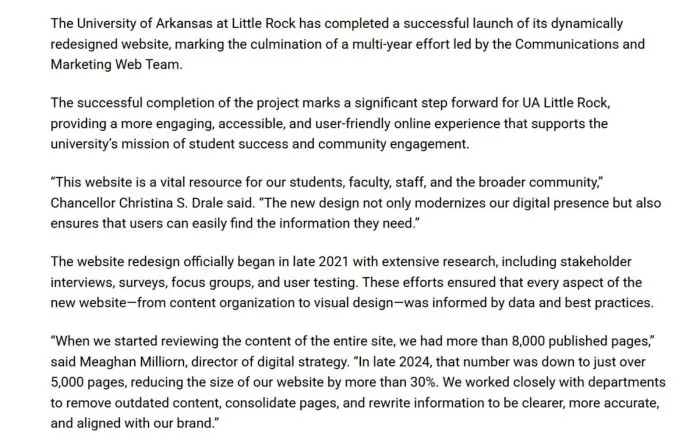
Example: University of Arkansas at Little Rock (UA Little Rock): Launched a redesigned website in 2025 that prioritized technical SEO fundamentals. The web team conducted a full content audit to streamline site architecture, consolidating and rewriting content for clarity and removing outdated information to improve crawlability and usability. This resulted in a leaner, more crawlable site aligned with best practices.
Quality Content and User Engagement Continue publishing in-depth, high-quality content. This attracts backlinks, increases time on site, and positions your pages as authoritative sources that AI systems are more likely to reference.
Think of traditional SEO as the bedrock. If your site is not technically sound and rich in valuable content, AI-focused tactics will not compensate. A strong foundation amplifies everything that follows.
2. Create High-Quality, AI-Friendly Content (Answer the Questions)
With the basics in place, the next step is tailoring content for conversational, answer-focused search behavior. AI-powered search excels at interpreting natural-language questions, especially longer and more specific queries.
To improve visibility, your content should directly address the questions prospective students and parents are asking, using clear structure and plain language.
Incorporate Long-Tail, Question-Based Keywords Shift part of your keyword strategy toward detailed, conversational queries. Instead of focusing only on broad terms like “MBA Canada,” develop content around questions such as “best MBA programs in Canada for working professionals” or “how to get a scholarship for an MBA.” AI systems are more likely to surface content that closely matches how users phrase their questions.
Use Q&A and FAQ Formats Question-and-answer formats are particularly effective for AI extraction. Admissions, financial aid, and program pages benefit from clearly labeled questions followed by concise, factual answers. This structure improves usability for readers and makes it easier for AI to identify relevant information.
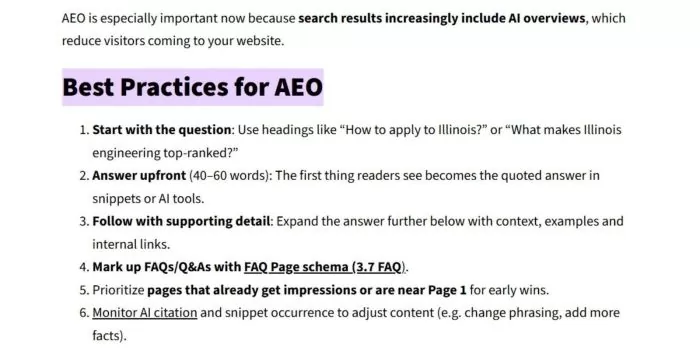
Example: University of Illinois Urbana-Champaign: Incorporates “Answer Engine Optimization (AEO)” into its content guidelines for web writers. The University’s brand training recommends structuring content in a Q&A format: start with a question in a heading (e.g. *“How do I apply to Illinois?”), Immediately answer it in a brief, concise paragraph before expanding with additional detail. This approach, coupled with applying FAQ schema markup, is designed to make Illinois’s content the direct answer in featured snippets or AI summary boxes. By focusing on full questions and concise answers, Illinois ensures its high-value content is AI-friendly and voice-search ready.
Emphasize Authoritative, In-Depth Content AI systems favor content that demonstrates expertise and depth. Schools can leverage faculty insight, research, and real-world outcomes to establish authority. Long-form guides, career pathway articles, and program explainers grounded in institutional expertise are strong candidates for AI-generated answers.
Structured Headings and Clear Writing Organize content using descriptive headings and subheadings. Avoid burying key information in long paragraphs. Specific headings aligned with search intent help AI match your content to relevant queries. Lists and step-by-step explanations are especially useful, as AI often presents answers in list form.
Evergreen Content and Regular Updates Keep content current. Evergreen content still requires periodic updates to remain accurate and competitive. AI systems favor up-to-date information, particularly for admissions policies, program offerings, and career outcomes.
By focusing on high-quality, question-oriented content, schools make it easier for AI to identify, trust, and reuse their information.
3. Leverage Local SEO and Google Business Profiles
For institutions with physical campuses, local SEO is a critical component of AI visibility. Many education-related searches carry local intent, and Google’s AI frequently integrates local data into its answers.
Claim and Optimize Your Google Business Profile Ensure your Google Business Profile is claimed, complete, and accurate. Fill out all fields, including locations, contact information, categories, and descriptions. This data is often pulled directly into AI-generated results.
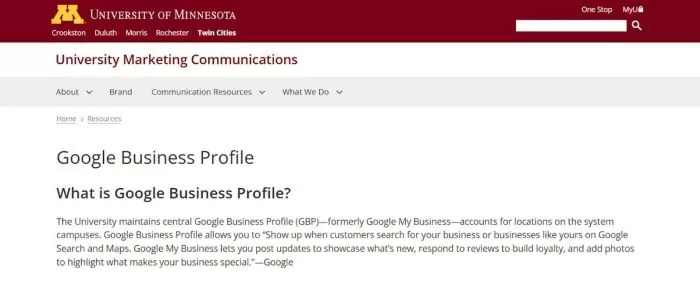
Example: University of Minnesota: Manages a centralized Google Business Profile (GBP) for its campuses to maximize local search visibility. The University’s marketing team keeps each campus’s GBP listing complete and up-to-date with addresses, hours, phone numbers, and descriptive text. They also utilize GBP features like posts and photos to highlight campus events and attributes. Following Google’s best practices, Minnesota fills out “as much location information as possible,” keeps listings current (e.g., holiday hours), and uses relevant keywords in descriptions and local posts to improve local search ranking. This ensures the University’s locations appear prominently on Google Search/Maps for relevant queries.
Keep Photos and Media Up to Date AI-generated listings frequently include logos and photos. Upload high-quality, current images of your campus, facilities, and branding. Visuals influence perception and can strengthen your presence in AI results.
Incorporate Local Keywords on Your Site Mention your city, region, and community naturally within site content. Blog posts, news updates, and program pages that reference local partnerships or opportunities help AI associate your institution with specific locations.
Maintain Consistent Local Citations Ensure your institution’s name, address, and phone number are consistent across directories, education portals, and social platforms. Consistency reinforces credibility for AI systems aggregating information.
Use Google Business Features Strategically Google Posts, Q&A sections, and program listings provide additional structured data that AI can reference. Schools that actively manage these features offer clearer signals to Google’s systems.
Strong local SEO increases the likelihood that your institution appears in AI-generated responses to geographically relevant searches.
4. Embrace Online Reviews and Social Proof
Why are online reviews important for AI search results? Online reviews provide fresh, user-generated content that signals credibility and relevance to AI systems. Positive, detailed reviews can help your institution appear in AI-generated answers by reinforcing trust, boosting visibility, and enriching the data AI uses to evaluate and summarize schools in search results.
Online reviews now influence both human decision-making and AI-generated search results. Google’s AI Overviews often incorporate ratings and review themes directly into responses.
Maintain Strong Ratings In competitive searches, AI systems tend to highlight institutions with strong review profiles, as ratings and review sentiment are commonly incorporated into AI-generated summaries. Strong ratings are increasingly a prerequisite for visibility, not just a reputation metric.
Monitor Review Content AI systems analyze recurring themes within reviews. Frequently mentioned strengths or concerns can appear in AI-generated summaries. Active monitoring helps ensure accuracy and context.
Encourage Positive Reviews Develop a structured approach to requesting reviews from satisfied students, alumni, and parents. Reviews that mention specific programs, facilities, or experiences provide richer signals for AI.
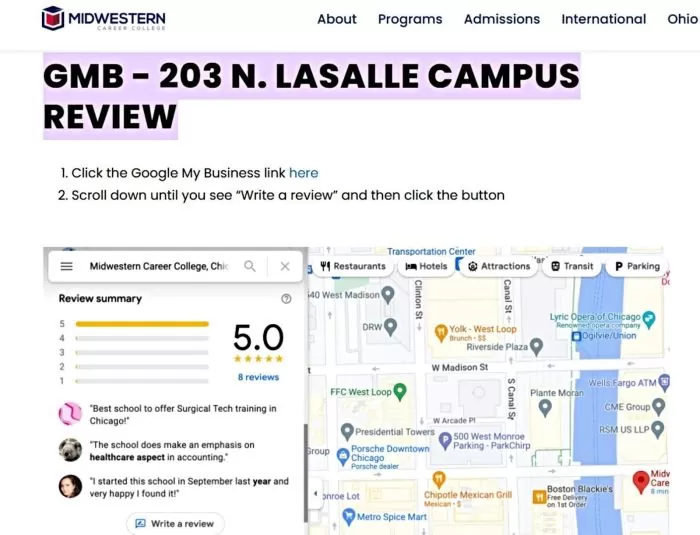
Example: Midwestern Career College: Encourages its community to engage on Google’s review platform for each campus location. On its official website, MCC provides step-by-step instructions for students to leave a Google review – from clicking the campus’s Google My Business link to hitting the “Write a review” button. This call-to-action shows MCC actively seeks public feedback. By driving satisfied students to post reviews, the college strengthens its online reputation and local search rankings. The steady flow of positive Google reviews serves as social proof to prospective students scanning the web for authentic feedback.
Diversify Review Sources While Google reviews are most influential, other education-focused platforms and social feedback also contribute to the broader information ecosystem AI systems draw from.
Showcase Testimonials on Your Site Highlight authentic testimonials and success stories on your website. When properly structured, these can reinforce credibility for both users and AI-driven search systems.
Online reviews have become direct inputs into how AI describes institutions. Active review management strengthens both reputation and search visibility.
AI-powered search rewards clarity, authority, and usefulness. Schools that invest in strong SEO foundations, question-driven content, local optimization, and reputation management are far more likely to appear when prospective students turn to AI for answers.
In an AI-first search environment, visibility belongs to institutions that make it easy for both people and machines to understand their value.
5. Optimize Visual and Multimedia Content
AI search results are no longer limited to text. They increasingly include images and videos to help users evaluate options more quickly. A search about campus life may trigger a photo carousel, while a branded university query could surface a campus tour video alongside the AI-generated answer. If your visual assets are weak, outdated, or poorly optimized, you risk losing attention even when your institution is referenced.
To compete effectively, schools must treat multimedia as a core part of search optimization, not a design afterthought.
Image Optimization Images should be handled with the same rigor as written content. Start by using descriptive file names that clearly indicate what the image represents. Replace default camera names with specific, readable names such as school-name-library.jpg or university-science-lab.jpg.
Alt text is equally important. It should accurately describe the image in plain language and, where appropriate, align with the page topic. For example, an image of a new facility might use alt text such as “State-of-the-art science lab at [School Name].” Avoid keyword stuffing or vague descriptions.
Page performance matters. Large, uncompressed images slow load times, which negatively affects SEO and user experience. Since AI systems often surface images closely tied to page content, it is also important to place your strongest visuals on pages where the surrounding text is directly relevant. If a user asks what your campus looks like, Google can only surface your images if they are indexable, contextualized, and optimized.
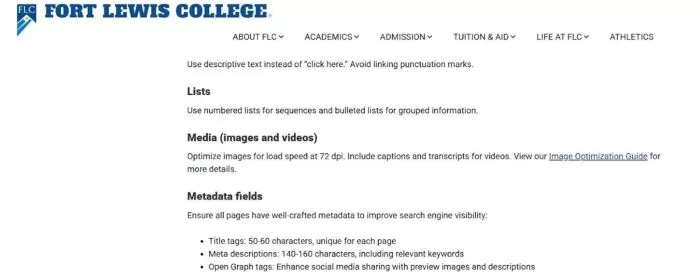
Example: Fort Lewis College: Ensures that images and videos on its site are optimized for both user experience and search visibility. Fort Lewis’s Web Style Guide instructs editors to compress and properly size images for fast loading, and to always include descriptive alt text for accessibility and SEO. For multimedia content, the college provides captions or transcripts for videos, knowing that search engines (and users) can’t index what isn’t in text form. By adding text transcripts to videos and alt tags to images (with relevant keywords where appropriate), Fort Lewis makes its visual content discoverable by AI and voice search tools while also improving page load times.
Infographics and Charts Custom graphics can strengthen authority, especially when they communicate outcomes, rankings, or program pathways. When using infographics or charts, include them on relevant pages with concise captions that explain what the visual shows. Captions help users and clarify context for search systems.
Do not place critical information exclusively inside images. If a chart highlights graduate employment rates or admissions statistics, repeat the key points in HTML text. This improves accessibility and ensures AI systems can accurately interpret and reference the information.
Video Content (YouTube and Beyond) Video is often the first impression prospective students have of an institution. Google regularly surfaces YouTube videos in search results, including AI-enhanced answers. A query like “tour of [School Name] campus” may show a playable video immediately, making video optimization essential.
Focus on video content that addresses high-intent questions, such as campus tours, residence life walkthroughs, student testimonials, program overviews, and admissions explainers. Titles and descriptions should be clear, descriptive, and aligned with how users search. For example, “Campus Tour | [School Name] | Student Life and Facilities” is more effective than a generic welcome video title.
On your website, embed key videos on relevant pages and include a transcript or written summary. Video alone provides limited context for AI. Supporting text gives search systems content they can analyze and reference. Engagement signals also matter. Videos with strong watch time and interaction are more likely to surface in search results.
Schema for Videos and Images Use schema markup where appropriate, particularly VideoObject schema for important videos. Structured data helps search engines understand what a video contains, its duration, and its purpose. While schema does not guarantee AI inclusion, it improves clarity and future-proofs your content as search becomes more structured.
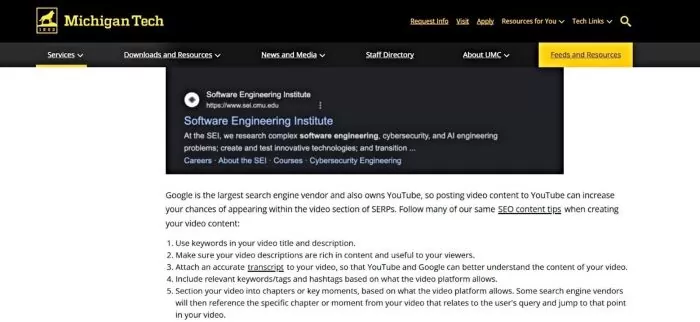
Example: Michigan Technological University: Integrates video SEO into its content strategy to capitalize on the popularity of video content. Michigan Tech advises its departments to treat video content like web text content for optimization: use keyword-rich titles and descriptions on YouTube, and crucially, attach accurate transcripts or captions to each video. Providing a transcript allows Google and other AI-driven search engines to “understand” the video’s content.
Michigan Tech emphasizes the importance of captions and transcripts so search engines can understand video content. More broadly, platforms like Google and YouTube use metadata such as titles, descriptions, and timestamps to better interpret video relevance in search results.These practices ensure the university’s lectures, tutorials, and marketing videos are accessible to search engines and can surface in voice or AI search responses.
Speakable Content and Voice Search As AI search integrates more closely with voice assistants, content clarity becomes even more important. While Speakable schema is not widely used in education yet, schools should focus on writing concise, well-structured answers to common questions. Clear summaries on admissions, tuition, and programs prepare your content for both visual and voice-based search experiences.
Multimedia optimization improves both visibility and perception. Strong images and videos help schools appear in AI results and stand out once they do.
6. Use Structured Data and Clean Site Architecture
Structured data and clean site architecture significantly improve how accessible your content is to AI systems. Generative AI for colleges relies on context, and schema markup provides that context explicitly. A logical site structure ensures important information is easy to find and understand.
Education-Specific Schema Schools should implement schema types relevant to higher education. EducationalOrganization schema supports institutional information. Course schema describes programs and credentials. FAQPage schema is ideal for admissions and financial aid questions, while Event schema works well for open houses and webinars. When the schema aligns with visible page content, it increases Google’s confidence in surfacing that information.
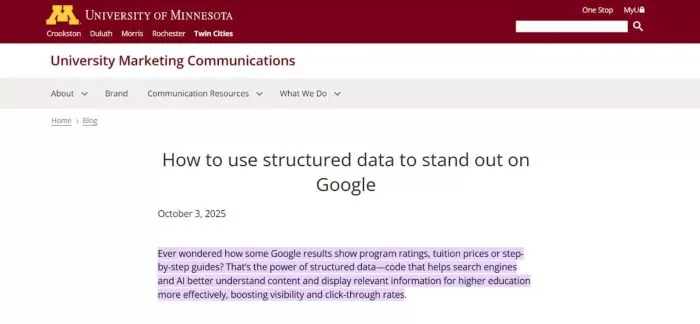
Example: University of Minnesota: Embraces structured data to enhance how its content appears in AI-powered results. In October 2025, U of M’s marketing tech team rolled out new schema features across its Drupal web platform to better label content for search engines. Their official guide explains “that’s the power of structured data” – snippets of code that help search engines and AI understand page details like program offerings, alumni, FAQs, etc., leading to rich search results. Minnesota’s web environment includes a Schema.org metatag module, and they continually update it (e.g., adding support for alternate organization names and parent organizations in 2025) so that university webpages can output a comprehensive JSON-LD schema. This clean, machine-readable markup boosts the visibility of U of M content in rich results and AI summaries.
FAQ and Q&A Schema The FAQPage schema is especially valuable for AI-powered search. It clearly signals which text answers specific questions. If a prospective student asks about tuition or application deadlines, schema-marked answers increase the likelihood that AI systems pull accurate snippets directly from your site.
Clean URLs and Logical Hierarchy Your site structure should be intuitive and reflected in URLs. Paths like /academics/programs/computer-science help both users and crawlers understand content relationships. Important pages should not be buried or scattered across PDFs without internal links. AI systems are more likely to surface well-organized pages than fragmented information.
Internal Linking Use internal links to connect related content using descriptive anchor text. Admissions pages should link to financial aid details. Program pages should link to career outcomes or internship information. Internal linking helps AI systems follow context across your site and identify authoritative pages.
Technical Hygiene Keep sitemaps updated, fix broken links, and ensure key pages are indexed. Avoid blocking important content with noindex tags or robots.txt. Do not rely solely on PDFs or images to communicate essential information. Always provide HTML text summaries for critical details.
Data Accuracy and Consistency Structured data must match on-page content exactly. Inconsistent tuition figures, dates, or requirements can confuse AI systems and undermine trust. Centralizing frequently updated information reduces errors and improves reliability.
Clean structure and accurate schema make your site easier for AI to understand and more likely to be referenced correctly.
7. Stay Current and Adapt
The final requirement for AI-era visibility is continuous adaptation. AI-powered search is evolving quickly, and static strategies will fall behind.
Monitor Performance Track impressions, click-through rates, and query patterns. Declining clicks may indicate users are getting answers directly from AI results. Identify affected pages and strengthen their value or clarity.
Use AI Evaluation Tools Emerging tools can highlight gaps, such as missing schema or slow performance. While imperfect, they can help prioritize improvements.
Keep Content Updated Refresh pages when programs, policies, or deadlines change. Update older content with current data and examples. AI systems favor recent, accurate information, especially for admissions and cost-related queries.
Watch Industry Trends Follow credible SEO and higher education marketing sources to understand how AI search is evolving. Use early signals to adjust content strategy before visibility declines.
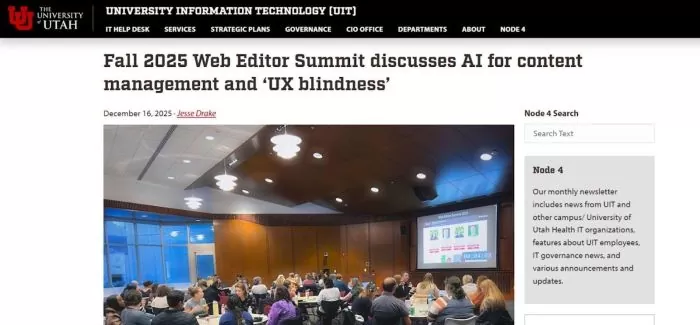
Example: University of Utah: Stays on the cutting edge by rapidly adapting to emerging search technologies and educating its staff. In late 2025, Utah’s Web Support & Usability team hosted a campus Web Editor Summit focused on the latest SEO and AI trends. They urged content editors to adjust strategies for AI-driven search, for example, by optimizing site content even if certain pages are blocked from traditional indexing (since AI models might analyze them regardless). Utah is even preparing for the next wave of AI by securing an enterprise ChatGPT license to integrate advanced AI into its services. By proactively training web editors on tools like custom GPTs and emphasizing new ranking factors, the University of Utah shows a commitment to continuous learning and quick adaptation in the AI era.
Balance Optimization With Human Experience AI visibility is only the first step. When users click through, your site must guide them clearly toward next actions. Strong user experience, clear calls to action, and authentic messaging remain essential.
Schools that combine technical discipline with ongoing refinement will remain visible as search continues to evolve. Continuous improvement is the most reliable long-term strategy in an AI-driven search environment.
Preparing Your School for AI-Driven Search
AI-powered search is fundamentally changing how prospective students discover, evaluate, and compare institutions. Visibility is no longer determined solely by blue-link rankings but by how clearly and credibly a school’s information can be understood and reused by AI systems. To remain competitive, schools must move beyond isolated SEO tactics and adopt a more holistic approach to search visibility.
This means maintaining strong technical SEO foundations, publishing content that directly answers real student questions, and ensuring visual, video, and structured data assets are optimized and accessible. Clean site architecture, accurate information, and consistent updates all play a role in whether an institution is surfaced or overlooked in AI-generated results. Just as important is a commitment to ongoing adaptation. AI search will continue to evolve, and schools that monitor performance, refine content, and prioritize the student experience will be best positioned to earn trust, attention, and engagement.
Need help refining your school search optimization strategy?
Discover how our specialized services can help you connect with and enroll more students.
FAQs
Question:What is Google’s AI Search (SGE) and why does it matter for schools?
Answer: Google’s Search Generative Experience, now commonly surfaced as AI Overviews, represents a major shift in how search results are delivered. Instead of presenting users with a list of links, Google increasingly provides synthesized, AI-generated answers that pull information from multiple sources and present it as a concise, conversational summary.
Question: How can my school improve its visibility in AI-powered search?
Answer: Achieving visibility in AI-driven search results requires a blend of traditional SEO best practices and newer approaches often referred to as Generative Engine Optimization. This means maintaining a strong SEO foundation so Google understands and trusts your site, while also optimizing your content and digital presence for how AI retrieves, synthesizes, and presents information.
Question: Why are online reviews important for AI search results?
Answer: Online reviews provide fresh, user-generated content that signals credibility and relevance to AI systems. Positive, detailed reviews can help your institution appear in AI-generated answers by reinforcing trust, boosting visibility, and enriching the data AI uses to evaluate and summarize schools in search results.
Texas A&M philosophy professor Martin Peterson has a choice: Drop readings related to race and gender — including ones by Plato — from his course, or face reassignment.
Just weeks ago, FIRE warned that A&M policy banning professors from teaching issues of “race or gender ideology” and “sexual orientation” in core courses violates faculty academic freedom. The First Amendment prohibits public universities from deciding which viewpoints can be taught in a classroom, and which must be banished.
The following can be attributed to Lindsie Rank, director of Campus Rights Advocacy at FIRE.
Texas A&M now believes Plato doesn’t belong in an introductory philosophy course. The philosophy department is demanding that professor Martin Peterson remove Platonic readings because they “may” touch on race or gender ideology. He’s been given until the end of the day to comply or be reassigned. This is what happens when the board of regents gives university bureaucrats veto power over academic content. The board didn’t just invite censorship, they unleashed it with immediate and predictable consequences. You don’t protect students by banning 2,400-year-old philosophy.
With cost barriers removed, UW–Madison sees rapid expansion of active learning across disciplines.
TORONTO – January 7, 2026 – Through a strategic partnership with Top Hat, the leader in student engagement solutions for higher education, the University of Wisconsin–Madison has eliminated student costs for using the platform while accelerating adoption of evidence-based teaching practices like active learning and frequent low-stakes assessment across courses. Over the past year, the university’s enterprise license agreement with Top Hat has saved students more than $1 million while empowering educators to deepen student engagement and learning outcomes at scale.
“Affordability and instructional excellence are top priorities for our institution,” said Kristy Bergeron, UW–Madison Learn@UW Associate Director in Academic Technology. “Top Hat is helping us directly support educators by giving them the tools they need to teach with confidence, creativity, and impact. As more faculty adopt the platform, students benefit through deeper engagement and meaningful cost savings.”
Strong satisfaction among educators and students was a key driver in the decision to move to an enterprise model. In a recent survey1 94% of UW–Madison students said they would want their instructors to use Top Hat again, while 85% reported that Top Hat helped them feel more engaged in the learning process. Since implementing the license agreement in 2022, the number of educators and students using Top Hat has more than doubled, with a 30% increase in the number of courses using Top Hat over the past year alone. The rapid growth in adoption has been fueled by the removal of cost barriers and a close partnership between Top Hat and UW–Madison’s Instructional Technology Group, which provided coordinated outreach and hands-on support to help faculty succeed.
“The University of Wisconsin–Madison is a champion for active learning as a pathway for stronger student success,” said Maggie Leen, CEO of Top Hat. “This partnership empowers educators with the support and tools they need to deepen engagement, boost persistence and elevate learning outcomes. We’re proud to be part of their journey.”
Top Hat’s steady release of new features is making it easier for UW–Madison faculty to increase the impact of their instruction, while reducing time and effort. With Ace, Top Hat’s AI-powered teaching and learning assistant, educators can instantly generate interactive polls, quizzes, and reflection prompts to promote active learning and frequent assessment in online and in-person lectures. These tools save valuable preparation time, while helping create more engaging, active learning environments that support student success.
About Top Hat
Grounded in learning science and powered by AI, Top Hat is the leader in student engagement solutions for higher education. We enable educators to adopt evidence-based teaching practices through interactive content, tools, and activities across in-person, online, and hybrid classrooms. Top Hat also provides access to thousands of digital textbooks and OER resources, along with authoring tools that let instructors customize or create their own accessible, interactive course materials. More than 1,500 institutions and thousands of faculty use Top Hat to support the learning of over three million students each year. To learn more, please visit tophat.com.