Blog

  • Scaffolding for Success in a Crash Course – Faculty Focus

    Scaffolding for Success in a Crash Course – Faculty Focus

    Source link

  • 20+ Ultimate Ice Breakers for College Students

    20+ Ultimate Ice Breakers for College Students

    This guide is designed for college professors and educators seeking effective ways to help students connect and participate. It covers 20+ practical icebreakers for college students and provides a free downloadable list with additional activities, ensuring you have the tools to foster a welcoming classroom environment. Even better, these icebreaker activities can easily be assigned in the Top Hat app. Icebreakers for college students encourage new students to have conversations, get to know you and each other and build a sense of community and trust. Icebreaker activities help students relax and connect with one another during orientation, creating a sense of community and trust in a classroom setting. Used early on, icebreakers can help students feel comfortable in your classroom or team meeting. They’re ideal for the first day of school, but can be used throughout the semester and serve as a precursor for teamwork and collaborative learning. Virtual icebreakers—facilitated via social media, discussion boards or in virtual team meetings—have also gained new meaning in helping group members warm up to one another.

    A classroom icebreaker for college students can be as simple as asking learners to introduce themselves to the class or to the students sitting next to them, but games and activities offer a chance to interact with a greater number of classmates and build camaraderie. According to a guide1 from Nottingham Trent University, for classroom icebreaker games “there ought to be a fun aspect to the activities in order to provide participants with some shared history that they can discuss later and, where possible, a relevance to the taught course/university experience.”

    It’s no doubt that icebreaker activities like scavenger hunts or Pictionary are overdone. Campus-based icebreakers, such as orientation activities or exploring campus landmarks, can also help students get familiar with their new environment. Keep in mind that some classroom icebreakers for college students could be awkward or uncomfortable, such as publicly sharing personal information. The key is to get students talking to each other, having conversations and making connections—without social risk. This could mean facilitating small group activities versus requiring students to share personal information in front of the whole class. As an educator, help your students get to know one another in a safe and effective way. Recognizing the importance of icebreakers in fostering inclusion and community can set a positive tone for the semester. Icebreakers encourage people to participate, help students find commonalities with their peers, and build rapport within the group.

    Download The Ultimate List of Icebreakers for the College Classroom and begin assigning to your students using Top Hat (get the list here).

    Introduction to classroom icebreakers

    Classroom icebreakers are a powerful way for college professors to set a positive tone at the beginning of a course. These activities help college students introduce themselves, share fun facts, and discover what they have in common with fellow students. Whether you’re teaching a small group or a larger group, icebreakers can be tailored to fit your classroom’s unique needs and the goals of your course material. By encouraging students to interact and get to know one another, icebreakers help build a sense of community and belonging right from the start. When students feel comfortable and connected, they’re more likely to participate, collaborate, and engage with the material and each other throughout the semester. Incorporating icebreakers into your teaching toolkit is a simple yet effective way to foster a welcoming classroom environment where everyone feels included.

    Benefits of icebreakers

    Encouraging participation

    Fun icebreakers offer a range of benefits for both students and teachers, especially for first year students who may be new to the college experience. Icebreaker activities help students feel more at ease in the classroom, making it easier for them to participate in class discussions and share their ideas. Icebreakers can create a relaxed atmosphere that encourages participation among students.

    Supporting academic success

    Icebreakers can also introduce students to key course concepts in a fun and engaging way, setting a positive tone for the rest of the semester. When students feel supported and included, they’re more likely to take academic risks, ask questions, and explore new ideas. Ultimately, using icebreakers helps create a classroom environment where everyone feels welcome, valued, and ready to learn.

    With these benefits in mind, let’s explore how to plan and implement effective icebreakers in your classroom.

    Planning icebreakers

    Setting goals

    When planning icebreakers for your class, it’s important to start with your goals in mind. Think about what you want your students to gain from the activity—whether it’s helping students get to know each other, encouraging participation, or introducing a new topic.

    Considering group size

    Consider the size of your class: some icebreakers work best in small groups, while others are ideal for larger groups. Choose activities that are interactive and fun, such as “Two Truths and a Lie” (a fun way to help students get to know each other), “Human Bingo” (students find classmates who match traits on a bingo card), or “The Human Knot” (a physical activity where participants untangle themselves without letting go of each other’s hands, fostering non-verbal teamwork). These classic icebreakers can be easily adapted to fit your group size and learning objectives.

    Selecting activities

    The key is to encourage students to share, connect, and engage with one another in a way that feels natural and enjoyable. By selecting the right icebreakers, you’ll set the stage for a lively and inclusive classroom experience.

    Best practices for icebreaker design

    Inclusivity and comfort

    Designing effective icebreakers means keeping your students’ needs and comfort in mind. Start by choosing activities that are inclusive and respectful, ensuring that every student feels welcome to participate. Avoid icebreakers that might make some students uncomfortable or single anyone out.

    Clear instructions

    Make sure your instructions are clear and the activity is easy to follow, so students know exactly what to expect. As the teacher, be ready to guide the activity, answer questions, and offer support as needed.

    Building community

    The goal is to create a sense of community and belonging in your class, helping students feel connected to each other and to the course material. By following these best practices, you’ll design icebreakers that not only break the ice but also lay the foundation for a positive and collaborative classroom environment.

    Now that you know how to plan and design effective icebreakers, let’s dive into a variety of activities you can use in your classroom.

    7 group games for college students (with fun icebreaker questions)

    This list features a variety of effective icebreakers for college students, including fun, low-pressure activities like Two Truths and a Lie, Human Bingo, interactive games like the Marshmallow Challenge, and simple question prompts. These activities are designed to help students relax, connect, and build community, whether you’re teaching in-person or online.

    1. Concentric circles

    This is a great team-building icebreaker for an in-person learning environment. Arrange students in two circles, one inside the other, with students facing each other in pairs. Ask a fun icebreaker question, such as “what’s your favorite thing about college and why?” Pairs discuss the answer, then rotate the circle to form new pairs for the next question—exposing students to the different perspectives of their peers. The trick is to provide open-ended questions rather than those with a ‘yes’ or ‘no’ answer to get students to talk and engage in meaningful conversation.

    2. Find someone who…

    Alternative: Human Bingo: students find classmates who match traits on a bingo card.

    • Students are given bingo cards with a grid of squares. Each square contains an item, such as ‘traveled to another continent’ or ‘has a younger sister.’
    • During the activity, students can pass their bingo cards to others to verify matches or to keep the game moving.
    • Students are given a time limit to find classmates who fit the description.
    • Whoever gets ‘Bingo’ first wins. You can even award a prize of your choice, such as a bonus point or two on an upcoming assignment.

    Human Bingo is considered an effective, low-pressure icebreaker for college students and is a good classroom activity to help your students warm up to one another at the start of the school year—especially those who are meeting one another for the first time.

    3. Name game

    Enables participants to informally interact with their teammates.

    This classic party game can also be applied in the classroom—you can even tweak it to reflect the curriculum. Write down names of famous people (or names related to course material) on sticky notes. Students place a sticky note on their forehead and interact with their classmates, asking fun icebreaker questions to understand which person they are embodying. For example, a student might ask, “Am I a historical figure?” and another might respond, “Yes, you are,” helping the student narrow down their guess. This team icebreaker helps students loosen up and informally interact with their classmates. It also helps them learn about a figure who may have previously been unknown to them.

    4. Poker hand

    This classroom icebreaker for college students is ideal for large groups (a maximum of 50). Shuffle a deck of cards and hand out a card to each student.

    • Give students a set amount of time to find four classmates and form a hand of poker.
    • The best hand ‘wins’ when their time is up—consider offering a couple of bonus points on an assignment.
    • To encourage connections among students with similar academic interests, you can adapt the activity by having students form groups based on their major, or by assigning card suits to different majors.
    • Keep in mind that not everyone knows how to play poker, so display the rules of the game on a whiteboard or a slide at the front of the classroom.

    This activity may help students develop their analytical skills.

    5. Three of a kind

    Helps students find commonalities with each other.

    • Set a time limit and instruct students to find commonalities by seeking out three other students they share something in common with—though not anything obvious or visible, such as hair color.
    • The idea is to help them make connections that may not be immediately apparent.

    For more strategies to help your students get to know their classmates, download our free list of college icebreakers.

    6. Find your pair

    In advance of class, prepare word pairs—such as salt and pepper, or ketchup and mustard—on separate pieces of paper.

    • Have students select a piece of paper from the pile, ensuring they don’t share their word with anyone else.
    • Run the activity as a quick round, giving students a limited time to walk around the room and ask yes or no questions to their peers to try and figure out what word they have (and helping them get to know more people in your class).
    • Once students have figured out what word they have, they then must find their pair (if they haven’t already) by continuing to ask fun icebreaker questions.

    7. Act and react

    Ask students to write down an event or scenario on a piece of paper. These may range from “I just got fired from my job” to “I just got stung by a bee.” For a more meaningful experience, you can choose scenarios that encourage students to connect on a personal level, helping them share relatable or significant moments.

    • Fold the pieces of paper up and put them in a bag or hat.
    • Have students randomly draw a slip of paper and react to the experience using their facial features, gestures or words.
    • The remaining students can guess what just happened.

    This activity will help lighten the mood in your class and allow for student-student interaction.

    → Download Now: 20+ Free Icebreakers for College Courses

    7 first day icebreakers for college students

    8. Two truths and a lie

    A fun way to help students get to know each other.

    Divide the class into small groups. Each group sits in a circle, and each participant tells their group three statements; two are true and one is a lie. The other students in the group must guess which is the lie. This interactive icebreaker could be used during the first day of class to make introductions and reduce first-day jitters, with each student sharing a fun fact about themselves as part of the activity.

    9. This or that

    Prompts students to choose between two options, revealing preferences through movement or gestures.

    Present students with a choice between ‘this or that.’ Topics should be relatively light, such as whether they prefer dogs or cats (though you could also tie this back to course material). For example, ask students whether they would rather visit the mountains or the beach.

    • Students move to the side of the room that reflects their choice.
    • After a few minutes, encourage one or two members in each group to defend their position amongst a new group of students.
    • Ask students to repeat this process for several rounds to help familiarize themselves with a variety of standpoints.

    Similar to would you rather, this or that is ideal for small or large groups and spurs conversations and makes connections.

    10. Longest line

    Instruct students to form one continuous line based on certain criteria, such as alphabetically by first name or from shortest to tallest. For large classes, you could ask students to gather in groups based on some commonality (such as by birthday month). Another engaging option is to have students line up according to the part of the world they are from or a country in the world they would most like to visit. The goal is for students to line up as fast as possible—a result of clear and open communication in medium-sized groups. This classroom icebreaker for college students is a great team-building activity and can help create a sense of community should it be used as a first day icebreaker or at the beginning of the year.

    11. Three Ps

    Divide students into small groups, and have them share three facts about themselves to help them connect on a personal level: something personal, something professional, and something peculiar, such as an interesting hobby or habit. This icebreaker idea can easily be used in virtual meetings. It should be noted, the personal fact shouldn’t be anything too personal—it could be something as simple as a country they’ve always wanted to travel to. Use this great icebreaker when students go back to school from the summer, helping them warm up to their peers.

    Start assigning fun icebreakers for college students directly in Top Hat. Access the guide now!

    12. Beach ball

    Like the name suggests, this activity requires an inflatable plastic beach ball. Ahead of class, write different get-to-know you questions on each segment of a beach ball using a Sharpie. Arrange students in a circle. For larger classes, you may want to divide the class into smaller groups. The fun icebreaker questions could be “what was one of your highlights from the summer?” or “who is your celebrity idol and why?”

    • Toss the ball. Whoever catches it asks the question closest to their left thumb, answers it and then tosses the ball to another student.

    In a virtual or hybrid setting, students could post their answers to the beach ball questions on a discussion board or class social media page to encourage interaction and connection.

    13. Syllabus questionnaire

    Before sharing your syllabus with students, place them into groups of five and have them fill in a Google Doc or worksheet with questions they have about your course.

    • Structure the first five minutes as a brainstorming session.
    • After each group has prepared their list of questions, distribute the syllabus and have students find answers to their questions using this document.
    • Re-convene as a group and give students an opportunity to ask any further questions that couldn’t be answered from the syllabus.

    For remote teams, this activity can be easily adapted by using virtual breakout rooms and collaborative online documents to ensure all participants are engaged, regardless of location. You may also wish to facilitate this activity using individual lesson plans throughout the semester.

    14. String a story

    Arrive to class with a big roll of yarn or string and cut various pieces ranging from five to 20 inches in length. Bunch the pieces of string together and place them to the side.

    • Have each student draw a piece of string from the pile and slowly wind it around their index finger.
    • As they are winding the string around their finger, students must introduce themselves and give a first-person account of their life—in whatever capacity they wish—until the string is completely wound up.

    For example, a student might share a story about moving to a new city for college, describing how they felt nervous at first but made friends by joining a campus club.

    6 course- or assignment-specific icebreakers for college students

    15. Blind contour

    This activity is a fun way to get your visual arts students talking in a small group of people.

    • Split students into groups of five and have each student choose an object to sketch—without looking at their paper.
    • Give students five minutes to complete their sketch, then have them share it with their team members and ask the remaining students to guess what they drew.
    • Repeat the process with another item or object, until time runs out.

    This game helps hone students’ observational skills, while making sure students are mentally present.

    16. It was the best of classes, it was the worst of classes

    This classroom icebreaker not only helps students relate to each other, it can help inform your teaching practices throughout the term.

    • On one side, write “the best class I ever had” and on the other side, write “the worst class I ever had.”
    • Without referring to specific professors or courses, ask students to share what they liked and disliked about their previous courses.
    • For example, a student might say their best class experience involved interactive group projects and clear feedback, while their worst class experience was a lecture-heavy course with little student engagement.
    • Make a list of these items to potentially implement—or avoid—in your own course this semester.

    Additionally, consider using an anonymous discussion board or a group worksheet in your virtual classroom to encourage participation.

    17. The living Likert scale

    This icebreaker question for college students lets learners see where they—and their peers—stand on a variety of topics related to your discipline.

    • Before class, write numbers ‘1′ through ‘7′ on pieces of paper and place them across the room. The sheet with ‘1′ on it could refer to ‘strongly disagree’ while ‘7′ might refer to ‘strongly agree.’
    • Acting as a facilitator, pose a series of statements related to your discipline—such as “I think television can make children act aggressive” in a social psychology class—and have students move to the side of the wall according to their stance.
    • Students who are comfortable sharing their opinions pertaining to the topic may do so.

    18. Why am I here?

    Have students draw a picture that represents why they enrolled in your course.

    • Encourage them to include their major in the drawing or explanation, and to think beyond the fact that they may need your course credit to graduate, or that their high school guidance counselor recommended your course.
    • They could think about wanting to learn more about your field, how their major connects to the course, or simply that their friends were enrolled in your class, too.
    • After five minutes, have students share their picture with the larger group if they’re comfortable—helping students feel like part of one interconnected community.

    Want to assign these icebreakers and more using your Top Hat account? Get started by downloading our classroom icebreaker resource now!

    19. Class in one word

    Have students share their perceptions of your discipline in one word, such as ‘complicated,’ ‘analytical,’ or ‘enjoyable.’

    • Students can go around in a circle—or the order they appear in your Zoom tile view—and describe their past experiences in your field using a single word.
    • In an asynchronous course, set up an anonymous discussion question in Top Hat and have students respond on their own time.

    This activity offers a humanizing view of who else is in the same boat.

    20. Philosophical chairs

    A statement that has two possible responses—agree or disagree—is read out loud.

    • Depending on whether they agree or disagree with this statement, students move to one side of the room or the other.
    • After everyone has chosen a side, ask one or two students on each side to take turns defending their positions.

    This allows students to visualize where their peers’ opinions come from, relative to their own.

    Classroom icebreakers aren’t just a ‘feel good’ exercise. The best icebreakers can help students create connections and build a sense of camaraderie in your classroom. It can also help educators get to know their students and build better relationships. Whether you’re in a physical classroom or in a remote team setting, the above icebreakers will surely create a light-hearted environment for your students to thrive in.

    As Jennifer Gonzalez explains on her website, Cult of Pedagogy, “building solid relationships with your students is arguably the most important thing you can do to be an effective teacher. It helps you build trust so students take academic risks, allows you to better differentiate for individual needs, and prevents the kinds of power struggles often found in poorly managed classrooms.”2

    5 good icebreaker questions to engage college students in your classroom

    21. Dream dinner party

    Ask students: If you could invite any three people, living or dead, to a dinner party, who would they be and why? This question allows students to share their interests, values, and the historical or influential figures they admire. It can spark interesting conversations and provide insights into each student’s personality.

    22. Bucket list sharing

    Ask students to share one item from their bucket list. This can range from travel destinations to personal goals. It helps students discover shared interests and aspirations, fostering connections based on common goals.

    23. Memory lane

    Ask each student to share a significant or memorable experience from their past, such as a favorite childhood memory, a significant achievement, or an interesting travel story. This allows students to open up about their lives in a positive way.

    24. Favorites icebreaker

    Ask students to share their favorites, such as their favorite book, movie, food, or vacation spot. This simple icebreaker can reveal common interests among students and provides an easy topic for conversation.

    25. Superpower scenario

    Ask students, if they could have any superpower, what would it be and why? This question adds a creative and imaginative element to the discussion, and students can explain the reasoning behind their choice, providing insights into their personalities.

    Download The Ultimate List of Icebreakers for College Students, packed with 20+ easy-to-implement activities that you can assign directly in Top Hat. Get the full list of fun icebreakers.

    Related stories

    References

  • Creating a welcoming digital community: Teaching online with personality, compassion and with real interaction. (2021). Retrieved from https://www.ntu.ac.uk/media/documents/adq/flexible-learning-documentation/creating-a-welcoming-digital-community.pdf
  • Gonzalez, J. (2017, July 23). A 4-Part System for Getting to Know Your Students. Retrieved from https://www.cultofpedagogy.com/relationship-building/
  • Frequently asked questions

    1. What are the most effective icebreakers for college students on the first day of class?

    Effective first-day icebreakers for college students are activities that help students feel comfortable, reduce anxiety, and encourage early participation. Popular options include Two Truths and a Lie, Human Bingo, and This or That, all of which allow learners to connect quickly without feeling put on the spot. These activities work well for both small and large classes and set a positive tone for discussion and collaboration throughout the semester.

    2. How do icebreakers help build community in the college classroom?

    Icebreakers for college students support community-building by breaking down social barriers, encouraging conversation, and helping classmates discover shared interests or experiences. When students feel more connected to one another, they are more likely to participate, collaborate on group work, and engage with course material. This sense of belonging is especially important for first-year students who may be adjusting to a new environment.

    3. What types of icebreakers work best for large college classes or lecture halls?

    For large groups, the best icebreakers for college students are high-movement or fast-interaction activities. Examples include Longest Line, Poker Hand, and Concentric Circles, which encourage students to meet many peers in a short period of time. These scalable activities help foster connection in spaces where traditional discussion-based icebreakers may be less practical.


Source link

  • New Accreditors, Civic Discourse Programs Win FIPSE Grants

    New Accreditors, Civic Discourse Programs Win FIPSE Grants

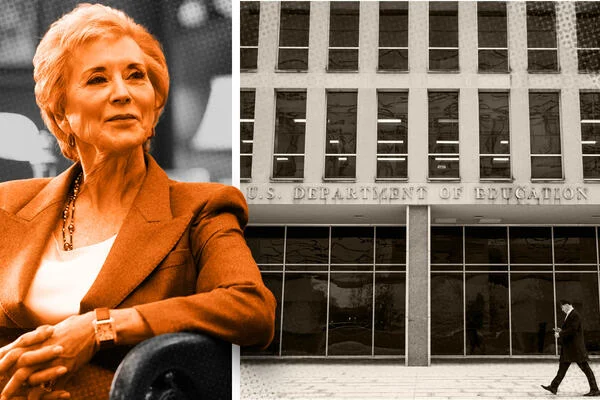
    Photo illustration by Justin Morrison/Inside Higher Ed | Anna Moneymaker/Getty Images | Pete Kiehart for The Washington Post via Getty Images

    More than 70 colleges, universities, nonprofits and other organizations are sharing $169 million to advance a number of the Trump administration’s priorities.

    Those include accreditation reform, promoting civil discourse, short-term workforce training programs and advancing the use of artificial intelligence in higher education. The Education Department announced the grant competition in November and said Monday that it had awarded the funds, which have historically gone to programs that support student success.

    Colleges received funding to switch accreditors, start short-term programs that will be eligible for the new Workforce Pell program, hold workshops on constructive dialogue and support peer-to-peer engagement in civil dialogue.

    Just over $50 million apiece went to the AI, civil discourse and Workforce Pell priorities, while projects related to accreditation received nearly $15 million, according to an Inside Higher Ed analysis of department data. All the grants in this tranche are for four years.

    Two new accreditors planning to seek federal recognition—the Postsecondary Commission and the Commission for Public Higher Education Inc.—each received $1 million. The department also awarded $1 million to the University of Rochester for its plans to establish an accreditor focused on higher education certificate programs that serve students with intellectual disabilities, and another $1 million to Valley Forge Military College, which wants to create a new hybrid accrediting agency for military-aligned associate and certificate programs. (Valley Forge Military College is one of several institutions that have indicated interest in the Trump administration’s compact for higher education.)

    Meanwhile, Davidson College’s Institute for Public Good is getting nearly $4 million to create the Deliberative Citizenship Network across 100 colleges and universities, according to a news release. Among other goals, the network aims to train faculty and staff on how to facilitate forums on difficult topics and create teaching resources that can be widely shared.

    “With this funding, we will reach thousands of students and educators nationwide,” Chris Marsicano, executive director of the institute, said in a statement. “Davidson’s Institute for Public Good will serve as a national hub that connects research, teaching and public engagement around respectful inclusion across political viewpoints—no matter how unpopular on campus—as well as participating in community efforts to examine, talk through and solve big problems.”

    The department’s initial announcement about the awards didn’t provide specific information about the funded projects, but the agency briefly posted documents Monday afternoon outlining which institutions received awards and for how much. Inside Higher Ed captured some of that information before the documents were taken down and compiled the details into a searchable database below. A department spokesperson said the final documents should be posted next week.

    In the meantime, Inside Higher Ed reached out to the identified institutions for more information about how they plan to use the grant funding. The database will be updated as they respond.

    The grant money comes from the Fund for Improvement of Postsecondary Education, which has historically supported programs related to student success. Those include the Basic Needs, Veteran Student Success and Postsecondary Student Success programs. But in November, the Education Department announced plans to send the funds to a different special projects program—a move that Democrats and advocates criticized. Department officials say this round of funding, for which they “received a historic number of applications,” will help to support students through their academic journeys.

    “This historic investment will realign workforce programs with the labor market, break up the accreditation cartel and support institutions who want to change accreditors, and strengthen responsible use of AI in the classroom,” said Ellen Keast, a department spokesperson, in a statement. “These investments will open new, affordable higher education alternatives to American families, and we are very excited to see federal dollars driving change in the sector that is long overdue.”

    Some critics have raised concerns about the truncated grant-review process. Typically, the FIPSE grant competition opens in the spring and awards go out by Dec. 31, one former department official said. They also question who will administer the program moving forward. Like other higher ed grant programs, FIPSE is slated to move to the Labor Department under agreements announced late last year.

    Source link

  • The fragile future of EDI demands bold university leadership

    The fragile future of EDI demands bold university leadership

    Higher education institutions are absolutely critical to enabling communities, economies, knowledge, and innovation to tackle the most pressing issues and advance as a diverse society.

    Alongside this, universities would not exist if they did not prioritise and invest in equal and equitable opportunities, access, and connecting with diverse and intersectional communities across the world.

    Upon reflecting on the role higher education has played throughout history, we know that universities have never played it safe.

    Our higher education sector performs an instrumental role in being a critical mirror to social, cultural, and political narratives.

    However, it is challenging to be critical when societal views and beliefs are polarised, with only some who are able to cultivate opportunities to build good relations and celebrate differences.

    Value and values

    It is amongst such divisive rhetoric that there are movements questioning the value of equality, diversity, and inclusion in organisations, systems, and society – we make a statement not to minimise the profession by using the acronym.

    The world opened their eyes in 2020, again, to the intersectional trauma of structural racism, sexism, classism, harassment, bullying, victimisation, and discrimination, to name some.

    The higher education sector “reacted” to impress on society that equality, diversity, and inclusion would be sustained to protect the civil liberties of staff and students, who help to ensure that our institutions play a transformative role in education and society.

    Five years on, we find ourselves in a time where equality, diversity, and inclusion have, in some cases, been absolved into safer initiatives like “organisational development” and “social responsibility”.

    These initiatives can often disguise the goodness of the work towards equality, diversity, and inclusion rather than champion it to the world.

    This is not a new issue for those helping to cultivate a socially just, fair, dignified, and respectful society. The work of equality, diversity, and inclusion has always been precarious, and the “academy” is a microcosm reflective of wider society.

    The risk-aversion and caution often adopted by universities as a result can be performative, rarely penetrating the deep-rooted structural and systemic problems that permeate the sector.

    Another American import

    This precariousness is now tested from discussions to end diversity, equality, and inclusion from across the Atlantic.

    While we may feel the physical distance, recent reports highlight that UK universities receiving funding from the USA have to prove none of their spend is going towards diversity, equality, and inclusion. This highlights a level of political interference in the autonomy of universities not often seen before.

    We, as the higher education community, know why equality, diversity and inclusion matters, so let us look at the data from McKinsey & Company’s 2023 research:

    • More diversity in both boards and executive teams, in both gender and ethnicity, is correlated with higher social and environmental impact scores.
    • Organisations in the top quartile for gender diversity are 39 per cent more likely to outperform peers.
    • Organisations in the top quartile of board-gender diversity are 27 per cent more likely to outperform financially.
    • 77 per cent of consumers are motivated to purchase from organisations committed to making the world a better place.
    • Higher levels of ethnic representation in leadership teams are correlated with higher financial, social, and environmental sustainability across the board.
    • A strong link between leadership diversity and a motivated workforce.

    Recent research from the University of Oxford, UCL Policy Lab, and More in Common found that:

    “Britons are five times more likely to express positive views about EDI and that the initiatives are beneficial to them.

    Recently, UCL Provost Michael Spence made a public statement highlighting:

    “We are, and were always intended to be, an institution to which it is possible to bring your ‘whole self,’ to bring your history, culture, identity, and views of the world, free of arbitrary discrimination… If we do not, then we run the risk of only poorly serving the needs of this wonderful, global, and incredibly diverse city – London – of which we are a part.

    In resistance to those wanting to dismantle diversity, equality, and inclusion in higher education across the Atlantic, Harvard University released a statement saying that:

    “…no government regardless of which party is in power should dictate what private universities can teach, whom they can admit and hire, and which areas of study and inquiry they can pursue.

    We see some institutions speaking truth to power to safeguard academic and educational freedom, equitable access, and liberty. It is in this climate that higher education institutions need to strengthen their collective voice to safeguard the championing of equality, diversity, and inclusion that are essential to the civic impact of universities.

    It is remarkable that there is resistance to helping create and sustain a more equitable, fair, dignified, respectful, socially just, and inclusive society. This is a resistance that exists and appears to be rising.

    For institutions who are yet to re-affirm their commitment to equality, diversity, and inclusion, we ask these questions – is this what we are and is this who you want to be?

    Source link

  • NIH cap on indirect research costs struck down on appeal

    NIH cap on indirect research costs struck down on appeal

    This audio is auto-generated. Please let us know if you have feedback.

    Dive Brief:

    • A federal appeals court ruled on Monday that the National Institutes of Health cannot cap research overhead funding across the board, upholding an April lower court decision that spelled relief for beleaguered universities.
    • The 1st U.S. Circuit Court of Appeals unanimously concluded that NIH violated statutory law and the agency’s own regulatory procedures when it issued a policy capping reimbursement rates for indirect research costs at 15% for current and new grants.
    • The ruling is the latest blow to the Trump administration’s attempts to have multiple federal agencies cap indirect cost reimbursement rates at 15%. NIH on Tuesday declined to comment on the ruling or say if it planned to appeal.

    Dive Insight:

    When NIH issued the contested guidance in early February, it said it expected the move to save $4 billion — money that it planned to funnel toward financing direct research costs for institutions. 

    The move — widely panned in the academic community and elsewhere — broke with long-standing procedure of negotiating reimbursement rates with individual research institutions. For many large research universities, those rates top 50% and help pay for things like information technology, utilities, administrative support, and building and running laboratories. 

    These negotiations, built into NIH’s regulations, were also codified by Congress during the first Trump administration. Legislators passed an addition to an appropriations bill that advocates and judges have said specifically bars NIH from drawing up a universal reimbursement rate rather than negotiating individually with grantees. 

    NIH’s new policy drew multiple lawsuits, with high stakes looming while the legal battle played out. As one researcher at the University of Alabama at Birmingham put it, the cap would “cripple research infrastructure at hundreds of US institutions, and threatens to end our global superiority in scientific research.” 

    In court documents, scores of universities have described in detail how NIH’s 15% indirect cost cap would imperil their medical research operations and workforces, as well as the country’s ability as a whole to advance biomedical science — historically one of the U.S.’s major economic strengths. A February New York Times analysis found the policy could cost some of the top research universities over $100 million a year in funding. 

    As federal appellate Judge Kermit Lipez, a Clinton appointee, noted in this week’s ruling, NIH research has led to major medical breakthroughs and lowered death rates from conditions such as heart attacks and strokes. 

    In short, the public-health benefits of NIH-funded research are enormous,” Lipez wrote.

    In March, a district court judge ruled the new policy illegal and issued a preliminary injunction against it, followed by a permanent injunction in April. Despite the setbacks, the Trump administration has tried instituting identical caps at other agencies — namely, the U.S. departments of Energy and Defense, and the National Science Foundation. Federal judges so far have blocked those moves as well.

    Several of those opposing NIH’s cap, which included a coalition of state attorneys general, lauded this week’s ruling. 

    The Trump Administration wanted to eviscerate funding for medical research that helps develop new cures and treatments for diseases like cancer, diabetes, and Alzheimer’s,” California Attorney General Rob Bonta said in a statement Monday. “We’re starting the new year by building on our previous successes and securing yet another important victory against the Trump Administration.”

    Source link

  • Martin University will close after short-lived ‘pause’

    Martin University will close after short-lived ‘pause’

    This audio is auto-generated. Please let us know if you have feedback.

    Dive Brief:

    • Martin University, Indiana’s only predominantly Black institution, will close, according to its board.
    • The announcement comes after the private Indianapolis nonprofit said on Dec. 9 it would temporarily cease operations at the end of the year in an effort to find a path toward long-term viability. 
    • Instead, Martin’s trustees are now looking to “wind down operations with dignity, transparency and compassion.” The board cited declining enrollment, increasing costs and a growing institutional debt in a Dec. 31 letter published through Indianapolis Recorder Newspaper.

    Dive Insight:

    Martin’s accreditor, the Higher Learning Commission, directed the university to cease operations after it announced the pause, according to university board members. HLC has either sanctioned the university or had it on monitoring status since 2012.

    A public disclosure from HLC shows Martin “voluntarily resigned” its accreditation as of Dec. 31.

    “Combined with the lack of sufficient operating revenue, Martin has had no choice but to move toward closure,” the board said.

    Martin has maintained a small student body since its founding in 1977. But like many small private colleges, its enrollment has suffered in recent years.

    In fall 2023, just 223 students attended Martin, down nearly 30% from five years prior, according to federal data.

    Those students primarily came from backgrounds underrepresented in higher education, a point of pride for Martin. In fall 2023, 74% of its undergraduate students were age 25 or older, and more than 4 out of 5 students were Black or African American. Another 71% received Pell Grants for the 2022-23 academic year, according to the most recent federal data.

    But a majority of those who attended Martin, 85%, did not graduate within eight years, according to the U.S. Department of Education’s College Scorecard.

    Now the path to a degree becomes less clear for the students who remain.

    Martin is in the process of establishing teach-out plans for its students, the board said. HLC has signed off on at least one such agreement with the University of Indianapolis. And nearby Marian University and Indiana Wesleyan University have expressed interest in supporting Martin’s students, according to a Dec. 16 email to students obtained by Mirror Indy.

    Each of the university’s students will receive an individualized support plan, the board said.

    The board’s Dec. 31 letter marked the end of a short-lived recalibration attempt.

    Just days after announcing the initial pause announcement, Martin laid off all of its employees, WISH-TV reported.

    “They said they don’t know when they will get us paid,” Kory Amyx, Martin’s now-former senior financial aide and veteran affairs adviser, told WISH. 

    The board confirmed when announcing the pause that Martin had no endowment funds. The university’s interim president, Felicia Brokaw, went a step further when she reportedly told staff Martin’s coffers were completely empty, according to WISH.

    “They plan to get us paid, but whether that happens tomorrow, the next day, a month, a year, who knows?” Amyx said.

    Martin’s former president, Sean Huddleston, left the university in November after six years in the job. Through his last day, Huddleston had worked to keep the university viable, but nothing sustainable panned out, according to Board Chair Joseph Perkins.

    “Over the past several years, university leadership explored a number of different educational models designed to honor the founders’ mission while adapting to the realities of modern higher education,” the board said on Dec. 31.

    Its members pursued donors, enrollment growth strategies, and partnerships with business, local organizations and other colleges.

    “Despite these intensive efforts, none produced the financial or enrollment progress necessary to sustain operations,” it said.

    The board’s closure announcement acknowledged Martin’s numerous recent struggles but did not delve into any specifics.

    A fiscal 2023 audit found “substantial doubt” about the university’s ability to keep operating, citing enrollment challenges, increased borrowing to sustain itself and the “use of restricted funding for operational needs.”

    Martin also experienced an extensive cyberattack in 2022 that corrupted its records. The recovery process required considerable time and effort “due to significant turnover and instability in the finance and operation teams,” the 2023 audit found.

    Source link

  • Morgan State says cut the cameras, stop the presses

    Morgan State says cut the cameras, stop the presses

    Sourcing is one of the most foundational skills any journalist learns. But at Morgan State University, the student press is effectively barred from speaking to faculty or staff without prior approval. In other words, for student journalists writing about their own university, basic sourcing is banned unless exceptions are made at the whim of an administrator.

    MSU has historically encouraged media to coordinate requests for such interviews through its Office of Public Relations and Strategic Communications. But on Nov. 13, OPRSC Director Larry Jones escalated the university’s suggestion into a demand in an email to the school community, specifically targeting student media with new requirements.

    Now reporters from The MSU Spokesman, BEAR TV, and WEAA 88.9 FM must clear all interviews involving the university or its operations with the OPRSC. Even more astonishingly, the same rule applies even if the interview request doesn’t directly relate to university matters, but nonetheless occurs on campus.

    Journalism doesn’t come with a permission slip.

    The new directive didn’t stop there. Any filming not sponsored by the university that takes place on campus is now subject to a “comprehensive review and approval process” by the university’s communications office.

    FIRE’s Student Press Freedom Initiative teamed up with the Society of Professional Journalists to remind MSU of the student press’s rights to speak to sources and report on campus-related news. It should not have to be said, but journalism doesn’t come with a permission slip.

    Questions unasked

    The plain language of MSU’s policy prevents student journalists from merely asking school-affiliated sources to answer questions, even though such requests are themselves protected expression. The policy suppresses this speech before it can even occur — a textbook example of prior restraint, which the Supreme Court has called “the most serious and least tolerable infringement” on free speech.

    A university afraid of questions is a university afraid of answers. 

    Questions unasked are questions unanswered. Faculty and student employees, who would speak in their private capacity on topics of public concern, have the right to share their views. If public university employees don’t present themselves as representing the university, and are speaking about newsworthy issues, their statements are generally protected speech. MSU can tell employees not to speak on behalf of the university, but it can’t issue a blanket ban on employees’ ability to speak with the press. Now, however, faculty and staff cannot offer their own opinions in response to a student media request.

    These restrictions are rarely valid, which is why many of the colleges and universities that SPFI has contacted have rolled back such policies. But MSU is not one of them, at least not yet. And this is really not a good look because a university afraid of questions is a university afraid of answers.

    B-roll blackout 

    MSU pulls campus filming into its restrictive policy, too. Both professional and student newsrooms across the country gather video footage to support their storytelling, a practice that is increasingly common due to the widespread availability of smartphones and social media. B-roll, or supplementary video footage used to add context to a story — such as an establishing shot of the university campus or a scene of students studying in the library — cannot be filmed at all if the shots include any of MSU’s outdoor areas, at least not without OPRSC approval. The same goes for filmed interviews. 

    Morgan State University: Public Calls on Morgan State University to Punish Faculty for Charlie Kirk Comments

    The public has called on Morgan State University to discipline faculty for exercising their free speech rights when commenting on public issues.


    Read More

    But breaking news doesn’t wait to happen until an administrator has reviewed and approved a film request. Open, outdoor areas of a university are generally public fora, where student expression is at its most protected. Instead of enhancing students’ newsgathering or teaching them how to be better reporters, the school is instead delaying, if not outright suppressing, multimedia journalistic efforts along with faculty interviews. 

    By targeting the student press specifically, MSU is sending a clear message that it doesn’t want its student journalists addressing questions about important campus issues to those most personally affected by them. That message runs counter to the very fundamentals of journalism. The result, possibly by design, will be that many stories will likely die on the vine for lack of sunlight. And even for those that survive, they’d better not include video footage unless an administrator signs off first. That’s not media policy. It’s message control.

    Source link

  • Higher Education Inquirer : End of an Era

    Higher Education Inquirer : End of an Era

    We extend our deepest gratitude to the many courageous voices who have contributed to the Higher Education Inquirer over the years. Through research, reporting, whistleblowing, analysis, and public service, you have exposed inequities, challenged powerful interests, and helped the public understand the realities of higher education.

    Special thanks to:

    Bryan Alexander (Future Trends Forum), Stephen Burd (New America), Ann Bowers (Debt Collective), James Michael Brodie (Black and Gold Project Foundation), Randall Collins (UPenn), Keil Dumsch, Garrett Fitzgerald (College Recon), Richard Fossey (Condemned to Debt), Erica Gallagher (2U Whistleblower), Cliff Gibson III (Gibson & Keith), Henry Giroux (McMaster University), Terri Givens (University of British Columbia), Nathan Grawe (Carleton College), Michael Green (UNLV)Michael Hainline (Restore the GI Bill for Veterans)Debra Hale Shelton (Arkansas Times), David Halperin (Republic Report), Bill Harrington (Croatan Institute), Phil Hill (On EdTech), Robert Jensen (UT Austin), Seth Kahn (WCUP)Hank Kalet (Rutgers), Ben Kaufman (Protect Borrowers)Robert Kelchen (University of Tennessee)Neil Kraus (UWRF), LACCD Whistleblower, Michelle Lee (whistleblower), Wendy Lynne Lee (Bloomsburg University of PA), Emmanuel Legeard (whistleblower), Adam Looney (University of Utah), Alec MacGillis (ProPublica), Jon Marcus (Hechinger Report)Steven Mintz (University of Texas), Annelise Orleck (Dartmouth), , Margaret Kimberly (Black Agenda Report), Austin Longhorn (UT student loan debt whistleblower), Debbi Potts (whistleblower), Jack Metzger (Roosevelt University), Derek Newton (The Cheat Sheet), Jennifer Reed (University of Akron), Kevin Richert (Idaho Education News), Gary Roth (Rutgers-Newark), Mark Salisbury (TuitionFit), Stephanie Saul (NY Times), Christopher Serbagi (Serbagi Law), Bill Skimmyhorn (William & Mary)Peter Simi (Chapman University), Gary Stocker (College Viability), Strelnikov, Theresa Sweet (Sweet v Cardona), Harry Targ (Purdue University), Mark Twain Jr. (business insider), Michael Vasquez (The Tributary), Richard Wolff (Economic Update), Helena Worthen (Higher Ed Labor United), DW (South American Correspondent), Heidi Weber (Whistleblower Revolution), government officials who have supported transparency and accountability, and the countless other educators, researchers, whistleblowers, advocates, and public servants whose work strengthens our understanding of higher education.

    Together, you form a resilient network of knowledge, courage, and public service, showing that collective insight can illuminate even the most entrenched systems. Your dedication has been, and continues to be, invaluable.
    Dahn Shaulis and Glen McGhee

    Source link

  • A Mandate for Transformation: Inside the 2026 Marketing and Enrollment Management Benchmarks 

    A Mandate for Transformation: Inside the 2026 Marketing and Enrollment Management Benchmarks 

    For too long, institutions have operated under an enrollment model built for a market that no longer exists. That status quo persists because it benefits entrenched service providers who profit from preserving the illusion that yesterday’s playbook will solve tomorrow’s challenges. These models feel safe, but they quietly divert resources away from the work of real institutional evolution. 

    At EducationDynamics, we reject that approach. We refuse to manage a legacy of decline. We are actively dismantling the traditional enrollment playbook to meet a new reality defined by rapid AI advancement, fundamental shifts in student behavior and a growing demand for data-driven action. 

    The 2026 Marketing and Enrollment Management Benchmarks is more than a collection of data. It is a strategic blueprint for institutions willing to challenge convention. Traditional benchmarks act like a rearview mirror. These benchmarks define the road ahead, focusing on the forces now driving growth: brand authority, AI visibility, intent-rich audiences, operational speed and measurable value. 

    The Forces Defining Higher Ed in 2026

    These trends are not incremental adjustments or cosmetic shifts. They represent a structural reset in how students discover institutions, how trust is earned and how enrollment engines generate growth. Together, they form the pillars of survival for institutions that intend to compete in the next decade, not merely endure it. 

    1. High-Value Branding

     Winning institutions treat brand equity and transparency as primary drivers of top-of-funnel performance. In an era of automated information, trust is the only currency that matters. Reputation is the new SEO. If students don’t trust you, they never search for you. 

    By 2025, nearly 60% of online learners started their journey by searching for a specific institution—a 354% increase in brand-first searches since 2015. The funnel is no longer program-first. Your brand is the search term. If students don’t already believe in your value, you may never enter their consideration set.

    This shift makes it clear: reputation, trust and visibility now shape the top of the enrollment funnel more than any single program. Institutions that invest in brand equity, AI-ready SEO and consistent messaging across channels are the ones that show up first when learners start their search. 

    Visibility is no longer earned by keywords alone; it is earned with reputation, authenticity and authority—especially in AI-driven environments: 

    • Answer Engine Optimization (AEO): Provide concise, factual responses to zero-click queries so AI surfaces your brand as the answer. 
    • AI Density: Measure how often your institution appears as a cited source within AI ecosystems, your new visibility metric in a Search Everywhere world. 

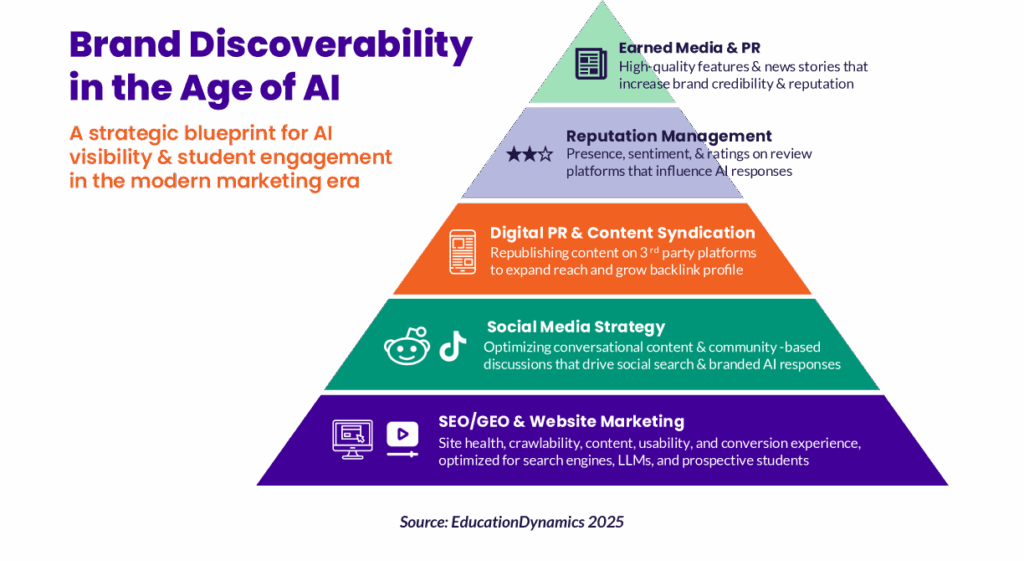
    The report introduces the AI Visibility Pyramid, a strategic framework that connects brand reputation, content, reviews and earned media into one system designed to make your institution the trusted answer inside AI ecosystems—not just another result if someone happens to click. 


    2. “Search Everywhere” Transformation

    The traditional search results page is disappearing. It is being replaced by conversational AI and a multi-platform ecosystem where students demand answers, not links. Visibility is now a conversation, not a click. 

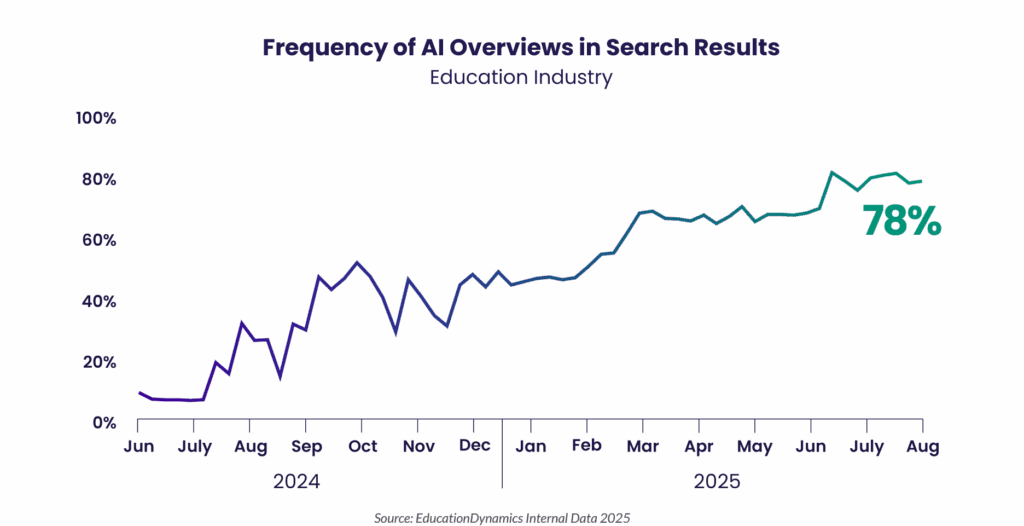
    An estimated 78% of education-related searches now return an AI Overview, and nearly 45% of Google searches end without a click. Students are building shortlists and making decisions from AI overviews, chatbots, social feeds and video long before your institution’s website loads. If your brand isn’t present in these AI-driven answers, you’ve lost the conversation before you see the prospect. 

    3.The Efficiency Imperative 

    Cost inflation is no longer a future concern. It is the operating reality for higher education marketing. In 2025, total digital media spend surpassed $2.77 billion, yet rising costs failed to produce proportional performance gains. 

    Efficiency across traditional acquisition channels has eroded. Non-brand paid search CPCs climbed 30.9% year over year, increasing the cost of competing on generic, high-intent keywords. That pressure is amplified by zero-click search behavior, which continues to weaken keyword-driven volume strategies. 

    In this environment, efficiency is not a budgeting exercise. It is a competitive advantage. Institutions outperforming the market are using AI-driven attribution models to understand how organic, paid, and brand touchpoints actually influence enrollment. The focus shifts from chasing clicks to identifying high-intent learners earlier and engaging them with precision. 

    The Efficiency Imperative is about where and how institutions invest. In 2026, growth will favor those who deploy capital intelligently, align messaging to intent, and reach the right learner at the decisive moment. 

    4. Value Outperforms Volume

    Inquiry volume once signaled success. In 2026, it signals inefficiency. High volumes of low-intent leads inflate costs, overwhelm admissions teams, and obscure real demand. 

    Institutions can no longer rely on inquiry-driven attribution to understand the market. Many of today’s strongest prospects never raise their hand. Growth now depends on brand authority within AI ecosystems, content structured for conversational search, and predictive models that surface high-intent learners before a form is ever submitted. 

    The data confirms this shift. Career Changers and Leadership Track learners convert at 9.75% and 15.73%, far outperforming less motivated segments. These learners are decisive, outcome-driven, and ready to act when value and ROI are clear. 

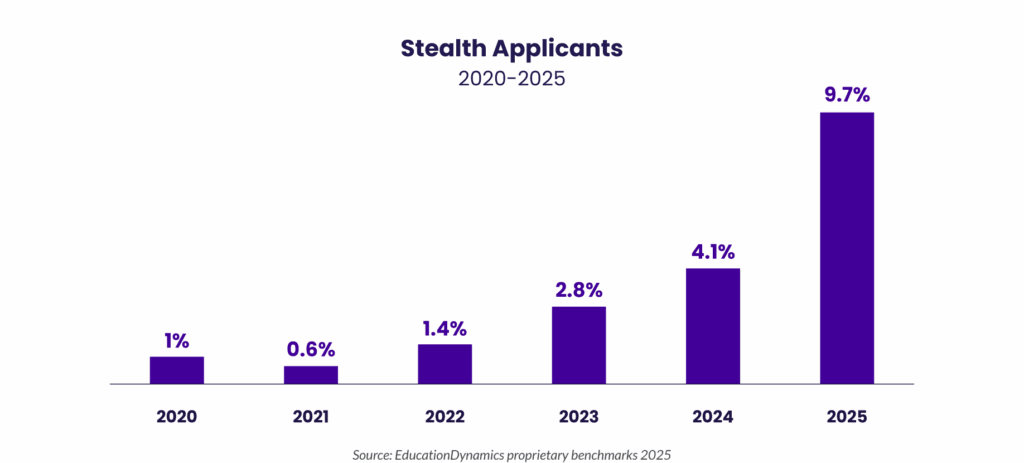
    At the same time, stealth applicants now account for 9.7% of total applications, up from just 1% in 2020. They research independently, build their own shortlists, and apply when confident, often without entering a traditional funnel. 

    Institutions that prioritize motivation, fit, and outcomes over raw inquiry counts build smarter funnels that convert faster and operate more efficiently. In 2026, success is defined not by how many leads you generate, but by how many of the right students you enroll.

    What this Means for Higher Ed Leaders 2026  

    Higher education has entered a new era, and the data leaves no room for debate. Modern Learners have rewritten how institutions are discovered, evaluated and chosen.  

    Institutions that prioritize scale over substance will fall behind in a market defined by AI-driven search, zero-click behavior and value-first decisions. Survival is not the goal. Growth is. 

    The strategic imperatives that follow are not recommendations. They are the minimum requirements for relevance in 2026 and beyond. 

    The Strategic Imperatives Higher Ed Leaders Must Prioritize 

    1. Mechanize Brand Authority for a Zero-Click World  

    Nearly half of searches now end without a click. Visibility no longer belongs to the best-ranked institutions. It belongs to the most trusted brands. In a zero-click world, institutions must optimize for AI Density, ensuring brand content, outcomes data and FAQs are cited inside AI Overviews, while actively defending brand authority across the decentralized platforms that shape AI answers. 

    2. Pivot from Lead Volume to Enrollment Value  

    The era of buying growth through lead volume is over. Rising CPIs have made mediocre leads an expensive distraction. More leads are not the objective. Enrolling the right students is. Success in 2026 requires abandoning vanity metrics and optimizing toward Cost per Application and Cost per Enrollment using first-party data and AI-driven optimization. 

    3. Engineer Velocity into the Funnel  

    Modern Learners move fast and reward speed. Most enroll at the first institution that admits them. Delay kills conversion. Institutions must design for velocity at every stage, using AI as a 24/7 admissions concierge to answer questions, engage stealth researchers, and eliminate friction across the funnel. 

    4. Move from Performative to Operational AI  

    In 2026, the greatest barrier to progress is not technology, but cultural paralysis. Institutions waiting for a “perfect plan” will end up optimizing a strategy the market has already outgrown. AI cannot live on the sidelines. Leadership must treat it as operational infrastructure, championing upskilling and cross-functional integration across marketing and enrollment. The advantage comes from using AI to drive real-time personalization and faster decisions, not from experimenting in isolation. 

    Source link

  • Higher Education Inquirer : A Syllabus of Resistance

    Higher Education Inquirer : A Syllabus of Resistance

    Higher education today demands that we strip away illusions. The university is no longer a sanctuary of truth but a contested battleground of austerity, automation, and alienation. Students, adjuncts, and staff are caught in a cycle of debt, precarity, and surveillance. To resist, we need not another glossy strategic plan but a syllabus — a curriculum of solidarity, transparency, and rehumanization.

    Debt defines the student experience. Student loan balances now exceed $1.77 trillion, and repayment programs like PSLF and income-driven repayment offer only partial relief. In 2024, as federal student loan payments resumed after a pandemic pause, millions of borrowers simply refused to pay, transforming individual debt into collective action. The Debt Collective has organized strikes and campaigns to cancel student debt, reframing borrowing as a political issue rather than a private burden. This movement challenges whether the entire financing model of higher education can survive.

    Faculty labor is equally precarious. More than seventy percent of instructors are contingent, often earning poverty wages without benefits. At Harrisburg Area Community College, over 200 faculty went on strike in November 2025 after years of stalled negotiations, exemplifying a growing national labor movement against stagnant pay and weakened job security. Adjunct faculty unions at Rutgers and elsewhere continue to push back against layoffs and austerity measures. The crisis of contingent labor has moved from quiet exploitation to open confrontation.

    Climate crisis compounds the meltdown. Universities expand globally in a frenzy of collegemania, while ignoring ecological collapse. Student activists demand divestment from fossil fuels, but boards often resist. At Princeton, campaigners uncovered that the university owns a controlling stake in PetroTiger, a fossil fuel company, profiting directly from extraction. Edge Hill University in the UK recently committed to divest from both fossil fuels and border security companies after sustained student pressure. The University of Illinois, despite pledging to divest years ago, still faces protests demanding action. These campaigns show that climate justice is inseparable from educational justice.

    Surveillance intensifies alienation. Universities increasingly deploy corporate partnerships and AI tools to monitor student dissent. At the University of Houston, administrators contracted with Dataminr to scrape students’ social media activity during Palestine solidarity protests. Amnesty International has warned that tools like Palantir and Babel Street pose surveillance threats to student activists. Truthout reports that campuses have become laboratories for military-grade surveillance technology, punishing dissent and eroding trust. Education becomes transactional and disciplinary, leaving students reporting higher levels of stress and disconnection.

    Resistance must also be moral. University governance remains hierarchical and opaque, resembling corporate boards more than democratic institutions. Calls for transparency and veritas are drowned out by branding campaigns and political capture. A pedagogy of resistance must be rooted in temperance, nonviolence, and solidarity. Rehumanization is the antidote to robostudents, roboworkers, and robocolleges. It is the refusal to be bots, debtors, or disposable labor, and the insistence on reclaiming education as a public good.

    Developing a Democratic Syllabus of Resistance

    This syllabus is not a catalog of courses but a call to action. Debt strikes, adjunct unionization, climate divestment campaigns, and surveillance pushback are fragments of a larger curriculum of resistance. But this syllabus is incomplete without you. Readers are invited to join in creating it — to add new units, case studies, and strategies that reflect the lived realities of students, workers, and communities.

    For inspiration, see the Higher Education Inquirer’s earlier piece on Methods of Student Nonviolent Resistance, which documents the long history of campus activism and the evolving tactics of protest, persuasion, and noncooperation. That archive reminds us that resistance is not only possible but essential.

    The classroom is everywhere, and the time is now.

    Source link