Canada’s heading into some pretty choppy waters in 2025. For a century or so, we’ve had a one track economic strategy, closer integration with the United States. Now, the Trump administration with its faith in tariffs as an instrument of both power and corruption, has essentially nuked that strategy, at least as far as the trading goods is concerned. There’s a lot of change coming to Canada, and it’ll be costly. In much the same way that diplomatic evolution and defense needs are forcing European countries to look at higher education in a different light, Canadian universities are looking around at their new situation very nervously too.
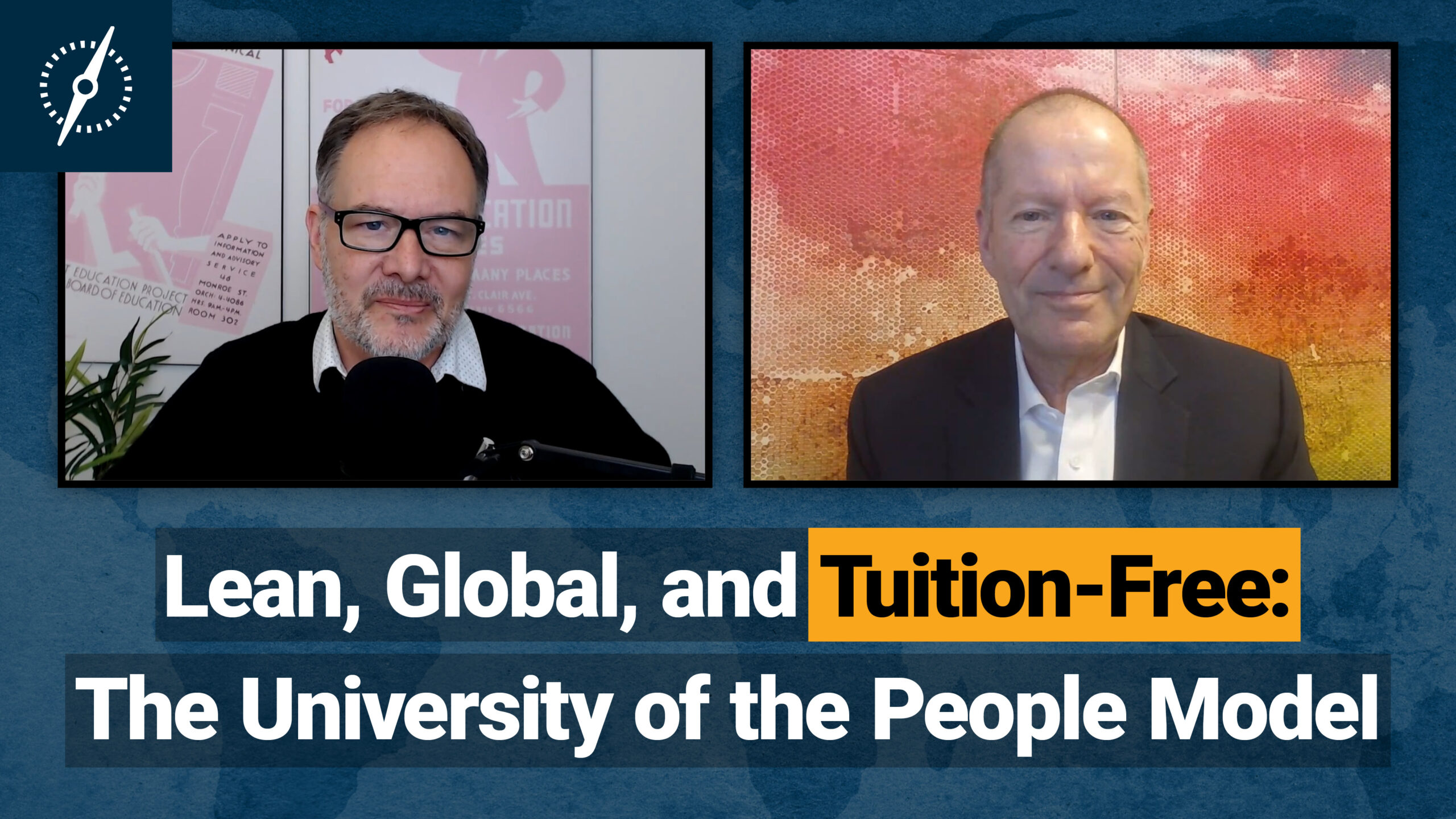
In Canada right now, a few people are making the case for change as strongly as John Stackhouse. John’s the ex editor-in-chief of the Global Mail. He’s now a Senior Vice President at the Royal Bank of Canada, leading that organization’s economics and thought leadership group. He’s the lead author of a recent report called “A Smarter Path, the Case for Post-Secondary Reform.” This report makes a number of, shall we say, uncomfortable observations about the relationship between Canadian higher education and the Canadian knowledge economy, in particular, between high spending and high graduate numbers on the one hand, and low productivity and significant levels of graduate underemployment on the other.
Though the report does not directly address the issue of Trump or tariffs — it was released 48 hours before Liberation Day — it has added to the sense in Canada that the higher education sector is headed for and indeed needs a shakeup. And just to come clean for a moment, we here at Higher Education Strategy Associates are in a partnership with John and RBC and the Business Higher Education Roundtable, putting together a series of events culminating in a policy summit on post-secondary education in late September of this year.
In the interview today, I talked to John about what the Canadian system’s biggest challenges are, how universities and businesses can more effectively partner with one another, and why Canadian political parties are increasingly shy about betting on the knowledge economy. But enough for me. Let’s turn it over to John.
The World of Higher Education Podcast
Episode 3.30 | Banking on Human Capital: How RBC Sees the Future of Talent, Innovation, and the Role of Post-Secondary Institutions
Transcript
Alex Usher (AU): Okay, John, why does a bank care so much about post-secondary education?
John Stackhouse (JS): That’s a fair question, Alex—and thank you for including us in the podcast. If I can put it in terms of capital, maybe that’s what people would expect from a bank. Our economy, and the society that depends on it, relies on different kinds of capital. We have natural capital, technology capital, and of course, financial capital—which you’d expect from a bank. But just as critical is human capital. That’s core to the economy.
There’s nothing new in saying that, except to emphasize that from RBC’s perspective, when we look at Canada’s prospects through the 2030s and the prosperity we hope to achieve, we need to think seriously about how we harness all these forms of capital: natural, financial, technological—and critically—human capital.
We need to develop a more prosperous economy and society, but also the kind of vibrant communities that companies want to be part of, and that we as individuals want to contribute to. As a bank, that matters to us. Our purpose is to help clients thrive and communities prosper—and both of those depend on human capital. We hear that from our clients, our community partners, and our employees. So those are just some of the reasons why RBC is leaning into the post-secondary conversation.
AU: In the paper you co-wrote, you describe Canada’s post-secondary education system as being slow, costly, and often out of sync with the economy. I think those are fairly common criticisms of higher education around the world. Do you think there’s something specific to Canada in that critique? Or is this more of a general observation about modern higher ed?
JS: There’s probably some parchment from a thousand years ago where an education critic wrote, “You’re too slow, too costly, and out of touch with the economy.” -Signed, the monks of higher education. But yes, it’s fair to say that Canada isn’t alone in facing these challenges. That said, there are a few things that may be more pronounced here. One is that we’ve been a bit of a victim of our own success. We have a lot of post-secondary education in this country, but we haven’t differentiated enough within the system.
Continental Europe, for example, continues to differentiate in ways we haven’t. So we end up producing graduates with degrees and diplomas that are too similar—and not always aligned with specific needs.
We also haven’t allowed the business model to evolve at the pace of the economy or society, or even the expectations of students and educators. Many of them know the world is moving faster than our institutions are.
And then on the research side—which I’m sure we’ll get to—we really lag behind. As an advanced economy, a G7 country, we’re not where we should be in post-secondary research. Part of the issue lies with the private sector—we haven’t integrated research and business to the degree that an advanced economy will need to in the 2030s.
AU: RBC has been a really strong voice on the education–work connection. What are employers still not getting from the current system? And what responsibility do you think they have in helping to improve it?
JS: There’s definitely a shared responsibility—and thanks for mentioning RBC’s commitment to work-integrated learning. One of the reasons we’re so invested in this is because our CEO, Dave McKay, is a product of the co-op system at Waterloo. He has a deep belief that work-integrated learning not only improves the student experience, but also strengthens the education system itself.
When students return to the classroom after applying their knowledge in the real world, it deepens their learning. And it also improves the organizations they work with. At RBC, we hire a couple thousand co-op students every year—not just programmers from Waterloo, but fantastic interns from TMU and a wide range of colleges and universities across the country.
We benefit from that. It improves how we work. Yes, it creates a talent pipeline—but we’ve also seen something more transformative. Over the past decade, we’ve started giving our co-op students real challenges to solve. We form teams, provide some management support, and tell them: here are some of our biggest problems—see you in August. Then they present their ideas to senior leadership in what’s essentially a competitive showcase. We’ve had around a hundred patents come out of that system.
Students bring critical thinking, fresh perspectives, and a collaborative mindset that they develop in post-secondary. They often arrive with stronger teamwork skills than we could teach them from scratch, and they’re able to apply those skills to real problems.
So what do employers need to do? They need to treat this as a serious investment in their own businesses. It’s a way to drive change, but it requires resources. You have to hire people who are good at managing these programs. Students don’t just walk in and figure it out on their own—it’s not Lord of the Flies. It takes organizational effort.
AU: Let’s talk about what educational institutions are doing. I got the impression from the report that you think they still need to do more to align educational outputs with labor market needs. That said, there’s been a lot of progress over the last decade: growth in work-integrated learning, the rise of microcredentials, experiments with competency-based learning. But it sounds like you don’t think that’s enough. What more needs to happen?
JS: Sadly—or depending on your perspective, maybe excitingly—none of us are doing enough. That’s partly because of technology, but also because of broader global forces. The world around us is changing faster than most of us are able to keep up with—including large organizations, small businesses, and educational institutions.
The pace of change is accelerating, and it will only continue to do so. Institutions need to become much more change-minded in how they operate. That’s hard in education, for all the reasons your listeners will understand.
One major challenge is the business model. It’s becoming a crisis. Post-secondary institutions aren’t getting the funding they need. Everyone knows that—but they’re losing the argument in the public square when it comes to making the case for new funding. And given the pressures society is under, I don’t see that changing in a meaningful way anytime soon.
So institutions need more freedom to change—to evolve their business models, including how they generate revenue. And that means becoming more connected to, and responsive to, the broader economy around them. That’s where many of the new opportunities lie.
AU: John, we’ve been talking mostly about human capital, which you’ve said is a key concern for RBC. But what about research and the co-production of knowledge? What are the respective roles of post-secondary institutions and businesses? Why don’t we see the kind of close connection between enterprises and universities that exists in parts of Europe or the U.S.? What’s the missing link?
JS: That’s a tough nut to crack—and one that people far smarter than me have studied and debated for decades. But part of the challenge lies in the private sector itself. In many ways, we’ve become too much of a “branch plant” and “hinterland” economy—living off the wealth of the land, our access to the U.S. market, and the dividends of an innovation economy.
I wouldn’t say that’s coming to an end—because that would be overly dramatic—but we’re clearly experiencing a sharp shift. In an odd way, the Trump challenge to Canada is a bit of a gift. It’s forcing us to acknowledge that we can’t be so dependent on the U.S. market. That’s become a broadly shared Canadian view. We need to build stronger connections with other parts of the world—and that’s going to require more serious investment in R&D from our businesses.
If we want to transform branch plants into independent, globally competitive facilities, especially ones that can succeed in European and Asian markets—despite the distance—we need to invest in research and development in a way we haven’t for a generation.
New governments—federal and provincial—need to act with urgency. They should bring business leaders together and ask, “What do we need to build?” And not just through one-off tax incentives. We need to foster a culture of collaboration and dynamism between universities, colleges, polytechnics, and businesses to shape what I’d call a post-Trump Canadian economy.
That’s not going to happen by copying Germany’s Fraunhofer model or Japan’s approach—those are deeply rooted in specific cultural contexts. We need to develop something uniquely Canadian.
And we can’t afford to spend years on a Royal Commission or slow-moving studies. This needs to happen quickly. A new federal government could seize this moment to bring together the provinces and private sector with a sense of urgency—and maybe even a crisis mindset.
AU: I’ll come back to the Trump issue in a moment, but going back to the report—you lay out a number of challenges in the sector: outdated budget models, over-credentialed but under-skilled graduates, and so on. What do you think is the most pressing reform Canadian post-secondary needs right now? What’s the weakest link in the system?
JS: That’s a great question—and a hard one to answer. But I’d go back to the funding model. Post-secondary institutions need more flexibility to innovate with how they’re funded. They need to move beyond the constraints of provincial funding and develop new approaches to tuition and fees—ones that are more closely tied to performance, outputs, and outcomes.
There also needs to be more competition within the sector. Most people I know in post-secondary are pretty enthusiastic about that idea—though, understandably, they’d like the model to be structured so they have a good shot at succeeding.
I think provinces need to be nudged—and maybe not even that much—to open the door to more innovation, more competition, and a bit more daring on the institutional side.
AU: I think the words you used in the report were “reasonable deregulation.” Tell me more about increased competition—are there things we could do to incentivize more new players in the system who might be more disruptive?
JS: There’s nothing quite like new players. I’ve studied enough sectors over the years to see that when it comes to innovation, nothing works quite as well as a vibrant, well-funded new entrant. Encouraging that kind of disruption would move us forward significantly—and it would give creative people across the sector permission to come up with ideas they’re not even thinking about yet. That’s the power of competition.
So one key step is reducing the regulatory barriers that prevent those new players from entering the space.
I also think employers can play a bigger role by sending clearer market signals. That could be as simple as hiring differently. We tend to recruit from the same institutions over and over—often for good reasons—but “like hires like.” If we want to encourage new entrants, we have to show that their graduates will have good job prospects. That kind of signal travels fast—even down to the high school level, where students are making decisions about their future.
AU: Outside the scope of the report, you’ve been very outspoken in recent months about the gravity of the threat Canada faces from the U.S. under Trump. You spoke at the Business + Higher Education Roundtable event, and I know people who heard your remarks were quite sobered by them.
There are clearly big changes coming to the country as a whole. What are the implications for universities? What changes do you think are now baked into the systems of government subsidy and regulation because of the shifting geopolitical situation?
JS: It’s unfortunate that colleges and universities aren’t more central to the Trump-related conversation. We’re hearing a lot about pipelines, export infrastructure, and ports—which are all important. We’re also hearing a lot about trade-exposed sectors: autos, steel, aluminum, even pharmaceuticals. Guess what? All of those sectors depend on post-secondary institutions.
So how are we thinking about the steel plant of the future that might be exporting more to Europe or Asia? It’s going to need incentives to retool. The same goes for auto plants that may need to shift into different kinds of manufacturing—including, potentially, defense production as we scale up defense spending. What kind of talent will be needed for that? How are schools in those regions adapting? And to your point about research—how can we better integrate the research side of those institutions into this transformation?
They’ll need to develop new models—and we need to incentivize that shift. The good news is, I think there will be more money on the table. But it will be different kinds of research and institutional funding than what we’ve seen in the past. And that could be a good thing.
So how do colleges and universities rise to that challenge? There could be tens of billions of dollars available to support economic transition. They’ll need to step up and play a leading role—and if they do, they’ll be rewarded for it.
Interestingly, there’s already growing enthusiasm to attract academic talent from the U.S.—what some are calling “Trump intellectual refugees.”
I’ve seen similar cycles before. After 9/11, during the Bush years, there was a similar kind of excitement. Star academics moved here as a sort of cultural vote for Canada. But that kind of movement doesn’t tend to be sustainable—or even all that interesting—from a long-term perspective.
So how do we make it sustainable and interesting? One idea, from someone else, is to create a kind of Canada Research Chairs 2.0 for the late 2020s.
Not a play to say “Come escape Trump,” but rather to say: if you’re an entrepreneurial, ambitious academic working in areas that matter to Canada, there’s no better place in the world to be right now than here.
AU: One of the points you touched on earlier is that political parties seem to be responding to aggressive tariffs on exports by doubling down on producing goods. I find that kind of strange—surely one of the answers is to pivot more toward services. We’re not especially strong in that area, and in theory, that’s where universities should have an advantage. Why do you think we’re pushing so hard on goods while letting the services side drift?
JS: That’s a great observation. We’ve become more of a services—or maybe better put, an intangibles—economy. A knowledge economy. That was a popular thing to say a decade ago, though it’s become a bit derided since.
But we need both. You can have intangibles on their own, but the best ones tend to emerge from tangible activities.
We need to play to our strengths, and that includes our resource economy. One of the things we noted in our study is that post-secondary doesn’t align with the resource economy as well as it should. That doesn’t mean just producing miners and rig operators—though those roles will still matter for years to come. There’s a whole spectrum of science and discovery we’ve long excelled at, and we need to scale that up if we want to lead in critical minerals, for example.
It’s not just about having critical mineral mines or processing plants. We’ve shut down many of our best mining schools in this country, while China has established far more than we have—far more than you’d expect based on population size alone.
So yes, we need to invest in the intangible—knowledge—side of that tangible sector. It’s not just manufacturing, as you said. It’s also processing and resource extraction, which are highly sophisticated fields. Those have earned Canada substantial academic recognition over the decades.
We need to ensure that the intangible capacity we’re building in our universities and colleges remains closely tied to the real economy—especially to manufacturing and resource development.
AU: Best case scenario—ten years from now—what does the Canadian post-secondary system look like? How is it different from today?
JS: It would have much more variation. In fact, we might see something entirely new emerge—something that’s not quite a college, university, or polytechnic, but a distinct Canadian model.
Just as Canada pioneered community colleges in the 1950s and ’60s, we have a chance to create a new tier. And this wouldn’t be at the expense of the existing systems—but something more suited to evolving needs.
We’d have institutions that reflect and respond to the economy across all regions, including the far North. We don’t need to be physically present everywhere—we can do a lot of this remotely—but we do need our institutions to better reflect the realities of the country and the economy. And they need to be more connected to the world.
You and I have talked a lot about the situation with international students. The real tragedy of what’s happened over the last decade would be if we abandoned the whole model. We had something that was largely good—it got mucked up—but that doesn’t mean we throw it out.
We need to fix what went wrong. And we need to remain a destination for the best and most ambitious students from around the world. Ideally, we want them to stay—but even if they go back home, they can help connect us to the world.
Because if we’re being honest with ourselves, what we’re really saying as Canadians—though maybe not quite this explicitly—is that we want to be a more global country. And our post-secondary system is one of the best tools we have to make that happen. But it will take a deliberate effort to reach out to the world—and there’s no sector better positioned to do that than post-secondary.
AU: John, thanks so much for being with us today.
JS: Thanks, Alex. I’ve really enjoyed it.
Alex Usher: And it just remains for me to thank our excellent producers, Tiffany MacLennan, Sam Pufek, and you, our viewers, listeners, and readers for following us. If you have any questions or concerns about today’s episode or suggestions for future ones, please don’t hesitate to get in touch with us at [email protected]. Run, don’t walk to our YouTube page and hit subscribe. That way you’ll never miss an episode of the World of Higher Education Podcast.
Join us next week when our guest will be Rómulo Pinheiro. He’s a professor at the University of Agder in Norway, and we’ll be talking about university’s role in the economic development strategies of rural and remote regions. Bye for now.
*This podcast transcript was generated using an AI transcription service with limited editing. Please forgive any errors made through this service. Please note, the views and opinions expressed in each episode are those of the individual contributors, and do not necessarily reflect those of the podcast host and team, or our sponsors.
This episode is sponsored by KnowMeQ. ArchieCPL is the first AI-enabled tool that massively streamlines credit for prior learning evaluation. Toronto based KnowMeQ makes ethical AI tools that boost and bottom line, achieving new efficiencies in higher ed and workforce upskilling.