The problem with scholarly focus is that it leads where you intend to go. And this is a problem because when you get there, you’re likely to find that your destination isn’t all that interesting. In practice, scholarship is not about effectively carrying out a plan but about exploring a terrain and developing the plan that is warranted by what you discover in that terrain.
This issue with the act of scholarship in particular is really just an extension of what we know about the act of writing in general. Namely, writing is not the process of explaining the argument that is embedded in your outline but instead the process of finding out what that argument should be. If your paper follows your outline from beginning to end, it’s clear that you haven’t learned anything in the course of writing that paper. You found what you were looking for rather than what was actually out there waiting to be found.
This reminds me of a question that my friend David Angus used to ask candidates for faculty positions at the University of Michigan College of Education: “Tell me about a time that your research forced you to give up an idea you really cared about.” If you discover something that upsets your thinking, that’s an indicator that you’re really learning something in the course of carrying out your study. This in turn suggests that the reader is likely to learn something from reading your paper on the subject, instead of just confirming a previous opinion.
Scholars need an intellectual starting place for a piece of research—an established conceptual framework that provides us with a promising angle of approach into a complex intellectual problem space. But the danger is getting trapped within the confines of the conceptual framework in a manner that predetermines the conclusions we reach. Instead, we need to be open to the possibility that our favored framework needs to adapt to the demands of the data we encounter. Perhaps we need to add an additional perspective to this framework or adapt or even discard parts of the framework that don’t seem to be validated by the data at hand. After all, getting things wrong and then correcting them in light of evidence is at the heart of the discipline we call science.
The need to open ourselves to perspectives that are beyond the scope of our established conceptual frameworks is what calls for us to deploy our peripheral vision. As I used to tell my students, the book you’re looking for may not be the one you need to read, which may be a few books down on the shelf. In this manner, scholarship becomes a process of continually evolving your conceptual framework over time, as each study nudges you in new directions. This is what can make academic pursuits so stimulating, as you bump into problems your current perspective can’t resolve and construct a new perspective that allows you to move forward in developing an argument. You can’t predict where you’re going to end up, but you’ll know that it’s going to be interesting—both for you and for your reader.
David Labaree is a professor emeritus at Stanford Graduate School of Education. He blogs at davidlabaree.com and his recent books include Being a Scholar: Reflections on Doctoral Study, Scholarly Writing, and Academic Life (2023, Kindle Direct Publishing).
By Stephanie Marshall, Vice Principal (Education), Queen Mary University of London. She is the author of the forthcoming Strategic Leadership of Change in Higher Education (3rd edition, Routledge).
Warner Bros., Goldman Sachs, Bank of America, Coca-Cola, PepsiCo, Disney, Deloitte, Amazon, and Google – these are just some of the companies that have scaled back their Diversity, Equity, and Inclusion (DEI) initiatives or changed their language around such programs since Trump’s inauguration. This list, as we know, continues to grow more than three months into his administration. Meanwhile, universities around the world have anxiously watched the US Department of Education threaten to withdraw funding from institutions that consider race in their decision-making, with institutions like Columbia University under the axe.
Universities in the UK are not immune to the ideological shifts across the Atlantic. The Daily Mail, for example, has already drawn attention to DEI spending in UK higher education, with attention-grabbing headlines such as: ‘Spending on university campus diversity staff skyrockets to massive £28 million a year – with one boss on an eye-watering six-figure sum’.
Advocates of DEI have argued against such sentiments, emphasising that ethnic minorities are not the only ones to benefit from equitable and fair workplace policies and practices. The advantages of inclusion spread to first-generation learners, individuals with disabilities and others from underrepresented backgrounds. Proponents also remind us that social justice has a compelling business case. Yet even where a business case for DEI exists, it appears that ideological pressures are beginning to outweigh even commercial logic, let alone basic fairness.
The bigger picture
This pushback against DEI does not occur in isolation. It is part of a broader challenge to the values of openness, inclusion and global cooperation that have long underpinned and defined higher education. And as we have seen in the last few years in the UK, international students have become part of this debate.
The pressing question for university leadership is whether these trends will gain further traction in the UK. If so, what implications will they hold for the future of UK higher education – a sector that has prided itself on the collective efforts and advances made towards a more representative, inclusive offer?
‘The UK is not the US. That is a critical starting point for any approach we have’, Professor Tim Soutphommasane, Chief Diversity Officer at the University of Oxford, recently pointed out at a seminar hosted by the Higher Education Policy Institute.
This distinction is important, yet ongoing political developments suggest that the UK remains susceptible to US influence while facing similar pressures against openness from within its own borders. So, what are some of the risks and opportunities?
On the one hand, growing anti-DEI and anti-immigration sentiment poses a shared risk to universities worldwide.
Leading study destinations such as the US, Canada, the UK and Australia often have an interdependent, shared approach to international student policy. To elaborate, in 2021 – four years ago – fears over declining international student numbers led the UK and Canada to implement measures that attracted more applicants, ultimately allowing them to surpass pre-pandemic enrolment figures. Meanwhile, Australia struggled and lagged behind until it lifted its cap on working hours, offered visa refunds and extended post-study work permits. (I discuss these trends and their implications in greater detail in my forthcoming book, Strategic Leadership of Change in Higher Education, 3rd edition, Taylor & Francis.)
Roll forward four years, and we can see that restrictive policies in one country create lucrative opportunities for others.
With Australia now tightening visa rules, Canada reducing student permits, and the US signalling an ‘immigration crackdown’, the UK government has a unique opportunity – perhaps even a responsibility – to assert its stance on cross-border education and research while strengthening its position as a preferred destination. The British Council’s Annual Five Trends to Watch 2025 report highlights how Trump’s first term (2017-21) saw consecutive declines in international student enrolment in US universities, and it would come as no surprise to anyone if enrolment were to drop again during his second term in office.
Way forward
As global uncertainties persist, it is more important than ever for the UK to demonstrate its commitment to diversity and inclusivity, both domestically and internationally. From an economic perspective, and contrary to popular rhetoric, it is worth remembering, as Dr. Gavan Conlon of London School of Economics stated:,
International students contribute nearly ten times more to the economy than they take out, boosting both local and national economic well-being.
Education is indeed one of the UK’s greatest exports.
But continuing to attract international students is not just a pragmatic move for financial sustainability – it is also a powerful statement of the values of collaboration, inclusivity, and global engagement that define UK higher education. Moreover, if there are financial gains brought by international students, they must be utilised to strengthen our ability to protect institutional autonomy and uphold our principles in these difficult times. As culture wars intensify, UK universities must stand firm as internationally highly respected centres of partnership and exchange.
U.S. universities have long relied on international students, and the big tuition checks they bring, to hit enrollment goals and keep the lights on. But now, just as the number of American college-aged students begins to fall — the trend that higher education experts call the “demographic cliff”— global tensions are making international students think twice about coming to the United States for college.
In this episode, hosts Kirk Carapezza and Jon Marcus take you inside the world of international admissions. With student visa revocations on the rise and a growing number of detentions tied to student activism, some international families say they are rethinking their U.S. college plans. And that has college leaders sounding the alarm.
In fact, international student interest was already falling. Now, as the Trump administration ramps up immigration crackdowns on campuses across the country, many worry the U.S. could lose its status as the top destination for global talent. So what happens if international enrollment drops just as domestic numbers dry up?
The stakes are high, not just for international students and colleges but for what everybody else pays — and for the whole U.S. economy.
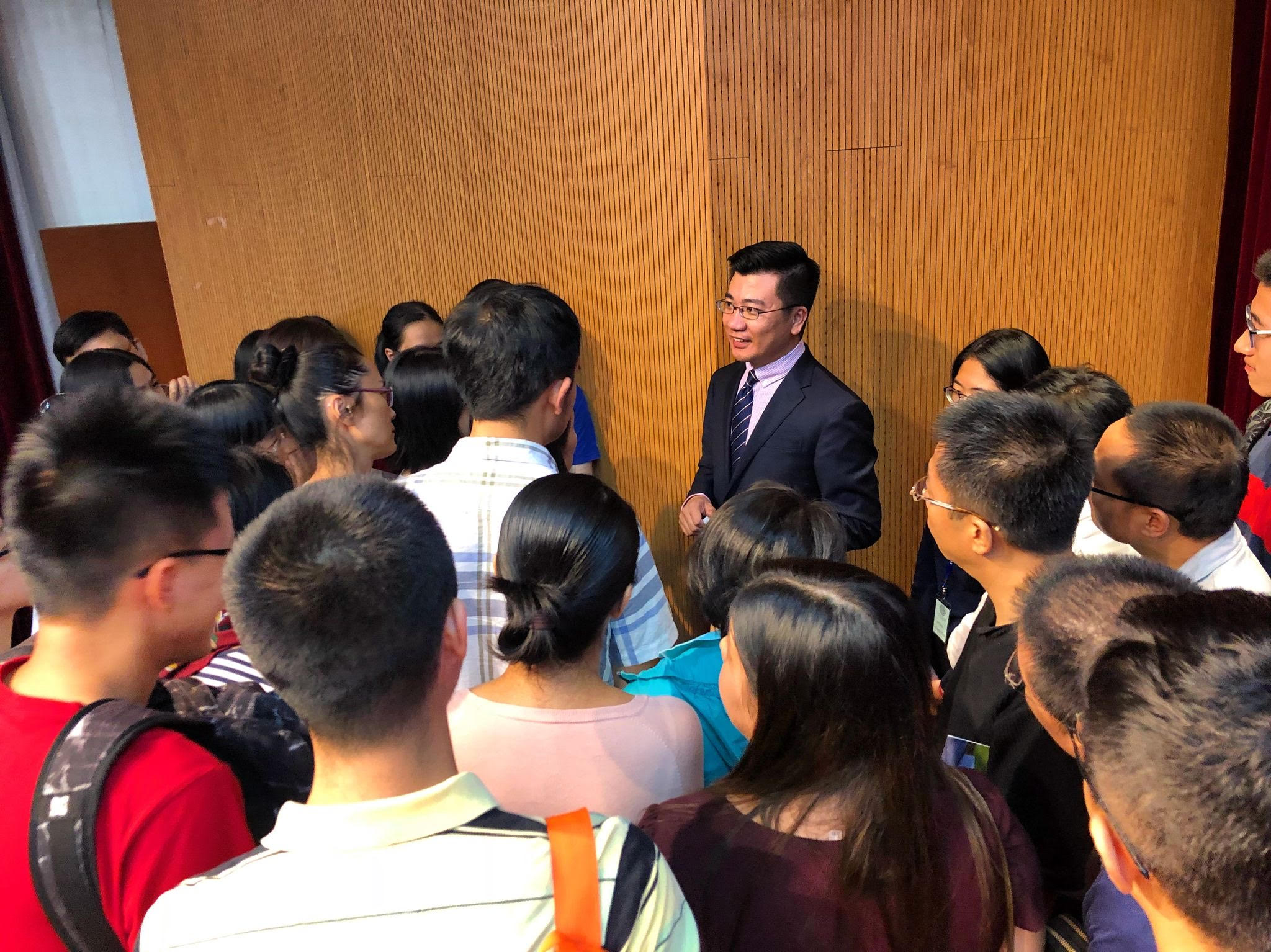
[Kirk] That’s Xiaofeng Wan, making his pitch in Mandarin to Chinese students and parents at a high school in Shanghai. Wan used to be an admissions officer at Amherst College in western Massachusetts. Now he’s a private college consultant, guiding Chinese students through the maze that is college admissions in the U.S.
[Xiaofeng Wan] So I’ll walk them through the initial high school years before they apply. And then by the time of their college applications, I’ll help them go through the process as well.
[Kirk] This is big business for colleges. Like most international students, Chinese families do not qualify for financial aid, and often they pay the full cost. Wan also trains guidance counselors across China, showing them how to support students heading abroad. So he’s got a front-row seat to what Chinese families are thinking right now.
[Xiaofeng Wan] They see the United States as a primary study-abroad destination.
[Kirk] But Wan says that might be starting to shift.
[Xiaofeng Wan] America has an image problem right now, so we will definitely start to see reluctance from families.
[Kirk] I caught up with him while he was in Ningbo, a port city known for manufacturing, on the same morning President Trump’s tariffs on Chinese goods took effect.
[sound of news anchor] Across the globe this weekend, world leaders are trying to figure out how to respond to President Trump’s attempt to reshape the global economy by imposing steep tariffs. …
[Kirk] Just hours later, the Chinese government warned the more than 270,000 Chinese students already studying in the U.S. to think twice about staying. Wan says that kind of message stokes fear that’s been building. House Republicans sent letters to six universities saying America’s student visa system has become a Trojan horse for Beijing, and a lot of Chinese parents worry the U S government doesn’t want their kids.
[Xiaofeng Wan] That’s what they’ve been hearing from President Trump, his rhetoric toward Chinese students. And now they’re seeing news about how international student visas are being revoked.
[Kirk] This is College Uncovered, a podcast pulling back the ivy to reveal how colleges really I’m Kirk Carapezza with GBH News …
[Jon] … and I’m Jon Marcus with The Hechinger Report. Colleges don’t want you to know how they operate, so GBH …
[Kirk] … in collaboration with The Hechinger Report, is here to show you.
This season, we’re staring down the demographic cliff.
[Jon] If you’re just joining us, a quick refresher here: The demographic cliff is a steep drop in the number of 18-year-olds. That’s because many Americans stopped having children after the Great Recession of 2008. And now, 18 years later, colleges are feeling the pinch.
[Kirk] Yeah, and just when many of them thought the situation couldn’t get any worse, international students are under threat. During President Donald Trump’s first term, we saw visa restrictions and travel bans contribute to a 12 percent drop in new international enrollment. So we’ll ask, could that happen again, just as schools are scrambling to fill empty seats?
[Jon] And we’ll explain what all of this means for you, whether you’re an international student or a domestic one, and why you should care.
Today on the show: The Student Trade Wars.
[Kirk] Since Trump’s return to power, his administration has yanked more than 1,000 student visas, often without explanation. Some students have been detained and faced deportation, fulfilling a pledge he often made on the campaign trail.
[Donald Trump] If you come here from another country and try to bring jihadism or anti-Americanism or antisemitism to our campuses, we will immediately deport you. You’ll be out of that school.
[Kirk] In just a few months, that hardline rhetoric has become policy, putting campuses on edge. ICE agents have detained pro-Palestinian student activists, including Mahmoud Khalil at Columbia and Rumeysa Ozturk at Tufts.
[sound from arrest of Rumeysa Ozturk]
[Kirk] This video of her arrest has shaken the international campus community and sparked protests across the country.
[sound of protesters] Free Rumeysa, free her now! We want justice, you say how? Free Rumeysa, free her now!
[Kirk] And now many international students won’t even go on the record, too scared the federal government will target them, or that they’ll be doxxed and ostracized online.
[Frank Zhao] The biggest difficulty for us is building trust.
[Kirk] At Harvard, student journalist Frank Zhao has seen that fear firsthand. He hosts the weekly news podcast for the student newspaper.
[sound of podcast] From The Harvard Crimson, I’m Frank Zhao. This is ‘News Talk.’
[Kirk] Zhao isn’t an international student himself, but the Chinese-American junior from Dallas is plugged into the campus, where a quarter of students are international.
How would you describe the current climate for international students?
[Frank Zhao] The overwhelming sentiment is anxiety. There are so many international student group chats where students were saying, ‘Oh my gosh, there are ICE agents on campus.’ And so it’s quite the Armageddon scenario.
[Kirk] The Trump administration has demanded Harvard turn over detailed records of all foreign students’ — quote — illegal and violent activities, or lose the right to enroll any international students. Harvard says it has complied but won’t publicly disclose details.
The university is suing the administration over this and other demands, but some faculty and students question how hard Harvard is really pushing back. Conservatives, though, defend increased immigration enforcement.
[Simon Hankinson] If a student is studying and minding their own business and obeying the rules of the college and of the United States and the state that they live in, they have nothing to worry about. This is a very small number of people that is being looked at for fraud.
[Kirk] Simon Hankinson is a senior fellow at the Heritage Foundation. He says visa vetting on and off campus is essential for national security after a year of disruptive campus protests.
[Simon Hankinson] Maybe your parents are shelling out a lot of money for you to go, or you’re getting a scholarship. Get your education. Make that the priority. Sure, go out and hold a placard if you want to, and do your thing, light a candle, but if your primary focus is protest and vandalism, I think you’re on the wrong type of visa, and we don’t have a visa for that.
[Jon] Higher education is now a global marketplace, and international students have emerged as a key part of the university funding equation. They’re fully baked into the business model as full-pay customers for colleges who subsidize the cost for domestic students.
[Kirk] And even before the demographic cliff, the competition for international students was fierce.
[Gerardo Blanco] It always has been and sometimes it is intended to be that way, but this is just making it like the Hunger Games
[Kirk] That’s Gerardo Blanco, director of the Center for International Higher Education at Boston College. He warns tht Trump’s America First approach, combined with federal funding cuts, is putting U.S. colleges at risk of losing a generation of global talent.
Is that hyperbole?
[Gerardo Blanco] I don’t think it’s hyperbole in any way.
[Kirk] Why not?
[Gerardo Blanco] The system has been built on the assumption that there wouldn’t be decreases in a dramatic scale to the funding dedicated to research. And therefore they have made some decisions that are somewhat risky.
[Kirk] What’s your biggest concern when it comes to international students?
[Gerardo Blanco] It’s just the generalized sense of uncertainty. I think there are so many balls up in the air and I think it’s really difficult to even focus our attention.
[Kirk] Take the reduction of research funding, for example. It’s affecting many graduate students, especially those who are international and can’t find work in labs. Some schools like Iowa State University, Penn, and West Virginia University are rescinding graduate admissions offers.
[Gerardo Blanco] So that’s one squeeze. We also are looking at just the general rhetoric that tends to be negative.
[Kirk] And Blanco says that rhetoric matters. One survey at the start of Trump’s second term found that nearly 60 percent of European students were less interested in coming to the U.S. Blanco said, considering the demographic cliff, the timing for all of this uncertainty couldn’t be worse for colleges.
[Gerardo Blanco] The clock is ticking and nobody really knows what’s happening.
[Kirk] Okay, so, Jon, why should American students and citizens care about all of this?
[Jon] Well, international students bring different perspectives and experiences to the classroom. And as we said earlier, they also tend to pay full tuition. So they subsidize tuition that American students pay.
But a drop in international student numbers isn’t just a college cash-flow problem. It’s a broader economic one. International students infuse $44 billion into the U.S. economy each year.
Here’s Barnet Sherman, a business professor at Boston University. It’s New England’s largest private university, and one in five students there are international.
[Barnet Sherman] Look, I just teach business and finance. So if one of my top 10 customers comes to me with $44 billion to spend and creates a lot of American jobs, over 375,000 American jobs, I don’t know about you, but I’m opening up the door and giving them the best treatment I possibly can.
[Jon] Here in Massachusetts alone, there are about 80,000 international students contributing $4 billion to the state’s economy each year. That puts the state fourth in the U.S., after California, Texas and New York. So, yeah, this matters.
But Sherman says the impact goes far beyond big cities like Boston, New York, and L.A. Take the tiny town of Mankato, Minnesota, for example — population, 45,000.
[Barnet Sherman] And they’ve got about 1,700 international students there contributing to the local economy. They’re bringing in literally over $25 million to, you know, a perfectly nice burg.
[Jon] In addition to tuition dollars, these students contribute to businesses and local communities that are losing population.
[Kirk] And, Jon, if fewer international and domestic students are coming through the pipeline to fill jobs that require college educations, it puts the U.S. at a serious disadvantage, just as other countries are actively recruiting talent and increasing the number of their citizens with degrees. More and more countries are recruiting international students, including Canada, France, Japan, South Korea and Spain, but also countries that hadn’t recruited before, like Poland and Kazakhstan.
Right before Trump’s first term, I went to Germany, where the government was offering free language classes to attract international students and scholars, including Americans. Because just like the U.S., Germany is losing population. A demographic cliff has already hit Europe, so it needs immigrants and international students, too. Think of it like this: It’s a global talent draft. All of these students, they’re the trading cards. The collectors are the countries. And the more talent you attract, the more ideas, innovation and business growth you get.
[Dorothea Ruland] If you look at Germany, the only resource we do have are human resources, actually.
[Kirk] Dorothea Ruland is the former secretary general of the German Academic Exchange Service, which is in charge of Germany’s international push. When I visited Bonn, we had coffee at her headquarters.
[Dorothea Ruland] We depend on innovation, on inventions, of course, and where do they come from? From institutions of higher education or from research institutions.
[Kirk] Ruland told me nearly half of foreign students earning degrees in Germany stick around. And not just for the short-term. About half of them stay for at least a decade. In the U.S., most international graduates leave and take their talent back home, often because of scarce visas available for skilled workers.
Do you see Germany competing with American universities?
[Dorothea Ruland] Yes, I would say so. You know, we are doing marketing worldwide because we are part of this world and we cannot neglect these trends going on. So of course we are competitors.
[Kirk] But she also made it clear the student trade war isn’t just about competition. It’s about collaboration.
[Dorothea Ruland] If you look at the global challenges everybody’s talking about, questions of climate change, energy, water, high tech, whatever, this cannot be solved by one institution or one country. So you have to have big international networks.
[Kirk] Since my visit, though, isolationism has been creeping in, not only in Germany, but Hungary and Russia, and obviously here in the U.S., too. Some professors and students have pointed to recent issues with visas and detainments without due process and accused the Trump administration of taking an authoritarian approach.
[sound of protest]
[Kirk] Outside Harvard’s Memorial Church in Cambridge, more than 100 students and faculty recently held signs and waved American flags, cheering the university for standing up to the White House and calling on Harvard to do more to protect their civil rights. Among other things, they spoke out about visa revocations. It is incredibly scary here.
Leo Gerdén is a senior from Sweden. He says the administration is trying to divide the campus community.
[Leo Gerdén] At first I was very anxious about speaking up. They want us to point fingers to each other and say, you know, deport them, don’t deport us. And you know, it’s classic authoritarian playbook.
[Jon] Trump supporters? Well, they see it very differently.
[Simon Hankinson] I would call that ridiculous. I mean, that’s an insane argument to make.
[Jon] Simon Hankinson is a senior fellow at the Heritage Foundation’s Center for Border Security and Immigration. We heard from him at the top of this episode, and we should also add he’s a career foreign service officer.
[Simon Hankinson] So I’ve certainly interviewed tens of thousands of these applicants, including thousands of students.
[Jon] Hankinson acknowledges the uptick in visa revocations lately, but says it’s still a tiny number compared to the one million international students in the U.S.
[Simon Hankinson] But just looking at the scale of it all, it is more than we’ve seen in the past, because, generally speaking, this wasn’t something that the government devoted a lot of resources to. But it was always a power that they had.
[Jon] And he’s not buying the narrative that these changes and the crackdowns on visas will scare off students from coming to the U.S.
[Simon Hankinson] Are people not going to go to Harvard because, you know, they’re afraid that they’re going to get hassled. No. Try going to Russia or China and speaking your mind. Good luck with that.
[Jon] Hankinson also argues some universities — especially ones with a high percentage of international students, like Columbia, NYU, Northeastern, and Boston University — they have a financial incentive for complaining.
[Simon Hankinson] It’s a strong constituency that they want to keep happy and they want to keep the money flowing. So they want to make this as big an issue as possible. They want to cry panic.
[Jon] So, Kirk, colleges signal all the time that they’re open to international students. Just listen to some of these welcome videos.
[sound of international recruiting videos]
[Jon] But parents like Claire from Beijing don’t feel like their kids are welcome.
[Claire] I think the government is really hostile right now.
[Jon] Claire asked us to withhold her full name, worried it could affect her son, who’s already studying here. She also has a daughter in high school who was thinking about college in the U.S., but now they’re rethinking her plans and looking at schools in the UK, Canada, Singapore and Hong Kong.
[Claire] You know, we have to consider all the possibilities, obviously in a trade war, you know, like, because next year, when my child has to go to college, you know, Trump is still the president.
[Kirk] Claire says she still believes in the power of an American education, so it’s really hard for her to just write it off completely.
[Jon] Okay. So, Kirk, we’ve tackled a lot in this episode. Bottom line, do you think American colleges will still be able to recruit and enroll enough international students to help offset this looming shortage we’ve been talking about in the number of 18-year-olds?
[Kirk] Well, it’s not looking great for colleges. International enrollment, as we said, dropped 12 percent during Trump’s first term, and now we’re heading toward a 15 percent drop in the number of 18-year-olds by 2039. That’s a big gap to fill, and the reality is the current climate would have to shift dramatically and quickly for the U.S. to stay competitive.
International students are essential for filling seats and making budgets, especially in regions like New England and the Midwest, where the demographic cliff isn’t coming — it’s already here. A college consultant once told me, if your campus isn’t near an international airport, the clock is ticking on your institution. And that was before America developed this reputation as an unwelcoming place.
[Jon] So what do you think you’ll be watching as we continue to cover this issue?
[Kirk] Yeah, for me, one of the biggest questions is how colleges handle what I see as a major communication and messaging problem. Administrators and faculty haven’t done a great job telling the full story of what U.S. universities actually do, or why international mobility benefits the country as a whole.
[Jon] This is College Uncovered. I’m Jon Marcus from The Hechinger Report …
[Kirk] … and I’m Kirk Carapezza from GBH News.
[Jon] This episode was produced and written by Kirk Carapezza …
[Kirk] … and Jon Marcus, and it was edited by Jonathan A. Davis.
Our executive editor is Jenifer McKim.
Our fact checker is Ryan Alderman.
GBH’s Robert Goulston contributed reporting to this episode.
[Jon] Mixing and sound design by David Goodman and Gary Mott.
All of our music is by college bands. Our theme song and original music is by Left Roman out of MIT.
Mei He is our project manager, and head of GBH podcasts is Devin Maverick Robins.
[Kirk] College Uncovered is made possible by Lumina Foundation. It’s a production of GBH News and The Hechinger Report and distributed by PRX.
Thanks so much for listening.
The Hechinger Report provides in-depth, fact-based, unbiased reporting on education that is free to all readers. But that doesn’t mean it’s free to produce. Our work keeps educators and the public informed about pressing issues at schools and on campuses throughout the country. We tell the whole story, even when the details are inconvenient. Help us keep doing that.
The first day of September 2025 sees an important chunk of the Economic Crime and Corporate Transparency Act come into force.
And if you are involved in academic partnerships or the use of agents, you might want to pay heed.
Receiving Royal Assent in 2023, the Act was initially promoted as tidying up some of the very curious practices around submitting information to Companies House.
The Act also introduces a range of new offences that can lead to fines, disqualification, and even imprisonment – and higher education providers are among those carefully considering the September start date for offence of “failure to prevent fraud”. And, almost inevitably – the issue comes down to franchising and academic partnership.
Quick definitions
Simply put, fraud is the act of gaining a dishonest advantage over another person. In most cases this is a financial advantage.
To give some sector focused examples – we’ve recently seen cases where student maintenance loans and student fee loans have been paid out to students who have no intention of actually studying. We’ve seen evidence that some providers (and some higher education agents) may have been knowingly registering students for financial rather than educational benefit, and that franchise and partnership agreements – where incentives may be set around income maximisation rather than educational benefit – might have played a role in some of these instances.
Fraud, obviously, is a criminal offence. Those who commit fraud face consequences, but before the Act it has been harder to ensure that the companies involved do.
The “failure to prevent fraud” offence, in the words of the government’s guidance, means that:
an organisation may be criminally liable where an employee, agent, subsidiary, or other “associated person”, commits a fraud intending to benefit the organisation and the organisation did not have reasonable fraud prevention procedures in place. In certain circumstances, the offence will also apply where the fraud offence is committed with the intention of benefitting a client of the organisation. It does not need to be demonstrated that directors or senior managers ordered or knew about the fraud.
This applies specifically to “large incorporated organisations” (one of: more than 250 employees, more than £36m turnover, more than £18m in total assets). This can apply to an entire organisation, or “a subsidiary or franchise” of an organisation.
Behind the sofa
It’s not difficult to imagine that a cash-strapped provider of higher education may not always be motivated to check up on the activities carried out in its name by agents and partners. When dubious recruitment practices are revealed in the press, the usual response by “lead providers” is alarm followed by a decision to withdraw from the partnership. Neither the OfS, Department for Education, or Student Loans Company really has the regulatory tools to deal with stuff on anything other than a whack-a-mole basis – and every time the music stops it turns out nobody realised how bad things really are. Withdraw, regroup – and very often enter into a similar partnership with another organisation.
The new “failure to prevent fraud” offence means that the onus will be on universities and other providers to prove that they had “reasonable prevention procedures” – and whether they did is a matter for the courts rather than a checklist.
Things in scope include the public law offence of cheating the public revenue alongside expected parts of the Fraud Act and Theft Act in England and Wales. The law is slightly different in Scotland and Northern Ireland.
As well as the person who committed the “base fraud” facing consequences, this new rule means that if they are a “person associated” with a relevant body – and are acting in the capacity of that body or providing services on behalf of that body as they commit the fraud – the body itself (the lead partner in our example) will also be on the hook. It is worth remembering that a small organisation can be an “associated person” for these purposes, and although there may be a formal contractual relationship there doesn’t need to be a contract in place.
Higher education, specifically
If you scroll through the guidance, you might start breathing normally when you spot that there is an exemption for some “franchisees” – these are seen as connected to the main company by contract only, rather than undertaking business for the parent company. If you think about models of franchising in other sectors, this makes sense – a franchisee basically pays for the rights to use a name and a set of products.
However, this is not the meaning of the word “franchising” in higher education – and there are specifics in the guidance dealing with the sector.
Academic franchises may be associated persons for the purposes of the offence depending on the details of the contract. Universities or other degree awarding bodies should take legal advice.
There’s a line drawn between “validation” franchises (university accredits awards) and “delivery” franchises (university subcontracts delivery of a programme), but there’s no easy line to draw as to whether either is an “associated person” or not. It all comes down to the nature of the individual relationship and what is in the contact or agreement.
Doing time
If you are involved in academic partnerships, relationships with agents, or anything similar it feels very much like now should be the moment to get on top of what is in each agreement and what “reasonable preventative measures” might be. How are you monitoring what people are doing on your behalf? How much control do you genuinely have?
In the main, franchising is done well by higher education institutions. But if corners are being cut, or inconvenient questions not being asked, for the less rigorous few the stakes just got even higher.
This audio is auto-generated. Please let us know if you have feedback.
Republicans on the House’s education committee grilled three college presidents Wednesday about how they’ve handled alleged incidents of antisemitism in the wake of the Israel-Hamas war, expanding their probe beyond the Ivy League and other well-known research universities.
The leaders came from Haverford College, a small private liberal arts college in Pennsylvania; DePaul University, a private Catholic research university in Chicago; and California Polytechnic State University, San Luis Obispo, a public institution in California.
All three institutions have been a hotbed of political activity for over a year. Pro-Palestinian protesters set up encampments at both Haverford and DePaul last year. Cal Poly also saw demonstrations, including a pro-Palestinian protest held around the one-year anniversary of the Oct. 7, 2023, Hamas attack on Israel.
Republicans on the House Committee on Education and Workforce said they sought to crack down on campus antisemitism and uphold Title VI of the Civil Rights Act, which prohibits discrimination based on race, color and national origin in federally funded programs.
However, some Democrats accused the panel’s GOP members of using antisemitism concerns to quell free speech. They also blasted the Trump administration for detaining international students involved in pro-Palestinian demonstrationsand for its heavy cuts to the U.S. Department of Education’s Office for Civil Rights, which investigates antisemitism and other discrimination allegations at colleges and schools.
Wednesday’s hearing was the first the House education committee has held on campus antisemitism since President Donald Trump retook office. Since then, his administration has frozen funding at several high-profile institutions that have been probed by the committee, claiming the colleges haven’t done enough to protect students from antisemitism.
“The Trump administration has taken a sledgehammer to due process rights of institutions,” said Virginia Rep. Bobby Scott, the top Democrat on the committee.“The public has seen a barrage of reports of this administration taking action without any investigation, such as taking away federal funding.”
Haverford’s federal funding threatened
Haverford President Wendy Raymond and DePaul President Robert Manuel struck a conciliatory tone in their opening remarks, and all three leaders outlined steps they have recently taken to protect Jewish students from discrimination, including setting up an antisemitism task force and tightening protest rules.
“I recognize that we haven’t always succeeded in living up to our ideals,” Raymond said. “I remain committed to addressing antisemitism and all issues that harm our community members. I am committed to getting this right.”
Last year, a group of Haverford students sued the collegeover allegations it had denied Jewish students the ability to participate in classes and educational activities “without fear of harassment if they express beliefs about Israel that are anything less than eliminationist.”
The lawsuit contains accounts of several incidents and comments it says are antisemitic, including one professor sharing a social media post on Oct. 11, 2023. The post included an image the lawsuit described as Hamas breaking through the border between Gaza and Israel and stating, “We should never have to apologize for celebrating these scenes of an imprisoned people breaking free from their chains.”
A federal judge dismissed the case in January but allowed plaintiffs to file an amended lawsuit, which they did that month.
Rep. Elise Stefanik, a Republican from New York, asked Raymond whether the professor who shared the post had faced disciplinary action,but the Haverford president declined throughout the hearing to talk about individual cases or share specific figures on disciplinary actions. The professor, Tarik Aougab, is listed on Haverford’s website as a faculty member.
“Many people have sat in this position who are no longer in the positions as president of universities for their failure to answer straightforward questions,” Stefanik replied.
During a similar hearing in 2023, Stefanik questioned the presidents of Harvard University, the University of Pennsylvania and the Massachusetts Institute of Technology, asking all three leaders whether calling for the genocide of Jewish people would violate campus rules.
They all declined to give a yes-or-no answer, contending that the language could cross the line into harassment depending on the situation.
The moment went viral, and Elizabeth Magill, then leader of Penn, resigned only days later. Claudine Gay stepped down as president of Harvard about a month later, amid allegations of plagiarism and growing calls for her ouster following the hearing.
During Wednesday’s hearing, Rep. Mark Messmer, a Republican from Indiana, asked whether calls for the genocide of Jews would violate university policies. All three said these types of calls would be subject to disciplinary action.
However, other Republican lawmakers criticized Raymond’s refusal to detail disciplinary actions, with some threatening Haverford’s federal funding.
“I suppose it’s your First Amendment right to be evasive, but it’s also our right to decide that such institutions are not deserving of taxpayer money,” Rep. Bob Onder, a Republican from Missouri, told her.
An anti-higher education agenda?
Democrats on the committee frequently lambasted recent cuts to the Office for Civil Rights, which lost roughly half of its staff and regional offices as part of the Trump administration’s moves to downsize — and eventually eliminate — the Education Department.
“For those of us who do want to stop the rise of antisemitism on college campuses, I remind you that the federal government already has an entity in place to investigate and resolve antisemitic instances”— OCR, said Rep. Suzanne Bonamici, a Democrat from Oregon.
She also pointed to reports from John Kelly, Trump’s former chief of staff, that the president privately said multiple times during his first term that Adolf Hitler “did some good things.” Bonamici likewise accused some congressional Republicans of promoting antisemitic conspiracy theories.
“It is unconscionable to weaponize the real problems of the Jewish community for political gain, and I’m not going to engage in more back-and-forth in this hearing with people who call out antisemitism when it’s part of their anti-higher education agenda but not when it’s coming from their side of the aisle,” Bonamici said.
Additionally, Bonamici pointed to a recent statement from 10 Jewish organizations, led by the Jewish Council for Public Affairs, which accused the Trump administration of stripping due process rights from studentsand threatening academic research under “the guise of fighting antisemitism.”
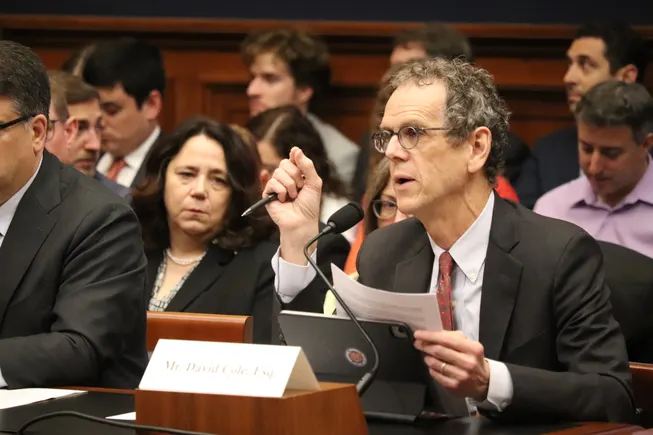
David Cole, a law and public policy professor at Georgetown Universityand the Democratic witness, didn’t mince words. Cole likened the House education committee’s use of hearings on antisemitism to McCarthyismand the work of the House Un-American Activities Committee, which probed suspected communists during that era.
Cole argued the committee had made “no effort to discern the difference between protected speech and discrimination.”
“That’s why I draw the comparison to HUAC,” Cole said.
He also said that Title VI does not prohibit antisemitic speech.
“Antisemitic speech, while lamentable, is constitutionally protected, just like racist speech, sexist speech and homophobic speech,” Cole said. “While such speech obviously causes deep harm, the greater danger is giving government officials the power to censor speech by labeling it antisemitic, racist or sexist.”
Antisemitic speech “implicates Title VI,” he said, when it constitutes harassment targeting an individual because of their Jewish identityor when it is “so severe, pervasive and objectively offensive that it denies equal access to an education.”
Determining whether speech has crossed into prohibited discrimination requires a fact-intensive investigation, Cole said. Moreover, colleges only violate Title VI when they were “deliberately indifferent” to the discrimination, he added.
Cole argued that the House hearings weren’t the right place to engage in these types of investigations, which he said require testimony from those involved in the alleged incidents. Instead, he called on the committee to bring in U.S. Education Secretary Linda McMahon.
“They should be calling Secretary of Education McMahon before the committee and asking her why she has decimated the very office that is supposed to be enforcing antidiscrimination law,” Cole said.
Clarification: This article has been updated to reflect that a group of Jewish organizations issued the statement led by the Jewish Council for Public Affairs.
In my head, I thought I understood the line between what counts as “academic judgement” and what doesn’t in cases, processes, appeals and complaints.
It matters because my understanding has long been that students can challenge and appeal all sorts of decisions – right up to the Office of the Independent Adjudicator (OIA) in England and Wales – but not if the decision is one that relates to matters of academic judgment.
Thus in a simplistic coin sorter, “this essay looks like a 2:1 to me” can’t be challenged, but “they’ve chucked me out for punching someone when I didn’t” can.
I’ve often wondered whether the position can hold when we think about the interaction between consumer protection law – which requires that services be carried out with reasonable skill and care – and this concept of unchallengeable academic judgement in the context of workloads.
Back in the halcyon days of Twitter, I’d regularly see posts from academic staff bemoaning the fantasy workload model in their university that somehow suggested that a 2,000 word essay could be read, graded and fed back on in 15 minutes flat.
Add in large numbers of assignments dribbling in late via extensions and accommodations, the pressure to hit turnround times generated by the NSS question, wider workload issues and moderation processes that look increasingly thin (which were often shredded or thinned out even further during the marking boycotts), and I imagined a judge evaluating a student’s case to say something along the lines of “to deploy your magic get out jail free card, sunshine, you’ll need to have used more… care.”
But that’s about an academic judgement being made in a way that isn’t academically defensible. I had a conversation with an SU officer this afternoon about academic misconduct off the back of a webinar they’d attended that OfS ran on AI, and now I’m more confused than ever.
Do not pass go
The bones first. The Higher Education Act 2004 mandated a body that would review complaints to replace the old “visitor” system, and it includes a line on what will and won’t qualify as follows:
A complaint which falls within subsection (1) is not a qualifying complaint to the extent that it relates to matters of academic judgment.
The concept is neither further defined nor mentioned anywhere else in UK law – but has deep roots. In medieval universities scholarly masters enjoyed autonomous assessment rights, and it gained legal recognition as universities developed formal examination systems during the Enlightenment period.
By the 20th century, academic judgment became legally protected from external interference, exemplified by landmark cases like Clark v. University of Lincolnshire and Humberside (2000), which established that courts should not intervene in academic assessments except in cases of procedural unfairness:
This is not a consideration peculiar to academic matters: religious or aesthetic questions, for example, may also fall into this class. It is a class which undoubtedly includes, in my view, such questions as what mark or class a student ought to be awarded or whether an aegrotat is justified.
The principle that most understand is that specialised academic expertise uniquely qualifies academics to evaluate student performance and maintain educational standards, free from political or economic pressures.
The OIA takes the line in the legislation and further defines things as follows:
Academic judgment is not any judgment made by an academic; it is a judgment that is made about a matter where the opinion of an academic expert is essential. So for example a judgment about marks awarded, degree classification, research methodology, whether feedback is correct or adequate, and the content or outcomes of a course will normally involve academic judgment.
It also helpfully sets out some things that it doesn’t consider fall into the ambit:
We consider that the following areas do not involve academic judgment: decisions about the fairness of procedures and whether they have been correctly interpreted and applied, how a higher education provider has communicated with the student, whether an academic has expressed an opinion outside the areas of their academic competence, what the facts of a complaint are and the way evidence has been considered, and whether there is evidence of bias or maladministration.
I’m not convinced that that “what’s in, what’s out” properly considers or incorporates the consumer protection law issue I discuss above – but nevertheless it hangs together.
In his paper on whether the concept will hold in an era of consumerism, David Palfreyman argues that academic judgment properly applies to subjective assessments requiring specialised expertise – grading student work, designing curriculum, and evaluating learning outcomes.
Educational institutions and courts generally consider these issues beyond external scrutiny to protect academic freedom and professional autonomy – because academics possess unique qualifications to make nuanced, context-dependent judgments about academic quality that outside parties lack the expertise to evaluate effectively.
On the other side of that see-saw, he argues that academic judgment should not shield factual determinations, procedural errors, or administrative decisions from review. When institutions make claims about whether they properly applied their own rules, or failed to follow fair procedures, these issues fall outside protected academic judgment.
Decisions about whether a student’s work contains plagiarism and the extent of that plagiarism will normally involve academic judgment, but that judgment must be evidence based.
If that feels like a fudge, it’s because it is. “Whether” feels like a significantly different concept to “extent of that”, insofar as I can see how “did you punch the student” is about weighing up facts, but “how much harm did you cause” might require an expert medical judgement. But in a way, the fudge is topped off with that last sub-clause – what the OIA will insist on if someone uses that judgement is that they’ve used some actual evidence.
And if they haven’t, that then is a process issue that becomes appealable.
The problem here in 2025 is that 30.4 starts to look a little quaint. When someone was able to say “here’s one student’s script, and here’s another” with a red sharpie pointing out the copying, I get the sense that everyone would agree that that counts as evidence.
Similarly, when Turnitin was able to trawl both the whole of the internet and every other essay ever submitted to its database, I get the sense that the Turnitin similarity score – along with any associated reports highlighting chunks of text – counts as evidence.
But generative AI is a whole different beast. If this blog over-used the words “foster” and “emphasize”, used Title Case for all the subheadings, and set up loads of sentences using “By…” and then “can…”, not only would someone who reads a lot of essays “smell” AI, it would be more likely to be picked up by software that purports to indicate if I have.
That feels less like evidence. It’s guess work based on patterns. Even if we ignore the research on who “false flags” disproportionately target, I might just like using those phrases and that style. In that scenario, I might expect a low mark for a crap essay, but it somehow feels wrong that someone can – without challenge – determine whether I’m “guilty” of cheating and therefore experience a warning, a cap on the mark or whatever other punishment can be meted out.
And yes, all of this relates back to an inalienable truth – the asynchronous assessment of a(ny) digital asset produced without supervision as a way of assessing a students’ learning will never again be reliable. There’s no way to prove they made it, and even if they did, it’s increasingly clear that it doesn’t necessarily signal that they’ve learned anything when they did.
But old habits and the economics of massification seem to be dying hard. And so in the meantime, increasing volumes of students are being “academically” judged to have “done it” when they may not have, in procedures and legal frameworks where, by definition, they can’t challenge that judgement. And an evaluation of whether someone’s done it based on concepts aligned to religion and aesthetics surely can’t be right.
Cases in point
There’s nothing that I can see in the OIA’s stock of case summaries that sheds any light on what it might or might not consider to count as “evidence” in its scheme rules.
I don’t know whether it would take as its start point “whatever the provider says counts as evidence”, or whether it might have an objective test up its sleeve if a case crossed its desk.
But what I do know is just how confusing and contradictory a whole raft of academic misconduct policies are.
The very first academic misconduct policy I found online an hour or so ago says that using AI in a way not expressly permitted is considered academic misconduct. Fair enough. It also specifies that failing to declare AI use, even when permitted, also constitutes misconduct. Also fair enough.
It defines academic judgement as a decision made by academic staff regarding the quality of the work itself or the criteria being applied. Fair enough. It also specifically states that academic judgement does not apply to factual determinations – it applies to interpretations, like assessing similarity reports or determining if the standard of work deviates significantly from a student’s usual output. Again, fair enough.
But in another section, there’s another line – that says that the extent to which assessment content is considered to be AI generated is a matter of academic judgement.
The in-principle problem with that for me is that a great historian is not necessarily an LLM expert, or a kind of academic Columbo. Expertise in academic subject matter just doesn’t equate to expertise in detecting AI-generated content.
But the in-practice problem is the thing. AI detection tools supplying “evidence” are notoriously unreliable, and so universities using them within their “academic judgment” put students accused of using AI in an impossible situation – they can’t meaningfully challenge the accusation because the university has deemed it unchallengeable by definition, even though the evidence may be fundamentally flawed.
Academic judgements that are nothing of the sort, supported by unreliable technology, become effectively immune from substantive appeal, placing the burden on students to somehow prove a negative (that they didn’t use AI) against an “expert judgment” that might be based on little more than algorithmic guesswork or subjective impressions about writing style.
Policies are riddled with this stuff. One policy hedges its bets and says that the determination of whether such AI use constitutes academic misconduct is “likely to involve academic judgement”, especially where there is a need to assess the “extent and impact” of the AI-generated content on the overall submission. Oil? Water? Give it a shake.
Another references “academic judgment” in the context of determining the “extent and nature” of plagiarism or misconduct, “including the use of AI” – with other bits of the policy making clear that that can’t be challenged if supported by “evidence”.
One I’m looking at now says that the determination of whether a student has improperly used AI tools is likely to involve academic judgement, particularly when assessing the originality of the work and whether the AI-generated content meets the required academic standards. So is the judgement whether the student cheated, or whether the essay is crap? Or, conveniently, both?
Set aside for a minute the obvious injustices of a system that seems to be profoundly incurious about how a student has come to think what they think, but seems obsessed with the method they’ve used to construct an asset that communicates those thoughts – and how redundant that approach is in a modern context.
Game over
For all sorts of reasons, I’ve long thought that “academic judgement” as something that can be deployed as a way of avoiding challenge and scrutiny is a problem. Barristers were stripped of their centuries-old immunity from negligence claims based on evolving expectations of professional accountability in the 2000s.
In medicine, the traditional “Bolam test” was that a doctor was not negligent if they acted “in accordance with a responsible body of medical opinion” among their peers But a case in the nineties added a crucial qualification – the court must be satisfied that the opinion relied upon has a “logical basis” and can withstand logical analysis.
Or take accountancy. Prior to 2002, accountants around the world enjoyed significant protection through the principle of “professional judgment” that shielded their decisions from meaningful challenge, but the US Congress’s Sarbanes-Oxley Act radically expanded their liability and oversight following Arthur Andersen’s role in facilitating Enron’s aggressive earnings management and subsequent document shredding when investigations began.
Palfreyman also picks out architects and surveyors, financial services professionals and insurance brokers, patent agents and trademark lawyers, software suppliers/consultants, clergy providing counseling services, and even sports officials – all of whom now face liability for their professional judgments despite the technical complexity of their work.
As Palfreyman notes in his analysis of the Eckersley v Binnie case (which defined the standards for “reasonable skill and care” for professionals generally), the standard that a professional “should not lag behind other ordinarily assiduous and intelligent members of his profession” and must be “alert to the hazards and risks” now applies broadly across professions, with academics sticking out like a sore, often unqualified thumb.
Maybe the principle is just about salvageable – albeit that the sorry state of moderation, external examining, workload modelling and so on does undermine the already shaky case for “we know better”. But what I’m absolutely sure of is that extending the scope of unchallengeable decisions involving “academic judgement” to whether a student broke a set of AI-misconduct rules is not only a very slippery slope, but it’s also a sure fire way to hasten the demise of the magic power.
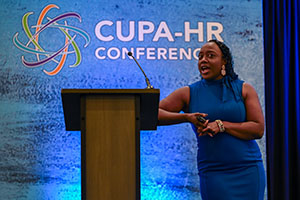
At the 2025 CUPA-HR Spring Conference in Seattle, our keynote speakers shared their insights into the future of the higher ed workplace. They encouraged HR practitioners to step boldly into brave leadership, to investigate neuroscience’s insights into human behavior, to embrace advances in artificial intelligence, and to use data to enhance the employee experience.
But the key message was that innovation should be people-centered and align with HR’s fundamental goal: creating workplaces where people feel safe, valued and free to thrive.
The Brain Needs to Belong
The brain is a social organ, Dr. Jessica Sharp stressed in her opening keynote. Whether or not we’re conscious of it, we’re always searching for connection and belonging — for psychological safety.
“Our brains need affirmation that we belong. Without it, we don’t feel safe,” Dr. Sharp said.
Because our brains interpret emotional threats in the same way as physical threats, feeling unsafe at work can provoke a similar feeling to walking alone in a dark parking garage or seeing a snake on a hiking trail. But when we feel a sense of psychological safety and social belonging, our brains shift into connected mode. When we feel safe, we’re more likely to collaborate with our team, be less resistant to change and feel creative.
Dr. Sharp invited higher ed HR to step into the future of work through neuroleadership. Neuroleadership is a model of talent management that understands the connection between the brain’s inner workings and people’s best work.
Takeaway: The brain can’t be inspired when it’s in survival mode. Prioritize safety and belonging to encourage creativity.
AI is the future of work, said Jennifer Parker, the assistant director of HR operations at Colorado Community College System. While this may sound intimidating, it’s important to know that AI won’t replace you, but rather free up time and mental energy so that you can focus on strategy and long-term projects.
Here’s how Parker uses AI to simplify routine HR tasks:
As a brainstorming partner. For example, you can say to AI, “help me write my leadership statement.” Provide context about your career to enhance the responses.
To write or revise emails. Parker’s communication mode tends to be folksy, so she has ChatGPT rewrite her emails to be more formal in tone.
As a software coach. Ask AI to give you step-by-step directions on creating an Excel formula.
To develop presentations, trainings and professional development sessions. ChatGPT helped Parker write microsessions for an online civility campaign, create slide decks and a video explaining benefits to employees.
As an employee engagement assistant. Tell AI the dynamics of your culture and ask how you can help foster a healthy workplace.
As an event planner. Ask AI to create a training calendar or other complex timeline. For events like open enrollment, ask it for an invitation to the health fair or to craft an inspiring message to remind employees to review their benefits.
AI can also summarize complex information, break down survey results, act as a career coach or problem solver, offer advice, and more. Get creative! But always review what AI generates for accuracy, and make it your own.
Takeaway: AI can simplify HR’s daily tasks and free up time for strategic thinking.
Further reading: Read this step-by-step guide to learn how Parker used ChatGPT as her assistant in creating a virtual civility training program.
Benchmark Your Employee Experience Using CUPA-HR’s Data
What does it take to attract top talent to higher ed? CUPA-HR’s new survey — the Benefits, Employee Experience, and Structure Survey — gives higher ed a snapshot of what it takes to be an employer of choice in a competitive employment landscape, explained Melissa Fuesting, associate director of research at CUPA-HR.
Using the BEES Survey, colleges and universities can benchmark traditional benefits. And now, for the first time, explore data on:
Flexible work
Professional development
Campus and community engagement
Hiring metrics
Performance reviews
Institutional structure (such as where HR is housed)
Policies
The BEES survey also allows you to take a deep dive on these topics. For example, when it comes to flexible work, you can find answers to questions such as: Which employees have the ability to work flexible schedules or flexible hours? Who determines the policies around hybrid and remote work? Which employee groups can be hybrid or remote?
Takeaway: To enhance your employee value proposition, benchmark your benefits and employee experience using data from CUPA-HR’s new BEES Survey with DataOnDemand.
Further reading: For more on attracting and retaining talent, check out the results of the 2023 Employee Retention Survey and stay tuned for the results of the 2025 survey coming this fall.
“Who We Are Is How We Lead”
Cheryl Cofield closed this year’s spring conference with a compelling message: “Who we are is how we lead.” In her powerful keynote, Cofield challenged higher ed HR professionals to examine the leadership armor we wear — the protective behaviors that keep us from leaning into vulnerability and courage. Instead of avoiding difficult conversations or striving for unattainable perfection, brave leaders must be willing to get uncomfortable, speak honestly and model the values they profess.
Drawing from Brené Brown’s research, Cofield identified four key skill sets that support courageous leadership: vulnerability, values, trust and learning. She described how emotional armor — such as perfectionism, detachment, or a need to always be right — gets in the way of connection, inclusion and growth.
Through self-reflection and practical tools like emotional literacy, empathy and curiosity-based conversation cues, Cofield encouraged attendees to identify their own “call to courage.” She reminded us that courage in leadership is not only a personal practice but a collective force. When one person shows up bravely, others are more likely to do the same.
Takeaway: Courage is contagious. When leaders remove their armor and lead with vulnerability, they create more inclusive, trusting and human-centered workplaces.
The buzz around AI in higher ed is undeniable. The topic dominated conference discussions at ASU + GSV, with nearly every booth, breakout, and keynote referencing AI somehow. When AI gets tossed around so often, it can be hard to differentiate between what’s real and what isn’t.
While the transformative promise of AI is exciting, successful AI implementation requires more than fast adoption. The more important question is: How can institutions move from ideas to impact?
The reality is that achieving meaningful results with AI requires more than just purchasing the latest tool. That’s often the easiest part, but it can also be a trap. Tool and tech procurement, absent a well-informed implementation strategy, can add to your technical debt. It’s critical to look beyond the buzzword and first define where you want your institution to be in the future. With your north star in place, you can determine how AI can play a role in a holistic solution.
Operationalizing AI for Real Impact
Many discussions around AI for higher ed focus on its evolving capabilities to generate content, automate tasks, engage and support students, and handle other critical functions. But what is the impact you’re looking to make, and how are you going to measure the return on investment? Those questions tend to be missing from higher ed’s ongoing AI conversation. Don’t implement tactics (or tools) until you know their role in your broader tech strategy. Too often, there is a heightened sense of urgency to implement and not enough focus on the complexities of weaving these tools into the intricate fabric of an institution. There is no easy button in AI.
Trying to catch the AI hype without having a strategic AI implementation plan is like buying state-of-the-art lab equipment before you’ve decided what type of science courses you are going to offer. Effective integration involves significant change management, process design, and ongoing investment.
For example, many schools already use AI-powered agents to assist with student recruitment by answering prospects’ questions and suggesting next steps. These bots can scale engagement significantly — but to be effective, they require meticulous training, constant monitoring, and attentive human oversight to ensure the interaction is aligned with a school’s culture and values. As technology evolves, the operational model must adapt. Without constant care and feeding, AI tools can become outdated, provide incorrect information, or fail to align with the institution’s unique voice and mission. Remember, technology and tool outputs are only as good as the inputs.
And the investment isn’t just the initial software cost. The investment also includes ongoing commitment to deployment, integration, training, and ensuring the technology drives the desired outcomes. Many underestimate this operational heavy lifting in the rush to adopt AI, yet it’s the linchpin for success.
Start with Strategy, Not Just Software
A more effective, pragmatic approach to AI implementation in higher education begins by identifying the institution’s core challenges and strategic objectives.
Are you focused on reversing enrollment declines? Improving student retention rates? Enhancing support services? Increasing operational efficiency? By defining your goals and measurable key performance indicators (KPIs) from the outset, you’re in the best position to strategically evaluate how AI — alongside other data, technology, and talent resources — can contribute to a solution that supports the entire student lifecycle.
Without this clarity, institutions risk spending significant resources without achieving tangible returns. It’s about focusing efforts, perhaps starting with a contained, controllable area where impact can be carefully monitored and measured, rather than attempting to boil the ocean.
Leveraging AI Strategically
Currently, many institutions are grappling with important discussions around AI ethics, academic integrity, and preventing misuse by students to cheat. It’s important not to get stuck there. Students who want to circumvent rules will find a way. AI is simply the newest tool. Focusing excessively on policing AI use means missing the boat on its strategic potential.
The real opportunity lies in leveraging AI across the entire student lifecycle — from recruitment and enrollment to engagement, support, and retention. AI can personalize outreach, provide 24/7 advising support, identify at-risk students earlier, and automate administrative tasks, freeing up staff for higher-value interactions. It will almost certainly be part of effective solutions, but it shouldn’t be the only part.
The Indispensable Human Element
In the race to apply AI, we must not forget the crucial role of human intelligence (HI). AI tools, even sophisticated ones, require human oversight. They must train on the correct data and the institution’s values, mission, and unique persona.
Humans are essential for guiding AI, correcting its inevitable errors and ensuring its outputs align with institutional standards. Furthermore, education remains a fundamentally human endeavor. While AI can enhance efficiency and scale, it cannot replace true empathy, mentorship, and social-emotional connection, which are vital to student success and belonging. The most effective approach combines the power of AI with the irreplaceable value of human talent — a synergy Collegis champions through its focus on data, tech, and talent.
Moving Fast, But Moving Smart
The desire to rapidly adopt AI in higher ed is understandable. However, a rushed implementation without a clear strategy is likely to falter. Stepping back to define objectives, plan the integration, and establish metrics is the best way to accelerate the path to meaningful impact.
This more deliberate, strategic approach enables institutions to harness AI’s power effectively, ensuring it serves their unique mission and drives measurable results. It’s about moving beyond the hype and focusing on the pragmatic steps needed to make AI work for higher ed, creating sustainable value for the institution and the students it serves. The journey requires careful navigation, a focus on operational reality, and often, a partner who understands how to bridge the gap between potential and practice.
Innovation Starts Here
Higher ed is evolving — don’t get left behind. Explore how Collegis can help your institution thrive.
This audio is auto-generated. Please let us know if you have feedback.
Dive Brief:
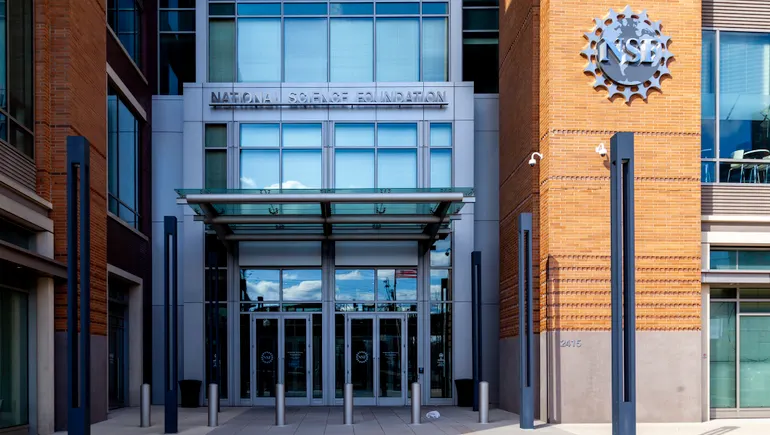
A group of universities and higher education associations is suing theNational Science Foundationover its new cap on reimbursement for indirect research costs for all future college grants.
In court documents filed Monday, the plaintiffs — led by the American Council on Education, the Association of American Universities and the Association of Public and Land-Grant Universities — allege the unilateral 15% cap, which took effect May 5, violates the law in “myriad respects” and that its effects will be “immediate and irreparable.”
The new lawsuit follows two other legal challenges over similar caps implemented by the National Institutes of Health and the U.S. Department of Energy — both of which have been blocked, at least temporarily.
In the ruling, the judge said NIH unlawfully implemented the cap and violated constitutional prohibitions on applying new rules retroactively. The Trump administration quickly appealed the ruling, and the case is ongoing.
Next came the Energy Department. In April, the agency announced the same 15% cap on indirect research costs,alleging the plan would save taxpayers $405 million annually. Again, colleges sued, and a federal judge blocked the plan — albeit temporarily — while the lawsuit moves forward.
The ACE, AAU and APLU are plaintiffs in both cases.
Now NSF has introduced its own cap, to the chagrin of colleges and higher ed experts. When announcing the 15% cap, the agency argued the move would streamline and add transparency to the funding process and“ensure that more resources are directed toward direct scientific and engineering research activities.”
But the new lawsuit argues that NSF’s policy echoes the other agencies’ attempts, to deleterious effect.
“NSF’s action is unlawful for most of the same reasons, and it is especially arbitrary because NSF has not even attempted to address many of the flaws the district courts found with NIH’s and DOE’s unlawful policies,” it said.
Like the lawsuits against NIH and Energy Department’s policies, the plaintiffs allege that the NSF’s cap oversteps the agency’s authority.
“It beggars belief to suggest that Congress — without saying a word — impliedly authorized NSF to enact a sweeping, one-size-fits-all command that will upend research at America’s universities,” it said.
In fiscal 2024, Congress gave NSF $7.2 billion to fund research and related activities. In turn, the agency funded projects at 1,850 colleges —more than 1 in 4 of the higher education institutions in the U.S. eligible to receive federal dollars.
That year, NSF awarded Arizona State University, one of the plaintiffs, 172 awards worth a total of $197.5 million in anticipated and obligated funding, according to court documents. Prior to the NSF’s new policy, the institution negotiated a 57% rate for indirect costs in fiscal 2026.
The University of Illinois, another plaintiff, receivedjust over $129 millionin NSF funding in fiscal 2024 —making the agency its biggest funder — and negotiated an indirect research funding rate of 58.6%.
The university said in court documents that it has received the most NSF funding of all U.S. colleges for six years in a row, and it is poised to lose more than $23 million a year if the agency’s new cap is allowed to continue.
The college plaintiffs are:
Arizona State University.
Brown University, in Rhode Island.
California Institute of Technology.
The University of California.
Carnegie Mellon University, in Pennsylvania.
The University of Chicago.
Cornell University.
The University of Illinois.
Massachusetts Institute of Technology.
The University of Michigan.
The University of Minnesota.
The University of Pennsylvania.
Princeton University, in New Jersey.
The lawsuit also cited an attempt by the first Trump administration to cap rates for indirect research at a federal agency. In 2017, the White House proposed cutting the cap to 10% for all NIH grants. Congress – then under Republican control as it is now — “identified serious problems immediately” and took “swift and bipartisan” action against the proposal, the lawsuit said.
As this semester comes to an end and summer vacation approaches, I’ve decided to slow down and take this season as an opportunity to reset. For me, summer is more than just a break from classes; it’s a time to reconnect with myself, reflect on everything I’ve experienced, and dive into stories that stir the soul. This year, I’m choosing books that entertain, challenge, heal, and expand the way I see the world.
Here’s my curated summer reading list, filled with stories from powerful voices across cultures, themes of identity, and quiet moments of transformation.
Pinterest
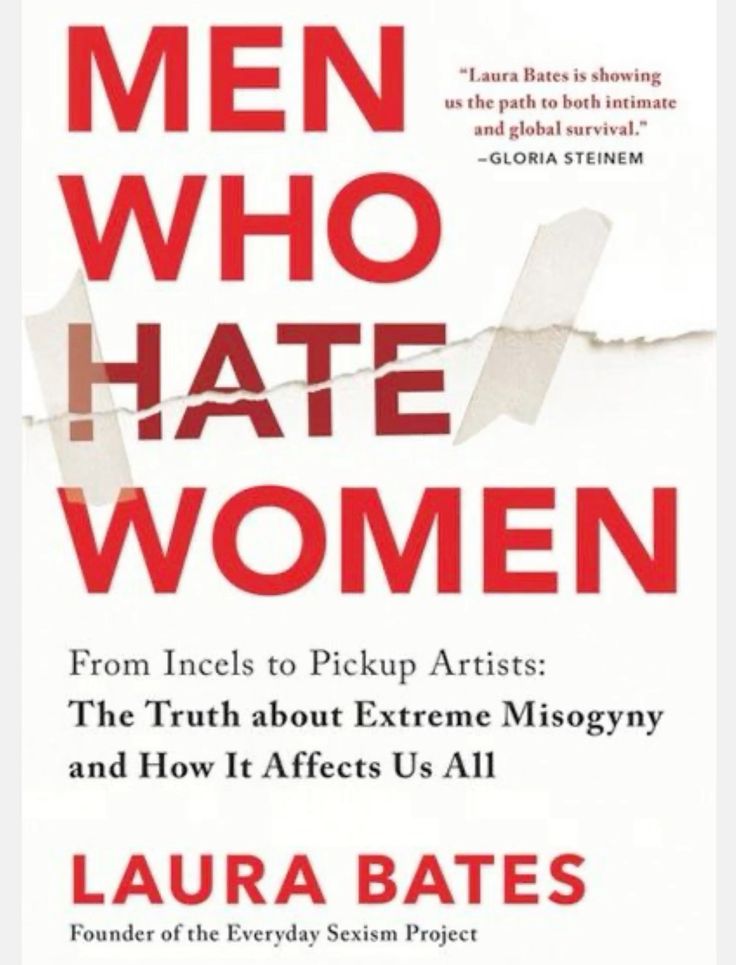
Men Who Hate Women by Laura Bates
This book is at the top of my list because I want to understand more about the online communities and ideologies that shape modern misogyny.
Pinterest
The Vegetarian by Han Kang
A haunting and surreal novel that explores one woman’s quiet rebellion against societal expectations. I’ve heard it’s unsettling and beautiful all at once.
Pinterest
The Stationery Shop by Marjan Kamali
I am a big fan of historical fiction, and this one is about love and loss set against the backdrop of political upheaval in 1950s Tehran. I hope it’ll be the kind of book that makes yoy cry and smile in the same chapter.
Pinterest
A Tale for the Time Being by Ruth Ozeki
This book has been on my list for a while. Blending time, memory, and the interconnectedness of human experience. I think it’s going to be one of those profound, mind-opening reads that makes you think about life, time, and the way we tell our stories.
Pinterest
The Forest of Enchantments by Chitra Banerjee Divakaruni
Chitra Banerjee Divakaruni is one of my favourite authors. I love the way she writes. This is a retelling of the Ramayana through Sita’s perspective. I’m excited to experience this retelling, not just as a story, but as a reflection of womanhood, resilience, and strength.
Pinterest
More Days at the Morisaki Bookshop by Satoshi Yagisawa
I adored the first book in this series; it was gentle, nostalgic, and filled with the kind of warmth that lingers long after you’ve closed the pages. I’m expecting the same comforting experience with this one.





 Because our brains interpret emotional threats in the same way as physical threats, feeling unsafe at work can provoke a similar feeling to walking alone in a dark parking garage or seeing a snake on a hiking trail. But when we feel a sense of psychological safety and social belonging, our brains shift into connected mode. When we feel safe, we’re more likely to collaborate with our team, be less resistant to change and feel creative.