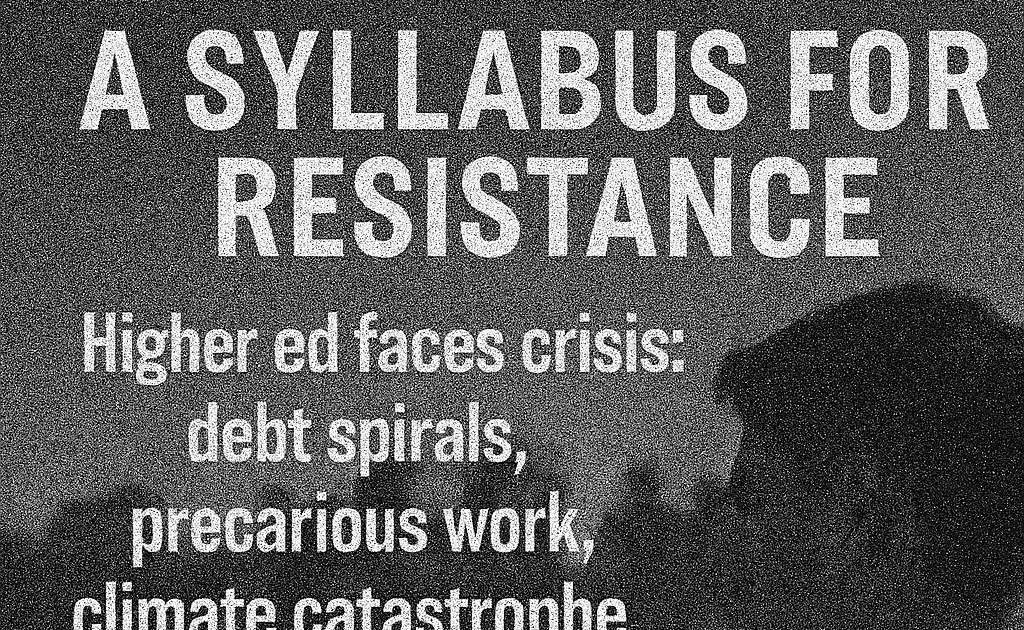
Higher education today demands that we strip away illusions. The university is no longer a sanctuary of truth but a contested battleground of austerity, automation, and alienation. Students, adjuncts, and staff are caught in a cycle of debt, precarity, and surveillance. To resist, we need not another glossy strategic plan but a syllabus — a curriculum of solidarity, transparency, and rehumanization.
Debt defines the student experience. Student loan balances now exceed $1.77 trillion, and repayment programs like PSLF and income-driven repayment offer only partial relief. In 2024, as federal student loan payments resumed after a pandemic pause, millions of borrowers simply refused to pay, transforming individual debt into collective action. The Debt Collective has organized strikes and campaigns to cancel student debt, reframing borrowing as a political issue rather than a private burden. This movement challenges whether the entire financing model of higher education can survive.
Faculty labor is equally precarious. More than seventy percent of instructors are contingent, often earning poverty wages without benefits. At Harrisburg Area Community College, over 200 faculty went on strike in November 2025 after years of stalled negotiations, exemplifying a growing national labor movement against stagnant pay and weakened job security. Adjunct faculty unions at Rutgers and elsewhere continue to push back against layoffs and austerity measures. The crisis of contingent labor has moved from quiet exploitation to open confrontation.
Climate crisis compounds the meltdown. Universities expand globally in a frenzy of collegemania, while ignoring ecological collapse. Student activists demand divestment from fossil fuels, but boards often resist. At Princeton, campaigners uncovered that the university owns a controlling stake in PetroTiger, a fossil fuel company, profiting directly from extraction. Edge Hill University in the UK recently committed to divest from both fossil fuels and border security companies after sustained student pressure. The University of Illinois, despite pledging to divest years ago, still faces protests demanding action. These campaigns show that climate justice is inseparable from educational justice.
Surveillance intensifies alienation. Universities increasingly deploy corporate partnerships and AI tools to monitor student dissent. At the University of Houston, administrators contracted with Dataminr to scrape students’ social media activity during Palestine solidarity protests. Amnesty International has warned that tools like Palantir and Babel Street pose surveillance threats to student activists. Truthout reports that campuses have become laboratories for military-grade surveillance technology, punishing dissent and eroding trust. Education becomes transactional and disciplinary, leaving students reporting higher levels of stress and disconnection.
Resistance must also be moral. University governance remains hierarchical and opaque, resembling corporate boards more than democratic institutions. Calls for transparency and veritas are drowned out by branding campaigns and political capture. A pedagogy of resistance must be rooted in temperance, nonviolence, and solidarity. Rehumanization is the antidote to robostudents, roboworkers, and robocolleges. It is the refusal to be bots, debtors, or disposable labor, and the insistence on reclaiming education as a public good.
Developing a Democratic Syllabus of Resistance
This syllabus is not a catalog of courses but a call to action. Debt strikes, adjunct unionization, climate divestment campaigns, and surveillance pushback are fragments of a larger curriculum of resistance. But this syllabus is incomplete without you. Readers are invited to join in creating it — to add new units, case studies, and strategies that reflect the lived realities of students, workers, and communities.
For inspiration, see the Higher Education Inquirer’s earlier piece on Methods of Student Nonviolent Resistance, which documents the long history of campus activism and the evolving tactics of protest, persuasion, and noncooperation. That archive reminds us that resistance is not only possible but essential.
At SRHE’s Annual Conference 2025, I gave a paper which argued that community, collegiality and care were key elements of the writing groups and retreats I’ve facilitated for female academics. I used Massey’s heuristic device of activity space to foreground interactions of gender, space and power in those writing interventions. I concluded that in embodying community, collegiality and care, they can potentially be seen as activity spaces of resistance to the geographies of power operating across universities and the individualised, competitive neo-liberal academy.
Academics must write. Written outputs are one of the principal means by which academics enact professional capital as experts and specialists in their disciplinary fields (French, 2020 p1605). Scholarly publications are central to individual and institutional success in the UK’s Research Excellence Framework (REF). Writing does not automatically or quickly lead to publication and just finding the time to write productively presents challenges at all career stages. But as Murray and Newton state: ‘the writing element of research is not universally experienced as a mainstream activity’ (Murray and Newton, 2009 p551).
Applying Massey’s analytical tool of activity space: ‘the spatial network of links and activities, of spatial connections and of locations within which a particular agent operates’ (2005 p55)to this context, we can imagine the UK HE sector as an activity space shaped by networks and power relationships of disciplines, governance, financial and knowledge capitals, metrics and institutional audit. We can also imagine the sector’s 160 universities as nodes within that wider activity space. Massey coins the term ‘power geometry’ to describe how individuals and groups are differently positioned in relation to different geographies of power in activity spaces. For example, UK universities are more or less powerfully positioned across a spectrum of elite, pre-1992 and post-1992 institutions.
We can also consider each university as an activity space, with its own spatial networks and connections shaped by the wider sector and by regional and local factors. These are enacted within each university through systems of management, workload and performance, creating the environments within which ‘agents’ – staff and students – work and study. Academics in more senior ranks, with higher salaries and research-focused roles are more likely to produce scholarly publications (McGrail, Rickard and Jones, 2006). And while the relationship between research and teaching is a troubled one across the sector, this tension is exacerbated for academics located in post-1992 institutions, many describing themselves as ‘teaching intensive’. Research and publication remain strategic corporate priorities for post-1992s, yet workload allocation is heavily weighted towards teaching and pastoral support.
So, in relation to academic writing and publication, academics are also differentially positioned, more and less powerfully, within the activity space of the university. One of the key factors influencing that positioning is gender. If we scratch the statistical surface of the UK HE landscape we find longstanding gender inequality which is proving glacially slow to shift. Women form an overall majority of UK sector employees in academic and professional services roles but 49% of academic staff, 33% of Heads of Institution and 31% of Professors are women (Advance HE, 2024). They predominate in part-time, teaching-only and precarious contracts, all of which play a role in slowing or stalling academic career progression. These data cannot be seen in isolation from women’s disproportionate responsibilities for pastoral and informal service roles within the university and gendered social roles which place a burden of care for family, household and caring on many women of all working ages.
Academic writing groups and retreats are a popular response to the challenge of writing productively. They can ‘be a method of improving research outputs’ (Wardale, 2015 p1297); demystify the process of scholarly writing (Lee and Boud, 2003 p190), and ‘enable micro-environments in what is perceived of as an otherwise often unfriendly mainstream working environment’ (ibid). Groups and retreats are often targeted at different academic career stages and/or specific groups within the academic workforce. Since 2020, as critical higher education academic and diversity worker, I have run online writing groups and in-person writing retreats for female academics at all career stages, most employed at my own post-1992 university. Over 140 individuals have participated in one or other of the interventions and I used a range of methods (survey, interview, focus group) to gather data on their motivations, experiences and outcomes.
The combined data of all three studies show that the primary motivation of every participant was to create protected space for writing, space not made sufficiently available to them within working hours, despite the professional expectation that they will produce scholarly publications. In this context, the meaning of ‘space’ is multi-dimensional: encompassing the temporal, the physical and the intellectual. The consequence of the interaction of protected temporal and physical/virtual space is intellectual space, or what was referred to by several participants as ‘headspace’ – the extended focus and concentration necessary to produce high quality scholarly writing (Couch, Sullivan and Malatsky, 2020) .
When I launched the online writing group (WriteSpace) during the UK’s first COVID-19 lockdown, MS Teams software enabled the creation of a virtual ‘writing room’ and a sense of community over distance. Socially-isolated colleagues sought contact with others, even those previously unknown to them. As lockdown restrictions eased and remote, then hybrid, working arrangements ensued, the act of writing alongside others virtually or in-person remained an important way to engage in a shared endeavour. The in-person residential retreats in 2023 and 2024, followed Murray’s structured retreat model (Murray and Newton, 2009 p543). Participants wrote together in one room, for the same time periods over three days. They also ate, walked and socialised together.
Each of the writing interventions were multi-disciplinary spaces for female academics at all career stages, including those undertaking part-time doctoral study. Whatever their grade or experience, no one individual’s writing was more important or significant than another’s. These hierarchically flat spaces disrupted the normative power relationships of the workplace and the academy. On the retreats, additional practices of goal setting and review in pairs encouraged ongoing reflection and exchange on writing practices and developing academic identities.
Many participants experienced the facilitation of the groups and retreats as professional care – a colleague taking responsibility for timekeeping, recommending breaks and stimulating reflection on writing practices. The experience of care was extended and heightened at the residential retreats because all meals were provided in a comfortable and peaceful environment and no household chores were required. This was particularly significant in the context of women’s social roles and conditioning to care for others.
Viewing these writing interventions as activity spaces situated within the wider contexts of the university and the UK HE sector foregrounds interactions of power, space and gender in the context of academic writing. The writing interventions were not neutral phenomena. They were deliberately initiated and targeted in response to a gendered imbalance of power in the academy and the university. They were occupied solely by women. They intentionally prioritise temporal, physical and intellectual space for writing over teaching, administrative, pastoral, household and domestic responsibilities. Within them, academic writing becomes a social practice and a common endeavour.
The interventions do not remove longstanding and pervasive gender inequality across the UK sector, change gendered social roles, resolve the tensions between teaching and research in the contemporary neoliberal academy, nor increase workload allocation for academic writing. However, in embodying community, collegiality and care they can potentially be seen as activity spaces of resistance to the normative geographies of power operating across universities and the wider sector.
Kate Carruthers Thomas is Associate Professor of Higher Education and Gender at Birmingham City University. Her research is interdisciplinary, drawing on educational, sociological and geographical theories and methods. She also has a track record in creative research dissemination including graphics, poetry and podcasting.
President Donald Trump did not exceed his authority when he issued a Sept. 19 proclamation requiring employers to pay an additional $100,000 before new H-1B visas can be processed, a federal district court judge held Dec. 23 in Chamber of Commerce of the United States of America v. U.S. Department of Homeland Security.
President Trump legitimately exercised his broad discretion authorized by the Immigration and Nationality Act to restrict the entry of noncitizens into the U.S., the judge found. Trump found the proclamation was necessary to counter abuse of the H-1B program, which the proclamation asserts is harming American workers and creating a national security threat, he said.
The ruling does not discount the contributions H-1B workers are making to the American economy, the judge stressed. But the parties’ debate over how the proclamation will affect employers and the economy is not within the court’s province to decide, so long as it is within the confines of the law, she said.
Dive Insight:
The Association of American Universities and the Chamber, a business federation with approximately 300,000 members, sued the Trump Administration in October. It was the first of at least three lawsuits by different groups challenging the proclamation, including California v. Noem, filed mid-December by 20 state attorney generals from mainly Democratic states.
The litigation focuses on two issues — that President Trump exceeded his delegated authority, or acted “ultra vires,” under the INA and that DHS and the State Department “arbitrarily” implemented the proclamation without following proper notice-and-comment rulemaking under the Administrative Procedure Act.
The judge ruled against AAU and the Chamber on both claims. The INA’s “exceedingly broad language” gives President Trump the authority to issue the proclamation, which he backed with evidence showing how the H-1B program is being abused, and the proclamation does not contravene the INA’s H-1B scheme, the judge held.
As for the second issue, DHS and the State Department “plainly do not act ‘arbitrarily and capriciously’ or ‘contrary to law’ in implementing a legally permissible presidential directive,” the judge wrote. “Indeed, defendants here had no other course of action” because agencies “‘may not simply disregard’ a binding presidential directive,” she said.
Following the ruling, the Chamber posted a statement by Executive Vice President and Chief Counsel Daryl Joseffer that said, “The $100,000 fee makes H-1B visas cost prohibitive for businesses, especially small- and medium-sized businesses that can least afford it. We are disappointed in the court’s decision and are considering further legal options to ensure that the H-1B visa program can operate as Congress intended: to enable American businesses of all sizes to access the global talent they need to grow their operations.”
Special education is at a breaking point. Across the country, more children than ever are being referred for evaluations to determine whether they qualify for special education services. But there aren’t enough school psychologists or specialists on staff to help schools meet the demand, leaving some families with lengthy wait times for answers and children missing critical support.
The growing gap between need and capacity has inspired districts to get creative. One of the most debated solutions? Remote psychoeducational testing, or conducting evaluations virtually rather than face-to-face.
Can a remote evaluation accurately capture what a child needs? Will the results hold up if challenged in a legal dispute? Is remote assessment equivalent to in-person?
As a school psychologist and educational consultant, I hear these questions every week. And now, thanks to research and data released this summer, I can answer with confidence: Remote psychoeducational testing can produce equivalent results to traditional in-person assessment.
What the research shows
In July 2025, a large-scale national study compared in-person and remote administration of the Woodcock-Johnson V Tests of Cognitive Abilities and Achievement (WJ V), the latest version of one of the most widely-used and comprehensive assessment systems for evaluating students’ intellectual abilities, academic achievement, and oral language skills. Using a matched case-control design with 300 participants and 44 licensed school psychologists from across the U.S., the study found no statistically or practically significant difference in student scores between in-person and remote formats.
In other words: When conducted with fidelity, remote WJ V testing produces equivalent results to traditional in-person assessment.
This study builds on nearly a decade of prior research that also found score equivalency for remote administrations of the most widely used evaluations including WJ IV COG and ACH, RIAS-2, and WISC-V assessments, respectively.
The findings of the newest study are as important as they are urgent. They show remote testing isn’t just a novelty–it’s a practical, scalable solution that is rooted in evidence.
Why it matters now
School psychology has been facing a workforce shortage for over a decade. A 2014 national study predicted this crunch, and today districts are relying on contracting agencies and remote service providers to stay afloat. At the same time, referrals for evaluations are climbing, driven by pandemic-related learning loss, growing behavioral challenges, and increased awareness of neurodiversity.
The result: More children and families waiting longer for answers, while school psychologists are facing mounting caseloads and experiencing burnout.
Remote testing offers a way out of this cycle and embraces changes. It allows districts to bring in licensed psychologists from outside their area, without relocating staff or asking families to travel. It helps schools move through backlogs more efficiently, ensuring students get the services they need sooner. And it gives on-site staff space to do the broader preventative work that too often gets sidelined. Additionally, it offers a way to support those students who are choosing alternate educational settings, such as virtual schools.
Addressing the concerns
Skepticism remains, and that’s healthy. Leaders wonder: Will a hearing officer accept remote scores in a due process case? Are students disadvantaged by the digital format? Can we trust the results to guide placement and services?
These are valid questions, but research shows that when remote testing is done right, the results are valid and reliable.
Key phrase: Done right. Remote assessment isn’t just a Zoom call with a stopwatch. In the most recent study, the setup included specific safeguards:
Touchscreen laptops with screens 13” or larger;
A secure platform with embedded digital materials;
Dual cameras to capture the student’s face and workspace;
A guided proctor in-room with the student; and
Standardized examiner and proctor training protocols.
This carefully structured environment replicates traditional testing conditions as closely as possible. All four of the existing equivalency studies utilized the Presence Platform, as it already meets with established criteria.
When those fidelity conditions are met, the results hold up. Findings showed p-values above .05 and effect sizes below .03 across all tested subtests, indicating statistical equivalence. This means schools can confidently use WJ V scores from remote testing, provided the setup adheres to best practices.
What district leaders can do
For remote testing to succeed, schools need to take a thoughtful, structured approach. Here are three steps districts can take now.
Vet providers carefully. Ask about their platform, equipment, training, and how they align with published research standards.
Clarify device requirements. Ensure schools have the right technology in place before testing begins.
Build clear policies. Set district-wide expectations for how remote testing should be conducted so everyone–staff and contractors alike–are on the same page.
A path forward
Remote assessment won’t solve every challenge in special education, but it can close one critical gap: timely, accurate evaluations. For students in rural districts, schools with unfilled psychologist positions, virtual school settings, or families tired of waiting for answers, it can be a lifeline.
The research is clear. Remote psychoeducational testing works when we treat it with the same care and rigor as in-person assessment. The opportunity now is to use this tool strategically–not as a last resort, but as part of a smarter, more sustainable approach to serving students.
At its best, remote testing is not a compromise; it’s a path toward expanded access and stronger support for the students who need it most.
Five years after the violent breach of the U.S. Capitol, January 6, 2021, is already being reframed. Once documented as an unprecedented attack on American democracy—captured in real-time video, congressional testimony, and thousands of contemporaneous reports—it is increasingly portrayed not as a factual event but as a malleable symbol in the service of ideology. Through selective memory, amplification of distortions, and the cultivation of doubt, some narratives depict the day as a “patriotic protest” or a “routine political demonstration gone awry,” erasing violence, shootings, and clear attempts to overturn a certified election.
This phenomenon mirrors a long-standing pattern in U.S. history education. Scholars such as James Loewen have documented how American history textbooks frequently sanitize or mythologize the past. In works like Lies My Teacher Told Me and Lies Across America, Loewen demonstrates that slavery, genocide, systemic oppression, and the struggles of marginalized peoples are often minimized, distorted, or omitted entirely. Textbooks present events in palatable, ideologically convenient ways, softening uncomfortable truths and creating myths that can shape generations’ understanding of history.
The parallels are striking. Episodes of slavery, genocide, and the oppression of indigenous peoples have long faced pressures to be simplified, sanitized, or celebrated as part of a “progressive” or patriotic narrative. These distortions often appear in children’s textbooks, turning lived suffering into background context or moral lessons rather than acknowledging systemic cruelty and resistance. The pattern establishes a precedent for reframing contemporary events, like January 6, in ways that normalize myth over fact.
This process is already visible in Texas and Florida. In Texas, the TEKS (Texas Essential Knowledge and Skills) standards were revised for 2024–2025, requiring students to study slavery and sectionalism. Critics, however, note that Texas textbooks historically minimized slavery as a cause of the Civil War and that initiatives like the 1836 Project promote celebratory narratives of state history, often downplaying oppression and Indigenous dispossession. In Florida, recent social-studies standards have described enslaved people as developing “skills which, in some instances, could be applied for their personal benefit,” a characterization widely criticized for sanitizing the brutality and systemic oppression of slavery. Florida has also rejected textbooks containing material deemed inconsistent with state standards on “social justice” or critical race theory. As a result, textbooks may present sanitized, recontextualized versions of history that obscure systemic injustice and human suffering.
The consequences are profound. When textbooks mythologize slavery, genocide, or oppression, they normalize the selective telling of history. Students may internalize incomplete or sanitized narratives, making it easier for future events to be reframed or mythologized. Once historical facts are treated as optional or negotiable, myth replaces reality; ideology displaces context; collective memory becomes selective. The rewriting of January 6 is only the latest iteration of a long-standing educational trend documented by Loewen and others: the molding of history to comfort, persuade, or conceal rather than to illuminate.
For educators, historians, journalists, and concerned citizens, the challenge is urgent. Preserving factual records, teaching critical thinking, and highlighting the mechanics of mythmaking are essential to resisting the erasure and distortion of history. January 6, like slavery, genocide, and other atrocities, demonstrates that when truth is optional, democracy itself is at risk. Recognizing the difference between lie, myth, and historical reality is not merely academic—it is central to defending memory, civic understanding, and the integrity of public discourse.
Sources
Loewen, James. Lies My Teacher Told Me: Everything Your American History Textbook Got Wrong. New York: The New Press, 1995.
Loewen, James. Lies Across America: What Our Historic Sites Get Wrong. New York: The New Press, 1999.
Texas State Board of Education. 2024–2025 TEKS Social Studies Crosswalk (Kindergarten–Grade 8).
“How some Texas parents and historians say a new state curriculum glosses over slavery and racism,” Texas Tribune, Nov. 18, 2024.
Thomas B. Fordham Institute critique of 2010–2014 Texas history standards.
“Florida’s new social‑studies standards on Black history stir outrage over embrace of ‘benefits,’” TIME, July 2023.
Reporting on textbook rejections and curriculum restrictions in Florida under Governor Ron DeSantis.
Wikipedia: The 1836 Project — background and aims.
Studies and critiques of bias in curricula and textbooks — how history can be whitewashed, sanitized, or mythologized in official education materials.
Ashley teaches Spanish at a public high school in the U.S. state of New Jersey that has a large percentage of students from low-income backgrounds. She has gone food shopping for families and has babysat for weeks while a parent had surgery. She has attended countless graduations, birthday parties and baby showers. She has spent thousands of dollars of her own money on students.
Because school teachers can face negative repercussions for speaking out, I agreed not to use her last name or the last names of any of the other teachers in this article.
Ashley is one of many teachers across the United States who perform duties beyond their job description, training and pay. They see it as a result of parents who must work multiple jobs due to greater financial hardship.
“Anything can happen in this economy,” Ashley said. “A family can be one pay check away from being unhoused.”
In the U.S. state of Colorado, Shannen teaches at a charter school — a taxpayer-funded, public school that operates under its own “charter,” giving it a degree of independence within local school systems. In November 2025, she voted to approve two propositions to boost Colorado’s universal free school meals program and food stamps program, known as SNAP, which subsidizes nutritious food for low-income families. In 2023, about 35% of SNAP recipients were children.
“I think it’s a good thing to have in schools,” Shannen said. “We see a lot of kids with food insecurity, but who don’t want to say that, so it’s nice that it’s just available [for everyone]. We provide breakfast, snack and lunch.”
Should schools feed everyone?
According to a 2025 report from UNESCO, decades of international evidence support the benefits of universal school meals, including behavioral and academic improvement for students of all income levels, and less stigma compared to income-based eligibility.
Yet Shannen and other teachers wonder if initiatives like this are sustainable — or just blurring the lines between school and home, and parenting and teaching.
“I wish it weren’t so dependent on schools because then what happens on the weekends and in the summers?” Shannen said. “I don’t know if it should necessarily be the school’s role, but it ends up being the school because it’s the easiest. Teachers and administrators are asked to take on far more than just educating.”
Ashley said that school is where many of her students get their needs met, and much of that support comes from teachers. “If I don’t supply medicines, they’re not getting them,” she said. She also buys bandages, rubbing alcohol, tissues, hand sanitizer, paper plates, napkins, utensils and wipes. “If I’m not replacing them, it’s not getting done,” she said. Ashley’s students can also wash their clothes using the school’s laundry machines.
Students attending school without the resources they need is not unique to the United States. According to a 2024 report by the National Foundation for Educational Research in the United Kingdom, economically disadvantaged students there continue to arrive at school hungry and without necessary supplies and clothes like winter jackets. Nearly 20% of teachers in the UK are also reporting spending their own money to meet the welfare needs of their students.
Equity versus equality
Shannen said that it is important to understand the difference between equity and equality as a teacher. “If one of my kids said they didn’t have shoes, I would … make sure they got their shoes,” Shannen said. “For certain students [in need], I think schools should provide as much as possible to make sure they have the same opportunities. Sometimes equity is making sure certain kids are getting more so that in the long run it’s more equal.”
Giving all this extra support can take a toll. Jill, a public high school teacher in New Jersey, takes on multiple roles but gets no additional support. That has affected her well-being and ability to do her job.
“I have to be a social worker, psychologist, counselor, nurse, provider, all of it,” Jill said. “I came home crying the other day because a student has a severe drug problem at home, and also came out to me because he couldn’t come out to his parents. As this is happening, I have a whole class of 30 other kids who need my attention.”
Jill said she could benefit from working with an aide in the classroom. Reporting by the National Education Association showed that today’s students have increasingly complex needs that would benefit from smaller class sizes.
Ashley agrees that more professionals are needed at school. “We have six guidance counselors, a substance use counselor and a trauma counselor,” Ashley said. “We have a team of educational experts, social workers, psychologists and nurses. We probably have 25 different healthcare professionals. And that’s still not enough.”
Who should pay for the essential needs of students?
All of the teachers I interviewed also say their pay needs to reflect their workload. Salary is not keeping up with inflation and the economic challenges those in the United States are facing. Without the help of her partner’s income, Jill would not be able to afford the $3,000 monthly rent on their apartment. She has a master’s degree and her salary is $68,000 after 10 years of teaching.
Carson is a former teacher at a private high school in Sacramento, California. He believes unions can advocate for burnt-out teachers.
“Teachers’ unions usually help with salary, but they should help with managing expectations, like grading,” Carson said. “It wasn’t the teaching that burnt me out. It was … all the other stuff.”
Education International is a global education union that believes the rights of teachers and students are intertwined — the right to dignity at work and the right to receive a quality education.
Organizations in the United States that are members of Education International are the National Education Association and the American Federation of Teachers.
“Teaching is a calling,” Carson said. “And that’s why I think teachers’ unions are important,” Carson added. “Teachers are naturally going to give and give. They need somebody looking out for them.”
Questions to consider:
1. Why are many schools becoming places that provide food and social services in addition to education?
2. Why do some teachers feel compelled to pay for things like food and clothing for their students?
3. In what ways are schools good places for the distribution of food and other public assistance to needy people?
It has been just over four months since I last wrote for my “Resident Scholar” column. There are two explanations for this. First, I am on a magnificent, hard-earned sabbatical that I delayed multiple times. My last one was 12 years ago. I have protected this sacred time for reflection and renewal.
Second, the political intensity of 2025 necessitated a break. I am not usually a break-taking kinda guy, but 2025 most certainly was not a usual year. It was disorienting, stressful, devastating and overwhelming. Consequently, I decided to take a much-needed break.
In 2024, the Inside Higher Ed editors and I chose to name my column “Resident Scholar” because I proudly live among the people—meaning, I try my hardest to not be an out-of-touch, ivory tower academician. I aim to write about realities that are relevant, timely and at times taboo. I know the enormous challenges that confront presidents, provosts, student affairs vice presidents, chief diversity officers, academic deans and other higher education leaders, because I talk with several of them every week.
I know what is happening on campuses because I spend time on dozens beyond my own year after year. I talk to students to hear and understand their experiences, expectations and appraisals. It feels like I live among policymakers because I often hear their considerations firsthand. Parents and family members of Black prospective and current students tell me what is on their minds. I do not have to guess what is happening at historically Black colleges and universities because informants on those campuses let me know.
The people told me that 2025 was disorienting, stressful, devastating and overwhelming for them. Consequently, to the greatest possible extent, many of them chose to take breaks.
At first, I did not think that doing so was an option for me. The vicious attacks on U.S. higher education and the dismantling of diversity, equity and inclusion efforts across all industries (including ours) demanded a fight-like-hell response, I thought.
I launched the National DEI Defense Coalition. Also, I dropped everything last spring to travel the country to interview students, faculty and staff for a forthcoming documentary film about the impact of the elimination of DEI programs and positions. I testified twice to Congress last summer; one hearing was specifically about DEI in higher education. I felt then and continue to feel a strong sense of urgency.
But many colleagues with whom I reside at the University of Southern California and elsewhere throughout American higher education modeled something different. Specifically, they showed me how taking breaks is essential to self-care. This break has afforded me space and opportunities to breathe, grieve, process, connect with affected others, consider conservative viewpoints, strategize and reflect on why higher education and our democracy were so easily disrupted in 2025 and the years leading up to it.
It allowed me to reside with my people and do what many of them wisely elected for themselves: pause, take a break. I now feel ready to resume the fight for our democracy, while savoring the seven months that remain in my sabbatical. I acknowledge that elective break-taking is not a privilege that is available to everyone in U.S. higher education.
I genuinely appreciate this “Resident Scholar” platform, mostly because it is an outlet that enables me to represent and weigh in on topics that are on the hearts and minds of actual people on the actual campuses at which I do research and climate assessments, strategy advising, keynote addresses, professional learning activities, and consultations. Those places and the people who live, learn and work at them gave me permission to take a much-needed break in the final months of 2025. I am grateful for this and ready to resume my important role as our field’s resident scholar in 2026 and beyond.
Shaun Harper is University Professor and Provost Professor of Education, Business and Public Policy at the University of Southern California, where he holds the Clifford and Betty Allen Chair in Urban Leadership. His most recent book is titled Let’s Talk About DEI: Productive Disagreements About America’s Most Polarizing Topics.
Q: Where do CTLs come into the AI higher ed story? What has been going on with AI at CELT and UK, and what are you seeing nationally?
A: For some, CTLs might not be the first space that comes to mind when crafting vision and strategy or enhancing knowledge and skill about AI. Yet, for my money, regardless of where you are, you’ll be hard-pressed to find people who are more embedded in the discourse about AI in education, who are more knowledgeable about it in multidimensional ways, who experiment with and use AI tools daily, and who are more expert in both the scholarship and day-to-day realities of education across the institution. Teaching center staff are polymaths; they are scholars, practitioners, educators and curious minds that, every day, have to inhabit a dizzying range of epistemic grounds.
In response to the question, I’d venture that CTLs come into the story about AI in higher education before ChatGPT altogether. For years, we’ve engaged in critical and scholarly approaches to technology beyond how-to and best practices towards larger inquiries about how digital tools, platforms and infrastructures affect our capacity to learn, grow, connect and act in the world. Those are the waters in which we swim. From that history, CTLs were able to engage generative AI with nuance from the outset.
At the University of Kentucky, CELT began hosting information sessions, focused workshops, discussion forums and even play sessions starting in the first week of 2023. We were the main central unit to do so at that time, and we quickly became the go-to, trusted hub for faculty, staff and graduate students to make sense of AI as it might impact their scholarly work, student learning and our overall purpose.
As we begin 2026, CELT continues to make AI a central part of our work. We’ve led 200 AI-related events for thousands of participants and are working with the second faculty cohort of our Teaching Innovation Institute to focus on AI. In partnership with our Center for Computational Sciences, we’ve hosted education tracks for regionalsummits and an NSF ACCESS regional workshop. We’ve produced resources such as an AI use scale, which has proven popular among instructors and will soon release a comprehensive starter course on AI literacy for faculty, academic staff and graduate students.
Our work has informed the university advisory group on AI. I co-chair this group, which maintains guidelines on AI in educational, research, clinical and professional contexts. Colleagues have indicated that it has been meaningful for CTL leadership to play a significant role in composing institution-level guidance and contributing to a “post-AI” vision for education, scholarship and service.
Nationally, I’ve seen some variety in how CTLs are engaging with AI, though many are pursuing a version of what I’ve outlined here. CTLs are remarkably diverse in size, specialties, org charts, cultures and goals. Across higher education, though, I see an opportunity to further capitalize on CTLs in light of recent developments around institution-level requirements, curricular integration, industry partnerships and infrastructure.
If the first step is recognizing that CTLs are effective partners in making sense of AI as a disruption, the next step is including CTLs in these larger initiatives for implementation as well as assessment. There is a good deal of discussion about how to convincingly assess the impact of AI on student learning, scholarly activity and institutional success. This involves questions that often are oversimplified or shortchanged. What is learning? Where and how does it happen and for whom? What counts as evidence? How do we know that our data means what we say it means? What are the relevant scholarly precedents? What do we need to know about AI? CTLs stand to add a great deal of integrity and insight to these projects.
Q: You make the case for CTLs being an indispensable resource as universities navigate the AI tsunami. And yet, across the country, CTL budgets, staffing and sometimes even existence are under attack. How can CTL leaders better position their centers for institutional resiliency?
A: CTLs rarely operate with large budgets outside salary lines, which is to say that we traditionally have strategized for impact with this reality in mind. I don’t mean to dismiss the precarity that some CTLs may be feeling, but I do think there are ways to show our value and build resiliency, especially in the context of AI and when additional resources may not be available.
Christopher Hakala and Kevin Gannon have offered some great advice on that front. For me, the first step is about aligning CTL work with institutional priorities. Obviously, teaching excellence and student learning are a stated priority for any institution, but there are different ways that those goals resonate locally. Especially if we notice a gap, CTLs are well positioned to jump in and address it. A big part of resiliency is being imagined as a solution when the community is faced with a challenge.
AI offers a great example of an institutional exigency in CELT’s case, and we’ve contributed proactively to other priorities such as our quality enhancement plan, our state’s graduate profile and digital accessibility. But we should also make sure to prioritize the academic units within our institution. I regularly collaborate with our colleges and departments. Those leaders and their colleagues often are the most persuasive agents for communicating our value.
Resiliency is also built through partnerships that lend the CTL’s expertise, imprimatur and labor. AI is precisely the kind of catalyst that normalizes these exchanges even if they’re not typical. Other units may be able to assist with travel funding for a joint project, for example. In some cases, a unit might fund an initiative so long as the CTL coordinates it; our SoTL community is a good example of this. Bandwidth permitting, CTL staff can participate on funded grants that generate income through labor costs.
Despite the persistent urgency to expand, resiliency also means not losing sight of core services. At CELT, midsemester student feedback has become so popular that I have to shut off our request form early in the semester. Along with support for faculty dossiers and teaching portfolios, this work makes a clear case for our impact on career advancement as well as capitalizing on local data for student success.
When bandwidth seems scarce, light-lift activities can still offer a high yield. Communities of practice, reading groups, teaching triangles, drop-in hours and other programming that leverages the CTL as a community center can raise visibility and value while leaving gas in the tank. Faculty partners or affiliates allow for more sustainable reach and programming while increasing buy-in.
All of this, though—alignment, initiative, partnerships, services, reach—rely on relationships and recognition that CTL leadership needs to cultivate and work daily to affirm. We are, fundamentally, a relational enterprise. Our resiliency lies in our relationships.
Q: What was the career journey that brought you into a CTL and institutional leadership role, and what advice do you have for early or midcareer academics who might want to follow a similar professional path?
A: Ironically, I never interacted with the CTL at my doctoral institution. I did, however, begin to work in instructional development through unique graduate assistantships that friends had held and encouraged me to pursue. It was also critical that I used teaching assignments as opportunities to experiment and explore broader issues in higher education. Those projects ultimately determined the direction of my graduate work as a whole.
As I looked beyond my program, I wanted that work to continue as a career. It meant moving away from the traditional faculty role I’d imagined toward a version of what Donna M. Bickford and Anne Mitchell Whisnant have described as the administrator-scholar. Of course, I discovered most of what I know about this sort of work and about higher education on the job. My goal—my backward design—was (and still is) to elevate scholarly teaching, meaningful learning and the significance of a college education.
To be clear, I don’t mean to imply any sort of self-made myth; I can’t stress enough how much my mentors and colleagues have enabled my career every step of the way. Like many paths, CTL work is collaborative by nature. It’s not a stage for solo acts.
I’m still learning a lot about leadership. I worked as an educational developer at my CTL before stepping into the associate director and, later, director and assistant provost roles. Looking back, I see some thematic coherence despite the usual noise of life. Those transitional moments typically involved acting upon an opportunity to make our projects, organization or people more successful at a particular inflection point of pressure or change. I’ve also prioritized becoming as familiar as possible with the full complexity of the university and its communities well beyond the immediate operations of the CTL.
For the curious, I’d recommend getting to know your local CTL if you haven’t already. Attend their events, participate in a program or just set up a time to learn more about the center. Whether you’re in a staff or faculty role, you might discover an opportunity to support or collaborate with the CTL, even in just small ways. I’d also recommend getting to know what it’s like to teach in different disciplines and under different conditions than you normally experience. Getting to know the landscape of CTLs and higher education more broadly helps significantly with clarifying your why as well as what you’d want to see in a new position.
There are some helpful organizations and resources to get a sense of educational development as a field of work. This is especially helpful if a CTL is not easily accessible. The POD Network is a good place to start, though there are other organizations as well as surveys of the field. If you’re a podcast listener, there’s never been a better time for higher education podcasts: Teaching in Higher Ed, Tea for Teaching, Intentional Teaching, Centering Centers and so on. Becoming conversant about the work and the issues is at least half of the journey.
Keep in mind that there are many career paths in educational development: some with CTLs, some with other kinds of administrative offices and some outside higher education altogether in both public and private sectors. Depending on your interests and skills, you can go into a variety of meaningful roles.
Education Secretary Linda McMahon told a conservative news outlet she wants to focus less on higher ed this year. The comment comes after the Trump administration’s yearlong use of multiple federal departments to pressure universities and their employees and students to conform to the White House’s desires.
McMahon discussed her 2026 priorities in an interview with Breitbart before Christmas. As the outlet put it, “McMahon said the new year is a chance to shift a little bit away from higher education and focus on elementary and secondary.” (Education Department spokespeople didn’t respond Monday to Inside Higher Ed’s requests for further information on what she meant.)
On social media, McMahon posted, “In 2026 we will empower parents, strengthen families, and end Washington’s grip on education by returning it to the states.” She also shared a video touting what she sees as the administration’s many wins. Those included cutting deals with several universities to restore funding the administration froze, changes to the federal student aid application and steps toward dismantling the Education Department.
She told Breitbart her top three priorities will be literacy, noting poor scores on a national K–12 test; school choice, which usually refers to providing public money for parents to send their children to K–12 charter or private schools or to homeschool them; and “returning education to the states.”
Regarding that last priority, McMahon told the outlet, “That’s what we’re really going to be working on, and that falls in line with the president’s directive to eventually totally move education to the states and to make sure that the bureaucracy of the Department of Education doesn’t exist in Washington anymore.”
It remains unclear what “returning education to the states” would look like, even if Congress agrees to sign off on the Trump administration’s push to close the Education Department. Other laws Congress has passed over the decades would still continue to require a significant federal role in education.
McMahon also touted what Breitbart called her “victories,” with the outlet writing that “one of her favorite accomplishments is the department’s Title IX work protecting women’s sports.” It wrote that McMahon “specifically pointed to an agreement reached with the University of Pennsylvania ordering awards to be taken” from transgender former swimmer Lia Thomas “and given to the [cisgender] female athletes who really deserved them.”
In April, the department’s Office for Civil Rights found that Penn violated Title IX by allowing a trans woman to compete on a women’s sports team—presumably referring to Thomas, who last competed on the swim team in 2022, in accord with NCAA policies at that time.
New research from Wake Forest University shows that boosting a student’s sense of belonging in college can significantly increase their likelihood of earning a degree.
The findings draw on nationally representative survey data from more than 21,000 undergraduates enrolled in two- and four-year colleges across the country.
The survey measured belonging by asking students to rate their agreement with the statement “I feel that I am a part of [school]” on a five-point scale, where 1 means strongly disagree and 5 means strongly agree.
Students who rated their sense of belonging in their second year one step higher on the five-point scale than they did in their first year—such as moving from neutral to agree—were 3.4 percentage points more likely to graduate within four years.
That pattern held over time: Each one-step increase in a student’s reported sense of belonging was linked to a 2.7-percentage-point higher likelihood of earning a degree within six years.
“What stood out to me was just how consistent the findings were,” said Shannon Brady, a Wake Forest University psychology professor and the study’s author. “We’re seeing this relationship hold across different kinds of students and institutions.”
Students in the study began college during the 2011–12 academic year, and their graduation outcomes were measured four and six years later. That’s the most recent nationally representative data available, Brady explained.
She said the findings send a clear message that fostering a sense of belonging is vital on campus, and that its impact on persistence and graduation rivals the effect of thousands of dollars in additional financial aid.
“One of the things that’s nice about belonging is that it doesn’t have to cost a lot,” Brady said, adding that intentional support—such as structuring first-year seminars or addressing hurdles in registering for classes—can make a meaningful difference in creating a sense of belonging with relatively few resources.
“It takes attention, and it takes people doing the work to make it happen,” she said.
The findings: The study identified two statistically significant differences in how belonging related to graduation outcomes for specific student groups.
The link between belonging and four-year graduation rates was stronger for students whose parents had attended college than for first-generation students. The report suggests this gap may be due to first-generation students being more likely to “face structural and psychological challenges that may, at times, weaken the benefits of belonging.”
“These challenges can take many forms,” the report said, including limited guidance in navigating college systems, financial pressures that compete with academic engagement and systemic cultural mismatches between institutional and home environments.
Belonging also had a weaker connection to six-year graduation rates for Asian students compared to non-Asian students. The report attributes this, in part, to the fact that Asian students are more likely to have “alternative supports that promote academic persistence.”
Those supports can include family expectations that emphasize educational achievement, peer networks with strong academic norms and cultural orientations that prioritize sustained effort over socio-emotional connection to an institution.
The authors caution that the broad “Asian” category includes considerable diversity across countries and regions of origin, generation status, and socioeconomic background; such diversity shapes both students’ access to support and their experiences of belonging and credential attainment.
The implications: Brady pointed to the City University of New York’s Accelerated Study in Associate Programs as a “fantastic” model for fostering student belonging.
The ASAP program works to remove everyday barriers, such as transportation costs, complicated scheduling and limited advising, and has been shown to improve graduation rates while also helping students feel connected to their campus.
“If you can’t get the classes you need, it’s hard to feel connected to school,” Brady said. “And if transportation is complicated—if you’re dependent on buses or rides from friends because you can’t afford a bus pass—it’s hard to build the relationships you want.”
Beyond individual programs, Brady recommended institutions adopt a standardized measure of student belonging across campuses.
“Almost no cross-institution conversation happens on this because the measures that schools are using are different,” she said. “You can’t aggregate knowledge as well as we might if we had a more standardized measure.”
Ultimately, Brady said, colleges have a responsibility to create environments where students feel they belong.
“I don’t want to suggest that belonging is always inherently a good thing, but we want to create institutions where it is reasonable and positive to build a connection to them,” she said.
Get more content like this directly to your inbox. Subscribe here.