With research contracts, cost recovery and student financial aid totaling billions of dollars on the line, many universities have called upon powerhouse external lobbying firms to defend against federal funding cuts and make the case for the public good that flows from higher education. Engaging external government relations experts can bring important perspective and leverage in this critical period, but this approach may not be scalable or sustainable across the nearly 550 research universities in large and small communities across the country.
Fortunately, campuses have their own powerful asset for advocacy: alumni. Graduates know firsthand the benefits of higher education in their lives, professions and communities, and they can also give valuable feedback as campuses work to meet the challenges of this moment and become even better. The National Survey of College Graduates estimates that 72 million individuals hold at least a bachelor’s degree. Engaged well, alumni can be a force multiplier.
Alumni often get attention in their role as donors. They will receive, on average, more than 90 email messages from their alma mater this year, many asking them to reflect on the value of their college experience and pay it forward. The most generous donors will be celebrated at events or visited personally by campus leaders. Millions and sometimes billions of dollars will be raised to advance campus missions.
As generous as alumni donors may be, the effectiveness of their philanthropic support is linked to the even greater investments states and the federal government make in higher education. University leaders in fundraising and beyond have an obligation to provide alumni with candid information about the potential impacts of looming generational policy and funding shifts, along with opportunities to support their campus as advocates.
In a crisis, information and attention necessarily flow first to on-campus constituents. Crisis communications and management plans may initially overlook alumni or underestimate the compelling role that they can play with both external and internal stakeholders. While most alumni are not on the campus, they are of the campus in deep and meaningful ways. And, unlike the handful of ultrawealthy alumni who have weighed in to the detriment of their Ivy League campuses, a broad group of alumni can bring practical wisdom and a voice of reason to challenging issues.
Campus leaders now preparing for a long period of disruption should assess alumni engagement as part of this planning and gather their teams to consider:
How might alumni and development staff work with strategic communications, government relations staff and academic leaders to shape university messaging and advocacy?
What facts about policy and funding challenges do alumni need to understand in a media environment filled with misinformation?
How might alumni perspectives inform campus discourse about challenges to the institution’s values and academic freedom?
How might existing alumni programming provide opportunities for information-sharing between campus leaders, academic leaders and alumni?
How are campuses acknowledging and supporting alumni who are directly affected by changes in the federal workforce and economic disruption?
This is a critical time for campus leaders to build bridges. Alumni can be a huge asset in this work. As degree holders, donors, professionals and citizens, engaged alumni know the specific value of their alma mater and of higher education broadly. They have stakes, authenticity and social capital, and they deserve the opportunity to add their voices.
Lisa Akchin,senior counsel at RW Jones Agency and founder of On Purpose LLC, previously served as associate vice president for engagement and chief marketing officer at University of Maryland Baltimore County.
Earlier this year, HEPI, with support from global information analytics company Elsevier, hosted a roundtable dinner on how UK research and innovation should support the government’s five missions.
This blog considers some of the themes that emerged from that discussion.
The Labour government has made clear that five missions drive its decisions on policy. These are: kickstarting economic growth, an NHS fit for the future, safer streets, breaking down barriers to opportunity and making Britain a clean energy superpower. In October 2024, it announced a £25 million R&D Missions Programme to address specific challenges involved in meeting these missions and to help turn scientific advances into real-world benefits.
How well do the UK’s research strengths already map to the missions, and how much capacity exists to do more? For global information analytics company Elsevier, this was worth interrogating. It set to work, drawing on its Scopus database of research publications and the Overton index of policy documents, clustering papers into topics and using artificial intelligence and large language models to link them to the missions.
This allowed it to track what share of UK research carried out between 2019 and 2023 relates to the missions the government has identified and how this compares to other policy areas, including how it has varied over time. Elsevier has also been able to make comparisons with the research strengths of other countries in these areas. The process involved developing a methodology that matched huge datasets to the narrative national goals set out in Labour’s manifesto.
The role of R&D in supporting government priorities was the subject of a roundtable dinner, informed by this analysis, hosted by HEPI in February and attended by policymakers and senior leaders from across the higher education sector. The discussion was held under the Chatham House rule, by which speakers express views on the understanding that they will be unattributed.
Useful information
Sarah Main, vice-president, academic and government relations at Elsevier, told participants that the aim of the analysis was to be useful, for the research community and policymakers, in making the case for continued investment in R&D in the lead up to a tight spending review.
The work shows that a significant share of the UK’s published research relates to government priorities: for example, 11% relates to growth and around 35% to its aims around health. By making comparisons with research outputs in other countries, it also identifies possible future partnerships and collaborations.
But she pointed out that research output is only one way in which research and innovation supports the government’s missions; people, skills and infrastructure also play a part. Further work, she said, could help identify the key people, institutions and areas in which the UK has relevant strengths, as well as suggest emerging questions and themes.
Many of those attending the roundtable felt that it was useful to see how far universities are producing research that supports government priorities and to be able to demonstrate this to policymakers – and the Treasury. They particularly welcomed the chance to identify where relevant research was taking place internationally.
It was suggested that the tool would be useful in maintaining a dialogue between research and government priorities, identifying quickly the kind of work taking place and who was doing it and helping to build communities around research areas.
Potential problems
But there were reservations about aligning research too closely with specific policy areas. The fear was that what could be lost in the process was curiosity-driven work, which was a feature of the UK system and which could lead to valuable nuggets of knowledge that could go on to solve world problems. Another concern was that innovation strengths did not always translate into strengths around delivery.
Some questioned how much could be achieved without investment in supporting a healthy research environment for the long term. The recent decision to cut overseas aid in favour of increasing the defence budget was an example of how quickly government policies could change.
Research priorities could change too. One participant in the roundtable said it would be important not to ignore findings from further back in the past or for policymakers to forget the broader research agenda in favour of the latest exciting paper.
‘I look at the missions and I think the reason these are possible is because of R&D that was being done 25 years ago,’ said one delegate, who was worried that concentrating on where the government is looking now could be at the expense of developing capability in the missions of future generations and working out what these would be – learning to live with robots perhaps or addressing chronic loneliness.
Focusing exclusively on missions also ignores how ready the research community is for a shock like Covid or another existential challenge. And what about some of the nuances of where the UK’s research strengths are located, such as working with other disciplines, and how research feeds into growth in more general ways than through specific papers? Relevant skills training and universities’ educational role are also important.
Talking politics
Then, how much weight should be given to a government’s stated priorities? If last July’s election had elected a party with the mission to make Britain great again, would the research community want to find out how far the work it was doing supported it?
Also, how far are the government’s missions likely to persist, with Donald Trump and Vladimir Putin doing everything they can to undermine them, as one delegate argued? Far more likely to determine whether the government gets re-elected will be progress on growth and healthcare, which have been consistent public concerns for decades. Even if, as Elsevier has found, 35% of research in the UK relates to health, ministers may respond by asking why, in that case, people are no healthier.
Some felt that universities needed to be more political and to understand better the channels by which research becomes policy and how to negotiate them. This could involve researchers considering the attitudes of the public as well as those of politicians.
The government may also need to give universities a clearer idea of what good looks like when it comes to universities, such as whether the amount of research related to healthcare that Elsevier has identified is good enough, where the government wants universities to be focusing and what resources will be available to them.
But spending too much time dabbling in politics could be dangerous. Instead, suggested one participant, universities should be engaging “at scale” with all sectors and everyone involved in the political process, giving advice to whoever needs it.
The public purse
Universities should also avoid dwelling on their own self-interest. One delegate noted that finding out how far they contribute to the government’s missions would be of little use if the sector collapses. But another suggested that focusing too closely on missions could encourage universities merely to highlight relevant work they are already doing and then make another request for money.
It is certainly the case that there will be plenty of other calls on the public purse over the next few months and years. In this context, it could be useful for the sector to stress the shorter-term wins relevant to the missions that management science or operational research can offer, as well as long-term gains such as new drugs. One delegate suggested that it would be useful to have clearer identification of where research has directly led to spin-out companies and economic growth.
The roundtable concluded that universities are clearly relevant to addressing the government’s missions, that they are already influencing policy and that the methodology under discussion could help inform strategy. But it recognised that outcomes – such as reduced crime and an efficient NHS – are what matter most to the public and these therefore should be the priority.
RIVER FOREST, Illinois — Cuando Jacqueline Quintero empezó a explorar opciones para ir a la universidad cuando se graduara de secundaria, se dio cuenta de algo que muchas parecían tener en común.
“No me gusta decirlo, pero todo el mundo parecía tan blanco”, dijo Quintero, cuyos padres llegaron a Estados Unidos desde México. “Simplemente no sentía que yo pertenecía allí”.
Hasta que fue a una recepción para estudiantes admitidos en la Dominican University, cerca de donde creció en los suburbios del oeste de Chicago. Entre las cosas que la hicieron decidirse casi de inmediato a ir allí: Se proporcionaba información a las familias tanto en inglés como en español.
“Por fin mis padres pudieron hacer preguntas” en su lengua materna, dice Quintero, que ahora cursa el penúltimo año de la carrera de Derecho. “Estaba acostumbrada a traducirles toda mi vida. Me puse a llorar, literalmente”.
Este aparentemente pequeño detalle es uno de los muchos que han ayudado a impulsar la matrícula de Dominican en casi un 25 por ciento desde 2021, un período durante el cual las instituciones comparables han luchado por atraer estudiantes y cuando el número de jóvenes de 18 años está a punto de comenzar un largo declive.
Esto se debe a que la universidad ha aprovechado un grupo de clientes potenciales que está creciendo: Los graduados hispanos como Quintero.
Históricamente, a las universidades y escuelas superiores no les ha ido bien a la hora de reclutar estudiantes hispanos. Ahora su propio éxito puede depender en gran medida de ello.
“La demografía de nuestro país está cambiando, y la enseñanza superior tiene que adaptarse”, afirma Glena Temple, presidenta de Dominican.
O, como dijo Quintero, sonriendo: “Ahora nos necesitan”.
Relacionado: ¿Te interesa recibir más noticias sobre universidades? Suscríbete a nuestro boletín quincenal gratuito de educación superior.
Jacqueline Quintero, hija de inmigrantes mexicanos, estudia en la Dominican University y tiene previsto estudiar Derecho. “Ahora nos necesitan”, dice refiriéndose a las universidades que reclutan estudiantes hispanos como ella. Credit: Camilla Forte/The Hechinger Report
Mientras que se prevé que en 2041 las cifras de graduados en enseñanza secundaria blancos, negros y asiáticos disminuyan en un 26%, un 22% y un 10%, respectivamente, se prevé que el número de graduados hispanos en enseñanza secundaria durante ese periodo aumente un 16%, según la Western Interstate Commission for Higher Education, que realiza el seguimiento de estos datos.
Según el Centro Nacional de Estadísticas Educativas, casi 1 de cada 3 alumnos desde preescolar hasta 12º curso es hispano. Esta cifra es superior a la de menos de 1 de cada 4 de hace una década. La proporción de alumnos hispanos en las escuelas públicas es aún mayor en algunos estados, como California (56%), Texas (53%) y Florida (38%).
Esto hace que estos jóvenes – a menudo hijos o nietos de inmigrantes, o inmigrantes ellos mismos – adquieran una nueva importancia para las universidades, que históricamente no han conseguido atraer a tantos estudiantes hispanos como a gente de otros orígenes raciales.
Sin embargo, en un momento en que la educación superior necesita que aumente, la proporción de estudiantes hispanos que van a la universidad ha ido disminuyendo. Invertir esa tendencia es todo un reto, por muchas razones – el elevado costo, la necesidad de encontrar un trabajo inmediatamente después de la secundaria, el hecho de que muchos proceden de familias sin experiencia universitaria a las que pedir consejo – agravadas por los ataques cada vez más agresivos a los programas de diversidad de los campus, que podrían dificultar aún más la captación y el apoyo a estos estudiantes.
En el pasado, según Deborah Santiago, directora ejecutiva de la organización de defensa de los hispanos Excelencia in Education, las instituciones de enseñanza superior “podían alcanzar sus cifras [de matriculación] sin implicar a esta población. Eso ya no es así”.
Ese gran número de estudiantes hispanos que se acercan a la edad universitaria “es para lo que tenemos que prepararnos como instituciones de enseñanza superior y para satisfacer las necesidades de nuestras comunidades”, afirma Greg Mosier, presidente del Kansas City Kansas Community College, que ahora se anuncia en periódicos en español y en la radio en español.
“A medida que los baby boomers se jubilan, la población joven es mucho menor y tiene que sostener a una población de más edad”, afirma Michael Collins, vicepresidente del Centro para la Equidad Económica Racial de la organización sin fines de lucro Jobs for the Future.
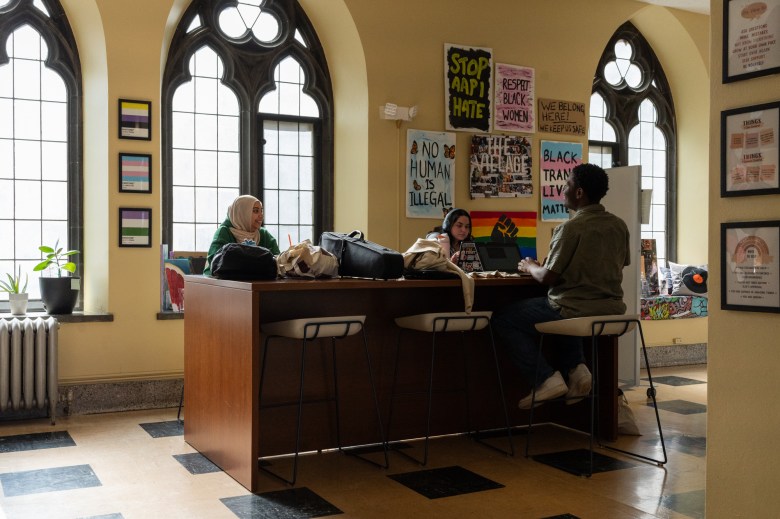
El Centro para la Liberación Cultural de la Dominican University, cerca de Chicago. La sala es un lugar de estudio, conversación y encuentro para estudiantes de todas las procedencias. Credit: Camilla Forte/The Hechinger Report
A menos que las universidades construyan redes más amplias, dijo Collins – incluyendo la ayuda para que más hispanoamericanos puedan acceder a empleos mejor pagados – “nuestra calidad de vida será menor. Es un panorama bastante desolador”.
Incluso los más pequeños esfuerzos por matricular y apoyar a los estudiantes hispanos se complican aún más con la retirada de los programas de diversidad y las ayudas económicas a los estudiantes indocumentados, muchos de ellos hispanos.
Aunque la base jurídica de esa decisión ha sido ampliamente cuestionada, tiene en vilo a las instituciones de enseñanza superior. Incluso muchos colegios y universidades que los activistas elogiaron por impulsar la matriculación de hispanos no quisieron hablar de ello.
Algunos expertos dicen que la mayoría de los programas para reclutar y apoyar a los estudiantes hispanos no se verían afectados por las campañas anti DEI, ya que se ofrecen a cualquiera que los necesite. “Estas cosas funcionan para todos los estudiantes”, dijo Anne-Marie Núñez, directora ejecutiva del Instituto para el Éxito de los Estudiantes Hispanos de la Universidad de Texas en El Paso.
La proporción de graduados de secundaria hispanos que van directamente a la universidad es inferior a la de sus compañeros blancos, y está disminuyendo: del 70% al 58% entre 2012 y 2022. Ese es el último periodo para el que se dispone de cifras del Centro Nacional de Estadísticas Educativas. Los estudiantes hispanos que se matriculan en la universidad también la abandonan en mayor proporción.
Hay razones económicas y culturales para ello.
Según la Oficina del Censo, el ingreso medio anual de las familias hispanas es más de un 25% inferior al de las familias blancas, lo que significa que la universidad puede parecer fuera de su alcance. El Center for Law and Social Policy ha calculado que más de tres cuartas partes de los estudiantes hispanos que acuden incluso a colegios comunitarios de bajo coste tienen necesidades financieras no cubiertas.
Esto empuja a muchos directamente al mercado laboral. Muchos estudiantes universitarios hispanos trabajan al menos a tiempo parcial mientras estudian, algo que, según las investigaciones, reduce la probabilidad de graduarse.
Cuando Eddie Rivera terminó la secundaria en Carolina del Norte, “la universidad no era realmente una opción. Mi consejero no me ayudó. Sólo seguí lo que mi cultura hispana nos dice, que es ir a trabajar”.
Cuando Eddie Rivera terminó la secundaria en Carolina del Norte, “sólo seguí lo que mi cultura hispana nos dice, que es ir a trabajar”. Animado por sus compañeros, acabó matriculándose en la Dominican University. Credit: Camilla Forte/The Hechinger Report
Rivera, que tiene el estatus DACA, o Acción Diferida para los Llegados en la Infancia, trabajó en una residencia de ancianos, en un parque de trampolines cubierto y en un hospital durante la pandemia, donde sus colegas le animaron a ir a la universidad. Con la ayuda de un programa de becas para estudiantes indocumentados, también terminó en Dominican, donde a sus 28 años es estudiante de tercer año y se especializa en relaciones internacionales y diplomacia, con planes de obtener una maestría en política exterior y seguridad nacional.
Dominican, una pequeña universidad católica que data de 1922 y que antes se llamaba Rosary College, tiene una historia de educación de hijos de inmigrantes, del norte y centro de Europa, inicialmente.
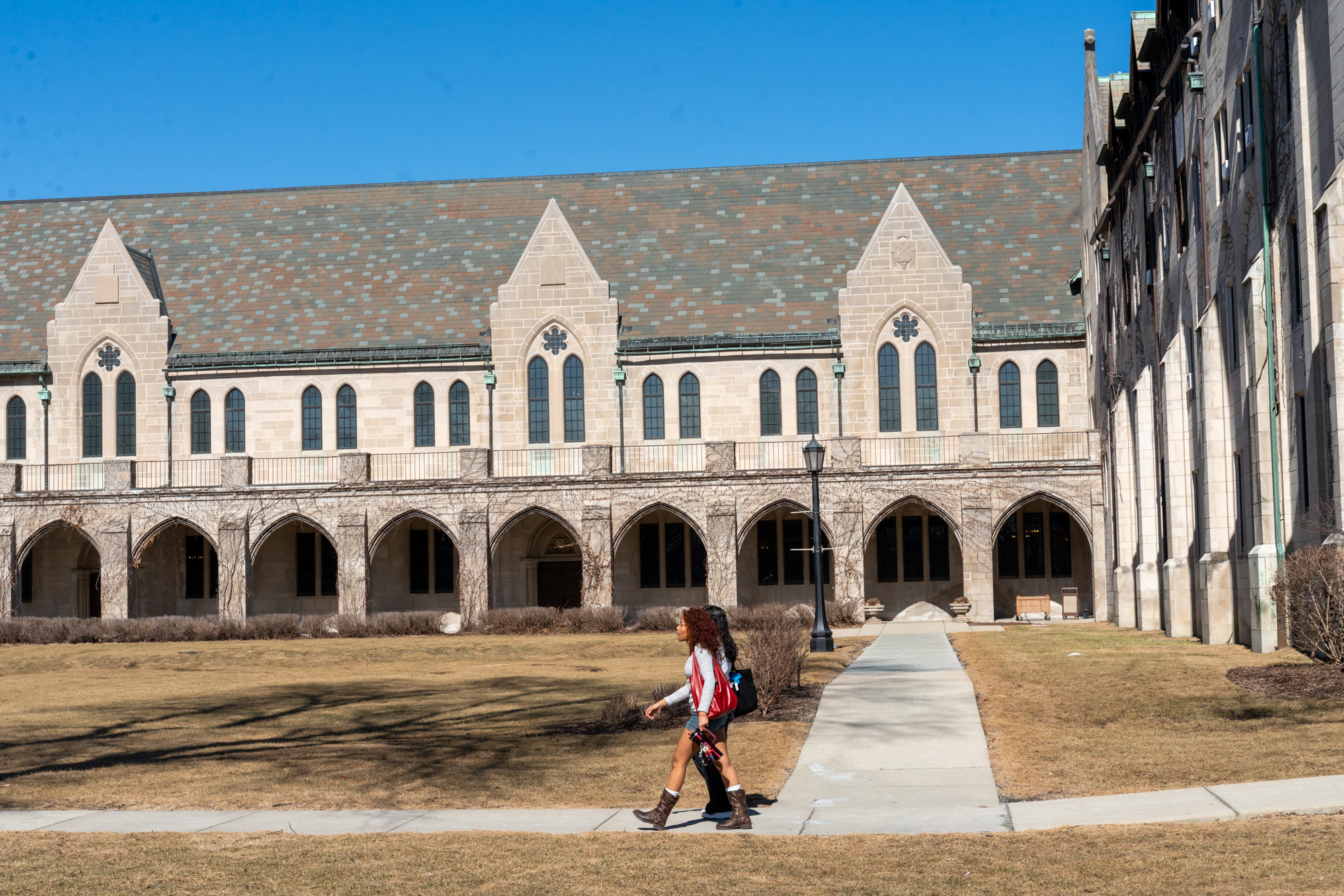
Hoy, de las farolas del campus de 30 acres cuelgan pancartas con fotos de antiguos alumnos hispanos de éxito, y una banda de mariachis dirige las celebraciones del Día de los Muertos.
Las visitas a la institución se realizan en inglés y español, se ofrece a los estudiantes trabajo en el campus y el personal ayuda a familias enteras a superar crisis sanitarias, de vivienda y financieras. Dominican añadió un campus satélite en otoño en el barrio mexicano-americano de Pilsen, en Chicago, que ofrece titulaciones de dos años orientadas al empleo. Todos los estudiantes de la universidad reciben ayuda financiera, según datos federales.
“Todos los días me encuentro con un miembro del personal o un profesor que me pregunta qué me pasa en la vida y cómo pueden ayudarme”, dice Aldo Cervantes, estudiante de tercer año de Negocios con especialización en Contabilidad, que quiere dedicarse a la banca o a los recursos humanos.
También hay una Academia Familiar para que los padres, abuelos, hermanos y primos de los estudiantes conozcan los recursos de la universidad; como incentivo, las familias que acudan a cinco sesiones obtienen créditos para que su estudiante realice un curso de verano sin costo alguno.
Un armario de ropa en la Dominican University para estudiantes que necesitan trajes de negocios para entrevistas de trabajo. Uno de los factores que frenan la matriculación de hispanos en la universidad es la menor renta media de los hogares. Credit: Camilla Forte/The Hechinger Report
“Cuando observamos a la población latina que va a la universidad, no se trata de una elección individual”, afirma Gabe Lara, Vicepresidente de Éxito y Compromiso Estudiantil, utilizando el término preferido por la universidad para referirse a las personas de ascendencia latinoamericana. “Es una elección familiar”.
Estas y otras medidas han contribuido a más que duplicar la proporción de estudiantes hispanos en los últimos 10 años, hasta casi el 70% de los 2.570 estudiantes de Dominican, según cifras facilitadas por la universidad.
Genaro Balcazar dirige las estrategias de matriculación y marketing como director de operaciones de la universidad, tiene una forma pragmátuca de ver la situación.
“Atendemos las necesidades de los alumnos no por quiénes son”, dijo Balcázar, “sino porque necesitan la ayuda”.
Este artículo sobre la enseñanza superior y el reclutamiento de alumnos hispanos fue producido por The Hechinger Report, una organización de noticias independiente sin fines de lucro centrada en la desigualdad y la innovación en la educación. Suscríbete a nuestro boletín. Escucha nuestro podcast sobre educación.
The Hechinger Report provides in-depth, fact-based, unbiased reporting on education that is free to all readers. But that doesn’t mean it’s free to produce. Our work keeps educators and the public informed about pressing issues at schools and on campuses throughout the country. We tell the whole story, even when the details are inconvenient. Help us keep doing that.
Two years ago, I was invited to deliver a course at a prestigious management school abroad. Though hesitant at first, I accepted the opportunity to do what turned out to be one of my most rewarding teaching experiences. I taught a group of students unlike any I had taught over the span of my long teaching experience in diverse settings and institutions.
The students portrayed an exceptional level of behavioral engagement. This surprised me since I had never seen them before, and I was new to them. I had not had the chance to establish any social or emotional bonds with them. I could see them taking their own notes during the lessons, never asking me for my slides, a common practice among other students I have taught. They would work on the assigned tasks in class and use their time efficiently. Assigned homework was always completed without me having to send them reminders. When I gave a break during a session, many would open books and read until the class resumed.
It happened that my class was interrupted by the New Year’s one-day holiday. I asked the class after the holiday to think of a new year’s resolution, and to my surprise, a handful of students said that they intended to increase the number of books they would read in the coming year.
At the end of my visit, I left those students and went back home to my regular educational setting. I found myself reflecting on my own recent experience. In my setting, most teachers I work with grapple with the challenge of engaging their students in their learning; thus, they work hard on providing students with incentives and support to stay on tasks, contribute to their groups, and complete their assigned work. I know that many of those teachers designed very good learning experiences and tried to accommodate their students’ needs, yet they did not observe the engagement they hoped for.
This contrast raised several questions:
What are we missing as educators when it comes to student engagement?
Are the challenges related to the curriculum, the school, or the larger context extending beyond the school to the home and society?
Is it the collective perception toward education a factor in fostering student engagement? Have educators and parents been able to help students understand the bigger meaning behind their school experiences and tasks?
Have we been able to help them make the connection between these tasks and their reality?
Has the system taken these into considerations when designing the educational curricula?
Talking about relating learning experiences to real life brings to my attention how this group of young management students integrated their academic knowledge with their online profiles. Many connected with me on LinkedIn, where I have been seeing them share deep reflections and insights from their studies. Although they are still in their early years of their university studies, they express their opinions and stand as though they are experts in their field. They report on activities they engage in related to what they study and reflect on what they encounter and experience. They provide bulleted lists of advice and practice. Reading their posts, I see these students already can foretell their placement in life after they graduate and are acting accordingly. This could be a reason why they embrace schoolwork and engage with it willingly.
I end with two incidents from my visit that resonate with me. For one of the assessments, I conducted an online, objective-type quiz, consisting mainly of multiple-choice questions. The class speed in which the students submitted their responses led me to think they had worked collectively on a WhatsApp group. When I raised this concern, one student who seemed offended assured me that they would not do such a thing. This claim was validated when I graded the final exam, a rigorous three-hour subjective type of exam. The class average was an impressive A.
The second incident was when I asked the class for feedback on my teaching, as I usually do towards the end of a semester. One student advised me: “Next time you teach here, be tougher on students. We are used to working hard, and we can handle it.” I had never heard of anything similar from a student; on the contrary I have students who often request reduced workload and extended deadlines.
Reflecting on this experience, I believe the following can be considered as main takeaways for educators:
Design meaningful learning experiences: The type of learning experiences we design for our students should relate to their realities and be meaningful and to where the students see themselves later in life
Recognize the multifaceted nature of engagement: Student engagement is not necessarily the product of the teacher’s efforts but a myriad of aspects including the curriculum, perceptions, school and culture.
Allow students’ voices: Listening to the students’ voices provides us with a lot of tips on how we can improve the learning experiences for them and attend to what they think they need help with.
Foster student accountability: There are ways to help students be accountable to their own actions and to behave responsibly towards their learning
Cultivate academic integrity: academic integrity can be achieved effortlessly when students are interested in what they do and understand the positive impact of their learning on their lives.
Amal Farhat has experience in teaching and instructional coaching at K-12 schools and higher education. She has worked in the private and public sectors. Her interests mainly pertain to the development of professional learning communities through positive, constructive interactions among stakeholders of an institution. In higher education, she taught in the Faculty of Letters and Humanities and Faculty of Education. Additionally, she works as a teaching and learning specialist supporting faculty members with their teaching practices. Amal holds a PhD in education from the Doctoral Institute at Lebanese University, a counseling in pedagogy diploma from St. Joseph University, and is CAEL (Certificate in Advanced Education Leadership) certified from Harvard Graduate School of Education.
Over the past few decades, there has been – as many an academic will attest – a significant shift in the extent to which parents are involved in their children’s higher education.
Parents now often attend university open days with their children, with some institutions laying on separate talks and events for them. Moreover, despite the introduction of tuition fees and maintenance loans, many parents end up making some financial contribution to their child’s higher education.
To date, however, we know relatively little about parents’ perspectives on their involvement, nor about the extent to which they support their children in non-financial ways once they have embarked on their higher education journey. Research that I have recently completed (with Julia Cook and Dan Woodman) on parents of Australian higher education students may be transferable to the UK, given the similarities between the two higher education systems and social structures more generally.
Drawing on data from the longitudinal Life Patterns project, which has been following the lives of young Australians since the 1990s, we asked parents with children in higher education – or shortly to enrol – a series of questions about the support, if any, they were offering their children, as well as whether they felt parents should be supporting their children in any particular ways. Their responses were fascinating.
Independence and intervention
Nearly all of those we spoke to believed that higher education was a space in which young people learned how to be independent – and it was this that helped to distinguish it from school. University was typically positioned as a space where their children would “fend for themselves”, engage in “adult learning”, and be accountable for their own actions.
However, while there was a strong rhetorical commitment to higher education as a time of achieving independence, when describing the detail of their parenting practices our participants outlined a wide range of ways in which they had been closely involved in the lives of their student children (or thought a parent should be), providing high levels of practical and emotional support.
All of those we interviewed were either already providing financial support to their offspring at university, or they had clear plans to do so when their children enrolled. In addition, they either had already spent, or thought it was desirable to spend, considerable time with their children supporting them through any problems they encountered during their studies. This differed between participants but often included “coaching” approaches, to help the child identify the root cause of problems; strong encouragement to take advantage of the various services available on campus – sometimes with detailed advice about how best to access these; and, in a significant number of cases, direct involvement in academic matters, including paying for private tutors.
The following excerpts from our interviews are illustrative:
Yeah, we would help [daughter] through that and … make a timetable for her for the week on how she could help with the study. …. So she’s not thinking it’s all got to be done in a short amount of time.
The other thing we could do is investigate some tutoring if that’s required.
None of our interviewees remarked on the apparent paradox between the rhetorical foregrounding of “independence”, on the one hand, and the numerous examples of parental intervention, on the other. This is perhaps unsurprising. It does, however, raise the interesting question of why these parents continued to see university as a space of independence given the various forms of support they were giving their child (or thought should be given).
Defining distances
In answering this question, we can first point to the dominance of discourses about independence. Despite the well-documented changes to young people’s lives over recent decades and the associated later age at which the traditional markers of adulthood are on average now reached, independence as an achievement of early adulthood retains considerable discursive power. Admitting that one’s child is “semi-dependent”, or similar, while at university may thus be viewed as admitting or that an adult child is struggling and even that one has “failed” as a parent.
Relatedly, it appears that there continues to be some social opprobrium associated with acknowledging that one intervenes in the life of one’s son or daughter once they reach the age for higher education. This is alluded to in the following comment from one of our interviewees:
Kids get older, they’re more mature than you think. You don’t want to be seen as mothering your children, I don’t want to be that umbrella parent that’s hanging over them all the time saying ‘do go do this’ or ‘you should do that’.
Both structural factors (such as having to pay tuition fees, and the high cost of university housing) and cultural influences (such as the expectation that parents take responsibility for monitoring their child’s educational progress) likely encourage parents to continue to intervene quite significantly in the lives of their student-children. Yet it appears that these participants were nevertheless keen to discursively distance themselves from such behaviours.
These findings provide new insights into how parenting practices are shifting over time. They may also have broader political and policy implications. Our sample was broadly middle class and we would speculate that the interventions outlined above may not be available to all students – particularly those from families with no prior experience of higher education. Universities thus need to be aware that some students may be being supported in their academic endeavours by parents, and this may serve to exacerbate social inequalities. Can more support be offered within universities to those without such familial resources?
With respect to more general policy debates, for those who believe that the student loan should be increased (or grants restored) to cover costs currently often picked up by parents, arguments may be harder to make if the actual degree of parental contribution is masked by the discourse of “independence”. There may therefore be some advantage to being more open about the degree of parental support, with respect to finances at least.
This is Mason Science College, founded in 1875 by Sir Josiah Mason. It was one of the institutions which formed the nucleus of the University of Birmingham in 1900 (the other was Queen’s College, founded in 1825 as the Birmingham Medical School). The buildings were used by the university until the 1960s but are now gone.
Mason had made his fortune in manufacturing – mostly steel pens, but other products too.
The card was posted on 17 April 1905 in Bournemouth to an address in Doncaster.
Thanks for letter and will answer in a day or so. Went to hear Sousa’s band today. Have you heard him? I trust you are stronger dear. Love in haste …
John Philip Sousa and his band were touring Britain in 1905, but I can’t pin down where they played on Monday 17 April.
Apologies for the brevity of this post – I’m under the cosh this week, with work and other stuff, so the postcard blog is short and sweet. Hopefully back to normal next week!
This week on the podcast we discuss the financial crisis at the University of Dundee, as a revised recovery plan reduces proposed job cuts while requesting additional funding. Is this a sustainable solution for institutions facing similar challenges?
Plus we look at concerning new Wonkhe and Cibyl polling on student health, and we examine how international student policies have become political battlegrounds in global elections.
With Chris Shelley, Director of Student Experience at Queen Mary University of London, Rachel MacSween, Director of Partnerships and Stakeholder Engagement (UK and Europe) at IDP, Michael Salmon, News Editor at Wonkhe and presented by Mark Leach, Editor-in-Chief at Wonkhe.
Few will be unaware of Donald Trump’s antipathy towards diversity, equity, and inclusion (DEI) in the US. In February 2025, Trump issued executive orders and policy directives aimed at eliminating DEI programmes and removing references to “gender ideology” from federal agencies.
For those of us who know DEI as equality, diversity and inclusion (EDI), there is concern about the ripple effects of Trump’s measures on UK universities, for research as well as teaching and learning.
One of the immediate impacts of this manoeuvre was to remove essential LGBTQ+ content from federal websites. Terms such as “transgender”, “LGBT”, and “pregnant person” were all banned. Decades of HIV data, contraception guidelines, and research on racial health disparities were suddenly inaccessible. For US researchers in higher education, such staggeringly blatant anti-EDI policies have disrupted the passage of critical research focused on improving health outcomes for marginalised groups.
Such censorship – to our minds at least – thoroughly undermines scientific integrity, limiting the study of complex health and social issues. Our colleagues in the US are now forced to work within these constraints, which threaten accuracy and inclusivity. Indeed, the politicisation of scientific terminology arguably damages public trust in research and, in the US, diminishes the credibility of federal agencies.
Implications for LGBTQ+ researchers
Trump’s anti-EDI stance is a menace to any form of university research seeking to address inequalities and build inclusion for seldom heard population groups, and the effects of these decisions will have wide-reaching and intersectional repercussions.
As committee members of a university’s LGBTQ+ staff network, our focus is understandably on the impact for our colleagues working on LGBTQ+ issues. US-based researchers working on LGBTQ+ themes now face obstacles in securing funding and publishing their work. And this has a knock-on effect on wider LGBTQ+ population groups. The suppression of critical health information and the suspension of targeted research leaves LGBTQ+ communities bereft of vital support and resources.
More fundamentally, Trump’s policies send the signal that LGBTQ+ identities and needs are irrelevant from his agenda for US growth. It’s a quick step from this to the increase of social stigma and discrimination targeted at LGBTQ+ people. And this in turn worsens mental health and social marginalisation. To put it bluntly: the absence of LGBTQ+ representation in official communications sends a damaging message about the validity of these communities’ experiences.
Lessons for UK universities
To bring this back to the UK context then, a few things come to mind.
First, the UK has its own, depressingly recent, history of government-led suppression of LGBTQ+ communication, which we’d do well to remember. Section 28 of the Local Government Act 1988 banned the promotion of homosexuality in schools across England, Scotland, and Wales. Repealed in England and Wales in 2003, this act led to years of silence and marginalisation within educational settings.
Section 28 not only harmed students and staff at the time but also created a culture of fear and misinformation, curtailing inclusive teaching and research. To ensure the UK does not repeat such history, universities must prioritise legal advocacy and protection for all involved in higher education, to safeguard academic freedom and inclusivity. Being involved in the LGBTQ+ staff network as we are, we might also add that coalition building among universities, LGBTQ+ advocacy groups, and non-profits can also strengthen efforts to resist any potential policy shifts that might echo the restrictive measures of the past.
Second, Trump’s agenda also urges us to re-think our approach to US-UK research collaborations and student exchanges. There seems to be an increasing discrepancy between what the UK and US each consider to be worthy of research and funding.
Universities in the UK should assess how they foster links with other nations whose research agendas align more closely with UK priorities, to mitigate any potential funding losses. Moreover, UK universities should ideally review their reliance on external funding from the US to determine whether any existing projects might be impacted by shifts in US policy. Equally, with US suppression of data relating to LGBTQ+ issues impacting LGBTQ+ health and wellbeing, it’s vital that UK universities ensure that their research connected to LGBTQ+ issues is readily available.
Third, it seems crucial that UK universities futureproof their relationships with US students. The possibility of new limitations on exchange programmes, including restrictions on modules with extensive EDI content, could impact the accessibility of UK higher education for US students. Online programmes that currently enrol US students may also face scrutiny, raising concerns about whether course content is monitored or whether degrees will continue to be recognised in the US due to their inclusion of EDI principles.
Looking forward
UK universities have a pivotal role to play in responding to what’s happening in the US in relation to Trump’s anti-EDI stance.
We’ve focused particularly on the impacts of these political and policy shifts on LGBTQ+ research and culture in higher education. But they represent a more wholesale attack on initiatives seeking to safeguard the wellbeing of marginalised population groups. UK universities must continue to represent a safe space for education which upholds inclusivity, critical thinking, and academic integrity. This requires a strong coalition of organisations, advocacy groups, and academic institutions working together to resist the erosion of rights and the suppression of essential research.
Such a coalition of critically-minded parties seems all the more important given the recent ruling by the Supreme Court on 16 April 2025 in relation to the Equality Act 2010, which insisted on the binary nature of sex, which is determined by biology. As a result, this leaves trans women unable to avail themselves of the sex-based protections enshrined in the Equality Act.
Universities, like other institutions, will need to review their policies accordingly and should do their utmost to continue to assert a safe and inclusive environment for trans people. But this decision, coming so soon after the Cass review, is also contributing to the anxiety and uncertainty experienced by LGBTQ+ people more broadly. With echoes between the US situation and recent UK developments, the direction of travel is concerning.
By standing together, we can safeguard the rights of all marginalised communities and ensure that the integrity of scientific research, human dignity, and social progress are protected.
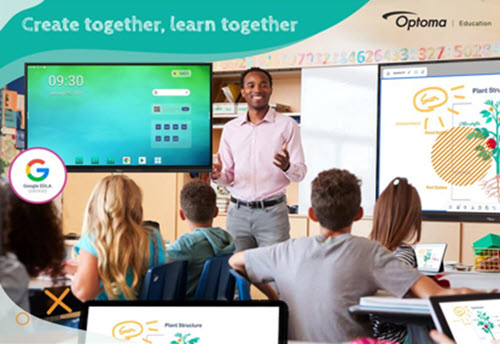
FREMONT, CA –Optoma, a world-leading provider of visual solutions, today announced its latest Creative Touch 3-Series Interactive Displays designed to empower educators and business professionals with new tools and features to enhance learning, make presentations more effective, and increase collaboration in classrooms, lecture halls, boardrooms, remote working and other business environments.
With Google’s Enterprise Device Licensing Agreement (EDLA) Certification and added functionality, the new 3-Series empowers professionals and educators to deliver dynamic and impactful content by providing cutting-edge tools that streamline management and elevate engagement. The advanced capabilities of the new 3-Series simplify planning and workflow through wireless collaboration, screen sharing, and innovative meeting solutions in both corporate and educational environments alike, all packed into a robust yet user-friendly platform.
The 3-Series: Purpose-Built for Corporate and Education Environments
New features and key highlights include:
Google EDLA Certification: Ensures compatibility and optimized performance with thousands of educational applications and services available directly from the pre-installed Google Play Store allowing users to experience the full Google Suite for real-time collaboration from practically anywhere in the world. Without compatibility issues or the hassle of connecting an external PC, users can easily access the entire suite of Google-based applications they are accustomed to – including Google Drive, Google Docs, YouTube, and more!
The Optoma Solution Suite (OSS®):User-friendly software featuring Artificial Intelligence (AI) enabled tools, such as Sticky Notes* and AI Handwriting Recognition, the OSS package also includes:
Whiteboard: Unleash creativity through a digital whiteboard packed with tools that make learning and sharing ideas engaging – facilitating collaboration in real-time from anywhere.
Smart Sketch tool is ideal for drawing diagrams as it recognizes shapes and drawings and converts them into clipart images.
Floating Toolbar and Infinity Canvas allow you to seamlessly switch between tools to suit your tasks with a virtually limitless writing space.
Innovative Annotation and Highlighter Tools make underlining key points or annotating complex diagrams a breeze.
File Manager: Easily save, organize, or move files from local storage to networkable storage or to popular cloud services in seconds.
Display Share: Connect any device to wirelessly broadcast, share, or stream your content to the big screen. Bringing your own device has never been easier.
Exceptional Performance: Seamless performance with an 8-core processor, Android 14 OS, and Zero Bonding screen for that natural writing experience.
“We are excited to announce our new 3-Series and partnership with Raptor Technologies which truly embodies our commitment to supporting education through cutting-edge visual solutions, enhanced software packages and safety and security,” said Maria Repole, Head of Marketing at Optoma.
A value-added solution, Optoma Management Suite (OMS®) is available out of the box on the 3-Series Interactive Displays, with a free trial available.** OMS offers IT administrators and technicians a real time remote platform to monitor, manage, diagnose, and update multiple or entire fleets of displays simultaneously that are either on the same network or connected through the cloud. OMS makes it easy to broadcast emergency messages, alerts, or announcements across displays worldwide.
Optoma is thrilled to partner with Raptor® Technologies, the leading innovator in school safety solutions, redefining the landscape of school security with its Raptor School Safety Software Suite. By integrating Raptor’s software with Optoma’s interactive displays, school administrators and students can receive real-time alerts and emergency notifications using CAP protocols to improve the overall safety of the school.
*Some AI features may require the use of an Optoma (OSS) account.
**Free trial licenses are available for a limited time. Please register your OMS® Cloud account at https://oms.optoma.com or speak with your local representative.
OMS and OSS are registered trademarks of Optoma Corporation
DLP is a registered trademark of Texas Instruments
About Optoma Technology, Inc.
Optoma combines cutting-edge technology and innovation to deliver remarkable visual display products designed to connect audiences with engaging video experiences. From the company’s ProScene projectors to its Creative Touch interactive, Professional LCD and LED displays, Optoma’s suite of products can meet the demands of nearly any professional environment, including conference rooms and classrooms, digital signage, corporate, houses of worship, retail, simulation environments and control rooms. Optoma Technology is the U.S. headquarters for The Optoma Group, with continental headquarters also in Europe and Asia. For more information, visit optomausa.com.
eSchool Media staff cover education technology in all its aspects–from legislation and litigation, to best practices, to lessons learned and new products. First published in March of 1998 as a monthly print and digital newspaper, eSchool Media provides the news and information necessary to help K-20 decision-makers successfully use technology and innovation to transform schools and colleges and achieve their educational goals.
Duke Universityis offering voluntary buyouts for employees and has frozen hiring as it braces for federal funding cuts, the institution said Wednesday.
The North Carolina institution signaled that layoffs were likely in the coming months, but said it is “pursuing several employment actions now in hopes of reducing the scale of involuntary separations later this summer.”
The moves are in response to federal cuts and policy shifts, which could translate into funding losses for Duke between $500 million and $750 million, university officials said during an internal webinar Wednesday, according to media reports.
Dive Insight:
Historically, much of Duke’s research enterprise has been devoted to work on behalf of the government. Federal grant support made up nearly three-quarters of the $1.5 billion in sponsored research funds that Duke received in fiscal 2024,much of it going toward health science.
The university, in its latest financial statement, described its medical school as “one of the largest biomedical research enterprises in the country.”And funding just from the U.S. Department of Health and Human Services — which houses the National Institutes of Health — accounted for 58% of all of Duke’s sponsored research funding.
The National Science Foundation and U.S. Department of Energy also accounted for tens of millions of dollars in the university’s funding.
Since President Donald Trump retook office, those agencies and others have been cutting and delaying grant awards at a frantic pace, including moves to cap reimbursement for indirect research costs at NIH and theEnergy Department. Both funding caps have been blocked in courts — at least for now — but the Trump administration is continuing to fight the legal cases against the policies.
Uncertainty over the funding will likely loom for some time to come.
For Duke, the NIH indirect cost cap would mean $194 million in lost funding each year, President Vincent Price and other leaders said in February.
“Much is at stake,” the officials said then. “Our nation’s world-leading research enterprise has been enabled by — and will only be sustained by — partnership and co-investment from both the government and higher education.”
They also signaled at the time that “careful planning and difficult decisions” could lie ahead.
Today, Duke is trying to cut $350 million from its budget, according to reports of the university’s presentation, as it grapples with funding gaps under the Trump administration.
As it trims down, Duke has paused capital spending on buildings, renovations and other projects that are “not fully funded or deemed essential,” the university said Wednesday.
It’s also reviewing universitywide programs — such as technology adoption, off-campus real estate and on-campus space consolidation — for potential cost-savings.
Employee benefits could also be on the chopping block.
“A study is also under way to assess how certain changes to the university’s benefits may generate savings while protecting the program’s strong competitive position,” Duke said.
However, Executive Vice President Daniel Ennis told employees Wednesday that the university still plans to give out merit raises and will not change its tuition grant program for children of employees.
Universities around the country have been scrambling in recent months to open breathing room in their budgets to cope with the uncertainty and disruption created by cuts and delays at federal agencies. Many have frozen hiring and budgets to maintain financial flexibility while others have laid off employees to cope with cuts.