Blog

  • Adjusting to Generative AI in Education Means Getting to the Roots

    Adjusting to Generative AI in Education Means Getting to the Roots

    To help folks think through what we should be considering regarding the impact on education of generative AI tools like large language models, I want to try a thought experiment.

    Imagine if, in November 2022, OpenAI introduced ChatGPT to the world by letting the monster out of the lab for a six-week stroll, long enough to demonstrate its capacities—plausible automated text generation on any subject you can think of—and its shortfalls—making stuff up—and then coaxing the monster back inside before the villagers came after it with their pitchforks.

    Periodically, as new models were developed that showed sufficient shifts in capabilities, the AI companies (OpenAI having been joined by others), would release public demonstrations, audited and certified by independent expert observers who would release reports testifying to the current state of generative AI technology.

    What would be different? What could be different?

    First, to extend the fantasy part of the thought experiment, we have to assume we would actually do stuff to prepare for the eventual full release of the technology, rather than assuming we could stick our heads in the sand until the actual day of its arrival.

    So, imagine you were told, “In three years there will be a device that can create a product/output that will pass muster when graded against your assignment criteria.” What would you do?

    A first impulse might be to “proof” the assignment, to make it so the homework machine could not actually complete it. You would discover fairly quickly that while there are certainly adjustments that can be made to make the work less vulnerable to the machine, given the nature of the student artifacts that we believe are a good way to assess learning—aka writing—it is very difficult to make an invulnerable assignment.

    Or maybe you engaged in a strategic retreat, working out how students can do work in the absence of the machine, perhaps by making everything in class, or adopting some tool (or tools) that track the students’ work.

    Maybe you were convinced these tools are the future and your job was to figure out how they can be productively integrated into every aspect of your and your students’ work.

    Or maybe, being of a certain age and station in life, you saw the writing on the wall and decided it was time to exit stage left.

    Given this time to prepare, let’s now imagine that the generative AI kraken is finally unleashed not in November 2022, but November 2024, meaning at this moment it’s been present for a little under six months, not two and a half years.

    What would be different, as compared to today?

    In my view, if you took any of the above routes, and these seem to be the most common choice, the answer is: not much.

    The reason not much would be different is because each of those approaches—including the decision to skedaddle—accepts that the pre–generative AI status quo was something we should be trying to preserve. Either we’re here to guard against the encroachment of the technology on the status quo, or, in the case of the full embrace, to employ this technology as a tool in maintaining the status quo.

    My hope is that today, given our two and a half years of experience, we recognize that because of the presence of this technology it is, in fact, impossible to preserve the pre–generative AI status quo. At the same time, we have more than info information to question whether or not there is significant utility for this technology when it comes to student learning.

    This recognition was easier to come by for folks like me who were troubled by the status quo already. I’ve been ready to make some radical changes for years (see Why They Can’t Write: Killing the Five-Paragraph Essay and Other Necessities), but I very much understood the caution of those who found continuing value in a status quo that seemed to be mostly stable.

    I don’t think anyone can believe that the status quo is still stable, but this doesn’t mean we should be hopeless. The experiences of the last two and a half years make it clear that some measure of rethinking and reconceiving is necessary. I go back to Marc Watkins’s formulation: “AI is unavoidable, not inevitable.”

    But its unavoidability does not mean we should run wholeheartedly into its embrace. The technology is entirely unproven, and the implications of what is important about the experiences of learning are still being mapped out. The status quo being shaken does not mean that all aspects upon which that status quo was built have been rendered null.

    One thing that is clear to me, something that is central to the message of More Than Words: How to Think About Writing in the Age of AI: Our energies must be focused on creating experiences of learning in order to give students work worth doing.

    This requires us to step back and ask ourselves what we actually value when it comes to learning in our disciplines. There are two key questions which can help us:

    What do I want students to know?

    What do I want students to be able to do?

    For me, for writing, these things are covered by the writer’s practice (the skills, knowledge, attitudes and habits of mind of writers). The root of a writer’s practice is not particularly affected by large language models. A good practice must work in the absence of the tool. Millions of people have developed sound, flexible writing practices in the absence of this technology. We should understand what those practices are before we abandon them to the nonthinking, nonfeeling, unable-to-communicate-with-intention automated syntax generator.

    When the tool is added, it must be purposeful and mindful. When the goal of the experience is to develop one’s practice—where the experience and process matter more than the outcome—my belief is that large language models have very limited, if any, utility.

    We may have occasion to need an automatic syntax generator, but probably not when the goal is learning to write.

    We have another summer in front of us to think through and get at the root of this challenge. You might find it useful to join with a community of other practitioners as part of the Perusall Engage Book Event, featuring More Than Words, now open for registration.

    I’ll be part of the community exploring those questions about what students should know and be able to do.

    Join us!

    Source link

  • Limestone University Announces Closure

    Limestone University Announces Closure

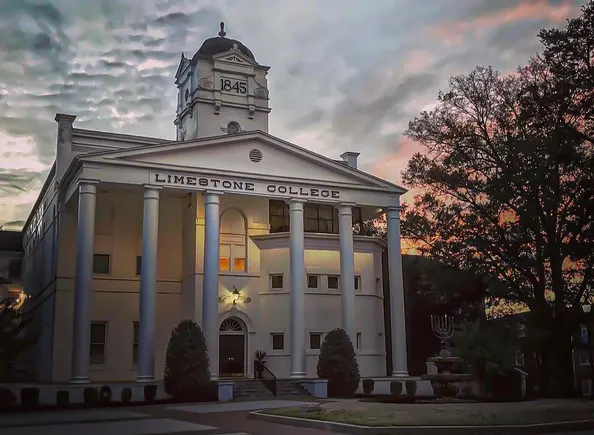
    Limestone University survived the Civil War and the Great Depression, but protracted financial struggles have proven harder to overcome: After nearly 180 years, Limestone will cease operations next week.

    Officials announced the closure Tuesday night.

    “Words cannot fully express the sorrow we feel in having to share this news,” Limestone president Nathan Copeland said in a statement. “Our students, alumni, faculty, staff, and supporters fought tirelessly to save this historic institution. While the outcome is not what we hoped for, we are forever grateful for the passion, loyalty, and prayers of our Saints family.”

    The move follows a tumultuous period for the university. After years of financial challenges, the Board of Trustees was set to decide last week on whether to shift to online-only operations or close altogether. At the last minute it decided to hold off on the decision because a “possible funding source” had emerged.

    Limestone was seeking a $6 million infusion to help facilitate the shift to a fully online model. Though the university was able to secure $2.1 million in pledged commitments from almost 200 donors, according to the closure announcement, it ultimately fell well short of the goal, prompting the board to close the private institution in South Carolina.

    Now 478 employees will lose their jobs.

    The closure comes on the heels of significant enrollment and financial losses. The university enrolled 3,214 students in fall 2014, according to federal data; Limestone recently noted enrollment at around 1,600.

    It has also operated for years with substantial budget deficits. The latest audit for the university noted “significant doubt” about Limestone’s ability to remain open, given that it had “suffered recurring significant negative changes in net assets and cash flows from operations” and had “a net deficiency in [unrestricted] net assets.”

    Limestone’s board also borrowed heavily from the university’s meager endowment in recent years.

    In 2023, the South Carolina attorney general agreed to lift restrictions on Limestone’s endowment to allow the board to increase spending from those funds. As a result, the endowment collapsed in value, falling from $31.5 million at the beginning of fiscal year 2022 to $12.6 million at the end of FY23. Auditors noted that “all endowment funds are underwater” as of last June.

    Auditors also expressed skepticism that Limestone would be able to pay off mounting debts.

    The university had more than $30 million in outstanding debt in the last fiscal year, including $27.2 million owed to the U.S. Department of Agriculture. Limestone’s latest audit shows the university listed its buildings and land as collateral for both the U.S. Department of Agriculture and another bank loan.

    Auditors also found that Limestone’s “internal controls over financial reporting are informal and lack formal documentation,” and that the university’s accounting department was understaffed.

    Despite the abrupt nature of the closure, Limestone officials wrote in Tuesday’s announcement that the university “will proceed with an orderly wind-down process” and help students transfer to other institutions and support faculty and staff with more information to come on those efforts.

    Limestone will hold its final commencement on Saturday.

    “Our Limestone spirit will endure through the lives of our students and alumni who carry it forward into the world,” Limestone board chair Randall Richardson said in the closure announcement. “Though our doors may close, the impact of Limestone University will live on.”

    The closure announcement comes less than a week after St. Andrews University, a private institution in North Carolina, made a similar decision to cease operations due to fiscal issues.

    Source link

  • What Online College Students Need

    What Online College Students Need

    It’s been five years since colleges moved their teaching and learning online in response to the COVID pandemic, and Inside Higher Ed’s 2025 Survey of Campus Chief Technology/Information Officers, released today, shows that while online learning may still be adjusting to a new post-pandemic normal, it’s not going anywhere.

    Half of surveyed CTOs indicate that student demand for online and/or hybrid course options has increased substantially year over year at their institution. Nearly the same share say their college has added a substantial number of new online or hybrid course options over the same period. Meanwhile, the most recent Changing Landscape of Online Education Project report found something similar: Nearly half of chief online learning officers surveyed said that enrollment in online degree programs at their institution is now higher than that of on-campus programs—and even more said their college had undergone a strategic shift in response to such demand.

    And even while identifying increased student interest in on-site learning for certain activities, the 2025 Students and Technology Report from Educause also reveals general student appreciation of flexible learning formats and an outright preference for online courses among older learners.

    Amid this growing demand for online and hybrid courses, we surveyed students studying in different modalities to understand how their needs and interests might differ.

    Our annual Student Voice survey of 5,025 two- and four-year learners with Generation Lab polled learners about their study experiences relative to their peers taking all their courses online and those taking a mix of both in-person and online courses, as of spring 2024. We looked for gaps in responses and key overlaps between those groups, along with potentially counterintuitive responses from online-only learners. (The survey asked all students about academic success, health and wellness, involvement in college life, career readiness, and more.)

    Experts say the findings, listed below, have big implications for institutions looking to better serve online learners. One clear takeaway, up front? Online-only students’ sense of belonging—a student success factor linked to academic performance, persistence and mental health—lags that of peers studying in person. But promoting belonging among online learners may look different than it does in other classroom settings.

    “In general, if we want to foster belonging among online learners, we need to stop importing in-person solutions into digital environments,” said Omid Fotuhi, director of learning innovation at WGU Labs and a research associate at the University of Pittsburgh who studies online learners, belonging, motivation and performance. “Belonging online isn’t a watered-down version of the campus quad—it’s a different ecology altogether. And that ecology requires deliberate psychological attunement to the lived realities of today’s increasingly diverse, time-strapped, digitally distributed students.”

    Stephanie L. Moore, associate professor of organization, information and learning sciences at the University of New Mexico and editor in chief of the Journal of Computing in Higher Education, who also reviewed the data for Inside Higher Ed, had a similar take: that it’s a “good impetus for higher education leaders and planners to think about what belonging means beyond extracurricular activities.”

    But first—and to Fotuhi’s point about diversity—who are online learners? Across the U.S., they tend to be older and more likely to be working already than their in-person peers. And the 854 online-only Student Voice respondents are significantly more likely than the 4,000-plus other respondents to be working full-time: Some 45 percent are working 30 or more hours per week, versus 22 percent of the group as a whole.

    Most are first-generation college students, as well, at 59 percent, compared to 33 percent of in-person students and 48 percent of those taking a mix of in-person and online courses.

    Perhaps related to their working status, online-only students are less likely than the group over all to be taking a full-time course load, at 48 percent versus 68 percent. But they’re roughly as likely as the group over all to report a learning disability or difference (14 percent), a physical disability or condition (14 percent), or a mental health condition or illness (35 percent).

    Whatever their characteristics, Moore said online students want to feel that “they are truly part of the university,” viewed by an institution as “our students” versus “those students.” That’s a helpful lens through which to interpret the following findings.

    What We Found

    1. Online-only students rate their sense of academic fit and educational quality highly. Their sense of belonging? Not so much. 

    Online-only students’ perceptions of quality are somewhat lower than those of respondents studying exclusively in person, but a majority of each group still rate their educational quality good or excellent: 67 percent of online students versus 76 percent of in-person learners. Students taking a mix of online and in-person courses split the difference, at 71 percent. And while online-only students’ sense of academic fit at their college approaches that of the group over all, the gap widens on sense of social belonging. Just 31 percent of online-only students rate their sense of belonging as good or excellent, compared to 48 percent of in-person students. Those taking a mix of online and in-person courses again split the difference.

    The responses suggest that colleges and universities over all have work to do on belonging, regardless of modality. But the especially low ratings among online-only students merit particular attention, given that online learners have elsewhere been shown to complete at lower rates. It’s not immediately clear from this survey to what online-only students attribute this lower sense of belonging, as they’re less likely than the group over all to say that professors getting to know them better, study groups and peer learning, and more opportunities for social connection—all factors associated with belonging—would help boost their success. They’re also less likely than in-person-only peers to attribute what’s been called the mental health crisis to increased loneliness, when presented with a list of possible drivers (21 percent versus 33 percent, respectively).

    However, online-only students are significantly less likely to have participated in extracurriculars than other peers: 64 percent say they haven’t participated in any such activities, compared to 35 percent of the group over all. Similarly, 57 percent of online-only learners have attended no events at their college, compared to 26 percent of the group over all. (More on that later.)

    1. Online-only students, like their other peers, want more affordable tuition and fewer high-stakes exams.

    Across the board, students say fewer exams and lower tuition will improve their chances of success. The No. 1 non-classroom-based thing all students—including online-only students—say would boost their academic success, when presented from a list of possibilities, is making tuition more affordable so they can better balance academics with finances and other work. And the No. 1 classroom-based action online students and their other peers say would help is encouraging faculty members to limit high-stakes exams, such as those counting for more than 40 percent of a course grade.

    1. Online-only students tend to prefer online, asynchronous courses.

    Would online students prefer to be studying in person? Many Student Voice respondents studying online say no, supporting other data suggesting that online learners value the modality for its flexibility and convenience. Asked about their preferred modality, the largest share of online-only students, 54 percent, choose online, asynchronous courses. Still, the second-most-popular option for this group—if by a wide margin—is in person, selecting up to two options.

    In-person students, meanwhile, overwhelmingly prefer in-person learning, at 74 percent. Many students taking a mix of in-person and online courses also tend to prefer the in-person setting, with 52 percent choosing this.

    As for their preferred class formats and teaching practices, beyond modality, online-only students and students over all are most likely to prefer interactive lectures, in which the professor delivers a short lecture but punctuates the class with active learning strategies. About a quarter of online students also prefer case studies, which connect course concepts to real-world problems. That’s when selecting up to two options from a longer list.

    One bonus finding: Online-only students are slightly less likely than the group over all to say they consider themselves customers of their institution in some capacity (58 percent versus 65 percent, respectively).

    1. Many online-only students, like their other peers, report that stress is impeding their academic success.

    Online-only students report experiencing chronic academic stress (distinct from acute academic stress) at half the rate of in-person students: 13 percent versus 26 percent. This could be related to the fact that relatively fewer online students are taking a full-time course load. But online-only students are more likely to cite balancing academics with personal, family or financial responsibilities as a top stressor (52 percent versus 44 percent of in-person students). And they are about as likely as the group over all to say that stress impacts their ability to focus, learn and do well academically “a great deal,” at 42 percent. This overall finding on stress was one of the most significant of this Student Voice survey cycle, and online-only students’ responses mean that institutions trying to tackle student stress should keep these learners in mind.

    To that point: The top thing all students say their institution could do to boost their overall well-being is rethinking exam schedules and/or encouraging faculty members to limit high-stakes exams: 42 percent of online-only students say this would be a big help, as do 46 percent of respondents over all (when presented with a list of options, selecting up to three).

    1. Most online-only students don’t participate in extracurriculars, and some say they could benefit from more virtual participation options.

    Two in three online-only students say they haven’t participated in any extracurricular activities, much more than the group over all. Online-only students are also less likely than the group over all to believe that participation in extracurriculars and events is important to their overall well-being and success: Just 21 percent of online-only students say this is very important to their success as a college student, while 23 percent say this is true for success after graduation.

    As for what would increase online students’ involvement, the top two factors from a longer list of options are if they lived on or near campus and if there were more virtual attendance options (34 percent each). These numbers don’t necessarily amount to a ringing endorsement of virtual participation options, but they do signal that colleges could be doing more in this area. And beyond virtual participation, while many online learners do not live close to their institutions, many do live within an hour’s drive, according to existing data. This means that institutions might also benefit from including local or semi-local online students in their campus involvement initiatives.

    1. Only-online students are confident in their futures but highlight career support needs.

    Online-only students indicate they’ve interacted with their college career center at comparable rates to their peers. Their perceptions of career-readiness efforts across different dimensions are also comparable to their peers’. For example, 21 percent of online-only students describe their career center as having sufficient online resources, compared to 20 percent of the group over all—a sign that these resources may be lacking across the board. Many online students, like students generally, also say they want more help from their institutions connecting with internships and job opportunities, when presented with a list of career-readiness priorities.

    At the same time, 74 percent of online students are very or somewhat confident that their education and college experiences are preparing them for success postgraduation, however they define it, as are 80 percent of in-person students.

    What Faculty and Institutions Can Do

    Fotuhi, of WGU Labs, said the findings resonate with national trends he and colleagues track in their College Innovation Network research—notably, “the tension between the appeal of flexibility and the risks of isolation” for online learners.

    Fotuhi described what’s been called “the efficiency-belonging dilemma” as when online learning “meets students’ logistical needs, but often falls short on the emotional and relational dimensions of engagement.” Yet if online students (like those in our survey) aren’t demanding engagement in the form of study groups or professor familiarity, what do they want instead—or at least more acutely?

    Fotuhi’s answer: “From our work, we see strong signals that online learners benefit from institutionally scaffolded structures of connection.” These include:

    • Proactive nudges from advisers and coaches, especially those personalized to milestones or struggles
    • Peer mentorship or cohort-based models that operate virtually
    • Role clarity about where (and to whom) to go for academic, emotional and professional support

    Interventions to support students’ digital confidence may also be a “powerful, indirect lever for fostering belonging,” Fotuhi said. Same for virtual participation options for involvement as well as services “that mirror the convenience of their academic experience.” Think asynchronous orientation materials, online student organizations and virtual mentoring.

    Tony Bates, a now-retired online learning expert based in Canada, also highlighted the role of the classroom in promoting belonging in online learning, where there remains much variation in teaching methods: Course activities “are more likely to be the only way online students can bond with other students,” and the “online course environment needs to be designed to encourage such interactivity.”

    Moore, of the University of New Mexico, added that in online learning, students “look for and experience belonging through increased interactions with their fellow learners and their instructors, through seeing themselves represented in examples, cases and readings, and through access to support services and resources.”

    Similar to Fotuhi’s framework for an “ecology” of supports, Moore encouraged institutions to take an “ecosystems” approach to supporting online learners, beyond offering them mere access to courses. This can include health and wellness offerings, librarians who “make support feel more personal,” and career services that are “proactive.”

    When it comes to students’ attitudes toward high-stakes exams, Moore said the Student Voice data point to “continued overreliance on testing, especially high-stakes testing, as a primary assessment method.”

    Adult learners, in particular—many of whom are online learners—“are looking for learning that is relevant to their careers and futures,” she said. And in the realm of assessment, this “is facilitated by different instructional and assessment strategies than tests.”

    Bates argued that online learning “lends itself to continuous assessment,” or frequent, formative assessment, as it’s “much easier to track individual students’ progress through an online course,” where all their learning activities can be monitored and recorded.

    Moore said that shifting assessment away from high-stakes testing has some “added bonuses of increasing learner motivation, decreasing their stress—specifically the kind that might motivate some to cheat—and increasing their learning outcomes.”

    This report benefited from support from the Education Writers Association’s Diving Into Data program. We’re also gearing up for our 2025 Student Voice survey cycle. What would you like to know about student success, from a student’s perspective? Drop us a line here.


    Source link

  • What does our future workforce look like – and how are universities responding?

    What does our future workforce look like – and how are universities responding?

    • By Jamie Roberts, Policy Manager, and Aiste Viduolyte, PhD student intern at the Russell Group.

    To achieve the government’s ambitious aims of increasing growth and productivity, the UK will need a skilled workforce to match.

    All eight high-potential growth sectors identified by the government’s Industrial Strategy green paper will heavily rely on graduate skills – in particular the creative, digital and life sciences sectors, where over 70% of the workforce is made up of graduates. The government’s own forecasts show that the UK will need an additional 11 million graduates across the country by 2035, with 88% of new jobs being graduate-level.

    To meet these needs on both national and local levels, Russell Group universities are building on their existing partnerships with colleges, businesses and local authorities to make sure education remains as relevant and responsive as possible for graduates and employers alike. Our latest briefing paper, Local Partnerships to Deliver Skills, looks in more detail at the ways in which our universities collaborate with industry, local government and education providers.

    Here we explore three key characteristics of the UK future workforce – and how our universities are responding.

    1. Workers’ skills must keep pace with employers’ rapidly evolving needs

    The government is determined to get British business back to full health and has identified several growth-leading sectors in the Industrial Strategy green paper. These are likely to attract the most investment, but to generate productivity and deliver innovation, they will also need a workforce with the right set of skills – and these needs are evolving at speed.

    Not only will we need new graduates with the latest skills and knowledge, but also existing workers who can be upskilled and reskilled to make sure the workforce’s capabilities keep pace with rapidly changing technological developments and industry practices. This is why Russell Group universities partner with industry to shape course content, ensuring education and training are agile and responsive to each sector.

    Increasingly – now at 17 of our 24 universities – this includes degree apprenticeships, which give people opportunities to pivot or upskill at any stage of their career. Apprenticeships have become an essential pathway for delivering skills directly to industry at all levels, and almost 8,000 students enrolled on apprenticeships at Russell Group universities in 2023/24. At Queen’s University Belfast, for example, business partners such as PwC and construction firm Farrans are directly influencing apprenticeship course content and building talent streams in the areas where skills are most urgently needed, from digital software technology to civil engineering and building.

    More and more, this also means partnering with Small and Medium Enterprises (SMEs) which form the bedrock of the UK economy. At the University of Liverpool, the careers and employment service works with a network of local SMEs to support graduate recruitment and ensure that the university’s graduates are equipped not only with the specialist and technical know-how, but also essential soft skills to enhance what they can bring to local small businesses.

    2. Local workforces must meet each region’s specific needs, strengths and skills gaps

    Whether it’s fixing cold spots or supporting existing industry clusters, we can’t take a one-size-fits-all approach across the country. Local growth plans will be vital in shaping each region’s workforce needs.

    That’s why universities, as important anchor institutions in their towns, cities and regions, must be at the heart of these plans. Our members are already in active collaboration with local and combined authorities to research, understand and address local workforce needs – as part of City Deals, Civic University Agreements, or university involvement in local skills networks.

    In Manchester, the University has teamed up with Greater Manchester Combined Authority and four other regional university partners to develop the first ever city-region Civic University Agreement (GMCUA) in the UK. This model is transforming the relationship between the university sector and local government, allowing them to work together on mapping skills and opportunities, particularly in green skills, the creative sector, health and social care. Meanwhile in London, UCL’s partnership with the councils of Camden, Islington and Newham enables students to contribute to local research and policy, while granting residents access to data skills and literacy training to improve their employability and career prospects.

    3. Every workforce benefits from multiple educational pathways to build the best combination of skills and experience

    While growing the UK’s graduate workforce, it is important we remain cognisant of the wide variety of educational backgrounds and pathways in our communities, and maximise the strengths that different providers bring. We need to move toward a skills and education system that incentivises true collaboration. Partnerships between higher education and further education are invaluable and should acknowledge that further education colleges are not just feeder institutions. Building on existing collaboration will allow students the best of both worlds, while creating cohesive educational pathways that complement, rather than compete with each other.

    Through a mixture of academic and vocational training, our universities’ partnerships with our further education colleagues offer a broad range of expertise, which can support a variety of career options and cover the multitude of skills needed in each region.

    Working together makes sure we not only fulfil a broader range of skills and sectors but also support greater access to education for all. A co-ordinated system, where further and higher education are aligned, creates clearer pathways for people of all backgrounds and educational experiences to access higher-level qualifications. This generates more mechanisms by which we can upskill our workforce.

    A sustainable, highly skilled workforce is of course reliant on a stable, well-funded university system. which is one of the reasons the sector has been so keen to make government understand the scale and urgency of the financial challenges we’re facing. Simply put, the UK won’t have the right workforce to achieve its growth ambitions without considering the role of its universities.

    Source link

  • In some states, colleges face a double dose of DOGE

    In some states, colleges face a double dose of DOGE

    Oklahoma wants some of its less-expensive universities to cut travel and operational costs, consolidate departments and reduce energy use — all in the name of saving money.

    Already, earning a degree at one of these regional institutions is relatively inexpensive for students, costing in total as much as $15,000 less per year than bigger state universities in Oklahoma. And the schools, including Southeastern Oklahoma State University and the University of Central Oklahoma, graduate more teachers and nurses than those research institutions. Those graduates can fill critically needed roles for the state.

    Still, state policymakers think there are more efficiencies to be found.

    Higher education is one of the specific areas targeted by a new state-run agency with a familiar name, with the goal of “protecting our Oklahoma way of life,” Republican Gov. Kevin Stitt said in the first DOGE-OK report this spring. The Oklahoma Division of Government Efficiency, created around the same time as the federal entity with a similar title, counts among its accomplishments so far shifting to automated lawn mowers to cut grass at the state capital, changing to energy-efficient LED lighting and cutting down on state government cell phone bills. The Oklahoma governor’s office did not respond to a request for comment about this effort.

    Oklahoma is one of about a dozen states that has considered an approach similar to the federal DOGE, though some state attempts were launched before the Trump administration’s. The federal Department of Government Efficiency, established the day Trump took office on Jan. 20, has commanded deep cuts to federal spending and the federal workforce, with limited justification.

    As academia becomes a piñata for President Donald Trump and his supporters, Republican state lawmakers and governors are assembling in line: They want to get their whacks in too.

    Related: Interested in more news about colleges and universities? Subscribe to our free biweekly higher education newsletter.

    Beyond Oklahoma, Florida Gov. Ron DeSantis launched FL DOGE in February, with a promise to review state university and college operations and spending. Republicans in the Ohio statehouse formed an Ohio DOGE caucus. One of the Iowa DOGE Task Force’s three main goals is “further refining workforce and job training programs,” some of which are run through community colleges, and its members include at least two people who work at state universities.

    The current political environment represents “an unprecedented attack on higher education,” said Veena Dubal, a law professor at the University of California, Irvine, and general counsel for the American Association of University Professors.

    The state-level scrutiny comes atop those federal job cuts, which include layoffs of workers who interact with colleges, interdepartmental spending cuts that affect higher education and the shrinking of contracts that support research and special programs at colleges and universities. Other research grants have been canceled outright. The White House is pursuing these spending cuts at the same time as it is using colleges’ diversity efforts, their handling of antisemitism and their policies about transgender athletes to force a host of changes that go beyond cost-cutting — such as rules about how students protest and whether individual university departments require more supervision.

    Florida Atlantic University students Zayla Robinson, Aadyn Hoots and Meadow Swantic (from left to right) sit together at the Boca Raton campus. Swantic objects to Florida’s efforts to dictate what subjects universities can or can’t teach: “You can’t erase history.” Credit: Michael Vasquez for The Hechinger Report

    Higher education, which relies heavily on both state dollars and federal funding in the form of student loans and Pell grants, research grants and workforce training programs, faces the prospect of continued, and painful, budget cuts.

    “Institutions are doing things under the threat of extinction,” Dubal said. “They’re not making measured decisions about what’s best for the institution, or best for the public good.”

    For instance, the Trump administration extracted a number of pledges from Columbia University as part of its antisemitism charge, suspending $400 million in federal grants and contracts as leverage. This led campus faculty and labor unions to sue, citing an assault on academic freedom. (The Hechinger Report is in an independent unit of Teachers College.) Now Harvard faces a review of $9 billion in federal funding, also over antisemitism allegations, and the list of universities under similar scrutiny is only growing.

    Related: The Hechinger Report’s Tuition Tracker helps reveal the real cost of college

    Budget cuts are nothing new for higher education — when a recession hits, it is one of the first places state lawmakers look to cut, in blue states or red. One reason: Public universities can sometimes make up the difference with tuition increases.

    What DOGE brings, in Washington and statehouses, is something new. The DOGE approach is engaging in aggressive cost-cutting that specifically targets certain programs that some politicians don’t like, said Jeff Selingo, a special adviser to the president at Arizona State University.

    “It’s definitely more political than it is fiscal or policy-oriented,” said Selingo, who is also the author of several books on higher education.

    “Universities haven’t done what certain politicians wanted them to do,” he added. “This is a way to control them, in a way.”

    The current pressure on Florida colleges extends far beyond budget matters. DeSantis has criticized college campuses as “intellectually repressive environments.” In 2021, Florida state lawmakers passed a law, signed by the governor, to fight this perceived ideological bent by requiring a survey of public university professors and students to assess whether there is enough intellectual diversity on campus.

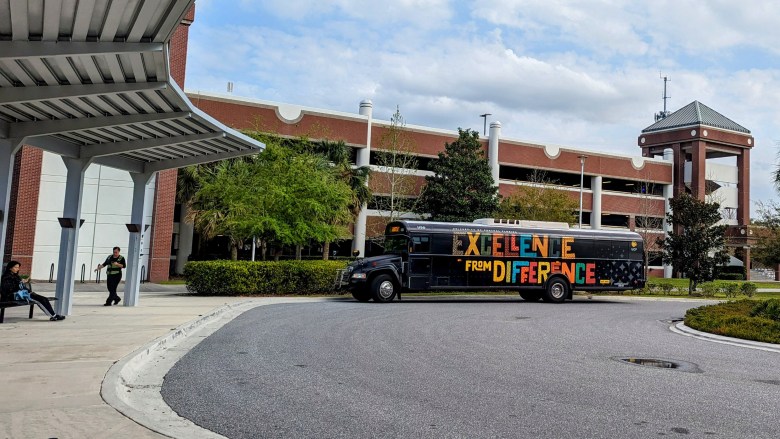
    A diversity-themed bus transports students at the University of Central Florida’s Orlando campus. Credit: Michael Vasquez for The Hechinger Report

    At New College in Sarasota, DeSantis led an aggressive cultural overhaul to transform the college’s atmosphere and identity into something more politically conservative. The governor has cited Hillsdale College, a conservative private Christian institution in Michigan, as a role model.

    Faculty and students at New College sued. Their complaints included allegations of academic censorship and a hostile environment for LGBTQ+ students, many of whom transferred elsewhere. One lawsuit was ultimately dropped. Since the takeover, the college added athletics programs and said it has attracted a record number of new and transfer students.

    Related: A case study of what’s ahead with Trump DEI crackdowns

    Across America, Republicans control both the legislature and the governor’s mansion in 23 states, compared with 15 states fully controlled by Democrats. In those GOP-run states, creating a mini-DOGE carries the potential for increased political might, with little oversight.

    In Florida, “state DOGE serves as an intimidation device,” one high-ranking public university administrator told The Hechinger Report. The administrator, who asked not to be named for fear of retribution, said “there’s also just this atmosphere of fear.”

    In late March, university presidents received a letter signed by the “DOGE Team” at the governor’s office. The letter promised a thorough review by FL DOGE officials, with site visits and the expectation that each college appoint a designated liaison to handle FL DOGE’s ongoing requests.

    The letter highlighted some of the items FL DOGE might request going forward, including course codes, descriptions and syllabi; full detail of all centers established on campus; and “the closure and dissolution of DEI programs and activities, as required by law.”

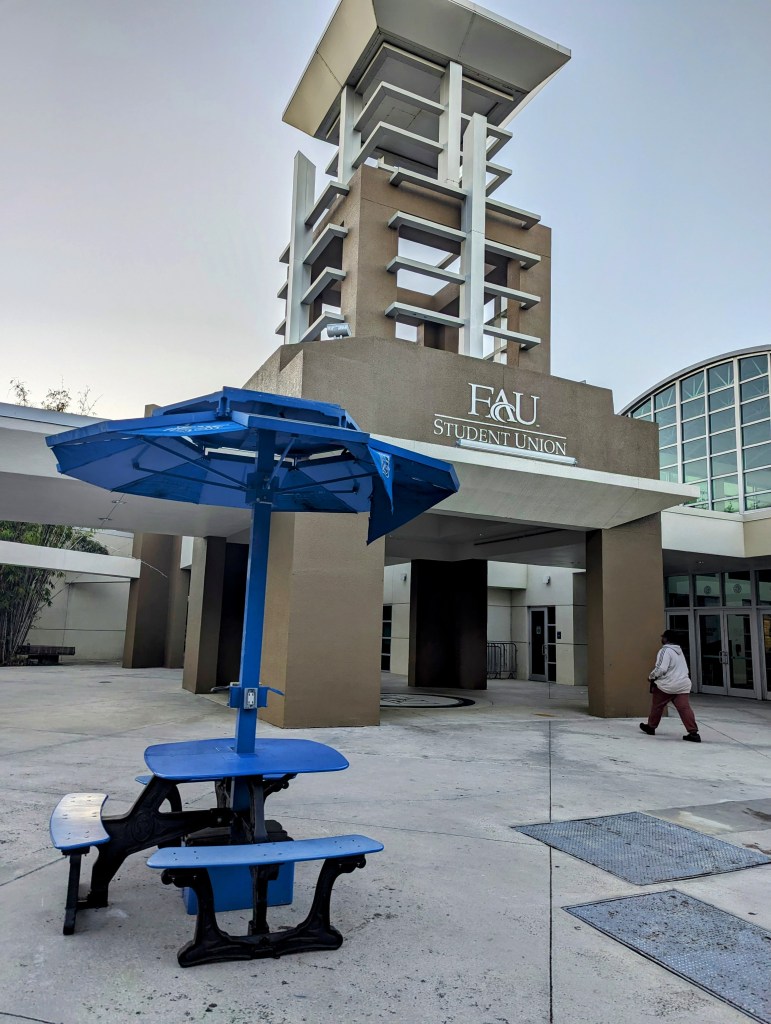
    The student union at Florida Atlantic University in Boca Raton. Florida Gov. Ron DeSantis, a Republican, launched FL DOGE in February, promising to review state university and college operations and spending. Credit: Michael Vasquez for The Hechinger Report

    The state did not respond to a question about whether FL DOGE is designed to attack higher education in the state. Molly Best, the deputy press secretary, noted that FL DOGE is now up and running, and cities and counties are also receiving letters requesting certain information and that the public will be updated in the future. 

    DOGE in Florida also follows other intervention in higher education in the state: Florida’s appointed Board of Governors, most of whom are chosen by the governor, removed dozens of courses from state universities’ core curriculum to comply with the Stop WOKE Act, a state law that took effect in 2022. The law, which DeSantis heavily promoted, discourages the teaching of concepts such as systemic racism or sexism. The courses removed from Florida’s 12 state universities were primarily sociology, anthropology and history courses.

    “You can’t erase history,” said Meadow Swantic, a criminal justice major at Florida Atlantic University, a public institution, in an interview at its Boca Raton campus. “There’s certain things that are built on white supremacy, and it’s a problem.”

    Fellow Florida Atlantic student Kayla Collins, however, said she has noticed some professors’ liberal bias during class discussions.

    “I myself have witnessed it in my history class,” said Collins, who identifies as Republican. “It was a great history class, but I would say there were a lot of political things brought up, when it wasn’t a government class or a political science class.” 

    At the University of Central Florida in Orlando, political science major Liliana Hogan said she had a different experience of her professors’ political leanings.

    “You hear ‘people go to university to get woke’ or whatever, but actually, as a poli-sci student, a lot of my professors are more right-wing than you would believe,” Hogan said. “I get more right-leaning perspectives from my teachers than I would have expected.” Hogan said.   

    Another UCF student, Johanna Abrams, objected to university budget cuts being ordered by the state government. Abrams said she understands that tax dollars are limited, but she believes college leaders should be trusted with making the budget decisions that best serve the student body.

    “The government’s job should be providing the funding for education, but not determining what is worthy of being taught,” Abrams said. 

    Related: Inside Florida’s ‘underground lab’ for far-right education policies

    Whatever their missions and attempts at mimicry, state-level DOGE entities are not necessarily identical to the federal version.

    For instance, in Kansas, the Committee on Government Efficiency, while inspired by DOGE, is in search of ideas from state residents about ways to make the state bureaucracy run better rather than imposing its own changes. A Missouri Senate portal inspired by the federal DOGE works in a similar way. Yet the federal namesake isn’t taking suggestions from the masses to inform its work.  

    And at the federal level, then-DOGE chief Elon Musk in February emailed workers, asking them to respond “to understand what they got done last week,” he posted on X. “Failure to respond will be taken as a resignation.” Employees were asked to reply with a list of five accomplishments.

    The Ohio DOGE Caucus noted explicitly it won’t be doing anything like that.

    “We’re not going to be emailing any state employees asking them to give us five things they worked on throughout the week,” Ohio state Rep. Tex Fischer, a Republican, told a local radio station. “We’re really just trying to get like-minded people into a room to talk about making sure that government is spending our money wisely and focusing on its core functions that we all agree with.”

    Contact editor Nirvi Shah at 212-678-3445, securely on Signal at NirviShah.14 or via email at [email protected].

    This story about DOGE cuts was produced by The Hechinger Report, a nonprofit, independent news organization focused on inequality and innovation in education. Sign up for the Hechinger newsletter.

    The Hechinger Report provides in-depth, fact-based, unbiased reporting on education that is free to all readers. But that doesn’t mean it’s free to produce. Our work keeps educators and the public informed about pressing issues at schools and on campuses throughout the country. We tell the whole story, even when the details are inconvenient. Help us keep doing that.

    Join us today.

    Source link

  • What does it mean if students think that AI is more intelligent than they are?

    What does it mean if students think that AI is more intelligent than they are?

    The past couple of years in higher education have been dominated by discussions of generative AI – how to detect it, how to prevent cheating, how to adapt assessment. But we are missing something more fundamental.

    AI isn’t just changing how students approach their work – it’s changing how they see themselves. If universities fail to address this, they risk producing graduates who lack both the knowledge and the confidence to succeed in employment and society. Consequently, the value of a higher education degree will diminish.

    In November, a first-year student asked me if ChatGPT could write their assignment. When I said no, they replied: “But AI is more intelligent than me.” That comment has stayed with me ever since.

    If students no longer trust their own ability to contribute to discussions or produce work of value, the implications stretch far beyond academic misconduct. Confidence is affecting motivation, resilience and self-belief, which, consequently, effects sense of community, assessment grades, and graduate skills.

    I have noticed that few discussions focus on the deeper psychological shift – students’ changing perceptions of their own intelligence and capability. This change is a key antecedent for the erosion of a sense of community, AI use in learning and assessment, and the underdevelopment of graduate skills.

    The erosion of a sense of community

    In 2015 when I began teaching, I would walk into a seminar room and find students talking to one another about how worried they were for the deadline, how boring the lecture was, or how many drinks they had Wednesday night. Yes, they would sit at the back, not always do the pre-reading, and go quiet for the first few weeks when I asked a question – but they were always happy to talk to one another.

    Fast forward to 2025, campus feels empty, and students come into class and sit alone. Even final years who have been together for three years, may sit with a “friend” but not really say anything as they stare at phones. I have a final year student who is achieving first class grades, but admitted he has not been in the library once this academic year and he barely knows anyone to talk to. This may not seem like a big thing, but it illustrates the lack of community and relationships that are formed at university. It is well known that peer-to-peer relationships are one of the biggest influencers on attendance and engagement. So when students fail to form networks, it is unsurprising that motivation declines.

    While professional services, student union, and support staff are continuously offering ways to improve the community, at a time where students are working longer hours and through a cost of living, we cannot expect students to attend extracurricular academic or non-academic activities. Therefore, timetabled lectures and seminars need to be at the heart of building relationships.

    AI in learning and assessment

    While marking first-year marketing assignments – a subject I’ve taught across multiple universities for a decade – I noticed a clear shift. Typically, I expect a broad range of marks, but this year, students clustered at two extremes: either very high or alarmingly low. The feedback was strikingly similar: “too vague,” “too descriptive,” “missing taught content.”

    I knew some of these students were engaged and capable in class, yet their assignments told a different story. I kept returning to that student’s remark and realised: the students who normally land in the middle – your solid 2:2 and 2:1 cohort – had turned to AI. Not necessarily to cheat, but because they lacked confidence in their own ability. They believed AI could articulate their ideas better than they could.

    The rapid integration of AI into education isn’t just changing what students do – it’s changing what they believe they can do. If students don’t think they can write as well as a machine, how can we expect them to take intellectual risks, engage critically, or develop the resilience needed for the workplace?

    Right now, universities are at a crossroads. We can either design assessments as if nothing has changed, pivot back to closed-book exams to preserve “authentic” academic work, or restructure assessment to empower students, build confidence, and provide something of real value to both learners and employers. Only the third option moves higher education forward.

    Deakin University’s Phillip Dawson has recently argued that we must ensure assessment measures what we actually intend to assess. His point resonated with me.

    AI is here to stay, and it can enhance learning and productivity. Instead of treating it primarily as a threat or retreating to closed-book exams, we need to ask: what do we really need to assess? For years, we have moved away from exams because they don’t reflect real-world skills or accurately measure understanding. That reasoning still holds, but the assessment landscape is shifting again. Instead of focusing on how students write about knowledge, we should be assessing how they apply it.

    Underdevelopment of graduate skills

    If we don’t rethink pedagogy and assessment, we risk producing graduates who are highly skilled at facilitating AI rather than using it as a tool for deeper analysis, problem-solving, and creativity. Employers are already telling us they need graduates who can analyse and interpret data, think critically to solve problems, communicate effectively, show resilience and adaptability, demonstrate emotional intelligence, and work collaboratively.

    But students can’t develop these skills if they don’t believe in their own ability.

    Right now, students are using AI tools for most activities, including online searching, proof reading, answering questions, generating examples, and even writing reflective pieces. I am confident that if I asked first years to write a two-minute speech about why they came to university, the majority would use AI in some way. There is no space – or incentive – for them to illustrate their skill development.

    This semester, I trialled a small intervention after getting fed up with looking at heads down in laptops. I asked my final year students to put laptops and phones on the floor for the first two hours of a four-hour workshop.

    At first, they were visibly uncomfortable – some looked panicked, others bored. But after ten minutes, something changed. They wrote more, spoke more confidently, and showed greater creativity. As soon as they returned to technology, their expressions became blank again. This isn’t about banning AI, but about ensuring students have fun learning and have space to be thinkers, rather than facilitators.

    Confidence-building

    If students’ lack of confidence is driving them to rely on AI to “play it safe”, we need to acknowledge the systemic problem. Confidence is an academic issue. Confidence underpins everything in the student’s experience: classroom engagement, sense of belonging, motivation, resilience, critical thinking, and, of course, assessment quality. Universities know this, investing in mentorship schemes, support services, and initiatives to foster belonging. But confidence-building cannot be left to professional services alone – it must be embedded into curriculum design and assessment.

    Don’t get me wrong, I am fully aware of the pressures of academic staff, and telling them to improve sense of community, assessment, and graduate skills feels like another time-consuming task. Universities need to recognise that without improving workload planning models to allow academics freedom to focus on and explore pedagogic approaches, we fall into the trap of devaluing the degree.

    In addition, universities want to stay relevant, they need agile structures that allow academics to test new approaches and respond quickly, just like the “real world”. Academics should not be creating or modifying assessments today that won’t be implemented for another 18 months. Policies designed to ensure quality must also ensure adaptability. Otherwise, higher education will always be playing catch-up – first with AI, then with whatever comes next.

    Will universities continue producing AI-dependent graduates, or will they equip students with the confidence to lead in an AI-driven world?

    Source link

  • So who says we don’t have post qualification admissions already?

    So who says we don’t have post qualification admissions already?

    In February 2022, then Secretary of State for Education Nadhim Zahawi told Parliament the Johnson government’s decision on post-qualification admissions.

    Clear as a welcome school bell, he stated “we will not be reforming the admissions system to a system of PQA at this time”.

    But who says that we don’t already have PQA?

    Admissions reform by stealth

    The “Decline My Place” button introduced by UCAS instead of Adjustment basically introduced PQA anyway. The only reason we haven’t noticed is that we were not, then, very focused on undergraduate home numbers. How things change.

    Let’s think about JCQ results day 2025. Let’s say I work at an institution in the Russell Group with good recruitment opportunities for UG home and some uncertainties (I enjoy understatement) about postgraduate international numbers. And let’s say I decide to make hundreds more spaces available than previously planned earlier in the cycle.

    But let’s also say that my colleagues further north, west and east do the same. I have a wonderfully smooth confirmation, accepting lots of well qualified and soon-to-be happy young people. I arrive on results day less stressed and tired than usual which is just as well because all hell breaks loose.

    From 8:00am until 1:00pm I am frantically confirming Clearing places and, I’m hitting refresh on our numbers forecast every 5 minutes. My blood pressure is rising as is my cake consumption (the renewable energy of choice for any self-respecting Admissions Office). I am desperately trying to work out if our gains are ahead of our losses.

    That’s because hundreds (more?) of our nurtured, valued and cultivated unconditional firm offer-holders have hit a button at UCAS and declined their place to go elsewhere. On top of this, for the first time in 2025, some who are still conditional have released themselves too. Fine, I hear you say – If you haven’t processed a decision you deserve to lose the student. But several of these students are still awaiting results (excluded from the requirement that Decline My Place is only for those with a complete set of Level 3 results).

    You may well ask where the problem is here.

    A better offer

    Well, these particular students are from schools and colleges where we have a partnership. Several have been on long-term aspiration-raising enrichment programmes with us for over two years. We have invested all we can in their (everyone must have one) journey. It’s just that they’ve had “a better offer”.

    This may be an offer from an institution in London where “our” student has been offered a big financial incentive, and which grew its Clearing intake from zero to 200 in two years. An offer from a delightful campus in the Midlands where “our” student will be very happy and which would not have been an option when only 45 Clearing places were available – but now there are 500. An offer from an exciting and vibrant institution in the north which can take “our” student for Economics – a real surprise as spaces are not often available for a subject like that, but then this university grew its Clearing intake from 200 to 885 over the last two cycles.

    These are all real examples from last year. Companies may well have to say that past performance is no guarantee of future results, but we wouldn’t select on the basis of predicted grades if it wasn’t to some degree – now would we?

    Personally I have always been in favour of PQA in theory. It is just that the jeopardy I enjoy about admissions doesn’t quite extend to the levels of uncertainty I predict for the few days after 14 August 2025. I wonder how many members of the UCAS Board and how many vice chancellors realise that there is, in a theoretical model that may very well be tested this summer, every possibility that every single firm accept that we have all secured, conditional or unconditional, melts on or before Results Day.

    They can all, with absolutely no controls (apart from a quick call to UCAS if you are still conditional) decline their place and go to the pub to celebrate “trading up”. If that isn’t PQA what is? I need another cake.

    Source link

  • HELU’s Wall-to-Wall and Coast-to-Coast Report – April 2025 (Higher Ed Labor United)

    HELU’s Wall-to-Wall and Coast-to-Coast Report – April 2025 (Higher Ed Labor United)

    April 2025 HELU Chair’s Message – May Day Strong

    From Levin Kim, HELU Chair
    Over the first 100 days of the Trump Administration, higher ed workers from coast to coast have been fighting back against attacks on critical lifesaving research, on immigrant workers, on education and research in the public interest. We’re in the fight of our lives, for our work, our communities, and our future. 

    Despite alarming news on the daily—from students and workers removed from our campuses, firings, program closures, government intervention in classroom curriculum, and brazen attacks on academic freedom—we refuse to be immobilised into inaction because we know a better world is possible if we fight for it. We’re standing up for the future of higher ed by building a wall-to-wall, coast-to-coast movement of workers ready to organize, to fight, and to win. Now is the time for coalition-building, for moving your coworkers to take action together, and getting out in the streets. Find and attend a May Day event near you tomorrow, and stay tuned for more ways to take action. 
     

    Source link

  • Limestone University to close after fundraising blitz falls short

    Limestone University to close after fundraising blitz falls short

    This audio is auto-generated. Please let us know if you have feedback.

    Dive Brief:

    • Limestone University, in South Carolina, will close when its current semester ends this week after last-ditch fundraising efforts came up short, the Christian institution announced Tuesday. 
    • The university’s trustee board voted to permanently shutter Limestone despite raising $2.1 million from almost 200 donors in the last two weeks. The board previously said Limestone would need $6 million to stabilize operations.
    • In the final analysis, we could not continue operations on-campus or online without a greater amount of funding,” board Chair Randall Richardson said in a Thursday statement.

    Dive Insight:

    Limestone ended last week on a hopeful note, with Richardson describing the board as “cautiously optimistic.”

    At the time, the board announced a potential financial “lifeline.” This came shortly after revealing a fiscal crisis that might force the university to shutter or move to online-only operations. 

    Days after revealing the possible “lifeline,” Limestone launched a public fundraising blitz and received an unrestricted gift of $1 million from the Fullerton Foundation, a local nonprofit with which it has a long relationship. 

    One of the largest in Limestone’s recent history, the transformative donation comes at a pivotal time as the institution rallies to secure critical funding that will help sustain its mission of providing life-changing educational opportunities,” the university said in the Fullerton announcement. 

    But even for a small university, the multimillion dollar campaign wasn’t enough to sustain Limestone.

    Founded in 1845, Limestone’s enrollment has declined in recent years, with fall headcount dipping 27% to 1,782 students between 2018 and 2023, according to federal data. Current enrollment stands at about 1,600 students, the university said last week.

    The university’s board has blamed those drops, as well as rising costs, for its financial travails. For fiscal 2024, it logged a budget deficit of $9.2 million, following an $11.4 million shortfall in 2023. 

    As it prepares to close, the university has promised an “orderly wind-down process” and said it will help students transfer to other institutions. 

    More detailed information about the closure timeline, academic records, transfer assistance, employment impact, and other support services will be provided in the coming days,” it said. 

    Limestone plans to hold its commencement ceremony on Saturday for those students graduating at the end of the term, 246 in all. 

    Our Limestone spirit will endure through the lives of our students and alumni who carry it forward into the world,” Richardson said. “Though our doors may close, the impact of Limestone University will live on.”

    Source link

  • 2025 Social Media Playbook for Education Marketers

    2025 Social Media Playbook for Education Marketers

    Reading Time: 12 minutes

    The year is 2025, and the influence of a rapidly evolving social media space in shaping education marketing campaigns is as critical as ever. While it has undoubtedly brought up several opportunities for those in the picture, it has also thrown up a few challenges that require the right gears to navigate. The stats are quite interesting: An increasing number of Gen Z users now turn to TikTok and Instagram as search tools, often preferring them over Google for quick information and exploration. This simply means that having a social presence for your school is no longer open to debate, it is an absolute necessity.

    Today’s prospective students spend a lot of time browsing through multiple social media platforms. They make key decisions about their academic future based on what they see on these platforms. This is why an active social media presence is a key part of today’s educational marketing campaigns. However, beyond being active on these platforms, it takes a deliberate and strategic social marketing strategy to curate and create winning margins in this space.

    At Higher Education Marketing Agency, we have several years of experience helping schools navigate the social space, converting interest into enrollment, and producing positive outcomes for many schools. Our personal, tested, and tried social media playbook for education marketers combines insights from leading education marketing experts with real-world examples. This playbook is designed to help your institution not just survive but thrive in today’s digital ecosystem. Read on to find out how.

    Struggling with enrollment?

    Our expert digital marketing services can help you attract and enroll more students!

    The New Social Landscape: Multiple Platforms, Multiple Touchpoints

    With social media evolving and becoming even more powerful, it is no longer a good idea to focus all your school’s attention on one platform. Today’s prospective students split most of their time among different platforms, and that’s why schools must be visible everywhere.

    Prospective students might discover your school through a friend’s TikTok, research your programs on Instagram, watch alumni testimonials on YouTube, and check what parents are saying about you on Facebook, all before visiting your website. Your presence on each of these social media platforms will offer you unique opportunities to engage with different audiences.

    Here’s a brief outline of the roles that different social media trends and platforms can play in your education marketing efforts.

    • Instagram: Great for visual storytelling, event promotions, and engaging reels showing student experiences.
    • TikTok: Ideal for short, fun, and informative content that drives brand awareness among younger audiences.
    • YouTube: The best place to show long-form videos, student testimonials, virtual tours, and other educational content.
    • Facebook: Essential for connecting with parents, alums, and local communities.
    • LinkedIn: Great for professional connections and showing academic credibility, targeting parents and graduate prospects.

    While having a presence across key platforms is essential, mastering the content formats that resonate most, particularly short-form video, has become equally critical.

    Example: John Cabot University offers virtual tours of its campuses, some of which you’ll find via its social media pages, YouTube, and straight off its website.

    HEM Image 2HEM Image 2

    Source: John Cabot University 

    Short-Form Video: The Undisputed Champion

    The influence of short-form video in shaping social media trends is at an all-time high today. Gen Z and Gen Alpha consume information fast, they don’t want to watch traditional ads or sit through long videos all day. Prospective students want to see what life at a school looks like in under 60 seconds.

    A large number of these students now turn to TikTok and its bite-sized videos for everything from study tips to campus tours. This is why things like TikTok and Instagram Reels have become key for student recruitment, school branding, and engagement.

    “Your goal is to freeze the thumb,” as one marketing expert puts it, creating content compelling enough to make someone stop scrolling. For best results, it is crucial to create educational short-form videos along these lines:

    • 1. Day-in-the-life glimpses: A student takes viewers through their campus routine
    • 2. Quick tips/educational snippets: A professor explaining a complex concept in 30 seconds
    • 3. Behind-the-scenes peeks: Showing areas of campus rarely seen on official tours
    • 4. Celebration moments: Capturing authentic reactions during events like graduation or move-in day
    • 5. “Did you know” facts about your institution’s unique features or history

    How can schools use short-form video to attract students? The key to creating winning short-form videos is to go for authenticity. Start by identifying what makes your institution stand out, whether it’s a unique program, a beloved campus tradition, or exceptional career outcomes

    You can then showcase these elements through quick, visually engaging stories highlighting your unique value proposition.

    The Authenticity Advantage: User-Generated Content

    The content created by your existing community is a powerful tool for building trust and driving engagement. User-generated content (UGC) from students, faculty, and alumni offers authentic perspectives as it comes from a real person, hence its effectiveness. Research shows that 84% of consumers trust UGC more than polished advertisements.

    How can we get user-generated content from students? One proven strategy in this line is to allow a student to manage your school’s Instagram Stories for a day, sharing their authentic campus experience. These glimpses into real student life help prospective students envision themselves at your institution in ways that traditional marketing cannot achieve.

    Here are some ways to incorporate UGC in your education marketing efforts:

    • Find your existing ambassadors: Search your school’s hashtags and location tags to find students already creating content about your institution. These natural enthusiasts often make the best collaborators.
    • Create participation opportunities: Develop challenges, contests, or hashtag campaigns encouraging content creation. For example, a “#MyFirstDayAt[YourSchool]” campaign can generate authentic content while welcoming new students.
    • Feature diverse voices: Ensure your UGC represents various perspectives, undergraduate and graduate students, international students, faculty members, alumni at different career stages, and parents.
    • Provide gentle guidance without controlling: When working with student content creators, provide general themes or questions but allow their authentic voice to shine through. Over-scripting defeats the purpose.
    • Amplify and appreciate contributors: Always credit creators when sharing their content and express genuine appreciation. This encourages continued participation while signaling to others that their contributions are valued.

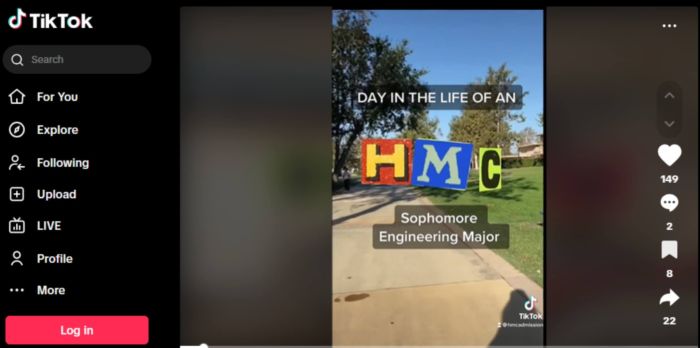
    Example: Harvey Mudd College frequently posts user-generated content of its students on its social media pages, like this one featuring a day-in-the-life of a sophomore engineering student posted on TikTok.

    HEM Image 3HEM Image 3

    Source: HMC

    Social Media as Search Engines: Optimizing for Discoverability

    Today, social media platforms are increasingly taking on the role of search engines for young people. Two-thirds of Gen Z use social platforms to research topics, including potential schools. A teenager is more likely to find your school by watching videos and posts on TikTok or Instagram than by visiting your website or Googling the school. This brings us to Social SEO, a way to optimize your content to be discoverable via social media platform searches.

    What is social SEO, and why is it important? Social SEO is the practice of optimizing your content to be discoverable through social media platform search functions. It’s important because younger audiences now use platforms like TikTok and Instagram as search engines. Optimizing SEO for visibility on these platforms helps schools reach and engage prospective students where they’re already searching.

    Here are some key steps to improve your school’s visibility in social media searches:

    1. Profile optimization: Treat your social profiles like mini homepages. Use clear, keyword-rich descriptions, consistent branding, and up-to-date contact information across all platforms.
    2. Content that answers questions: Create videos and posts that address common queries, such as “What’s the student-faculty ratio at [Your School]?” or “What’s housing like at [Your School]?” These directly match what prospective students search for.
    3. Strategic hashtags and keywords: Research what terms and keywords your target audience uses when searching for educational content. Incorporate these naturally into your posts, captions, and hashtags.
    4. Geo-tagging: Always tag your location in posts. Many users search by location when researching schools in specific areas.
    5. Consistent posting: Regular activity signals relevance to algorithms, improving your visibility in search results.

    It is important to note that these social platforms have different search algorithms; a hashtag strategy that worked on Instagram may need to be adjusted for TikTok or LinkedIn. To make your school more discoverable, explore and learn what best practices apply to each platform and what topics drive current conversations.  

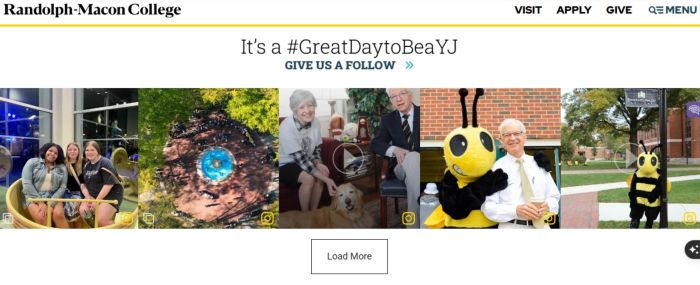
    Example: Randolph-Macon College frequently posts social media content featuring catchy headlines and hashtags, such as the one seen here promoting its athletics team, the Yellow Jackets.

    HEM Image 4HEM Image 4

    Source: Randolph Macon College

    Platform-Specific Strategies That Drive Results

    Although maintaining a presence across multiple social platforms is great, using a tailored approach for each one is even better. Here’s how you can leverage the strengths of major platforms.

    Facebook

    Often dismissed as an “older person” platform, Facebook continues to be key to reaching parents who double as key decision-makers for many prospective students. It is great for community building and event promotion. Here’s how to successfully use Facebook marketing for schools in your social marketing campaigns:

    • Use Facebook Events for open houses, application deadlines, and virtual info sessions
    • Create targeted ad campaigns using Facebook’s detailed demographic filters
    • Establish groups for admitted students or parents to foster community
    • Share longer-form content like student success stories and program highlights

    Instagram

    Instagram is a predominantly visually driven platform favored by people of different age groups. It is great at showcasing campus aesthetics and student experiences.

    • Post high-quality photos showcasing campus beauty and student life
    • Use Stories for day-in-the-life content, quick announcements, and behind-the-scenes glimpses
    • Create highlight collections for key topics (Admissions, Student Life, Athletics)
    • Utilize Reels for short-form video marketing
    • Leverage the Explore page for discovery by new audiences

    TikTok

    TikTok, the fast-growing epicenter of youth engagement and viral content, is important for reaching Gen Z. Some students now select schools based on how the schools will look on TikTok.

    • Create authentic, entertaining content that aligns with platform trends
    • Feature charismatic students or faculty who connect naturally with viewers
    • Participate in challenges relevant to education (with your institutional twist)
    • Use TikTok’s native editing tools and popular sounds to boost algorithm visibility
    • Don’t be afraid of humor and personality. TikTok rewards authenticity over polish

    YouTube

    YouTube for education favors long-form content and resources that can be searched.

    • Create structured playlists organized by topic (Campus Tours, Student Stories, etc.)
    • Produce both longer videos (3-10 minutes) and YouTube Shorts
    • Optimize video titles and descriptions with relevant keywords
    • Use cards and end screens to guide viewers to related content
    • Consider hosting live Q&A sessions during key decision periods

    LinkedIn

    LinkedIn is an underutilized tool that can help shape your education marketing. It is great for engaging parents, graduate prospects, and professionals.

    • Share thought leadership from faculty and administrators
    • Highlight alum success stories and career outcomes
    • Post about research innovations and academic achievements
    • Engage in industry conversations relevant to your programs
    • Encourage faculty and alumni to mention your institution in their profiles

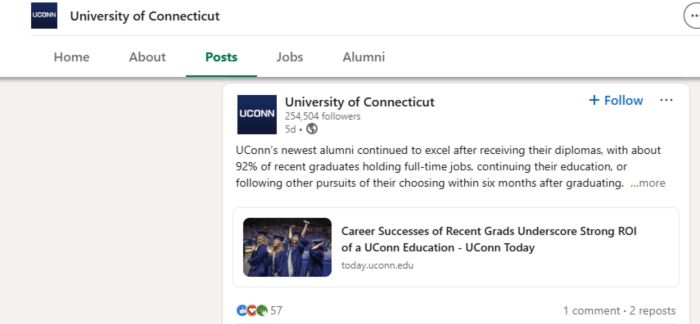
    Example: The University of Connecticut regularly posts news about its recent graduates, alumni, and students on its LinkedIn page. The LinkedIn post below highlights the success of its recent graduates.

    HEM Image 5HEM Image 5

    Source: University of Connecticut

    Making Engagement Fun: The Gamification Advantage

    Education marketing should be serious and informative, but serious does not mean bland and uninspiring. This is where gamification comes in, for fun and engaging learning. With gamification, you incorporate game-like elements and interactive content into your school’s content, effectively turning passive scrolling into active participation. Here are some gamification content and approaches:

    • Instagram Story quizzes about campus facts or traditions
    • TikTok challenges that showcase student creativity
    • Digital scavenger hunts across your website and social platforms
    • “Day in the life” simulation content where viewers “choose their adventure”
    • Trivia contests showcasing interesting institutional facts

    Tapping Cultural Currents: Trends Worth Embracing

    Trends are the main driver of conversations across social media. Connecting your content to a broader cultural conversation can give your school more relevance in the social space. Follow these three trends to place your institution in a position of opportunity.

    • Nostalgia Marketing: For institutions with some history to draw from, using content that brings back some memories of the past can provoke nostalgic feelings and add value to social marketing campaigns. This is nostalgia marketing. For best results, share throwback campus photos, compare “then and now” scenes, or invite alumni to submit memories. This content typically generates high engagement and shares.
    • Values and Social Impact: Today’s students care deeply about the position their schools take on issues of social and environmental relevance. To leverage this situation, highlight your school’s sustainability initiatives, community service programs, or research contributions. Point students to recycling initiatives and green campus programs via your social media videos and blogs.
    • Wellness and Mental Health: Any content that addresses student well-being will resonate strongly with prospects and parents concerned about support systems. This is why you must ensure you share resources from your counseling center and feature student wellness initiatives in your content. Also, create content acknowledging the stresses of academic life and how your institution helps students manage them. A student testimonial about how a mentor or counselor helped them thrive can help humanize your brand, so consider it.

    Example: The University of Illinois runs a mental health and awareness program with a full complement of staff and resources committed to student and staff welfare on campus.

    HEM Image 6HEM Image 6

    Source: University of Illinois

    Be Data-Driven and Adaptive

    Successful social media marketing calls for consistency in learning and adaptation. Platform algorithms are subject to regular changes that affect content visibility and engagement. Here’s what you can do to stay visible and ahead of the curve:. 

    • Monitor metrics to identify which content types perform best
    • A/B test different formats and approaches
    • Stay alert to algorithm changes and platform updates
    • Focus on generating quality engagement (comments, shares)
    • Adopt new platform features early for visibility boosts
    • Use AI tools for social media marketing thoughtfully to enhance (not replace) your creativity

    From Likes to Links: Driving Website Conversions

    Although social engagement is key to positive brand building, it’s not the ultimate goal. That would be converting interest into action, from website visits to inquiries or applications.

    To effectively bridge the gap between interest and action, here are a few tips worth considering:

    • Optimize your social profiles: Link every platform you’re active on to relevant landing pages. Consider using “link in bio” tools that offer multiple destination options (Apply Now, Virtual Tour, Financial Aid, etc.).
    • Strategic calls to action: Not every post needs a CTA, but regularly include invitations to learn more, especially on high-interest content. For example, after sharing a student success story, add something like “Discover how you can follow in Sarah’s footsteps—check out our Business program (link in bio).”
    • Track and analyze traffic sources: Find out which social platforms and specific posts drive the most valuable traffic using resources like UTM parameters. With this information in hand, you can refine your strategy toward what converts.
    • Amplify high-performing content: When a post generates strong engagement organically, extend its reach to similar audiences by allocating an ad budget to it. By putting out content that resonates with your existing community, you can reach prospects who share similar interests and achieve the desired engagement result.
    • Align social and search strategies: While many prospects might discover your school on social media, they often go on to later search your name on Google. This is why you must ensure that your search engine marketing complements your social strategy for a seamless user journey.

    Building Your School’s Social Media Playbook 

    As social media continues to evolve and draw more prospective students, today’s schools have to target it with intentional and strategic content. The most successful education marketers approach social media as conversations with future students, current community members, parents, and alumni.

    The goal of these conversations goes beyond promoting your institution, it involves bringing its unique culture and value to life in ways that traditional marketing can not achieve. This is why schools must develop an effective social media marketing strategy that factors in all the essentials and adds some extras. While at it, remember a few things: authenticity resonates, visual content engages, and genuine connection converts.

    By embracing short-form video, leveraging user-generated content, optimizing for social search, and maintaining a strategic presence across platforms, you create multiple pathways for meaningful connection. Add gamification elements and cultural relevance, and you have a formula for visibility and genuine engagement that drives enrollment outcomes.

    See the full Webinar here:

    YouTube videoYouTube video

    Struggling with enrollment?

    Our expert digital marketing services can help you attract and enroll more students!

    Frequently Asked Questions

    Question: What is social SEO, and why is it important? 

    Answer: Social SEO is the practice of optimizing your content to be discoverable through social media platform search functions. It’s important because younger audiences now use platforms like TikTok and Instagram as search engines. Optimizing for visibility on these platforms helps schools reach and engage prospective students where they’re already searching.

    Question: How can we get user-generated content from students? 

    Answer: One proven strategy in this line is to allow a student to manage your school’s Instagram Stories for a day, sharing their authentic campus experience. These glimpses into real student life help prospective students envision themselves at your institution in ways that traditional marketing cannot achieve.

    Question: How can schools use short-form video to attract students? 

    Answer: The key to creating winning short-form videos is to go for authenticity. Start by identifying what makes your institution stand out, whether it’s a unique program, a beloved campus tradition, or exceptional career outcomes. 

    You can then showcase these elements through quick, visually engaging stories highlighting your unique value proposition.


    Source link