One might expect to hear such exclamations from exultant college students, relieved or ready to rejoice upon polishing off their latest essay assignment. Instead, these are the words I hear with increasing frequency from fellow professors who have come to think that the out-of-class essay itself is now done. It’s an antiquated assignment, some say. An outmoded form of pedagogy. A forlorn fossil of the Writing Age, a new coinage that seems all too ready to consign writing instruction to extinction.
As a new director of my college’s faculty development office, I’m privy to ongoing conversations about the teaching of writing, many of which are marked by frustration, perplexity and pessimism. “I don’t want to read a machine’s writing,” one professor laments. “I don’t want to police student essay writing for AI use,” another asserts.
Kevin Roose, a tech writer for The New York Times, who recently visited my campus, has suggested that the take-home essay is obsolete, asking, “Why would you assign a take-home exam, or an essay on Jane Eyre, if everyone in class—except, perhaps, the most strait-laced rule followers—will use A.I. to finish it?”
Whether this situation is entirely new is arguable. For decades, we’ve had online resources that might make independent student reading unnecessary, yet we haven’t stopped assigning out-of-class reading. If I assign a rigorous novel like Charles Dickens’s Bleak House, I’ve long known that students can access an assortment of chapter summaries online—CliffsNotes, SparkNotes, LitCharts and others, all of which might make unnecessary the intellectual work of deciphering Dickens’s 19th-century sentences or wading into the deep waters of his sometimes murky prose. Maybe, as a recent New York Times piece about Harvard University students not doing their reading suggests, students aren’t doing that kind of homework, either.
Still, being able to create sentences, paragraphs, essays and research papers with a single prompt—or now, having “agentic AI” engineer an entire research process in a matter of minutes—seems different from googling the plot summary for the first chapter of Bleak House.
Maybe writing via LLMs is different because it’s not just about summarizing someone’s else’s idea; it’s about asking a machine to take the glimmer of one’s own half-hatched idea and turn it into a flawless, finished product. Somehow that process seems a little more magical, like being able to create a novel or a dissertation with a Bewitched-like twitch of the nose.
Further, the problems with out-of-class writing are different from those linked to out-of-class reading because of how embedded AI has become within the most basic writing tools—from Microsoft’s Copilot to Grammarly. With tools that blur the boundaries between the student and their “copilot,” students will increasingly have difficulty discerning what’s them and what’s the machine—to the chagrin of those who do want to develop autonomous intellectual skills. As high school senior Ashanty Rosario complained in an essay in The Atlantic about how AI is “demolishing my education,” AI tools have become “inescapable” and inescapably seductive, with shortcuts to learning becoming “normalized.”
In this world of ubiquitous AI shortcuts, how do we encourage students to take the scenic route? How do we help them see, as John Warner reminds us in More Than Words: How To Think About Writing in the Age of AI (Basic Books, 2025), that writing is an act of embodied thinking and a tool for forging human community, linking one human being to another? How do we encourage them, to use the language of Chad Hanson, to see their written assignments as “investments, not just in the creation of something to turn in on a deadline, but rather, investments in your humanity”? In an Inside Higher Ed essay, Hanson describes how he tells students, “When you give yourself time to use your faculties, you end up changing the dimensions of your mind.”
But there’s the rub. Writing takes time. Teaching writing takes time. The practice of writing takes even more time. If there is still value in the time invested in developing human writing skills, where is the time to be found within the constraints of traditional writing courses? Writing practice used to take place primarily at home, on student PCs and notepads, over hours, days and weeks. Now that student writing is being chronically offloaded to a magical deus ex machina, Roose asks why teachers wouldn’t simply “switch to proctored exams, blue-book essays, and in-class group work”?
As a writing professor, my answer is: There isn’t time.
Shifting writing practice from a largely out-of-class endeavor to an in-class one doesn’t provide students with the time needed to develop writerly skills or to use writing as a mode of deep thinking. Nor does it allow for both instruction and sufficient hands-on practice. At my college, courses typically run either three days per week for a short 50 minutes per class or two days per week for 80 minutes. Even in a “pure” writing course, such time periods don’t allow for students to have the sustained practice they would need to develop skill as writers. The problem is even worse in writing-intensive courses for which a significant amount of class time is needed for discussing literary history, philosophy, political theory, religion, art history or sundry other topics.
The solution I propose is to invest more rather than less in writing instruction: Just as we require labs for science lecture courses, we should provide required “writing labs” as adjuncts to writing classes. Here I don’t mean a writing lab in the sense of a writing center where students can opt to go for peer assistance. By writing lab, I mean a multihour, credit-bearing, required time during which students practice writing on a weekly basis under the supervision of the course’s instructor or another experienced writing teacher. Such labs would be time in which students develop their autonomous critical thinking skills, tackling assignments from conception to completion, “cloister[ed]” away, as Niall Ferguson puts it, from dependency on AI machines. And if writing “lab” sounds unduly scientific for the teaching of a human art, call it a weekly workshop or practicum. (Yet, even the word “laboratory” derives, via medieval Latin, from laborare, which simply means “to work or labor.”) Whatever the name, the need is real: Writing cannot be taught without student labor.
The problem I am addressing is a critical one, with too few alarms being sounded in higher education circles, despite the plethora of articles about education and AI. Even as colleges tout writing skill as a major outcome of college education, I fear that writing education may quickly fall between the cracks, with out-of-class writing being abandoned out of frustration or despair and insufficient in-class time available for the deep learning writing requires. Quiet quitting, let’s call it, of a long-standing writing pedagogy.
If colleges still wish to claim writing skill as an important learning outcome, they need to become more deliberate about what it means to educate student writers in the age of AI. Toward that end, colleges must first reassert the importance of learning to write and articulate its abiding value as a human endeavor. Second, colleges must devote professional development resources to prepare faculty to teach writing in the age of AI. And finally—here’s the pith of my argument—colleges need to restructure traditional models of writing instruction so that students have ample time to practice writing in the classroom, with a community of human peers and under the supervision of a writing guide. Only in, with and under those circumstances will students be able to rediscover writing as a true labor of love.
Carla Arnell is associate dean of the faculty, director of the Office of Faculty Development and professor of English at Lake Forest College.
Join HEPI and Advance HE for a webinar on Tuesday, 13 January 2026, from 11am to 12pm, exploring what higher education can learn from leadership approaches in other sectors. Key topics will include innovative approaches to recruitment and diversity, and how to ensure future sector stability through effective leadership. Sign up hereto hear this and more from our speakers.
This blog was kindly authored by Sholto Lindsay-Smith, Founder Director at Industry.
Universities have always had brands, long before they had brand guidelines. Their names carry weight, their reputations shape choice, and their architecture and tone say as much as any visual identity ever could. But as competition intensifies and finances tighten, branding is being used differently. It is no longer just a way of expressing who you are; it is increasingly seen as a tool to fix who you have become.
When brand becomes a quick fix
That shift has made brand strategy more visible, but not always more meaningful. Some institutions reach for branding too early, hoping design or language can solve deeper issues of identity. Others turn to it too late, treating it as an afterthought once major structural changes are already in motion. Either way, brand becomes detached from truth.
The University of Bolton’s plan to rename itself the University of Greater Manchester captured this tension perfectly. The logic was clear: broaden recognition, attract international students, and align with a region better known abroad. Yet the reaction from local MPs, alumni and commentators revealed discomfort at the idea that relevance could be borrowed. In chasing prestige, the university risked diluting the story that made it distinctive while blurring the line with its established neighbour.
If Bolton represents the outward pursuit of stature, the University of Warwick’s 2025 rebrand shows the opposite instinct: refinement. The new identity is modern and assured, visually linked to the university’s Brutalist architecture and centred on the word “Beyond.” It projects ambition and clarity, yet feels detached from the lived experience of a dynamic, human and intellectually alive campus. Capturing a university within a single narrative will always be difficult.
Together, these examples show a pattern. Universities are reshaping how they appear before clarifying what they stand for. Branding becomes a way to project control and confidence in an uncertain market. But when meaning is unresolved, those choices risk feeling cosmetic: tidy, professional and slightly hollow.
Reclaiming substance
The strongest university brands start from substance, not style. Their distinctiveness lies in how they interpret their purpose: curiosity made public at Oxford, invention woven into MIT, civic service at Manchester. These are not slogans; they are living narratives.
The universities founded in the 1960s, Warwick, Sussex, York and others, were built on a different kind of ambition: a post-Robbins optimism that saw higher education as a national engine of progress. Their founding principles championed interdisciplinarity, access and relevance to society. Many still reference innovation in their brand stories today, but the opportunity lies in making that spirit tangible again by translating institutional ambition into lived experience.
Branding through change
That same search for identity now plays out at an organisational level. Across the UK and Europe, alliances and mergers are accelerating as universities seek scale, stability and shared purpose. Yet branding often enters too late, once the legal and operational frameworks are fixed, rather than guiding the process from the start.
A Forvis Mazars paper on college mergers quoted Benjamin Franklin’s line that “an ounce of prevention is worth a pound of cure”: a reminder that the time to define purpose is before the process begins. When brand is part of that conversation early, clarifying mission and aligning cultures, it can hold the whole thing together. When it is left to follow, it merely papers over the cracks.
Different models show what is at stake. The partnership between Greenwich and Kent, which share a parent brand but retain distinct operating identities, shows how collaboration can create scale without erasing individuality. By contrast, City and St George’s have chosen full integration under a single name and structure. Each route carries trade-offs: one balances collaboration with complexity; the other clarity with compromise.
Coherence before appearance
Ultimately, effective university branding is not about logos or taglines. It is about coherence: aligning purpose, place and perception so that every expression, visual or verbal, reflects who the institution is and what it stands for. Expression gives form to meaning, turning strategy into something people can see, feel and trust.
For governing bodies and executive teams, brand coherence should be treated as a leadership issue, not a design one. When meaning comes first, design becomes not decoration but evidence.
The universities that thrive will be those that resolve meaning before appearance, modernising without flattening, expressing ambition without abstraction, and using brand to clarify meaning rather than replace it. That might mean articulating what makes their teaching distinctive, defining research specialisms, or strengthening their role in civic and social innovation.
Because the question facing higher education is not how to look relevant, it is how to be relevant.
by Kathryn Joyce, The Hechinger Report January 6, 2026
The West Shore school board policy committee meeting came to a halt almost as soon as it began. As a board member started going over the agenda on July 17, local parent Danielle Gross rose to object to a last-minute addition she said hadn’t been on the district’s website the day before.
By posting notice of the proposal so close to the meeting, charged Gross, who is also a partner at a communications and advocacy firm that works on state education policy, the board had violated Pennsylvania’s open meetings law, failing to provide the public at least 24 hours’ notice about a topic “this board knows is of great concern for many community members interested in the rights of our LGBTQ students.”
The committee chair, relentlessly banging her gavel, adjourned the meeting to a nonpublic “executive session.” When the committee reconvened, the policy was not mentioned again until the meeting’s end, when a lone public commenter, Heather Keller, invoked “Hamlet” to warn that something was rotten in the Harrisburg suburbs.
The proposed policy, which would bar trans students from using bathrooms and locker rooms aligned with their gender identity, was a nearly verbatim copy of one crafted by a group called the Independence Law Center — a Harrisburg-based Christian right legal advocacy group whose model policies have led to costly lawsuits in districts around the state.
“Being concerned about that, I remembered that we don’t partner with the Independence Law Center,” Keller said. “We haven’t hired them as consultants. And they’re not our district solicitor.”
To those who’d followed education politics in the state, Keller’s comment would register as wry understatement. Over the past several years, ILC’s growing entanglement with dozens of Pennsylvania school boards has become a high-profile controversy. Through interviews, an extensive review of local reporting and public documents, In These Times and The Hechinger Report found that, of the state’s 500 school districts, at least 20 are known to have consulted with or signed formal contracts accepting ILC’s pro bono legal services — to advise on, draft and defend district policies, free of charge.*
But over the last year, it’s become clear ILC’s influence stretches beyond such formal partnerships, as school districts from Bucks County (outside Philadelphia) to Beaver County (west of Pittsburgh) have proposed or adopted virtually identical anti-LGBTQ and book ban policies that originated with ILC — sometimes without acknowledging any connection to the group or where the policies came from.
In districts without formal partnerships with ILC, such as West Shore, figuring out what, exactly, their board’s relationship is to the group has been a painfully assembled puzzle, thanks to school board obstruction, blocked open records requests and reports of backdoor dealing.
Although ILC has existed for nearly 20 years, its recent prominence began around 2021 with a surge of “parents’ rights” complaints about pandemic-era masking, teaching about racism, LGBTQ representation and how library books and curricula are selected. In many districts where such debates raged, calls to hire ILC soon followed.
In 2024 alone, ILC made inroads of one kind or another with roughly a dozen districts in central Pennsylvania, including West Shore, which proposed contracting ILC that March and invited the group to speak to the board in a closed-door meeting the public couldn’t attend. (ILC did not respond to multiple interview requests or emailed questions.)
On the night of that March meeting, Gross organized a rally outside the school board building, drawing roughly 100 residents to protest, even as it snowed. The board backed down from hiring ILC, but that didn’t stop it from introducing ILC policies. In addition to the proposed bathroom policy, that May the board passed a ban on trans students joining girls’ athletics teams after they’ve started puberty and allowed district officials to request doctors’ notes and birth certificates to enforce it.
To Gross, it’s an example of how West Shore and other school boards without formal relationships with ILC have still found ways to advance the group’s agenda. “They’re waiting for other school boards to do all the controversial stuff with the ILC,” Gross said, then “taking the policies other districts have, running them through their solicitors, and implementing them that way.” (A spokesperson for West Shore stated that the district had not contracted with ILC and declined further comment.)
“It’s like a hydra effect,” said Kait Linton of the grassroots community group Public Education Advocates of Lancaster. “They’ve planted seeds for a vine, and now the vine’s taking off in all the directions it wants to go.”
Related: Become a lifelong learner. Subscribe to our free weekly newsletter featuring the most important stories in education.
ILC was founded in the wake of a Pennsylvania lawsuit that drew nationwide attention and prompted significant local embarrassment.
In October 2004, the Dover Area School District — situated, like West Shore, in York County, south of Harrisburg — changed its biology curriculum to introduce the quasi-creationist theory of “intelligent design” as an alternative to evolution. Eleven families sued, arguing that intelligent design was “fundamentally a religious proposition rather than a scientific one.” In December 2005, a federal court agreed, ruling that public schools teaching the theory violated the U.S. Constitution’s establishment clause.
During the case, an attorney named Randall Wenger unsuccessfully tried to add the creationist Christian think tank he worked for — which published the book Dover sought to teach — to the suit as a defendant, and, failing that, filed an amicus brief instead. When the district lost and was ultimately left with $1 million in legal fees, Wenger found a lesson in it for conservatives moving forward.
Speaking at a 2005 conference hosted by the Pennsylvania Family Institute — part of a national network of state-level “family councils” tied to the heavyweight Christian right organizations Family Research Council and Focus on the Family — Wenger suggested Dover could have avoided or won legal challenges if officials hadn’t mentioned their religious motivations during public school board meetings.
“Give us a call before you do something controversial like that,” Wenger said, according to LancasterOnline. Then, in a line that’s become infamous among ILC’s critics, Wenger invoked a biblical reference to add, “I think we need to do a better job at being clever as serpents.” (Wenger did not respond to multiple requests for comment.)
The following year, in 2006, the Pennsylvania Family Institute launched ILC with Wenger as its chief counsel, a role he remains in today, in addition to serving as chief operating officer. ILC now has three other staff attorneys and has worked directly as plaintiff’s attorneys on two Supreme Court cases: one was part of the larger Hobby Lobby decision, which allows employers to opt out of employee health insurance plans that include contraception coverage; the other expanded religious exemptions for workers.
ILC has financial ties and a history of collaborating with Christian right legal advocacy behemoth Alliance Defending Freedom, including on a 2017 lawsuit against a school district outside Philadelphia that allowed a trans student to use the locker room aligned with their gender. ILC has filed amicus briefs in support of numerous other Christian right causes, including two that led to major Supreme Court victories for the right in 2025: Mahmoud v. Taylor, which limited public schools’ ability to assign books with LGBTQ themes; and United States v. Skrmetti, which affirmed a Tennessee ban on gender-affirming care for minors. In recent months, the group filed two separate amicus briefs on behalf of Pennsylvania school board members in anti-trans cases in other states. In both cases, which were brought by Alliance Defending Freedom and concern school sports and pronoun usage, ILC urged the Supreme Court to “resolve the issue nationwide.”
In lower courts, ILC has worked on or contributed briefs to lawsuits seeking to start public school board meetings with prayer and to allow religious groups to proselytize public school students, among other issues. More quietly, as the local blog Lancaster Examiner reported — and as one ILC attorney recounted at a conference in 2022 — ILC has defended “conversion therapy,” the broadly discredited theory that homosexuality is a disorder that can be cured.
To critics, all of these efforts have helped systematically chip away at civil rights protections for LGBTQ students at the local level, seeding the policies that President Donald Trump’s administration is now trying to make ubiquitous through executive orders. And while local backlash is building in some areas, activists are hindered by the threat that the ILC’s efforts are ultimately aimed at laying the groundwork for a Supreme Court case that could formalize discrimination against transgender students into law nationwide.
But ILC’s greatest influence is arguably much closer to its Harrisburg home, in neighboring Lancaster and York counties, where nine districts have contracted ILC and at least three more have adopted its model policies.
The rural hillside and farmland in Lancaster County, Pennsylvania, are seen on Aug. 15, 2025. The local school district, Penn Manor, adopted anti-trans and anti-LGBTQ policies presented by the Independence Law Center, a Harrisburg-based Christian-right legal advocacy group.
A sign is seen in a residential neighborhood in Holtwood, Pennsylvania.
In Lancaster’s Hempfield district, it started with a 2021 controversy over a trans student joining the girls’ track team. School board meetings that had already grown tense over pandemic masking requirements erupted in new fights about LGBTQ rights and visibility. In the middle of one meeting, recalled Hempfield parent and substitute teacher Erin Small, a board member abruptly suggested hiring ILC to write a new district policy. The suddenness of the proposal caused such public outcry, said Small, that the vote to hire ILC had to be postponed.
But within a few months, the district signed a contract with ILC to write what became Pennsylvania’s first school district ban on trans students participating in sports teams aligned with their gender identity. Other ILC policy proposals followed, including a successful 2023 effort to bar the district from using books or materials that include sexual content, which immediately prompted an intensive review of books written by LGBTQ and non-white authors. (The Hempfield district did not respond to requests for comment.)
In nearby Elizabethtown, the path to hiring ILC began with a fraudulent 2021 complaint, when a man claimed, during a school board meeting, that his middle schooler had checked out an inappropriate book from the school library. Although it later emerged that the man had reportedly used a fake name and officials found no evidence he had children attending the school, his claim nonetheless sparked a long debate over book policies, which eventually led to the district contracting ILC as special legal counsel in 2024. Two anti-trans policies were subsequently passed in January 2025, and a ban on “sexually explicit” books, also based on ILC’s models, was discussed this past spring but has not moved forward to date. (The Elizabethtown district did not respond to requests for comment.)
Across the Susquehanna River in York County — where five districts have contracted ILC and two more have considered or passed its policies — the group’s influence has been broad and sometimes confounding. In one instance, as the York Dispatch discovered, ILC not only authored four policy proposals for the Red Lion Area School District, but ILC senior counsel Jeremy Samek, a registered Pennsylvania lobbyist, also drafted a speech for the board president to deliver in support of three anti-trans policies, all of which passed in 2024. (The Red Lion district did not respond to requests for comment.)
The same year, South Western School District, reportedly acting on ILC advice, ordered a high school to cut large windows into the walls of two bathrooms that had been designated as “gender identity restrooms,” allowing passersby in the hallway to see inside, consequently discouraging students from using them. (The district did not respond to requests for comment, but in a statement to local paper the Evening Sun, school board President Matt Gelazela cited student safety and said the windows helped staff monitor for vaping, bullying and other prohibited activities.)
In many districts, said Lancaster parent Eric Fisher, ILC’s growing relationships with school boards has been eased by the ubiquitous presence around the state of its sister organizations within the Pennsylvania Family Institute, including the institute’s lobbying arm, voucher group, youth leadership conference and Church Ambassador Network, which brings pastors from across Pennsylvania to lobby lawmakers in the state Capitol.
As a result, said Fisher, when ILC shows up in a district, board members often are already familiar with them or other institute affiliates, “having met them at church and having their churches put their stamp of endorsement on them. I think it makes it really easy for [board members] to say yes.”
But in nearly every district that has considered working with ILC, wide-scale pushback has also followed — though often to no avail. In June 2024, in Elizabethtown — where school board fights have been so fractious that they inspired a full-length documentary — members of the public spoke in opposition to hiring ILC at a ratio of roughly 5 to 1 before the board voted unanimously to hire the group anyway.
In the Upper Adams district in Biglerville, southwest of Harrisburg, the school board voted to contract ILC despite a cacophony of public comments and a 500-signature petition in opposition.
In Lancaster’s Warwick district, the school board’s vote to hire ILC prompted the resignation of a superintendent who had served in her role for 15 years and who reported that the district’s insurance carrier had warned the district might not be covered in future lawsuits if it adopted ILC’s anti-trans policies.
Since then, Warwick resident Kayla Cook noted during a public presentation about ILC this past summer, the mood in the district has grown grim. “We do not have any students at the moment trying to participate [in sports] who are trans. However, we have students who simply have a short haircut being profiled as being trans,” Cook said. “It’s tipped far into fear-based behaviors, where we are dipping our toes into checking the student’s body to make sure that they’re identifying as the appropriate gender.” (A district spokesperson directed interview requests to the school board, which did not respond to requests for comment.)
But perhaps nowhere was the fight as fraught as in Lancaster’s Penn Manor School District, which hired ILC to draft new policies about trans students just months after the suicide of a trans youth from Penn Manor — the fifth such suicide in the Lancaster community in less than two years.
Before the Penn Manor school board publicly proposed retaining ILC, in June 2024 — scheduling a presentation by and a vote on hiring ILC for the same meeting — district Superintendent Phil Gale wrote to the board about his misgivings. In an email obtained by LancasterOnline, Gale warned the board against policies “that will distinguish one group of students from another” and passed along a warning from the district’s insurance carrier that adopting potentially discriminatory policies might affect the district’s coverage if it were sued by students or staff.
In a narrow 5-4 vote, the all-Republican board declined to hire ILC that June. But after one board member reconsidered, the matter was placed back on the agenda for two meetings that August.
Members of the community publicly presented an open letter, signed by roughly 80 Penn Manor residents, requesting that, if policies about trans students were truly needed, the district establish a task force of local experts to draft them rather than outsource policymaking to ILC. One of the letter’s organizers, Mark Clatterbuck, a religious studies professor at New Jersey’s Montclair State University, said the district never acknowledged it or responded. (Maddie Long, a spokesperson for Penn Manor, said the district could not comment because of the litigation.)
That February, Clatterbuck’s son, Ash — a college junior and transgender man who’d grown up in Penn Manor — had died by suicide, shortly after the nationally publicized death of Nex Benedict, a nonbinary 16-year-old in Oklahoma who died by suicide the day after being beaten unconscious in a high school girls’ bathroom.
In the first August meeting to reconsider hiring ILC, Clatterbuck told the Penn Manor board, through tears, how “living in a hostile political environment that dehumanizes them at school, at home, at church and in the halls of Congress” was making “life unlivable for far too many of our trans children.”
Two weeks later, at the second meeting, Ash’s mother, Malinda Harnish Clatterbuck, pleaded for board members talking about student safety to consider the children these policies actively harm.
“ILC does not even recognize trans and gender-nonconforming children as existing,” said Harnish Clatterbuck, a pastor whose family has lived in Lancaster for 10 generations. “That fact alone should preclude them from even being considered by the board.”
A painted portrait of Ash Clatterbuck in his parents’ home in Holtwood, Pennsylvania.
Malinda Harnish-Clatterbuck walks a labyrinth made in 2023 by her late son, Ash, on their property in Holtwood.
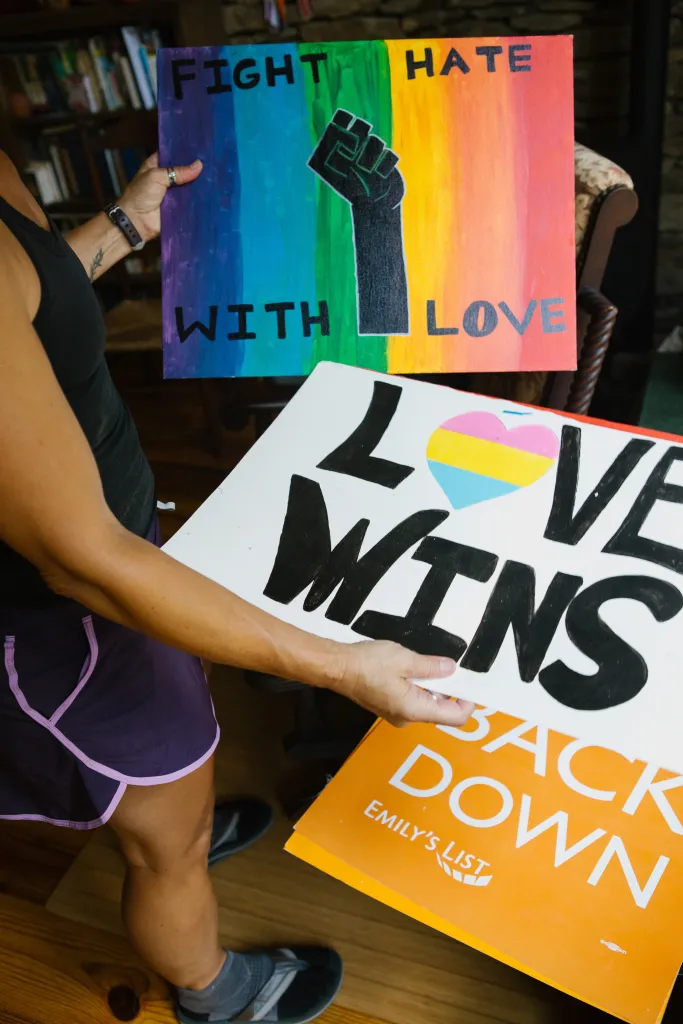
Hand-painted signs that once hung on the walls of Ash’s dorm room
Her husband spoke again as well, telling the board how Ash had frequently warned about the spread of policies that stoke “irrational hysteria around” trans youth — “the kind of policies,” Mark Clatterbuck noted, “that the Pennsylvania-based Independence Law Center loves to draft.”
Reminding the board that five trans youth in the area had died by suicide within just 18 months, he continued, “Do not try to tell me that there is no connection between the kind of dehumanizing policies that the ILC drafts and the deaths of our trans children.”
But the board voted to hire ILC anyway, 5-4, and in the following months adopted two of ILC’s anti-trans policies.
In anticipation of such public outcry, some school boards around Pennsylvania have taken steps to obscure their interest in ILC’s agenda.
Kristina Moon, a senior attorney at the Education Law Center of Pennsylvania, a legal services nonprofit that advocates for public school students’ rights, has watched a progression in how school boards interact with ILC.
When her group first began receiving calls related to ILC, around 2021, alarmed parents told similar stories of boards proposing book bans targeting queer or trans students’ perspectives, or identical packages of policies that included restrictions about bathrooms, sports and pronouns.
“At first, we would see boards openly talking about their interest in contracting with ILC,” said Moon. But as local opposition began to grow, “board members stopped sharing so publicly.”
Instead, Moon said, reports began to emerge of school boards discussing or meeting with ILC in secret.
In Hempfield, in 2022, the board moved some policy discussions into committee sessions less likely to be attended by the public, and held a vote on an anti-trans sports policy without announcing it publicly, possibly in violation of Pennsylvania’s Sunshine Act, as Mother Jones reported.
Across the state, in Bucks County, one Central Bucks school board member recounted in an op-ed for the Bucks County Beacon how her conservative colleagues had stonewalled her when she asked about the origins of a new book ban policy in 2022, only to have the board later admit ILC had performed a legal review of it “pro bono,” as PhillyBurbs reported.
Subsequent reporting by the York Daily Record and Reuters revealed the board’s relationship with ILC was more involved and included discussions about other policies related to trans student athletes and pronoun policy. (Both Central Bucks’ books and anti-LGBTQ policies were later cited in an ACLU federal complaint that cost the district $1.75 million in legal fees, as well as in a related Education Department investigation into whether the district had created a hostile learning environment for LGBTQ students.)
But the sense of backroom dealing reached an almost cartoonish level in York County, where, in March 2024, conservative board members from 12 county school districts were invited to a secret meeting hosted by a right-wing political action committee, along with specific instructions about how to keep their participation off the public radar. According to the York Dispatch, the invitation came from former Central York school board member Veronica Gemma, who (after losing her seat) was hired as education director for PA Economic Growth, a PAC that had helped elect 48 conservatives to York school boards the previous fall. (Gemma did not respond to interview requests.)
Gemma’s invitation was accompanied by an agenda sent by the PAC, which included a discussion about ILC and how board members could “build a network of support” and “advance our shared goals more effectively countywide.” The invitation also included the admonition that “confidentiality is paramount” and that each district should only send four board members or fewer — to avoid the legal threshold for a quorum that would make the meeting a matter of public record.
“Remember, no more than 4 — sunshine laws,” Gemma wrote.
In the wake of stories like these, Wenger’s 2005 suggestion that conservatives “become as clever as serpents” in concealing their intentions became ubiquitous in coverage of and advocacy against ILC — showing up in newspaper articles, in editorials and even on a T-shirt for sale online.
“I think it’s very obvious,” reflected Moon, “but if something has to be taking place in secrecy, I’m not sure it can be good for our students.”
But the lack of transparency shows up in subtler ways too, in the spreading phenomenon of districts adopting ILC policies without admitting where the policies come from. That was the case in Eastern York in 2025, where board members who had previously lobbied for an ILC pronoun policy later directed their in-house attorney to write an original policy instead, following the same principles but avoiding the baggage an ILC connection would bring.
In Elizabethtown (which did contract ILC), one policy was even introduced erroneously referencing clauses from another district’s code, in an indication of how directly districts are copy-pasting from one another.
In 2025, ILC attorney Jeremy Samek even seemed to acknowledge the trend, predicting that fewer districts might contract ILC going forward, since the combination of Trump’s executive orders on trans students and the general spread of policies similar to ILC’s meant “it’s going to be a lot easier for other schools to do that without even talking to us.”
In the face of what appears like a deliberate strategy of concealment, members of the public have increasingly turned to official channels to compel boards to disclose their dealings with ILC. Mark Clatterbuck did so in 2024 and 2025, filing 10 Right-to-Know requests with Penn Manor for all school board and administration communications with or about ILC and policies ILC consulted on and any records related to a set of specific keywords.
Thirty miles north, three Elizabethtown parents sued their school board in the spring of 2025, alleging it deliberately met and conferred with ILC in nonpublic meetings and private communications to “circumvent the requirements of the Sunshine Act.”
In both cases, and more broadly in the region, ILC critics are keenly aware that, by bringing complaints or lawsuits against the group or the school boards it works with, they might be doing exactly what ILC wants: furthering its chances to land another case before the Supreme Court, where a favorable ruling could set a dangerous national precedent, such as ruling that Title IX protections don’t cover trans students.
“They’re itching for a case,” said Clatterbuck. To that end, he added, his pro bono attorneys — at the law firm Gibbel Kraybill & Hess LLC, which also represents the Elizabethtown plaintiffs pro bono — have been careful not to do ILC’s work for it.
Largely, that has meant keeping the cases narrowly focused on Sunshine Act violations.
But in both cases, there are also hints of the larger issue at hand — of whether, in a repeat of the old Dover “intelligent design” case, ILC’s policies represent school boards imposing inherently religious viewpoints on public schools. After all, ILC’s parent group, the Pennsylvania Family Institute, clearly states its mission is to make Pennsylvania “a place where God is honored” and to “strengthen families by restoring to public life the traditional, foundational principles and values essential for the well-being of society.” And in 2024, the institute’s president, Michael Geer, told a Christian TV audience that much of ILC’s work involves working with school boards “on the transgender issue, fighting that ideology that is pervasive in our society.”
In the Elizabethtown complaint, the plaintiffs argue that district residents must “have the opportunity to observe Board deliberations regarding policies that will affect their children in order to understand the Board members’ true motivation and rationale for adopting policies — particularly when policies are prepared by an outside organization seeking to advance a particular religious viewpoint and agenda.”
The public has ample cause to suspect as much. Five current and former members of Elizabethtown’s school board are connected to a far-right church in town, where the pastor joined 150 other locals in traveling to Washington, D.C., on Jan. 6, 2021. Among them were current board members Stephen Lindemuth — who once preached a sermon at the church arguing that “gender identity confusion” doesn’t “line up with what God desires” — and his wife, Danielle Lindemuth, who helped organize the caravan of buses that went to Washington. (Stephen Lindemuth replied by email, “I have no recollection of making any judgmental comments concerning LGBTQ in my most recent preaching the past few years.” Neither he nor his wife were accused of any unlawful acts on Jan. 6.)
Another board member until this past December, James Emery, went through the church’s pastoral training program and in 2022 served as a member of the security detail of far-right Christian nationalist gubernatorial candidate Doug Mastriano.
School board meetings in Elizabethtown have also frequently devolved into religious battles, with one local mother, Amy Karr, board chair of Elizabethtown’s Church of the Brethren, recalling how local right-wing activists accused ILC’s opponents of being possessed by demonic spirits or a “vehicle of Satan.”
In Penn Manor, Clatterbuck similarly hoped to lay bare the “overtly religious nature” of the board’s motivation by including in his Right-to-Know requests a demand for all school board communications about ILC policies containing keywords like “God,” “Christian,” “Jesus,” “faith” and “biblical.”
For nearly a year, the district sought to avoid fulfilling the requests, with questionable invocations of attorney-client privilege (including one board member’s claim that she had “personally” retained ILC as counsel), sending back obviously incomplete records and protestations that Clatterbuck’s keyword request turned up so many results that it was too burdensome to fulfill. Ultimately, Clatterbuck appealed to the Pennsylvania Office of Open Records to compel the board to honor the request.
This fall, Clatterbuck received a 457-page document from the board containing dozens of messages that suggest his suspicions were correct.
In response to local constituents writing in support of ILC — decrying pronoun policies as a violation of religious liberty, claiming “the whole LGBTQ spectrum is rooted in the brokenness of sin” and calling for board members to rebuke teachers unions in “the precious blood of Jesus” — at least three board members wrote back with encouragement and thanks. In one example, board member Anthony Lombardo told a constituent who had written a 12-page message arguing that queer theory is “inherently atheistic” that “I completely agree with your analysis and conclusions.”
When another community member sent the board an article from an evangelical website arguing that using “transgendered pronouns … falsifies the gospel” and “tramples on the blood of Christ,” board member Donna Wert responded, “Please know that I firmly agree with the beliefs held in [this article]. And please know that heightened movement is finally being made concerning this, as you will see.”
To Clatterbuck, such messages demonstrate the school board’s religious sympathies, as well as how Christian nationalism plays out at the local level. While national examples of Christian right dominance, like Defense Secretary Pete Hegseth’s Crusader tattoos or Supreme Court Justice Samuel Alito’s “Appeal to Heaven” flag, get the most attention, Clatterbuck said, “this is what it looks like when you’re controlling local school boards and passing policies that affect people directly in their local community.”
But the local level might also be the place where advocates have the best chance of fighting back, said Kait Linton of Public Education Advocates of Lancaster.
Speaking ahead of a panel discussion on ILC at Elizabethtown’s Church of the Brethren last June — one of several panels PEAL hosted around Lancaster in the run-up to November’s school board elections — Linton emphasized the importance of focusing on the “hyperlocal.”
“With everything that’s happening at the national level,” Linton said, “we find a lot of folks get caught up in that, when really we have far less opportunity to make a difference up there than we do right here.”
PEAL’s efforts have been matched by other groups at the district level, like Elizabethtown’s Etown Common Sense 2.0, which local parent and former president Alisha Runkle said advocates against the sort of policies ILC drafts and also seeks to support teachers “being beaten down and needing support” in an environment of relentless hostility and demands to police their lesson plans, libraries and language.
They’re also reflected in the work of statewide coalitions like Pennsylvanians for Welcoming and Inclusive Schools, which helps districts share information about ILC policies — including a searchable map of ILC’s presence around the state — and resources like the Education Law Center, which has sent detailed demand or advocacy letters to numerous school districts considering adopting ILC-inspired policies.
This past November, that local-level work resulted in some signs for cautious hope. In Lancaster County’s Hempfield School District — one of the first districts in the state to hire ILC — the school board flipped to Democratic control. Among the new board members are Kait Linton and fellow PEAL activist Erin Small.
Across the river, in West Shore, the departure of three right-wing board members — one who resigned and two who lost their elections — left the board with a new 5-4 majority of Democratic and centrist Republican members. After the election, the board promptly moved to table three contentious policy proposals, including the anti-trans bathroom policy the board had copied from ILC and a book ban policy that drew heavily on ILC’s work.
While in other Lancaster districts — including Elizabethtown, Warwick and Penn Manor — school boards remained firmly in conservative control, there are also signs of growing pushback, as in Elizabethtown, where Runkle noted the teachers union has recently begun challenging the board during public meetings and local students have gotten active protesting book bans.
Similar trends have happened statewide, said the Education Law Center’s Kristina Moon, who noted that voters “were so concerned about the extremist action they saw on the boards that it was kind of a wake-up call: that we can’t sleep on school board elections, and we need to have boards that reflect a commitment to all of the students in our schools.”
While reports of ILC’s direct involvement with school boards seem to have waned in recent months, said Moon, that “does not mean the threat to our public schools is over. We see continued use of those discriminatory policies by school boards just copying the policy exactly as it was adopted elsewhere. And it causes the same harm in a district, whether the district is publicly meeting with ILC or not.”
Plus there are now Trump’s anti-trans executive orders, which have spread confusion statewide. And just this December, a legal challenge brought by another Christian right law firm, the Thomas More Society, is challenging the authority of Pennsylvania’s civil rights commission to apply anti-discrimination protections to trans students in public schools.
As a consequence, the Education Law Center has spent much of the past year trying to educate school and community leaders that executive orders are not the law itself, and they cannot supersede case law supporting the rights of LGBTQ students.
“We’re trying to cut through the noise,” Moon said, “to ensure that schools remain clear about their legal obligations to provide safe environments for all students … so they can focus on learning and not worrying about identity-based attacks.”
*Correction: At least 20 of Pennsylvania’s 500 school districts are known to have consulted with or signed formal contracts accepting the ILC’s pro bono legal services. This story previously reported 21.
Contact editor Caroline Preston at 212-870-8965, via Signal at CarolineP.83 or on email at [email protected].
This <a target=”_blank” href=”https://hechingerreport.org/clever-as-serpents-how-a-legal-groups-anti-lgbtq-policies-took-root-in-school-districts-across-a-state/”>article</a> first appeared on <a target=”_blank” href=”https://hechingerreport.org”>The Hechinger Report</a> and is republished here under a <a target=”_blank” href=”https://creativecommons.org/licenses/by-nc-nd/4.0/”>Creative Commons Attribution-NonCommercial-NoDerivatives 4.0 International License</a>.<img src=”https://i0.wp.com/hechingerreport.org/wp-content/uploads/2018/06/cropped-favicon.jpg?fit=150%2C150&ssl=1″ style=”width:1em;height:1em;margin-left:10px;”>
It was announced in October that Earth has reached its first catastrophic climate tipping point, with warm water coral reefs facing long-term decline.
The report was produced by the University of Exeter’s Global Systems Institute, a world-leading centre in climate change research, and it carries the stark warning of further impacts – like melting of the polar ice sheets, and dieback of the Amazon rainforest – that “would cascade through the ecological and social systems we depend upon, creating escalating damages.”
Despite such findings emphasizing the need for more effective and faster progress, the consensus about climate action needed to propel change that existed in 2019 has given way to scepticism and cynicism in some quarters.
Political parties and influential figures in the UK (and beyond) are turning their attention away from the climate crisis and Net Zero, if they don’t dismiss it outright. The Conservatives have pledged to repeal the Climate Change Act, claiming it has harmed the economy. Reform supports the continuing use of fossil fuels. Donald Trump has recently called climate change a ‘con job’.
So political support for Net Zero, and by extension the climate emergency, is shaky. As a result, there is a risk to climate action being perceived by the wider public to be unfair, something that forces a negative economic impact on their lives, and that’s out of touch with the concerns and needs of ordinary people.
A fair COP?
With these developments forming part of the backdrop of the COP30 global climate summit, that took place in Brazil in November, and mindful of there being a need to transform the narrative on climate action, the President of COP30 (Ambassador André Aranha Corrêa do Lago) made it his mission to turn the story about tipping points from one of doom and danger into one of hope, opportunity, and possibility.
Although confidently billed in advance as “the implementation COP”, in fact it concluded as anything but. One positive outcome of the event was agreement to establish a just transition mechanism that would enable equitable and inclusive transitions for communities of workers in high-carbon industries shifting to clean energy and a climate-resilient future: though participation in the mechanism is nonetheless voluntary.
There was a modest step towards the phasing out of fossil fuels amidst accounts of fractious talks and frantic negotiations. Outside, indigenous groups protested, and a thunderstorm caused flooding and brought down trees; the climate crisis visiting the venue, literally. Other commentators speak of underwhelm and disappointment, judging that COP30 did not deliver a turning point, and that not much will change if climate action is left to governments – it being instead down to other organisations and individuals to take collective responsibility.
What it means for the sector
Universities, with their core mission of delivering for the public good, have a pivotal role here. A poll published by the University of Cambridge last year demonstrated that nearly two-thirds of adults expect universities to come up with ways of fixing the climate crisis. The need for universities to “[ground] the realities of a sustainable future in the day to day of people’s lives” was advocated by James Coe in Wonkhe three years ago.
How does what UK universities are doing on climate action now reflect these matters and respond to the attendant challenges?
Here are some examples that offer reasons to have hope for the future.
The reassuring starting point is that there continues to be consensus within higher education about the need for climate action. The UK Universities Climate Network includes academic and professional services staff from over 90 institutions advancing climate action and promoting a “zero carbon, resilient future”, and the University Alliance of professional and technical universities aims to find “practical solutions to pressing climate challenges, making a difference for people in their everyday lives”.
Much of what universities do to exert influence on climate action is through research grounded in science which seeks to inform policy-making by developing human understanding of the consequences of climate change, and how its effects will play out in different geographical contexts. Leading academics in climate change contributed to the National Emergency Briefing in Westminster on 27 November, a gathering of political, media and business figures.
Meanwhile, research that leads to the design and implementation of scientific solutions provides tangible evidence of public benefit. The Sheffield Institute for Sustainable Food has recently published work on transforming food systems, addressing public health and biodiversity challenges. Its recommendations include incentivising the growing of beans and peas, which are both healthy for people and require less energy, land, and water to grow, have a lower carbon footprint compared with animal products, and are good for the soil.
A connection is made
One thing that’s persuasive about this is how it relates climate action to real lives and issues that carry significance for people, like health, food, and – this is the UK after all – the weather. Another fascinating example in this vein is the Weathering Identity: Weather and Memory in England project at the King’s Climate Research Hub. This involved the gathering of oral histories of the weather and how it has shaped individual lives, and considering how more frequent extreme weather events might alter human memory and sense of place.
A different way in which universities convince with their action on climate change, especially in a world where many are cynical about the established order, is by demonstrating they are not simply acting in a business-as-usual way and ‘admiring the problems’ caused by current policy. One example of critical thinking with reflection on radical policy change is James Dyke’s System Update film, which challenges the “incremental and timid policies of today” in search of a better world, putting the spotlight on the role that continuous economic and material growth has in causing ecological degradation. The film also suggests that citizens’ assemblies of people who are invested in meeting climate change challenges in the longer term could play a larger role in determining policy. In recent years several UK universities have convened their own climate assemblies mobilising students and staff.
Living through change
Building on that idea of public empowerment, there is a strand of university research focusing on the abilities and education needed to help people live through and address the challenges of climate change. Researchers at University College London have suggested ways of embedding climate education into the secondary curriculum, promoting emotional engagement with the climate crisis as a means of helping young people avoid negative feelings, and motivating them to take action.
Environmental and social justice go hand in hand and feature prominently in university climate action. The Priestley Centre for Climate Futures in Leeds has a study looking at how the climate crisis, decarbonisation, and net zero will impact the world of work, with the guiding principle that climate transformation measures should be just and fair for workers.
And across the Pennines, the JUST centre based at the University of Manchester but involving researchers from a group of northern institutions focuses on the pursuit of sustainability transformations that are people-centred, joined-up and socially just for citizens in regions that benefit the least from dominant economic and political systems.
The field of arts and cultures has always played a part in inspiring reflection – which is itself a form of action – sparking emotions, and firing the imagination of its audience, with the potential to ultimately lead that audience to doing something transformative. VOTUM at Hadrian’s Wall is an art project supported by Newcastle University, part of a programme where artists are invited to undertake research inspired by Roman archaeology and climate research. Interlocking mirrored shields arranged in the shapes of artefacts found at the Wall reflect the sky and show the viewer themselves in the landscape, holding a mirror up to people and challenging them to think about their impact on the environment.
What the examples above show is that, through work responding to climate change, universities are collectively addressing some of the concerns that are important to everyone whatever their background: healthy living, sustainable places and communities, and empowering people to maximise their potential.
They are aligned with the narrative of the future that the COP30 President said should be “not imposed by catastrophe, but designed through cooperation”. Universities are committed to urgent climate action, but the story these examples offer is not gloomy, alienating, or dispiriting; it is engaging, inclusive and hopeful.
It has the power to counteract climate denialism and allay doubts over net zero; it speaks of collective responsibility and points towards the possibility of a world that is fairer and greener.
Higher education institutions are navigating one of the most complex operating environments in their history.
Financial pressure, demographic change, regulatory scrutiny, political scepticism, and shifting student expectations are no longer episodic challenges, they are structural conditions. One function increasingly sits at the centre of institutional success and risk: careers and employability.
Graduate outcomes are no longer a background metric; they shape league tables, influence recruitment, inform regulatory judgements, and increasingly underpin public and political confidence in higher education. But their significance goes far beyond compliance. Careers and employability are now where strategy, regulation, and student experience collide.
From bolt-on to backbone
For many years, professional careers work in higher education was framed – often unconsciously – as a support service operating at the margins of the academic project. Careers services were unfairly characterised as cardigans and chamomile in a cupboard in a quiet corner of campus. Valuable, certainly, but supplementary. That framing could not be further from the truth today.
Over the last 15 years we have seen a wide range of regulatory changes in HE (particularly in England) including the Teaching Excellence Framework, the tightening of access and participation regulation, the Graduate Outcomes survey, or the debate around fees. In practice, this has shifted careers and employability from the periphery to the core of institutional performance.
Careers teams are now the heartbeat of access and participation commitments, facilitating and supporting curriculum design and assessment, driving progression outcomes, and at the intersection of institutional risk and reputation.They are shaping the conditions under which universities can evidence quality, value, and legitimacy.
More than a metric
It is understandable that the sector has been wary of graduate outcomes being reduced to a blunt proxy for value. But rejecting the importance of outcomes altogether is neither realistic nor desirable. Graduate outcomes matter because graduates matter, and graduate destinations are not just a metric; they are a test of purpose. Every regulatory data point represents a graduate life shaped by institutional choices about curriculum, opportunity, support, and inclusion.
Careers and employability professionals work in that space every day, translating learning into identity, helping students navigate uncertainty, and addressing structural inequalities that regulation increasingly demands institutions confront.This is skilled, strategic work. It requires data literacy, policy fluency, pedagogical understanding, and deep employer insight.
One of the clearest lessons of the regulatory environment is that employability cannot be “fixed” by a single team. No careers service, however strong, can alone address continuation risks, differential outcomes, or progression gaps rooted in curriculum design, assessment practice, or institutional culture. Contemporary careers and employability requires academics embedding employability meaningfully into learning, scalable work-based learning opportunities, aligned systems and student support, senior leadership expectation setting and accountability and employers as partners.
As Lisa-Dionne Morris put it at our Annual Conference last year: “it takes a village to raise a child, and a whole university to make a student employable.” Careers services remain the engine room of this work, but they are most effective when employability is treated as a strategic, institution-wide endeavour, not a delegated function.
Public confidence, political scrutiny, and the graduate narrative
Beyond regulation, careers and employability now sit at the heart of a wider reputational challenge for higher education. Public confidence in universities has been strained by debates about value for money, fairness, and relevance. Graduate outcomes, rightly or wrongly, have become a proxy for these concerns.
This is why the creation and fulfilling of opportunity features so prominently in the current Universities UK work on HE reputation in society. Careers and employability offer one of the most tangible, human responses to scepticism: evidence that higher education enables social mobility, economic participation, and meaningful contribution.
This is not about reducing education to salary metrics. It is about demonstrating that universities help people build sustainable lives and purposeful futures. These are outcomes that matter to individuals, communities, and policymakers alike. This is why the vast majority of our members got into this line of work, and what motivates them to succeed.
A moment of change
Over the past year, the professional community supporting this work has been reflecting deeply on its future. Through a large-scale listening exercise, careers and employability professionals made their views clear: the work has evolved, expectations have risen, and the structures supporting it need to evolve too. That reflection has led to a significant moment of renewal.
AGCAS (The Association of Graduate Careers Advisory Services) is becoming the Graduate Futures Institute. This change reflects a broader shift in how careers and employability are understood and positioned. The new name signals our holistic focus on graduate futures – not just immediate graduate destinations, an inclusive view of who contributes to graduate success and a commitment to impact, leadership and quality.
It recognises that careers and employability are not ancillary to university success – they are fundamental to it.
Careers leadership is institutional leadership
One of the most striking changes in recent years has been the role of careers leaders themselves. They now operate at the intersection of regulation, pedagogy, strategy, and performance. They advise on risk, shape institutional narratives, and increasingly sit at tables where decisions about quality, investment, and accountability are made. This is why leadership development and collective voice matter so much in this space.
The Graduate Futures Institute exists to support that leadership; equipping practitioners to engage confidently with policy, influence institutional strategy, and articulate the value of their work in a regulatory environment that demands clarity and evidence.
Universities are unlikely to see regulatory pressure ease in the near future. If anything, expectations around outcomes, value, and accountability will intensify. In that context, careers and employability are a strategic asset to be invested in, not a reputational risk to be managed.
Graduate Futures Institute members will make that strategic intent a reality. They connect students to opportunity, institutions to purpose, and regulation to lived experience. If universities are serious about success, then they must be serious about careers and employability.
Has your chapter hosted a standout presenter or offered content that deserves to be shared more broadly? If so, we encourage you to submit it through the CUPA-HR Chapter Speaker Form.
This form is designed to capture speakers and session content from chapter meetings that were especially impactful, highly rated, or well received—so they can be shared with other chapters and, when appropriate, across the broader CUPA-HR membership. Who were the speakers or topics from your recent events that really resonated with attendees? By sharing your great speakers and content, you help other chapters plan meaningful programming.
Looking for a presenter or specific content for an upcoming event? Connect with your Chapter Support Council representative and let them know what you’re seeking. Council representatives have access to the speaker form submissions and can review them to help identify potential speakers or content ideas that align with your needs.
January 5, 2026 – Editor’s Note: Last week we published a synthesis of insights from Small College America’s 2025 webinar series, featuring voices from seven leaders navigating change, partnerships, and strategic decisions. Here, two expert panelists from the December webinar on mergers and partnerships provide a deeper analytical examination of the economic forces and partnership models reshaping small colleges.
By Dr. Chet Haskell and Dr. Barry Ryan. During a recent national webinar titled Navigating Higher Education’s Existential Challenges: From Partnerships and Mergers to Reinvention, in which we served as panelists, we were struck by both the familiarity and the seriousness of the questions raised by senior higher education leaders—particularly those concerning the growing consideration of mergers and partnerships. Most were no longer asking whether change is coming, but which options remain realistically available.
This article builds on conversations from that webinar and complements the recent synthesis of insights shared by our fellow panelists and the college presidents who participated in Small College America’s fall webinar series. Here we examine more systematically the economic forces and partnership models small colleges must now navigate. This article represents our attempt to step back from that conversation and examine more deliberately the forces now reshaping higher education.
Anyone involved with higher education is both aware and concerned about the struggles of small, independent colleges and the challenges to their viability. Defined as having 3000 or fewer students, more than 90% of these institutions lack substantial endowments and other financial assets and thus are at risk.
For many of these institutions, the risk is truly existential. Many simply are too small, too under-financed, too strapped to have any reasonable path to continuity. The result is the almost weekly announcement of a closure with all the pain and loss that accompanies such events.
Why is all this happening? Most of the problems are well known and openly discussed. Since almost all of these institutions are tuition revenue dependent, the biggest threat is declining enrollments. Demographic changes leading to fewer high school graduates are central, a situation exacerbated in many cases by Federal policy changes that discourage international students. But there are many others: excessive tuition discounting leading to reduced net tuition revenue, rising operating costs for everything from facilities to insurance to employee salaries, changes in state and Federal policies, especially student aid policies and restrictions on international students are just some examples.
The reality is that higher education is in a period of consolidation. After decades of growth beginning after the Second World War, the basic economic drivers of the private, non-profit residential undergraduate institutions are slowing down or even reversing. There simply are not enough traditional students to make all institutions viable. The basic financial model no longer works. If it did work, one could expect to see new institutions springing up. This has not happened except in the for-profit sphere, a totally different model known mostly for its excesses and failures. While there is a place for the for-profit approach, it is not in the small liberal arts college world. This is true for the same reason that the small institutions are under stress: the economics do not work.
One crucial challenge is simple scale or, rather, lack thereof. Small institutions have fewer opportunities for achieving economies of scale. Unlike larger public institutions (that have different challenges of their own) these colleges cannot have large classes as a significant characteristic of their modes of delivery. Their basic model assumes a relatively comprehensive curriculum provided through small classes, giving a wide variety of choices and pathways to a degree for undergraduates. But the broader the curriculum, the fewer students per program, almost always without commensurate faculty reductions. The economic inefficiency of the current model is clear.
And there are certain base personnel costs beyond the faculty. Every institution needs a range of administrative personnel (often required by accreditors) regardless of size. Attracting experienced personnel to such institutions is neither easy nor inexpensive.
The undergraduate residential model is both a key element in the American higher education ecosystem and a beloved concept for those fortunate enough to have experienced it. These schools are often cornerstones of small communities. They have produced an inordinate number of future professors and scholars. For example, a 2022 NCSES study provided evidence of doctoral degree attainment being at higher ratios for graduates of baccalaureate arts and science institutions than for baccalaureate graduates of R1 research universities.* The basic matter of scale is central to the liberal arts institutions’ attractiveness for students who may go on to doctoral study: small classes with high levels of faculty interaction; a focus on teaching instead of research; the sense of intimacy and a clear mission.
With proper planning and courage, some of these colleges may yet find ways to survive through some form of merger with – or acquisition by – a larger and stronger institution. Further, with sufficient foresight, many other seemingly more solid colleges may find ways to assure survival through other forms of partnerships.
However, the fact is that only the wealthiest 10% of institutions are not at immediate risk, even though prudence would suggest even they should be considering possible changes in their paths.
What can be done?
There have been multiple efforts to reimagine higher education. Some have been based on technology and have led to the growth of various distance or remote models, some quite successful, other less so. MOOCs were going to take over education generally, but have faded. For-profit models have all too often led to abuses, especially of poorer students. Artificial intelligence is at the forefront of current change concepts, but it is too early to assess outcomes. But small residential colleges have resisted such innovations, in part because they are clear about their education model and in part because they often lack the expertise or the resources to take advantage of change.
Some institutions have sought to mitigate the impacts of their scale limitations through consortia arrangements with other institutions. While significant savings may be achieved through the sharing of administrative costs, such as information technology systems or certain other “back office” functions, these savings are unlikely to be more than marginal in impact.
Other impacts for a consortium may come from cost sharing on the academic side. Small academic departments (foreign languages, for example) may permit modest faculty reductions while providing a wider range of choices for students. Athletic facilities and even teams may be shared, as well as some academic services such as international offices or career services operations. In the case of two of the most successful consortia, the Claremont Colleges and the Atlanta University Center, the schools share a central library. Access to electronic databases certainly creates an easier and less expensive pathway to increased economically efficient use of critical resources.
While the savings in expenses may be considered marginal, the true potential in such arrangements is the chance to grow collective student enrollments by offering more options and amenities than would be possible for a single institution.
However, there are other challenges to the consortium model. A primary one relates to location. Institutions near each other likely can find more ways to take advantage of the contiguity than those widely separated. Examples might be the Five Colleges in Western Massachusetts, the previously noted Claremont Colleges or the Atlanta University Center that links four HBCU institutions in the same city. New examples of cooperation include the recently announce CaliBaja Higher Education Consortium, a joint effort of both private and public institutions reaching across the border in the San Diego/Baja California region.
A different kind of sharing arrangement is represented by initiatives to share academic programs though arrangements where one institution provides courses and programs to others through licensing agreements and the like. An example would be Rize Education, an initiative that seeks to enable undergraduate institutions to expand and enhance academic offerings through courses designed elsewhere that can be readily integrated into existing curricula, thus avoiding the costs of time and money needed to build new programs.
At the other end of the spectrum are straightforward mergers and acquisitions. One institution takes over another. Sometimes this is accomplished in ways that preserve at least parts of the acquired school, even if only for political reasons related to alumni, but the reality is that one institution swallows another.
Another version is a true merger of rough equals. There are numerous examples, one of the best known being Case Western Reserve University in Ohio. In this situation, two separate institutions decided they could both be better together and, over time, they have built an integrated university of quality. A recent example may be the announced merger of Willamette University and Pacific University in Oregon. Such arrangements are quite complex, but may provide a model for certain institutions.
A third model might be the new Coalition for the Common Good. Initially a partnership of two independent universities, Antioch and Otterbein Universities, the Coalition is built on three principles: symbiosis, multilateralism and mission. The symbiosis involves Antioch taking on and expanding Otterbein’s graduate programs for the shared benefit of both institutions. Multilateralism refers to the Coalition basic concept of being more than two institutions as the goal: a collection of similar institutions. Mission is central to the Coalition. The initial partners share long histories of institutional culture and mission, as reflected in the name of the Coalition itself.
Other partnership models are possible and should be encouraged. While it is rare to see a partnership of true equals, as one partner is usually dominant, this middle ground between a complete merger or acquisition and consortia should be fertile ground for innovation for forward thinking institutions not in dire straits. Since there is no single approach to such structures, the benefits to participating partners should be at the core of the approach. These partnerships may be able to address the challenge of scale and provide opportunities for shared costs. Properly presented, they should be attractive to potential students and provide a competitive edge in a highly competitive environment.
The importance of mission and culture
While the root cause of most college declines and failures is economic in nature, it is all too easy to forget the role of an institution’s mission and culture. Many colleges look alike in terms of academic offerings, yet institutions usually have a carefully defined and defended mission or purpose. These missions are important because they help define the college as more than just a collection of courses. Education can serve many different missions and thus mission clarity is crucial to institutional identify. And identity is one way for institutions to differentiate themselves from competition, while also helping to attract students.
Mission is also tied to institutional culture. Colleges have different subjective cultures that serve to attract certain students, as well as faculty and staff members. Spending four years of one’s life ought not to be spent in an impersonal organizational setting. There are multiple individual personal reasons for attending one institution instead of another. Most of these reasons are not entirely objective, but instead depend on an individual’s sense of ‘fit’ in the college setting.
What should institutions be doing?
The stark reality is that for many smaller institutions the alternative to some sort of partnership is likely to be closure. But closure is not to be taken lightly. The impact of these institutions is far-reaching and the human, educational and community costs are very real.
All institutions, regardless of financial assets, should be openly discussing their futures in a changing world. As noted, a few may be able to simply proceed with what they have been doing for years. But this luxury (or blindness) is not a viable or attractive option for most.
Every institution should be looking into the future at its basic model. Is there a realistic path to assuring enrollment and revenue growth in excess of expenses over time? Is there a budget model that provides regular surpluses that can provide a cushion against unanticipated challenges or can enable investment in new initiatives? Are there alternative paths to revenues that can augment tuition, such as fundraising, auxiliary enterprises or the like? And in looking at such questions, an institution should be asking how it can be better off over time with a partner or partners.
Even institutions that examine such matters and conclude it would be advantageous to engage a partner are faced with daunting challenges. First is determining what is desired in a partner and then identifying one. Some colleges feel bound by geography, so can only think about like institutions nearby. Others are more creative, looking to use technology to enable a more widely dispersed partnership.
Once a partner is identified, the path to an agreement is arduous, complex, lengthy and costly. Accreditors, the Department of Education, state boards of higher education, alumni, and all manner of other interested parties must be addressed. This requires external legal and financial expertise. This process is excessively demanding of an institution’s leaders, especially presidents, provosts and chief financial officers. Boards must be deeply involved and internal constituencies of faculty and staff must be brought along.
And once a final agreement is reached, signed and approved, the work has only begun. The implementation of any partnership is also arduous, complex, lengthy and costly. Furthermore, implementation involves deep human factors, as institutional cultures must be aligned and new personal professional partnerships must be developed.
The fact is that many institutions will either enter into some form of partnerships in the coming years, as the alternative will be closure. Unfortunately, the clock is ticking, and unnecessary delays create limitations on available options and increase risks. Every institution’s path into partnerships will vary, as will the particulars of each arrangement. It is incumbent upon boards of trustees and institutional leaders to face such facts realistically and to devise practical plans to move forward. Not doing so would be a dereliction of duty.
Dr. Chet Haskell is an experienced higher education consultant focusing on existential challenges to smaller nonprofit institutions. and opportunities for collaboration. Dr. Haskell is a former two-time president and, most recently, a provost directly involved in three significant merger acquisitions or partnership agreements. including the coalition. for the common good, the partnership of Antioch and Otterbein University.
Barry Ryan is an experienced leader and attorney. has served as a president and provost for multiple universities. He helped guide several institutions through mergers, acquisitions, and accreditation. Most recently, he led Woodbury University through its merger. with the University of Redlands. He also serves on university boards and is a commissioner for WASC.
Haskell and Ryan are the Co-Directors of the Center for College Partnerships and Alliances, launched by Edu Alliance Group in late 2025. It is dedicated to helping higher education institutions explore and implement college partnerships, mergers, and strategic alliances designed to strengthen sustainability and mission alignment.
by Jill Barshay, The Hechinger Report January 5, 2026
Students, parents and school principals all instinctively know that some teachers are better than others. Education researchers have spent decades trying — with mixed success — to calculate exactly how much better.
What remains far more elusive is why.
A new study suggests that one surprisingly simple difference between stronger and weaker math teachers may be how often they use mathematical vocabulary, words such as “factors,” “denominators” and “multiples,” in class.
Related: Our free weekly newsletter alerts you to what research says about schools and classrooms.
Teachers who used more math vocabulary had students who scored higher on math tests, according to a team of data scientists and education researchers from Harvard University, Stanford University and the University of Maryland. The size of the test score boost was substantial. It amounted to about half of the benefit researchers typically attribute to having a highly effective teacher, which is among the most important school-based factors that help children learn. Students with highly effective teachers can end up months ahead of their peers.
“If you’re looking for a good math teacher, you’re probably looking for somebody who’s exposing their students to more mathematical vocabulary,” said Harvard data scientist Zachary Himmelsbach, lead author of the study, which was published online in November 2025.
The finding aligns with a growing body of research suggesting that language plays a critical role in math learning. A 2021 meta-analysis of 40 studies found that students with stronger math vocabularies tend to perform better in math, particularly on multi-step, complex problems. Understanding what a “radius” is, for example, can make it more efficient to talk about perimeter and area and understand geometric concepts. Some math curricula explicitly teach vocabulary and include glossaries to reinforce these terms.
But vocabulary alone is unlikely to be a magic ingredient.
“If a teacher just stood in front of the classroom and recited lists of mathematical vocabulary terms, nobody’s learning anything,” said Himmelsbach.
Instead, Himmelsbach suspects that vocabulary is part of a broader constellation of effective teaching practices. Teachers who use more math terms may also be providing clearer explanations, walking students through lots of examples step-by-step, and offering engaging puzzles. These teachers might also have a stronger conceptual understanding of math themselves.
It’s hard to isolate what exactly is driving the students’ math learning and what role vocabulary, in and of itself, is playing, Himmelsbach said.
Himmelsbach and his research team analyzed transcripts from more than 1,600 fourth- and fifth-grade math lessons in four school districts recorded for research purposes about 15 years ago. They counted how often teachers used more than 200 common math terms drawn from elementary math curriculum glossaries.
The average teacher used 140 math-related words per lesson. But there was wide variation. The top quarter of the teachers used at least 28 more math terms per lesson than the quarter of the teachers who spoke the fewest math words. Over the course of a school year, that difference amounted to roughly 4,480 additional math terms, meaning that some students were exposed to far richer mathematical language than others, depending on which teacher they happened to have that year.
The study linked these differences to student achievement. One hundred teachers were recorded over three years, and in the third year, students were randomly assigned to classrooms. That random assignment allowed the researchers to rule out the possibility that higher performing students were simply being clustered with stronger teachers.
The lessons came from districts serving mostly low-income students. About two-thirds of students qualified for free or reduced-price lunch, more than 40 percent were Black, and nearly a quarter were Hispanic — the very populations that tend to struggle the most in math and stand to gain the most from effective instruction.
Interestingly, student use of math vocabulary did not appear to matter as much as teacher use. Although the researchers also tracked how often students used math terms in class, they found no clear link between teachers who used more vocabulary and students who spoke more math words themselves. Exposure and comprehension, rather than verbal facility, may be enough to support stronger math performance.
The researchers also looked for clues as to why some teachers used more math vocabulary than others. Years of teaching experience made no difference. Nor did the number of math or math pedagogy courses teachers had taken in college. Teachers with stronger mathematical knowledge did tend to use more math terms, but the relationship was modest.
Himmelsbach suspects that personal beliefs play an important role. Some teachers, he said, worry that formal math language will confuse students and instead favor more familiar phrasing, such as “put together” instead of addition, or “take away” instead of subtraction. While those colloquial expressions can be helpful, students ultimately need to understand how they correspond to formal mathematical concepts, Himmelsbach said.
This study is part of a new wave of education research that uses machine learning and natural language processing — computer techniques that analyze large volumes of text — to peer inside the classroom, which has long remained a black box. With enough recorded lessons, researchers hope not only to identify which teaching practices matter most, but also provide teachers with concrete, data-driven feedback.
The researchers did not examine whether teachers used math terms correctly, but they noted that future models could be trained to do just that, offering feedback on accuracy and context, not just frequency.
For now, the takeaway is more modest but still meaningful: Students appear to learn more math when their teachers speak the language of math more often.
This <a target=”_blank” href=”https://hechingerreport.org/proof-points-math-vocabulary/”>article</a> first appeared on <a target=”_blank” href=”https://hechingerreport.org”>The Hechinger Report</a> and is republished here under a <a target=”_blank” href=”https://creativecommons.org/licenses/by-nc-nd/4.0/”>Creative Commons Attribution-NonCommercial-NoDerivatives 4.0 International License</a>.<img src=”https://i0.wp.com/hechingerreport.org/wp-content/uploads/2018/06/cropped-favicon.jpg?fit=150%2C150&ssl=1″ style=”width:1em;height:1em;margin-left:10px;”>
Begoña Gómez, the wife of Spanish Prime Minister Pedro Sánchez, was born a man by the name of Begoño. Some 500 kilos of gold were once found in her house on the Canary Islands. She is now being blackmailed with material stolen from her mobile phone while she was on a trip to Morocco. Oh, and she headed a drug-trafficking cartel.
If you believe even some of these stories as a Spaniard, you’d think your country had gone insane. You’d think you were being ruled by a class of deceiving drug traffickers. Lies, or rather disinformation, are nothing new in Spain, but in recent years they have been forming increasingly coherent narratives of an alternative reality.
They are often a fantasy that sometimes does brush up against reality: last June, several higher-ranking members of the governing party Partido Socialista Obrero Español (PSOE), or Spanish Socialist Workers’ Party, were forced to step down due to a corruption case. Private messages emerged in which they talked about large sums of money and escort services.
The case was particularly painful for Prime Minister Pedro Sánchez, who came into power fighting corruption.
In 2018, as leader of the opposition, he called a vote of no confidence involving then Prime Minister Mariano Rajoy. That government fell, and since then Sánchez has led consecutive governments, on a promise to finally eradicate the systemic corruption that plagues Spain.
“This [latest corruption case] is confirming the narrative that all politicians lie, all politicians steal, all politicians are there for their personal gain,” said Alba Tobella, director of Catalan fact-checking platform Verificat. “Every case of corruption serves to further reinforce this idea.”
A flood of falsehoods
Through their website and social media, Verificat checks the accuracy of news spread over the internet. They noticed that from the moment Sánchez came into power, institutions on the right have tried hard to discredit him.
“Anything that can be used to delegitimize Pedro Sánchez will be used against him,” Tobella said. “Any failure in Spain is directly linked to Pedro Sánchez.”
These disinformation campaigns were particularly evident during the 2017 referendum for independence of Catalonia, when falsehoods from both sides were widespread. That period was one of the reasons Verificat was founded.
Another surge of false information swept through the country in 2024, following the flooding disaster in the Valencia area in which at least 229 people died. At the time, misinformation spread among the local population quickly, because people felt the government had failed to protect them.
What is new though, Tobella said, is that hoaxes are becoming increasingly complex and nuanced. She notes a normalization of these alternative realities, which some people are completely immersed in.
“It’s like a complete disconnection of the audience from the truth, as well as a lack of interest in seeking the facts,” she said.
The spreaders of fabricated “facts”
Much of the disinformation reaches people through social media and WhatsApp messages, as is shown on the websites of fact checkers like Verificat. Some websites and media outlets also contain this kind of fake news, and it is sometimes spread by politicians such as Santiago Abascal, leader of radical-right party Vox.
Now, following the latest corruption cases involving the PSOE, misinformation has again found fertile ground. Even though Sánchez has acted and those involved in the corruption have stepped down, a general feeling of being unprotected persists among the Spanish population. In a Eurobarometer survey this summer, a whopping 90% of Spaniards said they considered corruption to be “widespread” — one of the worst scores in the EU.
Sebastiaan Faber, a professor of Hispanic Studies at Oberlin College in the United States, sees parallels with what is happening in the United States and elsewhere in the world.
“What is going on is a very conscious undermining of trust,” Faber said. “Creating doubt about science, about the judicial system, public health institutions. The goal is to push people away from traditional institutions so that maintaining them will be seen as less important.”
Faber, who wrote several books about Spain, the Spanish Civil War and the long dictatorship under Francisco Franco that ended in 1975, notes clear links between the way misinformation is used as a political tool in Spain and the United States.
“They, for instance, try to keep sending the message that any left-leaning government is illegitimate,” Faber said. “That goes back to ’36. The Franco regime was based on the idea that the elected government had forged the election results and that they were financed by Russia, with anti-Spanish ideas. It’s always a repetition of portraying the left as immoral.”
Actual corruption and phony accusations
Faber sees a clear connection between these Francoist tactics and Trumpism. Figures surrounding Trump during his rise, such as his former political advisor Steve Bannon, represent a group of people that actively try to deconstruct democracy.
Bannon once famously stated: “Flood the zone with shit.” He was referring to the creation of a deluge of half-truths and lies so consistent that people lose track of reality. Social media are an effective way to do so.
These tactics of disinformation campaigns crossed the ocean twice, Faber said. It could be seen under Franco, who constantly spread lies about the legitimate Segunda Republica government of Spain.
That made its way up to the United States. There, similar lies and disinformation campaigns culminated in Trump loyalists storming the Capitol in an attempt to stop Congress from certifying Joe Biden’s 2020 presidential election victory. These same tactics, a deluge of disinformation, are now being copied again in Europe to delegitimize people in power, such as Pedro Sánchez.
Faber doubts that the public is ready to believe all the disinformation about Sànchez even with the proven case of corruption in the Prime Minister’s own political party. “I would say that the receptiveness for fake news is very much defined by your political preferences and the information bubbles [you] are in,” he said.
Alienating voters
The corruption case might leave those on the right feeling further alienated from the left-wing government however, and they might start to believe additional falsehoods about the government and Sánchez.
And on the left, a general sense of hopelessness has now taken hold, as becomes clear when speaking with Spaniards about the case since the story of the corruption case broke.
Tobella said that what’s important here, is that people understand that it’s never only ‘the other side’ that behaves badly. For example, from a Catalonian perspective, where sentiments can at times be very anti-Spanish, there’s a long-standing myth that Catalonian politicians are less corrupt than those politicians in the national government in Madrid.
At the time of the interview with Tobella, the corruption case involving Catalonian leader Jordi Pujol had just begun. Pujol was in power for 24 years, and now faces charges of money laundering and criminal association.
“These accusations are extremely serious,” Tobella said. “If it is said that there is no corruption in Catalonia, I think that that is maybe the oldest myth going around. It is clear that there are also very serious cases here.”
So what can be done to counter the weakening of democracy through disinformation, especially when an alternative narrative does intersect with reality, as happens with these corruption cases? Debunk the lies, sift through hoaxes and show where claims rely on questionable evidence. In short, flood the zone with truth.
“Well, what we already do, right?” Tobella said.
Questions to consider:
1. What is new about the latest round of disinformation in Spain?
2. Why might disinformation campaigns have limited power when it comes to changing the minds of political supporters?
3. Do you generally trust the politicians representing you in government? What affects how you feel about them?