Blog

  • The people who live where nickel is mined

    The people who live where nickel is mined

    Etus Hurata, 56, and Tatoyo Penes, 64, gather sago, a starch found in tropical palm, in the forest near the Kali Meja River with bamboo sticks and machetes. They will process the sago they collect into daily food ingredients.

    Daniel Totabo, 27, meanwhile, hunts for Sogili, a type of eel, in the middle of the fast-flowing river.

    According to data from Survival International, 300 to 500 O’Hongana Manyawa people still reside in the forested interior of the island of Halmahera. The tribes have never had direct contact with people outside the forest.

    But mining companies have already taken over increasing parts of their forest. The latest research data from the Association of Indigenous Peoples Defenders of Nusantara reports 21 matarumah (lineages) of this tribe inhabit the entire Halmahera mainland. One matarumah usually consists of 4–5 heads of families.

    Nickel dredging projects in the corners of Halmahera have disrupted their lives. Based on observations on digital maps, there are at least four mining companies operating within a 50–100 kilometers radius of the forests inhabited by indigenous peoples. This number is likely to increase in the next few years as global demand for nickel continues to increase.

    “If it continues like this, the forests in Halmahera will be destroyed,” Sumean said. “The trees will be cut down and the animals will be driven out and die because their homes have been completely cleared. Then where will we live?”

    Moving people to make way for mines

    The Indonesian government has tried to resettle people in other hamlets and villages, like Dodaga Village where Sumean lives. But supporting facilities such as health, economy and education built there are often inadequate. And for a people who lived nomadically, moving from forest to forest, it is difficult to adapt to land and houses in a village.

    “The house is very hot during the day and very cold at night because it uses a zinc roof. It is different from a leaf roof that can adjust to the season,” Sumean said. “We did get a house, but maybe they forgot that we also must find our own food every day.”

    As a result, the indigenous community largely abandoned Dodaga Village. It is now inhabited by immigrants from outside the area.

    Some are pinning their hopes on Tesla which seemed to take a firm stand for Indigenous peoples in its 2023 Impact Report published in May 2024. The electric car manufacturer owned by Elon Musk says it is pushing for a no-go zone for mining system or a mining-free area that can protect the rights of uncontacted Indigenous peoples such as O’Hongana Manyawa.

    The UK-based nonprofit organization Survival International has said that this concept could provide fixed boundaries for the industrial sector and any mining company so that they do not pass through the living space of indigenous peoples.

    But until now, the company has not provided any follow-up regarding the development of the concept in the report. Tesla says it uses around 13% of nickel ore from Indonesia and that energy transition is almost impossible without these nickel supplies. Moreover, they predict that nickel production in Indonesia will continue to increase along with the increasing demand for electric vehicles in the global market.

    The multinational corporations moved in.

    Travel six hours by road from Dodaga Village and the beautiful, green and dense Halmahera plains begin to change shape as the highway reaches the Indonesia Weda Industrial Park (IWIP) located along Weda Bay. In Lelilef Sawai Village, coal-fired power plants and nickel smelters stand where the forest once stood. Thick smoke from chimneys billow without pause.

    This industrial area began operating in 2020 through development carried out by PT Weda Bay Nickel, a joint venture between state-owned company PT Aneka Tambang and Strand Minerals which was initially formed in 1998.

    The two parties then also attracted French mining company Eramet and Chinese stainless steel company Tsingshan Holding Group. Over time, Tshingsan and Eramet took full control of the project. This area, included in the Indonesia’s National Strategic Project since November 2020, is predicted to attract investment worth U.S. $15 billion

    The mountainous area on the north side of IWIP has long been known to be rich in nickel reserves. The world’s nickel needs are predicted to increase drastically by 60% by 2040 to meet carbon reduction requirements of the Paris Agreement.

    While sales of electric vehicles have slowed in the United States and Europe, it is projected that half of all new cars sold in China will be electric. China, Europe and the United States represent the largest markets for electric vehicles, collectively accounting for approximately 95% of all sales in 2023.

    Un-environmental side effects of an environmental push

    The carbon footprint of the nickel smelting in Indonesia could negate much of the carbon reductions the e-cars promise. In addition to the smoke coming out of a total of 12 new coal-fired power plants there, deforestation activities are also clearly visible.

    Seen from satellite imagery monitoring, queues of trucks carrying materials snake along the road. Dozens of heavy equipment are also digging the hills next to it. This view will be visible up to 10 kilometers away.

    Geospatial analysis research conducted by Climate Rights International and the AI ​​Climate Initiative at the University of California, Berkeley revealed that nickel mining activities throughout the island of Halmahera have destroyed 5,331 hectares of tropical forest that act as absorbers of greenhouse gases.

    The industrial area currently employs around 43,000 employees. They are housed in huts built not far from the smelter and power plant chimneys. The huts are built close together with very limited ventilation in each room. In some places, garbage is left to pile up in the open space. The grass and plants growing around it are also covered in road dust.

    The massive deforestation that has taken place, mostly in the upstream areas of large rivers, has increased the risk and frequency of flooding.

    Danger from flooding

    JATAM, an organization that advocates for communities affected by the mining industry, reported that between 2020 and 2024, floods with a height of more than one meter occurred more than 12 times. In the summer of 2024, a flood in the Weda Bay mining area submerged seven villages, sending some 1,670 residents into temporary tents.

    Flood waters completely covered the home of Ahmad Kruwet, 62, a transmigrant from Tegal who now lives in Woe Jarana Village, Central Weda. “I think this is the effect because the forest upstream has been cut down until it is completely gone,” he said.

    Ahmad added that changes in the quality of the groundwater around his house made it unsafe to use. Since the industrial park started operating, he has had to buy gallons of water to meet his daily drinking water need.

    Meanwhile, in Lukolamo Village, Central Halmahera, cocoa farmer Adrian Patapata, 64, also saw a change in the quality of his water, which became smelly and colored.

    “Before, the water in our house was still clean and fresh,” he said “We drank this water. After the mine came here, the water could no longer be used. Let alone for drinking, we couldn’t even bathe.”

    Now he and his family make sure they are prepared for the next flood. They will run to the tent on the hill behind his village where there is a new post set as an initial mitigation site for flood victims.

    Health suffers near nickel plants.

    Mining activities and the disasters that occurred also have physical and health consequences. Beside Adrian, Juni Nadira Patapata, 9, was scratching her feet which looked blistered as result of being submerged in the floodwater for too long. In addition the local health center has been seeing an increase in upper respiratory infections in areas near the industrial areas, mostly in children and the elderly, but some mine workers as well.

    In January 2024 the center saw 174 cases. That increased to 345 in July. He has special attention for them, because every day almost 40% of patients who come to the health center are workers.

    Data from Eramet shows that the company plans to mine around 6,000 hectares of the total area of ​​Weda Bay Nickel’s 45,065-hectare concession over a 25-year period.

    Currently, as many as 2,000 hectares of land and forest have been exploited, both for the construction of new smelters and for mining activities.

    Mining activities in the industrial area and massive deforestation around it have also damaged the ecosystem of agricultural land and plantations owned by residents who live not far from there. Many farmers have experienced crop failures because the plants they planted died or sickened due to declining water and soil quality. Others were lost in the flooding.

    In his plantation in the Trans Kobe area, Adrian saw coconut and chocolate trees that he had cared for destroyed by the flood.

    For many years he has maintained a 5.5-hectare plantation planting cocoa, coconuts, nutmeg and a fuzzy fruit called langsat. “Before the mud flood like now, I could even plant bananas and sweet potatoes. Now I can’t anymore,” he said.

    Adrian said floods occurred even before the logging and nickel extraction but the puddles of water and sand that rose to the surface of would recede quickly. The mud that now inundates his garden takes longer to recede, and inhibits plant growth.

    “When it is already flooded and muddy like this, the roots absorb too much water,” he said. “Now it is just left like that, the children are also lazy to clean the garden because not much is growing anymore.”

    Meanwhile, the same situation is also seen on the coast. The expansion carried out by mining companies coupled with the contamination of liquid waste and heavy metals from the ferronickel processing smelter also polluted the estuary, beach and Weda Bay areas where fishermen would catch fish every day.

    Pollution enters the sea water.

    One day, Hernemus Takuling left his fishing boat abandoned on the beach. Although it was a good season for fishing, the waves were too high and fierce and he was reluctant to fish on the beach. Hundreds of meters from where he stood, a pipe from the smelter was discharging waste into the sea, turning the water around the beach brownish yellow.

    Now, Hernemus and most fishermen on the coastal villages directly adjacent to the industrial park must travel farther to get better quality fish without exposure to hot water radiation from the waste disposal.

    Some even fish as far as other islands. “Now, I rarely fish here,” Hernemus said. “Usually, I take the closest boat up to four kilometers from the end of the beach because there the condition of the fish caught is much better.”

    He leaves every day at 4 AM and returns around 3 PM. In one day, he might only get a few fish with an average weight of just one kilogram. “Now I need more time and energy just to catch fish,” he said. “Moreover, I must buy diesel for boat fuel. When I get fish, it’s sometimes hard to sell. In the end, I just eat it alone with my family at home.”


    Three questions to consider:

    1. How is nickel mining and processing affecting the Indigenous people of Indonesia?
    2. What is being proposed to help the people who live near nickel plants?
    3. Do you think the benefits from electric cars outweigh the damage done from mining the needed metals?




    Source link

  • What would a TikTok ban mean for higher ed?

    What would a TikTok ban mean for higher ed?

    Less than two weeks into President Donald Trump’s second term, he’s already testing the limits of executive power.

    As one of his first actions in office, he wielded that power to resume Americans’ access to TikTok—the popular Chinese-owned short-form video app 47 percent of college students use on a daily basis—after the U.S. Supreme Court upheld a law banning it.

    Last April, Congress banned companies from distributing, maintaining or updating a “foreign adversary controlled application,” specifically those “operated, directly or indirectly” by TikTok or its parent company, ByteDance Ltd. As a result, TikTok went dark for about 12 hours two days before Trump, who had previously supported the idea of a TikTok ban, took office. Almost immediately after his inauguration, he issued an executive order halting enforcement of the ban for 75 days, while the administration determines “the appropriate course forward in an orderly way that protects national security while avoiding an abrupt shutdown” of TikTok.

    Some experts say Trump’s order falls into murky legal territory, and TikTok’s fate in the U.S. remains unclear. But banning a social media app that 170 million Americans use as a tool for self-expression and self-promotion would have numerous implications for both college students and their institutions. A 2022 study found two-thirds of teenagers were using TikTok to consume a wide range of information, including news, tutorials, entertainment and advertisements, making it a vital recruiting tool for colleges.

    “TikTok represents a pivotal transition point between what was the social media–driven higher ed of the last 15 years and now the artificial intelligence–powered, immersive digital future that’s going to define the next decade,” said J. Israel Balderas, an assistant professor of journalism at Elon University and a lawyer specializing in First Amendment cases. “TikTok isn’t just a social media platform somehow caught in this geopolitical battle. It represents a transition point in digital history.”

    Last week, Inside Higher Ed asked Balderas five questions about what a TikTok ban would mean for students, faculty and institutions. The interview has been edited for concision and clarity.

    1. What are the implications of a TikTok ban for the culture of higher education?

    TikTok has become a dominant space for student expression, activism and social engagement. For professors, it also has become a place of research and AI literacy. Losing the platform means that student organizers would lose a mobilization tool. TikTok has played a critical role, not just in campus activism—from political movements to social justice campaigns—but it has also been a way for others to communicate and play a role in the marketplace of ideas.

    What’s most concerning to me is the potential chilling effect on student expression. Students will start to question whether other digital spaces will face similar crackdowns. For example, if TikTok can be banned under the guise of national security, what will happen to other foreign-owned or politically sensitive platforms? Will they be next?

    Universities would also lose a primary storytelling platform. You have campus life blogs; you have student-run media accounts. TikTok allows institutions and students to shape their narrative in a way that no other platform currently allows.

    2. Do you think there’s justification for a TikTok ban?

    It depends on how you weigh national security risks versus free speech rights. The Chinese government could potentially use TikTok’s recommendation engine to shape political discourse, suppress content or even promote certain narratives. But we’ve been here before with that. We were here in 1919 with Schenck v. United States and Abrams v. United States that questioned influence from socialists and communists. What we discovered is that the marketplace of ideas theory works and the truth rises.

    While the national security argument is valid, why is TikTok being singled out when U.S.-based platforms with equally invasive data practices, like Meta, Google and X, remain untouched? The First Amendment doesn’t protect the companies from regulation, but it does protect Americans’ right to access information.

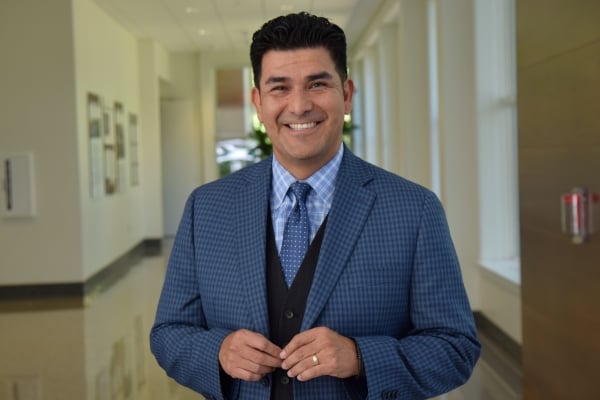
    Headshot of man with dark hair in a blue suit

    J. Israel Balderas is a journalism professor at Elon University and a First Amendment lawyer.

    3. Could such a ban really be enforced? What might college students do to get around it?

    Banning a social media app in a free society is incredibly difficult.

    Big tech being so powerful and so close to power in Washington also creates a very gray legal area, because Apple and Google control access to mobile apps. If they refuse to reinstate TikTok, then enforcement becomes a de facto reality even without the government directly blocking access. But what we saw earlier this month, with Trump’s intervention to reinstate TikTok, shows that enforcement can be overridden by executive power. So, it’s unclear how consistently a ban could be applied, but enforcement of a ban is far more complicated than either the courts or Congress can anticipate.

    College students are digital natives, and they adapt to these things by bypassing restrictions. They can use VPNs [virtual private networks], which are already widely used in countries with restricted internet laws, like China. Students could also download it from unofficial sources, instead of the traditional app stores. They can also use alternative apps, like the other, increasingly popular Chinese-owned app, RedNote.

    Somebody will find an emerging app, especially now in the world of AI, where AI is open source. You can take the backbone of TikTok, and with AI and proper coding you can create the same kind of environment as TikTok. So how many more clones out there would that be, right?

    4. How would a TikTok ban shape colleges’ digital literacy efforts in the age of AI?

    A TikTok ban would be a blow to digital literacy and AI education. This is the moment when we need to be talking about AI education and what it means for the workforce, students and us as faculty members, who are teaching that it’s not just about facts and knowledge. It’s about teaching students how to ask the right questions and how to connect the dots.

    TikTok opens the door to asking students what it is the algorithm knows about you, if that’s an ethical thing and if they want it. It’s not about shaming students for their choices. It’s about teaching them to think critically about what they’re doing and then letting them decide what it means for their lives and relationships.

    If the government can decide what content is good or bad for the population, we’d have to rethink what it means to have AI literacy in the curriculum.

    5. TikTok is caught in a geopolitical crossfire. Is there a teachable moment in all of this?

    The fact that we are having these conversations is the best part of this entire fiasco. Because students are questioning if the government can really do these things. What about the future? What about AI? Will the government be able to say that it’s not suppressing speech, but just suppressing the person who’s writing these codes or the person who’s putting these algorithms into the marketplace? Students are at least trying to figure out what is the role the government will play going forward when it comes to ideas that are not popular.

    If they’re being more critical about those things, then as a professor, I’ve done my job.

    Source link

  • Ducking and covering is no way to protect higher ed

    Ducking and covering is no way to protect higher ed

    This is one of those times I’m glad I’m in charge of only myself. I can’t imagine the pressure of leading an organization—like a higher ed institution—that is dependent on support from the federal government for its literal day-to-day operations.

    Also, I am aware of the old saw about free advice … it’s worth what you pay for it.

    Nonetheless, I’m going to venture some advice for institutions experiencing the assault of the opening 10 or so days of the second Trump presidency.

    Opinions may differ on exactly what is happening, but I’m convinced that New York Times columnist Jamelle Bouie is correct in saying, “Donald Trump is waging war on the American system of government.”

    If you believe this is true, there’s no room for accommodation. Ending democratic governance leaves no room for the kind of higher education that has made the U.S. the envy of the world.

    You’ve got to resist, all of it, actively, with as much countering force as possible. An administration that without notice “pauses” NIH and NSF activities, that even stops disbursement through the Office of Management and Budget, is not merely reorienting the government around the new president’s priorities. It seems clear they either intend to destroy or hobble higher education to make it a vassal state.

    I’ve got myself thinking of a couple of dynamics that I think are important to recognize in the moment.

    One is the problem of “institutional awe,” which I draw from the term “vocational awe,” coined by Fobazi Ettarh from observing the work of librarians such as herself. She calls vocational awe “the set of ideas, values and assumptions librarians have about themselves and the profession that result in notions that libraries as institutions are inherently good, sacred notions, and therefore beyond critique.”

    Ettarh identifies vocational awe as a route to self-exploitation as librarians are called upon to sacrifice their own well-being in order to preserve the operations of the library itself.

    “Institutional awe” is a bit different, and something perpetrated not by the laborers, but by leadership, where it’s judged that the continued operation of the institution is of the utmost importance, no matter the sacrifices required by the individual stakeholders, or the damage to the underlying mission of the institution.

    Under institutional awe, as long as the doors remain open, anything goes.

    There are already some worrying signs of this mentality in terms of some pre-emptive compliance with merely perceived threats from the Trump administration. In some cases, these moves appear to be motivated by a desire for administrations to use Trump policy as a rationale for either seizing more control or silencing dissent that’s causing them headaches. I do not want to think uncharitably of some of the leaders of the nation’s higher education institutions, but “Trump made me do it” appears to be a handy rationale for dodging responsibility.

    In other cases, I think we’re looking at rank cowardice, as in Northeastern University’s decision to purge any public-facing information that even references diversity, equity and inclusion. I suppose this suggests that Northeastern was not particularly committed to these things, as they are setting a land speed record for “obeying in advance.”

    The other big-picture caution I have is something I wrote about recently, to remember that there is always something next, and decisions you make in the present shape what that next thing is going to be.

    It seems clear to me that higher ed institutions are going to be fundamentally different both because of the efforts of Trump and some red state governors to make them over to something that must express fealty to their preferred vision, and simply because we’ve reached an endpoint regarding a prior vision of postsecondary education as something that should be accessible to all.

    A long-standing belief of many conservatives, that too many people go to college—and by too many people they mean women and minority students—that has been simmering under the surface for decades has now come into the open as overt attempts to, in the words of Victor Ray, “resegregate America” under the guise of challenging diversity, equity and inclusion initiatives.

    I understand the urge to treat what’s going on as perhaps elevated but still normal government functioning in line with what happens during any transition from one party to the other holding the White House. Members of the Democratic Party themselves seem to be acting according to this view.

    But how much evidence is necessary to recognize that this is a delusion and that pre-emptive appeasement or ducking and covering while hoping the blows land elsewhere is not going to work?

    While public trust in higher education has declined in recent years—mostly along partisan lines—it does not follow that most Americans would like to see the important work of teaching and research be utterly destroyed.

    As much as possible, institutions should act in solidarity with each other, considering an attack on one institution an attack on all, given that your institution will be next at some point.

    In the words of Alexander Hamilton, as imagined by Lin-Manuel Miranda, “If you stand for nothing, what will you fall for?”

    Source link

  • Q&A with a student success dean, Soka University of America

    Q&A with a student success dean, Soka University of America

    As an undergraduate student, Lisa MacLeod wasn’t sure where her career path would take her. She majored in English literature and international relations with the aspirations of being a journalist or a State Department staffer and found herself back in academia not long after.

    Lisa MacLeod, assistant dean of student success at Soka University of America

    Lisa MacLeod/Soka University of America

    Now, as the inaugural assistant dean of student success at Soka University of America since last fall, MacLeod is charged with breaking institutional silos at the California institution to improve student outcomes after graduation, working collaboratively across campus.

    MacLeod spoke with Inside Higher Ed about her time thus far at the institution, a private liberal arts college, and her aspirations in the long-term.

    Inside Higher Ed: What is your new role at Soka and how does it fit into institutional goals for student success?

    MacLeod: One of the most important things [about my role] is that I am housed under the dean of faculty, so I’m not under the dean of students, which is very different from how a lot of schools have done this.

    My top priority, luckily, isn’t getting students to graduate—because we already are doing that very well as an institution … I’m not just new in the job, the position is new at the university—so there’s some room for me to define what the position is.

    I was asked to look specifically at advising. Right now, our program is all faculty individually advising students for academic advising. Career services and internships is the other side of the house, and historically, the two sides of the house don’t talk to each other very well. So looking at how we advise, but also thinking about, are there ways that we can integrate better, because we have lots of good things happening by different people. But do faculty know about that? Do they know enough about it to recommend it to students? Not so much.

    The other thing is starting to integrate career readiness skills into the curriculum. This year, we are rolling out RATE (Reflect, Articulate, Translate, Evaluate), which was developed by the University of Minnesota for their liberal arts students.

    We’re having our first cohort this coming semester—so beginning in February—of faculty fellows who have pledged to develop the RATE system into their existing course, and we’re supporting them with some training and other kinds of activities so that we’re very specific in the application. We’re not asking you to change your course. What we’re asking is that you make it more evident to students how they are developing career readiness skills in addition to academic and subject area knowledge.

    Inside Higher Ed: You were a double major in college. While interdisciplinary learning can be an asset to students, sometimes academic departments can be more focused on helping students on a specific path within their discipline. Do you have any insights based on your experience as a dual major and helping students find their own path?

    MacLeod: At Soka, we don’t have majors—everyone graduates with a major in liberal arts, and then within that, we have concentrations. Students here do have the opportunity to double concentrate, so they’re not taking as many courses as you would for a major, but there’s still some degree of specialty.

    I encourage them to look at the whole course catalog and say, “Take the classes that really attract you, that are interesting, and you’ll figure out how they connect to each other if you look for it,” and to not worry about double concentrations. Or, you know, force yourself to take courses you wouldn’t otherwise.

    Certainly, I encourage students, depending on what their interests are, if you’re going to go to graduate school, yes, take statistics, take a research methodology course. Do these kinds of courses that are skill building [so] you’ll have that [for] the next level of your education; they will have expected you to have that background.

    But beyond that, I’m really focused on having students maybe try something they wouldn’t otherwise. I wish as an undergraduate I had taken an anthropology class, but it never occurred to me; it just wasn’t on my radar. Explore, because you don’t know what you don’t know, and to really find something that drives them, that they’re really excited about doing the coursework and learning more about that area. Because they’ll put more into it, and as they put more into it, they’re going to develop the liberal arts skills in the process. Whereas, if they’re forcing themselves to take a course because they feel they should take this course, they’re not going to have the same level of motivation. They’re not going to get the same out of it.

    Inside Higher Ed: As you said, one of your priorities is advising, which is so important to the student journey. What does quality advising look like to you?

    MacLeod: I think that quality advising really requires time and listening.

    I always ask students to come in with kind of a worksheet: Where are you [in your progress] toward graduation? Where are you in terms of taking required courses? But I also ask them things like, “OK, this is a required course, but you have a selection of five different faculty members that might be teaching that course, and of course, they bring their skills and expertise and kind of personality in each course. Why did you choose that faculty member? If you’re interested in this, maybe this other faculty member—even though it’s the same requirement—might teach that course in a way that you would find appealing?” And directing them to resources, encouraging them to talk to faculty before they enrolled in the course if they have questions or concerns or if they’re not certain about something.

    Then also asking them very blatant questions that I wish someone had asked me when I was an undergraduate. What are your plans after you graduate? What are you doing to achieve that goal? What information do you need to know, and how are you going to get it moving forward?

    I took time off [after graduating] because I’d never had those conversations. Maybe people at the university thought I was having it with my family. My family may have thought I was having it with people at the university. I’m not sure where I lost the memo, but it just didn’t happen. Before, someone had always come along and said, “Apply for this,” and it was a very structured thing. That’s not how life after graduation works at all. So I ask those questions I wish someone had asked me.

    Inside Higher Ed: What is student success to you?

    MacLeod: It’s not for me to define for someone else what success looks like. I have my own ideas, but I think it’s wrong to impose that on other people, because success can look like so many different things.

    In general, I feel that student success is they graduate from the program, and they feel good about that. That there’s not regret that they should have gone someplace else, but also that we’ve equipped them with the skills in their personal and in their professional life to face the challenges that will inevitably come and to be able to surmount them.

    The first couple years after graduation for everyone is hard—that’s just kind of the nature of the beast—but that they are prepared for, that they can get through it, and know that there’s something on the other side. that they are confident in their skills, that they will figure it out and then end up on the other side in a career that they find fulfilling in some manner, being able to contribute to the community, if that’s their goal, in a way that is meaningful to them. And hopefully happy alumni that are talking to our current students that and sharing their experiences.

    Inside Higher Ed: What are your long-term goals in this new role?

    MacLeod: It feels like so much of academic life is keeping your head above water for now.

    I think that in the long term, I’d really like to see a more collaborative campus culture, where faculty members are supporting each other in their endeavors, maybe a bit more. It’s not that my colleagues are unsupportive, but we don’t always ask each other or are aware of the ways in which our research overlaps and we could actually be doing more—whether it’s with our teaching or where we could be drawing more on each other’s skills and knowledge base.

    I’m still really new at this … so I think right now my priority is still listening, rather than planning for the future.

    Seeking stories from campus leaders, faculty members and staff for our Student Success focus. Share here.

    Source link

  • Academic unions should adopt neutrality (opinion)

    Academic unions should adopt neutrality (opinion)

    Institutional neutrality at universities is having its moment in the aftermath of a year of nationwide campus protests over the Israel-Gaza war. The list of universities that have adopted neutrality has grown over the course of the past 12 months. The concept necessarily is expanding to include conversations around university investments. Yet, academic unions have slipped under the radar as purveyors of positions on political issues. They should not be neglected in the push for neutral stances except for those that directly pertain to an institutional mission. In the case of the union, this should be to promote labor interests. Professors from a range of ideologies should be able to find common cause for collective bargaining purposes without being forced into supporting other political positions.

    The lack of neutrality of professors’ unions on non-labor-related issues is a pernicious problem. Federal law and some state laws that pertain to unions work to compel professors’ speech. Under the federal National Labor Relations Act, if a majority of private sector workers voting in a union election choose to unionize, all workers in that bargaining unit must be exclusively represented by that union. New York’s Taylor Law requires the same for public employees. And, if workers want the benefits of membership, like voting for union leadership and contracts, they must pay dues.

    While public employees could choose not to be union members before the Supreme Court’s 2017 Janus v. AFSCME ruling, that case now guarantees their right to not pay agency fees. But even if workers wish to eschew membership and not pay fees, they cannot dissociate entirely. They are required to be represented by a union that speaks via statements at the local, state and national level on many non-labor-related subjects. Therefore, with their veneer of solidarity, unions quash viewpoint diversity and suppress First Amendment rights. They tie one of the only forms of dissent possible (withdrawing dues) to disenfranchisement from the union, the organization that negotiates their wages and labor conditions.

    Professors who do stop paying their dues are often derided as “free riders.” They risk offending union leadership, who have a say in university processes that can impact their employment, like grievances and denial of reappointment. The union is formally required to provide equal advocacy as their exclusive representative. However, even if one believes biases will never prevail against “free riders,” there is still the suppressive impact of professors’ perception that paying dues and keeping quiet is best for their careers.

    And so, professors are forced into a kind of protection racket, paying unions that may endorse positions with which they may disagree. The National Education Association has opined on everything from ending private prisons to climate change, from promoting women-led businesses to helmets for motorcyclists. They have issued statements on the Israel-Gaza conflict, advocated for codifying Roe v. Wade into law and called for Donald Trump’s ouster. They have adopted progressive ideological lenses throughout such statements, arguing for instance that “white supremacy culture” is prevalent in the current U.S., and that “intersectionality must be … addressed … in order to advance the [NEA’s] social justice work.”

    To be clear, I am not arguing that these positions taken by unions are bad. I am not reflecting my own political preferences. I am not highlighting progressive examples to critique only progressive examples: I could find none that can be considered conservative. I am not saying that it’s not possible that a majority of members agree with the statements. I am also not arguing that workers do not have the right to form associations to advocate for political causes.

    What I am arguing is that due to laws making exclusive representation compulsory, unions should adopt neutrality on political issues that do not impact the primary purpose of academic unions: advocating for professors’ interests as workers. This lets ideological diversity exist and prevents coerced speech and dues payments. This neutrality is of paramount importance with public sector unions, where union leadership activities may receive taxpayer-subsidized administrative benefits.

    This neutrality should extend to political endorsements of individual candidates. While there may be some argument to be made that endorsing a pro-union or pro–higher education candidate over their opponent directly pertains to professors’ interests as workers, this carries with it implicit endorsement of a wide slate of other policies. A better approach would be for unions to support (or critique) candidates’ specific policy proposals or voting records. It would also reduce antagonism between unions and candidates they did not endorse, should those be elected.

    Recent examples show the perils of academic unions not having a neutrality standard. In 2018, a University of Maine professor sued his union, noting his opposition to its stances, like endorsing Hillary Clinton for president. More recently, in 2022, six City University of New York professors filed suit against the Professional Staff Congress (PSC), which passed a pro-Palestinian resolution they viewed as antisemitic. They resigned their memberships, along with approximately 263 other professors. But because of the Taylor Law, they are required to be represented by the PSC, which did not give evidence it could be fair in representing them. The PSC called them free riders, claiming their lawsuit was “meritless … funded by the notoriously right-wing National Right to Work Legal Foundation,” and described the “‘Right to Work’ agenda” as “rooted in white supremacy.”

    After lower courts ruled to dismiss their suit, the CUNY professors appealed to the Supreme Court, which just this month declined to hear their case. Yet, while this case could have been a victory for viewpoint diversity and free speech and an impetus for unions to get on the institutional neutrality bandwagon, future such suits will doubtless arise and reach a court favorable to their claims. Academic unions should get ahead of such a court ruling and make union membership attractive to all who may want to participate based on advocacy for improved working conditions, but not for particular solutions to international wars—or for wearing motorcycle helmets.

    Colleen P. Eren is a professor of sociology and criminal justice at William Paterson University and a research fellow at the Segal Center for Academic Pluralism. Her commentaries on higher ed and other topics can be found across a range of publications, including The New York Times, Discourse, Reason, and the Foundation for Economic Education.

    Source link

  • Ideas for navigating editor-reviewer relationships (opinion)

    Ideas for navigating editor-reviewer relationships (opinion)

    An editor or reviewer can have an outsize impact on the career of a scholar, particularly in the early stages. The stakes can be high for an author. A negative review or edit can set back a research plan by months and harm a scholar’s chances for tenure or promotion. This reality creates a power imbalance between an editor or reviewer and an author that can be abused.

    Graduate schools offer few pointers on how to navigate editor and reviewer relationships. Our goal in this essay is to debunk the process and offer suggestions and observations for editors/reviewers and authors on how to approach the task in a more thoughtful and efficient way.

    Understanding the Reviewer and Editor Roles

    First, it is important to note that while reviewers and editors take part in a similar process—assessing the work of an author—the tasks are different. The editor is rarely an expert in the specific subject of an article and necessarily needs to rely on impartial reviewers to place the work in context. Nevertheless, the editor—and, at times, an editorial board—is the decision-maker in this equation. Having a clear and transparent line of communication between the author and the editor is critical.

    The task of the reviewer is to place the work in its scholarly context and to weigh its merit. Is the work breaking new ground? Is it challenging a long-held interpretation within the academy? Are the sources contemporary and the most relevant? Does the work fit the subject area of the journal or press? Can it be revised to make it suitable for publication?

    It is our strong belief that reviewers need to meet the authors where they are—that is, to understand the goal of the author, determine whether the work is suitable for the journal or press in question and, if so, help them reach the promised land of publication. Simply put: The reviewer should weigh the author’s case against the author’s intent.

    Unfortunately, this does not always happen: It is sometimes the case that reviewers stray from this path and insert suggestions that they would like to see addressed but that are not central to the submitted work. The dreaded “reviewer number 2” has become the bane of many an author’s existence. In this sort of review, the reviewer raises so many questions and objections that an author is left to ponder whether the two are reading the same text. And, it must be said, just as on social media, anonymity can at times lead to incivility. Instead of being helpful, sometimes a reviewer is unkind and cruel.

    The role of the editor is to referee between the goals of the author and the desires of the reviewer. Egos and politics often come into play in this process because reviewers in many cases are colleagues of the editor and contributors to the publication in question. Our experience suggests there are two major types of editors. Authors will need to adjust their approach based on which of these two types best describes their editor:

    • Sympathetic editor: This is the ideal. This editor will work with an author to publish a submission if the research is strong and will allow them to keep their own voice. They do not seek to impose their vision on the book or article. They do not allow their personal politics to influence the decision-making process. They are driven by one central question: Does the author accomplish what they set out to do? This type of editor tries to determine whether a reviewer is acting out of hubris by suggesting tangential and substantial changes or whether they are addressing core issues. On the opposite end of the spectrum, they are alert to the two-paragraph, lackadaisical reviewer who read the work over lunch while answering emails.
    • Visionary editor: It may sound counterintuitive, but an editor with their own vision for someone else’s work can mean frustration and ultimately rejection for an author. This type of editor sees someone else’s work as an opportunity to explore an aspect of a topic that interests them. They impose their own vision on someone else’s work rather than determining whether the author has achieved the goal they set for themselves. This typically takes the form of a lengthy response asking an author to fundamentally rethink their piece. The response contains so many critiques that to adhere to the suggestions would amount to writing a completely different piece of scholarship. This editor also tends to extend and even impede the process almost endlessly.

    As an example, upon the death of Fidel Castro in November 2016, the Latin American historian of this writing duo (Argote-Freyre) was asked by a journal editorial board member to author an article comparing the career of Castro with that of the prior dictator of Cuba, Fulgencio Batista. The resulting piece concluded that the two political figures shared more similarities than differences. The editor, although agreeing to the concept, was unhappy with the conclusions reached by the essay. The editor struck out paragraph after paragraph; a lecture on tone and thesis ensued.

    The editor suggested a piece analyzing the revisionist historiography on Batista—a subject outside the contours of the original assignment and one that would take many months to complete. The author made a rookie mistake in assuming that a member of the editorial board was vested with the authority to make assignments. In retrospect, it seems as if the assignment was foisted upon the working editor, who then wanted to steer the piece in a completely different direction. The author withdrew the piece; the only positive was that only a few months were lost in the process.

    The visionary editor is the type who is never satisfied. They forget that the piece is the author’s, not theirs. Yes, the editor is a gatekeeper for the journal or press, but if it is not a good fit, they should say so and move on. This picky editor sends a revision back to a new third (or fourth) reviewer, who is likely to ask for another, different round of revisions. This is nothing other than moving the goalposts. One of us had this occur with an editor who said, “As you know, we often send articles to several rounds of reviewers.” Well, we did not know, because the journal’s website did not say that. Such a process could go on forever and, to our eyes, makes no sense. The editor should decide on his or her own whether the author has revised sufficiently: It is clear from the reader reports what needed to be done, so just check and see. The editor needs to be decisive.

    At the point a work is about to be sent to an additional set of reviewers, an author needs to withdraw the article or book from consideration. Run as fast as you can in search of another editor and publication. Do not let someone waste your time, especially if your clock is ticking for tenure and promotion.

    How to Make Relationships Work— and When to Walk Away

    The author-editor relationship should be a dance, not a duel. An author is not at the mercy of the process; you are a partner. If you are not clicking with the editor, walk away. A bad first date rarely turns into a good second date. This is particularly true when working on a book project, given the many steps and long timeline involved.

    For a revise-and-resubmit, we suggest strongly that you be professionally assertive. Ask about the review of the resubmission before you do it. If the editor says it will go to new readers, withdraw the piece. This never goes well. Editors should be transparent about the steps involved. It is our experience that some editors are hesitant to divulge their process. If that is the case, the author needs to reassess the integrity of that process.

    Being fully transparent allows you to ask for transparency in return, whether you are an editor or an author. If, as we have experienced, two peer reviews come in that are quite opposed, the editor should get a third before returning to the author. If there are two or three reviews, the editor should synthesize them with a memo attached to the reports. The summary should go something like: “All reviewers agree chapter four needs to be revised with this material, but there is disagreement about chapter six.” There is also nothing wrong with asking the author to make the tough call on a contested point of interpretation. Once again, it is the author’s scholarship, not the editor’s, the journal’s or the press’s.

    For authors: Have a conversation with the editor. If it’s a call, follow up with a written summary. When responding to reader reports, especially when they disagree, say what you will and will not do. Do not say you will revise when you disagree—but don’t be stubborn. Give a little to get what you won’t compromise. If you disagree with a reviewer’s suggestion, say why, and ask the editor for approval not to make a specific change suggested in one of the reader reports. Get that approval. If the editor says the revision will go back to one or both original readers instead of making the final call himself, politely insist that the written exchange between the author and editor be sent along, too.

    It may not always work. Recently, one of us did just what we described and the editor said the plan sounded good, only to have the journal reject the revision. The editorial board said a specific change was not made even though the editor agreed that change would not be necessary. Poor communication and coordination between an editor and an editorial board should not penalize an author.

    Finally, we’d like to briefly weigh in on the argument that professors should reject peer reviewing because it is an unpaid task. If you do not want to do it, don’t—but there are compelling reasons to write responsible peer reviews. First, unpaid labor is not without merit. Even if your tenure and promotion committees might not value the task, that does not mean it is not worthwhile. You’re not paid to volunteer at your local food pantry, but you still do it. Second, people do this for you; it is time to be generous in return. Third, reviewing provides insights into the process for your own work. Peer reviewing keeps you current on trends in the field. Editing and peer reviewing make you a better writer and produce better scholarship. Isn’t that what we all want?

    Frank Argote-Freyre and Christopher M. Bellitto are professors of history at Kean University in Union, N.J., with extensive experience with peer review on both sides of the process. Argote-Freyre, a scholar of Latin American history, serves as a frequent peer reviewer and content editor on various book and article projects. Bellitto, a medievalist, is the series editor of Brill’s Companions to the Christian Tradition and academic editor at large of Paulist Press.

    Source link

  • Degree Apprenticeships in England: What Can We Learn from the Experiences of Apprentices, Employers, and Education and Training Providers?

    Degree Apprenticeships in England: What Can We Learn from the Experiences of Apprentices, Employers, and Education and Training Providers?

    By Josh Patel, Researcher at the Edge Foundation.

    Degree Apprenticeships (DAs) were launched in 2015, as a novel work-based learning route to obtaining a degree. On their introduction, then Prime Minister David Cameron said they would ‘give people a great head start, combining a full degree with real practical skills gained from work and the financial security of a regular pay packet’. Since then, they have taken the higher education sector by storm. Their growth has been the key factor in the expansion of higher apprenticeships from 43,800 starts in 2015/16 to 273,700 in 2023/24, a rise from 4.8% to 35% of all apprenticeships. They have stimulated innovative models of delivery and new and productive relationships between employers and providers. Former Skills Minister Robert Halfon remarked that ‘Degree Apprenticeships’ were his ‘two favourite words in the English language’.

    DAs have, however, recently come under scrutiny. Concerns persist that the growth of DAs and their high cost – reported in the media as growing from 2% of the apprenticeship budget in 2017/18 to 21% in 2021 – might crowd out opportunities for young entrants to the workforce, as DAs are primarily taken by existing employees. The suitability of DAs as instruments to improve upward social mobility has been contested. Meanwhile, the government is drawing up plans to increase the flexibility of the Apprenticeship Levy through which Degree Apprenticeships can currently be funded, asking employers ‘to rebalance their funding for apprenticeships… to invest in younger workers’.

    Our report, ‘Degree Apprenticeships in England: What Can We Learn from the Experiences of Apprentices, Employers, and Education and Training Providers?’, written in collaboration with colleagues from the Universities of Bath, Huddersfield, and Oxford, was published on Tuesday and is a timely intervention into these discussions. Here, we present the evidence for some our policy recommendations, gathered from nearly 100 interviews with stakeholders including large employers and SMEs, providers, degree apprentices, and policymakers.

    Engaging employers

    The government needs to consider a more systematic approach that serves to rationalise the way that employers are supported to offer a wide range of work-based opportunities. As Edge has identified in other programmes, such as T Levels or plans to provide universal work experience through the government’s Youth Guarantee, DAs are restricted by the number of employers willing to engage. We repeatedly heard evidence of the difficulties ‘resource-poor’ employers had in engaging with the design of apprenticeship standards and participating fully in collaboration with providers. As one SME told us contributing to the design and development of a DA ‘doesn’t give me any benefit now, and I’m impatient’.

    The government needs to develop a coherent strategy for DAs with a particular focus on support for SMEs, including improved awareness of levy transfer schemes. Involvement in DAs is often based on being ‘in the know’ and contacts with providers and local authorities. In our ‘Learning from the past’ stream of work, we reviewed Education Business Partnerships, as an example of intermediary organisations, noting both their strengths and shortcomings, which could inform effective initiatives for supporting employers.

    Reducing complexity

    With the creation of Skills England, the government should take the opportunity to review and simplify the process of design, delivery and quality assurance for DAs, and ensure regulatory elements work together. DAs currently draw in a large number of bodies including the OfS, IfATE, regulatory bodies, professional bodies and Ofsted. Providers told us that this had created a complex landscape of ‘many masters’ where lines of accountability are blurred and innovation is stifled. Providers described ‘overregulation’ as limiting ‘our ability to go off-piste’, and while the process could be constructive, providers were unconvinced of its added value. ‘Does that add to the quality?’ one provider asked. ‘I don’t think it necessarily does’.

    Skills England’s remit includes shaping technical education to respond to skills needs, and its incorporation of IfATE has already begun. As a first exercise, it could review the regulatory requirements to remove any duplication and contradictions and then consult with the sector to devise a simpler, clearer mechanism for providers to report.

    Increasing flexibility

    These difficulties meant that, while we found examples of excellent integration of academic learning and the workplace, concerns persisted as to the vocational relevance and obsolescence of learning, particularly in fast-moving sectors such as IT and mental health provision. One employer involved in delivery said they told their apprentices: ‘we have to teach you this so you get through your apprenticeship, but actually in practice that is not the way it’s done any longer’.

    In other countries, such as the Netherlands, a proportion (up to 20-25%) of an apprenticeship standard is kept flexible to be agreed between the employer and provider so that it can take better account of the current and changing situation in that particular industry, location and employer – such flexibility could be piloted in the UK.

    …without compromise

    The government’s commitment to adapting the levy into a ‘Growth and Skills Levy’, offers opportunities to improve DA delivery. Diversification was not a major consideration for the majority of employers when recruiting, though we certainly did hear evidence from those with a strong sense of their social corporate responsibility. As one SME put it:

    there are too many people in the IT industry that are like me. So we’re talking middle-aged white guys. […] Now, DAs allow people who don’t necessarily, wouldn’t consider getting into this industry from a variety of backgrounds, creeds, colours…

    We recommended in our Flex Without Compromise report that the government should take a measured approach to levy reform to minimise the risk that a broadening of scope diminishes the opportunities available particularly for younger people and newer entrants to the labour market. It should consider modelling the impact of differentiating levy funding available for DAs by either or both age and staff status, and diversification of the workforce. This could be a powerful mechanism to encourage employers to focus DA opportunities on younger people and on new recruits but would need to be considered carefully to allow for continued expansion of DAs.

    These initiatives might help address existing challenges and enhance the efficacy of Degree Apprenticeships in fostering equitable access and meeting the needs of learners and employers.

    To find out more about Edge and to read the report in full, visit www.edge.co.uk

    Source link

  • UCAS End of Cycle provider data, 2024

    UCAS End of Cycle provider data, 2024

    Chat to anyone involved in sector admissions and you will hear a similar story.

    And the story appears to be true.

    It is now clear “high tariff” providers have been lowering their entry tariff (often substantially) in order to grow recruitment – meaning students with less-than-stellar grades have been ending up in prestigious institutions, and the kinds of places students like this would more usually attend have been struggling to recruit as a result.

    In other words, the 2024 looks a lot like a lockdown cycle (without the examnishambles and Zoom pub quizzes).

    Any major dude will tell you

    We noted, at a sector level, the rise in the number of offers made by high-tariff providers – it was the highest number on record. There was no parallel rise in A level attainment, which suggests a strategic decision, made early on, to widen access.

    Today’s release of UCAS End of Cycle data for 2024 at provider level illustrates that this picture is a generalisation. Some high-tariff providers have acted in the way described above, others have pursued alternative strategies. And other providers have hit on other ways to drive undergraduate recruitment.

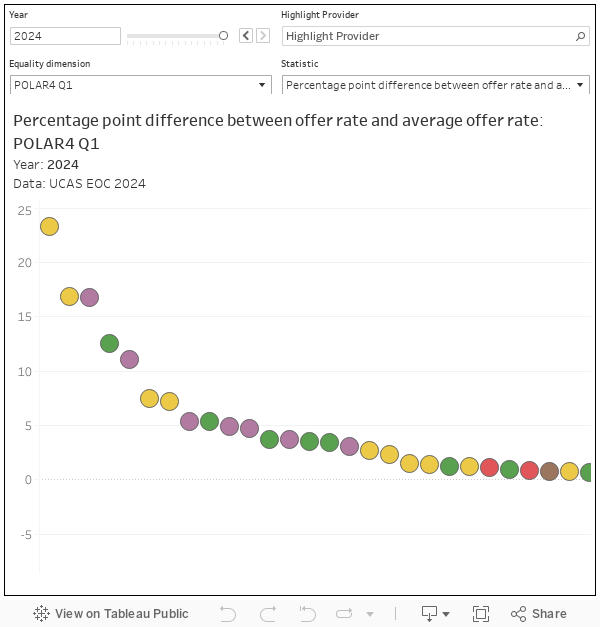
    Starting with my favourite chart, we can think about these individual strategies in more detail. This scatter plot shows the year-on-year change in the number of applications along the horizontal axis and the year-on-year change in acceptances on the vertical. There’s filters for gender, domicile, age group and subject group (at the top level) – and I’ve provided a choice of comparator years if you want to look at changes over a longer term. The size of the dots represents the total recruitment by that provider in 2024, given the parameters we can see.

    [Full screen]

    In essence this illustrates popularity (among applicants) and selectivity. What we can see here for 2024 (defaulting to UK 18 year olds applying to all subjects compared to 2023) is that pretty much the entire Russell group has made significant (c500 or above) increases in recruitment, whether or not they saw a corresponding growth in applications.

    It’s not the full story – the picture for other pre-92 and post-92 providers is more mixed, with some providers able to leverage popularity (or desperation) to find growth.

    My old school

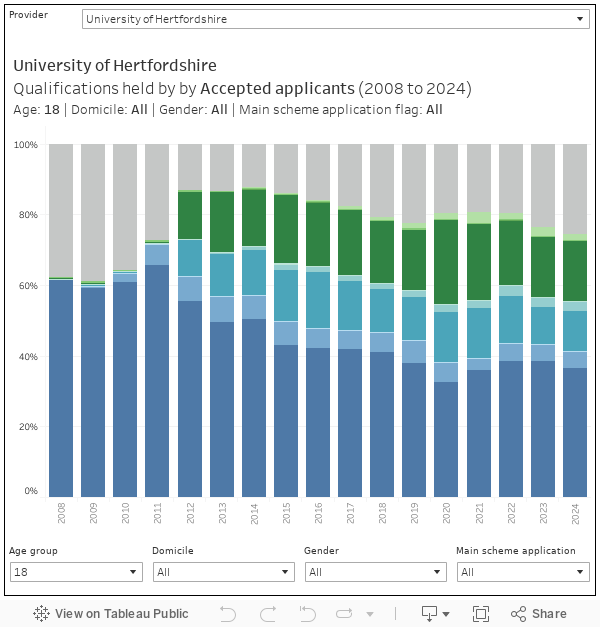
    We can’t look directly at provider behaviour by tariff, but we can examine what qualifications students placed at the provider have – here a key indicator might be an increase in the number of students entering without A levels (a group that tends to have lower tariffs overall).

    [Full screen]

    The trouble is, A level entry rates have also increased – pretty much anyone who wants to and can do A levels is now doing A levels. With the decline in BTEC popularity, and the still uncertain interest in T levels, this is to be expected. All this means most providers have seen an increase or steady state in the number of students entering with A levels (when you include that A level plus project options). In Scotland – and recall we don’t get the complete picture of Scottish applications from UCAS because of a wonderful little thing called intercalation – it’s SQA pretty much all the way.

    Everything you did

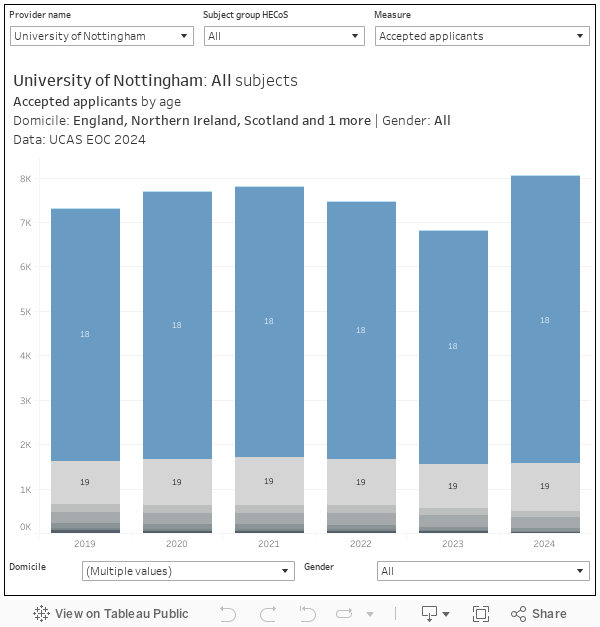
    If you are wondering whether a change in age groups placed as undergraduates could also have an impact on recruitment patterns, it looks as if the pattern of low and slowly falling mature recruitment continues for most providers. For larger universities most of the action is around 18 year old home recruitment – and specialist providers that focus on mature students (often via part-time or flexible study) tend to struggle.

    [Full screen]

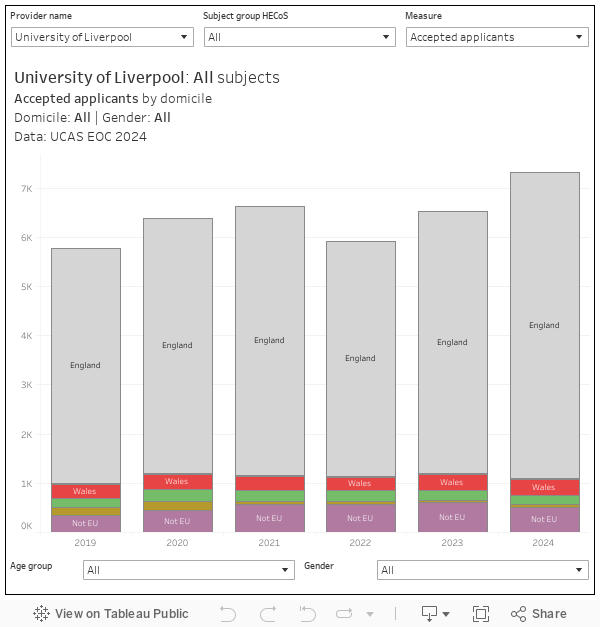
    The other key factor is domicile – the changes to visa arrangements this time last year had a huge impact on international applications (particularly from countries like India and Nigeria that have become important for lower tariff providers) and coupled with some of the changes described above this has resulted in some providers seeing undergraduate international admissions fall off a cliff.

    [Full screen]

    As always, undergraduate isn’t the full story – we’ve still no reliable way of understanding postgraduate recruitment in the round until we get the HESA data long after the academic year in question has finished. I just hope that regulators with new duties to understand the financial stability of the sector have more of a clue.

    Any world that I’m welcome to

    With some providers stuffed to the seams and beyond with students they wouldn’t usually accept – many with support needs it is unclear whether they are able to meet – it is unclear who exactly benefits from this new state of affairs. The claim we regularly hear is that universities lose money on educating home students, and that these must be cross subsidised by international recruitment.

    The corollary of this is that in times where international student recruitment is restricted you would expect to see the number of home students at providers reliant on this income fall – after all, if you lose money on every home student the more you recruit the more money you lose. Though measures to widen access and participation are important (and indeed, we see welcome evidence of contextual admissions at selective providers in the chart below) the fact of it is that you need to spend money to support students without the cultural capital to succeed.

    [Full screen]

    The rather painful conclusion I reach is that the only way to make this year’s sums add up is a reduction in spend per student – and, thus, most likely, the quality of the student experience among precisely the students who would have been overjoyed to get a place at a famous university. We should keep a close eye on continuation metrics and the national student survey this year.

    Source link

  • Institutions may be holding themselves back by not sharing enough data

    Institutions may be holding themselves back by not sharing enough data

    Wonkhe readers need little persuasion that information flows are vital to the higher education sector. But without properly considering those flows and how to minimise the risk of something going wrong, institutions can find themselves at risk of substantial fines, claims and reputational damage. These risks need organisational focus from the top down as well as regular review.

    Information flows in higher education occur not only in teaching and research but in every other area of activity such as accommodation arrangements, student support, alumni relations, fundraising, staff and student complaints and disciplinary matters. Sometimes these flows are within organisations, sometimes they involve sharing data externally.

    Universities hold both highly sensitive research information and personal data. Examples of the latter include information about individuals’ physical and mental health, family circumstances, care background, religion, financial information and a huge range of other personal information.

    The public narrative on risks around data tend to focus on examples of inadvertently sharing protected information – such as in the recent case of the Information Commissioner’s decision to fine the Police Service of Northern Ireland £750,000 in relation to the inadvertent disclosure of personal information over 9,000 officers and staff in response to a freedom of information request. The same breach has also resulted in individuals bringing legal claims against the PSNI, with media reports suggesting a potential bill for those at up to £240m.

    There is also the issue of higher education institutions being a target for cyber attack by criminal and state actors. Loss of data through such attacks again has the potential to result in fines and other regulatory action as well as claims by those affected.

    Oversharing and undersharing

    But inadvertent sharing of information and cyberattacks are not the only areas of risk. In some circumstances a failure to ensure that information is properly collected and shared lawfully may also be a risk. And ensuring effective and appropriate flows of information to the governing body is key to it being able to fulfil its oversight function.

    One aspect of the tragic circumstances mentioned in the High Court appeal ruling in the case concerning Natasha Abrahart is the finding that there had been a failure to pass on information about a suicide attempt to key members of staff, which might have enabled action to be taken to remove pressure on Natasha.

    Another area of focus concerns sharing of information related to complaints of sexual harassment and misconduct and subsequent investigations. OfS Condition E6 and its accompanying guidance which comes fully into effect on 1 August 2025 includes measures on matters such as reporting potential complaints and the sensitive handling and fair use of information. The condition and guidance require the provider to set out comprehensively and in an easy to understand manner how it ensures that those “directly affected” by decisions are directly informed about those decisions and the reasons for them.

    There are also potential information flows concerning measures intended to protect students from any actual or potential abuse of power or conflict of interest in respect of what the condition refers to as “intimate personal relationships” between “relevant staff members” and students.

    All of these data flows are highly sensitive and institutions will need to ensure that appropriate thought is given to policies, procedures and systems security as well as identifying the legal basis for collecting, holding and sharing information, taking appropriate account of individual rights.

    A blanket approach will not serve

    Whilst there are some important broad principles in data protection law that should be applied when determining the legal basis for processing personal data, in sensitive cases like allegations of sexual harassment the question of exactly what information can be shared with another person involved in the process often needs to be considered against the particular circumstances.

    Broadly speaking in most cases where sexual harassment or mental health support is concerned, the legislation will require at minimum both a lawful basis and a condition for processing “special category” and/or data that includes potential allegations of a criminal act. Criminal offences and allegations data and special category data (which includes data relating to an individual’s health, sex life and sexual orientation) are subject to heightened controls under the legislation.

    Without getting into the fine detail it can often be necessary to consider individuals’ rights and interests in light of the specific circumstances. This is brought into sharp focus when considering matters such as:

    • Sharing information with an emergency contact in scenarios that might fall short of a clear “life or death” situation.
    • Considering what information to provide to a student who has made a complaint about sexual harassment by another student or staff member in relation to the outcome of their complaint and of any sanction imposed.

    It’s also important not to forget other legal frameworks that may be relevant to data flows. This includes express or implied duties of confidentiality that can arise where sensitive information is concerned. Careful thought needs to be given to make clear in relevant policies and documents when it is envisaged that information might need to be shared, and provided the law permits it.

    A range of other legal frameworks can also be relevant, such as consumer law, equality law and freedom of information obligations. And of course, aside from the legal issues, there will be potential reputational and institutional risks if something does go wrong. It’s important that senior management and governing bodies have sufficient oversight and involvement to encourage a culture of organisational awareness and compliance across the range of information governance issues that can arise.

    Managing the flow of information

    Institutions ought to have processes to keep their data governance under review, including measures that map out the flows and uses of data in accordance with relevant legal frameworks. The responsibility for oversight of data governance lies not only with any Data Protection Officer, but also with senior management and governors who can play a key part in ensuring a good data governance culture within institutions.

    Compliance mechanisms also need regular review and refresh including matters such as how privacy information is provided to individuals in a clear and timely way. Data governance needs to be embedded throughout the lifecycle of each item of data. And where new activities, policies or technologies are being considered, data governance needs to be a central part of project plans at the earliest stages to ensure that appropriate due diligence and other compliance requirements are in place, such as data processing agreements or data protection impact assessments are undertaken.

    Effective management of the flow ensures that the right data gets in front of the right people, at the right time – and means everyone can be confident the right balance has been struck between maintaining privacy and sharing vital information.

    This article is published in association with Mills & Reeve.

    Source link

  • Lessons for leaders from the campus encampments

    Lessons for leaders from the campus encampments

    It’s neither a personal nor an especially novel observation to suggest that both in the UK and across North America and Western Europe, debates about campus climate, culture and freedom of speech were upended on 7 October 2023.

    It’s not the purpose of the report, but you can really feel some of the contradictions coming to a head in Josh Freeman’s terrific new HEPI report on the Encampments protesting for Palestine and the response to them, tentatively timed to offer early reflections now that a ceasefire has been secured.

    What until October 7 had been a rhetorically wide framing of freedom of speech and a pretty narrow one over protection from harm and harassment was always going to be challenged when speech took the form of pro-Palestine placards rather than the punch and judy of rarified Russell Group debating societies.

    And while plenty of people still pretend that there are no “fine lines” and contradictions between, say, expressions of pro-Palestinian solidarity and antisemitism, Freeman’s report lays out the realities and complexities of universities, their students’ unions and students themselves being expected to tread and police those lines.

    I was struck, reading the report, by the contradictions between the way in which student “debaters” (the subject of a previous report from Freeman) and student activists of the sort in the encampments are often framed in terms of what they represent – the former is often assumed to be a near-universal experience or at least an ideal, while the latter are painted as an angry mob that often aren’t even students anyway.

    Both, in truth, are pretty unrepresentative of the contemporary higher education experience, both can seem like indulgences that many students are unable to afford, but both do have an influence on students’ understanding of the world. The fact that both appear to be largely confined to the Russell Group could easily be a source of shame rather than relief.

    Motivations and disruptions

    There’s a good methodology to the report that some tend to turn their nose up at when used on other issues – it’s basically a qualitative, case study-based approach, drawing on lived experiences through semi-structured interviews with key players – student protestors, university staff, students’ union officers, and Jewish students – while triangulating these insights with documentary analysis of public statements and social media discourse.

    As a result, there are some fascinating insights from Freeman. Fairly early on, he notes that in the student interviews, many were motivated by factors which, at least at face value, went far beyond the situation in Gaza – referring to other factors like islamophobia, tuition fees, staff pay and pensions, mental health or even the freedom to protest:

    These issues were rarely mentioned in encampments’ official demands but they appear to have been significant motivators to join the protests.

    There’s also a clutch of material on the way in which the encampments themselves operated – laying bare both aspects and incidents of obvious antisemitism, but also anguish about the right (and for some, perceived duty) to object to and highlight the actions of Israel throughout the war, and the way in which those protestors knew that that might be misinterpreted.

    Material on “disruption” is interesting too. Freeman identifies both an oft-denied truism – that this kind of “speech” is designed to be disruptive – and a less-understood concern of some protestors that keeping students on side by not excessively disrupting their education was important.

    The section on the “institutional response” is particularly helpful, mainly because it draws comparisons in the approach on engagement. The running theme is that where – either by chance or by design – institutional managers and student protesters were caused to meet and discuss as people, some inching away from simplistic demonisation was possible and helpful. By contrast, it looks like a lack of engagement allowed a simplistic framing – of protester as terrorist, and university manager as oppressor – to unhelpfully persist.

    Freeman also reflects on the learning made possible by those encounters:

    The ultimate goals of discussions should be learning, on the one hand – these examples suggest institutions still have much to learn from their students – and explaining, on the other, why some demands are not feasible.

    Another aspect of the diversity in approaches relates to “demands”. The old “give them an inch and they’ll take a mile” approach to students can be seen in this quote:

    It would create two categories of students … it would give them a carte blanche for any kind of behaviour.

    …while others were perceptive enough to recognise that hard and fast rules can look quite silly quite quickly when it’s often context that counts:

    It’s a special situation, an emotional issue. It’s okay to call this a one-off. Though some have said we are setting a bad precedent by allowing this behaviour.

    That’s true too over a running theme in the narrative amongst protesters – that taking an early and unequivocal stance on Ukraine in the way that most of the sector did was, for them, incompatible with a sudden concern for neutrality over Israel/Palestine.

    Frustratingly, Freeman even reports that after accusations of being “hypocrites”, “several” senior staff said that, on reflection, their institutions would avoid political statements entirely in the future – as if carefully crafted regulations will always trump context. They won’t.

    I’d also tentatively add that while it was undoubtedly true that:

    …In comparison with the Marking and Assessment Boycott, there is tiny traffic from students. To the bulk of our students, it [the conflict] is not on their radar. We have had a few hundred emails on divestment, but they are the same people writing over and over, with the same template.

    …one might argue that a huge international conflict, with significant global implications, might cause one to wonder why more students weren’t engaged, particularly in universities where “activism” is more a rarity than a rhythm.

    Threats, reputation and officialdom

    There are, inevitably, some pointed observations both about government and the Office for Students – which to this day has said almost nothing about so many of the edge cases of freedom v harm involved in Israel/Palestine, despite being in the process of launching two new “sandbags on the see saw” in the form of free speech duties and anti-harassment duties.

    Universities – perhaps it was always thus – were neither to be trusted nor offered much in the way of help when being left to resolve the tensions themselves:

    They’ve left us to it. That may have been the best thing.

    In a week when student activists appear to have brought down a populist Prime Minister in Serbia, I was also especially interested in Freeman’s observations about the relationship between what we might call the “official” voice of students – students’ unions – and the activists in the encampments.

    Before I even got to page 35, for example, I knew that words to this effect would appear somewhere:

    We engage with the Students’ Union as they are the democratically elected representatives, not with some small group of people, most of whom have nothing to do with the University or its community.

    I would note in eyebrow-raising passing that I’ve often come across that view from those who tend, in other contexts, to challenge the representativeness of their students’ union when advancing recommendations or opinions.

    But more broadly, I tend to adopt a straightforward principle when an organised group of students decides that the “official” channel of communication isn’t cutting the mustard – they often have a point. That’s partly because, back on that “hard and fast rule” thing, some SUs (and their universities) can take their apoliticism and desire to be seen to be supporting all students too far – overcooking reputational or charity law fears, and undercooking their role as clearing houses for often opposed student opinion.

    When Freeman recommends that:

    Distinguishing between the collective position of the students’ union on the one hand and the stances of individual elected officers on the other, so elected officers can remain true to their own views and the mandate they were elected on, while allowing the students’ union to remain apolitical, follow charity law and be representative of the wider student body.

    …it also seems fairly clear that the “own views” aspect of that doesn’t mean silence in the way that has been imposed for many an SU officer with strong views on the issues.

    Mediation and advocacy

    What’s helpful in the report is the description of the positive role that many SU officers and staff played in the process as mediators (supporting both encampments and institutions to reach a resolution), as intermediaries (passing “intelligence” between encampments and institutions), and as advocates to make sure the voices of all students are heard roles that many of their staff (outside a handful) are neither routinely funded for nor recognised.

    And as Freeman puts it when discussing allegations of illegitimacy:

    But rather than undermining the positions of elected officers, it might be more productive to work with the SU to create an effective process for dialogue with all groups of students. When the main mechanism for students to contribute to institutional policy does not function properly, it may explain why many students choose to bypass their unions and channel their frustrations through protest.

    I discussed some of the differences between what we might call the “official” student movement and the activists leading the blockades in Serbia in my write up on that issue elsewhere on the site – and I’m struck by the character of the past 18 months’ pro-Palestinian activism when compared to previous intensifications of the Middle East conflict.

    For many years, the “voice” of such activism tended to be the Federation of Islamic Student Societies (FOSIS), often setting up an arguably unhelpful and simplistic link between Jewish students, the Union of Jewish Students and a “pro Israel” position on the one hand, and Muslim students, FOSIS and a “pro Palestinian” position on the other.

    For all sorts of obvious reasons, the simplicity of those links and resultant “sides” was always problematic – it has never been just Muslim students and Jewish students caught up in debates over the conflict, and there have always been significant differences of opinion on the conflict within those “sides”.

    But it’s also true to say that both UJS and FOSIS were able to act in an “official” student representative role in a similar way to that that Freeman frames students’ unions as inhabiting – able to speak to power, their own members, and through NUS, each other. In recent years, FOSIS has fallen away in prominence – the channel for much of the anger and activism now represented by the Palestinian Solidarity Campaign and related offshoots – while UJS has tended to focus its efforts on persuading power to exert authority over antisemitism.

    That is not to suggest that either is wrong, or illegitimate, or especially problematic – but it has meant that in this phase of the Middle East crisis, one “side” has looked very official, while the “other” has looked like the opposite. In a climate where words like “oppressor” get attached to one side and “terrorist” to the other, those types of perhaps accidental perceptions are likely to have clouded wider students’ engagement in and understanding of what has been happening.

    Partnership and power

    Bringing both Serbia and the HEPI paper together, in quieter moments this week I’ve been caused to re-read this terrific paper from Simon Varwell on citizen participation in an era of emergency decision-making.

    Varwell is a former staffer from Sparqs – the little known (outside of Scotland) student participation “agency” originally set up to give a boost to class rep training north of the border. It rarely gets the credit it deserves from Scottish ministers or Principals, but it’s much more than its roots as a train the trainer scheme for reps these days – producing acres of intelligent and helpful material that has helped to engender partnership between students and universities in Scotland more generally.

    His paper – written in the teeth of the Covid crisis – makes a compelling argument that what Sherry Arnstein described in the late 60s as a “ladder” of participation pretty much turned into a circle during the pandemic – where the very highest and lowest levels of student engagement overlapped in a zone of anger and conflict.

    I think that argument matters – not especially from a tactical point of view, but because it’s clear that in some universities, notions of “partnership” melt away quickly when something more “serious” or “risky” is on the table – whether that’s making cuts to provision, handling Covid, or dealing with ministerial and press interest in a protest or “woke” initiative on campus.

    Partnership can mean all sorts of things to all sorts of people. But fundamentally it’s about sharing power, both between groups of students and between students and their university.

    Few would argue that partnerships of the latter should be “equal”. But when what is sold as a safe environment doesn’t feel like it, and when what is promoted as way of having your voice heard or your interests met feels like being ignored or marginalised, “senior” partners should always be mindful that universities aren’t schools, authority tends to depend on consent, and whatever the weight of expectation on the “grown ups” to crack down and control, conflict almost always requires both mediation and mutual respect.

    Source link