Blog

  • WEEKEND READING: The 2025 Immigration White Paper and its impact on international teacher recruitment and retention in MFL and Physics

    WEEKEND READING: The 2025 Immigration White Paper and its impact on international teacher recruitment and retention in MFL and Physics

    This blog was kindly authored by Juliette Claro, Lecturer in Education at St Mary’s University Twickenham and Co-chair of the UCET Special Interest Group in Supporting International Trainee Teachers in Education.

    The Immigration White Paper, published in Summer 2025, introduced sweeping reforms that will reshape England’s teacher workforce. One of the most consequential changes is the reduction of the Graduate Visa route from 24 to 18 months, which directly undermines the ability of international trainees to complete their Early Career Teacher (ECT) induction. Ahead of the debate at the House of Lords on the sustainability of Languages teachers and the impact of the immigration policies on the supply of qualified languages educators in schools and universities, this article examines the implications of this policy shift, supported by recent labour market data and the House of Lords paper by Claro and Nkune (2025), and offers recommendations for mitigating its unintended consequences.

    The White Paper and the impact on shortage subjects

    The National Foundation for Educational Research (NFER) Annual Report (2025) confirms that Physics and Modern Foreign Languages (MFL) remain among the most under-recruited secondary subjects. Physics met just 17% of its Initial Teacher Training (ITT) target in 2024/25, while MFL reached 42%. These figures reflect a decade-long struggle to attract and retain qualified teachers International trainees have historically played a vital role in plugging these gaps, particularly in MFL, where EU-trained teachers once formed a significant proportion of the workforce.

    Following the significant rise in international applicants for teacher training in shortage subjects such as Physics and MFL, The University Council for the Education of Teacher (UCET) launched in  June 2025 a platform for Initial Teacher Education (ITE) providers to discuss the support of international trainee teachers through a Special Interest Group (SIG) composed of 83 members representing ITE providers across England. Members of the SIG shared their concerns towards the immigration reforms and the impact the White Paper may have on the recruitment and retention of teachers in shortage subjects such as Physics or MFL where a strong majority of applicants come from overseas.

    Graduate visa reform: a critical barrier

    The most contentious element of the 2025 Immigration White Paper is the reduction of the Graduate Visa route from 24 to 18 months, which started on 1 January 2026. The new 18-month limit creates a structural misalignment where international trainees will be forced to leave the UK before completing their two-year Early Career Framework (ECF) induction, unless their school sponsors them early through a Skilled Worker Visa. At this stage, many schools are unwilling or unable to undertake this process due to cost, administrative burden, and the complexity of the process.

    UCET SIG members conducted a small-scale research in their settings to understand the barriers with school leaders to sponsor international Early Career Teachers (ECT). Across the sector, the reasons are complex and multilayered, reflecting the lack of financial and administrative support schools have to navigate sponsorship. This is especially true for smaller schools that are not part of a Multiple Academy Trust (MAT).

    The changes in the White Paper not only disrupt career progression but also risk wasting public investment. International trainees in shortage subjects are eligible to receive bursaries of up to £29,000 in Physics and £26, 000 in MFL (2025-2026). If they are forced to leave before completing induction, the return on this investment is nullified. Coherence in policies between the Department for Education recruitment targets and the Home Office immigration policies is needed in a fragile education system.

    The fragile pipeline of domestic workforce

    Providers from the SIG who liaised with their local Members of Parliament and other officials were reminded that the White Paper encourages employers not to rely on immigration to solve shortages of skills. Moreover, the revised shortage occupation list narrows eligibility, excluding MFL and Physics teaching specialisms and requiring schools to demonstrate domestic recruitment efforts before sponsoring.

    This adds friction to recruitment as the pipeline of domestic workforce for secondary school teachers in MFL, and Physics is relatively non-existent. The Institute of Physics highlighted in their 2025 report that 700,000 GCSE students do not have a Physics specialist in front of them in class. In MFL, the successive governments and decades of failed government policies to increase Languages students at GCSE and A Level are now showing the signs of a monolingual nation, reluctant to take on languages studies at Higher Education. This has contributed to a shortage of linguists willing to join the teaching profession.

    Why do international teachers matter in modern Britain?

    While the current political climate refutes the importance of immigration to sustain growth and skills in the economy, the White Paper undermines not only the Department for Education recruitment targets in a sector struggling to recruit and retain teachers in shortage subjects, but it also undermines the Fundamental British Values on which our curriculum and Teachers’ Standards are based on. Through a rhetoric that a domestic workforce is better than a foreign workforce, we both deny our young people the opportunity to be taught by subject specialists, and we refute the possibilities for our schools to promote inclusion in the teaching workforce.

    International teachers bring a breadth of experience and expertise. This is being denied to students based on the assumptions that making visas more difficult to obtain and reducing the opportunities for sponsorship will make the economy stronger.

    International trainee teachers joining the teacher training courses from Europe and the Global South often come to England with decades of experience teaching in their country. UCET SIG members’ small-scale research suggests that the majority of them want to stay and work in English schools after they qualify. The latest 2025  Government report on international teacher recruitment also highlights the fact that the majority of internationals aspire for careers progression in highly a performing education system in England. These studies suggest that the rhetoric behind the White Paper is not necessarily applicable in Education and needs reviewing.

    International teachers show strength and resilience adapting to new curricula and new educational systems. They are role models and aspirations for learners not only sharing their expertise in the classroom but also their resilience and determination to thrive.

    Recommendations

    The following recommendations would help to address the current issues:

    • Restore the Graduate Visa to 24 months for teachers to align with the ECT induction period.
    • Introduce automatic Skilled Worker sponsorship for international trainees in shortage subjects who complete Year 1 of induction successfully.
    • Provide centralised visa support for schools, including legal guidance and administrative assistance.
    • Ring-fence bursary funding to ensure it supports retention, not short-term recruitment.
    • Monitor and publish retention data for international teachers to inform future policy.
    • To support the sector, Education and Skills England should collaborate with the Industrial Strategy Advisory Council and the Migration Advisory Committee to bring coherence to policies linked with sponsorship and visa waivers for shortage subjects for example in Languages and Physics.

    Conclusion

    The 2025 White Paper offers ambitious reforms to address England’s teacher shortages, but its immigration provisions risk undermining progress. The reduction of the Graduate Visa route creates a structural barrier to retention, particularly in MFL and Physics, where international trainees are most needed and the domestic workforce is not supplying the pipeline of specialist teachers. Without urgent policy realignment, England risks losing valuable talent and wasting public investment at a time when stability and inclusion should be the priority.

    Source link

  • Choosing Rhythms of Consistent, Predictable Joy – Teaching in Higher Ed

    Choosing Rhythms of Consistent, Predictable Joy – Teaching in Higher Ed

    These are the drawings from the instructor. Look lower in the post for information about the course she teaches, plus to see my drawings, as they are emerging….

    I don’t want to throw any shade on people who enjoy setting goals for yourselves in a new year. Hooray to Taylor Kay Phillips, who took over Lyz Lenz’s Dingus of the Week post this time, and said that she wants New Year’s Resolution Wet Blankets to settle down and let other people have their things. This year, one reflective approach that is resonating with me immensely this time around comes from Robert Talbert, in the form of his My Start/Stop/Continue for 2026 post. CW: He’s a bit down on resolutions in the beginning, but if you’re a big fan of setting them, just skip to his Start section about Going Analog and enjoy seeing what he’s up to…

    Start: Creating with Regularity

    Through an impulse purchase via Instagram advertising, I bought a year-long membership to the Art Makers Club at the tail end of the year. This all started with our son asking if he could participate in our revised advent plans for the holiday season (my goodness did our first attempt ever fail miserably) by doing digital art, instead of the watercolor the rest of us were doing. He likes using Procreate and mentioned offhand that it was one of those kinds of apps that you buy once (as in I/we already own it), which didn’t become relevant until weeks later, when I considered this purchase.

    My Art Makers Club purchase didn’t start with an entire year, but rather a highly structured course. The Kickstart Your Creativity with Procreate got me excited from the premise. I’m a huge fan of being able to track my progress toward goals, so the included progress tracker was super appleaing to me. Wait a second? I get to take 15-20 minute tutorials from an encouraging, down-to-earth, clear communicator and learn to actually use an app I already own instead of continuing to gather virtual dust, like I had been? And I get to save my various drawings in the form of a tracker all along, so I can see how far I’ve come and where I’m going?

    That was the hook, but it kept getting better from there. I also got a second Kickstart Your Creativity Course to go with it. But wait. There’s more. A ton of other courses, such as:

    • Imaginative Map-Making in Procreate
    • Getting Started with Procreate Dreams: Animation for Everyone (ever since seeing Mike Wesch’s very first animation video 10+ years ago: The Sleeper, I’ve dreamed of learning animation)
    • Easy, Eye-Catching Animations in Procreate
    • Realistic Paper Cut Illustrations in Procreate

    There are ~5 other full length courses and then a bunch of previously-recorded live sessions, the opportunity to be a part of a community of people going through the courses, etc. I have now drawn from the orange through the poppy, as of January 3, 2026, not too shabby a result of a person who hasn’t really taken art classes before.

    An unfinished grid of drawings... Created drawings include an orange, pear, fried egg, and some plants... there are still about 17 drawings to go on the tracker
    Here is my progress tracker so far for the course… I love how I can so easily see where I’ve been and where I’m headed. Those who know me well will know how excited I am to get to the bird!

    Depending on how you define art, of course…

    I also had bought one copy of Daily Drawing Prompts: A Year of Sketchbook Inspiration, by Jordan DeWilde for my Mom for Christmas and “accidentally” ordered a second copy for me. 😂😇 It has provided supplemental opportunities for reinforcing some of the skills I’m learning through the more structured courses.

    Tracing of a woman's hand, with a silver wedding band on the ring finger
    This was the first exercise in the book… to trace your hand and then add in details, like jewelry, etc. My hand does not look this young in real life, but if you look closely, you can tell that I at least tried to draw in the wrinkles.

    As excited as I clearly am about these drawing resources, I want to keep my definition of regular creation broad. Alan Levine recently shared his reflections on having achieved an entire year of capturing daily photos throughout 2025. He has previously been such an inspiration for me in those years when we don’t quite check every single box that we had hoped to… as in those years when he didn’t quite get to 365 days/photos. Still, it was fun to see him share stories of what his daily photo habit looked like in 2025 and in years past.

    I don’t want to say up front that I’m shooting for a daily goal. My streaks habits seem to be multiplying and I don’t want to put too much pressure on myself. As of today, I’ve used the Bend App to support 280 days of stretching. However, they let you “reset” your streak, once you’ve been consistent with it. So somewhere around 4-5 days, I missed stretching. But the following day was able to restore my streak without resetting the counter. I would love something like that for my daily create goal that is emerging, but I also am not inclined to figure out a whole system at this exact moment.

    Stop: Checking Work Email on My Mobile Devices

    This is one of those “I should 100% know better” things. I’ve gotta stop checking my work email on my mobile devices. One reason has to do with overall productivity. In The Extended Mind: The Power of Thinking Outside the Brain, Annie Murphy Paul describes the benefits researchers found of working on a large display (versus on a laptop or mobile device):

    When using a large display, they engaged in higher-order thinking, arrived at a greater number of discoveries and achieved broader, more integrative insights. Such gains are not a matter of individual differences or preferences, Ball emphasizes; everyone who engages with the larger display finds that their thinking is enhanced.

    Before reading The Extended Mind, I always felt like I worked more effectively at either of my two big-screen set ups (home and work offices), but Murphy Paul uncovered a number of researchers exploring this hypothesis much more soundly than my anecdotal evidence. I just feel better and more able to focus in constructive ways when I’m engaging with my work via a large monitor.

    Another reason I don’t want to keep doing this in 2026 is just that it tends to get me feeling all the negative feels during a time when I’m not going to proactively going to be able to dig in with problem solving or attempts to communicate about issues. If an email is going to evoke a sense that things aren’t right in a particular context, why not wait until I’m “in the saddle” and ready to “ride” toward a resolution vs stewing in the frustration needlessly. I don’t get that many emails that make me angry, by the way. I’ve got it pretty darn good in that department. But even if it is just an email that is going to require some kind of follow up, I tend to delay taking any steps toward moving forward until such time that I’m back at my computer. Why not just enjoy the time more in whatever context I may have been in when I succumbed to the temptation to just “dip my toe” into my work email to “check in”.

    As I prepare to live into this commitment (once again, as I have failed at this in the past), I will revisit Robert Talbert’s Grand Unified Theory of Academic Email: Fixing the Missing Piece of the Clarify Process, as he helps those of us who may have a tendency to over-function to ask ourselves if whatever may have bubbled up in our email is actually ours to do something with… I would probably do well to re-listen to Brené Brown’s Unlocking Us Podcast Episode: On Anxiety, Calm, and Over-/Under-Functioning. And Karen Costa’s conversation with me on Episode 505: How Role Clarity and Boundaries Can Help Us Thrive.

    Rinse and repeat. I feel a playlist coming on…

    Continue: Finding Times to Go to Jazzercise with My Mom

    Speaking of playlists, I’ve been having a bunch of opportunities to find great workout music, since I’ve been driving to Oceanside a number of times each week during this holiday break. If you’ve been listening to Teaching in Higher Ed for more than a couple of years, you may have “met” my Mom back on Episode 462: Teaching Lessons I Learned From Mom. During the episode, I read her a column I wrote for EdSurge about her: Teaching Lessons I Learned from Mom and then reflected with my mom on the death of her sister, Judy.

    It takes ~45 minutes to make the drive from where I live to the Oceanside Jazzercise location where my Mom takes classes. The class, itself, is an hour, and then it’s another hour to say my goodbyes and get back home. Yes, that’s three hours anytime I go take a class with her. However, I’ve been telling myself that if I set a goal to take a class with her once or twice a month, during regular work weeks, and then a few times a week when we are on Spring break, that it would quickly add up to a whole lot more joy in my life. I rarely take lunch breaks at work, though I do often go for walks during the day with work friends (and sometimes former students, etc.). I’m having this inner dialog with myself about how much time I would actually “lose” from work if I were to keep this commitment vs what I would “gain” from the experiences.

    Lest anyone reading this feel like you want to “fix” my stinkin’ thinking on this front and tell me stories about how much time you wish you still had with someone you’ve lost… you may be somewhat relieved of your duties to know that I’ve already put some things in motion toward this idea. Kerry Mandulak (who has been on Teaching in Higher Ed a couple times before) was down in Oceanside with her family this past week and we hung out together after I went to Jazzercise with my Mom. She raved about the Airbnb where her family was staying. I’ve already booked one in the same complex for Spring Break and blocked out four opportunities to join my Mom for Jazzercise that week.

    Two women smile together with an Airbnb in the backgroundTwo women smile together with an Airbnb in the background
    What a joy is was getting to spend some time with Kerry during her family’s trip to Oceanside.

    I’m headed down to the Lilly Conference on Tuesday and will stop and do a class with her on the way down. At this point, I just need to block a few more times in my calendar for Spring 2026 and I’ll have just the structure I need to turn this all into a reality and a bunch of memories with my Mom… That, plus an ever-growing playlist of energizing workout songs…

    Related Goals

    Robert Talbert mentions how poorly people, in general, tend to do with our resolutions. However, on my goal-setting, I tend to do ok, much of the time. To that end, I plan on continuing a few other things throughout 2026. I commit to:

    • Read at least 24 books (connect with me on StoryGraph, if you want to see how that’s going and what I’m reading)
    • Keep stretching daily using the Bend App
    • Continue closing my Apple Watch rings (currently at an 845 days streak, which kinda scares me a bit, just because I think occasional breaks are ok and even healthy to take)
    • Apply to present at a conference at another country with a couple of collaborators and see if we’re successful at getting to share our work in an entirely difference context than I will have ever experienced in my life (and I used to travel a ton for work in my younger days, so that’s saying something)
    • Air an episode of Teaching in Higher Ed each week for the entire year, keeping yet-another streak alive… making it 12+ years of consistent conversations about teaching and learning

    What are you up to in the new year? Anything you’re committing to stoping, starting, or continuing?

    Source link

  • The Poisoning of the American Mind

    The Poisoning of the American Mind

    For more than a decade, Americans have been told that polarization, mistrust, and civic fragmentation are organic byproducts of cultural change. But the scale, speed, and persistence of the damage suggest something more deliberate: a sustained poisoning of the American mind—one that exploits structural weaknesses in education, media, technology, and governance.

    This poisoning is not the work of a single actor. It is the cumulative result of foreign influence campaigns, profit-driven global technology platforms, and domestic institutions that have failed to defend democratic literacy. Higher education, once imagined as a firewall against mass manipulation, has proven porous, compromised, and in many cases complicit.

    Foreign Influence as Cognitive Warfare

    Chinese and Russian influence operations differ in style but converge in purpose: weakening American social cohesion, degrading trust in institutions, and normalizing cynicism.

    Russian efforts have focused on chaos. Through state-linked troll farms, bot networks, and disinformation pipelines, Russian actors have amplified racial grievances, cultural resentments, and political extremism on all sides. The objective has not been persuasion so much as exhaustion—flooding the information environment until truth becomes indistinguishable from propaganda and democratic participation feels futile.

    Chinese influence efforts, by contrast, have emphasized discipline and control. Through economic leverage, academic partnerships, Confucius Institutes, and pressure campaigns targeting universities and publishers, the Chinese Communist Party has sought to shape what can be discussed, researched, or criticized. While less visibly inflammatory than Russian disinformation, these efforts quietly narrow the boundaries of acceptable discourse—especially within elite institutions that prize funding and global prestige.

    Both strategies treat cognition itself as a battlefield. The target is not simply voters, but students, scholars, journalists, and future professionals—anyone involved in shaping narratives or knowledge.

    The Role of Global Tech Elites

    Foreign influence campaigns would be far less effective without the infrastructure built and defended by global technology elites.

    Social media platforms were designed to monetize attention, not to preserve truth. Algorithms reward outrage, tribalism, and repetition. Misinformation is not an accidental byproduct of these systems; it is a predictable outcome of engagement-driven design.

    What is often overlooked is how insulated tech leadership has become from the social consequences of its products. Executives who speak fluently about “free expression” and “innovation” operate within gated communities, private schools, and curated information environments. The cognitive pollution affecting the public rarely touches them directly.

    At the same time, these platforms have shown inconsistent willingness to confront state-sponsored manipulation. Decisions about content moderation, data access, and platform governance are routinely shaped by geopolitical calculations and market access—particularly when China is involved. The result is a global information ecosystem optimized for profit, vulnerable to manipulation, and hostile to slow, evidence-based thinking.

    Higher Education’s Failure of Defense

    Universities were supposed to be inoculation centers against mass manipulation. Instead, they have become transmission vectors.

    Decades of underfunding public higher education, adjunctification of faculty labor, and administrative bloat have weakened academic independence. Meanwhile, elite institutions increasingly depend on foreign students, donors, and partnerships, creating subtle but powerful incentives to avoid controversy.

    Critical thinking is often reduced to branding rather than practice. Students are encouraged to adopt identities and positions rather than interrogate evidence. Media literacy programs, where they exist at all, are thin, optional, and disconnected from the realities of algorithmic persuasion.

    Even worse, student debt has turned higher education into a high-stakes compliance system. Indebted graduates are less likely to challenge employers, institutions, or dominant narratives. Economic precarity becomes cognitive precarity.

    A Domestic Willingness to Be Deceived

    Foreign adversaries and tech elites exploit vulnerabilities, but they did not create them alone. The poisoning of the American mind has been enabled by domestic actors who benefit from confusion, resentment, and distraction.

    Political consultants, partisan media ecosystems, and privatized education interests profit from outrage and ignorance. Complex structural problems—healthcare, housing, inequality, climate—are reframed as cultural battles, keeping attention away from systems of power and extraction.

    In this environment, truth becomes negotiable, expertise becomes suspect, and education becomes a consumer product rather than a public good.

    The Long-Term Consequences

    The danger is not simply misinformation. It is the erosion of shared reality.

    A society that cannot agree on basic facts cannot govern itself. A population trained to react rather than reflect is easy to manipulate—by foreign states, domestic demagogues, or algorithmic systems optimized for profit.

    Higher education sits at the center of this crisis. If universities cannot reclaim their role as defenders of intellectual rigor and civic responsibility, they risk becoming credential factories feeding a cognitively compromised workforce.

    Toward Intellectual Self-Defense

    Reversing the poisoning of the American mind will require more than fact-checking or content moderation. It demands structural change:

    A recommitment to public higher education as a democratic institution, not a revenue stream.

    Robust media literacy embedded across curricula, not siloed in electives.

    Transparency and accountability for technology platforms that shape public cognition.

    Protection of academic freedom from both foreign pressure and domestic political interference.

    Relief from student debt as a prerequisite for intellectual independence.

    Cognitive sovereignty is national security. Without it, no amount of military or economic power can sustain a democratic society.

    The question is not whether the American mind has been poisoned. The question is whether the institutions charged with educating it are willing to admit their failure—and do the hard work of recovery.


    Sources

    U.S. Senate Select Committee on Intelligence, reports on Russian active measures

    National Intelligence Council, foreign influence assessments

    Department of Justice investigations into Confucius Institutes

    Shoshana Zuboff, The Age of Surveillance Capitalism

    Renée DiResta et al., research on computational propaganda

    Higher Education Inquirer reporting on student debt, academic labor, and institutional capture

    Source link

  • Artificial Intelligence, Mass Surveillance, and the Quiet Reengineering of Higher Education

    Artificial Intelligence, Mass Surveillance, and the Quiet Reengineering of Higher Education

    The Higher Education Inquirer has approached artificial intelligence not as a speculative future but as a present reality already reshaping higher education. Long before university leaders and consultants embraced Artificial Intelligence (AI) as an abstract promise, HEI was using these tools directly while documenting how they were being embedded into academic institutions. What has become increasingly clear is that AI is not merely an educational technology. It is a structural force accelerating corporatization, automation, and mass surveillance within higher education.

    Artificial intelligence enters the university through the language of efficiency and personalization. Administrators speak of innovation, student success, and institutional competitiveness. Yet beneath this language lies a deeper transformation. Teaching, advising, grading, counseling, and evaluation are increasingly reduced to measurable functions rather than human relationships. Once learning is fragmented into functions, it becomes easily automated, monitored, outsourced, and scaled.

    This shift has long been visible in for-profit and online institutions, where scripted instruction, learning management systems, predictive analytics, and automated advising have replaced meaningful faculty engagement. What is new is that nonprofit and elite universities are now adopting similar systems, enhanced by powerful AI tools and vast data collection infrastructures. The result is the emergence of the robocollege, an institution optimized for credential production, labor reduction, and data extraction rather than intellectual growth.

    Students are told that AI-driven education will prepare them for the future economy. In reality, many are being trained for an economy defined by automation, precarity, and diminished human agency. Rather than empowering students to challenge technological power, institutions increasingly socialize them to adapt to it. Compliance, constant assessment, and algorithmic feedback replace intellectual risk-taking and critical inquiry.

    These developments reinforce and intensify inequality. Working-class students, student loan debtors, and marginalized populations are disproportionately enrolled in institutions where AI-mediated education and automated oversight are most aggressively deployed. Meanwhile, elite students continue to receive human mentorship, small seminars, and insulation from constant monitoring. Artificial intelligence thus deepens a two-tier system of higher education, one human and one surveilled.

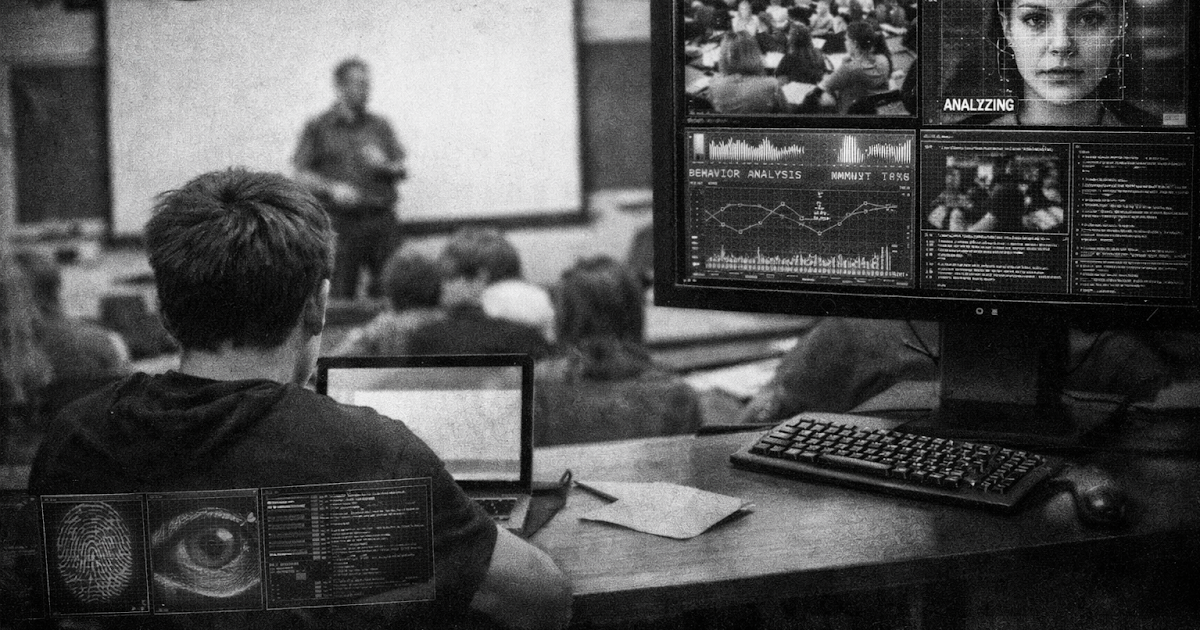
    Mass surveillance is no longer peripheral to higher education. It is central to how AI operates on campus. Predictive analytics flag students as “at risk” before they fail, often without transparency or consent. Proctoring software monitors faces, eye movements, living spaces, and biometric data. Engagement dashboards track clicks, keystrokes, time spent on screens, and behavioral patterns. These systems claim to support learning while normalizing constant observation.

    Students are increasingly treated as data subjects rather than citizens in a learning community. Faculty are pressured to comply with opaque systems they did not design and cannot audit. The data harvested through these platforms flows upward to administrators, vendors, private equity-backed education companies, and, in some cases, government and security-linked entities. Higher education becomes a testing ground for surveillance technologies later deployed across workplaces and society at large.

    At the top of the academic hierarchy, a small group of elite universities dominates global AI research. These institutions maintain close relationships with Big Tech firms, defense contractors, and venture capital interests. They shape not only innovation but ideology, presenting AI development as inevitable and benevolent while supplying talent and legitimacy to systems of automation, surveillance, and control. Ethics initiatives and AI principles proliferate even as accountability remains elusive.

    Cultural warnings about technological obsolescence no longer feel theoretical. Faculty are told to adapt or be replaced by automated systems. Students are told to compete with algorithms while being monitored by them. Administrators frame automation and surveillance as unavoidable. What is absent from these conversations is moral courage. Higher education rarely asks whether it should participate in building systems that render human judgment, privacy, and dignity increasingly expendable.

    Artificial intelligence does not have to dehumanize higher education, but resisting that outcome requires choices institutions have largely avoided. It requires valuing human labor over scalability, privacy over control, and education as a public good rather than a data pipeline. It requires democratic governance instead of technocratic management and surveillance by default.

    For years, the Higher Education Inquirer has examined artificial intelligence not as a neutral tool or a distant threat, but as a technology shaped by power, profit, and institutional priorities. The future of higher education is not being determined by machines alone. It is being determined by decisions made by university leaders, technology firms, and policymakers who choose surveillance and efficiency over humanity.

    The question is no longer whether AI will reshape higher education.

    The question is whether higher education will resist becoming a fully surveilled system that trains students to accept a monitored, automated, and diminished future.


    Sources

    Higher Education Inquirer, Robocolleges, Artificial Intelligence, and the Dehumanization of Higher Education


    Higher Education Inquirer, AI-Robot Capitalists Will Destroy the Human Economy (Randall Collins)


    Higher Education Inquirer, University of Phoenix: Training Folks for Robowork


    Higher Education Inquirer, “The Obsolete Man”: A Twilight Zone Warning for the Trump Era and the Age of AI


    Higher Education Inquirer, Stanford, Princeton, and MIT Among Top U.S. Universities Driving Global AI Research (Studocu)


    Higher Education Inquirer, Tech Titans, Ideologues, and the Future of American Higher Education — 2026 Update

    Source link

  • 10 Things To Know Before Going For NYSC

    10 Things To Know Before Going For NYSC

    After graduation what Next? NYSC. After Youth Service (NYSC) what next? You can start thinking of getting a good job, doing business, Masters Degree in Nigeria, or Going Abroad to further your Education… It is all left for you to decide.  This guide will strictly focus on your NYSC.

    Now, there are many things you still need to know as a fresh graduate. One of them is knowing how the National Youth Service Corps (NYSC) works and the common terms you will come across before and during service. Remember, it is what you have in your head that takes you ahead.

    1. NYSC Mobilization

    This is the first stage of the National Youth Service. As the name implies, all qualified graduates across all Schools in Nigeria are mobilized for service. A mobilization timetable is released by NYSC Officials to show various dates and their schedules.

    Content Of Mobilization Timetable

    An NYSC Mobilization Timetable Contain Dates for the following Activities:

    • Pre-Mobilisation Workshop.
    • Uploading of Senate Approved Results and Revalidation Lists
    • Submission of Senate/Academic Board Approved Results
    • Online Registration by Foreign and locally Trained Nigerian Graduates
    • Pre-Camp Physical Verification of Credentials of Foreign-Trained Graduates
    • Action by ICT Department
    • Notification and Printing of Call-up Letters by PCMs
    • Commencement of Orientation Course

    You can check how NYSC Mobilization Timetable looks here

    2. NYSC Senate List

    The Senate list is an official list of names and details of graduates who are eligible for NYSC from every institution in the country. This list will be prepared by your Institution and sent to the NYSC Board. The Senate list is uploaded Online so that you can check your name.

    How to Check NYSC Senate List:

    1. Go to NYSC Senate / Academic Board list portal
    2. Select your Institution.
    3. Supply your Matriculation Number and Surname in the required columns.
    4. Select your date of birth.
    5. Finally, click the ”SEARCH’ button to access your mobilization status.

    You may want to check the Latest NYSC Senate list here

    3. NYSC Registration

    From the name, you should already be able to guess what NYSC Registration is all about. Registration is the next step to take after confidently checking your name on the Senate List. The following are requirements for NYSC Registration:

    • Valid email account
    • Active phone number
    • Passport Photograph
    • Biometric Verification
    • And More (Link Below…)

    Recommended: How to do NYSC Online Registration

    4. NYSC Call-Up Letter

    After NYSC Registration, the next thing is the call-up letter. This is simply a letter that will show your state of deployment and other important information. If you have paid the N3,000, you will be able to print your call-up letter on your dashboard.

    You Will Spend Money

    Nothing is free… You will have to make payments. For example, during the NYSC registration, you will need to pay N3,000 to print the NYSC Call-up letter from your dashboard when it comes out.

    You have two options regarding printing your Call-up letter; You can either pay N3,000 and print it on your dashboard or don’t pay and go to your institution to collect it. In any which way, money must be spent.

    Recommended: 15 Ways to make money with your phone

    5. NYSC Orientation Camp

    I know you are already familiar with this. Right from your hundred level days, I’m sure you always get excited to see corpers in Camp. It is now your turn; how time flies.

    How long do corpers spend in orientation camp? You will spend three weeks at Camp doing a lot of programs. The orientation camp is always fun (if not the sweetest part of NYSC).

    6. Place Of Primary Assignment (PPA)

    On the last day of the Orientation camp, you will collect a letter that will specify the particular place where you will do your service. This is called the Place of Primary Assignment.

    Your place of assignment can be a secondary school, an industry, University and even government office. You can change your PPA if you are not satisfied with it.

    7. NYSC Allowee

    The is the biggest NYSC news right now. If you are serving this year 2023, you are in luck because Allowance has increased from #19,800 to #33,000. You will get a monthly payment of 33k starting from when you are in the orientation camp. The last payment will double (66k).

    You will open a new bank account and that is where the NYSC Allowee will be entering. It always comes about 2-3 days before the end of the month. Your allowance can come late some months.

    8. CDS Group

    CDS Stands for Community Development Service. The NYSC officials will split every Corps members into different CDS Group and they will be meeting once in a week.

    CDS is very important as you cannot do your clearance if you did not participate in your CDS group. This is where you brainstorm on how to do something important for the community where you serve.

    9. Clearance

    NYSC clearance exercise takes place every month end. If you miss a clearance, you will not collect your Allowee for that month and that is automatically an extension. The date for the clearance is always different and it depends on your Local Government schedule.

    10. NYSC Passing Out Parade

    This is the last ceremony of your Youth SERVICE Scheme. Remember, everything that has a beginning will surely have an end.

    No matter how you enjoy your place of assignment, you will end your NYSC after some months and face real life. Then no number seven (allowance) anymore. The passing out parade is always on a low key whereby you will go to your Local Government and collect your NYSC certificate.

    Hope you found this guide useful. Feel free to share with your friends using the share buttons below and don’t fail to let me know how you feel using the comment box.

    Source link

  • WEEKEND READING: LSST gave me a second chance: policy should protect, not penalise institutions like it

    WEEKEND READING: LSST gave me a second chance: policy should protect, not penalise institutions like it

    This blog was kindly authored by Ahmed Al-Athwari, PGCert Student and Academic Support Tutor employed at the London School of Science and Technology (LSST).

    My name is Ahmed Al-Athwari. I was born in Yemen and raised amid hardship, eventually graduating from Sana’a University with a degree in Oceanography and Environmental Science.

    My life changed dramatically in December 1999 when I was forced to flee Yemen. I found myself in a refugee camp in the Netherlands, starting from scratch in a new country, with a new culture and language. Rebuilding my life was not easy, but I succeeded, securing a job with the city council in Heerlen.

    In 2012, family reasons brought me to the UK, and once more, I had to adapt to a different culture and environment, starting over.

    While living in the Netherlands in 2006, I tried to enrol in an MSc programme. My application to the University was rejected due to limited experience in environmental issues and language requirements. I was advised to start with a BSc, but this application also failed because, at the time, the system didn’t allow students over 30 to access government loans. My dream of higher education, to fulfil the promise I made to myself and make my family in Yemen, and later my children, proud, never left me.

    After moving to the UK, I continued my quest. In 2013, I visited Birmingham City University and contacted several higher education providers to explore MSc opportunities in Environmental Sustainability Engineering. In 2016, I finally received an offer. However, at the first meeting, my application was rejected again, citing the long gap since I completed my BSc in Yemen. That was the moment I almost gave up, truly believing the obstacles were insurmountable. It was a moment of certainty that the train had truly passed, and any hope that I would get a second chance to correct the course of my life, which circumstances beyond my control had diverted, vanished.

    I still remember September 2019 vividly; I felt as if I were standing on a platform at dusk as the last train approached. My English was uncertain. I was an older student, grey-haired and full of doubt, wondering if it was too late to begin again.

    Then, the London School of Science and Technology (LSST) opened the door. What changed everything was the opportunity to study through a franchised programme: Buckinghamshire New University (BNU) offered its degree through a partnership, with BNU as the lead provider and LSST as the local delivery partner. Had recent proposals to restrict franchising been in place, that pathway might not have existed. This highlights why policy matters. Franchised provision is often portrayed as a risk; however, my experience suggests the opposite. When a university designs a rigorous curriculum and assures academic quality, and a dedicated local partner delivers responsive support, the model can widen participation and deliver strong outcomes.

    From the very first week, I felt seen. Study-skills sessions were strategic, showing me that progress is a process, not a miracle. I learned to draft summaries, write in focused bursts, and seek feedback early. By my second year, I could argue a point, speak without freezing, and write with purpose.

    Returning to education later in life is not the same as going straight from school to university. It means entering a classroom after years away, carrying not just books but a whole life, work, bills, family, and responsibilities that don’t pause for a 9am seminar. I studied on buses, revised in corridors, and wrote essays between school drop-offs. Some weeks were woven from early mornings and late nights, as sleep was traded for progress.

    Back in Yemen, the conflict that began in 1994 has only worsened. Family emergencies don’t wait for exam schedules. Calls come at difficult hours. News from home can drain your focus in an instant. In that context, studying is not just an academic pursuit; it is an act of hope.

    I chose LSST because it offered access with ambition. The message was clear: if you are willing to work, we are eager to help. I was not looking for easy; I was looking for possible.

    I was not seeking the prestige or amenities of a traditional campus. I needed a campus culture that understood mature students, commuters, and migrants, one that offered affordability, flexibility, and personalised support. Had regulation squeezed out providers like LSST, many students, especially those returning to education, would face far fewer choices.

    The support at LSST was practical and visible, comprising one-to-one academic advice, workshops on academic skills, access to librarians and digital resources, quiet study spaces, and well-being support when life outside the classroom became overwhelming. Encouragement was not sentimental; it was momentum. Gradually, the platform’s feeling faded. I was no longer chasing the train; I was on it.

    Through this route, I completed a BA (Hons) in Business Management with BNU via LSST, then progressed to an MSc in International Business Management at the University of West London. I am now completing a PGCert while preparing for my PhD. The habits I developed outlining, redrafting, critical reading, referencing did more than help me pass assignments; they sharpened my voice. The clarity that earned praise reflects a more profound truth: well-governed franchise partnerships can combine access with quality. The HEPI report “What Is Wrong with Franchise Provision?” explores perceived risks and argues for robust oversight, reporting, and governance to ensure these benefits are realised.

    In 2023 I won first prize for an essay on the Metaverse, which was praised by the Tony Blair Institute for Global Change and CNN for its clarity and narrative flow. The essay competition was organised by LSST.

    I often wonder what my journey would have looked like without LSST. Honestly, I might still be on that platform, promising myself “next term,” studying alone after long days, writing without a reader, working without a mentor. I would have continued caring and staying busy, but I missed the compound effect of structure, feedback, community, and belief. Franchised provision is not a loophole; it is a lifeline.

    Later, I became a Student Ambassador and then a Students’ Union Coordinator, roles that helped new cohorts feel they belonged and allowed me to work with staff to improve the student experience. As an Academic Support, I help students turn feedback into meaningful change.

    This pathway, from hesitant mature entrant to aspiring lecturer, was made possible by a policy environment that allowed universities to franchise degrees through trusted partners. Recent regulatory proposals risk painting those partnerships as inherently problematic. However, my experience suggests something different: the right approach is not to strangle the model, but to strengthen it, ensuring quality while maintaining open access.

    If you are coming from a non-traditional route, returning after years away, balancing work or caring responsibilities, or studying across borders, know this: you do not need a perfect start. You need the right place, steady habits, and people who will back you.

    Higher education policy should also consider this. If regulation makes it harder for providers like LSST to operate, the students who lose out will be those who most need a second chance. The focus should be on transparent quality assurance, risk-based oversight, and supportive partnerships between lead and delivery partners, not on discouraging the model altogether.

    Studying at LSST not only gave me degrees; it gave me resilience, confidence, and the belief that nothing is easy, but everything is possible. With the encouragement of my former professors, now my colleagues, I am currently preparing to submit a doctoral proposal.

    I began all this on a platform at dusk, afraid the last train would leave without me. It did not. I got on, learned the rhythm, and kept moving. Policy should keep that train running for others.

    Source link

  • Virginia Agrees to Scrap In-State Tuition for Undocumented Students

    Virginia Agrees to Scrap In-State Tuition for Undocumented Students

    Andrew Harnik/Getty Images News/Getty Images

    With just over two weeks left in office, Republican Virginia attorney general Jason Miyares agreed with the federal Justice Department that a 2020 law granting in-state tuition to undocumented students is unconstitutional.

    In a joint court filing, Miyares and lawyers for the Justice Department asked a federal judge to declare the Virginia Dream Act invalid and bar state authorities from enforcing it. If approved, the joint consent decree order would make Virginia the fourth state to scrap its policies that allow eligible undocumented students to pay the lower in-state tuition rate. The joint agreement came just one day after the Trump administration sued Virginia over its in-state tuition policies—the seventh such lawsuit.

    In response to these challenges, some states have fought the Justice Department, while several Republican-led states quickly agreed to stop offering undocumented students in-state tuition. The rapid change in policies spurred confusion and chaos for students as they scrambled to find ways to pay for their education. Some advocacy groups have sought to join the lawsuits to challenge the Justice Department.

    Miyares, who lost his re-election bid to Democrat Jay Jones in November, wrote on social media that it’s clear that the 2020 statute “is preempted by federal law.”

    “Illegal immigrants cannot be given benefits that are not available to American citizens,” he wrote. “Rewarding noncitizens with the privilege of in-state tuition is wrong and only further incentivizes illegal immigration. I have always said I will call balls and strikes, and I am proud to play a part in ending this unlawful program.”

    Trump lawyers argued in the Virginia lawsuit and elsewhere that such policies discriminate against U.S. citizens because out-of-state students aren’t eligible for in-state tuition. In Virginia, undocumented students can qualify for the reduced rate if they graduated from a state high school and if they or their parents filed Virginia income tax returns for at least two years before they enroll at a postsecondary institution.

    Jones, the incoming Democratic attorney general, criticized the administration’s lawsuit as “an attack on our students and a deliberate attempt to beat the clock to prevent a new administration from defending them.” He added that his team is reviewing their legal options.

    In the meantime, the Dream Project, a Virginia nonprofit that supports undocumented students, is seeking to intervene in the lawsuit and has asked the court to delay its consideration of the proposed order. An estimated 13,000 undocumented students were enrolled in Virginia colleges and universities in 2018, according to the filing.

    The Dream Project argued in its filing that it and the students it serves would be harmed if the Virginia Dream Act is overturned and that the court should hear a defense of the law.

    “The motion by the Trump administration was deliberately filed over a holiday in the dead of night without briefing, without public scrutiny, and without hearing from our scholars and families who would be impacted by this judgment,” Dream Project executive director Zuraya Tapia-Hadley said in a news release. “The state and federal administrations are attempting to re-legislate and set aside the will of the people. If we don’t intervene, that essentially opens the door for settled law to be thrown out with the wave of a pen via a judgment.”

    Carl Tobias, a law professor at the University of Richmond, said he’s hopeful that the judge, Robert Payne, will grant the motion for intervention, noting that he “is a stickler for proper procedures.”

    “There’s a basic premise that there should be two sides to every litigation, and there aren’t two sides in this litigation,” he said, adding that if the judge does approve the consent decree, the General Assembly could always put a law similar to the Virginia Dream Act back in place.

    To Tobias, the legislation is constitutional and should withstand a legal challenge.

    “This administration has a very different view of what the Constitution requires, so they can make their arguments,” he said. “But they shouldn’t be making them in a vacuum without hearing the other side.”

    Source link

  • What Student Loan Borrowers in the SAVE Plan Should Know for 2026

    What Student Loan Borrowers in the SAVE Plan Should Know for 2026

    Lender and Bonus disclosure

    THIS IS AN ADVERTISEMENT. YOU ARE NOT REQUIRED TO MAKE ANY PAYMENT OR TAKE ANY OTHER ACTION IN RESPONSE TO THIS OFFER.

    Earnest: $1,000 for $100K or more, $200 for $50K to $99.999.99. For Earnest, if you refinance $100,000 or more through this site, $500 of the $1,000 cash bonus is provided directly by Student Loan Planner. Rate range above includes optional 0.25% Auto Pay discount.

    Earnest Bonus Offer Disclosure:

    Terms and conditions apply. To qualify for this Earnest Bonus offer: 1) you must not currently be an Earnest client, or have received the bonus in the past, 2) you must submit a completed student loan refinancing application through the designated Student Loan Planner® link; 3) you must provide a valid email address and a valid checking account number during the application process; and 4) your loan must be fully disbursed.

    You will receive a $1,000 bonus if you refinance $100,000 or more, or a $200 bonus if you refinance an amount from $50,000 to $99,999.99. For the $1,000 Welcome Bonus offer, $500 will be paid directly by Student Loan Planner® via Giftly. Earnest will automatically transmit $500 to your checking account after the final disbursement. For the $200 Welcome Bonus offer, Earnest will automatically transmit the $200 bonus to your checking account after the final disbursement. There is a limit of one bonus per borrower. This offer is not valid for current Earnest clients who refinance their existing Earnest loans, clients who have previously received a bonus, or with any other bonus offers received from Earnest via this or any other channel. Bonus cannot be issued to residents in KY, MA, or MI.

    Student Loan Refinance Interest Rate Disclosure 

    Actual rate will vary based on your financial profile. Fixed annual percentage rates (APR) range from 3.97% APR to 10.24% APR (3.72% – 9.99% with .25% auto pay discount). Variable annual percentage rates (APR) range from 6.13% APR to 10.24% APR (5.88% – 9.99% with .25% auto pay discount). Earnest variable interest rate student loan refinance loans are based on a publicly available index, the 30-day Average Secured Overnight Financing Rate (SOFR) published by the Federal Reserve Bank of New York. The variable rate is based on the rate published on the 25th day, or the next business day, of the preceding calendar month, rounded to the nearest hundredth of a percent. The rate will not increase more than once a month, but there is no limit on the amount that the rate could increase at one time. Please note, we are not able to offer variable rate loans in AK, IL, MN, MS, NH, OH, TN, and TX. Our lowest rates are only available for our most credit qualified borrowers and requires selection of our shortest term offered and enrollment in our .25% auto pay discount from a checking or savings account. Enrolling in autopay is not required as a condition for approval.

    Auto Pay Discount Disclosure

    You can take advantage of the Auto Pay interest rate reduction by setting up and maintaining active and automatic ACH withdrawal of your loan payment. The interest rate reduction for Auto Pay will be available only while your loan is enrolled in Auto Pay. Interest rate incentives for utilizing Auto Pay may not be combined with certain private student loan repayment programs that also offer an interest rate reduction. For multi-party loans, only one party may enroll in Auto Pay.

    Skip a Payment Disclosure

    Earnest clients may skip one payment every 12 months. Your first request to skip a payment can be made once you’ve made at least 6 months of consecutive on-time payments, and your loan is in good standing. The interest accrued during the skipped month will result in an increase in your remaining minimum payment. The final payoff date on your loan will be extended by the length of the skipped payment periods. Please be aware that a skipped payment does count toward the forbearance limits. Please note that skipping a payment is not guaranteed and is at Earnest’s discretion. Your monthly payment and total loan cost may increase as a result of postponing your payment and extending your term.

    Student Loan Refinancing Loan Cost Examples

    These examples provide estimates based on payments beginning immediately upon loan disbursement. Variable APR: A $10,000 loan with a 20-year term (240 monthly payments of $72) and a 5.89% APR would result in a total estimated payment amount of $17,042.39. For a variable loan, after your starting rate is set, your rate will then vary with the market. Fixed APR: A $10,000 loan with a 20-year term (240 monthly payments of $72) and a 6.04% APR would result in a total estimated payment amount of $17,249.77. Your actual repayment terms may vary.Terms and Conditions apply. Visit https://www.earnest. com/terms-of-service, e-mail us at [email protected], or call 888-601-2801 for more information on our student loan refinance product.

    Student Loan Origination Loan Cost Examples

    These examples provide estimates based on the Deferred Repayment option, meaning you make no payments while enrolled in school and during the separation period of 9 billing periods thereafter. Variable APR: A $10,000 loan with a 15-year term (180 monthly payments of $157.12) and an 11.69% APR would result in a total estimated payment amount of $21,290.40. For a variable loan, after your starting rate is set, your rate will then vary with the market. Fixed APR: A $10,000 loan with a 15-year term (180 monthly payments of $173.51) and an 13.03% APR would result in a total estimated payment amount of $22,827.79. Your actual repayment terms may vary.

    Earnest Loans are made by Earnest Operations LLC or One American Bank, Member FDIC. Earnest Operations LLC, NMLS #1204917. 535 Mission St., Suite 1663, San Francisco, CA 94105. California Financing Law License 6054788. Visit earnest.com/licenses for a full list of licensed states. For California residents (Student Loan Refinance Only): Loans will be arranged or made pursuant to a California Financing Law License.

    One American Bank, 515 S. Minnesota Ave, Sioux Falls, SD 57104. Earnest loans are serviced by Earnest Operations LLC, 535 Mission St., Suite 1663 San Francisco, CA 94105, NMLS #1204917, with support from Higher Education Loan Authority of the State of Missouri (MOHELA) (NMLS# 1442770). One American Bank, FinWise Bank, and Earnest LLC and its subsidiaries, including Earnest Operations LLC, are not sponsored by agencies of the United States of America.

    © 2025 Earnest LLC. All rights reserved.

    Student Loan Planner® Bonus Disclosure:

    Upon disbursement of a qualifying loan, the borrower must notify Student Loan Planner® that a qualifying loan was refinanced through the site, as the lender does not share the names or contact information of borrowers. Borrowers must complete the Refinance Bonus Request form to claim a bonus offer. Student Loan Planner® will confirm loan eligibility and, upon confirmation of a qualifying refinance, will send via email a $500 e-gift card within 14 business days following the last day of the month in which the qualifying loan was confirmed eligible by Student Loan Planner®. If a borrower does not claim the Student Loan Planner® bonus within six months of the loan disbursement, the borrower forfeits their right to claim said bonus. The bonus amount will depend on the total loan amount disbursed. This offer is not valid for borrowers who have previously received a bonus from Student Loan Planner®.

    Source link