Blog

  • Scotland eyes new graduate visa for international students

    Scotland eyes new graduate visa for international students

    Speaking at an event in Glasgow this week, John Swinney blasted the UK’s “disastrous” decision to leave the European Union, but suggested a new migration route specifically for students who choose to study in Scotland.

    “Twenty years ago, the Scottish and UK governments worked together to launch a tailored migration route designed to enable international students to stay in Scotland after they graduated,” he said. “I see no reason why this cannot happen again.”

    Under the plans, designed to keep highly skilled graduates in the country, the Scottish Graduate Visa would be linked to a Scottish tax code and be issued on the understanding that recipients would live and work in Scotland. 

    But despite Swinney’s assurances that he was “ready to work with” Downing Street on making the proposal a reality, his idea already appears to have been rebuffed by the UK government.

    A government spokesperson quoted by The Evening Standard indicated that there were “no plans” for a new Scottish visa, citing the UK’s Graduate Route already in place that allows international students to stay in the country for up to two years after they graduate.

    In his speech, Swinney said a new Scottish Graduate Visa would benefit not only the country’s institutions but its economy after international students’ graduation, highlighting that this group contributes £4.75 billion a year.

    “In small but important ways, it would make our economy more robust, and our public services more sustainable. It would play a part in making our communities more prosperous,” he said.

    In small but important ways, it would make our economy more robust, and our public services more sustainable
    John Swinney, Scottish first minister

    Pointing out that Scotland’s projected population is expected to dip for the next two generations, Universities Scotland convener Paul Grice highlighted the benefits a Scottish Graduate Visa could bring the country and said he hoped the proposal would “progress in a meaningful way”.

    “It would be enormously helpful if a policy space could be created between governments to consider greater regional variation of migration within an overall UK framework,” he said.

    “Inward migration will be essential to Scotland’s future and there is a really positive opportunity for Scotland’s universities, as magnets for the attraction and retention of highly-skilled people, to help deliver this as a win-win for the sector and Scotland as a whole. There is a lot to like in this outline proposal.”

    Although it does not appear to welcome the idea of a Scottish Graduate Visa for the time being, the UK government seems to be embracing international students.

    This week, education secretary Bridget Phillipson recorded a video message to international students in the UK promoting the country’s post-graduation work opportunities.

    Source link

  • Report: Community Colleges Are Leaving Millions in Medicaid Funding on the Table Each Year

    Report: Community Colleges Are Leaving Millions in Medicaid Funding on the Table Each Year

    According to a newly released report, community colleges miss out on at least $115 million in available Medicaid funding each year. Only 3% of community colleges bill Medicaid for services, despite 84% of community colleges likely being eligible for Medicaid reimbursement. 

    The report, “Increasing Student Support and Success by Boosting Medicaid Engagement,” draws on data collected from a review of over 1,000 community colleges.

    “There is a missed opportunity right now where community colleges could be getting in a significant source of recurring funds that they are not currently claiming,” said Ryan Stewart, report co-lead and Founder and CEO of Mile 2 Consulting, LLC. “I want to raise awareness of that and try to build a culture where more community colleges take advantage.” 

    There are growing mental health concerns among college students and an increase in demand for all student health services among community college students. Unfortunately, the demand for student health services often exceeds a community college’s resources.

    Eligible health services include but are not limited to, psychological services, counseling, nursing services, physical therapy, Medicaid outreach and case management. According to Stewart, the call for community colleges to consider Medicaid reimbursements is more critical now than ever.

    “We’ve seen this growing need for particularly mental health resources at at the college level, and we’ve also seen that many colleges relied on COVID relief funding,” said Stewart. “Those funds are now expired, so you have a lot of schools right now who are looking for ways to sustainably replace those funds, and Medicaid could be a really important source.”

    Stewart previously served as the Secretary of Education for New Mexico and has inspired his thinking about how K-12 schools accessed student resources through Medicaid.

    “In that role we had done a lot of work with our Human Services department because they were really passionate about making sure K-12 schools knew about Medicaid and were doing all they could to claim all available funds,” he said. “Since I’ve left that role, I’ve done a lot of work to try to look at this from a national perspective.”

    Dr. Sara Goldrick-Rab, report co-lead and senior fellow at Education Northwest, brought a higher education perspective to the project.

    “For more than a decade I’ve documented the clear need for community colleges to offer basic needs and related health services,” said Goldrick-Rab, who is also a columnist for Diverse. “A growing number of administrators are trying to offer that help to students but struggle to afford the costs. My hope is that this report spurs action and increases funding available to support student success at community colleges.” 

    Stewart and Goldrick-Rab projected the amount of money that community colleges could potentially generate through Medicaid reimbursement claims, taking into account the health services currently offered at the school, an estimate of the number of students receiving each category of services, an estimate of the number of Medicaid-eligible students enrolled at the school and an estimate of the average reimbursement per student.

    According to the report, community colleges in the United States could collectively generate approximately $115 million in recurring reimbursement revenue from Medicaid.

    “Healthcare access is a critical component of student success and if students are experiencing either mental health or physical health crises and don’t have access to care, that can be a barrier to successful post-secondary completion,” said Stewart. “But that has to be funded. A lot of these services are not cheap, and for colleges who are looking for every resource to try to sustain their whole portfolio of programming, finding sustainable resources like [Medicaid] where money is already appropriate could really make a big difference if you’re looking to either sustain or expand health service programming.”

    When asked why they choose not to claim Medicaid reimbursements for eligible services, community college administrators listed several reasons, including the lack of capacity to manage the Medicaid billing process.

    “​​The primary barrier colleges face when accessing this funding is a lack of information about its existence and what’s required to obtain it. Ironically, that’s the same challenge students face when accessing other funding like financial aid and SNAP,” said Goldrick-Rab. “Of course, some colleges will still struggle to have sufficient staff to offer services in the first place, [because] you have to offer them in order to be reimbursed and deal with the billing.

    Goldrick-Rab said she and Stewart hope to offer technical assistance to teach colleges how to manage this process adequately.

    “I believe addresssing the informational barriers alone will close a lot of the gap. Imagine if even 50% of the colleges offering eligible health services got Medicaid reimbursement, compared to just 3%? That would be a major win,” she added.

    The report provides recommendations for community colleges, state Medicaid agencies, and the Center for Medicare and Medicaid Services. It urges community colleges to create partnerships with their state Medicaid agencies so that they can be informed about their eligibility and request the support needed to optimize health services and revenue potential.

    “Everyone is talking about the student mental health crisis, but until now, I haven’t seen many offering funding options,” said Goldrick-Rab. “We have to ensure community colleges have the resources needed to do this critical work.”

    Source link

  • Canadian study permit approvals fall far below cap targets

    Canadian study permit approvals fall far below cap targets

    Canadian study permit approvals are on track to fall by 45% in 2024, rather than the 35% planned reduction of last year’s controversial international student caps, new IRCC data analysed by ApplyBoard has revealed.  

    “The caps’ impact was significantly underestimated,” ApplyBoard founder Meti Basiri told The PIE News. “Rapidly introduced policy changes created confusion and had an immense impact on student sentiment and institutional operations.  

    “While aiming to manage student numbers, these changes failed to account for the perspectives of students, and their importance to Canada’s future economy and communities,” he continued.  

    The report reveals the far-reaching impact of Canada’s study permit caps, which were announced in January 2024 and followed by a tumultuous year of policy changes that expanded restrictions and set new rules for post-graduate work permit eligibility, among other changes.  

    For the first 10 months of 2024, Canada’s study permit approval rate hovered just above 50%, resulting in an estimated maximum of 280,000 approvals from K-12 to postgraduate levels. This represents the lowest number of approvals in a non-pandemic year since 2019. 

    Source: IRCC. Disclaimer: Data for 2021-Oct 2024 is sourced from IRCC. Full-year 2024 figures are estimates extrapolated from Jan-Oct 2024 and full-year 2021-2023 IRCC data. Projections may be subject to change based on changing conditions and source data.

    “Even from the early days of the caps, decreased student interest outpaced government estimates,” noted the report, with stakeholders highlighting the reputational damage to Canada as a study destination.  

    “Approvals for capped programs fell by 60%, but even cap-exempt programs declined by 27%. Major source countries like India, Nigeria, and Nepal saw over 50% declines, showing how policies have disrupted demand across all study levels,” said Basiri.  

    Following major PGWP and study permit changes announced by the IRCC in September 2024, four out of five international student counsellors surveyed by ApplyBoard agreed that Canada’s caps had made it a less desirable study destination. 

    Though stakeholders across Canada recognised the need to address fraud and student housing issues, many had urged the federal government to wait until the impact of the initial caps was clear before going ahead with seemingly endless policy changes.  

    At the CBIE conference in November 2024, immigration minister Marc Miller said he “profoundly disagreed” with the prevailing sector view that the caps and subsequent PGWP and permanent residency restrictions had been an “overcorrection”.

    Post-secondary programs, which were the primary focus of the 2024 caps, were hit hardest by the restrictions, with new international enrolments at colleges estimated to have dropped by 60% as a result of the policies.  

    While Canada’s largest source destinations saw major declines, the caps were not felt evenly across sending countries. Senegal, Guinea and Vietnam maintained year-over-year growth, signalling potential sources of diversity for Canada’s cap era.   

    The report also highlighted Ghana’s potential as a source destination, where approval ratings – though declining from last year – remain 175% higher than figures from 2022. 

    Rapidly introduced policy changes created confusion and had an immense impact on student sentiment

    Meti Basiri, ApplyBoard

    The significant drop in study permit approvals was felt across all provinces, but Ontario – which accounted for over half of all study permit approvals in 2023 – and Nova Scotia have seen the largest impact, falling by 55% and 54.5% respectively.

    Notably, the number of study permits processed by the IRCC dropped by a projected 35% in 2024, in line with the government’s targets, but approval rates have not kept pace.

    When setting last year’s targets, minister Miller only had the power to limit the number of applications processed by the IRCC, not the number of study permits that are approved.  

    The initial target of 360,000 approved study permits was based on an estimated approval rate of 60%, resulting in a 605,000 cap on the number of applications processed. 

    Following new policies such as the inclusion of postgraduate programs in the 2025 cap, Basiri said he anticipated that study permit approvals would remain below pre-cap levels.  

    “While overall student numbers may align with IRCC’s targets, the broader impact on institutional readiness and Canada’s reputation will be key areas to watch in 2025,” he added.  

    Source link

  • U.S. Department of Education’s Trump Appointees and America First Agenda

    U.S. Department of Education’s Trump Appointees and America First Agenda

    Rachel
    Oglesby most recently served as America First Policy Institute’s Chief
    State Action Officer & Director, Center for the American Worker. In
    this role, she worked to advance policies that promote worker freedom,
    create opportunities outside of a four-year college degree, and provide
    workers with the necessary skills to succeed in the modern economy, as
    well as leading all of AFPI’s state policy development and advocacy
    work. She previously worked as Chief of Policy and Deputy Chief of Staff
    for Governor Kristi Noem in South Dakota, overseeing the implementation
    of the Governor’s pro-freedom agenda across all policy areas and state
    government agencies. Oglesby holds a master’s degree in public policy
    from George Mason University and earned her bachelor’s degree in
    philosophy from Wake Forest University. 

    Jonathan Pidluzny – Deputy Chief of Staff for Policy and Programs 

    Jonathan
    Pidluzny most recently served as Director of the Higher Education
    Reform Initiative at the America First Policy Institute. Prior to that,
    he was Vice President of Academic Affairs at the American Council of
    Trustees and Alumni, where his work focused on academic freedom and
    general education. Jonathan began his career in higher education
    teaching political science at Morehead State University, where he was an
    associate professor, program coordinator, and faculty regent from
    2017-2019. He received his Ph.D from Boston College and holds a
    bachelor’s degree and master’s degree from the University of Alberta. 

    Chase Forrester – Deputy Chief of Staff for Operations 

    Virginia
    “Chase” Forrester most recently served as the Chief Events Officer at
    America First Policy Institute, where she oversaw the planning and
    execution of 80+ high-profile events annually for AFPI’s 22 policy
    centers, featuring former Cabinet Officials and other distinguished
    speakers. Chase previously served as Operations Manager on the
    Trump-Pence 2020 presidential campaign
    , where she spearheaded all event
    operations for the Vice President of the United States and the Second
    Family. Chase worked for the National Republican Senatorial Committee
    during the Senate run-off races in Georgia and as a fundraiser for
    Members of Congress. Chase graduated from Clemson University with a
    bachelor’s degree in political science and a double-minor in Spanish and
    legal studies.

    Steve Warzoha – White House Liaison

    Steve
    Warzoha joins the U.S. Department of Education after most recently
    serving on the Trump-Vance Transition Team. A native of Greenwich, CT,
    he is a former local legislator who served on the Education Committee
    and as Vice Chairman of both the Budget Overview and Transportation
    Committees. He is also an elected leader of the Greenwich Republican
    Town Committee. Steve has run and served in senior positions on numerous
    local, state, and federal campaigns. Steve comes from a family of
    educators and public servants and is a proud product of Greenwich Public
    Schools and an Eagle Scout. 

    Tom Wheeler – Principal Deputy General Counsel 

    Tom
    Wheeler’s prior federal service includes as the Acting Assistant
    Attorney General for Civil Rights at the U.S. Department of Justice, a
    Senior Advisor to the White House Federal Commission on School Safety,
    and as a Senior Advisor/Counsel to the Secretary of Education
    . He has
    also been asked to serve on many Boards and Commissions, including as
    Chair of the Hate Crimes Sub-Committee for the Federal Violent Crime
    Reduction Task Force, a member of the Department of Justice’s Regulatory
    Reform Task Force
    , and as an advisor to the White House Coronavirus
    Task Force
    , where he worked with the CDC and HHS to develop guidelines
    for the safe reopening of schools and guidelines for law enforcement and
    jails/prisons. Prior to rejoining the U.S. Department of Education, Tom
    was a partner at an AM-100 law firm, where he represented federal,
    state, and local public entities including educational institutions and
    law enforcement agencies in regulatory, administrative, trial, and
    appellate matters in local, state and federal venues. He is a frequent
    author and speaker in the areas of civil rights, free speech, and
    Constitutional issues, improving law enforcement, and school safety. 

    Craig Trainor – Deputy Assistant Secretary for Policy, Office for Civil Rights 

    Craig
    Trainor most recently served as Senior Special Counsel with the U.S.
    House of Representatives Committee on the Judiciary under Chairman Jim
    Jordan (R-OH)
    , where Mr. Trainor investigated and conducted oversight of
    the U.S. Department of Justice, including its Civil Rights Division,
    the FBI, the Biden-Harris White House, and the Intelligence Community
    for civil rights and liberties abuses. He also worked as primary counsel
    on the House Judiciary’s Subcommittee on the Constitution and Limited
    Government’s investigation into the suppression of free speech and
    antisemitic harassment on college and university campuses
    , resulting in
    the House passing the Antisemitism Awareness Act of 2023. Previously, he
    served as Senior Litigation Counsel with the America First Policy
    Institute
    under former Florida Attorney General Pam Bondi, Of Counsel
    with the Fairness Center, and had his own civil rights and criminal
    defense law practice in New York City for over a decade. Upon graduating
    from the Catholic University of America, Columbus School of Law, he
    clerked for Chief Judge Frederick J. Scullin, Jr., U.S. District Court
    for the Northern District of New York. Mr. Trainor is admitted to
    practice law in the state of New York, the U.S. District Court for the
    Southern and Eastern Districts of New York, and the U.S. Supreme Court. 

    Madi Biedermann – Deputy Assistant Secretary, Office of Communications and Outreach 

    Madi
    Biedermann is an experienced education policy and communications
    professional with experience spanning both federal and state government
    and policy advocacy organizations. She most recently worked as the Chief
    Operating Officer at P2 Public Affairs. Prior to that, she served as an
    Assistant Secretary of Education for Governor Glenn Youngkin and worked
    as a Special Assistant and Presidential Management Fellow at the Office
    of Management and Budget in the first Trump Administration.
    Madi
    received her bachelor’s degree and master of public administration from
    the University of Southern California. 

    Candice Jackson – Deputy General Counsel 

    Candice
    Jackson returns to the U.S. Department of Education to serve as Deputy
    General Counsel. Candice served in the first Trump Administration as
    Acting Assistant Secretary for Civil Rights, and Deputy General Counsel,
    from 2017-2021. For the last few years, Candice has practiced law in
    Washington State and California and consulted with groups and
    individuals challenging the harmful effects of the concept of “gender
    identity” in laws and policies in schools, employment, and public
    accommodations.
    Candice is mom to girl-boy twins Madelyn and Zachary,
    age 11. 

    Joshua Kleinfeld – Deputy General Counsel 

    Joshua
    Kleinfeld is the Allison & Dorothy Rouse Professor of Law and
    Director of the Boyden Gray Center for the Study of the Administrative
    State at George Mason University’s Scalia School of Law. He writes and
    teaches about constitutional law, criminal law, and statutory
    interpretation, focusing in all fields on whether democratic ideals are
    realized in governmental practice. As a scholar and public intellectual,
    he has published work in the Harvard, Stanford, and University of
    Chicago Law Reviews, among other venues. As a practicing lawyer, he has
    clerked on the D.C. Circuit, Fourth Circuit, and Supreme Court of
    Israel, represented major corporations accused of billion-dollar
    wrongdoing, and, on a pro bono basis, represented children accused of
    homicide. As an academic, he was a tenured full professor at
    Northwestern Law School before lateraling to Scalia Law School. He holds
    a J.D. in law from Yale Law School, a Ph.D. in philosophy from the
    Goethe University of Frankfurt, and a B.A. in philosophy from Yale
    College. 

    Hannah Ruth Earl – Director, Center for Faith-Based and Neighborhood Partnerships

    Hannah
    Ruth Earl is the former executive director of America’s Future, where
    she cultivated communities of freedom-minded young professionals and
    local leaders. She previously co-produced award-winning feature films as
    director of talent and creative development at the Moving Picture
    Institute. A native of Tennessee, she holds a master of arts in religion
    from Yale Divinity School.

    AFPI Reform Priorities

    AFPI’s higher education priorities are to:

     Related links:

    America First Policy Institute Team

    America First Policy Initiatives

    Source link

  • 200 years of Manchester Met

    200 years of Manchester Met

    The history of Manchester Met can be traced back to 1824 with the founding of the Manchester Mechanics Institution, established through private initiative and funds to teach artisans the basic principles of science by part-time study.

    Now, one of the most popular universities in the UK, Manchester Met has over 43,000 students and continues the legacy embedded in its proud history of transforming lives through the power of education and research.

    To mark the momentous milestone, the university had a year packed full of activities, which also served to highlight its areas of strengths:

    Driving Economic Growth: Advancing skills, knowledge, and digital technology to build inclusive and sustainable economic growth and innovation, shaped by industry 

    Transforming Health: Enabling people to start well, live well and age well with innovative research and transformative healthcare

    Championing Creative Excellence: Harnessing imagination to drive creativity, bringing architecture, art, design, fashion, media, and performance together

    Leading Sustainability: Driving innovative solutions for a greener and more sustainable future through advances in science and engineering, practice, and policy 

    Tackling Inequalities: Building cohesive communities and helping shape a more caring, just, and inclusive society: locally, nationally, and globally.

    Malcolm Press, vice-chancellor of Manchester Met commented: “By delivering on our areas of strength we continue to build a better future for all. Celebrating the 200th anniversary of Manchester Met has been a real highlight for me, especially in a year when we have achieved so much.  

    By delivering on our areas of strength we continue to build a better future for all.
    Malcolm Press, Manchester Met

    “We have continued to grow our research activity. In 2024, the University secured several large funding grants – marking a significant milestone in research grants and awards at the university. This is an indication of the quality and calibre of our research offer,” he said.
     
    “The university also celebrated achieving TEF Gold and an amazing set of results in the National Student Survey with improvements placing Manchester Met above sector for every theme. These results highlight the university’s unwavering commitment to ensuring a positive and enriching student experience.
     
    “2024 has been a year of progress, change and transformation. Education has a transformational effect on individuals and society. It is the key to growth, and the teaching, skills, and innovation that we provide will continue to deliver not just for the city of Manchester but to the whole country and internationally.”  
     
    A major part of this transformational year is the continued investment in campus. One of the many highlights of 2024 was the opening of Dalton building, home to the faculty of Science and Engineering and the most ambitious development project in the University’s history.

    The £115m development is set to be a global hub for innovation, research, and industry collaboration. Dalton positions the university as a leader in science and technology education. Its innovative laboratories, research hubs, and active learning environments, provide a vital space for delivering excellent education and research with impact.

    The opening of Dalton marked the culmination of a £400 million transformation of the campus over the last ten years. This has seen the opening of flagship buildings including the iconic School of Digital Arts (SODA) – a £35m investment to develop digital skills and drive innovation across all forms of creative content and the Institute of Sport – a world class facility championing everything that sport can do.

    Manchester Met’s School of Digital Arts (SODA) Photo: Manchester Met

    Historic buildings on campus have also been restored. The Ormond Building, built in 1881 is home to the University’s administrative hub and the Grade 2 Grosvenor West building in the School of Art received a £10 million upgrade.

    The transformation of the campus is aligned to the university’s sustainability goals, one of which is becoming a carbon free campus and supporting the city of Manchester to become carbon neutral by 2038. The university is serious about sustainability and is proud to be in the top 5 universities in the People and Planet league for more than a decade.

    Green spaces feature across campus, providing tranquility in the bustle of city life. The re-opening of All Saints Park has boosted biodiversity through the planting of new trees and wildflowers with wider improvement works contributing to creating a walkable, inclusive, and easy to navigate campus that encourages active travel through cycling, running, or walking.  

    The state-of-the-art facilities on campus are the enablers of excellent education, research with impact and make Manchester Met a great place to be for all students.
    For those students pursuing a vocational route, Manchester Met is a leading provider of degree apprenticeships and since 2019, more than 2,500 apprentices have graduated from the university. Manchester Met highlighted the significant impact of degree apprenticeships for individuals, employers, and the wider economy through the publication of its Force for Impact report 2024.

    2024 set the bar high and there is no doubt that 2025 will see the University continue to go from strength to strength. True to its progressive nature, the transformation is set to continue with plans for a new library given the green light. The visionary building will provide a modern and dynamic learning environment that places students and their learning at its core.

    This is a central part of the university’s strategy to deliver excellent education for its students, and research that delivers impact to the community and world.

    Source link

  • Frances Perkins, Secretary if Labor (Friday’s Labor Folklore)

    Frances Perkins, Secretary if Labor (Friday’s Labor Folklore)

    Sources from which I summarized, paraphrased or quoted directly:

    Wikipedia, “President Biden designates Frances Perkins homestead as new national monument,” press release, 12/16/2022; Executive Order 14121, Section 3a report, Dec. 2024; Hall of Secretaries, U. S. Dept. of Labor.

    Source link

  • Engineering College Management Software: Features

    Engineering College Management Software: Features

    Engineering college management software is an essential tool that automates the higher education sector from admission to graduation and beyond. It helps institutions achieve their mission and goals, increase student enrollment, and streamline college administration. For engineering colleges and higher education institutions, this software provides a comprehensive suite of features across web and mobile platforms, enabling them to manage records, enhance the student learning experience, improve operational efficiency, and reduce costs.

    The program is customizable, scalable, and versatile. It provides accurate administrative and academic information to college leadership, improving decision-making. Administrative, professor, and student communication is improved by this program, improving efficiency and effectiveness.


    Why Choose Engineering College Management Software?

    Managing admissions, academic progress, and finances are just a few of the many hats an engineering college administrator must wear. By providing a unified, user-friendly platform, Engineering College Management Software streamlines operations, increases productivity, and keeps campuses one step ahead of the competition. This allows institutions to concentrate on what’s important—providing a high-quality education and boosting student success—by automating laborious operations and providing real-time insights.


    Why Is It Game-Changing? Benefits of Engineering College Management Software


    • Reduces Difficulty: From enrolling students to keeping tabs on their classes, you may do it all from a central location.
    • Access Data Effortlessly: Make better decisions and respond faster with access to real-time analytics.
    • Efficient Communication: Facilitate the easy connection of staff, students, and professors to encourage collaboration.
    • Preparing for the Future: It is designed to be easily expanded to accommodate your growing institution.
    • Saves Money and Time: Reduces human effort and administrative burdens by automating routine tasks.
    • Tracking progress and offering timely interventions can greatly enhance student support, leading to better outcomes.

    The engineering college management software isn’t just software—it’s a smarter way to run your campus.


    Key Features of Engineering College Management Software

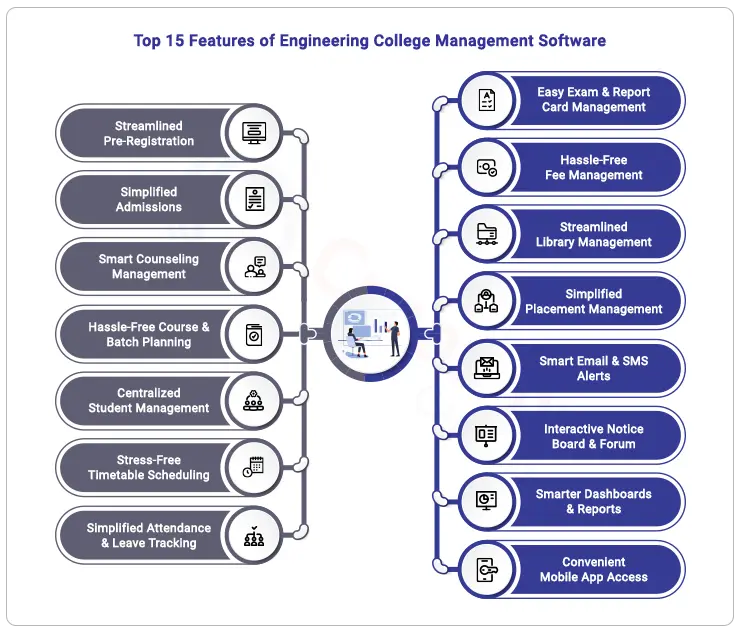
    The strong features of Engineering College Management Software simplify operations, improve student experience, and improve engineering institution decision-making. These characteristics, from pre-registration to placements, help engineering colleges compete in a competitive academic environment. See it closer:


    top-15-features-of-engineering-college-management-software


    1. Streamlined Pre-Registration Process

    • Use simple web forms to manage inquiries and registrations.
    • Gather students’ personal, contact, and course information.
    • Receive real-time status updates and automatic follow-up reminders.
    • Use dashboards and reports to keep track of inquiries and encourage student enrollment.


    2. Simplifying Admissions, One Click at a Time

    • Let students apply online and breeze through the admissions process.
    • Break it down: Create multiple phases for a clear, step-by-step journey.
    • Use entrance tests and ratings to admit the best-fit students effortlessly.
    • Offer flexible, personalized tuition payment options.
    • Keep everyone in the loop with instant email, SMS, and push notifications.
    • Say goodbye to manual work—generate admission forms, letters, and templates in a snap.


    3. Streamlined Counseling, Smarter Decisions

    • Automatically assign requests to counselors for faster, smoother processing.
    • Dive deep into admission standards and rules to guide applicants better.
    • Set clear fee discount policies for specific student groups.
    • Simplify seat allocation for government and management quotas with ease.


    4. Hassle-Free Course & Batch Planning

    • Easily set up lesson plans and manage courses across batches without the stress.
    • Create class schedules that actually work—no conflicts, no headaches.
    • Keep tabs on course progress and student performance in real-time, effortlessly.


    5. All-in-One Student Management Hub

    • Centralize student demographics and enrollment details in one place.
    • Automate emails and notifications to keep everyone informed.
    • Schedule personalized meetings and check-ins to support student success.
    • Monitor progress and learning outcomes to foster academic growth.


    6. Stress-Free Timetable Scheduling

    • Auto-generate timetables that work like magic—no conflicts, no chaos.
    • Juggle faculty and classroom availability with ease.
    • Get a clear picture of faculty workloads across programs and subjects.
    • Create classroom-specific timetables without breaking a sweat.


    7. Simplified Attendance & Leave Tracking

    • Track attendance for students and staff on the go—web or mobile, your choice.
    • Use RFID or biometric systems for attendance that’s automatic and hassle-free.
    • Generate detailed attendance and leave reports in seconds.
    • Streamline leave applications and approvals without manual back-and-forth.


    8. Exams & Report Cards Made Easy

    • Run online exams and assessments without the usual stress.
    • Let the system do the math—automate mark calculations with predefined weightages.
    • Create professional marksheets and report cards with built-in approval steps.
    • Manage result announcements for students and parents with zero fuss.


    9. Hassle-Free Fee Management

    • Choose from multiple invoicing options for tuition and other charges.
    • Automate recurring invoices to simplify scheduled payments.
    • Collect fees effortlessly with integrated online payment gateways.
    • Send students automated fee reminders so no deadlines are missed.


    10. Streamlined Library Management

    • Search the catalog like a pro with advanced search and barcode/QR integration.
    • Reserve and renew books on the go using a mobile app.
    • Automate issuing, returns, renewals, and fines with smart rules.
    • Get all the library stats you need with detailed reports and dashboards.


    11. Placement Made Simple

    • Plan placements with ease—set criteria, schedule assessments, and more.
    • Keep students updated with placement trends and training notifications.
    • Organize tests, interviews, and group discussions without the hassle.


    12. Smart Alerts via Email & SMS

    • Set up automated email and SMS alerts in just a few clicks.
    • Schedule reminders and updates to go out like clockwork.
    • Use an internal mailbox to keep communication streamlined and organized


    13. Interactive Online Notice Board & Forum

    • Schedule and share event updates and important announcements effortlessly.
    • Spark instant discussions and engage students and faculty in lively forums.
    • Post images, collect feedback, and keep the conversation flowing with comments.


    14. Smarter Dashboards, Sharper Insights

    • Dive into everything you need with one-click reports and dashboards.
    • Keep an eye on attendance, leaves, exams, fees, and more—all from one spot.
    • Stay on top of your finances with clear, detailed income and expense reports.


    15. Convenient Mobile App Access

    • Keep everything at your fingertips—access data on the go.
    • Mark attendance, approve leave, and manage student information anytime.
    • Create assessments, check grades, and send instant notifications with ease.


    Ready to Revolutionize Your Engineering Campus?

    Ready to take your engineering college to the next level? Creatrix Campus is the ultimate cloud-based education management system for managing everything from admissions to campus operations, designed with your unique needs in mind. Whether it’s simplifying administrative tasks, enhancing student engagement, or keeping faculty workloads in check, we’ve got it all covered. With real-time data, seamless integrations, and an intuitive interface, your institution will be equipped to tackle the challenges of today and embrace the opportunities of tomorrow.

    So, why wait? Let’s talk about how Creatrix Campus can streamline your operations and drive your institution’s success, all while giving you the flexibility and control you need to thrive. Your engineering campus deserves the best—let’s make it happen!

    Source link

  • Can we manage disasters that are no longer anomalies?

    Can we manage disasters that are no longer anomalies?

    In July 2024, the state of Kerala in southern India was struck by a massive landslide that devastated several villages, including Punchirimattam, Chooralmala and Mundakkai. The impact was catastrophic: nearly 300 people died and hundreds more injured. 

    This tragedy, triggered by unprecedented rainfall during the monsoon season, drew attention to a stark and growing concern: India’s ability to manage and mitigate the increasing frequency of natural disasters effectively. 

    Over the past few years, India has witnessed an alarming rise in the intensity and frequency of natural disasters, be it floods, heatwaves, cyclones or landslides. 

    This surge is being driven by the changing climate. With global warming altering weather patterns, India finds itself vulnerable to an array of disasters that threaten its people, infrastructure and economy. In response, there are calls for legislative reform, particularly an overhaul of the Disaster Management Act of 2005, so that the country will be better prepared to respond to natural disasters. 

    India’s experience can serve as a lesson for other nations in the region and globally. 

    Breathtaking landscapes become landslides.

    Kerala, located in southwest India on the Malabar Coast, is renowned for its lush landscapes, tranquil backwaters and tea plantations. The state is no stranger to monsoon rains, but in July 2024 it faced a sudden, violent landslide that wreaked havoc in the hilly region of Wayanad. 

    These areas, often prone to landslides, were overwhelmed by incessant rainfall, which led to soil erosion and a massive collapse of hillsides. 

    The villages of Punchirimattam, Chooralmala and Mundakkai were hit the hardest, with homes and buildings buried under tons of mud. Most residents were asleep when the disaster struck before dawn, leaving little time for evacuation. The landslides not only caused a tremendous loss of life but also rendered thousands homeless, further deepening the crisis. 

    In the aftermath, rescue operations were launched swiftly by the National Disaster Management Authority (NDMA), the Indian Army and the Air Force, along with local government authorities and communities. 

    Ramakrishnan, a tea estate employee in Mundakkayam, said that emergency relief included immediate financial assistance of Rs. 3,000 per individual. To put that into context 3,000 rupees is about U.S. $35 and the average person in Kerala earns the equivalent of about U.S $23,000 per year. They also received food and medical supplies. 

    Helping people after a disaster

    Affected families were relocated to temporary shelters, and school-going children were enrolled in nearby schools to continue their education. The National Disaster Response Force and state disaster funds provided crucial support for these efforts. 

    Yet, despite these swift actions, the Kerala government’s request for additional federal support, under the provisions of the Disaster Management Act, was delayed. 

    By October 2024, the High Court of Kerala had raised concerns about the delay in the disbursement of relief funds. This incident highlights some of the systemic flaws in India’s current disaster management framework — flaws that have become increasingly apparent as natural disasters grow in scale and frequency. 

    While the Wayanad landslide is one of the deadliest in recent memory, it is far from an isolated event. Over the last few years, India has experienced a disturbing rise in natural disasters, exacerbated by climate change. 

    In 2020, according to the United Nations Disaster Risk Reduction’s Prevention Web, the northeastern state of Assam faced catastrophic flooding that affected over five million people, leaving much of the region submerged. Back in 2018, the Indian Express newspaper reported that dust storms in Rajasthan not only caused widespread destruction but also revealed significant gaps in the country’s disaster management infrastructure, such as the lack of effective early warning systems and inadequate public awareness campaigns.

    Similarly, heatwaves, which have always been a concern in India, are becoming more extreme and frequent, leading to an increase in deaths and health crises.

    Inequity in disaster management

    Some weather events seem to get more attention than others, said Prathiksha Ullal, an advocate whose interests lie primarily at the intersection of environmental law and feminist perspectives. 

    “Despite heat waves being a major concern, they receive little attention, whereas cold waves are highlighted in discussions in the Lok Sabha [lower house of India’s Parliament],” Ullal said. 

    These disasters, which are often compounded by inadequate infrastructure and preparation, point to the urgent need for a restructured disaster management framework that can adapt to the growing threats posed by climate change. 

    The Disaster Management Act of 2005 was enacted to provide a comprehensive framework for disaster preparedness, response and recovery In response to India’s vulnerability to natural disasters. The act established the NDMA to coordinate disaster management efforts at the national level, as well as State Disaster Management Authorities (SDMAs) to manage disasters within individual states.

    The 2005 Act was an important step forward, but under it, there is confusion over the roles of national, state and local authorities in response to disasters; it doesn’t allocate enough money for disaster preparedness or response; and it doesn’t address climate-induced disasters such as heatwaves, droughts and extreme rainfall events. 

    This has made the framework less relevant in an era where climate change is increasingly contributing to the frequency and severity of disasters.

    Improving how a government responds to disasters

    Recognizing the shortcomings of the 2005 Act, the Indian government has proposed amendments to strengthen the country’s disaster management framework. The Disaster Management (Amendment) Bill of 2024 seeks to address many of these issues and build a more robust system to tackle the growing threat of natural disasters. 

    One of the central features of the bill is the strengthening and increased funding of the NDMA and the establishment of state disaster response forces. 

    The amendment aims to improve response times and coordination during disasters by providing state governments with more autonomy and resources. The bill also emphasizes disaster risk reduction, which focuses on preventing and mitigating the impact of disasters before they occur. This is a shift away from the previous focus solely on response and recovery. 

    Critics argue that the bill still centralizes too much power in the hands of the central government, limiting the autonomy of local authorities. Additionally, the bill’s failure to explicitly include climate-induced disasters, such as heatwaves and droughts, means that it may not fully address the risks posed by climate change. 

    India’s vulnerability to natural disasters is closely linked to the impacts of climate change. Rising temperatures, unpredictable monsoons and increased frequency of extreme weather events are all exacerbating the country’s disaster risk.

    State-specific disasters

    The 2024 Amendment Bill does begin to address climate change by incorporating disaster risk reduction as a key component, but it does not go far enough. For instance, heatwaves — which have become a major concern in India — are not adequately covered. 

    The DT Next newspaper reported that the South Indian state of Tamil Nadu has taken the initiative to declare heatwaves a state-specific disaster, enabling them to provide relief and take preventive measures. However, this is a localized response, and a more comprehensive national approach is needed. 

    The bill also does not fully address the role of technology in disaster management. Experts suggest that incorporating artificial intelligence and real-time data monitoring systems could significantly improve India’s ability to predict, track and respond to disasters. According to the AI company Ultralytics, AI models can be trained to provide early warning systems and help reduce the impacts of natural disasters.

    For example, predictive modeling and vulnerability mapping could help authorities better prepare for floods, landslides or heatwaves by identifying high-risk areas and populations. 

    India’s disaster management struggles are not unique. Bangladesh, Nepal, the Philippines and other countries in the region face similar challenges, with frequent floods, cyclones and landslides causing significant loss of life and economic damage. 

    India’s evolving approach to disaster management, particularly through the Amendment Bill, could serve as a model for these countries, helping them build more resilient systems for managing climate-related disasters. 

    The tragic landslide in Wayanad serves as a poignant reminder of the increasing vulnerability of India’s communities to natural disasters. While immediate relief efforts were swift and commendable, they also underscored the need for deeper, systemic changes in how India manages its disaster response. 

    In the face of escalating natural disasters, India has the opportunity to lead the way in developing disaster management policies that are not only reactive but proactive. 


    Questions to consider:

    1. What can cause a landslide in parts of India?
    2. What was wrong with the Disaster Management Act of 2005?
    3. What are some dangers climate change poses in your area?



    Source link

  • Perspectives on pedagogical innovation | SRHE Blog

    Perspectives on pedagogical innovation | SRHE Blog

    by Kamilya Suleymenova and Emma Thirkell

    The landscape of higher education (HE) in the UK (but also more widely, in Western countries and across the globe) has significantly changed, driven by the massification and the following marketisation of HE studies (Alves & Tomlinson, 2021; Molesworth et al, 2009). The predominance of particular governance structures and schools of thought shape the narrative further (as discussed by Marcia Devlin (2021) in her SRHE blog) and create a deceptively heterogeneous environment, where each prospective student can find their “place”, but all are conditioned to follow a similar narrative.

    New disruptions

    On this backdrop new disruptions appear, of which we want to focus on two specifically for the UK HE. First, the legacy of lockdowns, bringing more flexible working environment and an astonishing pervasiveness of digital tools together with disrupted earlier education and legacy of health, including mental health, concerns, unsettles further already brittle UK HE sector (as illustrated by SRHE blog by Steven Jones (2022). Second, the advent of Generative AI and its implications for teaching, learning, and assessment. Much has been said about these (Lee et al, 2024; O’Dea, 2024) – our learning points from this rapidly growing literature are that i) significant disruption has occurred and ii) something needs to be done to react to this change in context. In other words, while there are many tried and tested theories and methods in teaching and assessment, they need to be reviewed and very likely adapted to keep up with the changing context.

    The change did not occur only in the tools: we argue here that it is not merely a quantitative technical change (eg speed of communication), but a qualitative change, which affected or at least has the potential to affect, the mindset and the behaviour of students (and staff). Together, these factors produce more stressed, more demanding, potentially differently engaged students (sometimes perceived as less engaged), focused on the “added value” of their degrees and their “university experience”, anxious to acquire competences and skills through experiential learning to be in the best position for securing the employment of their choice.

    In this rapidly changing context, the need for pedagogical innovations (PI), or at least the desire and the ability to engage with disruptions in the education process, seems almost inevitable. But how do the staff working in the UK HE, respond to this demand? Are the challenges viewed as opportunities or rather as additional pressures, adding to an evolving workload and requirements to navigate a complex bureaucracy?

    Research focus: understanding the lived experiences of educators

    Our research explores the lived experiences of educators across 13 UK universities, investigating their engagement with PI in the aftermath of the COVID-19 pandemic. By examining how institutional dynamics, personal motivations, and perceived barriers shape decisions surrounding PI, we have developed the initial stages of a conceptual framework, presented at the SRHE International Conference, to guide policies that better support educators and foster sustained PI in teaching. Through 30 interviews with educators, senior staff, and technology-enabled learning (TEL) specialists, we reveal the complex decision-making processes that influence whether and how educators embrace or resist innovation in their teaching practices.

    What drives educators to innovate?

    Our research highlights a multifaceted landscape where educators’ motivations for engaging with PI are shaped by both intrinsic and extrinsic factors. For many, intrinsic motivations, such as a deep-rooted desire to enhance student learning and a personal commitment to pedagogical excellence, act as powerful drivers for innovation. As one educator noted, “I’m always looking for new ideas. Innovation gives me a sense of purpose and connection with my students, making teaching more fulfilling.” This indicates that where academics feel a strong personal commitment to education, and it is rewarded, they are more likely to embrace innovative practices.

    The tension between rhetoric and reality

    However, these motivations are often counterbalanced by extrinsic pressures from the institutional environment, whether perceived or real. Many educators reported feeling that institutional strategies, while rhetorically supportive of PI, were undercut by bureaucratic barriers, a lack of adequate resources, and managerial cultures focused on short-term, measurable outcomes. One academic explained, “Innovation is a buzzword here, but when it comes to implementing anything new, we’re stuck in a system that values research output over teaching innovation. There’s little incentive to invest time in something that doesn’t directly contribute to my publication record.” This highlights the tension between institutional narrative and individual motivations, with many educators perceiving a disconnect between institutional rhetoric purporting to encourage PI and the reality of its implementation.

    Autonomy and trust

    Another key finding concerns the role of autonomy and trust in fostering a culture of innovation. Educators who felt empowered within their departments – where trust was placed in their judgment – were more likely to experiment with new teaching methods. As one TEL specialist remarked, “When leadership trusts us, we feel freer to try new approaches. But when we are micromanaged, the innovation just stops. You’re constantly battling to prove that your idea is worth the time it takes.” This sense of autonomy, closely linked to professional identity, is crucial in determining whether educators feel motivated to innovate or revert to traditional methods.

    The cost of innovation

    However, these ‘empowering’ environments were not universally experienced. Many educators, particularly those in large departments or with heavy teaching loads, reported feeling that the cost of innovation – both in terms of time and energy – was too high. “It’s hard to innovate when you’re overwhelmed with marking, preparation, and administration. It feels like there’s no room to breathe, let alone experiment,” shared an academic. This sense of burnout, compounded by a perception of growing academic bureaucracy, led some to feel that the costs of engaging in PI outweighed the benefits, making it more difficult to justify the time and effort required for innovation.

    A balancing act

    Perhaps not surprisingly, some educators justified their lack of engagement with PI by citing these perceived institutional constraints. As one educator put it, “We’re told to innovate, but the structure just isn’t there to support it. It’s easier to stick with what we know works than to risk failure with something new.” This reflects the cognitive flexibility educators employ when balancing personal motivations with institutional limitations. As per Goffman’s (1959) ‘front’ and ‘back’ stage theory, educators sometimes present a compliant, innovative persona on the ‘front’ stage in order to ‘fit in’ (Nästesjö, 2023), while in the ‘back’ stage, they rationalize their lack of engagement by attributing it to costs and benefits, reconciling their professional image with their lived experiences.

    Reflections

    We are certain that some, if not all, of these quotes will resonate with many of the readers: these trends have been discussed in, for example, Lašáková et al (2017) and Findlow (2008). Our aim is not only to systematise and categorise the individual aspects shared with us by both frustrated and aspiring colleagues, but to focus on an in-depth analysis of their motivations. Based on previous literature and our data, we aim to generalise and develop a theoretical framework through the lens of an interdisciplinary management and economics analysis. The preliminary version of this theoretical framework, presented at the 2024 SRHE Conference, should provide a foundation for shaping institutional policies to develop a sustainable pipeline of innovations, in the full respect of both academic freedom and students’ interests. In other words, we hope that our work will facilitate structural changes to unlock the innovation potential and help institutions to help us to innovate.

    Kamilya Suleymenova is Associate Professor at the Department of Economics, Birmingham Business School, University of Birmingham with interests in assessment and feedback particularly for large cohorts, Generative AI in HE, as well as institutional and behavioural and experimental economics. Now twice a presenter at SRHE International Conference, Kamilya appreciates the constructive feedback of the community.

    Emma Thirkell is an Assistant Professor in Human Resource Management at Newcastle Business School, Northumbria University with interests in pedagogical innovation, experiential learning, and the integration of technology in education. A four-time teaching award winner, she is passionate about bridging academia and practice through innovative curriculum design and leadership in higher education.

    Author: SRHE News Blog

    An international learned society, concerned with supporting research and researchers into Higher Education

    Source link