Blog

  • Transform Your Classroom with Google Workspace AI Tools

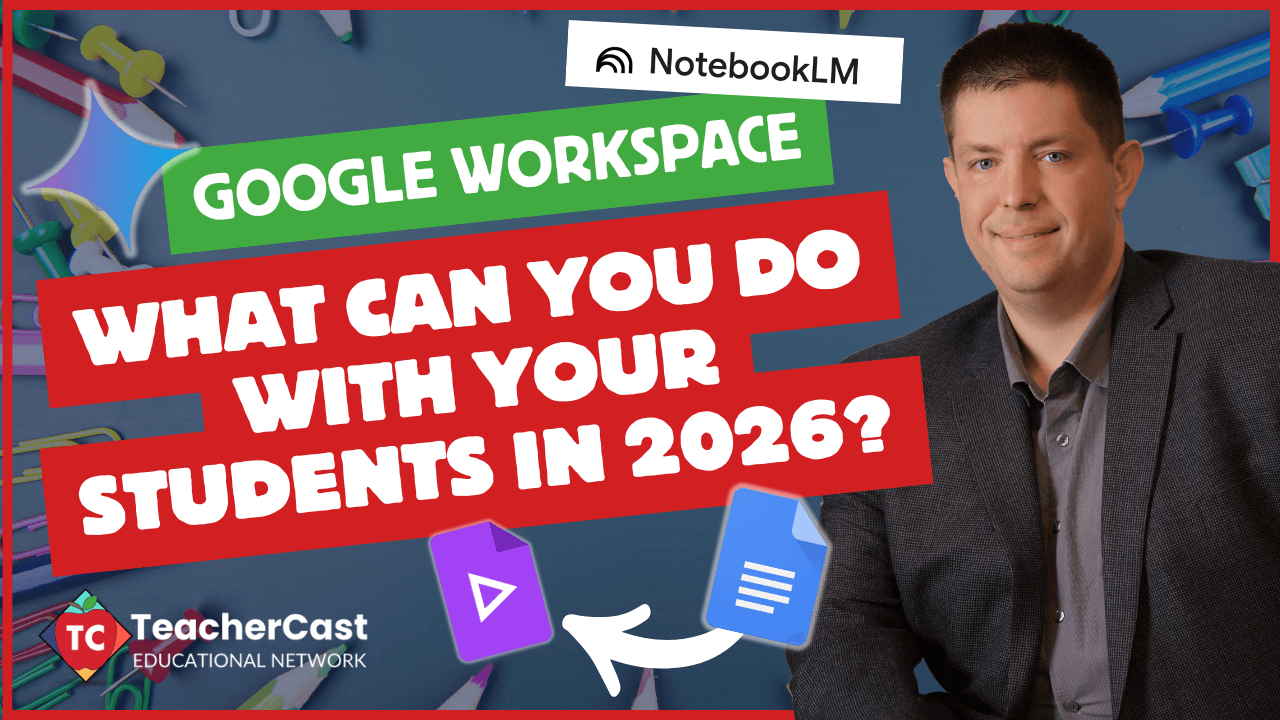
    Transform Your Classroom with Google Workspace AI Tools

    The 2025-2026 school year brought a wave of powerful AI-enhanced tools to Google Workspace for Education. These aren”t just shiny new features—they’re practical classroom tools designed to save you time, personalize learning, and unlock student creativity. Best of all? Most are free for educators and students. Now that 2026 is upon us, I am excited to share with you some of my favorite new features that can be used in your classroom with your students. If you are already using these, I’d love to hear from you and learn how you are exploring AI and Google Workspace in your classrooms.

    Let’s walk through the standout Google features you should try with your students this year.

    Google Gemini for Education: Your AI Teaching Assistant

    Google Gemini isn’t just another chatbot. It’s an AI assistant built directly into the Google apps you already use—Docs, Slides, Sheets, Gmail, and Classroom. No more copying and pasting between tabs.

    • Why it matters: Gemini 2.5 Pro incorporates LearnLM, making it the world’s leading model for learning. It’s purpose-built for education with enterprise-grade data protection. Your data isn’t reviewed or used to train AI models.
    • Try this on Monday: Ask Gemini to “Create a lesson plan on photosynthesis aligned to NGSS standards” or “Generate a 25-question multiple choice practice exam from this syllabus.”

    Key Features for K-12 Classrooms:

    Deep Research — Students can research complex topics and receive synthesized reports with sources and citations in minutes. Instead of spending hours searching, they get a comprehensive report they can then explore further.

    Gemini Canvas — Create quizzes, practice tests, study guides, and visual timelines in one interactive space. Go from blank slate to dynamic preview in minutes. Students can build interactive prototypes and code snippets without knowing how to code.

    Gemini Live — Students can talk through complex concepts, get real-time help, and even share their screen or camera for personalized feedback on problem sets.

    What Are Google Gems?

    Think of a Gem as a specialized AI assistant you create for a specific purpose. Instead of writing the same prompt over and over in Gemini, you build a Gem once with custom instructions, and it becomes your go-to expert for that task.

    The difference: Regular Gemini is a generalist. A Gem is a specialist.

    For example, instead of typing “Create a Jeopardy game about the water cycle for 5th grade” every time you need a review game, you create a “Jeopardy Game” Gem that already knows your grade level, subject area, and preferred format. Then you just give it the topic.

    Creating Custom Gems: Build Your Own AI Experts

    Once you’re comfortable with Gemini, Google Gems let you create custom AI assistants tailored to your classroom needs.

    How it works: Give Gemini instructions, examples, and resources so it behaves exactly how you need it to. Upload unit plans, pacing guides, rubrics, or anchor texts so your Gem can reference them when creating content.

    Teacher-facing Gems:

    • Lesson Plan Generator — Aligned to your specific standards and teaching style
    • Parent Communicator — Drafts emails that match your tone and school policies
    • Emergency Sub Plan — Creates ready-to-go activities when you’re out sick
    • Standards Unpacker — Breaks down complex standards into teachable chunks

    Student-facing Gems: Create a Gem and share it with your class through Google Classroom. Students interact with your custom AI expert independently.

    • AI Tutor — Provides step-by-step help without giving away answers
    • Writing Coach — Gives feedback on essays and helps students revise
    • Study Partner — Creates practice questions from their notes
    • Career Explorer — Helps students research potential career paths

    EduGems: Pre-Made Gems by Eric Curts

    Don’t want to build Gems from scratch? Eric Curts (Control Alt Achieve) created EduGems—a growing library of ready-to-use Gems organized by category.

    How to use EduGems:

    1. Visit edugems.ai
    2. Browse by category or search for what you need
    3. Click any Gem to see details
    4. Click “Use” to open it in Gemini, or “Copy” to customize it
    • 🧑‍🏫 AI Tutor — Guides students through problems with questions, not answers. Great for homework help and independent practice.
    • 🎭 Reader’s Theater — Converts stories or historical events into scripts students can perform. Brings content to life through drama.
    • ❓ Jeopardy Game — Creates Jeopardy-style review games on any topic. Perfect for test prep and engagement.
    • 🤔 Student Brainstorming — Helps students generate and organize ideas for projects and writing assignments.
    • 💼 Career Explorer — Students explore career paths, learn about required education, and discover related occupations.
    • 📋 Lesson Plan — Generates complete lesson plans with objectives, activities, and assessments.
    • 📦 Standards Unpacker — Takes complex standards and breaks them into clear learning targets.
    • 🚨 Emergency Sub Plan — Creates complete sub plans with activities, materials, and instructions.
    • 🔀 Re-level Text — Adjusts reading level of any text for differentiation.
    • 📊 Assessment Data Analyzer — Analyzes assessment results and suggests targeted interventions.

    EduGems Categories:

    • Curriculum & Lesson Design (13 Gems) — Lesson plans, unit plans, choice boards, station rotations
    • Student Activities (11 Gems) — Games, simulations, debates, interviews
    • Assessment (15 Gems) — Quizzes, rubrics, test prep, data analysis
    • Support (14 Gems) — Accommodations, scaffolds, behavior plans, social stories
    • Literacy & Language (6 Gems) — Decodable texts, discussion prompts, sentence starters
    • Professional Tasks (11 Gems) — Newsletters, recommendation letters, PD plans

    Pro tip: Start with EduGems to see how effective Gems work, then customize them for your specific needs. You can also submit your own Gems to be added to the collection.

    Learn more: Watch Eric Curts’ complete Gems tutorial video or explore his AI resources at controlaltachieve.com.

    NotebookLM: Your AI Research Assistant

    Teachers and students work with overwhelming amounts of information. NotebookLM becomes an instant expert on whatever documents you upload.

    What makes it special: It grounds all responses in the specific documents you provide—no hallucinations, no random internet sources.

    Features you’ll use:

    • Audio Overviews — Turn lecture recordings, textbook chapters, or research papers into podcast-style audio summaries. Students can study anywhere—on the bus, at practice, during their commute.
    • Document synthesis — Upload PDFs, articles, unit plans, and curriculum resources. Ask questions and get answers pulled directly from your materials. Create summaries, study guides, and student-friendly resources instantly.
    • Student independence — Help students understand complex texts without constant teacher intervention. They can ask clarifying questions and get explanations grounded in their assigned readings.

    Google Vids: Create Professional Video Content in Minutes

    Student attention spans are shrinking, and teachers need tools to deliver content that sticks. Google Vids is Google’s answer: an AI-powered video creation tool that lives right in your Google Workspace.

    What Makes Google Vids Different?

    Think Google Slides turned 90 degrees—instead of slides arranged vertically, you work with scenes arranged horizontally. If you can use Google Slides, you can use Google Vids. But here’s the game-changer: it’s powered by Gemini AI.

    The “Help me create” feature: Type what you want to create (“Make a 3-minute tutorial on the water cycle for 5th grade”), and Google Vids generates a complete first draft in under 60 seconds—script, visuals, timing, transitions, and all. You customize from there instead of starting from scratch.

    Key Features Teachers Love:

    • AI-Powered Creation — Describe your video in a sentence, and Gemini builds the first draft for you. Add your own screenshots, adjust the timing, choose AI voice or record your own.
    • Convert Slides to Videos — Already have a Google Slides presentation? Import it into Vids and transform it into an engaging video with music, transitions, and narration in minutes.
    • Stock Media Library — Access thousands of royalty-free videos, images, music tracks, sound effects, GIFs, and stickers without leaving the platform.
    • Professional Templates — Start with beautifully designed templates for tutorials, announcements, student projects, and more.
    • Real-Time Collaboration — Work together on video projects just like you would in Google Docs. Perfect for group projects or co-planning with colleagues.
    • Seamless Google Classroom Integration — Assign videos as templates so each student gets their own copy. Review student work directly in Classroom and see their progress in real-time.

    For Teachers: Scale Your Impact

    Create professional development videos, flipped classroom content, and instructional materials in 20-30 minutes instead of 2-3 hours.

    Practical use cases:

    • Tool tutorials — Record once, share forever. Every new teacher gets instant access to training.
    • Flipped lessons — Create micro-lectures students watch at home, freeing up class time for hands-on work.
    • Lab procedures — Record safety demos and complex procedures students can review anytime.
    • Personalized feedback — Send quick video messages instead of lengthy written comments.
    • Professional development — Build a library of PD resources teachers can access on-demand.

    For Students: Voice, Choice, and Creativity

    Google Vids gives students an accessible way to demonstrate understanding without needing advanced tech skills.

    Student projects:

    • Video essays — Students explain their thinking, cite sources, and present arguments visually.
    • Book reports — Create “movie trailers” for novels or informational texts.
    • Science demonstrations — Record experiments with narration explaining the process.
    • Digital portfolios — Showcase learning growth throughout the year.
    • Public service announcements — Combine research with persuasive communication skills.

    Scaffolding tip: Start simple. Have students brainstorm in Google Keep, create a 3-slide presentation in Slides, import those slides into Vids, replace slides with video B-roll, add music and transitions. This progression teaches cross-tool workflows while building video literacy skills.

    Getting Started is Simple

    Access Google Vids at vids.google.com or vids.new. No software to download, no complicated setup.

    Three ways to start:

    1. Record — Easiest for screencasts and quick tutorials on Chromebooks
    2. Use templates — Start with professional designs for various purposes
    3. “Help me create” — Describe what you want and let AI build the first draft

    Videos save automatically to Google Drive. Share through Classroom, Drive links, or export as MP4 files.

    Why It Matters for K-12

    Google Vids democratizes video creation. Students and teachers without technical expertise or expensive software can now create professional-looking content. This levels the playing field and opens doors for creativity that were previously closed.

    Want the complete guide? Check out these in-depth resources:

    Getting Started: Your Action Plan

    This week:

    1. Visit gemini.google.com with your school Google account
    2. Ask it to create one lesson plan or assessment
    3. Try Deep Research on a topic you’re teaching next week

    This month:

    1. Create your first custom Gem for a unit you teach frequently
    2. Have students upload their notes to NotebookLM and create an Audio Overview
    3. Record one instructional video in Google Vids

    This semester:

    1. Share the college student offer with your seniors
    2. Build a library of custom Gems for different units
    3. Let students create their own Gems as study partners
    4. Assign a Google Vids project—have students create a 2-minute video explaining a concept, book report trailer, or science demonstration

    One Important Reminder

    With all these powerful AI tools at our fingertips, don’t forget that the most meaningful learning still happens through conversation, hands-on exploration, and human connection. Technology should enhance—not replace—the relationships and dialogue that make your classroom special.

    Use these tools to reclaim your time and energy so you can focus on what matters most: your students.

    Frequently Asked Questions

    Want to Learn More?

    Take a free course: Getting Started with Google AI from Google for Education

    Explore use cases: 100+ ways to use Gemini in education

    Deep dive: Teaching Channel’s course 5381: Teaching with Google’s AI Tools covers Gemini, NotebookLM, Google Vids, and image creation


    Ready to try one of these features? Pick just one from this list and test it this week. Reply and let me know which one you chose and how it went.

    • Jeff Bradbury, your digital learning coach 🎸

    Don’t Miss the Next EdTech Breakthrough

    Google isn’t done innovating, and neither are dozens of other EdTech companies building tools specifically for K-12 educators. New features drop every month—some game-changers, some duds.

    I test them all so you don’t have to.

    Join 20,000+ educators who get my weekly newsletter with:

    ✅ Early access to tutorials on new classroom tech

    ✅ Honest reviews (I’ll tell you when something isn’t worth your time)

    ✅ Ready-to-steal lesson ideas and project templates

    ✅ Time-saving workflows that actually work in real classrooms

    No fluff. No vendor pitches. Just practical strategies from a teacher who’s actually using these tools with students.

    Subscribe to the TeacherCast Newsletter →

    Upgrade Your Teaching Toolkit Today

    Get weekly EdTech tips, tool tutorials, and podcast highlights delivered to your inbox. Plus, receive a free chapter from my book Impact Standards when you join.


    Discover more from TeacherCast Educational Network | Developing Standards-Based Instructional Technology Integration

    Subscribe to get the latest posts sent to your email.

    Source link

  • Bari Weiss, UATX, and the Corporate Rewriting of “Free Speech”

    Bari Weiss, UATX, and the Corporate Rewriting of “Free Speech”

    Bari Weiss has built a powerful public identity as a defender of free speech against institutional conformity. From elite universities to legacy newsrooms, she presents herself as a principled dissenter confronting ideological capture. Yet her expanding influence across higher education and corporate media suggests something deeper than individual controversy. It reveals how elite institutions are increasingly repackaging control, consolidation, and risk management as rebellion.

    Weiss’s involvement in the University of Austin and her editorial authority at CBS News illustrate how the language of free inquiry has been absorbed into a broader project of institutional realignment rather than democratization.

    The University of Austin was launched in 2021 as a highly publicized response to what its founders described as illiberal conditions in American higher education. Weiss, as a co-founder and public face of the project, helped frame UATX as a refuge for intellectual risk-taking and heterodox thought. Yet the institution was not built from the margins of academia. It emerged through the backing of wealthy donors, venture capitalists, tech executives, and high-profile media figures who already occupy powerful positions within American public life.

    UATX’s critique of higher education centers almost entirely on cultural politics, presenting universities as hostile to dissent while leaving largely untouched the material structures that govern academic freedom. The casualization of academic labor, the erosion of tenure, donor influence over research agendas, student debt as a disciplinary force, and retaliation against labor organizers and whistleblowers rarely figure into the narrative. In this way, UATX offers not a systemic challenge to elite education but an exit strategy for those with the resources to opt out of public accountability.

    The same logic appears in Weiss’s role within legacy media. In late 2025, CBS News pulled a completed investigative segment from 60 Minutes examining the Trump administration’s deportation of Venezuelan migrants to a notoriously brutal prison in El Salvador. The segment had reportedly passed legal and editorial review. The decision to shelve it, attributed to a demand for additional on-the-record administration comment, sparked internal outrage. Veteran journalists described the move as political interference rather than standard editorial caution, with some staff reportedly threatening to resign.

    The episode carried a deep irony. One of the most prominent self-described defenders of free speech now presided over the suppression of investigative journalism within one of the country’s most storied news programs. Whether temporary or permanent, the delay signaled a shift in institutional priorities, where political sensitivity and corporate risk appeared to outweigh journalistic autonomy.

    This controversy unfolded amid broader upheaval at CBS News. Longtime anchors departed the CBS Evening News in emotional farewells as management reshuffled talent and redefined the network’s public posture. Inside the newsroom, morale reportedly declined as staff faced uncertainty about editorial direction, layoffs, and ideological repositioning. Weiss reportedly questioned journalists about public perceptions of bias, reinforcing a top-down effort to rebrand the organization rather than engage in collective editorial deliberation.

    These developments cannot be separated from the corporate transformation of CBS’s parent company. Paramount Global has undergone a sweeping restructuring shaped by its merger with Skydance Media, led by David Ellison, the son of Oracle founder Larry Ellison. Under this new ownership structure, CBS News has been encouraged to restore “balance” and credibility, language that often accompanies efforts to reduce investigative risk and align journalism more closely with corporate and political interests.

    At the same time, Paramount’s deal-making has intersected with elite political networks. Jared Kushner’s private equity firm was involved in related media acquisition efforts before withdrawing, highlighting the increasingly blurred lines between media ownership, political influence, and capital consolidation. In this environment, editorial independence is not abolished outright but carefully managed, constrained by the priorities of ownership and the sensitivities of power.

    What connects UATX and CBS News under Weiss’s influence is not ideology so much as structure. In both cases, authority flows upward while dissent is curated. Free inquiry is framed as a moral value but detached from democratic governance, labor protections, or accountability to those most vulnerable to institutional retaliation. Meanwhile, individuals and groups who experience genuine silencing in academia and media—adjunct faculty, student activists, labor organizers, whistleblowers, and critics of militarism or donor power—remain largely absent from this version of the free speech debate.

    This pattern is familiar within higher education. When institutions face crises of legitimacy, elites rarely pursue democratization. Instead, they create alternatives that preserve control under new branding: private institutes, donor-led centers, honors colleges, and parallel universities. Legacy media has followed a similar path, repackaging dissent while narrowing the scope of accountability.

    Bari Weiss is not an anomaly within this landscape. She is emblematic of it. Her influence reflects how “free speech” has become an aesthetic rather than a structural commitment, invoked loudly while practiced selectively.

    The danger is not that Weiss holds strong opinions. It is that her framework for free speech travels so easily across institutions precisely because it leaves their economic and power relations intact. The University of Austin does not confront the forces hollowing out higher education. CBS News, under corporate consolidation, risks muting the investigative journalism that once defined it. In both cases, freedom becomes a branding strategy rather than a democratic practice.

    For those concerned with truly independent journalism and genuinely democratic education, the lesson is clear. Speech is never just about speech. It is about ownership, power, and who bears the consequences when truth becomes inconvenient.

    Source link

  • Stephen Ashley’s Gift and the Reputational Laundering of Elite Wealth

    Stephen Ashley’s Gift and the Reputational Laundering of Elite Wealth

    In December 2025, Cornell University announced a $55 million gift from alumnus Stephen B. Ashley to endow the newly named Ashley School of Global Development and the Environment. The university presented the donation as a transformative investment in sustainability, global development, and interdisciplinary research. Yet behind the headlines of generosity lies a pattern that has come to define elite higher education: the use of philanthropy to launder reputations and sanitize wealth accumulated through systems that produce widespread harm.

    Ashley’s career exemplifies this dynamic. As a longtime real estate investor and head of The Ashley Companies, he amassed significant wealth. His tenure on the board of Fannie Mae, including as chairman in the mid-2000s, coincided with periods of accounting irregularities, risky mortgage practices, and systemic failures in governance. Fannie Mae’s collapse during the 2008 financial crisis devastated millions of Americans, particularly low-income and minority households, yet board members and executives largely escaped personal consequences. Ashley’s wealth, in part derived from this environment, is now being funneled into a university named for him — transforming historical responsibility into a narrative of generosity.

    The pattern extends beyond domestic finance. Ashley also serves on the Founders Council of the Middle East Investment Initiative (MEII), a nonprofit focused on private-sector development in the Middle East. While MEII frames itself as a promoter of economic growth and development, critics argue that such organizations operate within a global financial ecosystem that prioritizes investor stability and elite networks over democratic accountability or local economic agency. Participation in these initiatives may be legal, even philanthropic, but they reinforce Ashley’s image as a global benefactor without confronting the broader systemic power he wields.

    Cornell, like many elite institutions, accepts such gifts with minimal scrutiny, emphasizing the moral and intellectual good the donation enables while obscuring the histories of harm that made the wealth possible. Naming a school dedicated to equity, sustainability, and global development after a figure linked to financial crisis and speculative practices exemplifies the reputational laundering function universities serve for wealthy donors. The institution converts fortunes built in high-stakes, opaque, or socially harmful arenas into lasting prestige, moral capital, and scholarly legitimacy — all while reinforcing its own image as an engine of public good.

    This is not a question of legality. Ashley’s wealth is largely untarnished in the courts. It is a question of accountability, ethics, and institutional values. By turning wealth into permanent naming rights, universities like Cornell signal that elite power can be absolved through philanthropy, creating a structural dynamic where generosity replaces responsibility, and reputation is more durable than accountability.

    For students, faculty, and the public interested in environmental justice, social equity, and global development, the contradiction is stark. The same systems that generate inequality now fund the study and critique of inequality itself. Elite institutions benefit materially and symbolically from the work of those who profited from structural harm, even as the original consequences fade from public memory. Until universities confront this tension, higher education will continue to function as a reputational laundromat for elite wealth, transforming past systemic damage into present prestige.


    Sources

    Cornell University, “Historic Gift Endows New CALS School,” Cornell News

    Cornell Sun, coverage of the Ashley School announcement

    Federal Housing Finance Agency, Special Examination Reports on Fannie Mae (2005–2008)

    Financial Crisis Inquiry Commission materials on Fannie Mae governance

    Reuters, coverage of post-crisis shareholder litigation involving Fannie Mae board leadership

    Middle East Investment Initiative, Board and Founders Council listings

    Aspen Institute, background on MEII origins

    Source link

  • Blog » ReachIvy

    Blog » ReachIvy

    Reading Time: 2 minutes

    Balancing academics, relationships, deadlines, and personal expectations can be incredibly challenging for students. Between hybrid learning, digital overload, and increased competition, the demands of student life in 2025 can feel overwhelming. 

    But here’s the good news: with the right tools and support, you can maintain your mental well-being while thriving academically and personally. This guide will help you understand your mental health, manage stress, and build resilience throughout your student journey. 


    1. Understanding Mental Health: The Foundation of Well-Being

    Your mental health affects how you think, feel, act, solve problems, and connect with others. It isn’t just about “feeling okay”—it’s about: 

    • Healthy coping strategies 

    Acknowledging your mental health needs is a sign of strength and maturity, not weakness. 


    1. Managing Stress: Practical Strategies for Students

    Stress is normal—but chronic stress isn’t. 

    Major student stressors today include: 

    To manage stress effectively: 

    Try these proven strategies: 

    • Time Management: Use planners or apps to organize your week. 
    • Mindfulness & Meditation: Even 5 minutes a day can help reduce anxiety. 
    • Healthy Work-Life Balance: Schedule breaks, downtime, and hobbies. 
    • Breathing Techniques: Box breathing, 4-7-8 breathing, or grounding exercises. 

    2025 Trend: Students increasingly rely on mental wellness apps like Headspace, Calm, Finch, or Breathwrk for daily routines. 


    1. Prioritize Self-Care (Non-Negotiable!)

    Self-care is more than face masks and long walks—it’s the practice of protecting your energy. 

    Daily self-care essentials: 

    • Sleep: Aim for 7–8 hours 
    • Nutrition: Consistent balanced meals 
    • Exercise: Even 20 minutes a day boosts mood 
    • Hobbies: Do things that spark joy—music, art, reading, sports 
    • Digital boundaries: Reduce screen time before bed 

    Self-care fuels your ability to focus, learn, and handle challenges. 


    1. Know When to Ask for Help

    You don’t have to struggle alone. 

    Reach out when you experience: 

    • Constant stress or anxiety 
    • Difficulty concentrating 
    • Relationship or family conflicts 

    Support can come from: 

    • Friends or trusted peers 
    • Mental health professionals 
    • University support groups 

    Most universities now offer free counseling, 24/7 helplines, mental health workshops, and peer support networks. 

    Seeking help is courageous—and life-changing. 


    1. Build a Supportive Environment Around You

    Mental health thrives in supportive communities. 

    Universities today are taking this seriously by implementing: 

    • Mental health awareness campaigns 
    • Peer mentoring programs 
    • Safe spaces for students 
    • Counseling centers & crisis lines 
    • Workshops on resilience, stress management, and academic pressure 

    You can also create your own micro-support system with friends, mentors, clubs, or study groups. 


    Final Thoughts: Your Mental Health Matters Every Day 

    Prioritizing mental health is essential to succeed academically, socially, and personally. When you combine self-awareness, practical strategies, and supportive connections, you build the resilience needed to face student life with strength and confidence. 

    Remember:
    Taking care of your mental health is not a sign of weakness—it’s a reflection of self-respect, clarity, and emotional intelligence. 


    Need Support With Academic Stress or Application Pressure? 

    If balancing academics, applications, and future planning feels overwhelming, ReachIvy’s experts are here to help. We support students holistically, not just academically. 

    Our services include:
    ✨ 1:1 Counseling Sessions
    ✨ Profile Evaluation to reduce guesswork
    ✨ Essay Editing & Application Guidance to ease stress
    ✨ Career Discovery Sessions for clarity & direction 

    👉 Start your journey with expert support at ReachIvy.com
    Your well-being comes first—always. 


    Source link

  • Higher Education Inquirer : Teens Who Made A Difference: Barbara Rose Johns

    Higher Education Inquirer : Teens Who Made A Difference: Barbara Rose Johns

    History often portrays social change as the work of seasoned leaders, elected officials, or famous intellectuals. Yet again and again, it is young people—often teenagers with little formal power—who ignite movements that reshape institutions and force nations to confront injustice. Long before they could vote, hold office, or even graduate, these teens recognized wrongs that adults had normalized and acted with courage that altered the course of history.

    Among the most consequential examples in U.S. education history is Barbara Rose Johns, a 16-year-old high school student whose leadership in 1951 helped set in motion events that would culminate in Brown v. Board of Education and the formal end of legalized school segregation.

    In the spring of 1951, Johns was a junior at Robert Russa Moton High School in Farmville, Virginia. The school, designated for Black students under Jim Crow law, was overcrowded and severely underfunded. Students were taught in makeshift tar-paper shacks without adequate heat. Textbooks and supplies were outdated, and facilities bore little resemblance to those at the nearby white high school. For years, parents and community leaders had petitioned local officials for improvements, but their appeals were ignored.

    Johns concluded that waiting for adults or authorities to act was futile. Acting largely on her own initiative, she secretly organized a student strike. On April 23, 1951, more than 450 students walked out of their classrooms. Johns had planned an assembly in advance, arranging for a speaker and framing the protest not as a request for cosmetic improvements but as a challenge to the underlying injustice of segregation itself. At just 16 years old, she demonstrated a sophisticated understanding of how institutional inequality operated and how public action could force change.

    The strike quickly attracted attention beyond Prince Edward County. It led to involvement from the NAACP, including attorneys Spottswood Robinson and Oliver Hill, and later Thurgood Marshall. What began as a protest against unsafe and unequal facilities evolved into a direct legal challenge to segregated schooling. The resulting case, Davis v. County School Board of Prince Edward County, became one of the five cases consolidated into the Supreme Court’s 1954 decision in Brown v. Board of Education, which declared that “separate educational facilities are inherently unequal.”

    The personal consequences for Johns were severe. She and her family faced threats and intimidation, and she was sent to live with relatives outside Virginia for her safety. For decades, her role received relatively little public recognition, even as the Brown decision became one of the most celebrated rulings in American history. Yet without her initiative, one of the central cases behind Brown might never have existed.

    Barbara Johns’ story underscores a broader truth about social change: teenagers are not merely passive recipients of policy decisions, especially in education. They experience institutional inequality firsthand, and when they organize, they often articulate moral truths that adults have learned to tolerate or rationalize. From desegregation to contemporary student movements challenging unequal funding, surveillance, gun violence, and climate inaction, youth activism has repeatedly forced institutions to confront contradictions between democratic ideals and lived reality.

    More than seventy years after the Moton High School strike, American education remains deeply unequal. Schools are still segregated by race and income, facilities vary dramatically by zip code, and access to opportunity is uneven. Johns’ legacy remains relevant precisely because the conditions that provoked her action have not fully disappeared. Her story challenges educators, policymakers, and communities to ask why it so often falls to young people to demand justice—and why their leadership is so frequently overlooked.

    Barbara Rose Johns did not wait for permission to make history. She organized, resisted, and changed the trajectory of American education while still a teenager. In remembering her, we are reminded that meaningful change often begins not in boardrooms or legislatures, but in classrooms where students decide that injustice is no longer acceptable.

    Sources

    Barbara Rose Johns, Wikipedia.

    Smithsonian National Museum of American History, “The Moton School Strike, 1951.”

    Library of Congress, Civil Rights History Project, Prince Edward County and Davis v. County School Board.

    National Park Service, Robert Russa Moton High School National Historic Landmark.

    Kluger, Richard. Simple Justice: The History of Brown v. Board of Education and Black America’s Struggle for Equality.

    Source link

  • Why new math problems won’t solve our nation’s math problem

    Why new math problems won’t solve our nation’s math problem

    eSchool News is counting down the 10 most-read stories of 2025. Story #4 focuses on making math instruction more relevant to students.

    Key points:

    How much longer will we keep trying to solve our nation’s dismal math proficiency problem by writing new math problems? Clearly, if that was the answer, it would have worked by now–but it hasn’t, as evidenced by decades of low proficiencies, historic declines post-COVID, and the widest outcome gaps in the world.

    The real question students are asking is, “When am I ever going to use this?” As a former math teacher, I learned that addressing this question head-on made all the difference. Students’ success in math wasn’t found in a book–it was found in how math applied to them, in its relevance to their future career plans. When math concepts were connected to real-world scenarios, they transformed from distant and abstract ideas into meaningful, tangible skills.

    My first-hand experience proved the premise of education innovator Dr. Bill Daggett’s “rigor-relevance-relationship” framework. If students know what they’re learning has real-life implications, meaning and purpose will ensure that they become more motivated and actively engaged in their learning.

    Years later, I founded the nonprofit Pathway2Careers with a commitment to use education research to inform good policy and effective practice. From that foundation, we set out on a path to develop a first-of-its-kind approach to math instruction that led with relevance through career-connected learning (CCL).

    In our initial pilot study in 2021, students overwhelmingly responded positively to the curriculum. After using our career-connected math lessons, 100 percent of students reported increased interest in learning math this way. Additionally, they expressed heightened curiosity about various career pathways–a significant shift in engagement.

    In a more comprehensive survey of 537 students spanning grades 7–11 (with the majority in grades 8 and 9) in 2023, the results reinforced this transformation. Students reported a measurable increase in motivation, with:

    • 48 percent expressing “much more” or “slightly more” interest in learning math
    • 52 percent showing greater curiosity about how math skills are applied in careers
    • 55 percent indicating newfound interest in specific career fields
    • 60 percent wanting to explore different career options
    • 54 percent expressing a stronger desire to learn how other skills translate to careers

    Educators also noted significant benefits. Teachers using the curriculum regularly–daily or weekly–overwhelmingly rated it as effective. Specifically, 86 percent indicated it was “very effective” or “somewhat effective” in increasing student engagement, and 73 percent highlighted improved understanding of math’s relevance to career applications. Other reported benefits included students’ increased interest in pursuing higher education and gaining awareness of various postsecondary options like certificates, associate degrees, and bachelor’s degrees.

    Building on these promising indicators of engagement, we analyzed students’ growth in learning as measured by Quantile assessments administered at the start and end of the academic year. The results exceeded expectations:

    • In Pre-Algebra, students surpassed the national average gain by 101 Quantiles (141Q vs. 40Q)
    • Algebra I students achieved more than triple the expected gains (110Q vs. 35Q)
    • Geometry learners outpaced the average by 90 Quantiles (125Q vs. 35Q)
    • Algebra II showed the most significant growth, with students outperforming the norm by 168 Quantiles (198Q vs. 30Q)

    These outcomes are a testament to the power of relevance in education. By embedding math concepts within real-world career contexts, we transformed abstract concepts into meaningful, tangible skills. Students not only mastered math content at unprecedented levels but also began to see the subject as a critical tool for their futures.

    What we found astounded even us, though we shouldn’t have been surprised, based on decades of research that indicated what would happen. Once we answered the question of when students would use this, their mastery of the math content took on purpose and meaning. Contextualizing math is the path forward for math instruction across the country.

    And there’s no time to waste. As a recent Urban Institute study indicated, students’ math proficiencies were even more significant than reading in positively impacting their later earning power. If we can change students’ attitudes about math, not just their math problems, the economic benefits to students, families, communities, and states will be profound.

    Latest posts by eSchool Media Contributors (see all)

    Source link

  • Business Schools in India | The Red Pen

    Business Schools in India | The Red Pen

    Business schools in India are evolving as the country’s education sector experiences significant growth, with projections indicating that the market will reach US$102.29 billion by 2029. This growth signals an increasing appetite for high-quality, future-ready education, particularly in business. In response, a new generation of undergraduate business programmes is reshaping the academic landscape. These institutions extend beyond traditional theory by incorporating real-world exposure, entrepreneurial thinking, and global insights. This blog explores four emerging business schools in India that are leading this shift.

    Institution Location Degree Awarded Global Exposure Key Distinction
    Tetr College of Business Multiple global campuses BSc from Illinois Tech; BSc (Hons) from a UK-accredited university 7-country rotation model Industry-designed, hands-on curriculum
    Mesa School of Business Bengaluru Professional certificate (not a degree) 3-month Silicon Valley immersion Build 3 real businesses + 3 internships
    Master’s Union School of Business Gurugram Bachelor’s degree (final year optional at Illinois Tech) Optional 4th year in the US Faculty of 60+ CXOs and a high placement rate
    Bower School of Entrepreneurship Hyderabad BBA from Manipal University Hyderabad startup hub Venture-building curriculum + VC access

    1) Tetr College of Business

    Tetr College of Business is a future-focused institution offering a four-year, mentor-led undergraduate business programme designed to develop real-world skills through immersive, hands-on learning. Unlike traditional models, Tetr follows a global rotation format. Each term takes place in a different country across seven international destinations. Its industry-aligned curriculum, created with input from global business leaders, prioritises problem-solving, venture building, and applied knowledge over passive theory. Students learn directly from Ivy League faculty and seasoned professionals, including founders, CXOs, and venture capitalists. This exposure builds practical, high-level insight. With a cohort drawn from over 45 countries, the programme fosters a collaborative, cross-cultural learning environment integrated into every project and challenge.

    Tetr offers two undergraduate degrees. The Bachelor of Science in Artificial Intelligence, delivered in partnership with the Illinois Institute of Technology, includes immersive projects such as building tech platforms and launching startups, alongside global business and cultural experiences. Students graduate with a degree from Illinois Tech and benefit from paid internships, research opportunities with leading companies, and scholarships covering up to 100% of tuition. The Bachelor’s Programme in Management & Technology combines entrepreneurial learning with academic rigour across locations like IIT in India, NUS in Singapore, and INSEAD in Europe. Students engage in real-world projects, including launching e-commerce ventures and sustainable brands, while faculty assess performance against clear business metrics. Graduates earn a Bachelor of Science (Honours) from a UK-accredited university, with the option to major in International Business, Management, or AI/ML.

    What makes this Indian business school unique?
    • Global rotation model with each term in a new international study destination
    • Strong industry partnerships enabling live project work
    • “Learn By Doing” approach that blends academics and real-world learning

    2) Mesa School of Business

    Located in Bengaluru, India, The Mesa School of Business offers a cutting-edge, four-year, full-time, residential Undergraduate Program in Business Management and Entrepreneurship. This programme is carefully designed with a hands-on, practical teaching approach, aiming to foster future leaders and job creators by embedding students deeply within the startup community.

    The programme combines academic rigour with practical application. It covers core business management principles alongside modern topics such as technology, AI, and product development. A key part of the curriculum involves students establishing three actual businesses with genuine customers, real revenue, and tangible products during their studies, offering unparalleled practical experience.

    Students learn from professors at leading universities, such as IIM, ISB, and Kellogg, as well as industry leaders, and participate in expert-run societies for drama, debate, public speaking, performing arts, and sports. 

    Additionally, Students complete three internships, spanning four months directly within the “founder’s office” of rapidly growing early-stage startups, providing invaluable practical work experience. These internships ensure students are immersed in the operational realities of dynamic businesses. Students also spend three months in Mountain View, USA, learning entrepreneurship directly from top Silicon Valley founders and operators. The internships and international exposure prepare graduates for immediate, impactful roles in businesses, product management, and other high-growth sectors, nurturing their development as effective entrepreneurs and business leaders.

    What defines this business school in India
    • Students launch three real businesses to gain hands-on startup experience.
    • Three internships at various founders’ offices provide exposure to startups. 
    • A Silicon Valley module provides direct access to top innovators.

    Note – Mesa School of Business is not a UGC-accredited higher education institution and does not offer degrees or diplomas. Students who complete all program requirements will earn a professional certificate. 

    3) Master’s Union School of Business

    Located in Gurugram (Gurgaon), Haryana, Master’s Union School of Business was founded by a collective of business stalwarts, academics, and bureaucrats who aimed to redefine business education. 

    The institution offers comprehensive four-year, full-time undergraduate programmes that emphasise experiential learning to gain practical skills by engaging in real-world challenges and projects rather than solely theoretical study. The faculty comprises over 60 active CXOs, MDs, and industry leaders from leading companies, ensuring that students learn directly from those who shape the business world. Master’s Union offers three distinct undergraduate programmes: 

    • Undergraduate Programme in Technology & Business Management: This programme equips students with a robust understanding of both core business principles and cutting-edge technological advancements. It focuses on preparing students for dynamic roles at the intersection of business and technology. The curriculum emphasises experiential learning through real-world projects and industry-aligned challenges.
    • Undergraduate Programme in Data Science and Artificial Intelligence: This programme equips students with the analytical skills and technical expertise necessary for success in the fields of data science and artificial intelligence. Students learn to master data interpretation, develop AI-driven solutions, and understand the ethical dimensions of these powerful technologies. 
    • Undergraduate Programme in Psychology and Marketing: This unique interdisciplinary programme explores the fascinating synergy between human behaviour and effective marketing strategies. Students gain in-depth knowledge of psychological theories, consumer insights, and contemporary marketing practices, including digital and brand management. 

    Students can choose a “Global Track,” which allows them to spend their fourth year at the Illinois Institute of Technology in Chicago, graduating with a B.S. degree from Illinois Tech. This unique structure ensures students are exposed to both domestic and international business practices. The business school also boasts a 92% placement rate, with graduates securing roles at top global firms, including Microsoft, Zomato, Accenture, BCG, EY, Google, Razorpay, and Bain. 

    What makes this business school in India different?
    • Practitioner-led learning with a faculty comprising industry leaders
    • Industry exposure and an experiential curriculum, ensuring practical application of knowledge. 
    • Global Pathways culminating in a degree from an international university

    4) Bower School of Entrepreneurship

    Located in Knowledge City, Hyderabad, the Bower School of Entrepreneurship offers an undergraduate programme in Business Entrepreneurship, with a major in Emerging Technologies. Designed for future entrepreneurs, this business school offers a highly immersive and hands-on learning experience. The core philosophy centres on students being actively engaged in building and launching real-world startups from the outset, culminating in a BBA degree from Manipal University. The programme blends structured academic content with boot camps and direct exposure to the entrepreneurial ecosystem.

    Students typically undergo a journey from idea to venture through structured phases, including ideation, market validation, prototyping, pitching, and scaling, all while immersed in real-world startup environments. They are mentored by domain experts and business leaders, with access to angel and VC networks for potential funding. 

    The curriculum emphasises experiential learning with live projects, accelerator-style sprints, and ongoing collaboration with seasoned entrepreneurs, investors, and CXOs. It is structured over three years, with each year focusing on critical stages of venture development. 

    • Year 1: Foundations of entrepreneurship introduces students to core business concepts, innovation methodologies, and essential analytical tools. This includes coursework in Design Thinking, Business Analytics and Technology Foundations, Accounting Information and Decision Making, and Financial Management and Planning. Students also gain an early insight into the entrepreneurial journey through a “Startup Lab” focused on “Experiencing the Life of a Founder.” 
    • Year 2: Growth and partnerships deepen this practical engagement with a “Startup Lab 360” and dedicated modules on “Venture Creation,” guiding students through the intricacies of growing their businesses and forging strategic alliances. 
    • Year 3: Scale and Impact focuses on strategies for expanding ventures and maximising their influence, though further detailed curriculum specifics for this year were not explicitly outlined.
    What makes this business school in India stand out?
    • Tailored specifically for future entrepreneurs
    • Expert mentorship from entrepreneurs, seasoned investors, and industry leaders 
    • Strategically located within Hyderabad’s technology, business, and finance hub

    Real-world learning and start-up exposure at business schools in India

    The table below compares how these institutions integrate real-world learning and start-up exposure across leading business schools in India.

    Institutions Real-World Projects Internships Startup Experience Industry Mentorship
    Tetr College of Business Global business projects Paid internships with top firms E-commerce and AI venture building Ivy League faculty + business leaders
    Mesa School of Business Build 3 businesses with real customers 3 founders’ office internships Deep integration in the startup lifecycle Founders, VCs, and top academics
    Master’s Union School of Business CXO-led real-world projects Practicum-based learning Optional capstone ventures 60+ active industry leaders
    Bower School of Entrepreneurship Live projects + accelerator-style sprints Not standardised internships Structured startup labs every year Direct mentorship + VC network

    Institutions like Tetr, Mesa, Master’s Union, and Bower reflect how business schools in India are responding to industry needs through experiential, application-led undergraduate programmes. For prospective students seeking dynamic, future-ready business education in India, these breakthrough institutions are certainly worth exploring. For assistance with the application process, connect with us today. Meanwhile, read our blogs, The Revival of Liberal Arts Education in India and The Ultimate Guide to 16 Exceptional Summer Programmes in India

    Source link

  • Happy Holidays from UCEA | Virtual School Meanderings

    Happy Holidays from UCEA | Virtual School Meanderings

    Happy Holidays from UCEA

    And yet another season’s greeting…

    No comments yet.

    Source link

  • Udacity EOY Sale | 55% Off Nanodegrees

    Udacity EOY Sale | 55% Off Nanodegrees

    (To support my writing, I may use affiliate links in the post. Rest assured, they don’t affect my honest reviews.)

    Looking for Udacity discounts or coupon codes? You’re in luck!

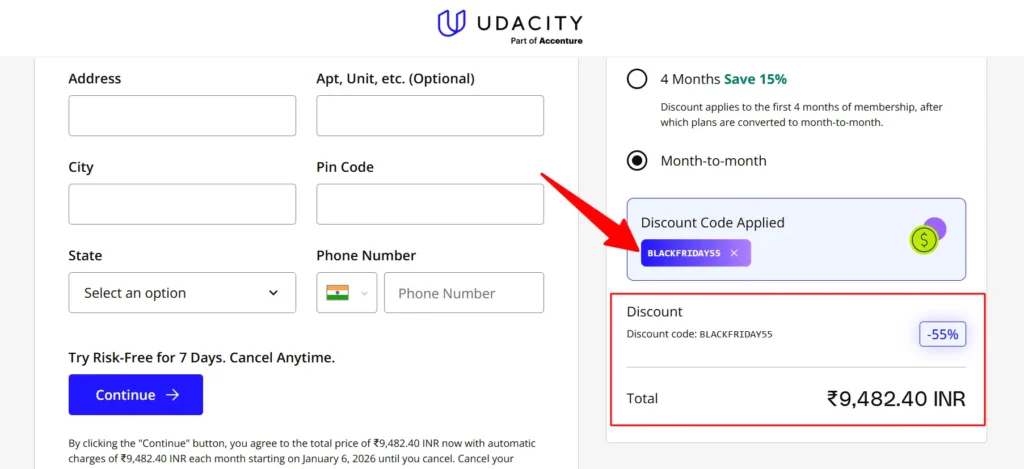
    Udacity is currently offering a massive 55% off (coupon code: FUTURE40) on all course access, bundles, and standalone Nanodegree programs.

    This is the highest discount Udacity is offering right now on its subscription plans, valid in most countries until January 6, 2026.

    If you’re planning to enroll in a Nanodegree program – to learn in-demand tech skills, get expert mentorship, and boost your career – this is the perfect time to save big. Don’t miss out on these huge savings.

    Not sure if this Udacity discount is worth it or how it can benefit your career? Keep reading – I’ll break it all down for you.

    But first, let’s see how much Udacity and its Nanodegree programs will cost you after this discount.

    💰 Udacity Regular Cost vs. 55% Off Discounted Cost”

    In the US (USD)

    • Monthly Subscription
      • Regular Price: $249/month
      • Discounted Price: $113/month
    • Individual Course Bundle (with 15% off based on avg. completion time)
      • Regular Price: Starts at $249/month
      • Discounted Price: Starts at $113/month

    In India (INR)

    • Monthly Subscription
    • Bundle Course / Individual Nanodegree (with 15% off based on avg. completion time)
      • Regular Price: ₹17,911/month
      • Discounted Price: ₹8,050/month

    Note: I’ve listed the monthly subscription discounts here; however, the 55% discount also applies to bundle subscriptions for longer durations.


    Review – Is Udacity 55% Off (January Sale) Worth Grabbing?

    Udacity 55% Off - Black Friday Sale 2025
    Source: Udacity

    If you’re wondering whether this discount is really worth the investment, my answer is yes.

    Udacity subscriptions and programs aren’t cheap, but this 55% discount on all Udacity pricing plans makes them much more affordable.

    And it’s not just about saving money – this heavy discount unlocks all Nanodegree programs, giving you the freedom to learn whatever you want. It’s a great opportunity if you want to:

    • Enroll in multiple programs at once, from beginner to advanced levels, without worrying about the cost of each individual program.
    • Easily switch between Nanodegree programs if one doesn’t meet your learning goals.
    • Explore new career paths—from programming to data analytics, AI to cybersecurity, Udacity offers a wide range of Nanodegree programs in every major tech domain.

    If you’re concerned about whether Udacity programs provide the right training or help you land a job, let me explain why they’re worth it – especially with the current 55% off sale.

    Why Choose Udacity?

    Udacity is a top-notch online learning platform offering high-quality courses and training programs, mostly in in-demand tech fields.

    These Nanodegree programs are not accredited by any educational institution, but they are developed in collaboration with leading tech companies in their respective industries, and their value comes from these companies themselves.

    For example, the Udacity Digital Marketing Nanodegree is built in collaboration with Google, Meta, and other top tech firms.

    Now, there’s no guarantee that holding a Nanodegree will land you a job at these top companies, as it depends on many factors – your hard skills, soft skills, academic background, and overall work experience. However, I can confidently say that the quality of training you’ll receive is truly worth it.

    Most Udacity Nanodegree programs are taught by industry experts who already work in the field you aspire to enter.

    From real-world projects to hands-on learning and career mentorship, these Nanodegree programs delivers exceptional value.

    If you want to test the quality yourself, start with these free programs I’ve personally taken:

    • AWS Machine Learning Foundations
    • Intro to Python Programming
    • Intro to Data Structures and Algorithms
    • Developing Android Apps with Kotlin

    You won’t need to pay anything – just sign up and start learning. These courses are beginner-friendly, so anyone can enroll. Once you’re satisfied with the quality, you can grab the subscription at 55% off.

    ⚠️ Note: This discount is only valid until January 6, 2026—so don’t wait too long! If finding worth it, claim your 55% Udacity discount.


    How to Get Your 55% Off Udacity Discount: Step-by-Step Guide

    Udacity

    Follow these steps to get Udacity’s biggest discount on its subscription:

    1. Visit Udacity.com
    2. Find the Nanodegree program you want to enroll in, or select any Nanodegree if you plan to purchase the Udacity subscription.
    3. Scroll down – on the right-hand side, you’ll see the regular pricing plans with the 55% off offer displayed below.
    4. Click the discount button, sign up for a free account, and log in.
    5. Choose your pricing plan- either month-to-month or a bundled course plan (longer duration). Both options include the 55% discount.
    6. Apply coupon code FUTURE40 and review the final cost.
    7. Complete your purchase by entering your payment details and confirming the payment.

    Act fast – this offer expires is only available for a week, valid until January 6, 2026.


    Top Udacity Nanodegree Programs – Access with Udacity 55% Off:

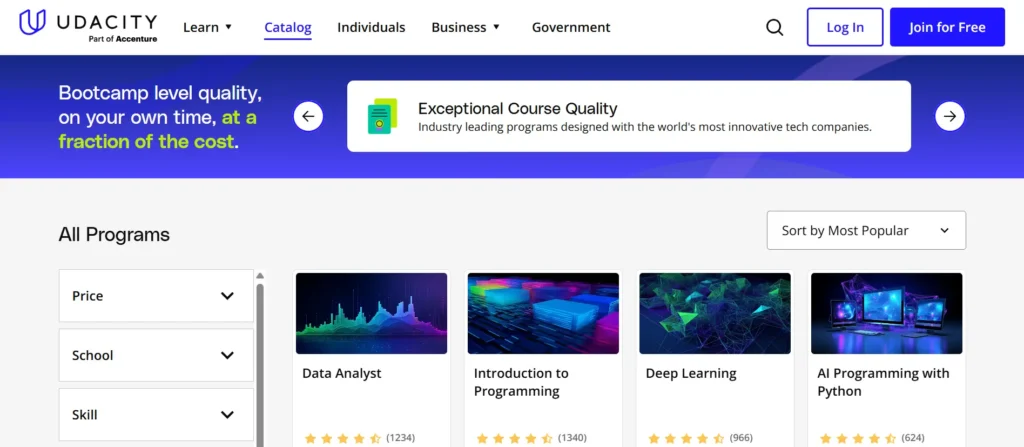
    Udacity is best known for its Nanodegree programs. With the current 55% off offer, you can access some of the most popular ones.

    These programs are featured based on:

    • Verified learner feedback from communities like Reddit, Quora, and Trustpilot
    • Enrollment volume and course completion rates (where available)

    Popular Udacity Nanodegree Programs You Can Get with 55% Off

    • Introduction to Programming – Build a strong foundation in web development and Python programming over four months. This beginner-friendly program includes hands-on projects, making it perfect for newcomers to coding.
    • Business Analytics Nanodegree – Learn SQL, Python, data visualization, and advanced Excel in just two months—no prerequisites required. Ideal for aspiring business, data, or financial analysts.
    • Data Analyst Nanodegree – Gain skills in data cleaning, exploratory analysis, and regression testing. Requires prior knowledge of Python, SQL, and statistics. Perfect for finding patterns in complex datasets.
    • Data Engineering with AWS -Learn to build scalable data infrastructure using AWS tools like S3, Redshift, and Lambda. Covers data modeling, warehousing, and big data technologies. Best for those with programming experience transitioning to data engineering.
    • Digital Marketing Nanodegree – Covers SEO, SEM, social media marketing, email marketing, and online advertising. Beginner-friendly and ideal for launching a digital marketing career.
    • Deep Learning Nanodegree – Master neural networks, NLP, computer vision, and reinforcement learning through hands-on AI and machine learning projects.
    • Programming for Data Science with Python – Start from scratch and learn Python, data visualization, and machine learning using NumPy, Pandas, and Scikit-learn. Includes real-world projects for practical skills.
    • Front-End Web Developer – Learn HTML, CSS, JavaScript, and React to create responsive, interactive websites. Includes hands-on projects for beginner web developers.
    • Data Scientist Nanodegree – An advanced program covering machine learning, data wrangling, and predictive modeling. Requires Python, SQL, and data analysis experience.
    • C++ Nanodegree – Master object-oriented programming, memory management, and multithreading in C++. Great for software, game, and systems development, with mentorship and practical projects.

    Note: All these Nanodegree programs are available at 55% off until January 6, 2025.


    Final Thoughts: Is Udacity’s 55% Off Sale Worth It?

    If you’ve been waiting for the right time to invest in your skills, this is it. Udacity’s 55% off deal is their biggest discount of the year, and it makes their premium Nanodegree programs far more affordable.

    Whether you want to start from scratch, switch careers, or upgrade your current skills, this offer gives you access to all Udacity Nanodegree programs—so you can learn at your own pace, explore multiple career paths, and gain hands-on experience through real-world projects.

    Remember, Udacity’s programs are built in collaboration with leading tech companies like Google, Meta, and AWS, and taught by industry experts who know what it takes to succeed in the field.

    While no certification can guarantee you a job, the skills, mentorship, and project experience you’ll gain from Udacity can put you miles ahead in your career journey.

    ⚠️ Don’t wait too long—this 55% off offer ends on January 6, 2026. If you’re serious about boosting your career, now’s the time to grab it.

    Happy Learning 🙂

    Udacity 55% Off – FAQs

    How long does the 55% off sale last?

    Udacity’s End of Year Sale 55% off sale is valid until January 6, 2026 in most countries. After this date, the offer will expire, and regular pricing will apply. If you’re planning to enroll, it’s best to grab the discount before the deadline.

    Udacity 55% Off – Month-to-Month vs. Bundle Subscription: Which One Should You Choose?

    When using Udacity’s 55% off deal, you have two options: month-to-month or bundle subscription.

    Bundle Subscription – Best for longer-term learning (typically 5–6 months). You lock in the 55% discount for the entire duration of your plan, giving you more time to complete your Nanodegree at your own pace without worrying about renewing each month. This is ideal if you want to take your time or explore more in-depth topics.

    Month-to-Month – Gives you 55% off for the first month only, and then you’ll be billed at the regular monthly price from the second month onward. This option works if you’re confident you can finish your Nanodegree quickly or just want to try it out before committing to a longer plan.

    Recommendation: If you plan to complete your program over several months, the bundle subscription offers better value and long-term savings.

    Can I combine this with other offers or scholarships?

    No — Udacity’s 55% off discount cannot be combined with other promotions, coupon codes, or scholarships. You’ll need to choose either this limited-time same or any other eligible offer, but not both.

    What kind of support do I get with a Nanodegree?

    With a Udacity Nanodegree, you get a range of support to help you succeed, including:

    1-on-1 technical mentor support – Get guidance when you’re stuck or need clarification on course content.
    Personalized project feedback – Industry experts review your projects and provide actionable feedback.
    Career services – Access resume reviews, LinkedIn profile optimization, and interview prep resources.
    Student community – Connect with fellow learners in forums and study groups for motivation and peer support.
    Flexible learning – Learn at your own pace with lifetime access to completed Nanodegree content.

    This combination of technical help, career guidance, and community support ensures you’re not learning alone.

    Read also:

    Source link

  • Merry Christmas, all | Bryan Alexander

    Merry Christmas, all | Bryan Alexander

    Today I’m taking a break from blogging to wish all of you who celebrate a merry Christmas.  If you’re in a cold and/or wet climate, be warm and dry.  Hug your loved ones and relish some downtime.  Be safe and take care.

    See you all soon.

    (photo by JLS Photography)

    Liked it? Take a second to support Bryan Alexander on Patreon!

    Become a patron at Patreon!

    This entry was posted in personal. Bookmark the permalink.

    Source link