On August 7, the Equal Employment Opportunity Commission (EEOC) issued a proposed rule to implement the Pregnant Workers Fairness Act (PWFA). The proposed rule provides a framework for how the EEOC plans to enforce protections granted to pregnant workers under the PWFA.
In December, the PWFA wassigned into law through the Consolidated Appropriations Act of 2023. The law establishes employer obligations to provide reasonable accommodations to pregnant employees so long as such accommodations do not cause an undue hardship on the business, and makes it unlawful to take adverse action against a qualified employee requesting or using such reasonable accommodations. The requirements of the law apply only to businesses with 15 or more employees.
Purpose and Definitions
Under the proposed rule, the EEOC states that employers are required to “provide reasonable accommodations to a qualified employee’s or applicant’s known limitation related to, affected by, or arising out of pregnancy, childbirth, or related medical conditions, unless the accommodation will cause an undue hardship on the operation of the business of the covered entity.”
Most definitions included in the EEOC’s proposed regulations follow the definitions provided under the Americans with Disabilities Act (ADA). The proposed rule, however, expands upon the definition of a “qualified employee or applicant” to include an employee or applicant who cannot perform an essential function of the job so long as they meet the following criteria:
Any inability to perform an essential function is for a temporary period
The essential function could be performed in the near future
The inability to perform the essential function can be reasonably accommodated
The rule continues by defining “temporary” as the need to suspend one or more essential functions if “lasting for a limited time, not permanent, and may extend beyond ‘in the near future.’” Accordingly, “in the near future” is defined to extend to 40 weeks from the start of the temporary suspension of an essential function.
Additionally, the terms “pregnancy, childbirth, or related medical conditions” include a non-exhaustive list of examples of conditions that fall within the statute, including current or past pregnancy, potential pregnancy, lactation, use of birth control, menstruation, infertility and fertility treatments, endometriosis, miscarriage, stillbirth, and having or choosing not to have an abortion. The proposed rule specifies that employees and applicants do not have to specify the condition on the list or use medical terms to describe a condition to receive an accommodation.
Reasonable Accommodations
The proposed rule states that requests for an accommodation should both identify the limitation and indicate the need for an adjustment or change at work. The rule adopts the interactive process for approving and adopting reasonable accommodations for employees or applicants as implemented under the ADA, meaning employers and the qualified employee or applicant can work together to reach an agreement on an appropriate accommodation.
The proposed rule also offers a non-exhaustive list of examples of reasonable accommodations that may be agreed upon during the interactive process. These include frequent breaks, schedule changes, paid and unpaid leave, parking accommodations, modifying the work environment to make existing facilities accessible, job restructuring and other examples.
Additionally, the proposed rule introduces “simple modifications,” which are presumed to be reasonable accommodations that do not impose an undue burden in almost all cases. The four simple modifications proposed are:
Allowing employees to carry water and drink, as needed, in the work area
Allowing employees additional restroom breaks
Allowing employees to sit or stand when needed
Allowing employees breaks, as needed, to eat and drink
Supporting Documentation
The proposed rule states that covered employers are not required to seek documentation to prove the medical condition or approve an accommodation, further stating that the employer can only request documentation if it is reasonable in order to determine whether to grant an accommodation for the employee or applicant in question. Under the regulations, “reasonable documentation” is that which describes or confirms the physical condition; that it is related to, affected by, or arising out of pregnancy, childbirth or related medical conditions; and that a change or adjustment at work is needed for that reason. Examples of situations where requesting documentation may be determined to be unreasonable include when the limitation and need for an accommodation are obvious; when the employee has already provided sufficient documentation; when the accommodation is one of the four “simple modifications”; and when the accommodation is needed for lactation.
Remedies and Enforcement
The proposed rule establishes the applicable enforcement mechanisms and remedies available to employees and others covered by Title VII of the Civil Rights Act of 1964 for qualified employees and applicants covered under the PWFA. The rule also proposes several anti-retaliation and anti-coercion provisions to the list of protections granted to those covered by the PWFA.
Next Steps
The EEOC’s proposed rule marks the agency’s first step toward finalizing PWFA regulations. Although the timing is uncertain, the EEOC will likely aim to issue the final regulations by December 29 — the deadline Congress gave the agency to finalize a rulemaking to implement the law. Notably, however, the PWFA went into effect on June 27, meaning the EEOC is now accepting violation charges stemming from PWFA violations without having a final rule implemented.
The EEOC invites interested stakeholders to submit comments in response to the proposed rule by October 11. Comments will be considered by the agency before issuing its final rule for the PWFA.
CUPA-HR will keep members apprised of any activity relating to the PWFA regulations.
Editor’s note: The information in this post came from the National Athletic Trainers’ Association’s white paper “The Collegiate Athletic Trainer Labor Crisis,” which includes a checklist and a library of resources to assist collegiate ATs and leaders in evaluating recruitment, hiring, retention and advancement practices.
Like much of higher ed, collegiate athletics is struggling with a labor crisis due to the post-pandemic “Great Resignation.” Particularly in the area of athletic training, colleges and universities are finding it more and more difficult to attract and retain talent. Given the role and value ATs and their sports medicine departments have in reducing risk for their athletic department and institution, it is critical for leaders to understand and address the current labor crisis.
To identify some reasons for this labor challenge, the National Athletic Trainers’ Association (NATA) Intercollegiate Council for Sports Medicine (ICSM) in collaboration with the NATA Compensation Task Force surveyed more than 1,120 collegiate athletic trainers (ATs) across the country. Pay, organizational culture, burnout and increased work responsibilities were the themes that emerged.
Findings
Salary remains the most important factor for collegiate ATs as they evaluate employment options. As the AT profession continues to see increasing employment opportunities within hospitals, sports medicine clinics, industrial settings, physician offices, and military and municipality services, the market is becoming more competitive. The collegiate AT average salary of $54,000 remains below the overall athletic trainer average salary of $61,000.
Workload is a cause for concern. More than half of the survey respondents indicated they were caring for more than 100 student-athletes, and 65 percent said they had received additional responsibilities from their supervisor without an increase in compensation. Due to workload, respondents expressed concerns around being able to provide student-athletes with the attention they deserve, being able to devote time to preventative care and/or corrective exercise, and an inability to provide one-on-one rehab time to student-athletes. Research suggests that ATs with very high patient loads perceive an inability to meet the demands of their athletic administrators and coaches, which leads to increased emotional exhaustion and burnout. The survey found that only 12 percent of respondents have been employed in collegiate athletics beyond 10 years.
Organizational culture plays a large role in attracting and retaining ATs. The survey found that collegiate ATs expect a positive work culture that promotes student-athlete health and safety, an understanding of ATs responsibilities, appropriate time demands, independent medical care and a collaborative team environment. Additionally, respondents indicated a desire for formal onboarding and mentorship programs specific to the AT position — while 60 percent of respondents indicated such a program would be favorable, only a third had any formal onboarding with their current position.
How Can Institutions Respond?
Institutions that are slow to respond to the athletic trainer labor crisis will continue to have challenges hiring and retaining ATs. To this end, NATA has outlined several steps institutions can take to address the challenges around attracting and retaining talent in the athletic trainer field:
Conduct a salary and benefits review of your institution’s ATs, with particular attention to different AT employment opportunities within your local area; additional provisions that could be offered (sign-on bonuses and/or retention bonuses); market rates and compa-ratios; and compensation for increased roles, responsibilities and job duties.
Audit your institution’s AT job descriptions to ensure they are reflective of AT duties and responsibilities.
Offer more work flexibility, support services and work-life balance resources for ATs.
Create AT-specific mentorship and onboarding programs.
On August 3, 2023, the Department of Homeland Security (DHS) published a notice in the Federal Register seeking comments on a potential pilot program to allow employers not enrolled in E-Verify to harness remote examination procedures for the Form I-9, Employment Eligibility Verification.
Background
DHS’s recent actions are built upon a series of moves aimed at modernizing and making more flexible the employment verification process. On July 25, 2023, the DHS rolled out a final rule enabling the Secretary of Homeland Security to authorize optional alternative examination practices for employers when inspecting an individual’s identity and employment authorization documents, as mandated by the Form I-9. The rule creates a framework under which DHS may implement permanent flexibilities under specified conditions, start pilot procedures with respect to the examination of documents, or react to crises similar to the COVID-19 pandemic.
Alongside the final rule, DHS published a notice in the Federal Register authorizing a remote document examination procedure for employers who are participants in good standing in E-Verify and announced it would be disclosing details in the near future about a pilot program to a broader category of businesses.
Key Highlights of the Proposed Non-E-Verify Remote Document Examination Pilot
DHS’s proposal primarily revolves around the following points:
Purpose: Immigration and Customs Enforcement (ICE) intends to gauge the security impact of remote verification compared to traditional in-person examination of the Form I99. This involves evaluating potential consequences like error rates, fraud and discriminatory practices.
Pilot Procedure: The new pilot program would mirror the already authorized alternative method for E-Verify employers, including aspects such as remote document inspection, document retention and anti-discrimination measures.
Eligibility: The pilot program is open to most employers unless they have more than 500 employees. However, E-Verify employers are excluded since DHS has already greenlit an alternative for them.
Application Process: Interested employers must fill out the draft application form, which DHS has made available online. This form captures details like company information, terms of participation, participant obligations, and more.
Information Collection: Employers wishing to join the pilot would be required to complete the formal application linked above. ICE would periodically seek data from these employers, such as the number of new hires or how many employees asked for a physical inspection.
Documentation: Participating companies must electronically store clear copies of all supporting documents provided by individuals for the Form I-9. They might also be required to undertake mandatory trainings for detecting fraudulent documents and preventing discrimination.
Onsite/Hybrid Employees: Companies might face restrictions or a set timeframe for onsite or hybrid employees, dictating when they must physically check the Form I-9 after the initial remote assessment.
Audits and Investigations: All employers, including pilot participants, are liable for audits and evaluations. DHS plans to contrast data from these assessments to discern any systemic differences between the new method and the traditional one.
What’s Next: Seeking Public Comments by October 2
DHS is actively seeking feedback from the public regarding the proposed pilot and the draft application form. The department encourages stakeholders to consider and provide insights on the following points:
Practical Utility: Assess if the proposed information requirement is vital for the agency’s proper functioning and whether the data collected will be practically useful.
Accuracy and Validity: Analyze the agency’s estimation of the information collection’s burden, ensuring the methods and assumptions are valid.
Enhance Information Quality: Offer suggestions to improve the clarity, utility and overall quality of the data collected.
Minimize Collection Burden: Propose ways to ease the data collection process for respondents, exploring technological solutions such as electronic submissions.
In light of this, CUPA-HR plans to carefully evaluate the notice and associated application. Based on its review, CUPA-HR is considering submitting comments to provide valuable insights to DHS. CUPA-HR will keep members apprised of any updates regarding this proposed pilot program and other changes to Form I-9 alternative examination procedures.
Each month, CUPA-HR General Counsel Ira Shepard provides an overview of several labor and employment law cases and regulatory actions with implications for the higher ed workplace. Here’s the latest from Ira.
Tenured Professor Loses First Amendment Retaliation Claim Related to “Offensive” Blog Posted Months Before the Adverse Action
The U.S. Court of Appeals for the 4th Circuit (covering Maryland, Virginia, West Virginia, North Carolina, and South Carolina) dismissed a North Carolina State University professor’s First Amendment retaliatory discrimination claim following the removal of the professor from a key university program. The professor claimed that his removal stemmed from his critical “woke joke” blog post. His blog stated that the Association for the Study of Higher Education’s conference had “… moved from focusing on general post-secondary research to social justice.” He claimed that the comment was protected speech and could best be characterized as a “woke joke.”
The Court of Appeals dismissed his claim holding that the blog post was published 10 months before his removal from the program area and eight months after the department head had emailed him stating that the blog had “generated controversy on social media.” The appeals court ruled 2 to 1 that “temporal proximity” between the alleged speech and the adverse action was lacking and therefore the case must be dismissed (Porter v. Board of Trustees of North Carolina State University (4th Cir. No. 22-01712, 7/6/23)).
Court Decisions on Telework Disability Accommodation Changing in the Aftermath of the COVID-19 Pandemic
Federal judges are less likely to decide in favor of employers rejecting telework accommodation in disability cases in the aftermath of the COVID-19 epidemic. The employer win rate in cases denying a disability telework accommodation has dropped to 60% in the aftermath of COVID-19 compared to a 70% win rate during the two-year period prior to the pandemic, according to statistics cited by Bloomberg Industry Group (DLR 7/6/23).
Federal judges are now more likely to consider telework as a reasonable accommodation in certain disability cases as a result of the widespread use of telework during the COVID-19 pandemic.
Mandatory Paid Family and Medical Leave Becoming More Common Among State and Local Jurisdictions
Twelve states, plus the District of Columbia, have enacted mandatory paid medical and family leave for workers within their jurisdictions. While the form of the mandate varies from jurisdiction to jurisdiction, workers are increasingly being granted by these statutes guaranteed paid time off to care for their own serious medical condition, a newborn or newly adopted child, or a family member’s major medical condition. In addition, according to Bloomberg DLR, Michigan and New Mexico appear likely to adopt mandatory paid-leave programs in the near future. It is important to check your state and local jurisdictions for developments in this area.
Professor of Iranian Decent Entitled to Title VII Jury Trial Over Allegations That His Contract Non-Renewal Was Based on National Origin Prejudice by His Turkish Supervisor
A federal district court judge denied a summary judgement motion and held that a tenure-track art professor of Iranian descent was entitled to a jury trial under Title VII regarding his allegations that his supervisor denied renewal of his contract because of the supervisor’s anti-Iranian, Turkish background. The judge concluded that the plaintiff stated a claim of national origin discrimination under Title VII and was therefore entitled to a jury trial over those allegations and allegations that the university denied the plaintiff access to legal counsel and misstated his legal position (Shams v. Delta State University (N.D. Miss. No. 22-cv-00035, 7/11/23)).
The plaintiff alleged that there is tension between Iranians like himself and Turks like his supervisor because the two countries “… share a contentious border and not much else.” The plaintiff also alleges that he was replaced by an art professor of Turkish background who was contacted for the position before the non-renewal of his contract.
Former Professor’s First Amendment Retaliation Claims Related to His Termination After Publishing an Article on “Racial IQ Gap” Dismissed Against University, But Survives Against University Officials
A former Cleveland State University professor can pursue some of his First Amendment retaliation claims, after he was terminated following publication of an article that advanced a theory that genetics cause a “Racial IQ Gap” between White and Black Americans. The federal district court hearing the case dismissed the complaint against the university on sovereign immunity grounds. However, the court let some of the complaint proceed against some university officials, at least through discovery. After completion of discovery, the court will rule on whether individual university officials are covered by the university’s sovereign immunity (Pesta v. Cleveland State University ( 2023 BL 242086, N.D. Ohio, No. 1-23-cv-00546, 7/14/23)).
The controversial article was subject to outside criticism that the professor unethically misused NIH Data on studies of racial differences to reach his conclusions. The university stated that the professor was terminated for ethical lapses and for violating its academic and integrity standards. The professor claims that he was fired because of university viewpoint discrimination against the conclusions in his article in violation of the First Amendment. We will follow developments as this case unfolds.
New Jersey Equal Pay for Temps Law Is First to Mandate Joint Liability of Employers Along With Temp Agencies
New Jersey employers will face expanded liability along with temp agencies under a law which mandates that temp employees receive pay and benefits equal to comparable full-time employees employed by the employer. The law is the first to impose joint-employer liability along with temp agencies employed by the employer and goes into effect on August 5, 2023, according to Bloomberg DLR, 8/4/23. While other states — including California, Illinois and Massachusetts — have temporary-worker bill-of-rights laws, New Jersey is the first to impose joint-employer liability on the actual employer employing the temp agency.
The New Jersey law imposes the requirement that temp employees in the state receive wages and benefits comparable to those of similarly situated full-time employees.
Richard Feynman the father of Quantum Electrodynamics or “OED” realized the significance of Thompson’s double slit experiment because he felt carefully thinking through its implications would allow one to get complete understanding of the wave particle duality of existence predicted by Quantum Mechanics.
However, one can understand it in terms of the classical properties of wave mechanics and the space-time universe defined by Einstein.
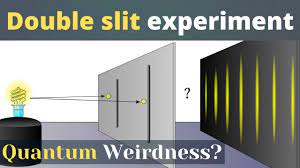
The double slit experiment is made up of a coherent source of photons illuminating a screen after passing through a thin plate with two parallel slits cut in it. Their wave properties cause them to interfere after passing through both slits, creating an interference pattern of bright and dark bands on the screen. However, at the screen, the light is always found to be absorbed as discrete particles, called photons.
When only one slit is open, the pattern on the screen is a diffraction pattern however, when both slits are open, the pattern is similar but with much more detailed. These facts were elucidated by Thomas Young in a paper entitled “Experiments and Calculations Relative to Physical Optics,” published in 1803 wrote “To a very high degree of success, these results could be explained by the method of Huygens–Fresnel principle that is based on the hypothesis that light consists of waves propagated through some medium.
However, discovery of the photoelectric effect made it necessary to go beyond classical physics and take the quantum nature of light into account.
It is a widespread misunderstanding that, when the two slits are open but a detector is added to determine which one a photon has passed through, the interference pattern no longer forms and it yields two simple patterns, one from each slit, without interference.
This is because there are ways to determine which slit it passed through in which the interference pattern will be changed but not be completely wiped out. For instance, by placing an atom at the position of each slit and monitoring whether one of these atoms is influenced by photon passing through it the interference pattern will be changed but not be completely wiped out.
But the most baffling part of this experiment comes when only one photon at a time impacts a barrier with two opened slits because an interference pattern forms which is similar to what it was when multiple photons were impacting the barrier. This is a clear implication the particle called a photon has a wave component, which simultaneously passes through both slits and interferes with itself. (The experiment works with electrons, atoms, and even some molecules too.)”
Many believe the importance of this experiment is that it demonstrates both the duality of the wave and particle properties of photons and the concepts of superposition and quantum interference.
Yet, one can understand this experiment in terms of the classical properties of waves and Relativity because they tell us an electromagnetic wave moves continuously through space-time unless it is prevented from doing so by someone observing or something interacting with it. This would result in its energy being confined in three-dimensional space. The science of wave mechanics also tells us the three-dimensional “walls” of this confinement will result in its energy being reflected back on itself thereby creating a resonant standing wave in three-dimensional space. This would cause its energy to be concentrated at the point in space where a particle would be found. Additionally, wave mechanics also tells us the energy of a resonant system, such as a standing wave which this confinement would create can only take on the discrete or quantized values associated with its fundamental or a harmonic of its fundamental frequency.
Additionally, it also tells us a particle would have an extended volume equal to the wavelength associated with its standing wave.
(Note the boundaries or “walls” of its confinement would be defined by its wave properties. If an electromagnetic wave is prevented from moving through space it will be reflected back on itself. However, that reflected wave still cannot move through space therefore it will be reflected back creating a standing wave. Putting it another way the wave itself defines its boundaries because if it cannot move though space it MUST STAND in place in the form of a standing wave.)
Putting it in the vernacular of Quantum Mechanics when an electromagnetic wave is prevented from moving through space either by being observed or encountering an object its “Collapses” to a form a standing wave that would define the quantized energy Quantum Mechanics associates with a particle.
It shows the reason why the interference pattern remains when one photon at a time is fired at the barrier with both slits open or “the most baffling part of this experiment” is because, as mentioned earlier it is made up of an electromagnetic wave, therefore it occupies an extended volume which is directly related to its wavelength.
This means a portion of its energy could simultaneously pass through both slits, if the diameter of its volume exceeds the separation of the slits and recombine on the other side to generate an interference pattern.
However, if its energy is prevented from moving through space by contacting the screen it will be confined to three-dimensional space causing it to be concentrated in a standing wave that as mentioned earlier would define the energy of the photon that impacted the screen.
Additionally, because the energy of the standing wave which earlier was shown to define the quantum properties of a photon is dependent on its frequency the energy of the particle has when it contacts the screen must have the same energy. Therefore, where it appears on the screen will be determined by where the interference of the wave properties from each slit combine to produce enough energy to support the standing wave associated with its particle properties.
It also explains why the interference pattern disappears, in MOST cases when a detector is added to determine which slit a photon passes through is because the energy required to measure it causes the wavelength of the one being measured to change so that it will not have the same resonant characteristics as one that passed through the other slit. Therefore, the energy passing thought that slit will not be able to interact, in MOST cases with the energy passing through the other one and no interference pattern will form.
However, it also explains why, as was mentioned earlier “there are ways to determine which slit a photon’s energy passed through that will cause a change in the interference pattern but will not completely wipe it out.
The reason for this is if the energy passing through one of the two slits is altered by a relatively small amount compared to what it originally was, classical wave mechanics tells us it will be able to interact to form a slightly different resonant structure with a slightly different interference pattern on the other side than would be the case if no measurement was taken.
However, this also means one should be able to use the science of wave mechanics and the physical properties of space-time to quantify the maximum amount of energy a measuring device can remove from the wave while passing through a slit that will permit the interference pattern although somewhat altered to be re-established on the other side.
For example, if the above interpretation for the double slit experiment is correct one should be able to use the science of wave mechanics to calculate the energy required to cause specific shift in the interference and determine if it matches the energy taken out of the system by the detecting equipment.
This provides an experimental way of determining if the results of the Thompson’s double slit experiment are due to physical properties of space-time or the quantum properties of the wave function because if the pattern disappears above that value and reappears below it would suggest the above explanation is valid. If not, it would suggest the quantum mechanical one is.
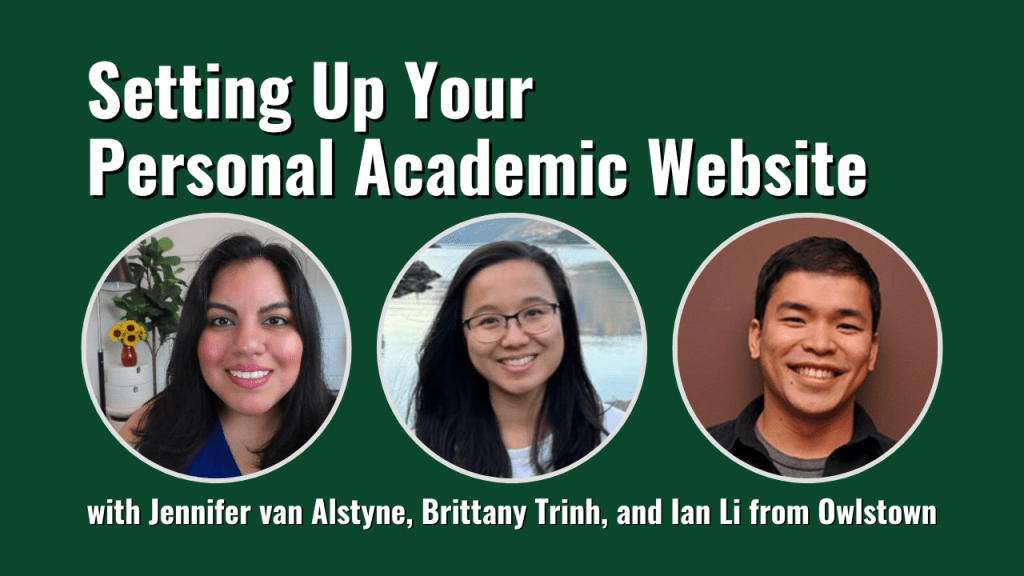
Jennifer van Alstyne, Brittany Trinh, and Dr. Ian Li talk about the best personal academic website hosts. You’ll get a demo of Owlstown. Watch our fireside chat about personal academic websites where we answer your questions.
Thinking about a personal academic website? Whether you want a do-it-yourself website or you’re thinking about hiring help, we hope the replay of our live event helps you. Have a photo of you, your bio, and your social media links? You have everything you need to set up a simple website with Owlstown, a free website builder for academics. Once you make your website, enter it in our Best Personal Academic Websites Contest to win one of multiple awards.
This event was recorded live on August 1, 2023 as part of The Best Personal Academic Websites Contest to help you set up your website.
Jennifer: Hi everyone! My name is Jennifer van Alstyne. Welcome to Setting Up Your Personal Academic Website. My name is Jennifer. I’m talking today with my friends Brittany Trinh who makes websites for scientists, and Dr. Ian Li from Owlstown, which is an academic website
builder for you all to check out. We’re going to have a demo of that today. We’re also going to talk about the most frequently asked questions when it comes to having your own personal website. Just to get us started, my name is Jennifer van Alstyne. I own The Academic Designer LLC where since 2018 I’ve been helping professors have a strong online presence so they can talk about their research and teaching. To really feel comfortable when they show up online. I help people with social media, bio writing, and websites. And I really love my work. But there’s so many people out there who want to D.I.Y. to do-it-yourself for your website. I was excited to put this event together with Brittany and Ian as part of our annual Best Personal Academic Websites Contest. Brittany, would you introduce yourself?
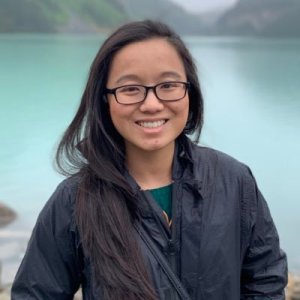
Brittany: Hi, everyone! My name is Brittany Trinh. I am a website strategist and designer for early career researchers. I’m also a third year PhD student in chemistry at the University of Wisconsin-Madison. I’ve been doing this since 2019, and I just really love helping the grad students and early career scientists, even like anybody at any stage, create their website. I think it’s really important for your personal development and your career development. As well, it’s a great place to show off your skills a little bit more about yourself. I also have a podcast called Beyond Your Science, so you can check that out. I’m really excited to chat with you all today.
Jennifer: Ian, please introduce yourself and let us know all about Owlstown too.
Ian: Sure thanks Jennifer hi I’m Ian and I’m the creator of Owlstown. I finished my PhD a long time ago, about 10 years ago now. I remember being in grad school and working on my website. I thought it was a good way to share my work with others. I thought that I could help others make their websites so they can share their work easily. About five years ago, I started working on Owlstown as a hobby. And also a way for it to help other people build their website. Owlstown’s mission has been to make it super easy to make an academic website. I will demo that later and also I’m looking forward to answering questions that people might have about how to share their research online and what things to share about the academic work. Thank you.
Why should academics have a website?
Jennifer: Thank you. You know the biggest question that comes up from academics kind of whatever stage they are in their career is: Is a website right for me? Should I have a website? Why should I have one? Let me know what do you guys think? Why should academics have a website?
Ian: I can answer that first. One reason is we’re in 2023 and people are gonna look for your name on search engines. You want something that you control that will show up on those search engines. If they search for your name, you want it to be a website that you have control over what content shows up. A website is a great way to share what you want to share, like your papers, your posters, an introduction about yourself, and a lot more content about your research.
Jennifer: Brittany what about you? Why should early early career researchers, why should people have a website?
Brittany: I think that early career researchers should have a website because, like Ian said, people will search for you on search engines and things like that. Having a LinkedIn is good. And your CV has a lot of things that you do. But it’s not everything that you do. And there’s a lot more sides to you that you can’t necessarily fit in your LinkedIn or CV because it may not be as relevant or something. But your website is a way to kind of show off that creativity. And it’s also possibly a way to maybe venture into an entrepreneurial side hustle or things like that if that’s something you’re interested in which is like what I did for myself prior to going to grad school and a little bit even right now too. I think that having the website opens you up to like so many more possibilities and opportunities for people to connect with you, with your work, and then maybe learn about services or things like that if that’s something you choose to offer. I think it’s just mostly a space that you can create and make your own and do whatever you want with it. And also right now we’re really in the content creator era I guess. Making a personal brand and just like becoming known for something is also important. Showing people not just what you do, but what you really value, what you’re passionate about. That is something that you can also showcase on your personal website.
Jennifer: I love that. You know I think one thing that you both talked about is having control. Having control over what people find about you when they search online. But also, having control that they’re finding the things that you value and care about, not the things that you know are standard in a CV or that you’re going to find necessarily on your faculty profile. I really feel like having your own space like a personal website having your own space that’s outside of your University, outside of your affiliation, makes such a lasting difference. I even have retired academics reach out to me because now that their faculty profile is just gone completely, they need somewhere to still share the hard work that they’ve done and the ways that they’re helping people. So it’s not like it’s ever too early or too late to create a website for your research, your teaching, the service that you do, and the things you care about. There are so many reasons to have a website, so many different ones that have surprised me whether it’s wanting to share your book, share your research, and connect better with your students. I mean there’s just so many options. I have a poll for you all, for everyone who’s in the audience.
I want to know how long have you wanted a website? Answer this poll. Let me know how long have you wanted a personal academic website. Is it something that’s been on your to-do list for a while? Or, is it something that’s new? Maybe some of you are like, “I don’t know if a website is right for me, that’s why I’m here.” That’s okay too.
All right, let’s see. For some of you, this has been on your to-do list for a long time. You’ve been wanting a personal academic website, and my guess is there’s something that’s been holding you back from making it. Feel free to let me know in the chat. If you’ve recently been inspired to want a website, I’m so glad you’re here. I mean this is the perfect event because we’re gonna help you make sure that you approach this project with a strategy, a plan in mind and think about your long-term goal. I’m excited. A few of you already have a personal website. Let me know how long you’ve had your website for in the chat.
Will my university be angry if I make my own website?
Jennifer: Okay, now one thing I wanted to ask you both before we move on. It’s a fear or anxiety that I’ve heard multiple times from a few people: Will my University get angry at me? Will they get mad if I make my own website? Do they not want me to do this? I have an answer based on my interactions with University Administration and with people who run social media and marketing for universities. But I want to hear from you both. In your experience, have you ever seen anyone get mad at someone for having a personal website?
Brittany: In my personal experience I don’t know about university, but I do know from working in Industry. This wasn’t directly related to my website, but I wanted to do something more in the online space and I asked for permission, which was not the way to go. I should always ask for forgiveness. But I would also say that I don’t know if the university would care. They just seem quite large unless you were very prominent or something. Then maybe they would care. But, I think Jennifer you might probably have the most expertise in this area.
Jennifer: No, that’s fine. I think that’s a perfect example because sometimes if you have an employer or a partnership outside of the University, they do have a strong opinion about it. One of my professor clients, for instance, worked for the military. And the military did not want her specifically to have a website. That’s fine. We found other ways for her to have an online presence. But when it comes to your University, mostly they want their professors to have a stronger online presence because you represent the university and the research that you do is awesome for the University. They want more people to know about it. They want more people to know about the awesome teaching you’re doing and how you’re affecting students. I mean it makes a big difference for them in terms of revenue. I mean I’m not gonna lie, it’s definitely about marketing and money for them, but it’s also about championing the resources that they give you, your lab, your ability to do research on campus, the teaching that you do.
If they give you innovative classes they get really excited about that. I am not going to lie to you, they are looking at your website because they want to see how it helps them. They’re not going to look at your website to see how it makes them mad. Now, one caveat to that is if you have highly confidential information that you’re not allowed to share. That’s something that you might want to check with your University about. One example of that is from a research lab, they had some specific equipment that their University didn’t want them to list as being in their lab just for security reasons. And so there may be some opportunities where you do want to ask permission. But other than that, I agree with Brittany. Go ahead and make your website. And if someone has a problem you know they’ll let you know and you can decide where to go from there. Ian, do you have anything you’d like to add?
Ian: Yeah. From my experience, I had a website in undergrad. And then in grad school, I went to a different school. I also started a website there. I used initially the servers that were provided by the university. And then at some point, I got my own domain name just so that in case I did move, I’d still have control over my own name. I think the university provides the space to share your work so I think they do want you to share your work online. They provide a space to do that. Now, whether it needs to be under the institution’s name or your own domain name, I think that could be up to you. In my case, I was shifting institutions. I wanted to have my own space so I didn’t have to move it. And also, the spaces that I had at my undergrad and my grad school eventually disappeared. It was good that I had my own domain name to kind of hold all that information.
How do I choose the best host for my personal website?
Jennifer: I love that. I feel like space is disappearing is a key reason why some academics reach out to me. I work with academics on really planning strategically their website.
Many professors are thinking about much more extensive websites than the typical person is looking for. But it’s always about, “what do I do? How do I not make the wrong decision when I’m first getting started?” And that’s why I wanted to talk to you both about personal academic website hosts. Because the first question people have when it comes to making their website is where do I even host my website? Ian, I know you’ve created a wonderful option with Owlstown, but there are a few different options that people can choose from. What are the options, Brittany?
Brittany: Yeah. For me, the two that I usually like to champion for people who are starting out would be Google Sites, which is free and it’s available in your Google Drive account. You can start making one there. It’s really good because you can still have some customizability. But everything is pretty like drag-and-drop, so if you know how to use PowerPoint or something like it, you’re good to go. You don’t need to worry about coding or anything. And then the other one I like to recommend is just like the free WordPress.com. That’s what I started out with when I was an undergrad because I wanted to blog. I think it’s good for blogging. And it’s a good introduction to what websites can do. But then of course once you kind of want to level-up then there are even more options. But maybe that’s a little bit further down the line. But yeah, those are the two I would recommend. Of course, Owlstown too. But we’ll see that later.
Jennifer: That’s great! Yes I love Google Sites, especially a beginner option. But I like Owlstown for academics more. Especially if you’re looking for something simple because Owlstown already makes it easy for you to drop things into that are specific for academics. But when it comes to free sites, WordPress.com I totally agree with. That’s my number one pick for academics. It’s what I recommend for all of my clients. Now, some people like using Squarespace. That has great features as well. I don’t typically recommend Wix.com. I know Brittany and I have talked about this before on my podcast, The Social Academic. Wix has issues. Many of my clients come to me with an old Wix website that is just practically impossible for them to update. I don’t recommend it for those reasons. What about you? Anything else that you don’t recommend when it comes to making your own website?
Brittany: Also in my personal experience, Weebly was not the greatest. It works. And I know a lot of people have made websites on Weebly, but I would say that if you haven’t made one yet, maybe not to try. It’s because with Weebly, there’s a lot of functionality that’s usually extra like you have to pay for it. But from other websites, it’s already included which kind of bothers me on principle. So, I don’t recommend [Weebly] for that reason.
Jennifer: Great. Ian, do you have any website hosts that you just don’t recommend?
Ian: I don’t know if I have ones that I don’t recommend. It’ll depend on how much time you have and how much effort you want to put in. I think some people choose to set up their own server and make their own website that way, like I did in undergrad. I guess I didn’t set up my own server, but I made my own website. I had too much time on my hands and in grad school I did set up my own server. Again, I think I maybe had too much time.
But it just depends on how much time you have and how much effort you want to put into it. I think there’s outside of Squarespace, Weebly, WordPress, some people choose to do like GitHub pages. My own personal website I think is GitHub pages. There’s a lot of free options like that. I think that when you’re thinking about when making the website you want to think about how much time you want to put into it, how much money, on top of what you want to share on your website. What I would recommend is focus on what you want to share rather than focusing on what would be the technology that you would use to make the website. Because learning HTML, JavaScript, and CSS can take up a lot of time. I know it. I do websites all the time so I know how much time it takes. You don’t you don’t want to get your PhD in HTML and CSS. You’re working on your PhD in whatever field you’re in and you want to share that and as much as possible spend the time on how you want to present your work and focus on that.
Jennifer: I completely agree with everything you said. Yeah. If you don’t want to learn CSS, JavaScript, or HTML, you don’t want to learn how to code for your website. Don’t try to build it from scratch. It’s not worth your time and honestly it means that you have to go back and make changes and updates using that same method. That can be okay now, but maybe you won’t have that time in the future. When it comes to exactly what Ian was talking about: time, effort, what do you want to focus your energy on? I agree, focusing your energy on what you say, why you’re saying it, and who you’re saying it to is what’s going to make the difference for your personal academic website. And I think that’s why Owlstown is such a good solution. Now I want to caveat and say that if you’re going to have a blog, I really do recommend WordPress and WordPress.com is a great option. That’s because blogging has been done by them for so long they’re going to continue to have very focused blogging Features. But Owlstown, if you want a website and blogging is not guaranteed something you want to do this year.
A demo of Owlstown, a free academic website builder
Jennifer: Let’s talk about Owlstown because this is an academic website builder that is meant to be easy so that you can focus on what you’re seeing and who you’re saying it to. And not on learning how to make your website.
Ian, can you tell us about Owlstown?
Ian: Owlstown compared to the other tools out there is only for academics. The idea is that it has templates that are focused on academics. So you can post your publications, your projects that you work on, courses that you teach, people that you collaborate with, and some blogging features. And also, you can post your CV and other pages that you might want to add on top of your publications and projects. As much as possible, Owlstown tries to get the way of fiddling with the design and the HTML so that you can focus on the content that you’re sharing. I’ve been working on it for about 5 years now. It’s a passion project and I really enjoy working on it. I’m looking forward to sharing it.
Jennifer: That’s great. Will you actually share your screen and give us a little demo of it now? Because if you did bring your bio, headshot, and your social media links with you today, this is so fast to set up. You’ll have time to do it while we’re talking today. Ian, why don’t you show us a demo of Owlstown?
For those of you who are listening, if you have questions drop them in the chat. We’re going to have time for Q&A after our discussion.
Ian sharing his screen: Okay. We’ll make a website. You can find it at Owlstown.com. First, we’re just gonna go through the ‘Create your free website’ [button] here. It’s going to welcome you with a Welcome Page.
Let’s get started. First, when I make this website I’ll put my own information. But you can put in your own information here. As you can see, as I’m filling out the fields here, the website is changing. I’ll set up an image here, but for now I’ll just set up a letter so we can go through this quickly. Here I can just do a short bio. I won’t spend too much time on this. This is something when you’re starting out you can probably just do something quickly. The note here is this is the 1st thing that people will do. This is the first page that people will see, so it might be good to kind of describe what you’re working on and something more about yourself.
Next and here’s one of the things that also when you’re creating a website is that you also have your social links. You might want to share several of your social links here. I have an example of my Twitter account, but you can share your ORCiD [identifier], ResearchGate, your Google Scholar page. If you have Instagram or a YouTube channel you can share it here. You can add those links. And, there’s more options here, for example, if you have Academia.edu, if you have a GitHub page, and so on and so forth.
The next one here is when you start creating an Owlstown website, it randomly picks a theme. Right now the theme it’s using is Flannel. But you can quickly switch, one of the things I mentioned earlier about reducing the friction of fiddling with your website. With Owlstown, changing your theme is just a click away. I click on a theme and it changes immediately. I don’t have to set up any HTML or any CSS. And then I can pick a color. I can also change a font. Again, I’m just clicking through and picking which ones I like. For now, I’ll pick out one of the fonts I like, Lotto. The other thing that you can do is also add your publications. And it’s just another just a click away. I’ve typed in my name, I searched for it, and then among [these entries], I have to figure out which one is mine. This one’s mine right here. I can just click on my name and my publications are automatically included. Okay, and done!
In this case, I have a website with some information about myself, an introduction and some publications. Then, if I want to edit some more things, I can. For example, I can add descriptions from my projects, people that I work with, courses that I teach, and blog posts. Then, if I want to publish this website I can create an account. Then, I can select the domain name that it will be published in.
Jennifer: That was so much easier than any other website creator that I’ve seen. I love how tailored it is for academics. Even when you get to the end and you get to the site editor, it’s giving you options that academics typically need like adding collaborators. That’s wonderful!
Let me ask this question because so many people feel like when they find a website host there’s not really a customer service on the other end. Let’s say you’re creating an Owlstown website. What can people do if they have a question?
Ian: Good question. One of the things that people do is they can contact me through Twitter or email. I try to respond quickly. Usually people email me. Most of the ideas for features for Owlstwon came from suggestions from users. They would email me: “I would like this feature on Owlstown.” If it fits with the goals of Owlstown, I usually try to add it. Also people contact me through Twitter. Just either post mentioning me, or sending a [direct message] D.M. and I answer. I try to answer as quickly as possible, usually there’s a turn back to time of within a day.
Jennifer: I love how personalized that is! So many of my clients, I have them at WordPress.com and they upgrade to the point in which they get good customer service. But it doesn’t always come with that free plan. One of my recent sales calls actually said she loves her small website host because of that personalized experience: when she emails she actually gets a response. That’s the experience you’re gonna get with Ian over at Owlstown for academics. That’s excellent! I’m so glad I asked you about that. Thank you for giving us a demo.
If you want to set up your Owlstown website now you know how. Based on our time, we’re going to keep going and talking about questions. I have another poll for you. Let’s open it up [not seen in replay]. Okay, we’re going to talk about website page ideas. What pages do you want for your personal academic website? Look at this poll and let me know. Check all of the pages that you’re kind of interested in having for your personal website. There’s so many options! And on Owlstown you can do a lot of these pages and add your own. There’s a lot of flexibility to grow your website over time but remember you can start with just one page (I’ve most recommended the About page).
Answer the poll. Let me know what pages you are interested in for your personal academic website. If there’s a page you don’t see here, let us know in the chat. This was the maximum number of options that Zoom let me add. Alright, looks like everyone has responded. Let me share the poll with you all.
Yay! Everyone definitely wants an About page. That’s exciting. Research and Teaching are super popular. Yeah. Many people want to share their Writing and Publications. That’s great! One of the things that I like about Owlstown is that you can add information to your Publications. You can add an abstract. So don’t think that just because it’s just letting you add those things in the list that you can’t make that even more engaging with abstracts. Okay, people are also interested in sharing Speaking Engagements and maybe some News and Media mentions. Definitely Contact. I love it. I love it. This is great.
Where should I start when adding pages to my academic personal website?
Jennifer: Brittany and Ian, where should people start when it comes to what pages should I add to my personal academic website? What would you say is most important? Which should people prioritize?
Ian: I have a particular opinion about this one. My opinion here is that having a description of your projects, so not necessarily your publications, but the projects that you’re working on. I think I’m pushing on this because sometimes people hesitate to have a website because they don’t have a publication yet. When I was in grad school, I didn’t publish until my 5th year. So they took a long time, but the ideas that I was working on started in my 1st year. I think being able to share those ideas and the stuff that I was working on was good. And it led up to getting published at some point.
But I was able to collaborate with people even before I was published because I was sharing my ideas on a website. I would say you have a website. You introduce yourself and then have descriptions of your project, including those project descriptions. You can add posters that you’ve shared, where you’ve shared those projects, and then eventually if it gets published then you can add publications on those project descriptions. But it’s okay to start out with just the description of the projects or ideas and then share that.
Jennifer: Brittany, what about you? Where should people start when it comes to what to prioritize for my personal academic website?
Brittany: I think actually Ian said it perfectly.
And also, if you have anything that’s outside of your research as well that you’re very passionate about, like some type of cause. A lot of people in the research, or at least in the sciences, there’s like science communication, science policy, advocacy, outreach. Any of those things that you do, especially if you’re particularly passionate about it. If you can feature that in some way like on your website. If you already have photos on hand, or just like to write a story about yourself. To Ian’s point, when you write your description about yourself, kind of root it in the why you’re doing this. The why you’re interested in research, or all the things that you’re doing. That’s I think really important in terms of creating that personal connection with somebody in the online space. Then people again can get to know you beyond just whatever they can read like in your CV, or your LinkedIn, or whatever.
Jennifer: I love that so why you’re doing what you’re doing is so important for helping people to connect with what you care about. And with the work that you’re doing now. When it comes to your personal academic website, making sure that why is in your bio and also in your project descriptions is great. Actually, if you only have one sentence for your bio and one sentence for each project description, it should probably be about why you’re doing it.
Now when it comes to helping people find your research on your website, make sure that you’re actually using the words that people are going to Google. If you have a specific phrase that you know that is related to your research, I can’t even think of one. Let’s see, for my recent client, she’s looking specifically at ‘immigration in the United States.’ So, she needs that specific phrase to be on her website so more people can find her research about that specific topic. Make sure you’re being descriptive in how you’re talking about your research as well. Include the why. And, include the words that people will actually use to search for your research topic. That would be my top suggestions for getting up your website.
Do I need a photo of myself on my website?
Jennifer: Let me ask what about a website photo. Do I need a photo of my face on my website? That is a frequent question I get. What would you say?
Brittany: I personally think that you should have at least one photo, if it’s just like a selfie. It doesn’t have to be fancy. Something that again kind of showcases who you are a little bit. And also, I think for a lot of universities, you do also upload a photo for your department anyway. But I think that also helps with the personal connection and such.
Jennifer: I really liked how Owlstown gave you different options so if you’re first getting just getting started you can have like your letter instead of a profile photo. What do you think, Ian, do you need a profile photo on your website?
Ian: Yeah, so Owlstown gives you that option but most people actually just put up their own photos. I think it is helpful to have your photo on there because eventually if they are interested in your work, in your research, you’re going to meet them eventually. The people who visit your website, you’ll meet them eventually at conferences, in talks that you do. When I was in grad school, people mentioned things that were on my website. That was kind of a way to start conversations. It’s probably good for them to associate my face with the content of the website so that when we do see each other at the university or at conferences, they know to associate it with my face.
Jennifer: I completely agree. I think having a photo of yourself is super helpful. If you really are uncomfortable with it, having some kind of avatar, a little cartoon version of yourself, is a great alternative. You could also use a different kind of graphic that is specifically representative of your research. So, a little icon or something I have seen people use. But overall, I just think a photo of your face can make a really big difference. And if you record a short video for your website? That goes such a long way to helping people really recognize you as a human being, as a person, and for remembering your research. Even if you’re like, “Ah, I can’t write a lot for my website, I don’t have a lot of time now. But, I can hop on zoom and record a 1-minute “Hi My Name Is video,” that could make a really big difference too.
Whats my 1st step when making my website?
Jennifer: When it comes to getting started with your personal academic website, where should people start? Ian, Brittany let me know what you think. Brittany, why don’t you go first. Where should people start, what’s their 1st step like physically, where should they start? Everyone here probably either has a website already or they are looking to actually make their website. Owlstown is a great solution. Now we know how to make it. We know how to use that.
But, what about people who are going to use Google Sites or WordPress.com? Where should they start when it comes to their website? Is it their domain name?
Brittany: Yeah, I would say besides the technical things, I think the most important thing we kind of touched on earlier: making sure you’re very clear about your goals for your website. What are you trying to do? How much time you want to put into it? That way you don’t feel like it’s something that you didn’t finish or whatever. Just say, “Okay, I just want to get my website out because of X, Y, Z reasons. And, for this time period, if it’s just like a one-pager website, that’s fine.” That’s better than nothing.
Being able to clarify your reason for creating your website at this point in time will help you feel less mind drama about whether you finish it or not finish it. Then, of course, choose your website builder. Definitely get a domain name. Get it in your name because a lot of the website builders if you use a free plan you are technically a subdomain under like their website name. But a domain name is quite inexpensive, like on Google Domains. I just like Google Domains because it’s simple. A subdomain is like YourName.WordPress.com, which is okay. But personally I really just wanted MyName.com. I have multiple domain names, just in case of other things in the future. You just go on Google Domains and like to buy one for about $12/year. It’s a pretty nice investment and then, it’s pretty simple. It’s just like buying anything else on the internet: you add it to cart and then there are some technical things that you have to figure out, but you basically just follow directions on their F.A.Q. page or Help Guide or something like that.
Jennifer: Ian, can you set up your own domain name on Owlstown?
Ian: Yeah. You can add your own domain name. Owlstown is free for what you mentioned, the subdomain (YourName.OwlsTown.com). But if you want your own custom domain, you have to get a paid plan. On Brittany’s point about where to start: I think having a one-pager is a good way to start. Sometimes people think that they have to have a complete website with multiple pages to feel like they have a website. With just one page I think you already have a website. If you have information about you, you can think of your website as a central place to direct you, or a central place to put your online content. If you have like an introduction about yourself, your contact info, your email for a way to contact you (because people are going to try to contact you about your work), and then maybe if you have links to where your publications are listed on Google Scholar, Academia.edu, or ResearchGate. If you just have links to those, that’s sufficient. Your academic website can act as a hub for people who are interested in your work to get connected to other things that might give more information about your work.
Should I add my middle initial to my domain name?
Jennifer: Asha asked a question. Perfect timing so we can do all of your questions. Drop them in the chat. You’ll also be able to unmute yourself and talk with us.
Asha’s question is: Should we add our middle initial to our domain name? That’s a great question. Ian, what do you think?
Ian: Yeah, I don’t think that’s a problem. I think it’s one way to kind of differentiate yourself if your name is common. For my name, I have two middle names. I was able to get IanLi.com, but I think if I were to try to get IanLi.com now, I wouldn’t be able to get it. I could probably use my middle initials in my domain name. I think that’s probably going to be one way that people are going to be looking for me also. So, Ian A. R. Li is one way to look for me, so if that’s on my domain name then they can find me.
Jennifer: Okay, Brittany what about you? What do you think about adding your middle initial to your domain name?
Brittany: I would say that I was also lucky, like Ian. I have BrittanyTrinh.com.
But I think again there’s a lot of things that play into it. One, do you want your middle initial in there too? Do people know you by your middle initial? I recently found out that I should include my middle initial when I publish academic papers. I didn’t realize that before. It’s just again to differentiate myself. Then the other thing, is it available? Right? You might also come to find out that you can use your name with your middle initial and the URL is still not available. Which is why I think it’s really important to get your domain name as soon as possible. So if there’s nothing else you do today, look up your domain name.
Jennifer: That’s great. One thing I would add to that is that if you have been publishing for a long time and you haven’t used your middle initial, adding it in now is fine. But, you’ll probably want to switch to publishing with your middle initial from now on. Your website is going to be the hub where all of that comes together. But when it comes to how people search and how people look for things, honestly copy/paste. Type in exactly what they see or what they’re looking to expect. If they type in your name without the middle initial and way too many people come up and it’s hard to find you, that’s when you want to add it in. And if you don’t have a middle name, which is true for so many people.
If you don’t have a middle name, that’s okay. A lot of my clients will add like one word or a short phrase that represents their research to the end of their name. That’s an easy way to differentiate yourself. Some people also add their title, like DrYourName.com or YourNamePhD.com to differentiate themselves. There are options. You don’t have to go with your middle initial just because you think that’s what other people are looking for. If you just want to go with your name without the middle initial, because that’s how you feel, that’s how you’re presenting yourself, that’s how you publish, and how you want to share your work with the world, go ahead. Don’t feel like you need to add it unless it becomes problematic for you in the future. But you know, when you build an online presence, things like that happen less and less because people are already able to find your website when they search for your name.
I’m thinking about leaving academia, can I still have a website?
Jennifer: Alright, next question. Would a website still be okay if transitioning away from academia (but not to industry) for a chemist? Is a website still okay if you might be transitioning away from academia? I would say yes. Definitely. What about you two?
Brittany: I think I just wanted to clarify: by ‘not industry,’ do you mean you’re not working in industry, but you’re doing something else? In general I think having a website is fine. I was just curious because I’ve had my website, I started technically, officially started my website while I was working in industry. So, I guess it also depends on what you mean by…Okay, [responding to a text comment], you will not will not be working in industry. Yeah, I feel like there’s nothing to lose with having a website. Except maybe $20, or however much it costs to host a website depending on what you get. Like I mentioned earlier, it’s like your creative space. You can use it for whatever you want. So if you want to use it as a portfolio of sorts for your projects and to get a career in a different field or something, that’s also a really good place to showcase some of that more in depth as well.
Jennifer: I’ve also created a website for someone who was leaving academia, and they were not going back into the workforce. They weren’t at retirement age, but they just weren’t going back. They were taking an extended time away from working and they still wanted a website because their work was still important to them. They still wanted readers for their book. They really wanted to keep in touch with their past students. They still wanted to be part of the community even though they weren’t going to be actively working or receiving employment from a university. And that made a really big difference in their lives and how connected they felt. So if you are feeling like you want a website, no matter what you’re doing after academia, or if you’re staying in academia but switching what you’re doing–say you’re moving into a leadership position. It’s all okay. And the best part is exactly what Brittany said, which is that your website can adapt with you over time. It can be your creative space and it can also be your professional space to showcase what you want when you want. And you can even get rid of those pages if they no longer align with your needs. Ian, what about you?
Ian: Yeah. I have been out of academia for 10 years now and I still have my website up because people still cite the publications I had from grad school. I make the PDFs available on my website so if people are looking for examples if it’s cited and they’re looking for the paper, they can find it on my website.
Jennifer: I just want to note to check your publication contracts or get permission before doing this.
Ian: Also, my dissertations there if they want to see it. I also have some talks, posters, and so it’s great for people who are finding my name on citations that they have a way of still different content related to that work.
Jennifer: I love that. So it’s definitely been something all of us have experienced both in academia and outside of academia. And, our website has been helpful to each of us personally during that time. We definitely think it’ll be helpful for you as well.
How do I know if I should hire help for my website or do-it-myself (D.I.Y.)?
Jennifer: I have a question for you two, how should people know when they should hire help? Like when they don’t want to D.I.Y. [Do-It-Yourself for] their website.
Brittany: Since I am a website designer and I have done this for a couple of clients, I would say usually it’s like a time issue if you are just very busy. The people who have normally hired me, some are more like mid-career professors hire me too which is really funny I think. Everything else is just higher priority than their website. They have to teach their classes, run their research group, write a textbook. They’re running their own business. Everything else is a higher priority, and they just need to delegate. I think that’s just a personal call you need to make: when can you delegate? When can you do it yourself?
The other important thing is making sure that whoever you choose to work with, if you choose to work with somebody, that they also like to show you how it works and stuff. And that they’ve set it up for you in a way that is easy for you to manage, especially if you don’t have a lot of time on your hands to do that later on. Either that, or if you have the funds available to just have someone manage it, I think that’s the important thing. It’s just like how important and how much time can you put into this?
Jennifer: Ian everyone on Owlstown is doing it themselves, is that right?
Ian: Yeah, that’s correct. With Owlstown, it’s all D.I.Y. in that you’re adding the content yourself. If people are asking for help from me, it’s mostly the features of the website rather than the how the content is being added to the website.
Don’t wait, you can publish a 1-page website and grow over time
Jennifer: Yeah, that’s a great point. I really find that when academics come to me, they’re exactly kind of the same as Brittany. They don’t have the time or energy to make their own website. And they know that whatever amount of time it’s gonna take it’s just more than they can afford. Not just in terms of their personal life and their research, but in terms of their attention and what they want to focus on. It makes a big difference if you can be writing your book or working on your dissertation. Focusing on the things that you need to be doing instead of your personal website.
Now, Owlstown makes it really easy. If you have the content, you can just drop it in and have your website published so fast. I just love that as an option. And if you’re like I want a really extensive website, but I don’t have time for it this year, go to Owlstown because maybe it’s gonna meet all of your needs. But, when it comes to hiring help, it’s okay to hire help if you feel like you want support. If you know that having support is going to make your life easier. And it’s okay to go out and reach out to people and ask questions to see if they’re going to be a good fit to work with you. A lot of professors find working with someone locally, a local website developer, works well for them because they already know what they want on their website. But when it comes to your website don’t let the what-should-I-put-on-it hold you back from publishing a one-page website.
We were talking about that earlier but it is so important that you know you don’t need a perfect website. It doesn’t need to be exactly the way you thought of it in your head to hit publish. Launching it now is great. And it also means you can enter our Best Personal Academic Websites Contest. This is our 2nd year running the contest where we’re giving away multiple awards for the best personal academic websites. We are definitely giving an award in the Owlstown category. So if you do decide to build your website with Owlstown, we hope that you’ll submit! But, we also give an award for one-page personal academic websites. So if you can create your website before September 10, 2023, when the deadline closes, we would love for you to submit to our contest. Okay, if you have questions about personal academic websites be sure to drop them in the chat. Or, raise your hand and you can unmute yourself. Brittany, Ian, is there anything we haven’t talked about that you feel like we should definitely talk about?
Share your website with people once it’s live
Brittany: I guess the other part of having a website is once you make it, you gotta share it with people. Put it on your LinkedIn. I know that on Google Scholar, you can also link a website on there, so that might be helpful. You gotta start putting it on things so people can find it beyond just Google Search. On your social media profiles too. Just throw it on there.
Jennifer: Yeah! That’s great. Also in your email signature and on your faculty profile. Those are pretty easy updates for how to share your website. Also in your bio! If you’re presenting at conferences, adding your website to your bio is going to help all those people attending your talk (and the people who can’t attend your talk) find you and your work.
Updating your personal academic website
Jennifer: Oh, we had another question. How often should we be updating our websites? How often should you update a website?
Ian: Yeah. I think if you have new information that you can add to your website. You can add it then. I wouldn’t say it has to be weekly or monthly. As long as you have new information, you can add it in. I think the important thing is that the information on your website is up to date. I’m of the opinion that the worst websites are the ones that are not updated. So if you go in there, you think that they’ve last published 5 years ago but really, they had something published like a year ago. People are looking for information on your website. You want it to be up-to-date now. Whether you need to update it weekly with new information? I don’t think you have to as long as it’s updated with the information that you want them to know.If I’m gonna rank the importance of how the website looks or how updated the website is, I think the how updated the website is is more important. I’ve had too much experience going to an academic website and finding really old information. It just becomes a problem when you’re looking for research or collaborators and things like that.
Jennifer: I like that. Typically with my clients, I tell them that updating your website can be a nice kind of celebration. Every time you were gonna add a line to your C.V. [Curriculum Vitae] or something, add it to your website too. Because it’s actually going to help people when it’s on your website. People will actually be able to learn about it, whereas with your C.V., not a lot of people are going to be reading it on a regular basis. Your website is going to show up when they are Googling your name, so it does make a difference. But on a minimum, I typically recommend it annually. So, if you are so busy and you’re like I know I’m not going to have time to update my website. Even if you’re like, “Yeah, I have publications, but I don’t have time to add them.” Add it into your calendar now to update your website in a year. That reminder will be really helpful to make sure you actually get that done.
Many of my clients have come to me 6-7 years after making their website, and they haven’t updated it since then. So it’s typical. It’s normal. It happens all the time. But, we don’t want that to happen to you. That’s why we’re suggesting updating it more often.
Can I add book review to my personal website?
Jennifer: Next question is: “Can we add book reviews? Even though I’m in theology, I enjoy productive books.”
Yes, definitely. You can add book reviews. You can add any kind of writing that you want. Book reviews may be a good thing to add to a blog, something where you’re regularly updating it, and you can add links to it, you can help share it. People can even subscribe to [your blog] to get more of your book reviews. You could also just publish it as a page and continually update it and add as you have new ones. So definitely add book reviews.
Jennifer: Next question is: “Do we still add when the page was last updated in the footer, or no?” Typically not unless it is relevant to the information that you’re sharing. For example, I have a blog post about the different social media platforms academics typically consider for themselves. At the very bottom of the page, I write that this has been recently updated on this date and that the information is coming mostly from the specific websites of each of the social media platforms. I want to keep that updated because it’s actually important for my readers to know when I’ve updated that. But if it’s not important for your readers to know when you updated a page, it’s probably information that they don’t need. That’s what I would say.
Alright, we are a little bit over time, but if you have any other questions we would love to answer them. Brittany, Ian is there anything I haven’t covered that we should definitely chat about?
Brittany: Just to add on to what we were talking about with updating websites, I also think another good time to update your website is when you decide that whatever’s on your website is not what you want on there anymore because your goals have changed. Or, your intention for your website has changed. When that time comes, you can change out whatever you need to change out.I think earlier we were saying you want to showcase your projects. But I’m also of the opinion that you want to showcase more. Let’s say you’re a science writer and you have a portfolio of sorts. I would want to update or feature the type of science writing that you want to do in the future, that you currently have that you want to do more of, rather than let’s say a blog post that you wrote years ago or something like that. Because that’s something one of my clients had an issue with. She was like, “What do I do with all these blog posts that I’ve written for external contributions?” And I was just like, “Well, is this the type of writing you want to continue to do?” And she was like, “No.” I said, “Well then, this doesn’t necessarily need to be front and center. Instead, let’s focus on the things that you really want to highlight. That’s something to keep in mind when you’re updating your website.
Jennifer: That’s great! That’s so important. Yes, thinking about what your goals are and if your website is going to meet them before you do the updates. You can save yourself time by thinking about what your goals are. That’s great! Anything else we should cover that I haven’t chatted about?
Adding social media links
Ian: I’d like to add to why we might want to add links to our website from social media. I think that helps with discovery of your website. One thing we noted earlier was that people would look for you in search engines. But people will probably encounter your name from Twitter, or they looked at Google Scholar, or other websites. So if they find your name and they have a link to your website, that’s a good way to introduce them to your other work. For example, in Google Scholar you can add a link to your home page. Twitter is the same way. And, Jennifer mentioned this earlier, putting your website on your email signature. So if they forward and see your email, they’re like: “Oh, there’s a link to a homepage I’d like to find out more.”
Jennifer: I love that. Well, thank you all so much for coming to Setting Up Your Personal Academic Website. I’m Jennifer van Alstyne. I’ve been talking with Brittany Trinh and Dr. Ian Li, creator of Owlstown. We’ve had a lot of fun talking with you about websites and we wish you so much luck making your own website. We hope that when you do, you’ll enter our Best Personal Academic Websites Contest. I do want to share with you this resource at the bottom of the contest page on my website. If you scroll down, there are going to be many articles, interviews, and resources from the 3 of us to help you set up your personal academic website. We do wish you the best of luck with this project! And, hope to see you again at our next event. Bye!
Bios
Brittany Trinh is a website strategist and designer for STEM leaders. She helps grad students, scientists, and academics create impact-driven websites so they can level up in their careers & get paid for their expertise. She’s currently a chemistry PhD candidate at University of Wisconsin-Madison.
Ian Li is the creator of Owlstown, the website builder for academics. Owlstown websites are easy to make and maintain, so you can focus on your research. With templates for various research artifacts, Owlstown allows you to present your research in various ways to inspire and inform others.
This blog post was contributed by Jennifer Addleman, member of CUPA-HR’s Southern Region board of directors and HR director at Rollins College.
And that’s a wrap on CUPA-HR’s 2023 Association Leadership Program (ALP) in Omaha, Nebraska! On July 13-14, leaders from CUPA-HR’s national, regional and chapter boards, as well as CUPA-HR’s corporate partners, gathered to discuss higher ed HR challenges, share successes, make connections and build relationships. I was fortunate to attend as a representative from the Southern Region board, and my mind is still reeling from two full days of content and networking with talented HR leaders from across the country. Here are some of my takeaways:
Lead with positivity, start with a win, and end with gratitude.
The CUPA-HR Knowledge Center continues to be a go-to resource for all things higher ed HR. In addition to HR toolkits that are constantly being updated or added, you’ll also find DEI resources, e-learning courses, a job description index, CUPA-HR’s Higher Ed HR Magazine and more. If you haven’t checked out the Knowledge Center lately, I encourage you to do so!
We in higher ed HR are doing important work — what we do matters, and we are impacting lives.
CUPA-HR continues to do valuable work in data collection and research — our data is the platinum standard! Learn more about CUPA-HR’s research in the Research Center (find the link in the menu on the CUPA-HR home page).
We must continue to make mental health a priority. As HR practitioners, we often prioritize taking care of others, but we should not be ashamed to take care of ourselves first! Find resources in the Mental Health and Health and Well-Being Knowledge Center toolkits.
You can walk to Iowa from Omaha! Who knew!
Sharing some quality time with higher ed HR peers from across the country, commiserating about and discussing strategies to overcome our biggest challenges, and meeting new people and making new connections is what CUPA-HR’s Association Leadership Program is all about. If you’re considering exploring volunteer leadership opportunities within the association, do it! You won’t regret it — in fact, you’re guaranteed to learn and grow, and have a great time doing it!
The Department of Labor (DOL) has accelerated release of proposed and final regulations as the agency strives to meet the self-imposed deadlines in the Biden administration’s Spring 2023 Unified Agenda of Regulatory and Deregulatory Actions (Regulatory Agenda). Multiple DOL sub-agencies are issuing rules and proposed rules in July and August on independent contractor classification, overtime pay exemptions, workplace inspections, and workplace injuries.
Overtime Pay Exemptions
As previously reported, on July 12, DOL’s Wage and Hour Division (WHD) sent to the White House Office of Information and Regulatory Affairs (OIRA) a proposed rule on “Defining and Delimiting the Exemptions for Executive, Administrative, Professional, Outside Sales and Computer Employees” (1235-AA39) for review. OIRA is part of the Office of Management and Budget (OMB) and is charged with reviewing the costs and benefits of regulatory actions. In the Regulatory Agenda, DOL targeted August for release of a Notice of Proposed Rulemaking (NPRM) on overtime exemptions. OIRA review signals DOL is trying to publish the NPRM at or close to that deadline.
While the content of the proposed rule has not yet been released to the public, we expect that the proposal will increase the minimum salary an individual must be paid to qualify as a bona fide executive, administrative, and professional employee exempt from the Fair Labor Standards Act (FLSA)’s minimum wage and overtime pay requirements.
WHD first announced that it planned to “update the salary level requirement of the section 13(a)(1) exemption” to overtime pay requirements within the FLSA in the Fall 2021 Regulatory Agenda (125-AA39). In early 2022, CUPA-HR and other employer groups requested that DOL hold stakeholder meetings before issuing any regulations. DOL held these meetings, and employer groups urged DOL to delay moving forward with changes to the overtime rule, which DOL did until July 12 when it sent the proposal to OIRA.
While OIRA may take up to 90 days to conduct a review, the agency generally completes review within 30 to 60 days. In the meantime, as with any proposed rule under review, OIRA is accepting input from stakeholders who would like to voice their potential concerns with the rulemaking. CUPA-HR will be requesting a meeting to reiterate the objections made to the rule in letters that CUPA-HR and other associations have sent to DOL since the introduction of the proposal in the Fall 2021 Regulatory Agenda. Most recently, CUPA-HR and 103 other signatories sent a letter to DOL in May 2023, requesting the abandonment or, at minimum, postponement of the anticipated overtime regulation due to the supply chain disruptions, workforce shortages, inflationary pressures, and shifting workforce dynamics that are already prevalent and could be exacerbated by the rulemaking. CUPA-HR has also participated in several DOL listening sessions on the matter.
Independent Contractor Classification
WHD announced in the Spring 2023 Regulatory Agenda that it plans to release the final rule for “Employee or Independent Contractor Classification Under the Fair Labor Standards Act” (1235-AA43) in August. While DOL has not sent the rule to OIRA yet, we expect it will do so any day now. WHD published the original NPRM on October 13, 2022, and allowed the public to provide comments on the proposal until December 13, 2022. Although DOL has not released the text of the final rule, we expect it will be substantially similar to the NPRM and will replace the existing Trump-era rule (1235-AA34) issued on January 7, 2021.
In evaluating whether a worker is an employee or independent contractor under the FLSA, the courts and DOL have long considered the following five factors: the opportunity for profit or loss; investment and permanency; the degree of control held by the employer over the worker; whether the work is an integral part of the employer’s business; and skill and initiative. In the Trump-era 2021 rule, DOL concluded two of the five identified factors — the nature and degree of control over the worker and the worker’s opportunity for profit or loss — are most probative in the analysis and should be considered “core factors” given additional weight. DOL asserted that this streamlined approach was consistent with how courts had historically applied the five-factor test. The 2021 rule also explained that whether the work is “integral to the employer’s business” depends on whether the work is part of an integrated unit of production and not whether the work is critical, necessary or central to the employer’s business, as the latter is subjective, confusing and difficult to apply.
DOL now asserts that the 2021 rule does not fully adhere to the text and purpose of the FLSA and thus intends to replace it with the new method outlined in the NPRM. This new method would shift away from the core factors test to a test in which the factors are all weighted equally and given full consideration. In addition, the DOL is reversing its position on the interpretations and clarifications of factors in the 2021 rule, including the aforementioned clarification on the integral factor.
Many in the business community filed comments opposing the NPRM and supporting the 2021 rule, and we expect that some of those same groups will challenge DOL’s final rule in court if it is substantially similar to the proposal.
Workplace Walkarounds
On July 17, the Occupational Safety and Health Administration (OSHA) sent the “Worker Walkaround Representative Designation Process” (1218-AD45) rule to OIRA for review. As mentioned above, this is an initial step in releasing the proposed rule, the target date for which was June. Again, we are not certain how long the OIRA review process will take, and OIRA is allowing for meetings with individuals and organizations interested in this NPRM.
Under current rules, a union may designate an employee to accompany an OSHA inspector during their facility walkaround. According to the Regulatory Agenda, this NPRM would allow an employee representative to accompany the OSHA inspector, regardless of whether that representative is a direct employee of the company subject to inspection.
Workplace Injuries and Illnesses
On July 17, OSHA released the text of the “Improve Tracking of Workplace Injuries and Illnesses” (1218-AD40) final rule, which was published in the Federal Register on July 21. DOL had projected in the Regulatory Agenda that it would release the rule in June 2023.
The rule amends OSHA’s occupational injury and illness recordkeeping requirements to mandate that certain employers electronically submit specified workplace injury and illness reports to OSHA on an annual basis. More specifically, the new rule will require employers with 100 or more employees in certain industries to electronically submit content from their OSHA Forms 300 and 301 once a year. To be included in the requirements, industries must meet certain criteria that establish them as high hazard. Meanwhile, employers with 20 or more employees in designated industries will continue to be required to electronically submit content from their OSHA Form 300A annually. Finally, employers with 250 or more employees in any industry will need to continue submitting content from their Form 300A on an annual basis.
OSHA plans to publicize the data from the annual electronic submissions. The data would be inputted to a searchable database after removing anything that could help identify the individuals in the reports. Employers will not be required to submit to OSHA details from Forms 300 and 301 related to employees’ names or addresses, the healthcare professionals involved, or the facilities where treatments were provided. In addition to these reporting requirements, the rule also updates the NAICS codes used by OSHA to select which industries should be included in these reporting obligations.
CUPA-HR will continue to keep members apprised of further details concerning the DOL’s advancement of its Spring 2023 Regulatory Agenda, along with opportunities for advocacy.
On July 21, the Department of Homeland Security (DHS) announced a final rule permitting the Secretary of Homeland Security to authorize optional alternative examination practices for employers when reviewing an individual’s identity and employment authorization documents required by the Form I-9, Employment Eligibility Verification. The rule creates a framework under which DHS may implement permanent flexibilities under specified conditions, start pilot procedures with respect to the examination of documents, or react to crises similar to the COVID-19 pandemic.
Simultaneously, DHS published a notice in the Federal Register authorizing an alternative document examination procedure. This provides employers who are participants in good standing in E-Verify with the option to remotely examine their employees’ identity and employment authorization documents via a live video interaction.
Background
Under current law, employers are required to physically examine an individual’s identity and employment authorization documents within three business days after an individual’s first day of employment. In response to the COVID-19 pandemic, DHS introduced temporary flexibilities in March 2020, enabling employers to remotely review these documents. This virtual inspection was to be succeeded by a physical examination within three business days once normal operations resumed. These flexibilities, extended multiple times, are set to expire on July 31, 2023.
Due to the success of temporary changes to document verification procedures implemented at the onset of the COVID-19 pandemic, DHS issued a Request for Public Input (RPI) on October 26, 2021, concerning remote document examination. This move initiated a discussion on whether these leniencies should be extended permanently. After examining the comments responding to the RPI, DHS proposed a framework on August 18, 2022, empowering the Secretary to extend these flexibilities. CUPA-HR submitted comments in response to the RPI (see here) and proposal (see here) encouraging DHS to move forward expediently and ensure that a remote review process remains available following the end of the COVID-19 Flexibilities.
Details of the Alternative Procedure
From August 1, 2023, eligible employers can start using the alternative procedure as outlined in the Federal Register notice. The conditions include: (1) restricting participation to E-Verify participants in good standing; (2) broadening document retention requirements to include clear and legible copies of all Form I-9 documents; (3) requiring E-Verify training on fraud awareness and antidiscrimination; and (4) holding a live video interaction after the employee transmits a copy of the document(s) to the employer.
Employers participating in E-Verify, who created a case for employees whose documents were examined during the COVID-19 flexibility period (March 20, 2020 to July 31, 2023), can opt for the new alternative procedure from August 1, 2023 to satisfy the required physical examination of the employee’s documents for that Form I-9. Conversely, employers not enrolled in E-Verify during the flexibility period must complete a physical examination in-person by August 30, 2023 as outlined in the Agency’s May 4 announcement.
What’s Next
Looking ahead, DHS continues to expand its efforts to streamline employment verification procedures. As part of this endeavor, the department is gearing up to roll out a pilot program offering a remote examination option not just to E-Verify-enrolled employers but also to a broader category of businesses. This pilot program is expected to inform decisions about a comprehensive expansion of the remote examination option.
Simultaneously, DHS is preparing to issue a new edition of Form I-9. Dated August 1, 2023, the new form will become the standard for all employers starting November 1, 2023. Until then, employers can still use the previous edition dated October 21, 2019, through October 31, 2023. It’s important to note, however, that if an employer chooses to utilize the 2019 edition in conjunction with the new alternative remote inspection procedure, they must mark “alternative procedure” in the Additional Information field in Section 2 of Form I-9.
According to DHS, more details about the new Form I-9 and the pilot program will be disclosed in the near future. CUPA-HR will continue to monitor these developments and keep members apprised as they are announced.
Update: We’ll be back for another contest in 2025! Jennifer, Brittany, and Ian look forward to your entry next year.
Do you have a personal academic website? Enter to win an award
Thank you for entering to win an award in the Best Personal Academic Websites Contest. The deadline for entries was extended through September 30, 2023.
I’m Jennifer van Alstyne of The Academic Designer LLC. My friends Brittany Trinh and Ian Li of Owlstown and I are teaming up again to bring you this professional development contest for
Faculty
Professors
Scientists
Postdocs
Grad students
Independent researchers
This is the 2nd annual Best Personal Academic Websites Contest. We’re excited to be back in 2023 to celebrate your websites. The entry form is quick to fill out.
Have a personal academic website? Yay! You should be proud of your website. They’re not common. We’re excited your website is in the world.
Watch the replay of our virtual event to help you set up your personal academic website
This event was recorded live on Zoom on August 1, 2023 at 6pm Pacific Time, hosted by Jennifer van Alstyne @HigherEdPR, Brittany Trinh @BrttnyTrnh, and Dr. Ian Li of Owlstown @Owlstown
Hosts
Brittany Trinhis a website strategist and designer for STEM leaders. She helps grad students, scientists, and academics create impact-driven websites so they can level up in their careers & get paid for their expertise. She’s currently a chemistry PhD student at University of Wisconsin-Madison.
“I hope that this contest will motivate more graduate students to get their websites done ASAP. I’m excited to see more academics share their finished websites on Twitter!”
— Brittany Trinh (@BrttnyTrnh)
Ian Li is the creator of Owlstown, the website builder for academics. Owlstown websites are easy to make and maintain, so you can focus on your research. With templates for various research artifacts, Owlstown allows you to present your research in various ways to inspire and inform others.
“I am excited that the contest will encourage people to share their research by creating an academic website. I hope that the experience of creating an academic website will help people to think about how to present their research. I also hope that people may gain inspiration from each other’s websites.”
— Ian Li (@Owlstown)
Jennifer van Alstyne helps professors feel confident when showing up online. The Academic Designer LLC is a minority woman-owned business helping academics share their research, teaching, and leadership on websites and social media since 2018. The Social Academic blog, podcast, and YouTube channel helps professors manage their online presence to build a strong digital footprint.
“This contest inspired so many people last year to make their own websites. I’m delighted we get to bring it back again this year. It’s never too early or too late to make your personal academic website.”
— Jennifer van Alstyne (@HigherEdPR)
Subscribe so you don’t miss the winners announcement!
Winners will be announced at the end of November here on The Social Academic blog.
7 free resources for creating your own personal academic website
Our goal is to help as many people as possible. Here are free resources from Ian Li of Owlstown, Brittany Trinh Creative, and The Academic Designer LLC to help you make your website. Please share with your friends.