Blog

  • UNC to require faculty to publicly post syllabi in 2026-27

    UNC to require faculty to publicly post syllabi in 2026-27

    This audio is auto-generated. Please let us know if you have feedback.

    Dive Brief:

    • The University of North Carolina System will treat class syllabi as public records effective Jan. 15 and require instructors to post their syllabi to a “readily searchable” online platform beginning in the 2026-27 academic year.
    • Under the Friday policy change, each syllabus will have to include a course’s name, description, methodology for student assessment and required course materials, as well as a “statement noting that the course engages diverse scholarly perspectives to develop critical thinking, analysis, and debate and inclusion of a reading does not imply endorsement.” The list does not include the instructor’s name or contact information.
    • The change, adopted during UNC’s winter break, comes as the system has been inundated with public records requests for course materials, with different universities coming to opposite decisions about whether to fulfill them.

    Dive Insight:

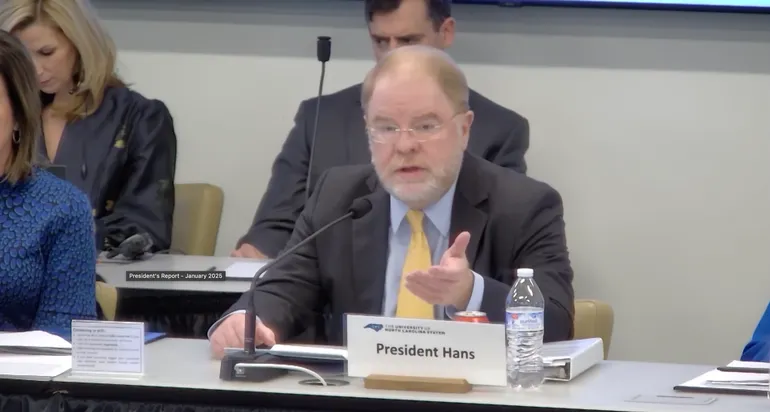
    Friday’s policy change carried out UNC President Peter Hans’ promise earlier this month that the 16-college system would soon adopt “a consistent rule on syllabi transparency.” 

    He publicly announced the forthcoming change in a Dec. 11 op-ed for The News & Observer after multiple UNC campuses received enormous public information requests this year from at least one conservative organization.

    In July, the Oversight Project, a conservative activist group that spun off from The Heritage Foundation, submitted a massive request to University of North Carolina at Chapel Hill, seeking course materials for over 70 undergraduate and graduate classes, ranging from topics on business to urban planning to nursing to African American studies. 

    Course titles included “United States Latino/a Theatre,” “Gender and Sexuality in Islam” and “Diversity and Inequality in Cities.” From those classes, the group requested “all syllabuses, lecture slides, course materials, or presentation materials presented to students” that include terms such as “sexuality,” “diversity and inclusion,” “implicit bias” and “cultural humility.”

    UNC-Chapel Hill declined to fulfill the request in August, on the grounds that it would infringe on instructors’ intellectual property

    An hour away, however, administrators at the UNC Greensboro ordered faculty to submit spring 2025 syllabi to fulfill a similar records request, according to WUNC, the public radio station operated by the university.

    Hans said this month that a single, campus-wide rule would “ensure that everyone is on the same page and similarly committed heading into each new semester.” He argued that public syllabi would enable students to make informed academic decisions and allow UNC to “stand behind our work” amid “an age of dangerously low trust in some of society’s most important institutions.”

    But Hans‘ edict prompted swift backlash from faculty.

    Two professors at UNC Charlotte — Caitlin Schroering and Annelise Mennicke — protested the forthcoming change in an op-ed published by NC Newsline the same day.

    “Publicly posting required course content and course objectives can lead to the weaponization of this information,” the pair said. “This will produce a chilling effect where faculty feel pressure to self-censor the content of their courses to avoid being pulled into the political spotlight.”

    Schroering and Mennicke also raised concerns that publicly posting syllabi “in an era of political extremism” could risk the safety of those on UNC campuses, citing the wave of disrupted lectures, faculty doxxings and politically motivated shootings.

    “Publicly posting course syllabi only increases access to sensitive information by bad actors. This is a real security concern that can be avoided,” they said.

    In his op-ed, Hans acknowledged that the policy change would open campus up to critique “in a time when healthy discussion too often descends into outright harassment.”

    “There is no question that making course syllabi publicly available will mean hearing feedback and criticism from people who may disagree with what’s being taught or how it’s being presented,” he said. “That’s a normal fact of life at a public institution, and we should expect a vibrant and open society to have debates that extend beyond the walls of campus.”

    But he ultimately argued that the benefits outweighed the costs.

    “We will do everything we can to safeguard faculty and staff who may be subject to threats or intimidation simply for doing their jobs,” Hans wrote.

    The North Carolina conference of the American Association of University Professors also pushed back on the change. The group urged Hans to ditch the policy in a petition that garnered over 2,800 signatures as of Monday afternoon.

    “If your concern is to guide students along their academic journey, then ask that syllabi be accessible only to students,” the letter said. “Faculty want what is best for their students and go to great lengths to make sure they have what they need, but do not want people who are not in their classes accessing their syllabi.”

    But making syllabi available publicly, the petition said, instead appears to be a “politically motivated” move with “no evidence of any accrued benefits for students, nor of goodwill being generated between the university and the public.”

    “Instead, providing public access to syllabi during a period of heightened partisanship and rising political violence looks like partisan pandering with a cost to faculty and no benefit,” it said.

    Source link

  • The Courage to Be Soft (Jennifer Reed)

    The Courage to Be Soft (Jennifer Reed)

    As the semester is coming to a close (and my office building is closed and locked with no heat during finals week), I am reflecting on teaching in person again. I have only taught online since the Covid pandemic.

    Working with undergraduate students in person has given me better insight into what’s going on for young adults at this time. While they are struggling more with reading and writing overall, which we hear about often, there is another part I don’t really see written about.

    As another instructor put into words while we were discussing it, these students are generally “softer” but not in a way that is weak. Sure, there are more mental health struggles (I mean, look at the world they’ve grown up in), but this is separate and different.

    What I’ve witnessed and other instructors echoed in their recent experiences is what Brené Brown refers to as vulnerability. Vulnerability that is courageous, and proposed solutions to today’s social problems that are “both/and” rather than “either/or.”

    As a trend, they’re tired of the division. And they’re bringing their hearts, not just their minds to finding a way forward. I have come to see this as a strength. We don’t need more clever ideas. We need more people who care.

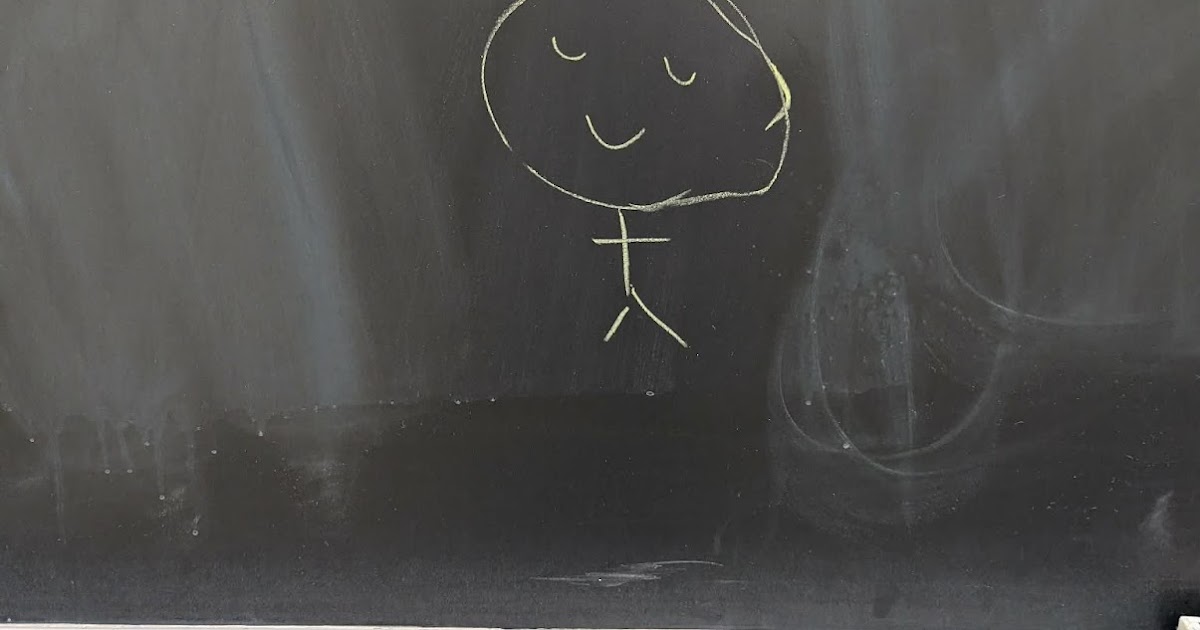
    So, the stick figure on the chalkboard was drawn by a young man right after class ended. We were having a class discussion about heavy topics, capitalism & the economy and authority & the state. Students engaged as small groups in a Power Council Meeting activity. Each group had to decide on one policy proposal to respond to an economic crisis. They did an amazing job.

    You can see the erased chalk all around the stick person. Remnants of a bunch of words I had written on the board pertaining to the lesson and students’ responses. This young man drew the stick person underneath in the middle of all that. It struck me.

    “What is he doing there?” I asked. “He’s just hanging out,” he replied. It was cold that day, so I asked if the guy in his drawing was at least warm. “No, but he’s trying to stay warm,” he said and looked down.

    We said our goodbyes. Then I started erasing the board. And I thought about the metaphor of this little person trying to just stay warm beneath all these big words and ideas. So, I erased all around him. Then snapped a picture to remember the moment.

    There was something so pure and poignant about it. That’s what I see in a lot of these young people. They understand that life doesn’t have to be this hard if you, we simply go back to the basics.

    Jennifer J. Reed, Ph.D. is an assistant lecturer of sociology at The University of Akron. She was a teen mom in Appalachian Ohio, completed her doctorate at the University of Nevada, Las Vegas, and is a gramma of 10.

    Source link

  • Pomona College considers acquiring Claremont Graduate University

    Pomona College considers acquiring Claremont Graduate University

    This audio is auto-generated. Please let us know if you have feedback.

    Dive Brief:

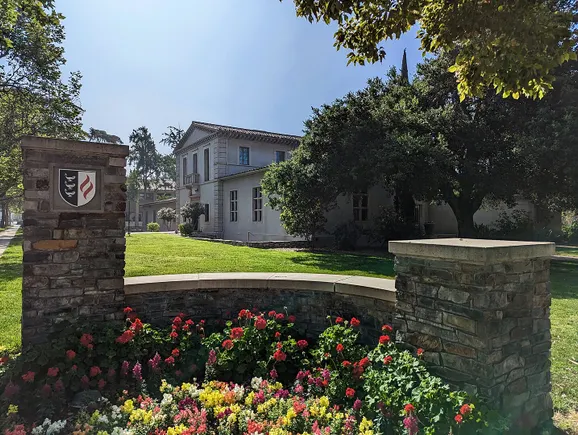
    • Pomona College is considering acquiring Claremont Graduate University after initiating confidential talks in late spring and entering exclusive talks in December. 
    • The private nonprofit institutions, in California, announced their discussions last week and invited their communities to weigh in. They expect to negotiate a definitive agreement over the next six months. 
    • CGU has been exploring teaming up with another institution for over a year. On an FAQ page, the university says it is seeking “a mission-aligned partner that values graduate education and can support CGU’s transformation in response to financial, demographic, and technological change.”

    Dive Insight:

    Pomona and CGU’s agreement to exclusively discuss a transaction is nonbinding, meaning either can walk away from the talks at any point. For its part, CGU said that if it determines that “a partnership is not in its best interest or cannot be structured appropriately, the partnership will not proceed.”

    Although they are still negotiating a detailed agreement, CGU wants a deal that would preserve its “name, mission, graduate identity, and academic autonomy.” The university also said that a transaction would neither result in a single institution nor would its students receive degrees from Pomona. 

    Pomona is an undergraduate liberal arts college offering just under 50 bachelor’s programs in the arts, humanities, natural sciences and social sciences, while CGU offers master’s, doctoral and certificate programs in a wide range of liberal arts and professional areas. 

    On the table is a deal that would turn CGU into a legal subsidiary of Pomona. This would not mean, according to CGU, that Pomona would subsidize its operations. Rather, Pomona would provide strategic guidance while helping it explore options for new financial models, investment management and additional revenue. 

    “CGU and Pomona would remain distinct institutions with separate admissions, academic programs, faculty, and degrees,” CGU said on its FAQ page. “Each school would continue to serve its own students and maintain its own educational mission.”

    Likewise, Pomona President Gabrielle Starr said in a statement Thursday that “Pomona’s liberal arts undergraduate mission must and will not be turned aside by any agreement with CGU.”

    Both institutions are part of the Claremont Colleges consortium, a century-old collaboration among seven independent institutions with adjoining campuses in southern California. It aims to provide “university-scale services and facilities” while individual institutions maintain the small liberal arts college experience, according to its website. 

    In entering talks with CGU, Pomona’s board considered “whether this partnership may, in fact, be essential to protecting and preserving the Consortium,” Starr said. Specifically, the college said in an FAQ that having a role in shaping CGU’s future could ensure the stability of the consortium, whereas an outsider partnering with CGU might not have the same interests in the coalition. 

    A partnership could also create new graduate pathways for Pomona’s students, the college said in the FAQ. 

    The two institutions have similarly sized student bodies, though they’re on different trajectories. Pomona’s fall headcount in 2023 stood at 1,664, up 5.8% from five years prior. CGU had 1,763 students in fall 2023, a decline of 6.3% from 2018. 

    Pomona also has more financial resources, with $3.9 billion in total assets and $424.6 million in liabilities in fiscal 2024 compared to CGU’s $347.4 million in assets and $57.2 million in liabilities. 

    Just under two years ago, CGU, facing an operating deficit, formed a committee to look at new institutional models to ensure its sustainability. Last July, it hired a consultancy, Tyton Partners, which specializes in transactions and partnerships in the education sector. In the early months of this year, the institution reached out to over 100 possible partners and invited them to provide written interest. 

    CGU narrowed the list of prospects down to about a dozen and sought formal indications of interest. It eventually landed on Pomona to hold exclusive talks about a transaction. 

    “This would not be a bailout or merger,” CGU Interim President Michelle Bligh said in a public message Thursday, describing instead a “true alliance” and “opportunity to co-create a new model of graduate education for the 21st century.”

    Source link

  • DOJ Report Declares MSIs Unconstitutional

    DOJ Report Declares MSIs Unconstitutional

    Photo illustration by Justin Morrison/Inside Higher Ed | d1sk and nullplus/iStock/Getty Images

    The Department of Justice has declared a slew of Department of Education programs and grants unconstitutional based on the Supreme Court’s decision in Students for Fair Admissions v. Harvard and the University of North Carolina.

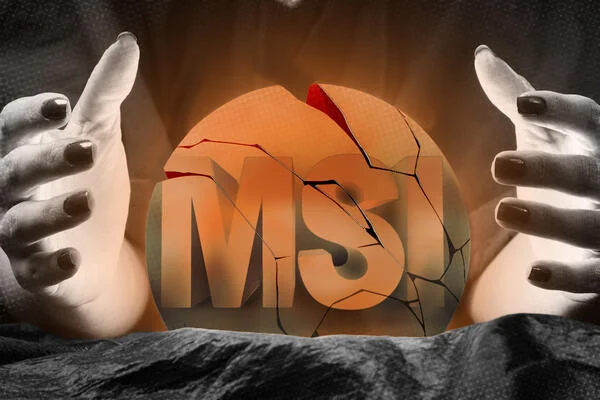
    According to a report by the DOJ’s Office of Legal Counsel (OLC), minority-serving institution (MSI) programs are unlawful because they award money to colleges and universities based on the percentage of students of a certain race. The report said such programs “effectively [employ] a racial quota by limiting institutional eligibility to schools with a certain racial composition” and should no longer be funded.

    The report also deemed it unconstitutional that two scholarship providers, the United Negro College Fund and the Hispanic Scholarship Fund, both of which award scholarships to students of a specific race, are given access to Free Application for Federal Student Aid data.

    In a statement from the education department, Secretary Linda McMahon said that the report is “another concrete step from the Trump Administration to put a stop to DEI in government and ensure taxpayer dollars support programs that advance merit and fairness in all aspects of Americans lives. The Department of Education looks forward to working with Congress to reform these programs.”

    The statement noted that the department is “currently evaluating the full impact of the OLC opinion on affected programs.”

    The OLC also evaluated the constitutionality of two TRIO programs, the Ronald E. McNair Postbaccalaureate Achievement Program, a scholarship that helps students from underrepresented backgrounds work towards Ph.D.s, and Student Support Services, which provides grants for institutions to develop academic support infrastructure. It ultimately concludes that those programs are constitutional and may continue to be funded.

    Nevertheless, in ED’s announcement of the DOJ decision, those TRIO programs were included in a list of “affected programs.”

    The Trump administration’s attack on MSI programs began in July, when the U.S. Solicitor General declined to defend against a lawsuit challenging the definition of a Hispanic-serving institution (HSI) as one that enrolls a student body with at least 25 percent Hispanic students. In September, ED officially announced its plans to end these programs, terminating the majority of MSI grants for FY2025.

    Supporters of MSI programs strongly criticized the OLC’s report.

    “Today’s baseless opinion from the Justice Department is wrong, plain and simple. Donald Trump and his Administration are once again attacking the institutions that expand opportunity for millions of aspiring students of all backgrounds. The opinion ignores federal law, including Congress’ bipartisan support for our nation’s Hispanic-Serving Institutions and Minority-Serving Institutions, including more than 100 MSIs in California alone,” Senator Alex Padilla, a California Democrat who chairs the Senate HSI Caucus, wrote in a statement. “Every student deserves access to the American Dream. This unconscionable move by this Administration will harm millions of students who deserve better.”

    Presidents of institutions that could be impacted by the legal decision are also speaking out. Wendy F. Hensel, president of the University of Hawai’i, called the news “disappointing” in a statement to the campus community. UH is an Alaskan Native and Native Hawaiian-serving institution, an Asian American and Native American Pacific Islander-serving institution, and a Native Hawaiian Career and Technical Education grantee; Hensel said these programs are “vital” to UH and the state of Hawai’i.

    She wrote that the university’s general counsel is examining the full report and that campus leadership is currently “evaluating the full scope of the impact on our campuses and programs and implementing contingency plans for the loss of funding.”

    “We recognize that this news creates uncertainty and anxiety for the students, faculty and staff whose work and educational pathways are supported by these funds. We are actively assessing how best to support the people and programs affected as we navigate this evolving legal landscape,” she wrote.

    Trump’s allies, however, applauded the report and ED’s efforts to end MSI programs.

    “Today’s announcement is a strong step by the Trump administration to end racial discrimination in our higher education system. These programs determine funding eligibility through arbitrary, race-based quotas which unfairly assume a student’s background determines his or her educational destiny,” Education and Workforce Committee Chairman Tim Walberg, a Republican representative from Michigan, wrote in a statement. “America was founded on the principles of freedom and equality, and that every citizen can chase the American Dream. In Congress, we are working with the Trump administration to create a fairer higher education system so every student has a strong chance at success.”

    Source link

  • CSU Trade Workers Union Votes to Strike Statewide

    CSU Trade Workers Union Votes to Strike Statewide

    David McNew/Getty Images

    Members of Teamsters Local 2010, a union representing 1,100 skilled trade employees at the California State University system, voted Monday to authorize a strike across all 22 campuses.

    CSU refused to pay contractually guaranteed five percent raises and salary step increases in July, and the union has filed several unfair labor practice complaints against the university system, union representatives said in a news release. Teamsters members are not striking yet, but are prepared to do so “if CSU continues to break the law, ignore their contract, and refuse to pay the raises that its skilled workforce is owed,” the release stated.

    “CSU is steering itself into a completely avoidable battle with the Teamsters Union. Our members will not stand by while the University commits unfair practices, misuses state funds, breaks its promises, and enriches executives at the expense of the workers who keep its campuses running,” Jason Rabinowitz, secretary-treasurer of Teamsters Local 2010, said in the release. “CSU’s greed, dishonesty and disrespect for its workforce are indefensible. This vote makes clear that we are ready to strike if CSU continues to rip us off while lining their own pockets.”

    In a statement, a spokesperson for the CSU Chancellor’s office said the vote is procedural and that a strike is not necessarily “imminent.”

    “The result of the strike authorization vote is disappointing, as the current labor agreement, negotiated and ratified through the collaborative collective bargaining process, contained clear contingency provisions language that tied certain salary increases to the receipt of new, unallocated, ongoing state funding. Those contingencies were not met, leading to the current reopener negotiations on salary terms,” the spokesperson said. “We believe the time and resources of all parties would be more productively devoted to the bargaining table, where meaningful progress can be made, rather than toward preparing for a strike.”

    Source link

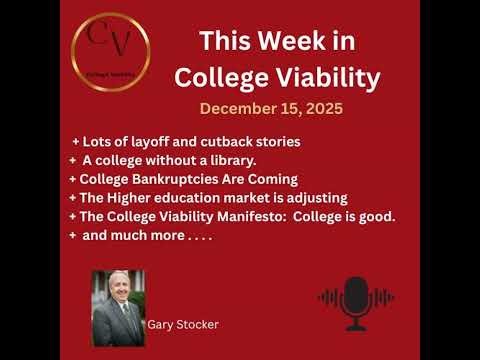
  • This Week In College Viability (TWICV) for Dec 15, 2025 (Gary Stocker)

    This Week In College Viability (TWICV) for Dec 15, 2025 (Gary Stocker)

    This podcast examines the financial health and long-term viability of public and private colleges, drawing on data, institutional financials, and perspectives rarely centered in mainstream higher education coverage.

    This week’s discussion highlights a wave of layoffs, program cuts, and institutional retrenchment across the sector. Stories include colleges eliminating dozens of “low-producing” academic programs, campuses experiencing sustained enrollment decline, and institutions emerging from—or newly entering—financial and accreditation probation after deep budget cuts.

    Several cases illustrate how financial stress reshapes academic life: colleges cutting entire majors such as economics and physics, institutions laying off staff as part of resource “shifts,” and campuses operating without core infrastructure—such as libraries—for years. The episode also addresses abrupt closures, including bankruptcies that disrupt students and anger alumni, reinforcing warnings that delayed action often increases harm.

    At a policy level, the podcast notes signs of structural adjustment in higher education, including Colorado Governor Jared Polis’s proposal to merge the state’s higher education and labor departments—an acknowledgment of the growing alignment between workforce policy and postsecondary education.

    Overall, the episode argues that college bankruptcies are coming, not as isolated failures but as predictable outcomes of demographic decline, financial mismanagement, and delayed decision-making. It closes by pointing listeners to The College Viability Manifesto, which calls for earlier, more transparent intervention to reduce damage to students, workers, and communities.

    Source link

  • The trouble with banning Fizz

    The trouble with banning Fizz

    On college campuses across the country, students and administrators are debating bans on Fizz, a mobile app that lets users within a particular community — such as a college or university — communicate anonymously.

    Some view Fizz as a source of bullying and other unwelcome content. Yet many students see Fizz — founded by two Stanford dropouts who felt their campus lacked opportunities to build community during the COVID-19 pandemic — as a source of vital connection. Indeed, The New School Free Press described the app as “a central hub for students to anonymously vent their frustrations, experiences, and feelings.” 

    Campus newspapers from communities as varied as The New SchoolGeorgetown, and Colby have run op-eds this semester proclaiming the app beloved by their student bodies. To these students, anonymous apps like Fizz and its industry peer Sidechat aren’t just sources of humor and gossip — they’re important forums for discussion about taboo subjects such as STDs, student labor union disputes, and law enforcement. Last spring at UCLA, for example, Sidechat played a noteworthy role in helping pro-Palestinian campus protesters track police actions.

    A brief history of attempts to ban anonymous platforms

    This isn’t the first time an anonymous social media platform has sparked controversy, split reactions, and faced bans on campus. In 2016, numerous private colleges and universities banned Yik Yak, a location-based anonymous messaging app that shut down in 2017 amid reports of rampant bullying. Then, as now, user experiences varied. Though some pointed to the app’s abuses, others found spaces for open discussion, particularly on sensitive subjects.

    For example, at John Brown University, a Christian college in Arkansas, students used Yik Yak to discuss a professor’s “views on the LGBTQ+ community” and the university’s treatment of same-sex couples. Without an anonymous platform, these students’ concerns may have gone unaddressed.

    In 2022, Yik Yak re-emerged with new “community guardrails” to prevent harassment and abusive behavior. Now, it’s back to facing proposed bans on campus, alongside Fizz and Sidechat — which acquired Yik Yak in March 2023. 

    The Futility of ‘Banning’ Yik Yak on Campus

    On college campuses across the country, students and administrators are debating banning Yik Yak, a mobile phone application that allows its users to communicate anonymously.


    Read More

    In some ways, it feels like 2016 all over again. But in the years since the first anti-Yik Yak crusades, what has changed? 

    On the technology side, the changes have been mostly minor. Yik Yak’s model of open access to geofenced forums for users within a certain mileage radius meant a competing setup could emerge with the advent of Fizz and Sidechat, which provide each college or university with its own private “campus community.” These communities are open only to those with verified school email addresses. 

    On the policy side, though, the developments have been more troubling. Instead of administrators imposing new restrictions over the objections of their student bodies, students themselves are now urging schools to curtail their ability to use anonymous apps. From liberal arts colleges in Pennsylvania to large research universities in Texas, students are leading campaigns urging their schools to ban platforms they say are causing “harm,” including “cruel, racist, homophobic, anti-disability comments” and “a surge of racism.” And this time around, public universities — that, unlike private institutions, are beholden to the First Amendment — are joining in on the bandwagon. The University of North Carolina system has said it is working on a ban targeting Yik Yak, Sidechat, Fizz, and Whisper. A public institution completely banning these platforms would jeopardize student rights and shut off popular avenues for expression on campus.

    How the First Amendment protects online and offline anonymous speech

    To FIRE’s knowledge, no public college or university blocked access to Yik Yak on its network during the first round of attempted bans in 2016. Such a restriction by a public institution would conflict with the First Amendment, which protects the right to anonymous speech. As the Supreme Court recognized in McIntyre v. Ohio, anonymity “exemplifies the purpose behind the Bill of Rights and of the First Amendment in particular: To protect unpopular individuals from retaliation . . . at the hand of an intolerant society.”

    The Electronic Frontier Foundation has likewise explained that a public institution’s prohibition on anonymous online platforms would contravene the First Amendment, since courts have recognized that the First Amendment protects anonymous speech on the internet specifically. In Doe v. 2TheMart.com, Inc., senior district judge Thomas Samuel Zilly concluded, “Internet anonymity facilitates the rich, diverse, and far-ranging exchange of ideas. The ability to speak one’s mind on the Internet without the burden of the other party knowing all the facts about one’s identity can foster open communication and robust debate.” “Indeed, our founders relied on anonymity when creating the Constitution,” EFF similarly wrote.

    Anonymous speech, present at the founding in The Federalist Papers and Common Sense, lies at the core of American liberty — and we must not forget it.

    The offensiveness of the speech at issue doesn’t strip it of First Amendment protections on campus — if anything, it reinforces why those protections exist. As recognized in Gay Lib v. University of Missouri, a public university, “as an instrumentality of the State, has no right to restrict speech or association simply because it finds the views expressed to be abhorrent.”

    The practical stakes of banning anonymous forums from campus are high. Cutting off access to online platforms doesn’t only silence offensive comments — it restricts the tools students use to speak, organize, and mobilize around political and social causes, in ways that are often faster and more powerful than offline alternatives.

    Consistent with their right to speak anonymously, students possess the First Amendment freedom to assemble and receive information through both online platforms and offline media. As Justice Black wrote in Martin v. City of Struthers, “This freedom embraces the right to distribute literature, and necessarily protects the right to receive it.” By prohibiting anonymous social media platforms, schools would unconstitutionally impede students’ ability to access information from peers who may express certain critiques of the status quo only through anonymous online speech.

    The symbolism of bans

    Attempts by colleges to block access to such platforms are not only legally fraught, but also ineffective. A campus’s control over internet access extends only so far: An institution cannot stop a student from visiting a particular website or using an app at home, in a public library, or from a neighborhood café. In an era of widespread cellular data and VPNs, bypassing a campus network restriction is as easy as disconnecting from campus Wi-Fi. Put simply, preventing student access to Yik Yak, Fizz, or any other app is impossible absent extreme measures such as disrupting cellular service or punishing students for using technology off campus.

    Despite this inherent futility, several institutions have nonetheless imposed such bans. When Saint Louis University banned Yik Yak in March 2015, it characterized the app as “inappropriate and counterproductive,” but acknowledged that it would remain accessible on students’ mobile devices, a tacit recognition of the ban’s ultimate ineffectiveness. Nevertheless, the university framed the ban as an “important and symbolic” step. After Yik Yak was blocked from campus internet access, the platform unsurprisingly continued to receive dozens of posts each day from SLU students using cellular data. New restrictions on platforms like Fizz, Sidechat, or Whisper are likely to prove equally pointless.

    So, given the ineffectiveness of such bans, why do they matter? SLU was right about one thing: They’re symbolic. And the symbol such bans conjure should alarm us all. That students would support, and in some cases, ask, for administrators to curb their right to anonymous speech is a disturbing harbinger of an all-too-common willingness to accept the tyranny of good intentions, oblivious or indifferent to the harms such kindly inquisitors pose. 

    From student activists today to political thinkers at the nation’s founding, anonymity has long been a vital tool for challenging entrenched power. 

    Students assume administrators will use such powers for good. When anonymous feeds start functioning as an unaccountable rumor mill — where, as one student at Marywood University put it, “Yik Yak’s anonymous posts allow for people to make fun of people and have no consequences” — it’s not hard to see why some students reach for the quickest lever available: Cutting off campus Wi-Fi access. And when students describe anonymity as “really bad” because it lets people post hateful attacks “and face no consequences,” the ban-them-all pitch is often framed less as punishing dissent than as basic harm reduction — a way to deter doxxing, harassment, and spiraling pile-ons when platform moderation and campus processes feel too slow or toothless. At the University of Vermont, for example, a student who said he’d seen posts that were “super racist or super sexist or homophobic” argued “there would be an improvement on the well-being of the community if the app were restricted.” Students want a safer campus climate, and they trust bans from administrators to get there.

    Yet, banning entire platforms is a heavy-handed solution. There are more narrowly-tailored ways to address genuine safety concerns. The First Amendment doesn’t protect discriminatory harassment, true threats, or violence; university administrators and content providers can address targeted instances of unlawful conduct without wholesale platform restrictions.

    Handing over broad banning powers carries its own risks, too. The idea that it’s anyone’s business which apps you use reflects a paternalistic and authoritarian mindset, one more appropriate to grade-school supervision than to the treatment of autonomous adults. This is probably not a precedent students actually want to set.

    Moreover, the moral panic we’re seeing flattens the reality that people engage with platforms in markedly different ways — technology is a tool capable of both benefit and abuse, not a single, undifferentiated force. Writing in Bloomberg, FIRE board member Virginia Postrel described her own experience exploring Yik Yak and concluded that anonymity can foster empathy and mutual support among students. Rather than serving only as an outlet for provocation, anonymity often creates a space where students can acknowledge vulnerabilities they “often won’t admit to their friends,” including academic pressure, loneliness, and mental health struggles.

    Postrel highlights exchanges in which students openly share feelings of despair and are met with immediate affirmation — simple responses like “I feel the same way” and “me too” that convey understanding and solidarity. In settings where public disclosure might invite ridicule or dismissal, anonymity allows students to recognize that they are “not alone.”

    Banning platforms that allow anonymous speech is not merely unlawful in some circumstances. It is fundamentally hostile to a culture of free expression. An open internet has long served as a refuge for subcommunities that might otherwise disappear entirely — political dissidents living under authoritarian regimes, sexual minorities navigating social stigma in small or insular communities, and countless others for whom visibility carries real risk. From Signal to Telegram, Reddit to Craigslist — and yes, from Yik Yak to Fizz — forums that permit anonymity have historically empowered the powerless. They do not inherently invert power dynamics in favor of abuse, as critics often suggest. If anything, they correct imbalances that would otherwise silence vulnerable voices altogether. 

    As EFF observed, anonymity can be essential to student activism and support-seeking on campus. Anonymity can allow survivors of sexual or racial violence to discuss their experiences and find support without exposing themselves to further harm. At Columbia, for example, student activists relied on anonymous speech to criticize what they viewed as an inadequate university response to sexual assault allegations from their peers — fearing retaliation, discipline, or lawsuits if they spoke publicly. At Guilford College, students circulated an online form to gather anonymous accounts and reports of racial violence from people who didn’t feel safe submitting their names through official university channels.

    These anecdotes are not outliers but part of a long American tradition of protecting the right to privacy. Speakers may opt for the security of anonymity rather than risk attribution; this should not be met with punishment. From student activists today to political thinkers at the nation’s founding, anonymity has long been a vital tool for challenging entrenched power. Anonymous speech, present at the founding in The Federalist Papers and Common Sense, lies at the core of American liberty — and we must not forget it.

    Source link

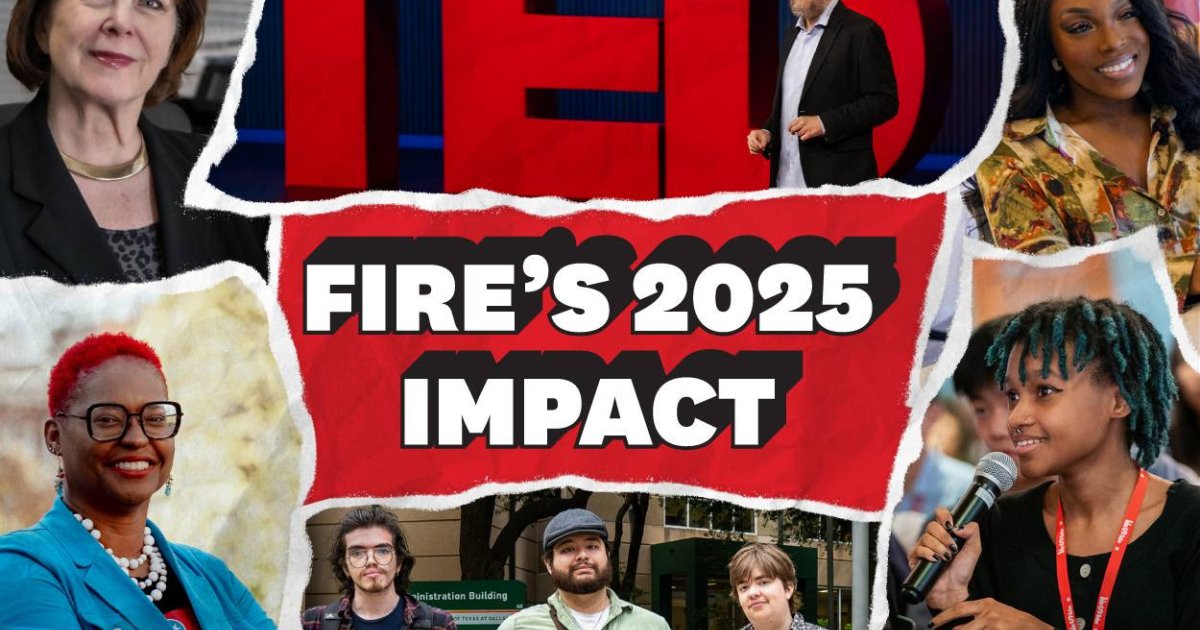
  • FIRE’s 2025 impact in court, on campus, and in our culture

    FIRE’s 2025 impact in court, on campus, and in our culture

    Each passing year gets busier and busier for FIRE, and this year was no different. The numbers alone say a lot: With a current caseload of 34 litigation cases and 300 more non-litigation advocacy matters, 50 amicus brief submissions, and 21,500 media mentions (and counting!) under our belt, FIRE is bringing the heat everywhere. 

    Our big — and growing! — community of supporters enabled us to go big and be bold, to stand up to bullies, to stand up for everyday Americans, and to fight for that precious right to free speech that we all love and cherish. We are proud to serve as the nation’s premier free speech watchdog and achieve victories like those highlighted below.

    In Court

    FIRE notched major litigation victories this year, proving our prowess in court as America’s leading First Amendment defender.

    We argued and won a federal appeal for a professor sanctioned for criticizing his college’s lowering of academic standards, and won a settlement for a pharmacy student expelled for posting song lyrics. We also persuaded a court to halt a new Texas law that bars all expressive activity on campus after 10 p.m., and ensured California won’t force community college faculty to endorse DEI principles.

    Her grad school tried to expel her for a tweet about Cardi B. Now they’ll pay a $250K lawsuit settlement

    Kim Diei’s settlement is a warning to colleges around the country: If you police students’ personal online expression, there will be consequences.


    Read More

    We got a high schooler’s record expunged, his school’s “hate speech” policy amended, and a monetary settlement after he was suspended simply for posting a “meme rap” song on personal time away from school; and achieved victory on behalf of town residents when we fought and won a repeal of an ordinance restricting the holiday decorations they could display.

    Our current docket includes a challenge to Immigration and Nationality Act provisions used to deport lawfully present noncitizens simply for speech the government dislikes. We are also defending a retired police officer jailed for 37 days for posting a Facebook meme, and an Iowa pollster, Ann Selzer, against President Trump’s ongoing lawsuit (we already won a dismissal of a separate class action making the same claims). Our docket also includes a return trip to the Supreme Court on behalf of a Texas citizen reporter jailed for newsgathering, and a challenge by an elected school board member barred by New Jersey law from engaging with her constituents. 

    We are currently awaiting appellate decisions in our challenge to Florida’s STOP WOKE Act, our suit for animal rights activists arrested for “offensive” industrial-farming videos, our lawsuit on behalf of students who wore “Let’s Go Brandon” garb to junior high, and our challenges to various state social media restrictions.

    In Briefs

    These are just some of the cases our team of in-house First Amendment attorneys are litigating directly, but we can’t forget the 50 amicus briefs filed to advance the law. 

    Over the year, we participated in multiple cases opposing government efforts to deport lawfully present noncitizen students for expression and viewpoints the administration disfavors; objected (while noting longstanding concerns with the state of free speech at their institutions) to the government’s efforts to withhold funding and interfere in governance and academic freedom at Harvard and Columbia; and opposed government efforts to censor individuals for sharing views on transgender athletes in high school sports.

    FIRE also fought for the right to anonymous speech by challenging actions requiring adults to turn over their government IDs to access online content, and we filed a brief in Garcia v. Character Technologies, a leading-edge case on First Amendment protection for artificial intelligence.

    Out-of-Court Advocacy

    Demonstrating our ability to defend expressive rights without ever setting foot in court, FIRE notched nearly 80 victories defending the First Amendment rights of everyday Americans in 2025. 

    As usual, our cases ran the gamut from defending a student threatened with discipline for wearing a TPUSA hat, to rallying the residents of a New Jersey town to defeat an ordinance requiring a $2 million insurance policy if residents wanted to demonstrate, to fighting for a student journalist who was kicked off campus for publishing criticism of the campus administration. 

    At the Institute of American Indian Arts, criticism of school officials is ‘bullying’

    Administrators kicked the Young Warrior’s editor out of student housing and put him on probation for publishing student work critical of school officials.


    Read More

    Campus Reform 

    In 1999, we started our work on campus because the American university is ground zero for censorship. It’s the place where we see illiberal trends emerge and generations indoctrinated with “free speech for me but not for thee” attitudes. It’s vital we defend and promote the values of free expression on campus so we can secure them for our country and Americans everywhere.

    This year, FIRE met with dozens of campus leaders, resulting in the reform of more than 30 campus policies impacting over 1 million students. We added four new institutions to our list of “green light” schools that maintain no restrictive speech policies, making this the first school year in our history when we tracked more schools that protect speech in their policies than schools that significantly restrict it.

    And, FIRE continues to shape the next generation of free speech leaders. We hosted 22 interns, 14 legal clerks, 100 undergrads at our Student Network Summer Conference, and 200 high schoolers at our second annual week-long summer camp, the Free Speech Forum. Our programs are free to attend and leave young people inspired. Here’s what just one had to say: 

    Before FIRE . . . I could not engage in a civil conversation over controversial topics. After FIRE, I’ve had many civil conversations over the same or different topics. What’s different? I listen, I ask, then I speak.

    Thought Leadership 

    Guiding the national conversation back to nonpartisan free speech principles, FIRE was everywhere this year, warning politicians across the political spectrum that practicing censorship will come back to haunt them, combating the “words are violence” cliche, and explaining that “hate speech” is protected speech. Our staffers placed op-eds in leading publications like The Wall Street Journal, MSNBC, and Reason; and The New York Times ran a front-page profile of FIRE and featured FIRE President and CEO Greg Lukianoff on an episode of The Daily.

    Greg was on the speaking circuit nonstop this year. The highlight was his TED Talk, which introduced hundreds of thousands to FIRE’s mission. Check it out if you haven’t yet! 


    Thank You!

    As a nonprofit organization, these achievements are only possible thanks to the generosity of our supporters. If you’ve already donated this year, please know that we sincerely appreciate your support. If you haven’t yet, please consider joining our growing movement of principled, nonpartisan free speech defenders by making a donation before the end of the year.

    Source link

  • Three Promising Practices to Engage a New Workforce – The 74

    Three Promising Practices to Engage a New Workforce – The 74


    Get stories like this delivered straight to your inbox. Sign up for The 74 Newsletter

    Right now, tomorrow’s workforce is on TikTok and Instagram, looking at “influencer” or “crypto genius” as an exciting career option — not so different, really, from a previous generation wanting to be a pop star or win Shark Tank.

    Like those old-school dream gigs, today’s hot online careers are mostly unattainable and unstable. For some young people, they’re also a capitulation: “My job feels like a dead end and business school isn’t in my future. Maybe people will watch me unbox purchases.”

    The next generation, a huge reservoir of talent, is rarely challenged to set a higher bar — and they get a lot more advice about building a personal brand than about building a career. Those of us leading organizations owe it to them to demystify professions and create new pathways.

    Here are three promising practices for the new workforce, especially for young people without traditional access: intensive mentoring, cross-organizational cohorts, and early experiences with professional environments.

    Mentoring

    The traditional approach to mentoring is the “old boy network.” Since the 1990s, more workers have also benefited from informal networks such as alumni associations or sometimes nonprofits that serve this purpose. However, young people may need more formal mentoring within the workplace to thrive and persist.

    Many companies assign mentors to brand new employees, but not generally for the long term. The next generation needs ongoing mentoring. First-gen professionals, especially, can find it difficult to seek guidance. They may not want to appear vulnerable; they may not know what they don’t know. Online courses — valuable for a population that has grown up watching videos — can help. But there are a million; which ones are useful? And perhaps the new employee fears being caught trying to learn their job. To address such needs, they need more than a mentor. They need a navigator.

    Beyond knowledge gaps, some young employees also need help with organizational culture. I know a recent college graduate in a start-up job where colleagues regularly drink at work. She felt she had to participate to be taken seriously. Some other, more senior colleagues who had opted out could have helped her find another way to engage. It’s on us to assist young coworkers struggling with fit.

    These new members of the workforce also need encouragement to find ongoing mentoring and keep seeking engagement. For many of them, an elevator ride with the CEO would be a terrifying moment, rather than an opportunity. A lack of guidance leads to frustration, and ultimately nonpersistence.

    Cohorts

    It doesn’t always take a senior person to help a new employee navigate. Peer cohorts can also help. Most young workers are already comfortable traveling in packs socially. An ongoing professional conversation with their peers can benefit both them and the company, and shared responsibility for problem-solving can be liberating. Women in particular have a stereotypical but real inclination to be useful, and they are more apt to receive if they can also give. Cohorts offer a way to do that.

    Even for midlevel employees, there is value in connecting across silos. I know one organization where colleagues from different departments meet monthly to catch up on their work. Individuals offer each other expertise, and departments pitch in together, which creates efficiencies.

    Engaging like this especially helps employees who are more reticent. Helping as well as being helped creates social glue — and it can also build organizational loyalty, as employees see themselves in a bigger picture.

    Early exposure

    “Summer camp” experiences on college campuses are a common way to create access and persistence for first-generation students. When middle schoolers visit campuses, they can imagine college life. Similarly, Take Your Child to Work Day has, since the 1990s, offered glimpses of the working world—at least, for children of white-collar professionals.

    But when parents work in a meatpacking plant, their children have no opportunity to get to know office culture. More and more next-gen workers lack a vision of how to belong in a corporate or institutional setting. Yet that is the most powerful element: the vision of oneself in a new context, and permission to be there.

    To get the farm team ready and overcome the sense of “not for me,” employers must invite them in early. Google, for example, invites school groups to its campus. If these young people eventually land an interview, the campus already feels familiar.

    If these promising practices seem self-evident to you, consider where you learned about your work environment. If the answer is “in college” or “from relatives,” you might ask: Who in my workforce did not get that experience? And if the answer is “I learned the hard way,” can you help someone else not to have to learn the hard way, too? 


    Did you use this article in your work?

    We’d love to hear how The 74’s reporting is helping educators, researchers, and policymakers. Tell us how

    Source link

  • 50 Baseball Jokes That Hit It Out of the Park

    50 Baseball Jokes That Hit It Out of the Park

    Baseball, the all American sport, is also great for thinking about the multiple meanings of words and playing around with language. These baseball jokes can be incorporated into morning meeting, ELA, or even math to challenge students. Give them as many at-bats as you can with these 50 jokes!

    We Are Teachers

    FREE DOWNLOAD

    Baseball Jokes Google Slides

    Share all the baseball jokes below with your students using our free Google Slideshow. Just fill out the form on this page to get them.

    Jump to:

    General Baseball Jokes

    Why do baseball games take place at night?

    Because bats sleep during the day.

    Which superhero is the best at baseball?

    Batman.

    How much time did the baseball player spend in the library?

    Five minutes. It was a short stop.

    Why was Cinderella kicked off the baseball team?

    Because she ran away from the ball.

    What did the baseball glove say to the ball?

    Catch ya later!

    Why does a pitcher raise one leg when he throws the ball?

    If he raised both legs, he would fall down.

    What animal is best at baseball?

    A bat!

    Why were there cattle on the ball field?

    They were looking for the bull pen.

    What position does Dracula play on the baseball team? 

    Bat boy.

    Why is a baseball stadium hot after a game?

    Because all the fans have left.

    Where do catchers sit at lunch?

    Behind the plate.

    A man at a baseball game wondered why the ball was getting bigger and bigger.

    Then it hit him.

    Which takes longer: running from first to second base or from second to third base?

    From second to third base, because there is a short stop in the middle.

    Why did the pitcher bring string to the baseball game?

    He wanted to tie the score.

    How many baseball players does it take to change a light bulb?

    None. They’re too busy arguing the last call.

    Where do they keep the largest diamond in NYC?

    Yankee Stadium.

    What has 18 legs and catches flies?

    A baseball team.

    Did you hear the joke about the pop fly?

    Forget it—it went over your head.

    Why did the police officer go to the baseball game?

    Because someone stole second base.

    Did you hear the one about the fast pitch?

    Never mind, you missed it.

    Baseball Riddles

    What would you get if you crossed a pitcher and the Invisible Man?

    Pitching like no one has seen.

    A man leaves home, makes three left turns, and is on his way back home when he notices two men in masks waiting for him. Who are they?

    The catcher and the umpire.

    What goes all the way around the baseball field but never moves?

    A fence.

    What is the difference between a boy who is late for dinner and a baseball hit over the fence?

    One runs home and the other is a home run.

    Two baseball teams play a game. The home team ends up winning, but not a single man from either team has touched a base. How can this be?

    The teams were all women.

    Baseball Wordplay Jokes

    What’s the difference between a pickpocket and an umpire?

    One steals watches and one watches steals.

    Where do coal diggers play baseball?

    In the miner leagues.

    When should baseball players wear armor?

    During knight games.

    What is a baseball player’s least favorite Star Wars movie?

    “The Umpire Strikes Back.”

    Why is Dodger Stadium the coolest place to be?

    It is full of fans.

    Where do you keep your mitt while driving?

    In the glove compartment.

    Which baseball player holds water?

    The pitcher.

    Which famous baseball player loved fireplaces?

    Mickey Mantle.

    How do baseball players keep in contact?

    They touch base every once in a while.

    Where does the baseball player go when he needs a new uniform?

    New Jersey.

    Why are frogs good baseball players?

    They are good at catching flies.

    What do baseball players eat on?

    Home plate.

    What do baseball players use to bake a cake?

    Mitts, Bundt pans, and batter.

    Where did the baseball player wash his socks?

    In the bleachers.

    Why can’t you play baseball on the savanna? 

    There are too many cheetahs.

    Which animated character is the best at baseball?

    Homer Simpson.

    What is a baseball player’s favorite thing about going to the park?

    The swings!

    Why are singers good at baseball?

    Because they have perfect pitch.

    What do you get when you cross a baseball player with a monster?

    A double header.

    Why don’t matches play baseball?

    One strike and they’re out!

    Why did the baseball player shut down his website?

    He wasn’t getting any hits.

    How is baseball like baking?

    They both need a batter.

    Why is it smart to bring a baseball player when you go camping?

    He can pitch the tent.

    What’s a home run hitter’s favorite type of music?

    Swing.

    What do a great hitter and a boxer have in common?

    They are both sluggers.

    Get your free baseball jokes Google Slides!

    an image of a computer and ipad screen featuring two baseball jokes slides
    We Are Teachers

    Your students will love these funny baseball jokes for kids! Just fill out the form on this page to grab your free baseball jokes Google Slides.

    Plus, check out these math jokes and puns to keep the laughs coming.

    Source link