Blog

  • Week in review: Trump expands travel ban

    Week in review: Trump expands travel ban

    Most clicked story of the week

    Beginning Jan. 1, individuals from 39 countries will face a partial or full travel ban to the U.S., following a proclamation from President Donald Trump. The expansion more than doubles the number of countries with restrictions and includes Nigeria, one of the U.S.’s top 10 sources for international students. 

    Number of the week: $2.5B

    The anticipated value of Coursera following the ed tech company’s planned acquisition of Udemy. Both MOOC providers cited demand for their artificial intelligence offerings as a motivating factor behind their merger.

    Cuts at religious colleges:

    • DePaul University, in Chicago, laid off 114 staff members as it seeks to shrink its fiscal 2026 budget gap of $12.6 million. Earlier this year, the Catholic nonprofit froze hiring, forewent merit pay increases for faculty and staff, lowered executive pay and reduced retirement contributions for senior administrators.
    • Christian Brothers University, in Tennessee, intends to eliminate 16 full-time faculty positions at the end of the spring semester. The long-struggling Catholic nonprofit notched a win earlier this month, when its accreditor removed it from probation after two years. 

    Pushback on conservative policies:

    • Attorneys general from 20 states are suing the Trump administration over its efforts to levy a $100,000 fee on new applications for H-1B visas. The lawsuit, the third of its kind, argued that the cost on skilled worker visas violates the Administrative Procedure Act because it didn’t go through a notice-and-comment period and because the fee itself is “arbitrary and capricious.”
    • A bipartisan group of federal lawmakers is urging the U.S. Department of Education to classify advanced nursing degrees as “professional” under a proposed framework for student loan lending caps. The designation would double the borrowing cap for graduate students in nursing programs to $200,000, and without it, the current “health care shortage, especially in primary care,” would worsen, they argued. 
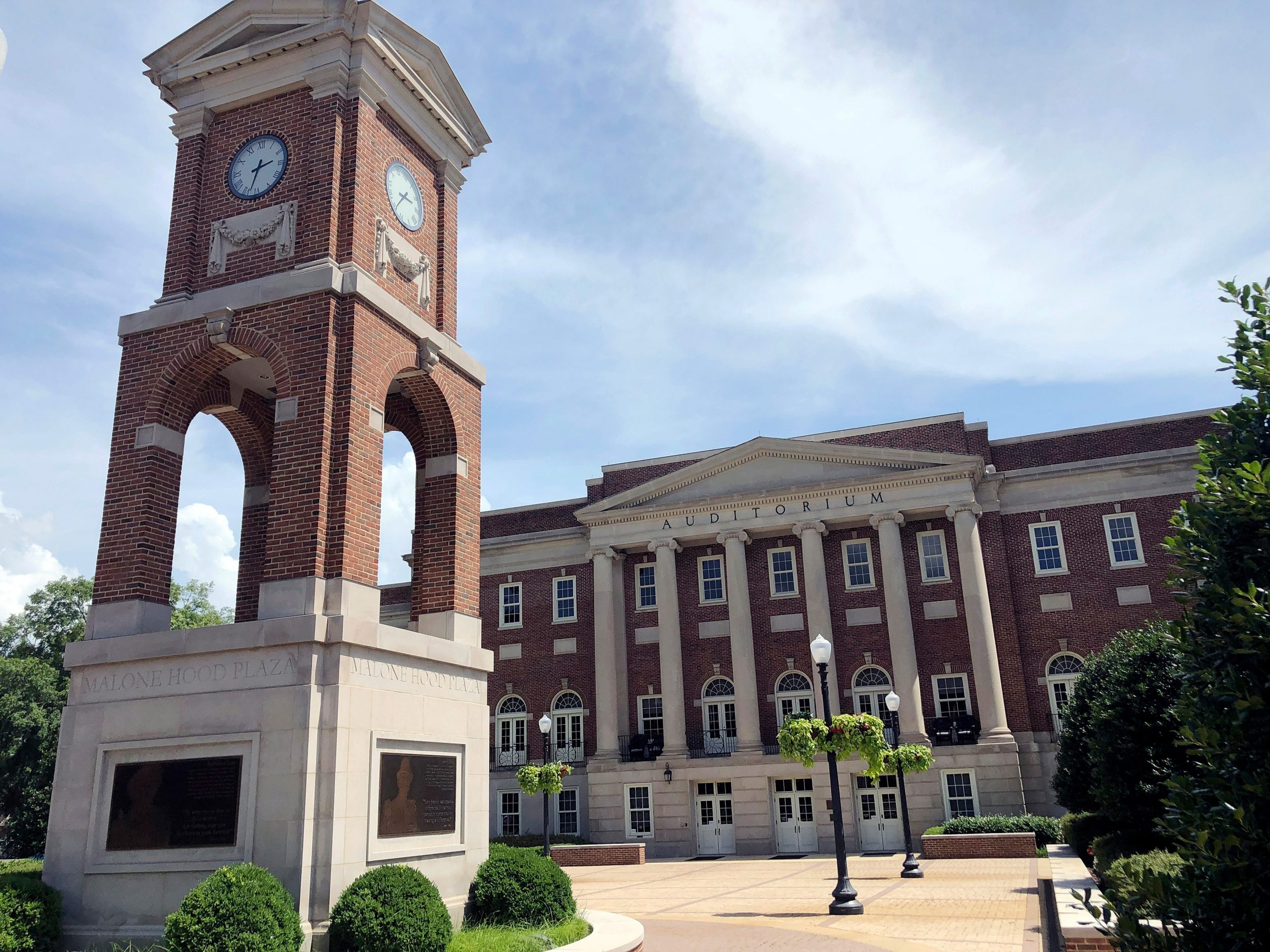
    • Faculty and students at Alabama public colleges are continuing to fight the legality of a state law that prohibits public educational institutions from sponsoring diversity, equity and inclusion programs or having DEI offices. The group appealed an August decision that kept the law in place, arguing the federal judge had misconstrued the First Amendment and overlooked important facts.

    Quote of the Week


    It is our responsibility to teach students to use [artificial intelligence] ethically and effectively, and we have to do that with a lot of strategic intentionality.

    Shonda Gibson

    Chief transformation officer at the Texas A&M University System


    Texas A&M recently partnered with Google to offer its students free access to and training on the tech company’s suite of AI tools. Gibson told Higher Ed Dive that the partnership will prepare graduates to enter a workforce increasingly shaped by AI.

    Source link

  • Community colleges are training the next generation of manufacturing workers

    Community colleges are training the next generation of manufacturing workers

    This audio is auto-generated. Please let us know if you have feedback.

    The manufacturing industry has long bemoaned the decline of its workforce. Yet today’s manufacturing educational pathways look much like they did in the ‘80s, when hiring numbers began declining.

    Apprenticeship programs remain scarce, with just 678,000 apprentices registered nationwide (in comparison, Germany’s labor force is less than a third of the U.S.’ yet maintains 1.22 million apprentices). And according to one Dewalt survey, students believe that trade schools are costly and offer limited networking opportunities. 

    One underrated option may hold the most promise for workforce growth: the local community college. 

    That’s according to a series of reports by The Rutgers Education and Employment Research Center released in October, which examines the “hidden innovative structure” of America’s community colleges. 

    Community colleges excel in ways conducive to a successful manufacturing career, said Shalin Jyotishi, founder of the Future of Work & Innovation Economy Initiative at think tank New America.

    The schools are accessible, closely plugged into the local manufacturing industry and usually more affordable. For many people, Jyotishi said, a community college is the best way to enroll in a program that offers all the benefits of an apprenticeship.

    “An apprenticeship program is the closest possible coupling between education and work experience since the Babylonian times. It’s largely considered the gold standard in workforce education. The problem is, in the U.S., only 2% of our students go through apprenticeship programs,” Jyotishi said.

    Apprenticeship coursework is often exclusively aligned with specific occupations and not transferable to four-year universities. Community colleges allow students to enroll in credit-bearing courses, which can open future doors to opportunities in advanced manufacturing and beyond.

    What makes community colleges unique

    Unlike many higher education institutions, community colleges are able to develop, tailor and put specialized courses in manufacturing on offer at a quick pace. 

    Students at Ohio-based Clark State College, for example, can obtain up to 14 manufacturing certificates, which can be applied toward a Bachelor of Applied Science degree in Manufacturing Technology Management. 

    President Jo Blondin said much of this is created according to the Developing A Curriculum model, which centers industry input.

    For instance, the college organized a workshop with a core group of subject matter experts representing Ohio Laser, Resonetics and GE/Unison to develop its most recent certification. This led to the Laser Materials Processing/Photonics certification, which Blondin said is “extremely important for base contractors, both inside and outside the fence.”

    Simultaneously, Blondin said, the college’s engineering tech coordinator organized another advisory meeting to “obtain key insights to evolving advanced manufacturing skills desired by industry partners.” This included participants from Amazon, American Pan, Honda, LH Battery, Rittal, Sweet, Topre and Valco.

    “If a business comes to us and says, ‘We really need this training,’ we’re going to move heaven and earth to make it happen. And I would say that most community colleges that have a strong workforce development focus take that approach,” she said.

    Maintaining excellent industry relationships isn’t just a boon for the curriculum, it also allows colleges to offer training with a degree of job placement support. 

    While still employed at Honda, Scot McLemore helped develop an apprenticeship program for manufacturing in which students could interview for and do paid work at a local advanced manufacturing employer for three days a week. 

    And while there was no guarantee, “it was the intention of both the company and the college for that student to then be employed with that company at the end of that apprenticeship,” said McLemore, who now serves as the vice president of the Office of Talent Strategy at Columbus State Community College. At worst, the student walked away with a network, real-life experience and skills tested in a live manufacturing environment. 

    Community colleges also offer something that many apprenticeships do not: following their coursework, students have the flexibility to move away from manufacturing.   

    Source link

  • What we lose when AI replaces teachers

    What we lose when AI replaces teachers

    eSchool News is counting down the 10 most-read stories of 2025. Story #8 focuses on the debate around teachers vs. AI.

    Key points:

    A colleague of ours recently attended an AI training where the opening slide featured a list of all the ways AI can revolutionize our classrooms. Grading was listed at the top. Sure, AI can grade papers in mere seconds, but should it?

    As one of our students, Jane, stated: “It has a rubric and can quantify it. It has benchmarks. But that is not what actually goes into writing.” Our students recognize that AI cannot replace the empathy and deep understanding that recognizes the growth, effort, and development of their voice. What concerns us most about grading our students’ written work with AI is the transformation of their audience from human to robot.

    If we teach our students throughout their writing lives that what the grading robot says matters most, then we are teaching them that their audience doesn’t matter. As Wyatt, another student, put it: “If you can use AI to grade me, I can use AI to write.” NCTE, in its position statements for Generative AI, reminds us that writing is a human act, not a mechanical one. Reducing it to automated scores undermines its value and teaches students, like Wyatt and Jane, that the only time we write is for a grade. That is a future of teaching writing we hope to never see.

    We need to pause when tech companies tout AI as the grader of student writing. This isn’t a question of capability. AI can score essays. It can be calibrated to rubrics. It can, as Jane said, provide students with encouragement and feedback specific to their developing skills. And we have no doubt it has the potential to make a teacher’s grading life easier. But just because we can outsource some educational functions to technology doesn’t mean we should.

    It is bad enough how many students already see their teacher as their only audience. Or worse, when students are writing for teachers who see their written work strictly through the lens of a rubric, their audience is limited to the rubric. Even those options are better than writing for a bot. Instead, let’s question how often our students write to a broader audience of their peers, parents, community, or a panel of judges for a writing contest. We need to reengage with writing as a process and implement AI as a guide or aide rather than a judge with the last word on an essay score.

    Our best foot forward is to put AI in its place. The use of AI in the writing process is better served in the developing stages of writing. AI is excellent as a guide for brainstorming. It can help in a variety of ways when a student is struggling and looking for five alternatives to their current ending or an idea for a metaphor. And if you or your students like AI’s grading feature, they can paste their work into a bot for feedback prior to handing it in as a final draft.

    We need to recognize that there are grave consequences if we let a bot do all the grading. As teachers, we should recognize bot grading for what it is: automated education. We can and should leave the promises of hundreds of essays graded in an hour for the standardized test providers. Our classrooms are alive with people who have stories to tell, arguments to make, and research to conduct. We see our students beyond the raw data of their work. We recognize that the poem our student has written for their sick grandparent might be a little flawed, but it matters a whole lot to the person writing it and to the person they are writing it for. We see the excitement or determination in our students’ eyes when they’ve chosen a research topic that is important to them. They want their cause to be known and understood by others, not processed and graded by a bot.

    The adoption of AI into education should be conducted with caution. Many educators are experimenting with using AI tools in thoughtful and student-centered ways. In a recent article, David Cutler describes his experience using an AI-assisted platform to provide feedback on his students’ essays. While Cutler found the tool surprisingly accurate and helpful, the true value lies in the feedback being used as part of the revision process. As this article reinforces, the role of a teacher is not just to grade, but to support and guide learning. When used intentionally (and we emphasize, as in-process feedback) AI can enhance that learning, but the final word, and the relationship behind it, must still come from a human being.

    When we hand over grading to AI, we risk handing over something much bigger–our students’ belief that their words matter and deserve an audience. Our students don’t write to impress a rubric, they write to be heard. And when we replace the reader with a robot, we risk teaching our students that their voices only matter to the machine. We need to let AI support the writing process, not define the product. Let it offer ideas, not deliver grades. When we use it at the right moments and for the right reasons, it can make us better teachers and help our students grow. But let’s never confuse efficiency with empathy. Or algorithms with understanding.

    Latest posts by eSchool Media Contributors (see all)

    Source link

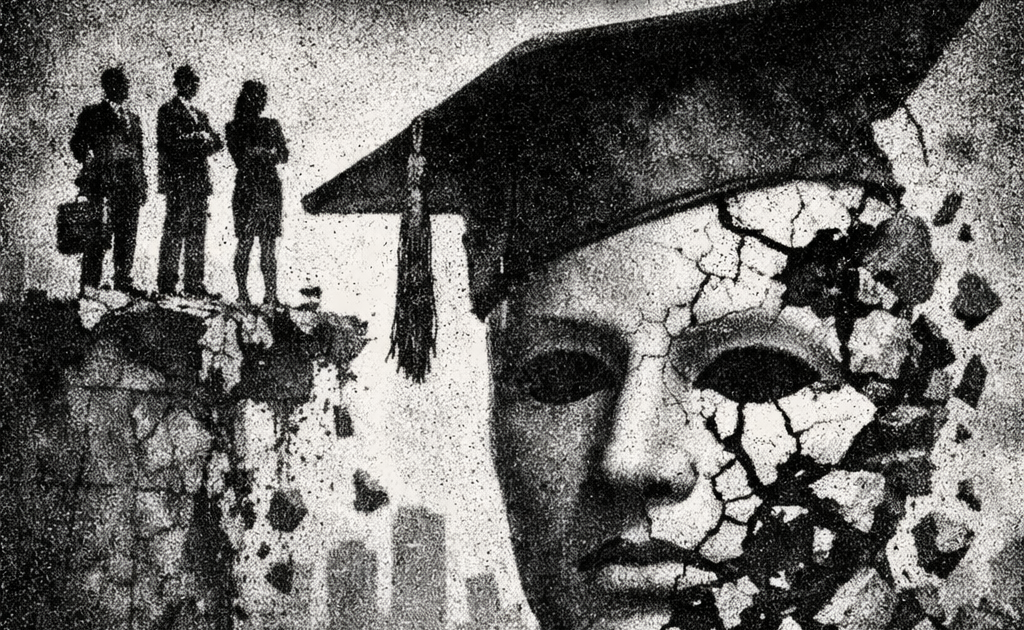
  • The Meritocratic Mask Is Crumbling (Glen McGhee)

    The Meritocratic Mask Is Crumbling (Glen McGhee)

    “The Merit Ladder”

    You unlock the door to a university, and the corridor stretches infinitely upward. Every student walks the same stairwell, one step at a time. The walls are adorned with clocks, calculators, and grade sheets, ticking and tallying as if the universe itself measured effort with perfect fairness.

    But something is wrong. Some students float effortlessly upward, their steps silent, their progress smooth. Others stumble on invisible obstacles, their feet dragging in ways the rules do not explain. They glance at the walls, at the clocks, at the calculators—every metric insists they are equal, every announcement proclaims fairness. Yet the disparity is undeniable.

    A voice echoes from the ceiling, calm, clinical: “Merit is universal. Merit is measurable. Merit is scale-invariant.” The students nod, forced to believe, even as they watch their neighbors leap ahead. Some students whisper, “It’s not the merit—it’s the ladder.” And indeed, the ladder is uneven, its rungs hidden, shifted by invisible hands of wealth, culture, geography, and health.

    In this world—the stairwell of American higher education—the illusion of fairness is maintained with meticulous care. But every so often, a student notices the truth, and then the voice falters, the clocks pause, and the corridors ripple with the secret that can no longer be hidden. For the myth of meritocracy is collapsing. The ladder was never fair, and now, as the illusion fades, everyone will see it.


    The Scale-Invariance Claim

    For more than a century, American higher education has rested on an elegant but unspoken assumption: that the rules of meritocracy are scale-invariant. The ideology promises that any student—regardless of wealth, geography, culture, family background, or health—can climb the credential ladder. A student from a low-income rural household competes on the same metric as a student from an affluent suburb. A community college student is measured by the same ruler as an Ivy League undergraduate. Merit, the story goes, is constant across all scales.

    This is the deep mathematical promise embedded in the system:

    (X, merit) ≅ (X, λ·merit) for all λ > 0.

    Change the scale—money, social capital, proximity, cultural background—and the metric of “merit” supposedly remains unchanged. Hard work is invariant. Ability is invariant. The measurement of learning is invariant.

    But no part of this has ever been true. To understand the experience, one could step into Kafka’s The Trial, where invisible, arbitrary rules govern the fates of all, or into the unsettling dimensions of The Twilight Zone, where a carefully maintained illusion of fairness masks structural control. Episodes like “The Obsolete Man” or “Number 12 Looks Just Like You” illustrate societies where uniform rules are proclaimed but inequities are baked into every interaction—a perfect mirror for the fiction of meritocracy.


    The Characteristic Scales American Higher Ed Pretends Not to Have

    Every foundational element of U.S. higher education has a characteristic scale. Once these scales are made visible, the meritocratic myth dissolves.

    Financial scale.

    With little money, a student cannot attend or persist. With substantial wealth, barriers disappear. Financial rescaling completely changes outcomes.

    Social capital scale.

    A family with generations of college experience confers knowledge, networks, and expectations that directly affect admissions, persistence, and post-graduation trajectories. First-generation students navigate blind. The system is not invariant under social capital rescaling.

    Geographic scale.

    Proximity to selective universities, high-performing high schools, or robust community college systems radically alters opportunity. Rural and small-town America operates at a completely different scale.

    Cultural and linguistic scale.

    Students whose home culture mirrors academic expectations “fit.” Students from culturally distant communities must perform costly translation work. This is not a scale-invariant environment.

    Health and disability scale.

    Students without health barriers move cleanly through the system. Students with disabilities or chronic illness face friction at every stage. Their outcomes follow a different curve.

    A genuinely scale-invariant system would show consistent outcomes across all these starting positions. American higher education shows the opposite. The system has always been scale-dependent—and merit was never the dominant term.


    The Measurement Problem the Meritocracy Never Solved

    The ideological foundation requires not only a scale-invariant world but a scale-invariant measurement system. GPA, grades, test scores, papers, and degrees must reliably track some underlying construct called “merit” or “learning.”

    Higher education never developed such a construct. “Learning” is not stable across institutions or contexts. It is socially constructed daily by instructors with different philosophies, different constraints, and different biases. There is no psychometric framework that defines a scale-invariant measure of learning. The closest attempts—standardized testing regimes—have repeatedly collapsed under their own inequities.

    Yet the system pretends that a 3.8 at an Ivy and a 3.2 at a regional university reflect a universal metric rather than two entirely different grading cultures.


    Grade Inflation and AI Cheating: The Mask Slips

    Recent trends expose how fragile the entire measurement fiction has become.

    Elite universities give A grades at unprecedented rates. Two-thirds of all grades at some institutions are now A’s. GPA averages well above 3.7 are defended as “signs of excellence,” but in practice they are rescalings of the ruler itself. Institutions under competitive prestige pressure simply adjust the metric to protect their reputation.

    AI cheating accelerates the collapse. Students with resources buy tutoring, editing, and AI-powered writing tools. These tools outperform human novices. The ability to “perform merit” is now directly purchasable. The metric no longer measures writing ability or analytical thinking. It measures access to technology, coaching, and time.

    The function of grades has shifted from signaling ability to signaling socioeconomic positioning. What was once ρ(ability) is now ρ(ability + money), with wealth as the dominant term.


    Literary and Cultural Parallels

    This collapse is eerily familiar in literature and media. Kafka’s The Trial captures the experience of navigating opaque rules that punish effort unpredictably. Huxley’s Brave New World and Orwell’s 1984 show societies that insist on fairness while structurally enforcing inequality. Ellison’s Invisible Man exposes the consequences of climbing a ladder rigged by invisible scales.

    The Twilight Zone dramatized these dynamics for mass audiences. Episodes such as “The Obsolete Man”, “Number 12 Looks Just Like You”, and “The Shelter” depict societies where declared rules are universal, yet outcomes are determined by hidden advantages. These narratives echo the experience of students forced to believe in meritocracy even while the structural scales—wealth, family education, geography, culture, health—determine success.


    What “Never Was Meritocratic” Actually Means

    When HEI reports that American higher education never was meritocratic, it is not a moral accusation. It is an empirical one. The system was constructed with characteristic scales baked in. Wealth, social capital, proximity, culture, and health have always determined trajectories.

    The ideology of merit obscured those scales by promising invariance where none existed. The promise served to justify gatekeeping, tuition inflation, credential inflation, and systematic exclusion. Legacy admissions, donor influence, geographic disparities, and familial educational background were not aberrations—they were structural pillars.


    The Collapse of the Meritocratic Narrative

    The contemporary system is unraveling because the myth of scale-invariance—its core ideological justification—has been exposed as untenable.

    Grade inflation reveals that institutions adjust the metric to preserve prestige.

    AI reveals that performance can be outsourced or purchased.

    Credential inflation reveals that degrees are required because employers have no alternative signal—not because the degrees measure anything.

    Homeschooling and private micro-schools reflect widespread disbelief in the system’s ability to measure learning.

    Employer skepticism shows that the labor market no longer trusts the bachelor’s degree as a signal.

    Once the legitimacy of the metric collapses, the legitimacy of the entire structure collapses with it.


    The Devastating Implication: A System Built on a Mathematical Fiction

    A truly scale-invariant system would show no significant correlation between wealth and degree attainment, no legacy effects, no geographic disparities, and no demographic patterning. The opposite is true in every dimension.

    This system is not failing to fulfill its meritocratic promise. It never could fulfill it. It was designed for scale-dependence and shielded by the promise of scale-invariance.

    Now that the mask is slipping, the $80,000 price tags, the exclusionary admissions processes, the credential inflation, and the crushing student debt load are losing their ideological justification. Without the fiction that merit is meaningfully and consistently measured, the system’s rationale dissolves.

    The crisis of American higher education is not primarily a financial crisis or a demographic crisis. It is a legitimacy crisis. The foundational myth—meritocracy as scale-invariance—has collapsed. And with it, the justification for the entire credentialing apparatus is beginning to collapse as well.


    Sources

    Higher Education Inquirer archives on grade inflation, admissions inequities, and credential inflation.

    John Beach’s work on the social construction of “learning.”

    HEI reporting on AI cheating, K-12 system collapse, employer distrust, and the shifting meaning of academic credentials.

    Franz Kafka, The Trial

    Aldous Huxley, Brave New World

    George Orwell, 1984

    Ralph Ellison, Invisible Man

    Twilight Zone episodes: “The Obsolete Man,” “Number 12 Looks Just Like You,” “The Shelter”

    Source link

  • Ken LaOrden, Quallege – The PIE News

    Ken LaOrden, Quallege – The PIE News

    Describe yourself in three words or phrases.

    Visionary, charismatic & innovative 

    What do you like most about your job?

    The people and the potential. I love the opportunity to build genuine relationships on a daily basis – with my team, our partners, and the students – that are all grounded in trust and integrity. Let’s have some fun while we create win-win solutions that drive positive change in global education.

    Describe a project or initiative you’re currently working on that excites you.

    At Quallege, beyond recruiting students to the US, we’re now assisting several top US universities in exploring transnational expansion opportunities. Helping them navigate the complex options for launching a branch campus abroad is an exciting way to think about extending a university’s brand and impact globally.

    What’s a piece of work you’re proud of – and what did it teach you?

    I’m incredibly proud that we launched Quallege, a company focused on connecting high-quality international students with top US universities, last February. And, even in the midst of a highly fluid geopolitical environment, we’ve already secured great university partners like Syracuse University, Pepperdine University, Bentley University and The Catholic University of America. While it somewhat felt like starting a bank during the Great Depression, I am a firm believer that quality always resonates. When universities are struggling with declining enrolment and rising discount rates and continue to seek ways to diversify their student bodies, our focus on connecting high-quality students with top universities is exactly the solution the market needs.

    What’s a small daily habit that helps you in your work?

    Biking. I ride almost every day, usually around 135 miles a week. I prefer gravel biking because the trails clear my head and give me the quiet space I need to formulate my best strategic ideas.

    What’s one change you’d like to see in your sector over the next few years?

    I’d like to see us finally figure out how to leverage the best of online education, both to create more affordable pathways and significantly reduce the overall program costs for international students.

    What idea, book, podcast or conversation has stayed with you recently?

    Don’t be afraid to get out into the field – whether that’s with university partners, channel partners, or students – because there is no better place to learn. And always remember: ask a lot of questions.

    Source link

  • 10 stories that shaped international education in Australia

    10 stories that shaped international education in Australia

    1. Election result brings continuity – and questions – for the sector

    Anthony Albanese secured a second term for the Labor government in Australia’s federal election. While the outcome removed uncertainty around a change of government – particularly given the Coalition’s proposed international student caps and higher visa fees – it also left many in the sector assessing what continuity would mean in practice. The result sparked renewed discussion about policy direction, including commentary on whether stability would translate into greater certainty or restraint for international education.

    2. Julian Hill steps into the international education brief

    In July, Julian Hill was appointed assistant minister for international education, giving the sector a dedicated political lead. Since taking on the brief, Hill has repeatedly emphasised the need to protect the “integrity” of the sector, particularly in relation to visa settings and compliance. Hill has spent a lot of time at out and about at industry events and liaising with the sector, including in an exclusive webinar with The PIE News.

    3. Perth International College of English shuts its doors

    Perth International College of English was not the only provider to close its doors in 2025. But its decision to shut down became a clear illustration of how rising visa fees and tightening settings were landing on the ground. For many in the ELICOS sector, it underscored the vulnerability of smaller providers operating with thin margins in a rapidly changing policy environment.

    4. Student visa fees jump to AUD$2,000

    One of the most talked-about changes of 2025 came when Australia lifted the cost of a student visa to AUD$2,000 – making it the most expensive in the world. The hike sparked debate across the sector about competitiveness and particular concerns came from the ELICOS sector with stakeholders arguing that yet another price hike would put off short-term students.

    5. Australia moves toward a new tertiary education watchdog

    This year saw the Australian government introduce legislation to establish the Australian Tertiary Education Commission (ATEC). The ATEC began interim operations in July 2025, with plans to become fully operational by 2026. This new body is set to centralise the planning and regulation of post-school education, including international education, marking a significant shift in how the sector will be governed in the years to come.

    6. International student enrolment limit lifted to 295,000

    Australia raised its de facto international student enrolment cap to 295,000 places. The decision provided some breathing room for universities and providers, even as questions remained about how limits would be managed long term and who would benefit most.

    7. The PIE Live Asia Pacific 2025 puts the spotlight on sector leaders

    The PIE Live Asia Pacific 2025 offered a moment for the sector to come together – to unpack policy and trends, hear from across the industry, and recognise the people driving international education forward. Lifetime Impact Awards recognised long-standing leaders whose work has shaped international education across decades – a reminder of the human side of an industry often discussed in numbers.

    8. Can Australia thrive in a “managed” era?

    One of the year’s most widely read opinion pieces asked a question many were already grappling with: can Australia remain globally competitive while tightly managing international student numbers? The piece captured a growing tension between regulation, reputation, and market reality.

    9. A new visa processing directive replaces MD 111

    Later in the year, Australia confirmed that Ministerial Direction 111 would be replaced with a new student visa processing directive. While intended to improve integrity and efficiency, the new settings under Ministerial Direction 115 largely mirror its predecessor, with a handful of key changes – including the introduction of a third priority category for providers that exceed their new overseas student commencement (NOSC) allocations by more than 15%.

    10. Education reforms are locked in after clearing parliament

    Rounding out the year, Australia’s education reforms moved from proposal to reality in 2025 after clearing parliament in the nick of time. The changes include a broader legal definition of an education agent and expanded ministerial powers. While the measures were designed to improve integrity, parts of the sector raised concerns during consultation, with attention now turning to how the reforms will be applied in practice.

    Source link

  • In memoriam: John Thompson – HEPI

    In memoriam: John Thompson – HEPI

    A rigorous mind, an uncompromising integrity, and a lasting legacy in higher education analysis.

    John Thompson, who has died after a distinguished career in higher education analysis and public policy, was one of the most intellectually rigorous and ethically uncompromising analysts of his generation. His work fundamentally changed how we understand educational progression, social disadvantage, and widening participation, and it continues to shape policy long after his formal retirement.

    John was born on the Wirral and grew up in circumstances that gave him early insight into inequality. His father died when John was young, and he was brought up by a single parent. Exceptionally for his background and environment, he went on to university, studying chemistry at the University of Leicester, where he graduated with a first-class degree. He remained at Leicester to complete a PhD, winning a prize for the most innovative research of his year – an early indication of the originality and methodological seriousness that would mark his later work.

    After university, John began his professional life as a teacher in a further education college in Liverpool. He taught boys from highly deprived backgrounds, many of whom had little interest in the subject matter or in formal education at all. The experience made a deep and lasting impression on him. Typically, despite his outstanding academic achievements in Chemistry, he considered himself unqualified to teach Mathematics and went on to achieve a first-class degree in Mathematics with the Open University.

    During this period, he joined the Communist Party – an affiliation he did not maintain – but the underlying conviction that injustice must be confronted never left him and became a defining feature of both his personal and professional life.

    John later moved from teaching into analytical work, joining the Inland Revenue as an analyst. While working there, he took yet another degree, completing a Master’s in Operations Research. His experience as an analyst at the Inland Revenue led to a position at GE in its direct marketing department – a role that may not have sat comfortably with his political worldview, but which proved unexpectedly formative. The work gave him a sophisticated understanding of population segmentation and data-driven identification techniques, skills that would later underpin his most influential contributions to education policy, including the the POLAR classification (for identifying disadvantaged students, developed under his guidance by one of his proteges in the course of a PhD.

    Outside work, John was a passionate and formidable cyclist. He cycled everywhere and at one point held the British record for the 100-mile tricycle time trial, recording the fastest time ever achieved in the UK under the auspices of the Road Time Trials Council (RTTC). With his partner Maggie, he shared a tandem bicycle on which they undertook many long and short journeys together, including cycling holidays at home and abroad. Cycling was not merely a pastime for John; it reflected the discipline, endurance, and quiet determination that characterised so much of his life.

    It was in the late-1990s that John undertook the work for which he is probably best known: his research into “who does best at university”. At the time, there was a widely accepted belief that school attainment bore little relationship to performance in higher education. An influential article in the Daily Telegraph even claimed that “A-levels are only slightly better than tossing a coin as a way of predicting who will do well at university”, attributing this conclusion to research by Professor Dylan Wiliam.

    John did what he always did: he went back to the sources. Tracing the citations carefully, and then the citations within those citations, he found that no such conclusion was supported by the original research. This episode crystallised another of his enduring frustrations: academics and commentators who cited research they had never actually read.

    Continuing his work, John demonstrated a clear – almost linear – relationship between school attainment and subsequent degree outcomes. More controversially, he showed that students from independent schools performed less well at university than their peers from comprehensive schools who had achieved the same A-level grades. The findings were strongly challenged by the independent schools lobby and were ultimately referred to the Royal Statistical Society. After reviewing the analysis, the Society judged it to be the most robust analysis ever encountered on the topic.

    Although “who does best at university” brought John wide recognition, it rested on a deeper and even more innovative achievement: his pioneering work on linking administrative records from different sources. John was instrumental in making it possible to link individual school records with university records, and later with Inland Revenue data in the context of student finance and loan repayment. Before this work, analysis relied almost entirely on aggregate data, separately collected across schools, universities, and further education colleges. As a result of John’s work, debates about widening participation, student fees, and social mobility could be informed by robust analysis and evidence rather than spurious correlation and conjecture, allowing far more nuanced and effective policymaking.

    Those who worked closely with John will remember two qualities above all others: his honesty and his rigour.

    His honesty meant that he would stand by what he knew to be true, even when it was personally risky to do so. Early in his time at HEFCE, a newly appointed Chief Executive had promised the Open University an increase in funding, justifying this internally on the grounds that the cost of teaching an Open University student was similar to that of a conventional undergraduate. John knew this was not correct and had the evidence to prove it. Despite intense pressure to produce analysis that would support the Chief Executive’s commitment, John refused. A stand-off followed, but John would not compromise. In the end, he prevailed – and in doing so earned the lasting respect of the very person he had challenged.

    His rigour was equally legendary, and at times exasperating to colleagues. He would not permit conclusions to be stated unless they were fully supported by evidence, and he was deeply resistant to claims of causality that could not be definitively established. On more than one occasion, he prevented colleagues from stating conclusions that seemed obvious from the data but could not be proven to the standard he required. It was not always convenient – but it was always right.

    While at HEFCE, John also took great care with the development of others. He sponsored and mentored several junior colleagues through doctoral study, including work that enabled record linkage. These were, in many respects, golden years for HEFCE’s analytical services. Under the leadership of Shekhar Nandy, the unit produced some of the most sophisticated data-driven higher education research in the country and attracted exceptionally talented young statisticians, many of whom stayed on to form the core of the team in subsequent years, and to refine and develop the strands of research that John had initiated.

    After retiring from HEFCE, John continued to work on a number of projects for HEPI. Among these was what may have been the first comprehensive analysis demonstrating the consistently poorer educational performance of boys and young men compared with girls and young women at every stage of the education system. The work was generally well received, although it attracted some idiosyncratic criticism – most memorably from a professor of gender studies who diagnosed ‘castration anxiety’ in the analysis. That suggestion caused great amusement among those who knew John well enough to understand that he was ruthlessly objective and entirely without personal agenda.

    In 2010, again for HEPI, John analysed the White Paper that preceded the introduction of full-cost student fees. He showed that the proposed system rested on flawed assumptions and would almost certainly cost as much as the more benign regime it was replacing. The Minister for Higher Education at the time, David Willetts, dismissed the HEPI analysis in the House of Commons as ‘eccentric’, only to concede a year later before the Commons Select Committee that it had been “right, but for the wrong reasons”!

    John Thompson was a gifted child who overcame the constraints of his background, an analyst of exceptional intellectual honesty, and a colleague whose standards improved everyone around him. He is survived by his partner of many years, Maggie, and by her daughters, Lucy and Clare.

    Those of us who worked with John at HEFCE and later at HEPI benefited not only from his work but also from his demeanour and principled behaviour. His legacy lies not only in the methods he developed and the conclusions he established, but in the example he set: that evidence matters, that integrity is non-negotiable, and that intellectual courage is worth the cost.

    John’s funeral will be at 10 am on 29th December at WOODLAND CHAPEL, WESTERLEIGH CREMATORIUM, WESTERLEIGH ROAD, WESTERLEIGH, BRISTOL BS37 8RF. All who knew John are welcome, but please RSVP to Bahram Bekhradnia at [email protected]

    Source link

  • Beyond DEI offices, colleges are dismantling all kinds of programs related to equity

    Beyond DEI offices, colleges are dismantling all kinds of programs related to equity

    by Jeni Hebert-Beirne, The Hechinger Report
    December 22, 2025

    It started with Harvard University. Then Notre Dame, Cornell, Ohio State University and the University of Michigan. 

    Colleges are racing to close or rename their diversity, equity and inclusion (DEI) offices, which serve as the institutional infrastructure to ensure fair opportunity and conditions for all. The pace is disorienting and getting worse: since last January, 181 colleges in all.  

    Often this comes with a formal announcement via mass email, whispering a watered-down name change that implies: “There is nothing to see here. The work will remain the same.” But renaming the offices is something to see, and it changes the work that can be done. 

    Colleges say the changes are needed to comply with last January’s White House executive orders to end “wasteful government DEI programs” and “illegal discrimination” and restore “merit-based opportunity,” prompting them to replace DEI with words like engagement, culture, community, opportunity and belonging. 

    One college went even further this month: The University of Alabama ended two student-run magazines because administrators perceived them to be targeting specific demographics and thus to be out of compliance with Attorney General Pamela Bondi’s anti-discrimination guidance. Students are fighting back while some experts say the move is a blatant violation of the First Amendment. 

    Related: Interested in innovations in higher education? Subscribe to our free biweekly higher education newsletter. 

    With the one-year mark of the original disruptive executive orders approaching, the pattern of response is nearly always the same. Announcements of name changes are followed quickly by impassioned pronouncements that schools should “remain committed to our long-standing social justice mission.” 

    University administrators, faculty, students, supporters and alumni need to stand up and call attention to the risks of this widespread renaming.  

    True, there are risks to not complying. The U.S. State Department recently proposed to cut research funding to 38 elite universities in a public-private partnership for what the Trump administration perceived as DEI hiring practices. Universities removed from the partnership will be replaced by schools that the administration perceives to be more merit-based, such as Liberty University and Brigham Young University.  

    In addition to the freezing of critical research dollars, universities are being fined millions of dollars for hiring practices that use an equity lens — even though those practices are merit-based and ensure that all candidates are fairly evaluated.  

    Northwestern University recently paid $75 million to have research funding that had already been approved restored, while Columbia University paid $200 million. Make no mistake: This is extortion. 

    Some top university administrators have resigned under this pressure. Others seem to be deciding that changing the name of their equity office is cheaper than being extorted.  

    Many are clinging to the misguided notion that the name changes do not mean they are any less committed to their equity and justice-oriented missions.  

    As a long-standing faculty member of a major public university, I find this alarming. In what way does backing away from critical, specific language advance social justice missions? 

    In ceding ground on critical infrastructure that centers justice, the universities that are caving are violating a number of historian and author Timothy Snyder’s 20 lessons from the 20th century for fighting tyranny.  

    The first lesson is: “Do not obey in advance.” Many of these changes are not required. Rather, universities are making decisions to comply in advance in order to avoid potential future conflicts.  

    The second is: “Defend institutions.” The name changes and reorganizations convey that this infrastructure is not foundational to university work.  

    What Snyder doesn’t warn about is the loss of critical words that frame justice work.  

    The swift dismantling of the infrastructures that had been advancing social justice goals, especially those secured during the recent responses to racial injustice in the United States and the global pandemic, has been breathtaking.  

    Related: Trump administration cuts canceled this college student’s career start in politics 

    This is personal to me. Over the 15 years since I was hired as a professor and community health equity researcher at Chicago’s only public research institution, the university deepened its commitment to social justice by investing resources to address systemic inequities. 

    Directors were named, staff members hired. Missions were carefully curated. Funding mechanisms were announced to encourage work at the intersections of the roots of injustices. Award mechanisms were carefully worded to describe what excellence looks like in social justice work.  

    Now, one by one, this infrastructure is being deconstructed.  

    The University of Illinois Chicago leadership recently announced that the Office of the Vice Chancellor for Equity and Diversity will be renamed and reoriented as the Office of the Vice Chancellor for Engagement. The explanation noted that this change reflects a narrowed dual focus: engaging internally within the university community and externally with the City of Chicago. 

    This concept of university engagement efforts as two sides of one coin oversimplifies the complexity of the authentic, reciprocal relationship development required by the university to achieve equity goals.  

    As a community engagement scientist, I feel a major loss and unsettling alarm from the renaming of “Equity and Diversity” as “Engagement.” I’ve spent two decades doing justice-centered, community-based participatory research in Chicago neighborhoods with community members. It is doubtful that the work can remain authentic if administrators can’t stand up enough to keep the name. 

    As a professor of public health, I train graduate students on the importance of language and naming. For example, people in low-income neighborhoods are not inherently “at risk” for poor health but rather are exposed to conditions that impact their risk level and defy health equity. Health is “a state of complete physical, mental and social well-being,” while health equity is “the state in which everyone has the chance to attain full health potential.” Changing the emphasis from health equity to health focuses the system’s lens on the individual and mutes population impact.  

    Similarly, changing the language around DEI offices is a huge deal. It is the beginning of the end. Pretending it is not is complicity.  

    Jeni Hebert-Beirne is a professor of Community Health Sciences at the University of Illinois Chicago School of Public Health and a public voices fellow of The OpEd Project. 

    Contact the opinion editor at [email protected]. 

    This story about colleges and DEI was produced by The Hechinger Report, a nonprofit, independent news organization focused on inequality and innovation in education. Sign up for Hechinger’s weekly newsletter. 

    This <a target=”_blank” href=”https://hechingerreport.org/opinion-colleges-are-not-just-saying-goodbye-to-dei-offices-they-are-dismantling-programs-that-assure-institutional-commitment-to-justice/”>article</a> first appeared on <a target=”_blank” href=”https://hechingerreport.org”>The Hechinger Report</a> and is republished here under a <a target=”_blank” href=”https://creativecommons.org/licenses/by-nc-nd/4.0/”>Creative Commons Attribution-NonCommercial-NoDerivatives 4.0 International License</a>.<img src=”https://i0.wp.com/hechingerreport.org/wp-content/uploads/2018/06/cropped-favicon.jpg?fit=150%2C150&amp;ssl=1″ style=”width:1em;height:1em;margin-left:10px;”>

    <img id=”republication-tracker-tool-source” src=”https://hechingerreport.org/?republication-pixel=true&post=114031&amp;ga4=G-03KPHXDF3H” style=”width:1px;height:1px;”><script> PARSELY = { autotrack: false, onload: function() { PARSELY.beacon.trackPageView({ url: “https://hechingerreport.org/opinion-colleges-are-not-just-saying-goodbye-to-dei-offices-they-are-dismantling-programs-that-assure-institutional-commitment-to-justice/”, urlref: window.location.href }); } } </script> <script id=”parsely-cfg” src=”//cdn.parsely.com/keys/hechingerreport.org/p.js”></script>

    Source link

  • California students with disabilities face ‘terrifying’ special ed cuts after Trump changes – The 74

    California students with disabilities face ‘terrifying’ special ed cuts after Trump changes – The 74


    Get stories like this delivered straight to your inbox. Sign up for The 74 Newsletter

    This story was originally published by CalMatters. Sign up for their newsletters.

    Sleep is a rare commodity at Lindsay Crain’s house. Most nights, she and her husband are up dozens of times, tending to their daughter’s seizures. The 16-year-old flails her arms, thrashes and kicks — sometimes for hours.

    But these days, that’s not the only thing keeping Crain awake. The Culver City mother worries about how President Donald Trump’s myriad budget cuts could strip their daughter of services she needs to go to school, live at home and enjoy a degree of independence that would have been impossible a generation ago.

    “Every family I know is terrified right now,” Crain said. “We still have to live our everyday lives, which are challenging enough, but now it feels like our kids’ futures are at stake.”

    Trump’s budget includes nearly $1 trillion in cuts to Medicaid, which funds a wide swath of services to disabled children, including speech, occupational and physical therapy, wheelchairs, in-home aides and medical care. All children with physical, developmental or cognitive disabilities – in California, nearly 1 million – receive at least some services through Medicaid.

    Meanwhile, at the U.S. Department of Education, Trump has gutted the Office of Civil Rights, which is among the agencies that enforce the 50-year-old law granting students with disabilities the right to attend school and receive an education appropriate to their needs. Before that law was enacted, students with disabilities often didn’t attend school at all.

    “We have a delicate web of services that, combined, support a whole child, a whole family,” said Kristin Wright, executive director of inclusive practices and systems at the Sacramento County Office of Education and the former California state director of special education. “So when the basic foundational structure is upended, like Medicaid, for example, it’s not just one cut from a knife. It’s multiple.”

    Republicans have also suggested moving the office of special education out of the Department of Education altogether and moving it to the Department of Health and Human Services. Disability rights advocates say that would bring a medical – rather than a social – lens to special education, which they described as a major reversal of progress.

    Trump has chipped away at other rights protecting people with disabilities, as well. In September, the U.S. Department of Transportation said it would not enforce a rule that requires airlines to reimburse passengers for damaged or lost wheelchairs. Trump has also repeatedly used the word “retarded,” widely considered a slur, alarming advocates who say it shows a lack of respect and understanding of the historical discrimination against people with disabilities. It’s all left some wondering if the administration plans more cuts to hard-fought rights protecting people with disabilities.

    Fewer therapists, less equipment

    The Medicaid cuts may have the most immediate effect. People with developmental disabilities typically receive therapy, home visits from aides, equipment and other services through regional centers, a network of 21 mostly government-funded nonprofits in California that coordinate services for people with disabilities. The goal of regional centers is to help people with disabilities live as independently as possible.

    More than a third of regional centers’ funding comes from Medicaid, which is facing deep cuts under Trump’s budget. The money runs out at the end of January, and it’s unclear what services will be cut.

    Schools also rely on Medicaid to pay for therapists, equipment, vision and hearing tests and other services that benefit all students, not just those with disabilities. In light of state budget uncertainty, it’s not likely the state could backfill the loss of Medicaid funding, and schools would have to pare down their services. 

    Uncertain futures

    For Lelah Coppedge, whose teenage son has cerebral palsy, the worst part is the uncertainty. She knows cuts are coming, but she doesn’t know when or what they’ll include.

    “I go down this rabbit hole of worst-case scenarios,” said Coppedge, who lives in the Canoga Park neighborhood in Los Angeles. “Before this happened, I felt there was a clear path for my son. Now that path is going away, and it’s terrifying.”

    Coppedge’s son, Jack, is a 16-year-old high school student who excels at algebra and physics. He loves video games and has a wide circle of friends at school. He uses a wheelchair and struggles with speech, communicating mostly through eye movements. He’ll look at his mom’s right hand to indicate “yes,” her left hand for “no.”

    Coppedge and her husband rely on a nurse who comes four days a week to help Jack get dressed, get ready for bed and do other basic activities. Medicaid pays for the nurse, as well as other services like physical therapy. Even though Coppedge and her husband both work and have high-quality private health insurance, they could not afford Jack’s care without help from the government.

    They also rely on the local regional center, which they assumed would help Jack after he graduates from high school, so he can remain at home, continue to hone his skills and generally live as independently as possible. If that funding vanishes, Coppedage worries Jack will someday end up in a facility where people don’t know him, don’t know how to communicate with him and don’t care about him.

    “It feels like we’re going backward,” Coppedge said. “Half the time, I put my head in the sand because I’m just trying to manage the day-to-day. The rest of the time I worry that (the federal government) is looking at people like Jack as medical problems, not as unique people who want to have full, happy lives. It feels like that’s getting lost.”

    The current uncertainty is stressful, but it’s even harder for families who are immigrants, Wright said. Those families are less likely to stand up for services they’re entitled to and are facing the extra fear of deportation. English learners, as well as low-income children, are disproportionately represented among students in special education, according to state data.

    “That’s the other piece to all this — how it’s affecting immigrant families,” Wright said. “It’s a whole other level of anxiety and fear.”

    Decades of progress on the line

    Karma Quick-Panwala, an advocate at the nonprofit Disability Rights Education and Defense Fund, said she worries about the rollback of decades’ worth of progress that was hard-won by the disability rights community. 

    The Individuals with Disabilities Education Act, the 1975 law that created special education, actually predates the federal Department of Education. In fact, Congress created the department in part to oversee special education. Removing special ed would be a devastating blow to the disability community — not just because services might be curtailed, but philosophically, as well, Quick-Panwala said. 

    In the Department of Education, special education is under the purview of education experts who promote optimal ways to educate students with disabilities, so they can learn, graduate from high school and ideally go on to productive lives. In the Department of Health and Human Services, special education would no longer be overseen by educators but by those in the medical field, where they’re more likely to “look at disability as something to be cured or segregated and set aside,” Quick-Panwala said.

    “The disability rights community has worked so hard and gave so much to make sure people with disabilities had a right to a meaningful education, so they could have gainful employment opportunities and participate in the world,” Quick-Panwala said. “The idea is that they wouldn’t just be present at school, but they would actually learn and thrive.”

    For the time being, Wright, Quick-Panwala and other advocates are reminding families that federal funding might be shrinking, but the laws remain unchanged. Students are still entitled under federal law to the services outlined in their individual education plans, regardless of whether there’s money to pay for it. The funding will have to come from somewhere, at least for now, even if that means cutting it from another program. And California is unlikely to roll back its own special education protections, regardless of what happens in Washington, D.C.

    An imperfect but successful routine

    Those reassurances are scant comfort to Crain, whose daughter Lena will rely on government support her entire life. Born seven weeks prematurely, Lena has cerebral palsy, epilepsy, a cognitive impairment and is on the deaf-blind spectrum. But she has a 100-watt smile and a relentless spirit, Crain said. Even after the whole family has been up all night, Lena insists on going to school and getting the most out of every day.

    From left, Jack Deacy, his daughter Lena Deacy, and Lindsay Crain at their home in Culver City on Dec. 1, 2025. The family fears potential Medicaid cuts because Lena, who has cerebral palsy, epilepsy and other medical conditions, relies on Medicaid-funded services for her daily care and well-being. Photo by Zaydee Sanchez for CalMatters

    Funny and assertive, she has a few close friends and, like many teenagers, plenty of opinions about her parents. She loves her English teacher and spends most of her day in regular classrooms with help from an aide. Her favorite book is about Malala Yousafzai, the Pakistani activist who won a Nobel Peace Prize for fighting for girls’ right to an education.

    Between school and home visits from aides and after-school therapists, Crain feels the family has pieced together an imperfect but mostly successful routine for Lena.

    “Our entire lives are about teaching her self-advocacy, so she can have the most independent life possible,” Crain said. “Just because you need support doesn’t mean you can’t have a say in your life. There’s been so much work around the culture and the laws and the education system to make sure disabled people can make their own choices in life. We’re absolutely terrified of losing that.”

    This article was originally published on CalMatters and was republished under the Creative Commons Attribution-NonCommercial-NoDerivatives license.


    Did you use this article in your work?

    We’d love to hear how The 74’s reporting is helping educators, researchers, and policymakers. Tell us how

    Source link

  • The Candace Owens–Erika Kirk Controversy Through a Higher Education Lens

    The Candace Owens–Erika Kirk Controversy Through a Higher Education Lens

    The September 2025 assassination of conservative activist Charlie Kirk sent shockwaves through the political and academic worlds. It also ignited a public feud between two figures whose influence stretches across campus activism and national media: Candace Owens, a former Turning Point USA (TPUSA) strategist turned media provocateur, and Erika Kirk, the widow of Charlie Kirk and newly appointed leader of TPUSA. The conflict exposes not only the personal and political stakes involved but also the broader dynamics of media influence, ideological factionalism, and the politics of grief in contemporary higher education.

    Charlie Kirk: Architect of Campus Controversy

    Charlie Kirk built his public persona on provocation and confrontation. He staged highly orchestrated debates on college campuses, often targeting liberal-leaning students with “Prove Me Wrong” events that were designed to go viral. Turning Point USA’s social media strategy amplified these conflicts, rewarding spectacle over substantive discussion. Kirk also courted controversy through statements on race and opportunity, claiming in interviews that a Black woman had “taken his slot” at West Point, and through his unabashed support of fossil fuels, rejecting many climate mitigation policies.

    Under Kirk’s leadership, TPUSA expanded its influence with aggressive initiatives. The Professor Watchlist cataloged faculty allegedly promoting leftist propaganda, drawing condemnation from academic freedom advocates who argued it chilled open debate and exposed professors to harassment. In 2019, TPUSA, through its affiliated nonprofit Turning Point Action, acquired Students for Trump, integrating campus organizing with national political campaigns. These moves cemented Kirk’s reputation as a strategist who thrived on conflict, spectacle, and the orchestration of young conservative voices, setting the stage for the posthumous clashes between Owens and Erika Kirk.

    Candace Owens: Insider Knowledge Meets Provocation

    Candace Owens leveraged her experience as a TPUSA strategist into a national media presence. Her commentary is known for being provocative, frequently conspiratorial, and sometimes antisemitic. After Kirk’s death, Owens publicly questioned the official narrative, hinting that TPUSA leadership may have failed Kirk or been complicit. She amplified unverified reports, including accounts of suspicious aircraft near the crime scene, drawing criticism for exploiting tragedy for attention. Owens’ stature as a former insider gave her claims credibility in some circles, but her approach exemplifies the hazards of insider knowledge weaponized against organizations and individuals in moments of vulnerability.

    Erika Kirk: Navigating Grief and Ideological Contradiction

    Erika Kirk’s public response has been markedly different. As TPUSA’s new CEO and widow of its co-founder, she emphasized factual communication, transparency, and respect for grieving families. Yet her messaging presents a striking tension. She has publicly urged women to “stay at home and have children,” even as she leads a major national organization herself. This contradiction highlights the challenges faced by leaders whose personal actions do not neatly align with ideological prescriptions, especially within high-profile, media-saturated contexts.

    Erika Kirk’s stance against conspiracy and misinformation underscores the responsibilities of institutional leadership in politically charged environments. By rejecting Owens’ speculation and emphasizing ethical communication, she models crisis management that prioritizes credibility and accountability, even as ideological tensions complicate her public image.

    The Groypers: External Pressure on Campus Politics

    The feud did not remain internal. The Groypers, a far-right network led by Nick Fuentes, inserted themselves into the controversy, criticizing TPUSA for insufficient ideological purity and aligning with Owens’ confrontational rhetoric. Their intervention escalated tensions, highlighting how external actors can exploit internal disputes to influence narratives, polarize supporters, and pressure campus organizations. The Groypers’ involvement illustrates the precarious environment student-focused organizations face, where internal conflict can quickly become a battleground for external ideological agendas.

    Media, Campus Power, and Ethical Considerations

    The Owens–Kirk conflict exemplifies the challenges inherent in politically engaged campus organizations. Insider knowledge can confer authority, but it can also be leveraged in ways that destabilize institutions. Personal grief and tragedy can be amplified in the media, creating narratives that are part advocacy, part spectacle. Organizations like TPUSA, with expansive networks, high-profile donors, and initiatives such as the Professor Watchlist and Students for Trump, are uniquely vulnerable to reputational damage and internal discord. Kirk’s legacy of confrontation and spectacle created fertile ground for sensationalism, factionalism, and opportunistic interventions by groups such as the Groypers.

    Toward Responsible Leadership

    The feud offers a cautionary lesson for student-focused political organizations and higher education at large. While former insiders may provide valuable insight, amplification of unverified claims can destabilize leadership, undermine institutional credibility, and warp student engagement. Erika Kirk’s insistence on restraint, transparency, and fact-based discourse demonstrates the importance of ethical leadership, media literacy, and principled decision-making in sustaining credible campus organizations.

    Entangled Worlds as Spectacle  

    The conflict between Candace Owens and Erika Kirk is more than a personal dispute. It reflects the entangled worlds of media influence, ideological factionalism, and institutional accountability in higher education. For observers, the episode offers a vivid study of how grief, ideology, and spectacle collide, and how effective leadership must navigate these pressures with clarity, ethical judgment, and a steady commitment to institutional integrity.


    Sources

    Candace Owens – Wikipedia: https://en.wikipedia.org/wiki/Candace_Owens

    Owens vs. Erika Kirk, AOL News: https://www.aol.com/news/candace-owens-strangely-accuses-erika-154928626.html

    Erika Kirk public statements, WABC Radio: https://wabcradio.com/2025/12/11/erika-kirk-snaps-back-at-candace-owens

    Megyn Kelly mediation reports, AOL: https://www.aol.com/articles/megyn-kelly-reveals-she-helped-220748120.html

    Charlie Kirk career and assassination, UPI: https://www.upi.com/Voices/2025/09/11/charlie-kirk-activist-fatal-shooting/5321757598392

    Conflict-driven persona, Washington Post: https://www.washingtonpost.com/politics/2025/09/10/charlie-kirk-dead/

    Campus engagement and media amplification, PBS: https://www.pbs.org/newshour/politics/charlie-kirk-dead-at-31-trump-says

    Charlie Kirk’s statements on race and West Point, Washington Post: https://www.washingtonpost.com/politics/2025/09/13/charlie-kirk-turning-point-politics-debates

    Professor Watchlist – Wikipedia: https://en.wikipedia.org/wiki/Turning_Point_USA

    Students for Trump acquisition, Charlie Kirk – Wikipedia: https://en.wikipedia.org/wiki/Charlie_Kirk

    Groypers intervention, Nick Fuentes – Wikipedia: https://en.wikipedia.org/wiki/Nick_Fuentes

    Source link