According to The American Association of University Women(AAUW), throughout their education, girls and women are systematically tracked away from science and math. This limits their access, preparation and opportunities to enter these fields for their careers as adults. By the time students reach college, women are significantly underrepresented in STEM majors. Women make up only 34% of the workforce in science, technology, engineering and math (STEM). While this is up from 28% two years ago, it is still significantly less than the existing overall percentage of women, and men vastly outnumber women majoring in most STEM fields in college. The gender gaps are particularly high in some of the fastest-growing and highest-paid jobs of the future, like computer science and engineering.
Women in STEM Occupations Biological Scientists 46% Chemists & Materials Scientists 40.4% Computer & Mathematical Occupations 25.2% Engineers & Architects 16.5% SOURCE: U.S. Bureau of Labor Statistics, “Employed persons by detailed occupation, sex, race, and Hispanic or Latino ethnicity,” Labor Force Statistics from the Current Population Survey, Table 11, 2020.
A typical STEM worker earns two-thirds more than those employed in other fields, according to Pew Research Center. And some of the highest-earning STEM occupations, such as computer science and engineering, have the lowest percentages of women workers. Giving women equal opportunities to pursue and succeed in STEM careers helps narrow the gender pay gap, enhances women’s economic security, ensures a diverse and talented STEM workforce and prevents biases in these fields and the products and services they produce.
To help close the STEM Gap, it is important that girls and women are given the skills and confidence to succeed in math and science. There should be improvements in STEM education and support for girls starting in early education and through K-12. Every student should be exposed to engineering and computer science, and Next Generation Science Standards.Classes should be taught by connecting STEM experiences to girls’ lives, promoting active, hands-on learning and emphasizing ways STEM is collaborative and community-oriented. AAUW also suggests expanding after-school and summer STEM opportunities for girls. They suggest Increasing awareness of higher education and career opportunities, pathway opportunities, role models and mentoring programs with women in STEM for girls.
While there have been some advances, more efforts need to be made to help women close the STEM gap. Educational consultants can help encourage young women with academic aptitudes and interests in math, science, computers and engineering to explore career paths they may not have considered for their future.
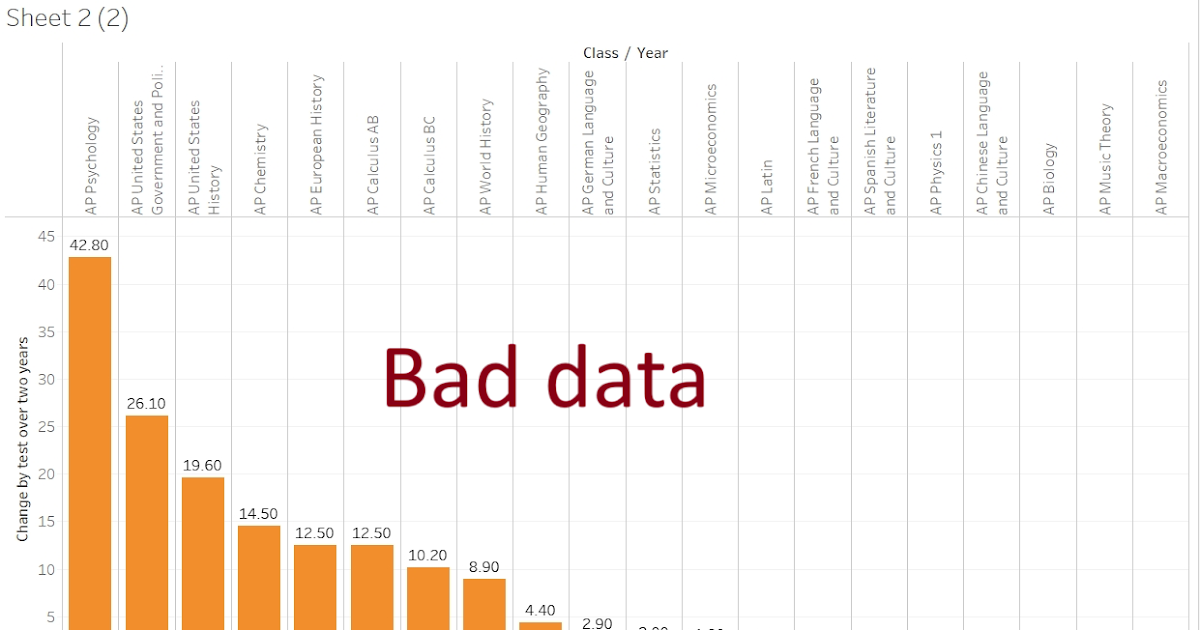
Last night, I looked at a chart that had been tweeted out by Marco Learning, a terrific source for information about The College Board’s AP Program. It showed the percentage of all scores graded 4 and 5 over time by subject, and there were some glaring points: Lots of big increases in certain subjects that didn’t seem to make sense. Turns out, their data was correct.
Wanting to dive down a little deeper, I went to the College Board website to look at the data myself, and to “download” it for some additional analysis. I put the word download in quotation marks on purpose.
I have a history with College Board, of course. I used to download the very rich AP data by state, exam, and ethnicity they’d post on their site and put it into an interactive format that pulled out insight better than the large, text-exclusive spreadsheets they’d post. Then–despite the organization’s oft-cited commitment to transparency–they stopped.
In an example of Newspeak worthy of the novel 1984 that they might want to use in a future AP English Literature Exam, College Board said they were going to implement a “streamlined” reporting protocol for the data. Less data, and less insight, in other words, was better. (They also announced that their “Landscape” product was being pulled down while they were saying they were making it more transparent, by the way, and no high school person has access to it today.)
Anyway, this chart shows incorrect data for AP Psych, suggesting that the percentage of 4 and 5 scores increased by 42 percentage points between 2022 and 2024. Let me explain how it found its way into my tweet, and the larger issues it points out.
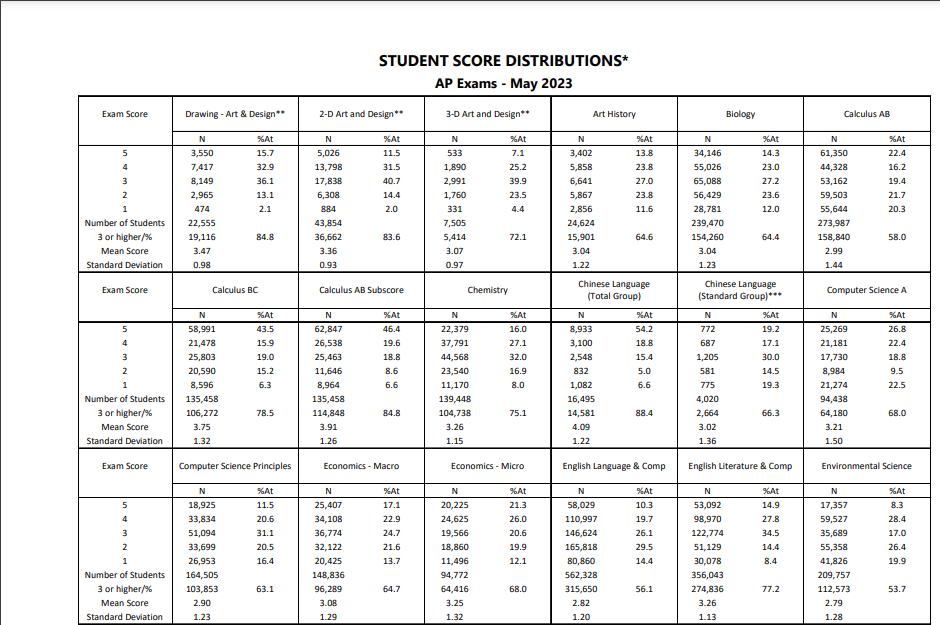
You can still download summary data at the subject level (but not more detailed than that) on the College Board website, but it comes in a messy format that makes one think they don’t really want you to do any analysis on it. It has hidden rows, hidden columns, merged cells, and different formats by row that make anything other than tedious manual extraction almost impossible. It looks like this; the data are clearly intended for casual users who want a quick answer, and not in a way that makes it easy to study in-depth.
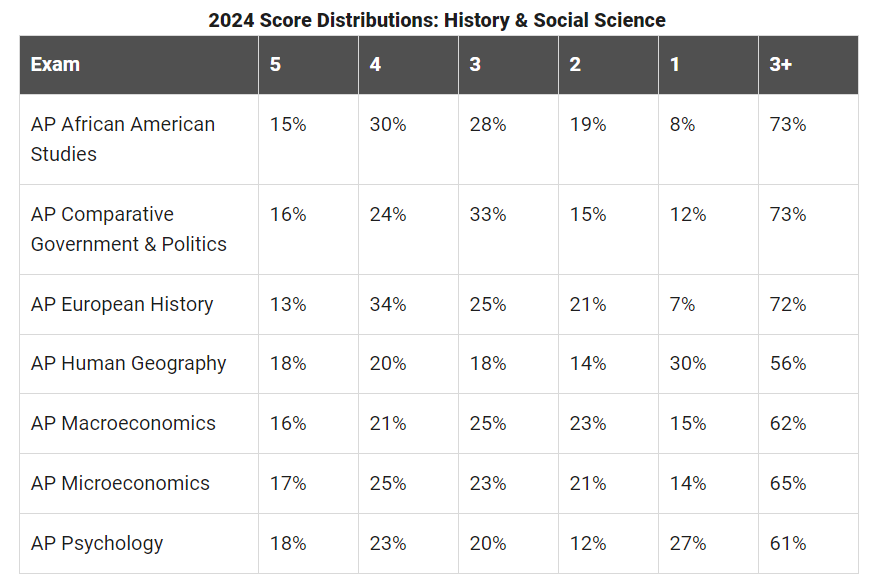
So, after getting frustrated after wrangling this and admitting I’d been foiled by the data people on Vesey Street, I settled not for raw data, but for summaries on their website, on pages like this for 2024 and this for 2022. I manually copied all the tables, pasted them into Excel, and then set about cleaning them up. Even that was frustrating: In some years, College Board calls its exam “AP English Language & Composition,” while in other years, it’s “AP English Language and Composition.” Similarly, it’s either “AP 2D Art & Design” or “AP 2-D Art and Design.” Some years, data are rounded to the nearest whole number; in others, to one decimal point. These are insignificant differences to human readers, but they’re a big deal for computers.
All seemed to be going well, although the year-to-year changes in nomenclature and formatting seem capricious and undisciplined from a data standpoint, especially for an organization that prides itself on its research and analysis capabilities.
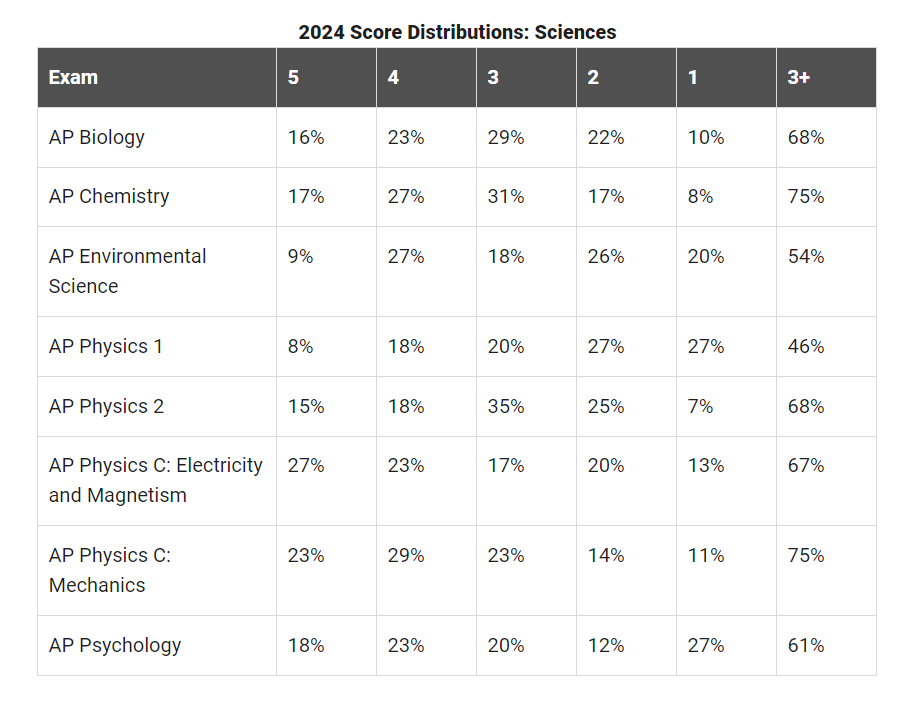
And, finally, on the 2024 link, above, guess what? AP Psych is listed twice: First under “History and Social Sciences”
and then again under “Sciences.” So, AP Psych in 2024 (but not the other years) got counted twice.
Had I been successful in just downloading and cleaning the numbers, this would not have happened because I calculate the percentage of the totals of raw numbers. But because I had to scrape this off a website, this error showed up. I should have checked this a couple of ways before posting, but I didn’t, and that’s my fault.
This would normally be where I’d call on College Board to make their data more accessible to the general public in the interest of transparency, but a) they don’t listen, b) they don’t give a crap about the members, and c) they just wait for people to forget how bad they are at the most simple things and keep paying their executives multi-million dollar salaries.
Supervisor training and leadership development are top priorities for HR — and it’s no wonder why. Skilled supervisors are critical to increasing employees’ job satisfaction. A solid leadership pipeline ensures that both institutional knowledge and talented employees remain at a college or university. And higher ed employees have a strong desire for professional and leadership development, which affects how they view their jobs.
How can institutions support supervisors and those who might move into that role? How can HR mitigate supervisor burnout? What about encouraging career development for employees who want a more fulfilling role, but not necessarily as a supervisor? Several higher ed HR practitioners have shared with CUPA-HR how they are tackling these common challenges.
10 Roadblocks to Supervision (and How to Surpass Them) (Watch Now) and Roadblocks to Supervision: Clearing a Path for Peer-To-Supervisors, New Supervisors and Hybrid Team Supervisors (Read Now)
While it might be evident that a supervisor is struggling, diagnosing the reason why is more complex. That’s exactly what this pair of valuable resources is designed to help with. Based on supervisor trainings at the University of North Carolina System, this webinar and companion article break down supervisor struggles into an adaptable list of roadblocks that prevent supervisors from flourishing. These range from interpersonal skills (such as misaligned communication styles), to systemic workload issues (supervisors being too busy), to communication across divisions (leaving HR out of the loop when a problem arises).
Building Leaders From Within: UT Rio Grande Valley Blends Leadership Development With a Master’s in Higher Ed Administration (Read Now)
The need for an internal talent pipeline at the University of Texas Rio Grande Valley was clear. So was the need to retain valuable employees, who sought career development opportunities. (The desire for promotion or more responsibility is the third most-cited reason for higher ed employees seeking new jobs.) To address both challenges, HR teamed up with administrative and academic leadership to create an innovative — and mostly free — Master of Arts in higher education administration program for current employees. Learn how they built and executed this initiative, which welcomed 100 employees over the past few years.
Recipient of the 2023 CUPA-HR Innovation Award, the BRIGHT Leaders program at the University of Texas at Dallas speaks to the needs of today’s employees, who desire flexible professional development programs. This webinar explains how BRIGHT Leaders encourages everyone on campus to lead from where they are. UT Dallas’s “all-access pass” model means any employee can take any leadership training session at any time. No matter their position or leadership level, all staff and faculty (and even students) are welcome to attend, and there’s no selective process that limits participation.
Investing in People: How to Create a Coaching Culture on Your Campus (Read Now)
Gone are the days when coaching was either for executives only or a remedy for poor performance. In fact, coaching can increase employee engagement and job satisfaction as well as boost retention and job performance. But coaching looks different from campus to campus. This article delves into how three institutions — Vanderbilt University, the University of Tennessee, Knoxville and the University of California, Berkeley — created cultures of coaching on their campuses. This data-driven resource not only outlines these unique coaching programs, but also offers resources and tips to help you convince leadership that coaching is an essential element of creating future leaders.
Update: On November 8, the federal judge from the Eastern District of Texas is set to hold a hearing on summary judgement in the business community’s challenge to DOL’s overtime final rule. While it is unknown how soon after we could get a decision on the validity of the rule, the judge could rule from the bench or quickly after the hearing. CUPA-HR will send out updates on the rulings as soon as we know.
On June 28, a federal judge in the Eastern District of Texas Court granted a narrowly scoped preliminary injunction for the overtime rule in the state of Texas, blocking the Department of Labor’s overtime final rule from taking effect on July 1, 2024. The judge only blocked enforcement for employees of the state of Texas (i.e., public institutions), so private institutions in Texas and all other institutions outside of Texas will still need to comply with the overtime rule beginning July 1, 2024.
The motion for a preliminary injunction was filed by the state of Texas alongside a lawsuit challenging the validity of the final rule in its entirety. At least two other lawsuits are currently pending before the Eastern District Court of Texas. The preliminary injunction will block the final rule from taking effect on July 1 for public employers and employees in Texas until a later decision is issued on the lawsuits challenging the validity of the final rule.
As a reminder, the final rule implemented a two-phase approach to increasing the minimum salary threshold under the Fair Labor Standards Act overtime regulations. The first increase was expected to take effect on July 1, increasing the minimum salary threshold from the current level of $684 per week ($35,568 per year) to $844 per week ($43,888 per year). The second increase is set to take effect on January 1, 2025, and it would increase the minimum salary threshold again to $1,128 per week ($58,656 per year). The final rule also adopted automatic updates to the minimum salary threshold that would occur every three years.
Given the judge’s narrow decision granting the preliminary injunction, private institutions in Texas and all institutions outside of Texas are still required to implement adjustments to comply with the July 1 minimum salary threshold until a later decision is made on the validity of the rule as a whole. CUPA-HR will be monitoring the pending cases closely.
House Appropriations Subcommittee Bill
On June 26, the House Appropriations Subcommittee on Labor, Health and Human Services, and Education released their fiscal year 2025 funding legislation for the Department of Labor (DOL) and other related agencies, which included a provision to prohibit any funding provided to DOL under the bill from administering, implementing or enforcing the overtime final rule. The Subcommittee passed the legislation out of Committee during a markup on June 27. It will now be sent to the floor for a vote, where House Republicans have a slim majority and could pass the bill along partisan lines. The fate of the overtime provision appears uncertain in the Senate, however, as the Democrat-controlled chamber is unlikely to include such language in their appropriations bill. CUPA-HR will continue to keep members apprised of any updates on the status of the overtime final rule.
OK, I admit it. That headline is clickbait. I have no idea which colleges might close in the near future, but I want to take a look at the problem from 30,000 feet.
This is prompted by the recent announcement that Eastern Nazarene College in Massachusetts will close. It comes on the heels of several other announcements like this over the past few years. And of course, because we’ve become accustomed to colleges surviving for long periods even during bad times, the surprise makes people wonder who’s next.
The meta-answer will surprise you: While we of course feel bad for the people who lose jobs, the students who are displaced, and the community that finds itself dealing with the loss of a respected institution, these trends are small blips in the industry. In fact, the institutions most likely to close (probably) collectively account for a small fraction of enrollment at America’s colleges and universities.
Follow along.
One of the challenges in talking about this is the graduate/undergraduate split in enrollment (enrollment is complicated, y’all) and the wide range of different types of missions in higher education. Some small institutions are completely undergraduate, while some are mostly graduate. Some institutions are heavily supported by outside money from a congregation or donations (think seminaries or other religious institutions), and still others are small by design, often because they have enormous endowments and/or highly focused missions.
But here is the hypothesis, and the data to give you some perspective on it.
Let’s suppose that colleges in danger of closing are very small, in either total enrollment or undergraduate enrollment. Some of those, as I suggested, aren’t in danger but we’ll leave them in for the sake of simplicity.
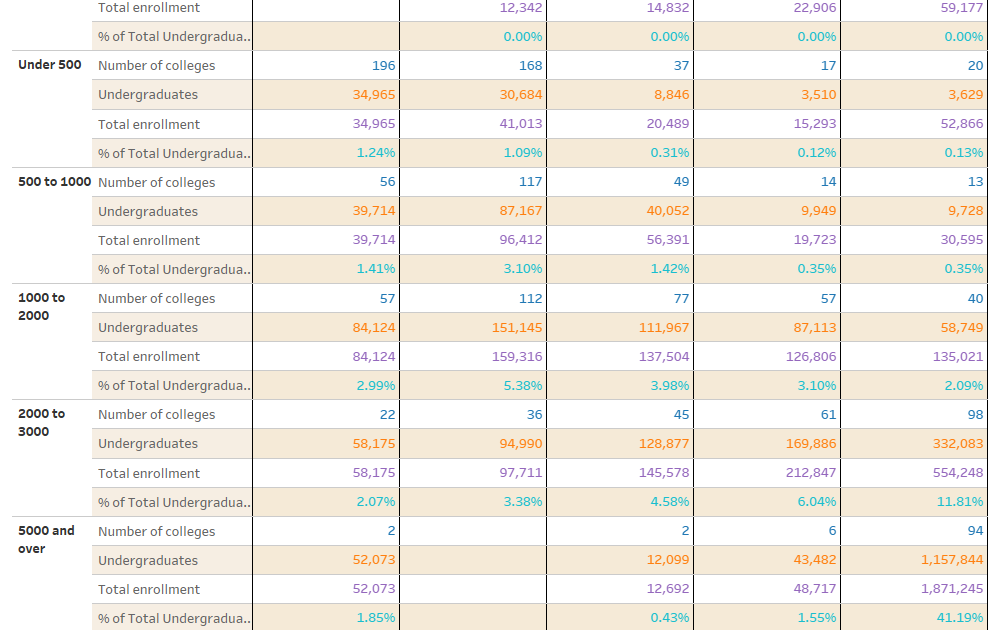
I took all four-year private colleges, since public institutions rarely close purely for financial reasons, and for-profit college closings happen frequently, without much fanfare. And I grouped them by undergraduate and graduate enrollment in 2022, and arrayed them on a grid. The values across the top break institutional graduate headcount enrollment into groups and the values down the left-hand column breaks them into undergraduate enrollment by that measure.
This is what the grid looks like. Click to expand:
Let’s get draconian, and say that in the not-too-distant future every college in the second and third row will close: That is, those colleges with undergraduate enrollment of at least one student, but fewer than 1,000, regardless of graduate enrollment. All 687 of them will close.
If that happened tomorrow, it would displace about 268,244 undergraduate students, or about 9.5% of all undergrads enrolled in those four-year, not-for-profit institutions. Not a small number or percentage. Again, these are real people who feel the results of those decisions.
But of course, four-year not-for-profit institutions are a small sliver of college students in America. All told, in the Fall of 2022, there were 15,964,998 undergraduate students enrolled across all types of institutions. If we were to lose all of those 687 institutions and all 268,244 students, it would represent 1.7% of all college students nationwide.
Again, not insignificant if you’re one the students affected. But do we believe that we will see 687 closures in the coming years? I suppose some people do. I don’t. And if you don’t, you’ll realize the net effect will probably be much, much smaller than you might have anticipated.
So when you hear about colleges closing, you should feel bad for the people affected. But take a look at the data before you make rash pronouncements about higher education in general.
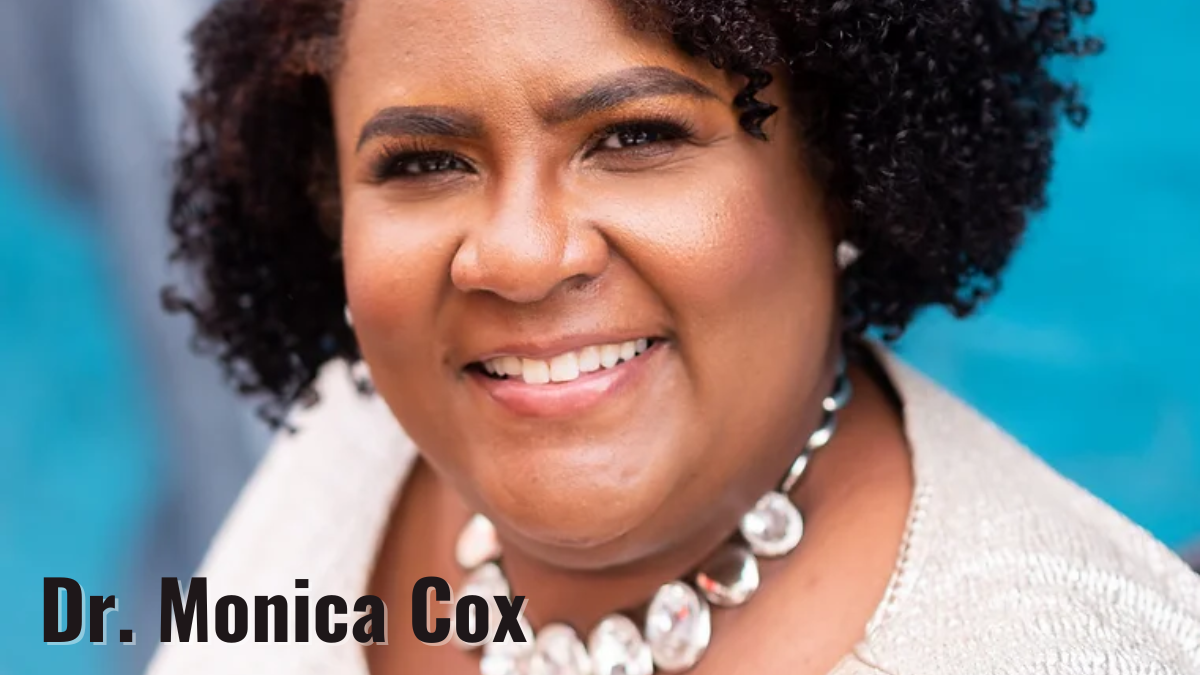
Introducing Dr. Monica Cox, professor and change maker for equity in the workplace
Jennifer: I’m so excited to feature Dr. Monica Cox, a professor, author, and change maker. Monica, thanks so much for coming today to talk about your new book Never Defeated: Nine Lessons from the Workplace Front Lines. I wanted to be sure to get that right.
Monica: It’s okay. That’s fine. It’s very long. So you did a great job. Thank you. So great to be here and to meet you in person, kind of.
Jennifer: Yeah. I know we’ve been connected on social media for a while and I’ve been following your amazing work, but I’m so excited to introduce you to The Social Academic community. Would you mind telling people a little bit about yourself?
Monica: Sure, sure. So I am of course Dr. Monica Cox. I am an academic and a professor, an engineering education professor. I’m also a former administrator and I am an entrepreneur who is the CEO and founder of STEMinent, LLC, which offers a variety of offerings that have an umbrella of helping people to emerge whole and bold and strong in the workplace, or whichever environment they so choose. So that’s me in a nutshell.
Jennifer: Bold and strong. I love it. I love it.
Monica: Yeah, thank you.
Writing Never Defeated
Jennifer: Tell me, What prompted you to write Never Defeated? This is such a powerful book. What, what made you know that it had to be out in the world?
Monica: Okay, so there’s the business answer and then there’s kind of the other heart related answer.
Jennifer: Yeah.
Monica: So I would say from a business perspective, I have a Stop Playing Diversity brand, which is based on just my commitment to authentic diversity, equity, and inclusion. And the quick part of that story is that when I was hired in my most recent organization, I told them not to hire me if they were playing diversity. And of course, they didn’t know what that meant. But over time I realized that a lot of the things that I needed to be successful in that workplace as a black woman administrator just, they weren’t there. And I decided to trademark Stop Playing Diversity, and that meant that I wanted to have guides coaching the business arm, and I wanted to write a series of books. So Never Defeated is one of the books that I’m gonna write as part of the Stop Playing Diversity brand and the trademark for the business. Amazing. So, like I said, that’s the business part.
Monica: The personal part is that I went through hell at work. It was a mess. And there’s a quote in the book where I talk about a blueprint and I wished I had a blueprint before I started this experience. But I always said, sometimes you have to be the blueprint. And as I was learning and documenting what was going on, I would look at tweets and kind of just record the tweets. And I wrote essays based on the things that were resonating with people on social media. So that is the heart part of this, where it’s my story where it also is informed from the voices of people who’ve gone through situations very similar to mine. And as you know about social media, there was also the upheaval with Twitter/X. And I thought, if it goes away, what about all of that information, all of those conversations. And this book is kind of the way for me to almost take ownership, to take back some of the valuable conversations and resources that came out of a really good time for me on social media. That was the long story.
Jennifer: Ohh! And a beautiful one that really touched my heart. So I hear what you mean when you say the heart side of, of your reasons for writing this very important book. Never Defeated is so powerful because it reads as authentic, it reads like you’re talking to me. And I think that’s what made me pick it up and not put it down until I finished.
Monica: Thank you.
Jennifer: I mean, I was like walking around the house with it, trying to make sure that I got all of these words in because, you know, sometimes when we see things on Twitter, it does make a meaningful difference in our lives. But seeing all of it at once, like being able to read your words, it just, it was, it was quite meaningful for me. I really appreciated it. Yeah.
Monica: Thank you. And I’ll say something really quickly about it, even this morning, my husband was telling me that someone was reading it and the words were powerful. So I thank you for this. It is still kind of difficult for me to process all of it because I’m also healing as I share what I’ve talked about. So it’s not easy for me to just be like, let me read this every day now. No, that was my life and I lived it. And it was just a moment. And there’s just an element about that that I wanna put about the book too, where it felt like I was sharing a piece of myself and it’s just that it’s all compact, but that was really my life with the death of, you know, my parents and so many real things that have impacted me. So, so even now I feel a little emotional talking about it because it was that real to me as a person.
Jennifer: Oh, I hear you. I hear you. And I really appreciate that maybe despite the emotional weight of writing the book and sharing, like you, you still put it out there in the world and you still write your tweets, even though, I mean, I, I guess I wonder, is there some fear when you’re talking about, you know, things that happen that are maybe not talked about in the room, like, but like you are saying it on Twitter. And so I’m wondering what are your feelings about that? Was it different when you were writing the book?
Monica: So, when I talk about the tweets, this seems very spiritual and some people may not get this, but I will, I will be asleep. And when I wake up I hear like, it’s almost like the words come to me. And so I’m writing them because it’s like, this is what I’m supposed to say for the day. And sometimes it’s punchy, but it is almost like you, you and I talking right now. I just know that there’s a thought that has formed. And so that’s what that is. I don’t feel the fear. When I write things that are so truthful because it is just as clear as to me that that’s what I’m supposed to say.
Jennifer: It’s like already formed in your mind when you’re going to say, I get that. ’cause it’s a poet. That’s how I write poetry. It’s not how I write social media posts, but it is how I write poetry. And so I really, I hear you when you say like, the feelings that, like, that happens when you’re writing it in your head and then it’s out there and you’re like, but I’ve already, it’s already there. It, it exists.
Monica: Exactly. And sometimes I’ll even, I have my phone next to me and I’ll write something as a note. And so that’s something too, like I’ll wake up at 3:00 AM and that’s one thing, the part about the book is that I had a book consultant, a developmental kind of editor.
Jennifer: Wonderful.
Monica: Thank you. And at first I was not going to write stories. Hmm. The first draft was very much practical, and that was it. And she pushed me to include more of myself in the book. And I did not think that I was ready to do that because there are some stories people didn’t know about. And I knew that I would be very vulnerable sharing, for example, how I contacted the president of my university when there were things happening after the murder of George Floyd. And you know, kind of what happened, like I’m whistle blowing on myself. To say, this is what I did with other people during this time. And one thing that people have really complimented me on, and I was very careful about is making sure that I, I was very truthful with my stories without naming names.
Jennifer: Yes.
Monica: So if people do not know where I work, you would not know. And my developmental editor, even by the time she looked at it, she’s like, I don’t even know where you work. So I realized that that’s an immense skill to be able to tell so much. And I do that on social media as well. So, so much without fully telling you what’s up.
Jennifer: Yeah.
Monica: And that also is something I would say that I have to tread carefully with from a legal perspective. Yeah. Because I was so involved in a legal case for three years where I had to decide, am I going to remove myself completely from social media? Am I not going to write? Am I gonna shut down my voice? Or am I going to figure out how to still share my truths without incriminating myself without telling too much? It was, it is a slippery slope to do this work. And I’ll say it’s very strategic, very deliberate. And I hope that’s what you see even as I’m like teetering right there. But nah, I, I know how to say it.
Jennifer: I’m curious when you say that you really had, you approached a point in which you had to make a decision whether to remove yourself from social media or to stay, what helped you make that decision?
Monica: Well, it’s the motivation for me actually being on social media. Once I was an administrator, I said it in my book that it was kind of like an archive for me, but I got to a point in my organization where it became very dangerous for me to be there because of the lack of equity work that they were doing. But also I could tell that I was being set up to be this scapegoat. And I wasn’t going to be that person, I was going to fight. So I had an attorney who I worked with at the time, and two of the things that he mentioned about social media usage is that it’s archived. And I mean, it’s an archived record, of course, of what happens. And he said, you have to tell the truth. Like in, in a court of law, it would be like the timestamps and is what you’re saying true. So I used it very strategically and I always said, because it literally got to a point where I was being harassed because of some stuff. I said, if anything, God forbid ever happened to me, then my husband, maybe my legal team, the people around me could look at what I wrote on social media and have that as evidence of what I was going through. So I was hiding in plain sight.
Jennifer: Yeah.
Monica: And people didn’t understand. What, why does she do this every day? Because I want people to know what happened on say, you know, Monday, February 17th. You know, people would say, “Oh, it’s too much. Why would a department chair do that?” Because I was concerned.
Jennnifer: People tend to have fear when it comes to social media, but you actually found some protection in it in the sense that it was a documented record.
Monica: Absolutely.
Jennifer: I’m wondering, for listeners who may be experiencing something similar on their university campuses, what kind of documentation do you recommend that they practice?
Monica: Well, I would say social media could be good, but you don’t even have to use your real name. You know, so some type of pseudonym or something. And I mean, of course if it ever came to the point where people needed to know that was you, you could say it was you. But that’s one way that you can use it. Another way. I mean, it’s email. When I was a department chair, I used to think about this all the time. There are some like basics. When you have a meeting with someone, you wanna make sure that things are clear. So you can send an email afterward. One of the things that people need to be careful of is having conversations on the phone, because that’s not really documentation.
Jennifer: Right.
Monica: You need it to be written. You need the summary to be written. And one thing that I even learned through my organization is that I would send things and people would not respond. But when it was time for me to compile information, you know, I could have, you know, five examples for of like, when I did contact people, like, “Hey, I told you I was in distress on this date. I told you that I was having this issue with an employee.” And I think that’s going to be one of the big things that we do strategically moving forward to protect ourselves, particularly in an anti-DEI age. People are going to avoid, they’re going to want to walk that fine line, but if we are in distress, we need to put that out there in writing that this is unacceptable. I am being treated this way and this is how I move forward. And I think one other quick thing I’ll say, the reason this is, this is very vital is because I’ve also learned through my experience that the policies are not in place to protect certain issues like microaggressions. There is no law against someone microaggressing you. There is no law in place against workplace bullying. So when you are experiencing situations that make you feel that your life is in danger, or in the case of, I don’t know if you saw Dr. Bonnie, Dr. Antoinette Bonnie, her full name is Candia-Bailey, she ended her life. You know, we need to tell our stories in ways that sometimes are cries for help, but are sometimes those records after we have left an organization to say, this is what happened on this day. This is my voice. These are the people who knew, you know, et cetera. Sorry I went off. That was long, but.
Jennifer: No, Thank you for sharing that much about all this. I, and I think that I have wanted to ask this kind of question before, sometimes I’ve had guests on my show that have experienced some bullying on social media and other things. I know I had Dr. Carlotta Berry, who came and talked about it. But you’ve been through the kind of legal battle and something that’s public. And you’ve written about it in ways that I feel like people will really hear what you’re saying and it, they’ll take it in and they’ll start practicing some of those things themselves. Like, I want to help inspire change with this conversation. And so I really appreciate you being open and authentic about that.
Social media presence and growth, How it’s changed for academics
Jennnifer: Now, when I think about your time on social media, like it’s been so impactful for your thinking and, and your thought leadership and what you share with people. But how has it changed over time? Like, you’ve been on social media for a while, right?
Monica: I have. I think Twitter was documented. I think I started in 2010. So how has it changed? I think people are actually talking, which is funny to me. You know, academics were not talking back in the day. I think there’s still some fields where people just kind of post their accolades, but now people are having more conversations. I also think when it comes to marginalized communities, people are bold, bolder about talking about the issues that are going on in their personal lives. So they’re showing more of themselves. They’re also talking about problems that they experience. I see a lot more political statements.
Jennifer: Yes.
Monica: You know, even religious statements, displeasure with things. And I wonder if it’s like the younger generation that’s coming in, but I feel they just have less fear when it comes to displaying themselves. And just talking about. I’m southern and you know, I come from this more subdued, maybe cultural environment. But I mean, there are people who drop in their pics in tight dresses. They’re kissing up on folks, you know, they’re just like grown and sexy. And I think we need to see people who are just beautiful in every form, who are thoughtful and funny. And so that’s what I see. I see people who are human more and not afraid to be human. And that’s good.
Jennifer: Hmm. What about for yourself? Do you feel like you’ve leaned more into that over time? Or have you always shown up and been authentic?
Monica: You know what? I think that all of this connects back to our disciplines because I said I’m an academic. And so as an academic in a STEM discipline, it’s got its own culture. Engineering has its own culture. I’m in engineering education. So that’s got its own culture. So it’s like nested cultures. And I would say my culture is very, very, very conservative in how they move. And this was like the running joke of me on social media where everybody would say like, “Oh my gosh, I can’t believe Monica said this. Like, is she off?” And one of my friends even said in my community, she said she didn’t wanna look at my social media because she’s like, she’s gonna get fired for saying stuff.
Jennifer: She was scared for you.
Monica: That’s what she said. And that also speaks to that culture. So how have I changed? I have gotten out of the fear of my community and I have connected so much broader, like my platform, I think across all of my social media. And I probably have repetitive followers as well. But it’s about 75,000 people.
Jennnifer: Wow.
Monica: And you know, I started with a handful.. And the noise of my community is so quiet, it’s so quiet now in terms of what they think, because I see the impact of my work. I see the feedback that I get, like people who are leaving careers because of a book, because of a tweet, people who are sharing their stories because of things that I’ve said. And I’ll even give this as like a testimonial. I knew that. I know there’s something to it. I started a newsletter on LinkedIn in December, and I only have maybe like 13 editions. ’cause it’s biweekly. And I am up to, I wanna say like 8,500 subscribers right now.
Jennifer: Wow. Back from December. Since December!?
Monica: And I had maybe 700 in the first day. So there is something that is happening that is bigger than what I am. So that’s it. It’s the boldness, it’s the, I don’t care what my academic community says about me, because I know that what’s happening is more impactful and bigger than what’s in their box.
The Accomplice Academy with Dr. Monica
Jennifer: Hm. Ooh. Tell me a little bit about the Accomplice Academy. I wanna make sure that people who are listening can join if they’re a good fit for it.
Monica: Absolutely. So it is a really intimate group right now of people who want to be equity accomplices. And what I mean by that is people who we have, we focus on three areas. One is, I talk about like the level of risk. You know, as an accomplice, you’re gonna understand that what you’re doing is high risk. And so I engage through a subscription service, a monthly subscription service, where we talk about what it’s like to take those risks and how people can do this and protect themselves in the process. The second area that’s kind of connected back to being an accomplice is like looking at the level of change. And so I really focus on systemic change. So if you are in an organization, how are we making sure that we are offering sustainable solutions for people to remain safe and for equity to be real? And the third part is really having people focus on others instead of themselves. Many times when you see people who are allies, you know, they’ll, some of them will wear it like a banner and be like, “I’m an ally, I’m an ally. Come to me!” But I often tell people, you’re not an ally if I don’t say that you’re an ally. And it’s this space where sometimes as an accomplice, we do the work and people don’t even know that we do the work. But that’s what it means to do it. And I, I brought up the example in the book about, you know, going to the president of the University, of my university and saying, this is what’s happening in our organization. Please look at these statements from our engineering students. Look at the statements from our engineering faculty and staff, and take that into consideration when you hire the next leader of this organization. So, like I said, even though I shared what I did at the time, it wasn’t that people knew it. And as I told you, my developmental editor was like, you need to share stories. And I was like, okay, I’m finally gonna tell people that I was an equity accomplice in my institution at a very dangerous level, at a pretty high level. And I knew that the consequences could have been a lot worse if the leader was not committed to racial equity. That was a lot. So those examples, that’s what The Accomplice Academy is. It’s like doing the work and having the support to talk about it in a safe space. And I would say a couple of my most active people, one is an LGBTQ plus advocate who is a burnout coach, and another is a professor in a state where they have anti-DEI laws now. And you know, we really talk about this, what does this look like in your roles as a coach or as faculty. So thank you for mentioning that.
Jennifer: That is amazing. It sounds like a group where real change can happen, not just change within ourselves, but change in our communities. That sounds so cool. Thank you. Oh, I’m curious, since we were just talking about being a good accomplice and, and how being an ally is really about making sure that other people feel that we’re good allies, not just ourselves. What’s one way that we could be better accomplices or allies on social media?
Monica: Man, there are a lot of ways. I think one is like amplifying statements that I think are very courageous. You know, so if there is someone who is saying something that the world needs to hear, and if they could be, you know, criticized for it, or if they’re in a vulnerable position by saying that, I think that the very public way that we show support sends messages to organizations that we are aligned with that person. Another is actually putting real content out. You know, being brave, being courageous and saying, you know, this is what systemic change looks like. Or here are some examples. So, so tips. You know, I think social media is a wonderful place to educate. And if we have handbooks, if we have resources that have helped us, if we have contacts, you know, other books, this is the prime place for audiences to see how to do the work really well. So sharing is another piece, but I think being authentic, like once you’re there, and I feel like this gets to like the risk part, but once you are on there, it’s about being that consistent voice so people know that you are trustworthy, that they can rely on you, that you are that person who is for the cause. And so consistency. I feel like that’s an internal thing, you know, for you to, for someone to be courageous, there’s a difference between the theory and action of it. And that’s what I mean. Like my inner circle of accomplices is so small right now because anyone can post just a good statement. But it’s the translation of that statement into action, under pressure that shows me if you are really an accomplice, because it can come with negative impacts on your livelihood.
Jennifer: Yeah.
Monica: And that can include a job. Maybe you lose an opportunity because you’re too dogmatic or because you know, you’ve said something that is really pushing the envelope. But from a business perspective, I often tell people, anyone who reads what you present and they’re turned off wasn’t someone you probably needed to connect to in the first place, because you are gonna have a lot more issues down the road. And that’s what I say even about doing equity work. You know, if someone’s like, “Oh, can you tone it down? Can you do whatever,” guess what? I’m not the consultant for you. Go to the one who’s going to help you to clear things and make sure everything is measured in your organization because that’s what you’re looking for. You’re not really ready for the accomplice level. That’s the work that I’m proposing.
Jennifer: Ooh, that’s really helpful. And I think it also helps people know whether they should join the Accomplice Academy. Like, are you, are you really ready to, to do the work and to take action in your organization? Oh, that’s fascinating. Absolutely. Oh, I love that. Okay. Well, I wanna show the book again.
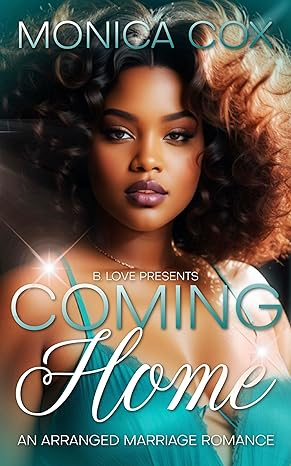
Monica: You know, just, I’m also an author. I write fiction. Yes. I have one that’s dropping this week.
Jennifer: I’m gonna get it. I’ll say I love romance books. I do.
Monica: Thank you. Thank you. Because you know what, that’s a taboo. So we can talk about that.
You know, we talk about authenticity, people like, what are you doing? Are you out there writing smut? What’s happening? And I’m like, my people love each other. Okay. They love, they love on each other. They love each other. So I will say that, and the thing that I will also mention is that I put social justice things in my book as well. So even in the one that’s coming up, and I’ll say this really quickly. My protagonist did not earn tenure, but she was involved in a domestic abuse situation. And we have an issue where she goes to Alabama and because of their laws, she can’t be an unwed mother and keep her job.
Jennnifer: Oh wow.
Monica: Yeah, with STEM students because of donors. And so that sounds very familiar. The arranged marriage part of my romance is when, spoiler alert, her principal boss doesn’t want to lose this amazing teacher. And so, they kind of like each other anyway.
Jennifer: Oh, That sounds great.
Monica: It’s this whole social justice thing that’s embedded in romance and how they have to move forward. So I’m just putting that teaser out there to say, it’s not just smut, although you get it, but it’s the lessons behind how women of color have to move professionally and personally to be successful and to be whole, bold and strong. Same thing.
Jennifer: I so appreciate that. As a survivor of domestic violence, myself, I found love. I found romance. Like I can’t wait to read this book. It’s, it’s, yeah, it’s on my reading list. I’m very excited. Okay.
Monica F. Cox, Ph.D., is an unstoppable force who has made it her mission to disrupt and trailblaze her way through the world. Her unapologetic approach to life has made her a change agent and leader who is unafraid to make people uncomfortable. Despite facing personal and professional adversity, Monica was raised by her educator parents to persist and pursue her dreams.
As a 2020 Fellow of the American Society for Engineering Education (ASEE), Distinguished Professor of Engineering, and former department chair at The Ohio State University, Dr. Cox is no stranger to conflict. Her unwavering dedication to advocating for people and women of color has transformed the fabric of her department and the larger organization.
Dr. Cox’s research focuses on the infusion of equity in STEM education and the empirical exploration of women of color in the workplace. With over 130 publications, a presidential award for research, and approximately $20 million in led and collaborated multidisciplinary projects, she is a true expert in her field.
As we prepare for a new year at CUPA-HR, we want to take a moment to introduce our board of directors for 2024-25 and to thank those who have served on the board over the past year. The board, which guides the association’s strategic priorities, is an incredible team of higher ed HR leaders who are dedicated to supporting and advancing the higher ed HR profession.
2024-25 Board Members
The chair of CUPA-HR’s board of directors for 2024-25 is Robyn Salvo, associate vice president for human resources at Monmouth University. Robyn has worked in HR for over 20 years, with the last 18 in higher ed at Monmouth University. In her current role, she leads an HR team in providing advice and guidance to the university covering all aspects of human resources, from talent management and compensation to benefits and compliance. Robyn has been a member of the CUPA-HR national board since 2020 and previously served as president of the CUPA-HR New Jersey Chapter.
Also serving on this year’s board are:
Executive Committee Members
Amanda Bailey, Chair-elect – Vice President for Human Resources at Boston University
Jami Painter, Past Chair – Senior Associate Vice President and Chief Human Resources Officer at the University of Illinois System
Kelli Shuman, Treasurer – Associate Vice President for Human Resources and Chief Human Resources Officer at Elon University
Andy Brantley, Ex-Officio – President and Chief Executive Officer at CUPA-HR
Regional Directors
Melanie DeSantis, Eastern Region – Associate Vice President for Human Resources and Chief Human Resources Officer at Franklin & Marshall College
Connie Putland, Midwest Region – Chief Human Resources Officer at the University of Wisconsin-Whitewater
Ale Kennedy, Southern Region – Associate Vice President for Human Resources and Chief Human Resources Officer at Clemson University
Clarity White, Western Region – Human Resources Supervisor at the University of California, Berkeley
At-Large Directors
Jazzmine N. Clarke-Glover – Vice President of Workplace Culture and Inclusion (Chief Human Resources Officer, Chief Diversity Officer, Title IX Coordinator) at Wagner College
Christine Lovely – Vice President and Chief Human Resources Officer at Cornell University
Josh Mackey – Vice President of Human Resources at Northern Arizona University
Helena A. Rodrigues – Senior Vice President and Chief Human Resources Officer at the University of Arizona
Eugene Whitlock – Chief People and Culture Officer and Associate Vice Chancellor for Human Resources at the University of California, Berkeley
Lynne Adams – Chief Human Resources Officer and Associate Vice President, Human Resources at the University of Maryland, Baltimore County
Maureen Binder – Associate Vice President and Chief Human Resources Officer at the University of Central Florida
Clint Eury – Program Director, Human Resources Strategic Partnerships and Communications at the University of Maryland, College Park
David Zajchowski – Human Resources Director at Rollins College
Thank you!
We also want to celebrate the outstanding leaders who are rolling off the board. They have invested countless hours of their time and energy in leading our profession and our association, and we are so grateful for their wisdom and guidance.
Jay Stephens, Past Chair – Vice President of People and Culture at the University of Montana
Kristi Yowell – Chief People and Culture Officer and Associate Vice President for Human Resources at Loyola University Maryland
Heather Hart – Vice Chancellor of Human Resources and Strategic Operations at Ivy Tech Community College of Indiana-Lafayette
El pagnier Kay (EK) Hudson – Senior Vice President, Human Resources at Florida International University
We couldn’t accomplish our mission without our leaders. Thank you for your dedication and commitment!
This is a reboot of a visualization I did in 2018, which I found fascinating, but which didn’t get much traffic at the time, and thus, I’ve not refreshed it. But I still find it compelling and instructive.
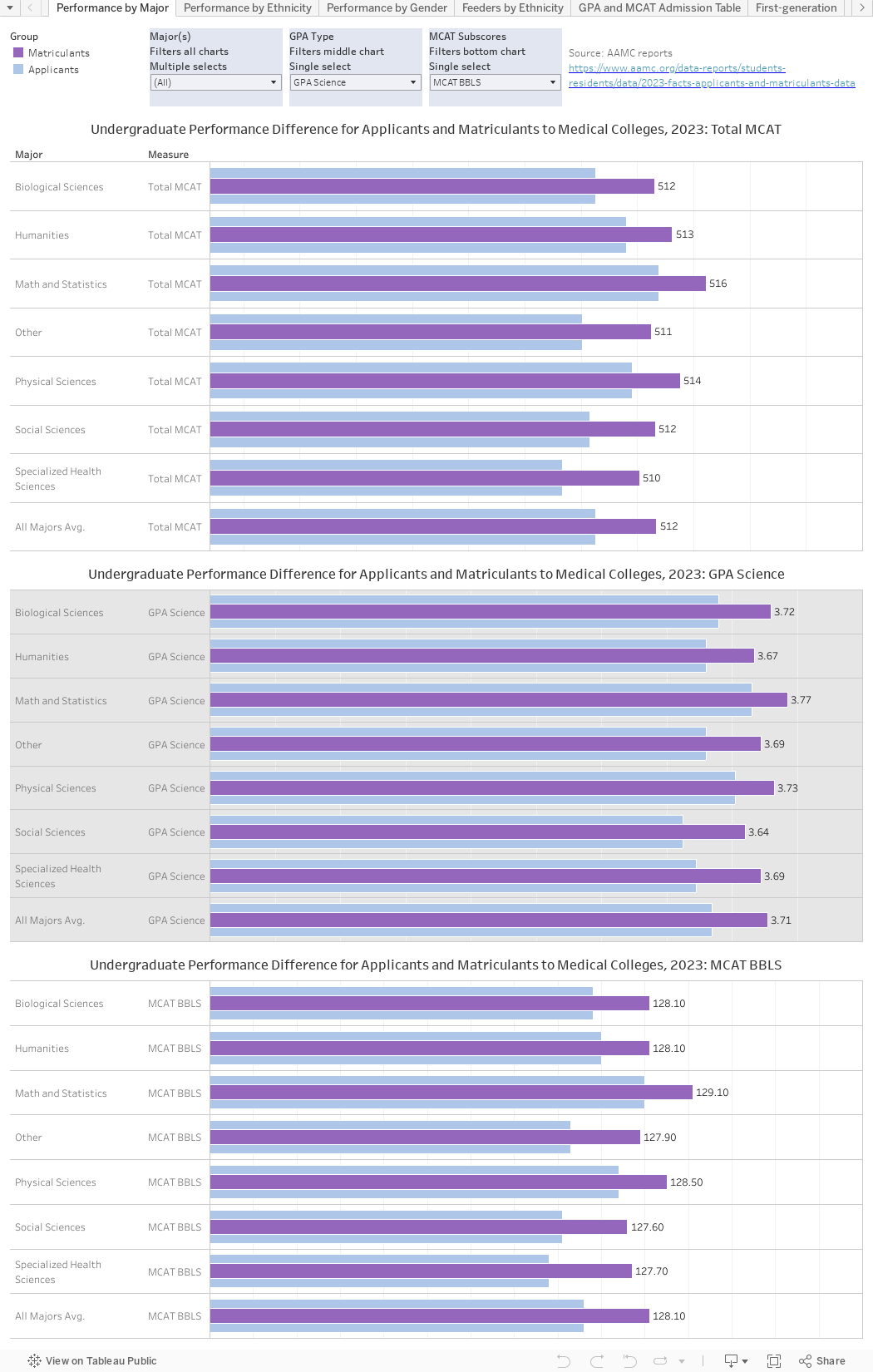
Each year, the Association of American Medical Colleges publishes a lot of data about admission to medical colleges in the US. But frankly, it’s a mess, and takes a lot of effort to clean up and visualize: Each link is a separate spreadsheet, and each spreadsheet has spacer rows and merged cells and lots of stuff that needs to be scrubbed (carefully) before analyzing and visualizing. So, if you use this work in a professional capacity, I’d appreciate your support for my time, software and hosting costs at this link. As a reminder, I don’t accept contributions from high school counselors, students, or parents who are using the site. (And if you know anyone at AAMC, tell them raw data would be much appreciated).
There are seven views here, some of which combine several data sets. Use the tabs across the top to access the views.
The first three tabs show similar data, broken out three ways: By undergraduate major, by ethnicity, and by gender for applicants and matriculants. Don’t be afraid to use the filters to get what you want; you won’t break anything, and there is a reset button at the bottom.
The top chart on these three views shows Total MCAT scores for applicants (blue) and matriculants (purple). The middle chart shows your choice of GPA, using the filter at the top: Science, Non-Science, and Overall. And the bottom chart shows sub-scores on the MCAT, again, based on the filter you choose. Hover over a bar for details.
Total MCAT scores range from 472 to 578 with 500 being the mid-score, and each of the four sections–Biological and Biochemical Foundations of Living Systems; Chemical and Physical Foundations of Biological Systems; Psychological, Social, and Biological Foundations of Behavior; and Critical Analysis and Reasoning Skills–is scored from a low of 118 to a high of 132, with a midpoint of 125. Read about them here, whence I shamelessly stole this information.
The fourth tab shows which undergraduate institutions sent applications to US Medical Schools in what quantity, based on student ethnicity. Note that the data are not complete, but rather a compilation of five different reports, for colleges sending applications from at least 100 White students, 50 Asian students, 15 African-American students, 10 Hispanic students, or five Native American/Alaska Native students. A college can be on one list but not another: For instance, the University of Oklahoma is #1 for Native students, but not on the list of institutions sending at least 50 Asian students.
When you hover over the bars, you can see that institution in larger context, like this:
The fifth tab gets into the nitty-gritty, and show the distribution of applicants and admits by GPA and MCAT ranges (top two charts), as well as the admission rate (bottom), showing the success of being admitted to at least one medical college.
The sixth and seventh tabs are simple summaries by first-generation status, and gender over time.
There is an awful lot of data here, and again, if you have any sway with the AAMC, tell them I’d sign my life away to get raw data in one big file. As always, let me know what you see here.
While the new KeepnTrack promises a wave of exciting updates, it’s essential to acknowledge the features that will not be available initially, which may come as a disappointment to some current users. Among the missing functionalities are free background and sex offender checks; instead, tokens will be necessary for their operation. Additionally, the absence of volunteer applications within the platform might pose a challenge for users accustomed to streamlined processes, but fear not! Solutions like utilizing Google Forms and importing responses into KeepnTrack can offer a temporary workaround until volunteer applications are integrated.
Camera support for Users or Kiosks is another feature not yet available in the new KeepnTrack, along with limited classifications and activities options. The absence of history UI, editing history, and merging patrons functionalities may also be felt by users who relied on these features for administrative purposes. However, the developers assure that future updates will address these limitations, providing a more robust and feature-rich user experience down the line. In the meantime, rest assured that subscription costs will remain unchanged, and advancements like saved operations showcase the platform’s commitment to evolving and meeting user needs as efficiently as possible.
Juneteenth commemorates the end of slavery in the United States and is now recognized as a federal holiday — Juneteenth National Independence Day. Observing Juneteenth’s historical significance is a meaningful step in understanding American history. But for its history to mean something in our present moment, its lessons must be translated into tangible action. CUPA-HR offers the following resources, tools and research data to help confront and change racial inequities in the higher ed workforce.
Racial Composition and Compensation
Lingering historical inequities remain in higher ed’s current-day compensation, hiring and promotion practices. Juneteenth is a reminder that we need urgent solutions to these persistent inequities. Here’s a snapshot of the composition and pay for people of color in the higher ed workforce:
Progress in both representation and pay has been sluggish for people of color, according to our data on administrators, faculty, professionals and staff collected in CUPA-HR’s signature surveys. Our interactive graphics track gender and racial composition as well as pay of administrators, faculty, professional and staff roles. (Read the executive summary.)
Women of color have consistently been paid inequitably, with Black women paid 76 cents on the dollar in our most recent data.
CUPA-HR research also digs down into sectors of the higher ed workforce in terms of composition and pay. Recent research reports include:
The Higher Education Financial Aid Workforce: Pay, Representation, Pay Equity, and Retention (read now)
Representation and Pay Equity in Higher Education Faculty: A Review and Call to Action (read now)
Higher Ed Administrators: Trends in Diversity and Pay Equity From 2002 to 2022 (read now)
The Higher Ed Admissions Workforce: Pay, Diversity, Equity, and Years in Position (read now)
Fostering Inclusion
Long-term solutions to a more representative and equitably compensated workforce include adopting inclusive hiring and retention strategies, analyzing and auditing both compensation and promotion practices, and enacting policies that support your employees’ well-being. In these resources, we offer best practices and data-driven recommendations for a more equitable future.