Blog

  • £11 billion of “Supplements” used for loans

    £11 billion of “Supplements” used for loans

    Given the relative absence of higher education from yesterday’s Autumn Statement, I turned my attention to the Department for Education’s 2019/20 annual accounts, which were published earlier this month.

    Regarding student loans, we have been in something of a hiatus since 2018, when Theresa May announced an review of post-18 funding and commissioned the Augar panel, which reported last summer. Although there were suggestions that we might get a long overdue response to the latter yesterday, we will probably have to wait now until the Budget next March, when the government will hope to have a better sense of its spending commitments.

    That leaves student loan finance in limbo with the small, nominal budget allocation for loan write-offs shored up by large “Supplementary Estimates” provided by parliament each February.

    This is in spite of an apparent “target RAB” of 36% and a budgeting process hanging over from 2014, when the old department for Business, Innovation and Skills (BIS) had responsibility for loans and was being “incentivised” to reduce the cost of the loan scheme. You can see both of these features still stipulated in the latest Consolidated Budgeting Guidance, but they represent zombie policy with little to no bearing on events.

    Why so? Well, DfE was given an extra £12billion plus back in February to supplement 2019/20’s budget for “non-cash RDEL” (mostly student loan “impairments”) of £4.7billion per year. (Student loans are “impaired” because the loans are worth less in estimated repayments than the cash advanced.) The supplement produces a total that is more than triple the original allocation.

    And… DfE managed to spend nearly £16billion of that last year. The accounts report an “underspend” of £1.1bn against that total.

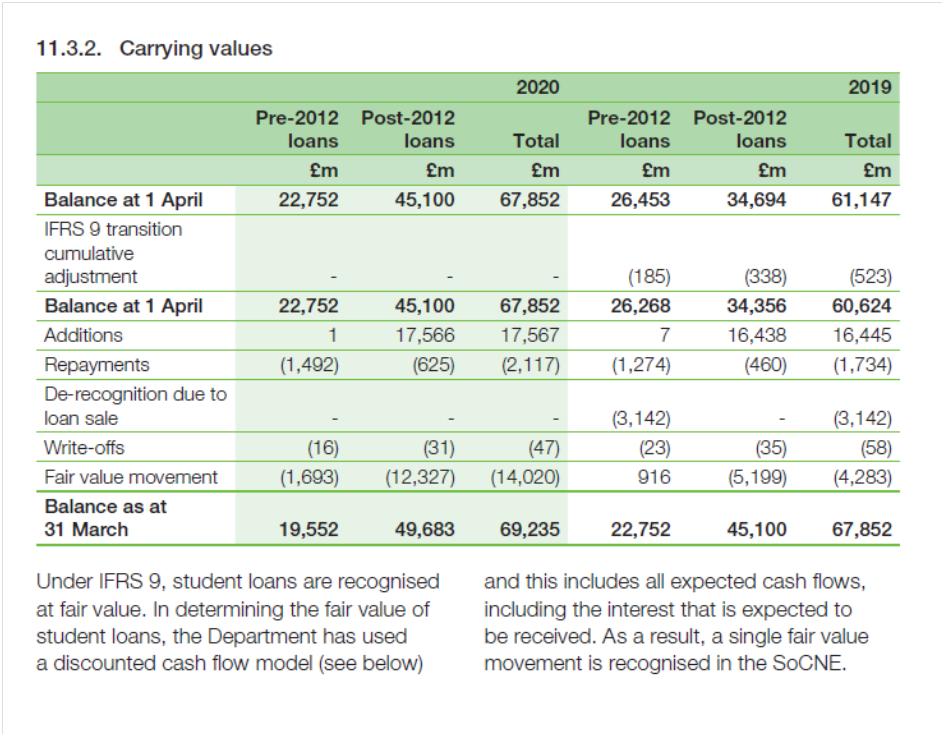
    As can be seen from the table below, “Fair Value movement” for student loans amounted to a non-cash cost of over £14billion.

    £17.6billion of new loans were issued, a net increase of £15billion once repayments of over £2billion are considered, but the new impairments on post-2012 loans increased by £12.3billion; for “pre-2012” loans the stock remaining at year-end lost nearly £1.7bn when revalued.

    Although the nominal value (“face value”) of outstanding post-2012 loan balances is nearly £105billion, those loans are thought to be worth less than £50bn.

    The increases in impairments break down into a RAB charge and a stock charge.

    The RAB charge is the estimated impairment on new loans issued. That came to nearly £9billion, reflecting the latest understanding that only 47% of the £17billion+ of annual undergraduate loan outlay is now expected to be repaid in net present value terms. Ie, the RAB charge is 53%, well above the official target of 36%.

    The other £7billion was a write down on loans issued in previous years and is based on changes made to the model used to estimate loan repayments. Only £2.1billion of that downwards revaluation is attributable to Covid (the loans were revalued in July).
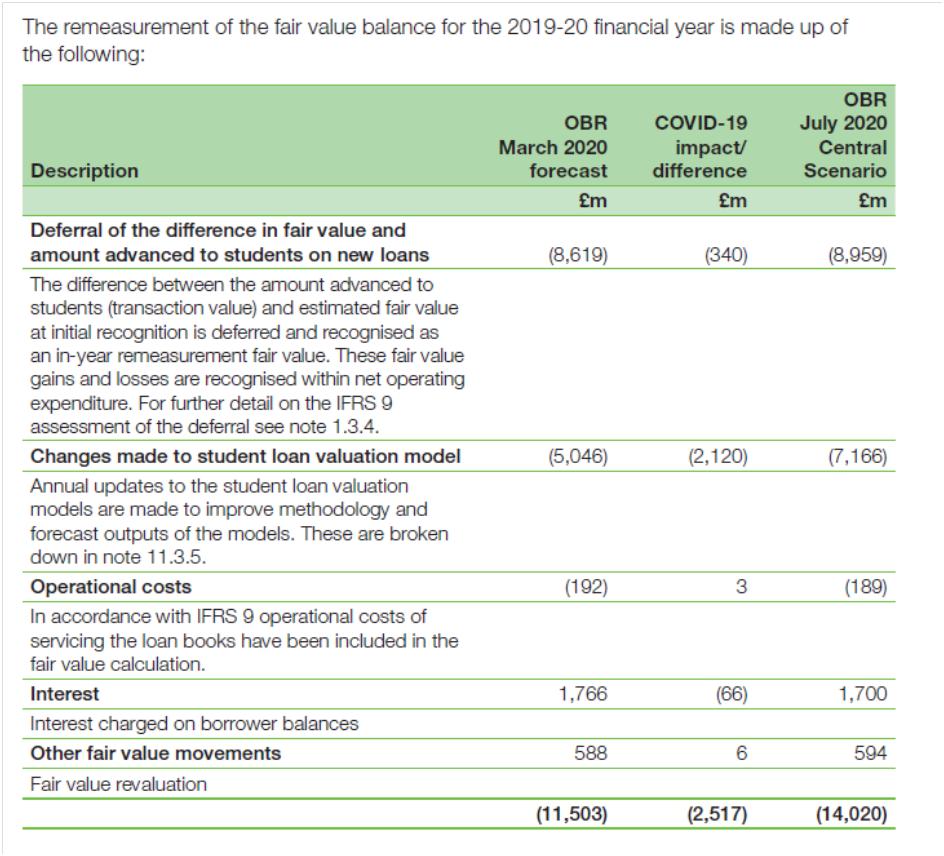
    The accounts make available a further breakdown of the modelling changes.

    The implications seem clear: HE is due a day of reckoning. From a financial perspective, the strongest measures would control outlay rather than boosting repayments. In cash terms, the former has immediate impact on finances, whereas the latter spreads the effect over decades and is politically difficult at this time.

    Tuition fees are to be frozen again in 2021/22 and we should expect this to continue. Announcements in FE suggest that the government would also like students to switch away from longer, more expensive HE courses. More radically, I would expect the government to be reviewing the Augar suggestions of tuition fee reductions and caps on places for certain courses (Recommendation 3.7).1  

    Back at the Conservative Party Conference, Rishi Sunak warned of “hard choices” to come and promised to “balance the books”:

    “Over the medium term getting our borrowing and debt back under control. We have a sacred responsibility to future generations to leave the public finances strong, and through careful management of our economy, this Conservative government will always balance the books. If instead we argue there is no limit on what we can spend, that we can simply borrow our way out of any hole, what is the point in us?”

    That final question invites some alternative answers, but the Spending Review’s focus on Further Education reinforces the idea that HE will be the required to balance the increased spending on the former.

    1 “We therefore invite the government to consider the case for encouraging the OfS to stipulate in exceptional circumstances a limit to the numbers an HEI could enrol on a specific course, or group of courses. It would be critical for the OfS to be transparent about the grounds and process for such an intervention and we can offer no more than a broad indication of what these circumstances might be. Where there is persistent evidence of poor value for students in terms of employment and earnings and for the public in terms of loan repayments, the OfS would have the regulatory  authority to place a limit, for a fixed period, on the numbers eligible for financial support who could be admitted to the course. The institution in question would remain free to recruit to all other courses without restriction. Such a cap system would clearly target the institutions that are offering poor value, rather than altering the entry criteria for individual students.”

    p. 102, Independent Panel Report to the Review of post-18 Education & Funding

    Source link

  • Dr. Jennifer T. Edwards: A Texas Professor Focused on Artificial Intelligence, Health, and Education: Reflecting on the 2020 Census

    Dr. Jennifer T. Edwards: A Texas Professor Focused on Artificial Intelligence, Health, and Education: Reflecting on the 2020 Census

    In Fall 2019, I was truly fortunate to receive a grant from the Hogg Foundation to promote the 2020 Census in East Texas. Yes, this area includes my hometown county – Panola County, then Rusk County and Shelby County. This was an AMAZING project! Thanks Hogg Foundation!

    The North East Texas Counts campaign had three goals for the project. Goal one was “to select and train 200 NETX Counts Ambassadors and Junior Ambassadors to tell the importance of the census to the community”. Goal two was “to engage and educate at least 3,000 residents in the tri-county community (especially hard-to-count populations) about the importance of the census”. The final goal, goal three” was “to saturate the tri-county community media outlets with Census information pertinent to their residents”. Through this campaign, we hosted 25 outdoor Census booths, eight interactive community information sessions, an engaging social media campaign, and received coverage in almost 10 newspapers and television outlets.

    The North East Texas Counts began the Census season by communicating with key contacts in the community and scheduling large-scale events to educate the community about the Census. We scheduled events at the local community college, library, etc. After the three counties restricted large scale and in-person events, we decided to develop a more robust online training and development process for our interns and volunteers.

    We offered numerous outdoor Census education table sessions. However, instead of offering these sessions outside large big-box retailers in the country, we offered these sessions in formats more focused on common pain points experienced by residents of the three counties and safety protocols of the counties. Instead of shopping at big-box retailers, the residents were more focused on shopping in smaller retailers, visiting gas stations, and visiting the post office. As a result, our strategy changed. During this process, we coined the phrase, “from gas stations to grocery stores”, because these were the essential places visited by residents during the pandemic. During this process, we offered information booths outside of gas stations, libraries in each county, Tractor Supply stores, city council areas, and on the side of the major highways. These strategies proved to be very effective because many residents indicated they have not taken the Census before and they did not know the importance of the Census. We were able to provide support for these residents through interactive in-person, on-one-one programming focused on the Census.

    Community Communication

    The North East Texas Counts team began the Census season by communicating with key contacts in the community and scheduling large-scale events to educate the community about the Census. We scheduled events at the local community college, library, etc. After the three counties restricted large scale and in-person events, we decided to develop a more robust online training and development process for our interns and volunteers.

    We offered three pop-up Census education table sessions outside large big-box retailers in the country. During these sessions, participants received USB chargers, Census t-shirts, and USB wall plugs. These technology and apparel items were essential items during the pandemic, because individuals in these areas usually have to travel to larger cities for technology items. People saw our items as they drove on the highways and many turned around to hear about the Census and to receive the items. Many residents commented that they have seen several Census shirts around their town and they wanted to learn more. We did not have any Census t-shirts left after September 30, 2020.

    North East Texas Counts Census – Coverage

    This project was one of the TOP projects of my faculty career. It truly changed my life and impacted the way that I see local, state, and federal government. This project ENERGIZED me!

    Stay tuned!


    Sincerely,


    Dr. Jennifer T. Edwards
    Professor of Communication

    Executive Director of the Texas Social Media Research Institute & Rural Communication Institute

    Source link

  • Dr. Jennifer T. Edwards: A Texas Professor Focused on Artificial Intelligence, Health, and Education: Use Google Trends for FREE Search Engine Keywords

    Dr. Jennifer T. Edwards: A Texas Professor Focused on Artificial Intelligence, Health, and Education: Use Google Trends for FREE Search Engine Keywords

    I really like using Google Trends for almost EVERYTHING! I use Google Trends for creating news articles, blog posts, course syllabi, and even when designing graphics!

    Here’s a video that I created about Google Trends – an amazing FREE technology!

    Exploring Google Trends is one of the best ways to discover social media topics and ideas for posts. Here’s a quick video focused on how to use Google Trends for Content Generation.

    Check it out! You can use Google Trends for everything from education to community engagement. Also, these are great for governmental outreach and engagement as well (depending on the search terms within your community).

    ###

    Try this campaign! Also, there are more campaigns available in my book – Retaining College Students Using Technology: A Guidebook for Student Affairs and Academic Affairs Professionals.

    Remember to order copies for your team as well!

    Thanks for visiting! 


    Sincerely,


    Dr. Jennifer T. Edwards
    Higher Education Speaker and Researcher


    My Social Media Channels!
    Remember to Follow Me on Twitter! @drjtedwards
    I Always Post Higher Education Videos on YouTube
    Find Me on Instagram
    Engage with Me on Facebook!
    Watch My Videos on Twitter Live – http://www.periscope.com/drjtedwards/
    Email Me! I am PR Friendly! – [email protected]


    Source link

  • Take Part In Our Self Paced October Challenge – Student Blogging Challenge

    Take Part In Our Self Paced October Challenge – Student Blogging Challenge

    Since 2008, the Student Blogging Challenge has run twice yearly, beginning every March and October.

    The 25th Student Blogging Challenge was scheduled to begin in October, however, 2020 has proved to be a year like no other.

    Due to the pandemic and subsequent changes happening in education throughout the world, the Student Blogging Challenge is on pause for now.

    But don’t despair! If you’re interested in ending the year with a challenge, we’ve got ideas for you.

    We’ve taken 10 of the best Student Blogging Challenge prompts from recent years for you to work on at your own pace. Perhaps you could aim to do one a week over 10 weeks, or pick and choose the challenges that suit you.

    You’ll also have the opportunity to have an authentic audience by sharing your work with our volunteer commenters.

    👉🏽 Click here to read the full post on The Edublogger where you can learn more and check out the prompts

    Source link

  • Teaching Our Students Have to Use the Library’s Ebscohost Databases

    Teaching Our Students Have to Use the Library’s Ebscohost Databases

    Research is VERY important for our students! Each of my classes has a research assignment focused on the library. They are paying for it, they should use it. At least this is what I believe. 🙂 

    I always make a training video for our students about the library’s databases. Here’s this year’s video!

    ***

    Check out my book – Retaining College Students Using Technology: A Guidebook for Student Affairs and Academic Affairs Professionals.

    Remember to order copies for your team as well!

    Thanks for visiting! 


    Sincerely,


    Dr. Jennifer T. Edwards
    Professor of Communication

    Executive Director of the Texas Social Media Research Institute & Rural Communication Institute

    Source link

  • EdTech Roundup Going on Extended Hiatus, edCircuit Taking Over in the Meantime!

    EdTech Roundup Going on Extended Hiatus, edCircuit Taking Over in the Meantime!


    Hi Everyone – 

    I will be taking an extended break from the blog.  My current workload and new responsibilities as a father have left me with not enough time to devote to the site.  I hope things balance back out in the future, but currently, I will be on break from the site until further notice. 

    In the meantime, our good friends over at edCircuit will be taking over the site and sharing some excellent posts and resources each week!  So even though I’ll be on break, we will still be sharing new material on a regular basis. 

    Thanks for understanding,

    Mike

    Source link

  • Dr. Jennifer T. Edwards: A Texas Professor Focused on Artificial Intelligence, Health, and Education: About Your Professor

    Dr. Jennifer T. Edwards: A Texas Professor Focused on Artificial Intelligence, Health, and Education: About Your Professor

    Over the summer, I always think about how the fall courses will be better. I always strive to make my courses at least 5% better than the courses the semester before. Course evaluations are important and I want to make sure the students have a great experience, but I also want to have a great experience teaching in the course as well.

    This means that I write down ideas as I read blog posts, listen to videos, and also as I listen to local/regional/and national news. So, I get EXCITED to introduce myself to a new group of students! 

    This year, I decided to pre-record TWO videos introducing myself to the students. Here’s the video (Part 2/2) that I plan to send the students in the fall semester. This videos is based on the questions that I requested from via an email survey in the summer.

    ***

    Check out my book – Retaining College Students Using Technology: A Guidebook for Student Affairs and Academic Affairs Professionals.

    Remember to order copies for your team as well!

    Thanks for visiting! 

    Sincerely,

    Dr. Jennifer T. Edwards
    Professor of Communication

    Executive Director of the Texas Social Media Research Institute & Rural Communication Institute

    Source link

  • Dr. Jennifer T. Edwards: A Texas Professor Focused on Artificial Intelligence, Health, and Education: About Your Professor

    Dr. Jennifer T. Edwards: A Texas Professor Focused on Artificial Intelligence, Health, and Education: About Your Professor

    Over the summer, I always think about how the fall courses will be better. I always strive to make my courses at least 5% better than the courses the semester before. Course evaluations are important and I want to make sure the students have a great experience, but I also want to have a great experience teaching in the course as well.

    This means that I write down ideas as I read blog posts, listen to videos, and also as I listen to local/regional/and national news. So, I get EXCITED to introduce myself to a new group of students! 

    This year, I decided to pre-record TWO videos introducing myself to the students. Here’s the video (Part 1/2) that I plan to send the students in the fall semester. This videos is based on the questions that I requested from via an email survey in the summer.

    ***

    Check out my book – Retaining College Students Using Technology: A Guidebook for Student Affairs and Academic Affairs Professionals.

    Remember to order copies for your team as well!

    Thanks for visiting! 

    Sincerely,

    Dr. Jennifer T. Edwards
    Professor of Communication

    Executive Director of the Texas Social Media Research Institute & Rural Communication Institute

    Source link

  • Reviews | Genially: Create Presentations, Infographics, and Visuals in Seconds

    Reviews | Genially: Create Presentations, Infographics, and Visuals in Seconds


    Genial.ly is a presentation creation platform that offers a wide range of possibilities for what teachers and students can create.  From excellent templates to interactive visuals, there are some really fun and exciting ways to easily create visuals of all kinds.  Plus, it’s a freemium resource, so teachers and students can get started creating completely for free. Continue reading on our Review’s Page.

    Source link

  • Prevention and Control of COVID-19 in Schools

    Prevention and Control of COVID-19 in Schools

    Schools play a critical role in helping to prevent and control the spread of infectious diseases within communities. With the outbreak of the novel coronavirus disease (COVID-19), there has been discussion on how to open public areas safely, specifically schools. As world organizations work to find a vaccine, communities must take steps to protect at-risk individuals and reduce the impacts of the outbreak.

    It is important to take the necessary precautions to prevent the potential spread of COVID-19 in school settings. To effectively mitigate the spread, administrators will need to provide clear and actionable prevention guidelines to students, parents, and staff. Below we’ve provided facts, resources, and suggestions for how to minimize the disruption of learning while protecting students and staff during this outbreak.

    What is COVID-19 and How Does it Spread in Schools?

    COVID-19 is a disease caused by a new strain of coronavirus. The most common symptoms can include fever, cough, and shortness of breath—though some may carry the disease without showing any signs.

    The virus can spread through direct contact with respiratory droplets (from a cough or sneeze) from an infected person. COVID-19 can also infect individuals who touch their faces (e.g., eyes, nose, mouth) after touching surfaces contaminated with the virus.

    Prevention of COVID-19 in Public Spaces

    Like all other respiratory infections (the flu or common cold), it takes the coordination of organizations and the community to slow the spread of diseases. The recommendations below should be followed by all those in the community, including offices, restaurants, government buildings, and more.

    Encourage the community to follow these measures:

    • Stay home when sick
    • Cover mouth and nose when coughing or sneezing
    • Dispose of tissues immediately after use
    • Wash hands often with soap and water
    • Clean frequently touched surfaces and objects

    Additional recommendations may be encouraged. Be sure to follow public health officials to stay up to date on the latest measures. Learn more here.

    Guidance for COVID-19 Prevention and Control in Schools

    Even if schools are not opening for in-classroom learning this fall, staff and students may still need to access the school facilities to participate in lunch programs, collect technology equipment, or gather other assets. Administrators will need to have guidelines to ensure safe reopenings or access to schools for all who enter. Below are suggestions and guidelines to keep in mind when implementing safe school operations during COVID-19.

    Screen Volunteers and Visitors

    Monitor the health of those coming in and out of your school before they enter your facility. Administrators can implement technology like KeepnTrack to take a proactive approach to prevent and control the spread of COVID-19 by vetting every individual who enters their facility. Administrators can ask a series of questions to determine if an individual’s symptoms or exposure is a threat.

    With KeepnTrack, administrators are given the tools and information to make accurate decisions. Learn more about screening volunteers and visitors here.

    Promote Information Sharing

    Administrators should make the school’s guidelines for preventing and controlling the spread of the virus accessible to parents and students. School community members should be encouraged to alert school and healthcare authorities and keep their children at home if someone in their household is diagnosed with COVID-19.

    Parent-teacher committees and other school volunteers can also help with the sharing of information and guidelines.

    Monitor Absenteeism and Track for Patterns

    Develop a monitoring system to track student and staff absences and compare usual absenteeism patterns at the school. If unusual patterns are found, alert local health authorities about significant increases in student and staff absenteeism due to respiratory illness.

    Now is the time to develop new school policies regarding attendance or sick leave that encourages students and staff to stay home when sick or caring for sick family members. Be sure to put in place alternative options for students who are at home sick or covering critical job functions or positions. Be sure to plan for possible academic learning changes or alterations when it comes to breaks or exams.

    Grants for Prevention and Control

    Congress set aside approximately $13.2 billion of the $30.75 billion allotted to the Education Stabilization Fund through the CARES Act for the Elementary and Secondary School Emergency Relief Fund (ESSER Fund). The Department will award these grants ­to state educational agencies (SEAs) to provide local educational agencies (LEAs), including charter schools that are LEAs, with emergency relief funds to address the impact that COVID-19 has had, and continues to have, on elementary and secondary schools across the nation.

    ESSER federal funding through the CARES (Coronavirus Aid, Relief and Economic Securities) Act intends to help your schools address the needs of your students with disabilities, English learners, and at-risk students, by providing resources to implement solutions that positively impact these populations.

    Source link