Blog

  • Let’s Reflect! – Student Blogging Challenge

    Let’s Reflect! – Student Blogging Challenge

    This is the final Student Blogging Challenge post until we start again in October 2020.

    We know many of you have been working on the challenge during very unsettled times. Well done!

    It’s time to reflect and celebrate.

    Week Seven Recap
    Trophy image -- great work

    Many students are enjoying sharing posts about emojis.

    You can find all the submitted tasks here (or click on the week 7 box on the sidebar).

    Here’s just a handful of excellent work we spotted recently:

    • Tushil from New Zealand made a unique basketball emoji and has a guessing game.
    • Lainie from Australia invites you to guess the movies from the emoji clues.
    • Olivia shared some interesting details about break time in New Zealand.
    • Eleanor from the USA made an emoji story using the prompts from Byrdseed.
    • Liv wrote an amazing poem about her school in New Zealand.
    • Ervins from Latvia came up with some emoji maths. Can you guess the answers?
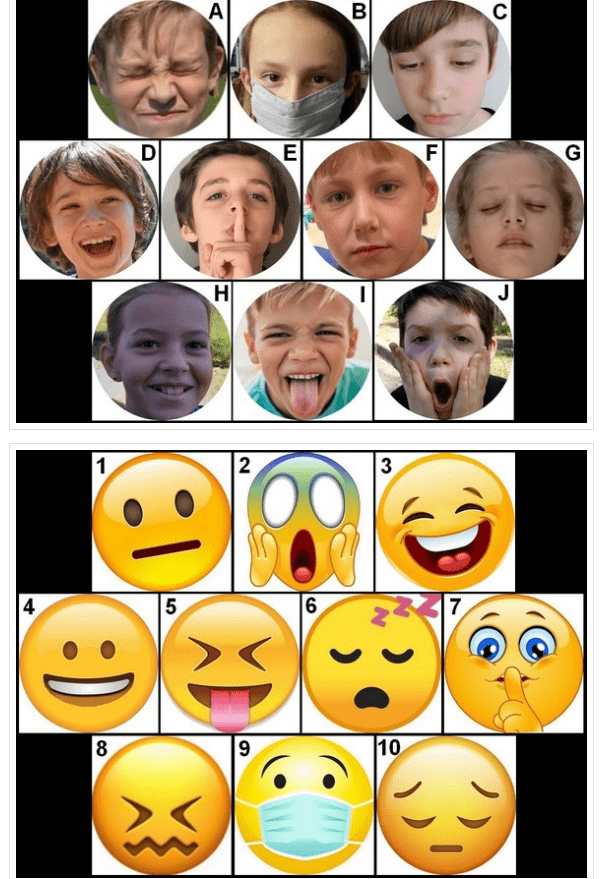
    • Serge Galligani’s class in France came up with a fun idea. The students turned their faces into emojis. Can you guess the answers?
    Reminders

    • The forms for weeks 1-6 are closed. If you’re catching up you can submit your tasks from weeks 1-6 in the week eight Google Form in this post. All Google Forms will close May 24th.
    • If you’d like to join us again for the next challenge in October 2020, make sure you’re on our mailing list. You’ll get an email in September when registrations are open. Otherwise, check this blog in September for all the news.
    • Follow The Edublogger — If you’re not already receiving the email newsletter from Edublogs, maybe you’d like to sign up? I send out an email regularly sharing the latest blog post.

    Thank You
    Thank you floral wreathThe Student Blogging Challenge is a real team effort. We couldn’t do it without the support of our wonderful volunteers.

    Many of our volunteers and participants have worked on the challenge during difficult circumstances. We admire your efforts immensely.

    To Sue Wyatt…

    Miss W/Tasteach/Sue Wyatt works tirelessly behind the scenes to help our commenting team, support participants, and keep our spreadsheets up to date. We appreciate you, Sue!

    To Marg Grosfield…

    Marg is a special commenter who does a wonderful job behind the scenes helping with the spreadsheets. Marg generously volunteers her time to ensure everyone is looked after. Thank you, Marg!

    To our commenters…

    Another big thank you goes to our team of commenters who provided an authentic audience for our students and classes each week. Your comments really helped our students with their confidence and motivation. We hope you’ll return again as a commenter in October.

    To our participants…

    It has been fantastic to see such enthusiastic participation from our students and teachers despite difficult circumstances! I hope you’ve all learned a lot and made some connections.

    Spread the word about the next Student Blogging Challenge!

    Summary Of The Student Blogging Challenge

    We had a good number of registrations for this Student Blogging Challenger, however, participation was naturally down due to over 90% of the world’s student population being affected by school closures.

    Let’s look at STUBC by the numbers…

    • Number of registered individual students: 1043
    • Number of registered classes: 111
    • Number of countries represented: 24

    Number of tasks submitted

    These are the edited numbers after incorrect and duplicate URLs were removed.

    What Makes A Quality Blog Post?

    I hope you’ve learned a lot throughout the Student Blogging Challenge! Perhaps if you look back to your posts from a few weeks ago you can see that you’ve improved.

    To wrap all our learning up, I invite you to take a look at this poster. It goes over some of the essential ingredients of a quality blog post. You might have your own ideas too!

    You’re welcome to add this poster to your blog.

    >> Download a PDF copy of the poster
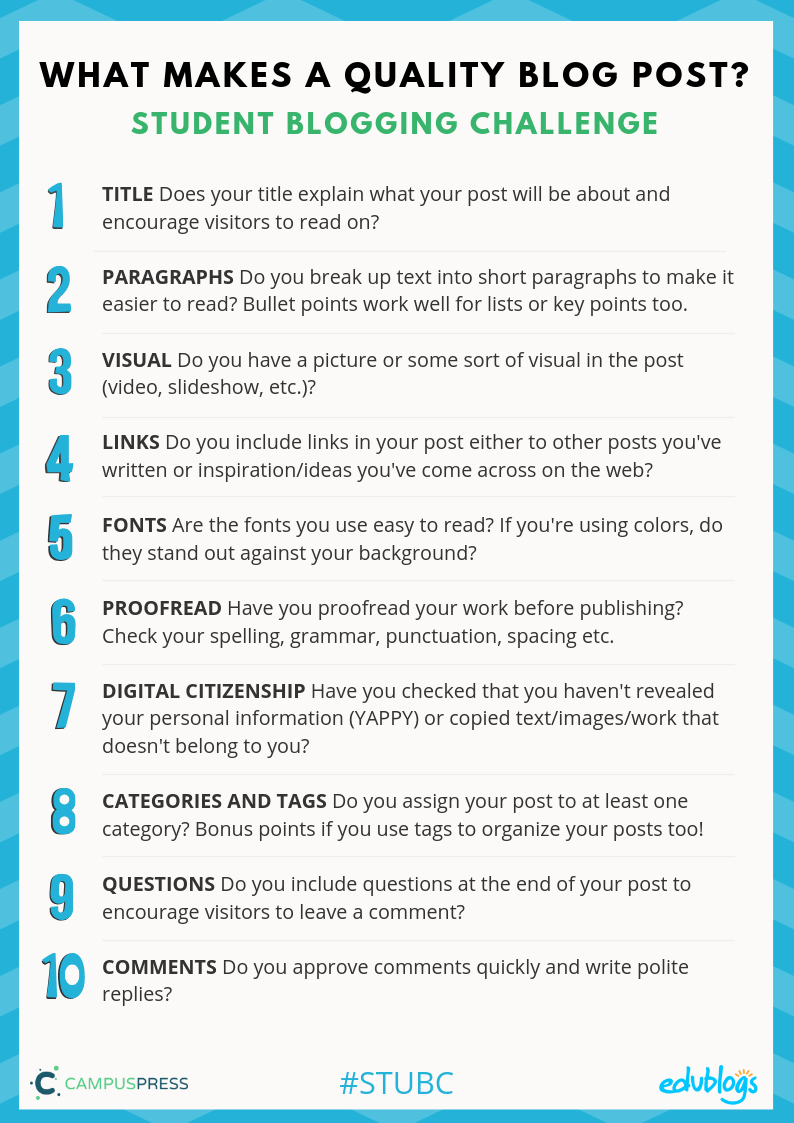
    10 point checklist showing what makes a quality blog post STUBC

    Week Eight Tasks

    This week there are 3 tasks to complete. If you don’t have time to write a post, please just spend 5 minutes completing our survey. We’d really appreciate it!

    There is a separate survey for teachers and students.

    Teachers, please help us in making sure your students fill in the correct survey (for students)
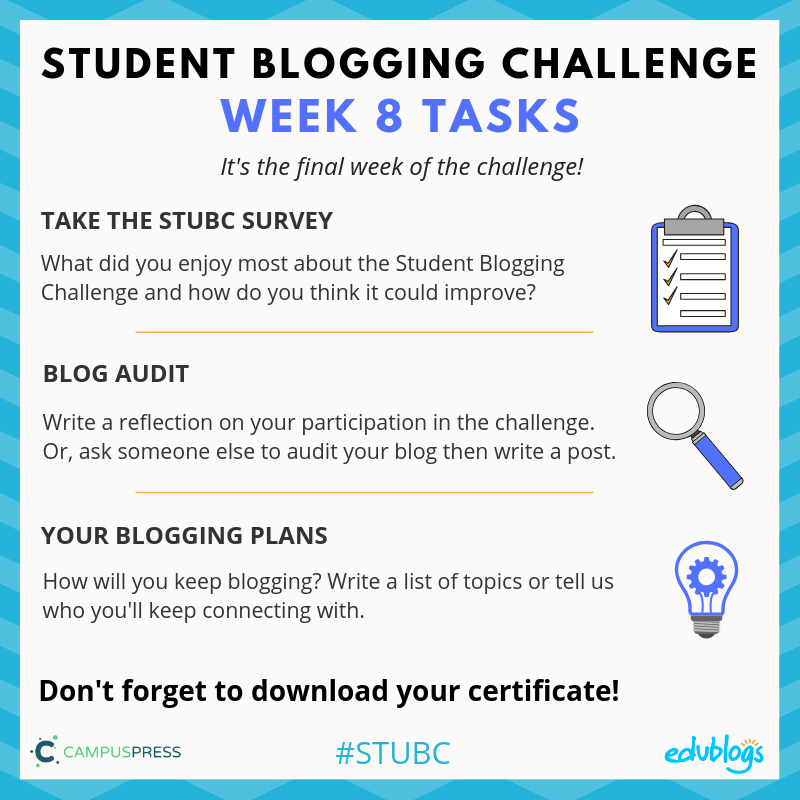
    Week 8 Tasks STUBC Let's Reflect -- as described in post

    Task 1: Evaluate The Challenge

    Please complete our short survey so we know what you enjoyed most about the challenge and what we could do to improve things in the future.

    There is a separate survey for teachers and students.

    Student survey

    👉🏽 Click here to open the student survey

    Teachers, add this URL to your class blog or LMS if you like https://forms.gle/XVcj8gutKWa4ENgJ7

    Teacher survey

    👉🏽 Click here to open the teacher survey

    Remember, the teacher survey is not for students.

    Thank you!

    Task 2: Audit Your Blog 

    Option One: Write a post on your blog reflecting on your participation in the challenge.

    These are the sorts of prompts you could answer in your post:

    • How many weeks of the challenge did you participate in?
    • How many posts did you write in the 8 week period?
    • How many comments did you receive from classmates, teachers, or other visitors?
    • Which post did you enjoy writing the most and why?
    • Which web tools did you use to show creativity on your blog?
    • What are your plans for your blog now? Will you keep posting?

    Option Two: Ask a friend or family member who might not have read your blog to do an audit.

    Send them your blog URL and ask them some questions.
    For example:

    1. What were your first impressions of my blog?
    2. What captured your attention?
    3. What distracted you on the blog?
    4. What suggestions can you give me to improve my blog?

    Task 3: Your Blogging Plans

    While the Student Blogging Challenge is coming to an end, we hope this is not the end of your blogging journey. We encourage you to keep blogging and connecting. To do this well, you might need a plan.

    Write a post about how you plan to keep blogging:

    • Perhaps you’d like to publish a list of ideas you have for future blog post topics.
    • Or, you could ask your readers for suggestions on what they’d like you to write about on your blog. You could even run a poll.
    • Write about anyone you have connected with throughout the challenge that you’d like to stay in touch with. Are there any blogs you’ll keep reading and commenting on?

    Blog post ideas for students:

    More advanced bloggers and teachers might enjoy these two posts on The Edublogger:

    If you’re working as a class on this activity, perhaps students could contribute post ideas which the teacher compiles. Readers could be invited to comment or vote. 

    Student Certificates

    Congratulations on completing the Student Blogging Challenge!

    Download a certificate to celebrate your achievement.

    Note for commenters: I’ll email you about accessing your certificate during the week. 

    >>Click here for a PDF copy of the student certificate

    Student Blogging Challenge Certificate Participants 2020


    Submit Your Post URL ⬇

    If you want a commenter and other participants to visit your final task on your blog, remember to fill in the Google Form below.
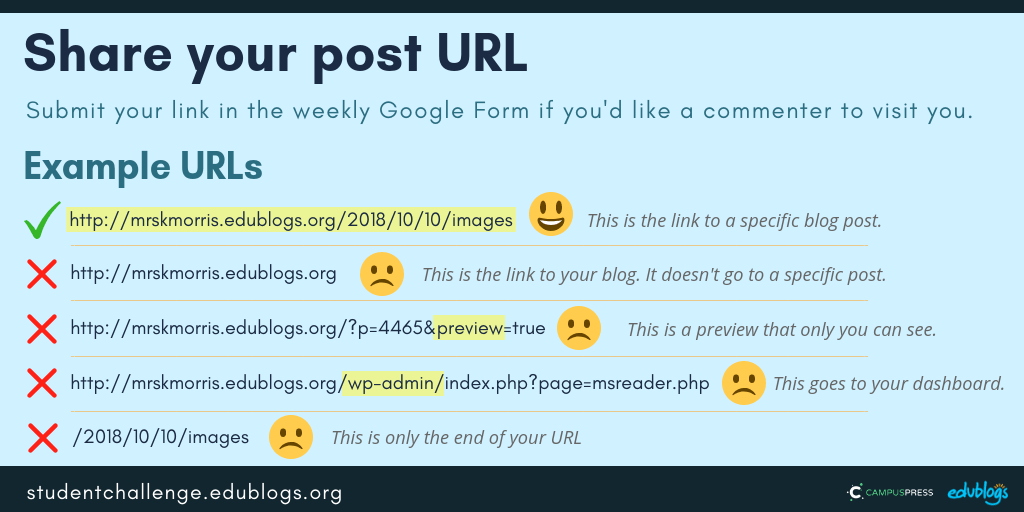
    Examples of post URLS for STUBCThe Google Form

    Teachers, you’re welcome to put the Google Form URL on your own blog or LMS if it makes it easier to share with students.

    https://forms.gle/XQyGmTtyBFrfdgQm6


    If you have any additional comments about the Student Blogging Challenge, feel free to leave a comment below!

    Thank you!

    Source link

  • Why every school district needs a Head of Remote Learning

    Why every school district needs a Head of Remote Learning

    Why every school needs a Head of Remote Learning (and yes, we should talk about this during a crisis)

    Most schools are facing multiple transformations. These range from digital transformation, to future-skills transformation, to the most important and urgent right now, which is distant-teaching and learning transformation.

    Whilst the corporate world has innovated with new roles from chief digital officers to agile coaches to futurists to attempt to capture value from these transformations — the roles we have in schools are still operating within the legacy mindset and systems, ranging from Math teacher, English teacher, PE teacher, and Art teacher, representing probably 90% of the roles that exist in any school.

    Leaving the titles aside, if we look at it from a skillset point of view, we know ‘subject’ teachers are more than the purveyors of subject knowledge. They are counselors, data analysts, advisors, experimenters, storytellers, investors (with their time), relationship builders, technologists, and today they are required to be remote teaching specialists.

    Teachers are more than the purveyors of subject knowledge. They are counselors, data analysts, advisors, experimenters, storytellers, investors (with their time), relationship builders, technologists, and now they are required to be remote teaching specialists.

    There’s never been a better case to be made for a Head of Remote Learning in schools and districts.

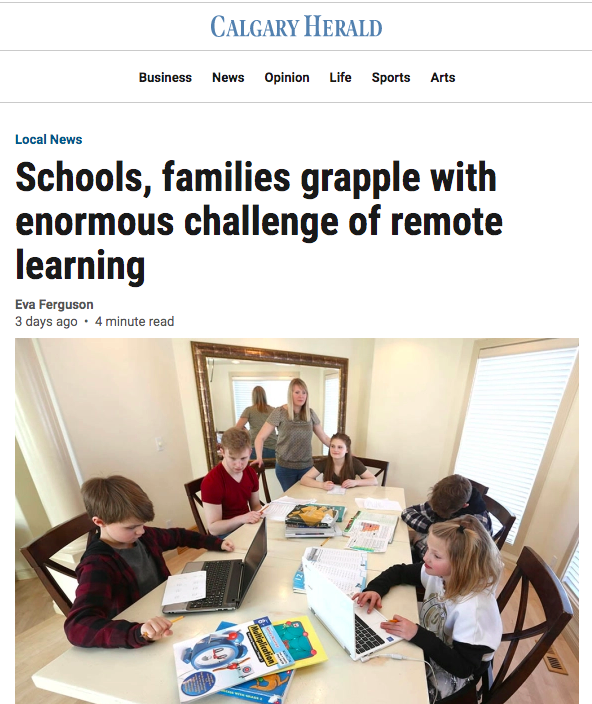
    With 70,000 students told to stay at home and over half the schools closed across the country as of March 18, 2020, for COVID19 prevention measures. With some schools potentially not opening until after summer break, teachers are scrambling to remotely continue the academic learning for students.

    Headlines like this one from the Calgary Herald describe the last-minute scramble.

    Before we go on, it’s important to state that this role can be taken on by more than one person in any school, and needn’t have to be a full-time role in the initial instance. First, by experimenting and creating value in the role, it can be used to justify the hiring-case to the wider district to fund this position.

    First, let’s discuss why this role is a must-have.

    Aside from once-in-a-lifetime (we hope) global pandemics, there are many reasons why schools should now have a remote learning role. Just take examples from the past two years, when schools closed for fires in California and the polar vortex in Wisconsin. Each region has different susceptibilities that threaten the continuation of the education of our children for periods of time.

    Remote learning doesn’t only have to occur for school-wide closures. Take, for example, the student with lice or Strep throat who’s out of class for a week who undergoes significant stress on top of their illness due to the difficulty of catching up on missed learning. What if some of those absent days can instead be counted due to remote learning plans?

    Never has there been a better time for remote learning than now. The confluence of fast internet capability and quality education technologies, both curricular and administrative, leads to the power to produce high-quality Remote Learning experiences. The considerations of equitable access, student (and home) privacy, screen-time, routine and movement management, and social isolation all need to be addressed. We can look to online high schools, like Stanford K-12 online schools and homeschooling experts, that likely have addressed many of these challenges as a starting point.

    March 19th’s article in Politico describes how lack of planning has led to last-minute efforts like how a “school sent home a paper survey Friday for parents to asses their technological access and received 114 responses — 92 percent have smartphones and 94 percent have internet access, but only 58 percent have computers and laptops. There are six different languages spoken at the school, with more than 60 percent of families on the poverty line.” Having someone who is responsible for processing this data in advance would result in better outcomes for the community.

    The role of Head of Remote Learning is essential for bridging the gap between school and home. A gap that has existed since the invention of schools. The role includes 3 focus areas, to ultimately create shared-knowledge, skills, mindsets, and behaviors between teachers and teachers, between teachers and parents, and between teachers and children.

    Between teachers and teachers

    • Professional development of teachers to convert to remote learning, including training on the various product platforms and how to integrate technology into learning design, such as with the SAMR Model.
    • Communication guidelines and templates to make life easier for all teachers to convert to remote learning plans rather than each teacher inventing their own solutions.
    • Sourcing of products to fulfill the role of communication, curriculum continuity, and emotional support.
    • Implementation plan for administrators, teachers, students, and parents, whether it’s for a single student or the whole school.

    Between teachers and parents

    • Parent support for difficult conversations with their children to ease anxieties by sharing resources and discussion questions.
    • Equipment planning, including devices and Wi-Fi hotspots for students’ homes. Why? 10% of students in the U.S. don’t have internet access at home. In these circumstances, the burden falls on parents who aren’t able or confident to take up their child’s education — things have changed so much since we were at school.
    • Equip parents with the resources to effectively use educational technology, not just to supplement curriculum learning, but also as a way to engage kids in subjects beyond the classroom.

    Between teachers and students

    • There are endless technology options that need to be experimented on, and where there is efficacy of the use-cases they then need to be scaled fast. Creative new technologies that can enhance the learner’s journey, include audio learning tools for connection, communication, and learning. For example, remote learning plans may include podcast tools for students to submit work to teachers and interactive voice technology apps, like Ask My Kid, with social-emotional support, movement breaks, and short academic practice sessions. Unlike most remote learning technology, audio technologies can be screen-free, helping parents stay within the American Pediatric Association’s screen time guidelines.
    • Show students how to use educational technology to become resilient, independent learners who are capable of organizing their own learning and educational objectives.

    A final benefit of remote learning is that they facilitate increased connection to the home. Healthy levels of parent engagement in their child’s education have long been coveted by educators. With children at home, whether due to sickness or catastrophic events, parents can reliably feel connected, and even contribute to the learning, with good remote learning plans.

    The most important part of this role is becoming an expert in keeping students calm and on-track. There are sudden isolation and disconnection from classmates, disruption of precious routines, uncertain parents, and distracting home learning environments. Direct daily communication and connection through hearing the teacher’s voice are essential. Students need to know the plan each day and hear it from their own teacher.

    Learning in social environments is critical. There will never be a complete substitute for physical togetherness, from the informal play at recess to the smell of the art room and science lab, but quality remote learning plans will only add resilience to our system of education. The role of Head of Remote Learning is central to strengthening the resilience of our schools and the continuity of learning for our children.

    Before you go, there are 3 immediate next steps:

    • If you found value in this article, we would love for you to share with your network to start a robust conversation and spread this thinking.
    • Everyone is time-poor and dealing with massive change right now. It is natural to think that this conversation should be put on hold, but now is the right time to start documenting what’s difficult so we can define this role with more fidelity when students return to school.
    • We are working with school, district, and foundation leaders to onboard the Head of Remote Learning role into the education system. Please reach out to us if you are interested to learn more at [email protected].

    by Dr. Aparna Ramanathan, CEO and Co-Founder, AskMyClass

    Aparna Ramanathan is the CEO and co-founder of AskMyClass. Aparna worked for over a decade as a medical doctor in Australia. After moving to the U.S., she coached professional women in practical stress management techniques, using a data-driven approach. That work led to the development of the first mental health games and programs using voice technology for parents and then the classroom — which lead to the founding of AskMyClass, a Silicon Valley-based Y Combinator-backed startup that creates classroom-specific activities to help students build essential social-emotional skills while increasing their classroom engagement.


    Source link

  • Keep up to date with all things digital

    Keep up to date with all things digital

    The Digital Learning News is a monthly newsletter from DET Digital Learning Services. Subscribe here to keep up to date with professional learning, software and resources to support you in your classroom.

    You can also find ​teaching ideas, materials and safety for using digital technologies in the classroom at the DET Digital Learning web page.

    Source link

  • Microsoft Education Tune-Up Recruiting New Schools!

    Microsoft Education Tune-Up Recruiting New Schools!

    Microsoft are accepting expressions of interest for their free Microsoft Education Tune-Up program for Terms 1 and 2, 2020. Their team of Education experts are on hand to meet with your school. Through a series of workshops and meetings we will deliver a comprehensive and bespoke strategy which leverages their Education Transformation Framework.

    Uncover answers to questions your school may be asking:

    • Are our school leaders and teachers equipped to deliver 21st Century learning skills for students in an rapidly-changing world?
    • Are we managing and deploying our devices and apps in an efficient and cost-effective manner?
    • Are we best leveraging technology to make our school a more equitable and inclusive institution?
    • Are we getting the most out of our existing Office 365 technology?

    This unique service capitalises on decades of research, global best practice and real evidence to help deliver a strategy tailored to your school’s needs.

    There are limited spaces available for this exclusive program, so reach out now to arrange a meeting with your school’s leadership team.

    About The Team

    1. A Technology Solutions Professional will offer guidance & support to help you; assess your technical readiness; optimise your Office 365 tenant; build your ICT team capacity; recommendations on the right Microsoft partner.
    2. A Learning Delivery Specialist who will help you see the potential of the Microsoft Education solutions; assist you to build a PD strategy to better reach curriculum outcomes and transform classroom time.

    Microsoft Offer / School Commitment

    • A move toward Office 365 and/or Windows 10 as the major platform in your school;
    • 2x term duration;
    • A technical readiness assessment;
    • Build a focused PD strategy with the LDS;
    • Key stakeholder attendance (incl. Principal or AP) at the Transforming Education Leadership 1-day workshop;
    • ICT Team to attend an M365 for IT Pros 1-day workshop and work directly with our TSP to build their capacity;
    • Your Learning Support/Inclusivity team to attend 1-day Inclusive Classroom workshop;
    • 2+ teachers released for 2 days to be certified as MIE Trainers;
    • Monthly virtual meetings with our team and other schools successfully implementing these tools.

    Find out more and register your interest by emailing [email protected]

    Source link

  • Using SQ3R to help college students read

    Using SQ3R to help college students read

    When students arrive in college, faculty often make the assumption that they know how to read for comprehension and retention. Unfortunately, and for a variety of reasons, many students are not well versed in how to read for class. In today post, I want to share an excerpt from my book, Teaching for Learning, about how you can use SQ3R to help college students read.

    Photo credit: Marketa

    SQ3R

    Overview

    The SQ3R activity provides a framework for students to better comprehend and retain information from readings assigned for class. Students often read course readings as they would any other text: start at page 1 and read to the end without framing the content, thinking critically about the content, and engaging the content. This IDEA offers a more systematic approach to better study the material while reading (Artis, 2008).

    SQ3R is a five-step process:  survey, question, read, recite, and review. The activity helps students engage with material and improve their processing of the information through framing and reflection. Although the use of these five steps take longer than simply reading a text, the advantages of improved understanding and recall are beneficial for students and they improve the teaching experience.

    Guiding Principles

    SQ3R is built on the foundation of an information processing theory of learning (Newell & Simon, 1972; Tadlock, 1978). This theory suggests that people structure and organize information into systems of meaning. The limitations of learning are frequently attributed to limits on the ability to organize information and by encoding information in a way that facilitates recall. By providing a framework to organize new knowledge, SQ3R helps students develop understanding faster and more efficiently. 

    The activity also makes use of the ways the brain stores and retrieves information using short and long-term recall. The framework of SQ3R encourages students to slow down and spend time on information which activates the processing strengths of particularly long-term memory. By asking questions and encouraging recitation, SQ3R allows students to better store and recall information from course readings.

    Preparation

    Most frequently, the SQ3R activity is completed by the student outside of class as part of assigned readings. Prior to assigning SQ3R, provide the framework for students and also explain why the activity proves useful. Students often complain that this process increases the time it takes to complete the reading and in doing so they often fail to see the value. Providing an understanding of why it works based on the guiding principles above can help students know the value and use the activity (Tadlock, 1978).

    Process

    • Explain the framework of the activity in the class and assign (or suggest) students use it on the readings for homework. The following steps explain the process of the activity.
    • Survey helps students gather the basic structure of the topic presented in the reading including reading the title, headings, graphics, and any text called out such as definitions or objectives. 
    • Question involves turning headings and other main ideas identified in the survey stage into question. Students should then seek answers to the questions as they read. 
    • In the Read stage, students read the text to capture the main ideas as identified in the survey and question stages. The goal is to write down the answers to the questions raised by filling in the main ideas without getting too bogged down by the details. 
    • Next, students Recite material, which assists with concentration and recall. Students look at each of the questions of a section and attempt to answer the question (while covering up their notes).
    • The Review step allows the students to consolidate learning and comprehension by reviewing each of the questions and answers.   

    Pro-tips

    Many students have never been taught how to read texts or study content rich material. This activity presents a great strategy to help students by providing a versatile framework to use while reading. Many instructors find it helpful to walk students through how to complete the steps in class. Taking the time to model the process in class can improve students’ use of the activity and improve their reading comprehension as a result.

    There are many different variations that have grown out of SQ3R such as, SQ4R (survey, question, read, recite, wRite, and review) (Pauk, 1984),  PQ4R (preview, question, read, reflect, recite, and review), and FAIRER (facts, ask questions, identify major/minor details, read, evaluate comprehension, and review) (Lei, Rhinehart, Howard, & Cho, 2010). Fundamentally, these all provide frameworks for self-regulation of reading. You can use any variation of this system, as the goal is to provide a way for students to work through a framework to organize and comprehend new information.

    One of the more difficult, yet important, aspects of the SQ3R activity is developing good questions. Students often can easily turn headings and other readily identifiable major points into questions, but struggle with developing good topic spanning questions. As part of other class activities and in debriefing this activity, help students develop good questions. You may do this by sharing good questions raised by classmates or by providing some starter questions early in the course you identified. Helping students learn to ask questions can assist students in your class and throughout their education.

    (Visited 1,640 times, 1 visits today)

    Source link

  • The Actual Work of an Edtech Sith Lord

    The Actual Work of an Edtech Sith Lord

    Coming to Terms With My Role as an Edtech Administrator and My Contribution to Education, Edtech, and Educators

    Recently, at the ISTE 2019 conference, I presented on building an educational technology professional development program on a budget. It was only the second time I had given this presentation and I was fortunate enough to be collaborating with my edtech sister, Kelly Martin. It was my first time presenting at what is the gold-standard conference in our field and I was feeling the incredibly trite combination of excited and nervous. Now that it is said and done, I’ve done a lot of thinking about the presentation, our message, the systems we have tried to build, and the pedagogical practice we have tried to improve. Our presentation, in many ways, speaks to a professional identity crisis I have been having since decided to cross over to the Dark Side and become an Edtech Sith Lord, an administrator.

    I came into edtech as a teacher coach. It was my job to be the expert on the tools AND to coach teachers. I would partner with them, build lesson plans and activities with them, and be in the room as support when we tested those lesson plans out with students. I loved it. If I am 100% honest with myself, after three years of being an administrator, I still miss it. In fact, I am going to commit a teaching taboo and admit: I think loved that job more than I loved my 14 years of being a classroom teacher, because the only thing I have loved more than helping middle school kids succeed by finding what they are capable of, is helping teachers succeed by finding what they AND their students are capable of.

    So when I became an administrator, when I made the conscious decision to join the Dark Side and trade my green lightsaber for a red one, I knew what it was I wanted to accomplish and why I was doing it. I wanted to build a great educational technology department in a district that was just starting out with edtech. I had had a great model at Fairfield-Suisun Unified School District, lead by Dr. Melissa Farrar. To this day, FSUSD still employs two of the best educational leadership role models I have met, Dr. Farrar and Kristen Witt. I was part of the team that first started the educational technology department in FSUSD, and naturally had some ideas on how I would do it “differently” or maybe “better.”

    I didn’t know how I was going to do it, but I had my what and my why in place. The how… well that has proved to be trickier, and more difficult than I expected. A thing I didn’t expect is how much being on The Dark Side was going to pull me farther and farther from direct contact with teachers. It has been a bit of a sacrifice, one that I am certain I would make again. Yet, it would have been easier if I had realized that going in.

    So now, after ISTE, after I have been allowed to represent myself as some sort of expert on building an educational technology department, I am reflecting even more on these questions: Am I effective? Am I an effective leader? What do I essentially do? How do I approach it? What do I believe in here?

    Teaching can be solitary work, but at least you have a whole school of other teachers, and a vast social media teacher community. One of the hardest things about my job is that to find a professional community you have to have friends outside of your district, because there’s only ever one of you. Even with that, I think what I still wrestle with most, having moved to the Dark Side, is missing teachers and classrooms.

    When I do get the chance to speak with men and women who do a similar job and we discuss how we interact with teachers and how we create professional development systems, there are common threads. What I have to say on this may not be terribly original. It could be summed up as “hire good people, and then get out of their way”, but since I have been reflecting on this, I thought I would share what the most important tasks of an Edtech Sith Lord are.

    Recruit Revolutionaries

    Every educational technology administrator I know in any public school district anywhere, who does not also have to do the IT portion of that work, is constantly messaging this to the entire organization: “We are not IT.” I like to tell people that IT works with boxes and wires, and edtech works with hearts and minds. Because we work with hearts and minds, we need the right people. Recruiting quality people is a quintessential part of building a good professional development program, educational technology or otherwise.

    One of the things you quickly find out when you’re recruiting for professional development is that even the best and most experienced teachers are not necessarily going to be the best professional developers. The skill-sets certainly overlap to a degree, the same way that there is overlap between pedagogy and andragogy, but they are not the same. Additionally, probably unsurprisingly, good teachers who are comfortable in front of a room full of second graders are not always comfortable in front of a room of their peers. So you do have to find people who are willing to do all the parts of the job. Good teachers are a must, but you cannot stop with that criteria.

    The reason I want to recruit “revolutionaries” is because an effective professional developer has to be willing to stand in front of a room full of teachers and say, “what you’re doing is good, but it could be great!” An effective professional developer is an agent of change. Being a champion of “it could be so much better” requires bravery, ardor, and perspicacity. Your people skills have to be on point. As a professional developer, you are yourself a recruiter. A recruiter to the cause of improved teaching practice, and you have to find a way to be both subtle and enthusiastic, to be a Pied Piper of teachers when you’re telling them “you can do better,” because that task is fraught with push back and hurt if you do it with a heavy hand. You must achieve a balance of gentle, yet relentless urging forward of your colleagues.

    Recruiting revolutionaries is no easy task, and they are usually in short supply. Another thing you have to be mindful of as a leader of revolutionaries, is that revolutionaries want change…and they want it now. Managing that expectation and engendering patience in them…also not easy. I wish I had better guidelines here, but I am not always patient myself, and sometimes my revolutionaries have had to teach me patience, but it is definitely a thing to think about. If you have done your recruiting right, you will find yourself being an Edtech Sith Lord who leads Edtech Jedi.

    Clear the Path

    The next thing I have learned over the last three years is that I need to clear the path for the revolution. In other words, I need to set up conditions so that my revolutionaries can get on with the work of proselytizing, being agents of change, and winning hearts and minds. What’s more, I need to ensure we don’t run out of the physical and emotional supplies they need to carry on. In short, you truly must support your revolutionaries in every conceivable way.

    Clearing the path can take many different forms. The most obvious is making sure that your team has the technology they need. You want them to be innovators and explorers so “standard issue” is often not enough. Hopefully, they will ask you, “Can we get some ____?” At first, or at least for me, my first compunction was to say, “yes.” But what you soon realize is that you are on the Dark Side, and you have peers and superiors on the Dark Side, and one of those higher Sith Lords is going to ask you why you spent $3,000 on 3D printers. You had better be ready to justify that cost using standards, superintendent goals, or board goals.

    In this case, one part of clearing the path is starting to ask your Jedi, your revolutionaries, “why,” and asking them to think about the pedagogical purpose for trying the cool new thing. Even when you yourself think it’s super cool and don’t want to ask why because you want to play with the new toys too, you have to ask that question. Another part of clearing the path is communicating and “educating” your peers and superiors behind the scenes to make connections between your experimental/innovative work and more conventional areas of education. If they already understand your department goals and vision to the point where they can guess why you’d be going to trainings or conferences, or purchasing technology they’re not themselves familiar with, then they’re less likely to question or push back.

    In fact, much of clearing the path is actually done away from your team. It might mean working with IT, principals, or union leaders. Sometimes clearing the path means finding paid professional development or peers for your Jedi and putting them in the same physical space to make connections and find support. And this last point, making sure your team has a professional community, is an example of clearing the emotional path for your team.

    I feel like, in order to do the work of professional development in education well, you have to really want to do it. If you have recruited revolutionary Jedi, and they are anxiously waiting to see change, then they might be in for some disappointment in the day-to-day. Especially in public education, changes are often incremental and slow. The word glacial comes to mind. However, if you can give your team a sense of belonging to something, remind and show them their accomplishments from time to time (hint: you will need this for yourself too as a Sith Lord) and provide opportunities for fun and bonding, then their emotional path will remain clear.

    Develop Your Developers

    This may not be as straightforward as it might sound. Obviously there is the normal goal-setting and driving people to develop their skills. In educational technology, we have the benefit of having many different certifications out there for our people to pursue. I work in a GSuiteEdu District, and I am very happy to say that we have added many Google Certified Trainers and Google Certified Innovators in our district, at all levels, and we have grown the number of Level 1 Google Certified Educators dramatically. This has been an outstanding achievement for our district, but this technical skill expertise is not enough.

    One of the things I have figured out, and it seems obvious when I read it, is to find out how people want to be developed, how they want to grow, and then find ways to grow them in those areas. This has two difficulties involved in it. The first difficulty is that sometimes you need to set aside how you want someone that you are leading to grow. Sometimes you have a need on your team, and you only have so many team members to fill it, and the team need can drive your actions in a way that isn’t always best for the person you’re trying to develop. There are, of course, certain basic team needs that must be fulfilled, but as new challenges or roles come along it’s good to be judicious and deliberate in assigning those roles and the accompanying development that goes along with them. The second difficulty comes when the team member isn’t really sure how they want to grow themselves. Allowing somebody the time and space for self-discovery and reflection can be difficult, especially if you are an impatient Sith Lord, but it will pay dividends in the long run.

    And then there’s this other thing, which seems to go opposite to the idea of developing people how they want to be developed. Sometimes you can see the potential for strengths in people; sometimes these strengths have no direct impact on the work of your team. Sometimes you can see that people are good at things even if they don’t know that they are good at those things, or, and this is a hard one, even if they don’t necessarily want to be good at those things.

    One of the members of my team is a natural diplomat, a clear-headed communicator, and has an overriding sense of fairness. It’s like he is a natural-born, level-headed leader. This is a role he shies away from. Every time he is in leadership he distinguishes himself so people keep asking him to do it. I think he would be a fabulous administrator, and it has taken me over a year to get him to a place to even consider it. For my part, I have had to be mindful and creative about how I use certain situations to help him see his strengths and the opportunities they might afford him.

    So in a way, being a Sith Lord is being a talent scout. This is pretty obvious at the recruiting phase when you’re looking for the initial attributes you want on your team. In addition, as you work with your individual team members–and you really should approach developing your team members as individuals–you need to be looking for their strengths so that you can build on them, and their areas of growth to mitigate them. The difficulty that comes as a team leader is when you know you need to push somebody up to a new position or a new challenge which will require them to leave your team. That can be hard, and downright annoying, but you develop yourself as a leader when you find new people to recruit and develop. You have to remember that teams succeed because of systems AND people. Build both, and in the long run the work will succeed, individuals will succeed, and the accomplishment will be satisfying.


    Source link

  • Scholarships for LGBT+ Students

    Scholarships for LGBT+ Students

    Martin Gardeazabal / Shutterstock.com

    The lesbian, gay, bisexual, transgender, queer, questioning, intersex, and asexual (LGBT+) community and its allies have made significant strides toward equality in the past few years. The legalization of same-sex marriage in 2015 and LGBT+ adoption in 2016 were huge. But discriminatory laws aren’t the only challenge faced by people who identify as LGBT+.

    Members of this community are more likely to experience hate crimes than any other group, for example. Similarly horrifying: LGBT+ high schoolers are more likely to suffer rapes and attacks than their peers. They may experience bullying, depression, name-calling, and feelings of uncertainty or shame before or after coming out.

    On a smaller scale, but still important: These students may struggle to find an LGBT+-identifying role model, like a teacher, mentor, or guidance counselor, and miss out on specific resources and support in school. It’s not uncommon for these students to get behind in their learning.

    Some organizations are not only recognizing these challenges, but encouraging LGBT+ students to continue their education despite the adversity. How? Scholarships! There are hundreds out there, and you might meet the requirements for some open to LGBT+ students.

    For students across the nation who are making the world better for the LGBT+ community:

    • The League Foundation has five scholarships for LGBT+ students. It evaluates applicants based on their leadership roles in LGBT+ activities, among other criteria. Applications open in January and close in April each year. Students will be required to submit their transcripts, two personal essays, two letters of recommendation, and proof of acceptance to an accredited North American institution.
    • The Point Foundation values applicants who demonstrate leadership and service to the LGBT+ community. High-achieving students who demonstrate financial need receive priority. The application will open on November 1 and close in January.
    • The Queer Foundation invites LGBT+ high school seniors to participate in an essay contest; the prize for winning is a $1,000 scholarship to study queer theory or a related field at a U.S. institution. Its theme changes from year to year, but the foundation always evaluates essays on their arguments, grammar, and originality.
    • Parents, Families, and Friends of Lesbians and Gays (PFLAG) chapters around the country award scholarships to LGBT+ students (and their allies) who are making the world a better place. Requirements and awards vary based on location.

    For residents of Alaska, Idaho, Montana, Oregon, and Washington:

    The Pride Foundation offers more than 60 scholarships for students pursuing postsecondary education, and each values something different. LGBT+ students with well-defined academic interests, leadership experience, and significant financial need may find an opportunity for themselves. Students are considered residents if they have lived in one of the above states for at least three months prior to the application deadline or if they lived in one of the above states for at least one year within the past five years. This year’s application will open on October 11.

    For residents of Connecticut, New Jersey, and New York:

    The LIVE OUT LOUD Educational Scholarship recognizes graduating high school seniors with financial need and a proven track record of leadership and community service. Students can earn up to $10,000 by completing an application, submitting two letters of recommendation, writing two essays, and participating in an interview.

    For students who don’t mind doing a little digging:

    The above list of LGBT+ scholarships is nowhere near exhaustive. In fact, there are hundreds of scholarships for students who identify as LGBT+, and some opportunities are very specific. There are some for LGBT+ students studying aviation or law, for example, and others for students attending specific colleges.

    The following websites maintain databases of these hundreds of opportunities. Sure, it may require a little digging to find the right scholarships for you, but just think of the payoff!

    For students who want to expand their funding options outside of LGBT+-related scholarships:

    To increase your chances of getting a scholarship, apply, apply, apply! Once you’ve scouted out LGBT+-specific scholarships, remember that the search doesn’t have to be over. There are scholarships abound for students of specific cultural backgrounds, races, religions, and genders. You may also qualify for scholarships open to students from your local community or the college you have chosen. Do a Google search, talk to your counselor, and don’t stop applying!

    Source link

  • Claves para una entrevista laboral

    Claves para una entrevista laboral

    tsyhun / Shutterstock.com

    Si has egresado satisfactoriamente de la universidad y sientes que es hora de conseguir un trabajo, o si aún estás estudiando y deseas probar cómo será trabajar en el área de tu especialización—o tienes que asistir a una entrevista para la pasantía que tanto has buscado y finalmente encontrado—estas claves para una buena entrevista te ayudarán a afinar tu acercamiento al puesto que buscas. Adelantarte a las posibles preguntas de una entrevista laboral te ayudará a calmar la normal ansiedad que te abraza. Haber armado un buen currículum fue la clave para que te hayan llamado a una entrevista laboral y seguramente te sientes muy ansioso de que te vaya bien. Las claves para una buena entrevista laboral pueden ser estudiadas y practicadas, y puedes lograr tu objetivo con dedicación.

    Sin embargo, no son solo tus palabras, forma de expresión o discurso lo que no tienes que descuidar, sino también la forma en que irás vestido y el lenguaje corporal vienen al caso. Depende, entonces, del puesto al que te hayas postulado, pero siempre deberías presentarte a una entrevista laboral lo más prolijo posible. Tu aspecto dice mucho sin usar palabras, así que nunca deberías asistir a una entrevista con tu vestimenta sucia. Sé prolijo, sencillo y limpio. Así mismo, aunque es aceptable que llegues diez minutos tarde, lo recomendable es que puedas llegar unos quince minutos antes para ubicarte en el lugar, y recorrerlo para echar un vistazo—en caso de ser una oficina corporativa. Con tantas cosas en qué pensar, no es sorprendente que ya te sienta abrumado. Aquí te dejo las preguntas más comunes y frecuentes en una entrevista laboral.

    Saludo y conversación inicial.

    Al presentarte ante tu entrevistador, normalmente estrecharás su mano y te presentarás con tu nombre. Deja de lado tus costumbres, no te lanzarás a darle un beso, un abrazo, ni tampoco chocar los cinco; mantén la formalidad para esta ocasión. Cuando debas referirte hacia tu entrevistador, es importante utilizar el título de Sr. o Sra. ante su apellido. Él o ella puede preguntarte cómo has llegado al lugar, mencionarte sobre el clima, u ofrecerte algo para tomar; esta conversación se llama “small talk” y te ayudará a romper el hielo. Cualquier cosa que respondas dentro de esta charla deberá ser breve pero no escueta, tu entrevistador no querrá saber cómo ha estado tu día entero con lujo de detalles o si has tenido problemas para dejar a tu perro solo en casa. Debes mantener una conversación relajada pero no profunda. Luego de llegar al escritorio, te invitará a sentarte. Mantén una postura dispuesta durante todo el transcurso de la charla, mostrando interés hacia lo que tu entrevistador menciona. Para tu entrevistador, no solo tus palabras son importantes, sino también tu lenguaje corporal. Él o ella observará cada detalle, por lo que debes mostrarte atento y concentrado. Nunca deberías cruzar los brazos o tocarte repetidamente la nariz cubriendo tu boca; estas son malas señales que a tu entrevistador no le caerá muy bien.

    Cuéntame un poco sobre ti.

    Esta suele ser una de las preguntas que inicia formalmente la entrevista y aunque técnicamente no sea una pregunta, la respuesta puede dispararse hacia múltiples direcciones. No deberías responder contando como eres como amigo, cúal es tu restaurante favorito o cuánto te gusta mirar el fútbol. Deberás concentrarte primeramente en mencionar lo académico, con entusiasmo y desplegando todas tus habilidades de comunicación. Luego, en segundo lugar deberías comentar sobre tu experiencia laboral previa y relacionada con el puesto al que te estás postulando. También es buena idea que comentes tus intereses personales dejando mostrar por qué has estudiado lo que has estudiado. La información provista como respuesta debe ser clara y ordenada, por lo que se recomienda practicar la respuesta la cantidad de veces necesaria.

    ¿Cuáles son tus fortalezas?

    Esta pregunta es muy común en entrevistas laborales. Tu potencial empleador quiere saber cuán consciente eres de ti mismo. Para practicar esta respuesta podrías escribir en un papel: “mi más grande fortaleza es _____.” y completar el espacio. Se te podrá ocurrir una variedad de características en las que tienes solidez y positividad. Puedes completar esta frase la cantidad de veces que desees, utilizando posibles sustantivos y adjetivos a usar en la entrevista. Ya que no memorizarás la respuesta de manual, es buena idea si practicas espontáneamente frente a una cámara y luego mires como has respondido para que mejores las cosas que no te han gustado de tu discurso.

    ¿Cuáles consideras que son tus mayores debilidades?

    Es una pregunta difícil. No solamente porque no queremos mostrar nuestras debilidades a un potencial empleador, sino también porque quizás no sabemos expresar cuales son. Trata de ser honesto. Tómate un momento para pensar cuándo realmente se te ha hecho difícil superar situaciones en el trabajo, y toma nota de cómo has hecho para lograrlo. Recuerda que lo más importante es mostrar que sabes cuales son tus debilidades y que también sabes como hacer para mitigarlos y mejorar en esas áreas. Esto se relaciona con clases que tomas—y por qué estás enfocado en eso—libros que lees, estas son las cosas que querrás compartir con tu potencial empleador.

    ¿Dónde te ves a tí mismo en cinco años?

    Los empleadores quieren saber cuales son tus aspiraciones y tus metas—y si tienes en mente abandonar tu prospectivo puesto más pronto de lo que ellos piensan. La pregunta también puede ser “cómo” te ves a mayor o menor plazo, por ejemplo, a uno o diez años. Quizás ni siquiera tú conoces la respuesta a esta pregunta porque ello no es algo que te preocupa, o quizás también puedas responder que quieres ser el nuevo director de la empresa, ser dueño de una aerolínea, o retirarte a los 35 años. Ninguna de esas respuestas suenan con los pies en la tierra. Ellos quieren ver también cuán comprometido estarás con el puesto al que te estás postulando. Entonces, una buena respuesta sería mencionar que quizás, eventualmente y con la experiencia práctica necesaria, puedes verte en algun puesto de manejo o quizás con gente a cargo.

    Otras preguntas podrían que podrán hacerte en una entrevista laboral son:

    • ¿Qué conoces de nuestra compañía? / ¿Cómo te has enterado de este puesto?
    • ¿Cuán bien manejas los cambios?
    • ¿Trabajas bien bajo presión?
    • ¿Cómo tomas decisiones importantes?

    Finalizando la entrevista laboral, y luego de que tu entrevistador se haya asegurado de haberte conocido bien viene el cambio de rol donde tú tomas el puesto de entrevistador. Es entonces cuando tu prospectivo empleador te pregunta:

    ¿Tienes alguna duda o pregunta que quieras realizar?

    Aquí es donde tu puedes resolver las dudas que tienes, como por ejemplo cuál es el próximo paso de aprobación; si deberás esperar un llamado o un correo electrónico. También puedes preguntar cómo deberías asistir vestido a trabajar o si necesitas un equipamiento especial en caso de que te contraten, o cómo son los grupos de trabajo en la organización y si creen que encajarías bien en alguno de ellos.

    Con toda esta información, estás destinado a ganarte el puesto que tanto buscas. Buena suerte y esperamos que oigas: ¡Estás contratado!

    Source link