Blog

  • 3 threats putting student safety at risk

    3 threats putting student safety at risk

    Key points:

    In today’s schools, whether K-12 or higher education, AI is powering smarter classrooms. There’s more personalized learning and faster administrative tasks. And students themselves are engaging with AI more than ever before, as 70 percent say they’ve used an AI tool to alter or create completely new images. But while educators and students are embracing the promise of AI, cybercriminals are exploiting it.

    In 2025, the U.S. Department of Education reported that nearly 150,000 suspect identities were flagged in recent federal student-aid forms, contributing to $90 million in financial aid losses tied to ineligible applicants. From deepfakes in admissions to synthetic students infiltrating online portals and threatening high-value research information, AI-powered identity fraud is rising fast, and our educational institutions are alarmingly underprepared.

    As identity fraud tactics become more scalable and convincing, districts are now racing to deploy modern tools to catch fake students before they slip through the cracks. Three fraud trends keep IT and security leaders in education up at night–and AI is supercharging their impact.

    1. Fraud rings targeting education

    Here’s the hard truth: Fraudsters operate in networks, but most schools fight fraud alone.

    Coordinated rings can deploy hundreds of synthetic identities across schools or districts. These groups recycle biometric data, reuse fake documents, and share attack methods on dark web forums.

    To stand a fair chance in the fight, educational institutions must work with identity verification experts that enable a holistic view of the threat landscape through cross-transactional risk assessments. These assessments spot risk patterns across devices, IP addresses, and user behavior, helping institutions uncover fraud clusters that would be invisible in isolation.

    2. Deepfakes and injected selfies in remote enrollment

    Facial recognition was once a trusted line of defense for remote learning and test proctoring. But fraudsters can now use emulators and virtual cameras to bypass those checks, inserting AI-generated faces into the stream to impersonate students. In education, where student data is a goldmine and systems are increasingly remote, the risk is even more pronounced.

    In virtual work environments, for example, enterprises are already seeing an uptick in the use of deepfakes during job interviews. By 2028, Gartner predicts 1 in 4 job candidates worldwide will be fake. The same applies to the education sector. We’re now seeing fake students, complete with forged government IDs and a convincing selfie, slide past systems and into financial aid pipelines.

    So, what’s the fix? Biometric identity intelligence, trusted by a growing number of students, can verify micro-movements, lighting, and facial depth, and confirm whether a real human is behind the screen. Multimodal checks (combining visual, motion, and even audio data) are critical for stopping AI-powered identity fraud.

    3. Synthetic students in your systems

    Unlike stolen identities, synthetic identities are crafted from real–and fake–fragments, such as a legit SSN combined with a fake name. These “students” can pass enrollment checks, get campus credentials, and even apply for financial aid.

    Traditional document checks aren’t enough to catch them. Today’s identity verification tools must use AI to detect missing elements, like holograms or watermarks, and flag patterns including identical document backgrounds, which is a key sign of industrial-scale fraud.

     AI-powered identity intelligence for education

    As digital learning becomes the norm and AI accelerates, identity fraud will only get more sophisticated. However, AI also offers educators a solution.

    By layering biometrics, behavioral analytics, and cross-platform data, schools can verify student identities at scale and in real time, keeping pace with advancing threats, and even staying one step ahead.

    Latest posts by eSchool Media Contributors (see all)

    Source link

  • NCCE on the Road: Takeaways from TechFest Events across the Pacific Northwest

    NCCE on the Road: Takeaways from TechFest Events across the Pacific Northwest

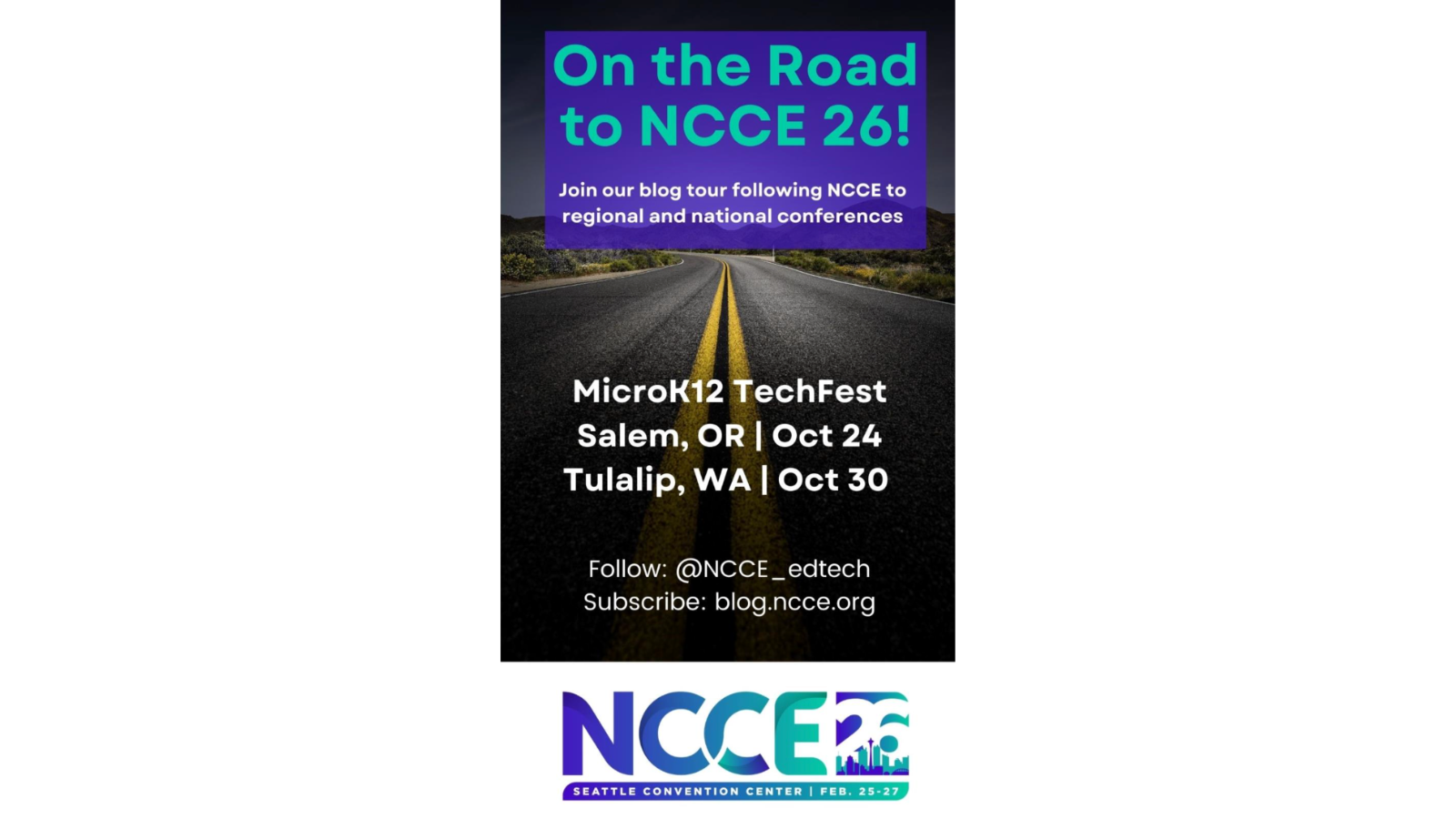
    We are excited to share that NCCE recently attended MicroK12’s 2025 TechFest, a series of education technology conferences for school district administrators. These events, including TechFest South in Salem, Oregon, and TechFest North in Tulalip, Washington, provided crucial platforms for NCCE to share professional learning from our members, NCCE board leadership, NCCE professional learning specialists and NCCE Regional Leaders. 

    Focus on AI and Learning Transformation 

    A primary focus across both conferences was the transformative role of Artificial Intelligence in education. NCCE explored frameworks for viewing this shift with Justin Huntley, Eugene School District and NCCE regional leader, who presented a session titled “Voices, Choices, & AI” at MicroK12’s TechFest South in Salem, Oregon. His session explores how educators can utilize digital tools and Artificial Intelligence (AI) to achieve several key learning objectives: 

    • Amplify student voice.  
    • Support unique learning paths
    • Spark authentic engagement

    Cheryl McClure, NCCE Professional Learning Specialist, presented a session titled “Coding 4 Climate” at MicroK12’s TechFest North in Tulalip, WA. This session focuses on integrating computer science and climate literacy by demonstrating how to use the Coding for Climate Action curriculum. The curriculum engages middle schoolers in STEM by having them: 

    • Use block coding with Micro:bit
    • Design natural hazard alerts
    • Simultaneously build CS, climate literacy, and problem-solving skills

    A group of people posing for a photo

AI-generated content may be incorrect.A selfie of two women

AI-generated content may be incorrect.

    “Being able to attend both TechFest North in Washington and TechFest South in Oregon means we can connect directly with our regional members and hear what is happening to districts in our region so we can be better prepared to provide professional learning solutions in real time,” stated Bobby Myers, NCCE COO. 

    Sally Bouvia, NCCE Marketing Coordinator, is passionate about traveling and supporting educational conferences while sharing all the exciting updates that NCCE brings to the world of Ed Tech, all the while growing and developing connections in the NCCE community. 

    If you have a conference you’d like NCCE to support, please let us know by contacting us at https://ncce.org/contact/ . For more information, visit our website at www.ncce.org

    Source link

  • Helping Students Achieve Economic Mobility

    Helping Students Achieve Economic Mobility

    FatCamera/E+/Getty Images

    As college students have become more diverse over the past few decades, a growing focus in education policy has centered on the university’s role in influencing their economic mobility.

    New research from Public Agenda evaluates the promising practices colleges and universities employ to improve the earning potential of students from low-income families and provide a stronger return on investment, compared to other institutions.

    The report outlines three primary themes across policies and practices to advance student success: involving families, creating supportive campus systems, and investing resources in low-income students.

    Survey says: Two in five students said one of their main reasons for attending college is to increase their earnings potential, according to data from Inside Higher Ed’s 2025 Student Voice survey. The most popular response was “to pursue a specific career or profession,” followed by “to gain knowledge and skills.”

    Students aged 25 and older were more likely to signal they enrolled to increase earnings potential (53 percent), as were students working full-time (48 percent) and those attending two-year colleges (44 percent), compared to their traditional-aged peers or four-year counterparts.

    Methodology: Staff at Public Agenda traveled to 10 colleges or universities in Michigan, Texas and California in 2024 to conduct interviews with administrators, faculty and staff; they also held focus groups with students and alumni. In addition to the qualitative research, Public Agenda leveraged data from the Department of Education’s College Scorecard to evaluate trends in socioeconomic mobility by institution type and student persona.

    The research: One of the overarching takeaways Public Agenda staff gleaned from their site visits was that the institutions most effective in boosting students’ economic mobility tended to value and respect student-facing staff and their perspectives on improving systems.

    “Success at the institutions we studied depends on cultivating an environment in which everyone recognizes that the people who interact directly with students possess the most important information and have the clearest ideas about how to fix problems,” according to the report.

    The evaluated colleges prioritized recruiting first-generation students and engaging with their families to help them understand the accessibility and value of higher education, because they were most likely to go straight into the workforce from high school, rather than consider college.

    “When senior leaders and front-line staff at these institutions refer to ‘the competition,’ they are talking about the forces pulling students away from college—not about other colleges,” the report said.

    It also noted that families and local schools are invited to campus for various events to establish familiarity and comfort with the institution. Offering resources in various languages or connecting families with bilingual staff can build trust and demonstrate commitment. Hiring staff who share identities with students, or are alumni themselves, can create a support system that helps first-gen and low-income students feel seen and understood.

    “The baseline of shared experience functions as a lubricant, reducing friction in efforts to achieve commonality of purpose among everyone working at the institution,” according to the report.

    Providing peer-to-peer resources and creating physical spaces on campus that engage learners can also establish a sense of belonging.

    In addition, researchers noted that creating affordable pathways to education can increase students’ overall economic mobility. Each of the states evaluated had some form of state funding for low-income students to enroll in college, and many had institution-level initiatives that bridge funding gaps between the Pell Grant and state dollars.

    In addition to meeting tuition costs, colleges invested dollars in data systems that relieved staff of burdensome administrative duties and increased the number of academic advisers on campus to provide more personalized, one-on-one advice and encouragement for students.

    Other trends: Researchers also underscored the role of financial stability in achieving socioeconomic mobility for low-income students. Financial obstacles and personal challenges are the top reasons students leave college.

    Ensuring students are aware of how to access emergency aid on campus or other social support benefits, such as food pantries or childcare assistance, is also critical, researchers wrote.

    Many low-income students work while enrolled, so creating opportunities for student employment on campus or connecting students to meaningful employment experiences can help them stay on track to graduate and develop career skills.

    Get more content like this directly to your inbox. Subscribe here.

    Source link

  • Turning Point’s Student Membership Keeps Growing

    Turning Point’s Student Membership Keeps Growing

    Trent Nelson/The Salt Lake Tribune/Getty Images News/Getty Images

    Three months after Charlie Kirk’s assassination, the footprint of the right-wing youth organization he founded continues to grow on college campuses.

    This week, Turning Point USA chapters at both Indiana University Bloomington and the University of Oklahoma reported membership surges. According to the Indiana Daily Student (IDS) and Indy Star, IU’s chapter says its membership has tripled this fall, from 180 to 363. At the University of Oklahoma—which put an instructor on leave after the Turning Point chapter accused them of “viewpoint discrimination”—the group’s membership has grown from 15 to 2,000 over the past year, NBC reported.

    Those increases follow other local media reports about new chapters and membership growth at scores of other universities across the country, including the University of Missouri, and Vanderbilt and Brigham Young Universities. Within eight days of Kirk’s death, Turning Point said it received messages from 62,000 students interested in starting a new chapter or getting involved with one.

    “I think that our club has kind of become a beacon for conservatives,” a Turning Point chapter member told IDS, Indiana University at Bloomington’s campus newspaper. “So, after his death, more people showed up, more people got involved, and it was really nice to kind of see a scene in the way people wanted to get involved.”

    Kirk founded Turning Point USA in 2012, with the mission of “to identify, educate, train, and organize students to promote the principles of freedom, free markets, and limited government.”

    He gained notoriety in conservative circles by traveling to college campuses across the country, challenging students to prove wrong his conservative stances on topics such as race, gender, abortion and immigration.

    On Sept. 10, Kirk was speaking to a crowd at Utah Valley University when a gunman fatally shot him in the neck. After his death, Trump and his allies moved to canonize Kirk as an exemplar of civic debate—and called to punish anyone who publicly disagreed. Numerous colleges and universities have since suspended or fired faculty and staff who criticized Kirk for his political views.

    Although some faculty and students have objected to new Turning Point chapters, the students growing the organization insist they’re committed to considering all perspectives.

    “You have a place here, you’ll always have a place here,” Jack Henning, president of Indiana University’s Turning Point chapter, told IDS. “We don’t discriminate against any viewpoints at all, we debate them. That’s what American democracy was built upon.”

    Source link

  • Come and be an AI meat widget!

    Come and be an AI meat widget!

    Joining their Big Ten brethren, Purdue University recently announced that they will be adding an “AI working competency” graduation requirement that will go into effect for first-year students entering Fall 2026.

    I have some questions. And also some concerns.

    Back in October I shared my impressions and experiences having travelled to a number of different institutions that are directly confronting the challenge of how to evolve instructions and operations to deal with the existence of generative AI technology.

    I identified a number of common approaches that seemed to be bearing fruit when it comes to engaging and energizing the entire university community at meeting these challenges.

    This is, above all, a chance to refresh and renew the work of the institution and in the places operating in that spirit I’ve witnessed considerable hope for a good future.

    1. Administrations must lead, but they should lead from a position of institutional values that are centered in the discussion.
    2. The challenge must be viewed as a collaboration between administration, faculty, staff and, yes, students, where each constituent group has an opportunity to articulate their views under the umbrella of those root institutional values.
    1. As part of this process, there must be space for difference that preserves individual freedoms. Faculty should both have the resources necessary to experiment with AI use and the power to refuse its integration. Students must ultimately be respected as the chief agents behind their own educations.
    2. The discussion must go beyond merely adding another untethered competency. As I say in that previous column, we must “do more than doing school.” Layering AI on top of the status quo is a missed opportunity to reimagine the work of teaching and learning in ways that will make institutions far more resilient to whatever additional technological changes are coming.

    Working from the reporting at Forbes, I can declare with some confidence that what Purdue is proposing is the opposite of these emergent best practices that I have seen elsewhere.

    Here is how the initiative is characterized:

    The requirement will be embedded into every undergraduate program at Purdue, but it won’t be done in a “one-size-fits-all” manner. Instead, the Board is delegating authority to the provost, who will work with the deans of all the academic colleges to develop discipline-specific criteria and proficiency standards for the new campus-wide requirement. Chiang [Purdue President Mung Chiang] said students will have to demonstrate a working competence through projects that are tailored to the goals of individual programs. The intent is to not require students to take more credit hours, but to integrate the new AI expectation into existing academic requirements.

    This is, in a word, impossible. At least it’s impossible in any way that’s genuinely meaningful or useful to students.

    Purdue has over 40,000 undergraduate students. They have more than 200 majors. They offer thousands of different courses. They have thousands of faculty. The expectation is that specific proficiency standards will be created for every single one of these programs, and after that, students will have to be held accountable to these proficiencies by next Fall by doing “projects.”

    Does that sound possible? Because it’s not.

    As a source of comparison, consider how long it takes to redo an institution’s general education curriculum which involves many fewer courses and fewer faculty.

    Consider, also, as should be clear to anyone paying attention, we “don’t know how to teach AI.”

    The fact that we don’t know how to teach AI is why the institutions engaging in the best practices have provided resources to the people best placed to figure out what kinds of proficiencies, experiences and projects may be useful, the faculty. They are treating the problem seriously as a challenge for the university to figure out how to serve its constituents.

    Purdue is offering a press release, not a plan. It’s not even a policy. They are cooking up a recipe for chaos and demoralization, for half-assed B.S. meant to satisfy a bureaucratic box-checking exercise. This is serious stuff, and Purdue is treating it unseriously.

    It’s worth asking why. One reason may be that Purdue is well-enmeshed with their corporate partners (primarily Google) and locking in experiences that use the products of these partners is pleasing to those partners. Purdue Provost Patrick Wolfe said, “it was ‘absolutely imperative that a requirement like this is well informed by continual input from industry partners and employers more broadly,’ and therefore he has ‘asked that each of our academic colleges establishes a standing industry advisory board focusing on employers’ AI competency needs and that these boards are used to help ensure a continual, annual refresh of our AI curriculum and requirements to ensure that we keep our discipline-specific criteria continually current.”

    But guess who else doesn’t know what AI competencies employees need? Employers!

    And guess who else doesn’t know what we’re supposed to be doing with this stuff? The tech developers themselves! Microsoft recently “scaled back” its AI sales targets because “nobody is using copilot.”

    Purdue is sending clear signals to both students and employers that they are in the business of producing certified meat widgets for the AI-mediated future, even as we have no idea what that future may entail. There may be some students who find this proposition attractive, but it is not a leap in logic to imagine that the endpoint of this future is one where large, costly entities like Purdue University are not a necessary part of the equation.

    Also, I think there is significant evidence that AI meat widget is not what students are looking for from their university experiences.

    I will lay down a marker and predict there will be much sound and fury to meet the demands of the board, but it will signify nothing.

    There is no need to waste everyone’s time chasing phantoms. We know how to work this problem, and what Purdue is doing ain’t it.

    Source link

  • NSF Lowers Grant Review Requirements, NIH Hunts for Phrases

    NSF Lowers Grant Review Requirements, NIH Hunts for Phrases

    sorbetto | DigitalVision Vectors

    Two major federal research funding agencies are altering their grant review processes. The National Science Foundation (NSF) is scaling back its reviews of grant proposals, according to a Dec. 1 internal memo that Science obtained and published, while STAT reported that the National Institutes of Health distributed guidance Friday ordering staff to use a “text analysis tool” to search for certain phrases.

    The NSF memo says the government shutdown, which ended in November, hampered its progress toward doling out all its funding by the end of the new fiscal year. It said “we lost critical time” and “now face [a] significant backlog of unreviewed proposals and canceled review panels. In parallel, our workforce has been significantly reduced.”

    The memo said the changes “enable Program Officers to expedite award and decline decisions,” including by moving away from the “usual three or more reviews” of proposals. It said that, now, “full proposals requiring external review must be reviewed by a minimum of two reviewers or have a minimum of two reviews. An internal review may substitute for one.”

    NSF spokesperson Mike England didn’t provide Inside Higher Ed the memo. He said in an email that the changes are “part of a comprehensive approach to streamlining processes and reducing administrative burden” and “also help expedite the processing of shutdown-related backlogs while maintaining the rigor of the external merit review process.”

    As for the NIH guidance, while it instructs program officers on how to review and possibly terminate grants, STAT reported that “some outside experts said the guidance is a positive step, making future terminations more of a dialogue that researchers can push back on.”

    But another media outlet, NOTUS, published a more critical article on the guidance, saying the “Trump administration is pausing new funding for National Institutes of Health grants that include terms like ‘health equity’ and ‘structural racism,’ pending review.” NOTUS reported that the guidance says new funding won’t be provided to “misaligned” grants until “all areas of non-alignment have been addressed.”

    Both articles said NIH ordered staff to use a “computational text analysis tool” to scan current and new grants for terms that may mean the submissions are misaligned with NIH priorities. (The NSF memo similarly said “Program Officers are also expected to maximize their use of available automated merit review tools, especially tools that identify proposals that should be returned without review.”)

    Andrew G. Nixon, a spokesperson for the Health and Human Services Department, which includes NIH, didn’t provide Inside Higher Ed a copy of the NIH guidance. In an email, he wrote that “claims that NIH issued a ‘banned words list’ or conducted word searches to remove specific terms from grants are unequivocally false. NIH has never prohibited the use of any particular words in grant applications.”

    Source link

  • Higher ed should look to limited series podcasts.

    Higher ed should look to limited series podcasts.

    Pressing record is not a plan.

    Last November, I wrote in Inside Higher Ed about the expanding opportunities for scholars and mission-driven organizations to embrace audio. According to eMarketer, U.S. adults spend about 21 percent of their media time with audio, yet brands devote only about four percent of ad budgets to it. That gap is a missed opportunity and a signal to communicators and institutions ready to build real loyalty through sound.

    And since that article was published, I have seen more teams start to recognize and implement audio as an essential channel for embedding important ideas into the culture. University centers, institutes and nonprofits are launching shows, and some are even building podcast “networks.” HigherEdPods, a community for higher ed podcasters, already counts 133 members, and its directory lists 1,205 podcasts from 210 colleges and universities. This is good, and it should definitely be happening.

    But the boom in podcasting has also created a new problem: It’s increasingly a one-percenter’s game. A small slice of shows capture most of the listening, and everyone else is left fighting over whatever attention remains. You can see this in higher ed’s own backyard. Click over to the “Podcasts by popularity” tab on HigherEdPods and you’re greeted mostly by celebrity science and psychology shows—Huberman Lab, The Happiness Lab, WorkLife with Adam Grant, No Stupid Questions—and by the usual institutional suspects, the Ivies, Stanford, MIT, and other major brands, at the top. (One delightful outlier in the top 20 is History That Doesn’t Suck, run by a fellow in Integrated Studies at Utah Valley University, a regional public school in my home state of Utah.)

    And this pattern isn’t unique to higher ed. As Axios’s 2025 Media Trends report notes, top creators across formats are capturing a disproportionate share of engagement.

    The legacy advice to build a podcast audience is to “stick it out”—to publish weekly or in seasons, and to expect it to take 50 to 100 episodes before an audience begins to form. That might be fine advice for an independent creator whose main product is the show.

    For institutions, it’s terrible advice. Most don’t have the mandate, appetite, budget or capacity to grind out 100 episodes and hope. A few marquee institutions can launch a weekly interview show and pull in listeners on brand name alone, for a while. But keeping them is another story. For other institutions and centers still building their reputations and networks, asking an audience to commit to an endless series is an even taller order. The appetite for podcasts is still strong; people simply have more, and more polished, choices than ever.

    When podcasting got easy, formats got generic.

    Part of how we got here is that podcasting became easy, in all the best and worst ways. The tools improved, the price of decent audio gear plummeted, and platforms made it almost frictionless to publish. That lowered barrier is great for access and experimentation. It also means “we should have a podcast” is now a default instinct, not a strategic decision.

    The result is a glut of weekly interview shows that all feel vaguely the same: a host, a guest, 45 minutes of conversation and a title that reads like a panel description. When these shows fall flat, they usually fail in one of two ways. They sound like a lecture (overstructured, dense, information-first) or a meeting (under-edited, meandering, inside baseball). Both signal the same problem: no designed listener experience.

    What’s been lost in the rush is not enthusiasm or expertise, but form.

    Weekly shows encourage institutions to think in terms of slots to be filled rather than journeys to be designed. The question becomes “Who do we put on the podcast next?” instead of “What story are we telling, and who actually needs to hear it?”

    There’s a better fit for how institutions work and how people listen: the limited series.

    From Endless Feed to Bingeable Arc

    A limited series treats audio not as an endless stream but as a complete experience. Instead of promising listeners “new episodes every Tuesday,” you promise them something like:

    “Five episodes that will change the way you think about X.”

    That simple shift does three important things.

    First, it aligns with how people actually listen. A recent Podcast Trends Report found that about 60 percent of listeners say mini-series or seasonal podcasts are easier to complete than ongoing shows. And SiriusXM notes that among binge listeners, roughly 60 percent say they finish an entire series within the first week of its release, and nearly 9 in 10 say they’re happy to listen to episodes that are several months old. In other words, a well-crafted limited series can pull people through quickly and keep working long after launch.

    Second, it matches how institutions actually operate. Universities and mission-driven organizations already think in projects and initiatives: a new center launch, a major report, a grant, a campaign, an anniversary. A three- to 10-episode arc maps cleanly onto that reality. It becomes a narrative companion to the work and a way to walk a specific audience through the why, the how and the stakes.

    Third, it forces craft. When you only have a few episodes, you can’t afford to wander. You have to choose a central question, decide whose voices matter most and design an arc that gives each episode a clear job to do. You’re not filling airtime; you’re building a story people can binge and remember.

    We’re already seeing this in higher education. Stanford’s Haas Center for Public Service recently produced Mosaic: 40 Years of the Haas Center, a three-episode limited series on the past, present and future of public service at Stanford, all organized around the question of why service learning is an essential part of student life and how its impact extends beyond the university.

    And this isn’t an either/or choice. Limited series can live inside an existing weekly show as clearly branded “special seasons,” giving loyal listeners something to sink their teeth into while also creating a front door for new audiences who want a finite, bingeable story before they decide whether to subscribe. They can also be packaged and repurposed long after the initial release as a project you can point to in syllabi, campaigns, grant reports and fundraising campaigns.

    The AI, Unscripted podcast from the University of Maryland shows what this kind of nested limited series can look like. This seven-part arc, designed to guide faculty from AI-curious to AI-confident, lives within the broader Moving the Needle teaching-and-learning podcast. It opens with a “host handover” episode between Moving the Needle host Scott Riley and the AI, Unscripted co-hosts—Mary Crowley-Farrell, Michael Mills and Jennifer Potter—and then rotates those co-hosts through episodes on AI in business, journalism, nursing, psychology, English and graduate education. The episodes are published in the same Moving the Needle feed and clearly tagged as a “Special Edition,” making the series easy to find while still drawing traffic to the main show.

    For institutional podcasters, that’s the big opportunity in this crowded, one-percenter landscape. You don’t need to win the “most episodes” game. You need to make a small number of episodes so compelling, so clearly scoped and so bingeable that the right people choose to press play, and then keep going.

    Danielle LeCourt is the founder and principal of De LeCourt, a strategic communications studio that helps universities, research institutes and mission-driven organizations turn complex ideas into stories that people care about. A longtime strategist and podcaster, she has worked with institutions such as Harvard, Southern Methodist University, the University of Delaware, and Genentech to elevate the visibility and impact of their work through storytelling and sound.

    Source link

  • How business school research can power inclusive and sustainable regional growth

    How business school research can power inclusive and sustainable regional growth

    This blog was kindly authored by Jack Harrington, CEO, Emma Parry, Chair and Katy Mason, President, British Academy of Management.

    Chartered ABS recently published its Business Schools as Engines of Growth report. This work provides a much needed look at the social and economic value of Business Schools. It paves the way for likely changes in the policy landscape.

    Here, we focus on why Business Schools are so well placed to deliver on so many policy priorities. Among other things, Business Schools are a channel through which social science research can change lives for the better.

    Business Schools across the UK are situated in very different kinds of regional economy. At a time of immense disruption – from climate shocks to technological transformation – our business schools must reimagine their role in helping shape the future of regional economies. The ‘Business Schools as Engines of Growth, Opportunity and Innovation’ report, published as a supplement to Universities UK’s 2024 Blueprint for Change, rightly positions business schools as more than excellent educators. Crucially, they are also strategic collaborators in place-based transformation, driving a new kind of socio-economic growth.

    The report calls to deepen research partnerships between business schools, local businesses, and policymakers. This is not just a question of economic necessity (though the productivity gap between UK regions remains stark). It is, most importantly, a question of social responsibility. We must place people and planet at the heart of our research agendas, building new understandings of inclusive, sustainable growth that reflect the urgent challenges of our time.

    From knowledge to impact: research that makes a difference

    Business and management research is often undervalued in national Research & Development debates. This is surprising, given it plays such a pivotal role in enabling the adoption and use of technical innovations as viable, scalable, and ethical elements of our everyday organisational practices and social lives. Research insights from UK business schools are already helping local firms adopt digital tools, improve leadership, decarbonise operations, and engage communities more inclusively.

    Programmes such as the Help to Grow: Management course, delivered by Small Business Charter-accredited schools, demonstrate how research-informed education can empower SME leaders to drive digital adoption and productivity. IPSOS evaluation shows 91% of participants report improved leadership and growth capabilities.

    This is just the tip of the iceberg. Research conducted through Knowledge Transfer Partnerships (KTPs), place-based innovation catalysts, accelerator and labs offers a roadmap for changing the way business schools can act as “anchor institutions” in their regions to drive positive change.

    A new narrative for business research

    If we are serious about creating a fairer economy and a more inclusive society, then the UK’s business schools and their research must be seen as essential infrastructure for inclusive and sustainable regional development.

    Fortunately, this is largely a matter of valuing what we already have. As the white paper shows, Business Schools often provide the most visible way in which the social sciences inform decision-making and operational life in organisations across the UK. Business Schools offer the networks, the expertise, and the commitment to act as coordinators between science, society, and markets, and the skills to drive the co-production of new kinds of knowledge and imaginaries for a better future.

    There is still more that business schools can do. We need to be much better at enabling and valuing interdisciplinary, engaged research that supports public and private sector leaders navigating complexity. We need to help early-career researchers to collaborate beyond the academy. And we need to rethink impact, not just as ‘REF returns’, but in terms of supporting the development of better jobs, fairer systems, and stronger communities.At a time when the Higher Education is in financial crisis, and the economy is struggling to grow, investment has never been so urgent.

    Source link

  • The New Rules of College Digital Advertising

    The New Rules of College Digital Advertising

    This post was co-authored with Vaughn Shinkus.

    Colleges are still trying to catch up to the digital expectations of students.

    Today’s college search usually begins with a scroll. Students meet their future alma mater while still in pajamas, thumb hovering over TikTok dorm tours, YouTube “day-in-the-life” videos, and Instagram stories showing everything from campus squirrels to club fairs.

    While most college marketers recognize the importance of meeting students in digital spaces, data show that many institutions are still catching up to student behavior.

    Nearly two-thirds of students use Instagram daily, yet only about half report seeing college content in their feeds, according to the 2025 E-Expectations Trend Report. That gap, between where students spend their time and where colleges spend their dollars, tells the real story.

    Here are several other significant places where student behavior and institutional strategies do not align:

    • Students live on TikTok and YouTube, but institutions continue to invest more heavily in Facebook and Instagram.
    • Retargeting and program-specific ads perform best because they feel relevant, yet many colleges default to broad brand campaigns.
    • Search and AI-driven summaries are now leading sources of inquiry traffic, but SEO remains underfunded or outdated.

    Today, nearly every institution had allocated a budget to digital channels, including search ads, Instagram, Facebook, display ads, YouTube, and more (according to our 2025 survey of marketing and recruitment practices). But sending dollars into platforms without a data-backed strategy is a recipe for low return.

    Channel usage and effectiveness

    The first step toward a smarter strategy is aligning digital investments with students’ stages of college planning. Timing matters.

    • 9th graders are dreamers; they are just beginning to imagine college. This is the moment for creative, curiosity-driven content on TikTok and other emerging platforms.
    • 10th graders start exploring and comparing. Snapchat, X (formerly Twitter), and BeReal are gaining influence as they seek authentic glimpses of campus life.
    • 11th and 12th graders shift into decision mode. They are more likely to engage with YouTube, Instagram, and even Facebook, the places where institutions focus most on deadlines, financial aid, and event promotions.

    Let’s examine how college and student perspectives align, and where they diverge. This table shows the usage and effectiveness of recruitment practices by recruitment professionals (taken from the 2025 Marketing and Recruitment Practices Report). The last column shows the student perspective as captured by the 2025 E-Expectations Report.

    Channel Usage by Colleges Effectiveness Student Perspective
    Instagram Private: 93%
    Public: 87%
    Two-Year: 86%
    Private: 94%
    Public: 90%
    Two-Year: 100%
    63% of users use Instagram daily, but only 53% view college content.
    Facebook Private: 81%
    Public: 89%
    Two-Year: 85%
    Private: 77%
    Public: 76%
    Two-Year: 100%
    Still visible, but less influential than Instagram or TikTok.
    YouTube Private: 81%
    Public: 66%
    Two-Year: 57%
    Private: 79%
    Public: 86%
    Two-Year: 100%
    Campus vlogs and videos help students picture themselves there.
    TikTok Private: 60%
    Public: 35%
    Two-Year: 71%
    Private: 82%
    Public: 74%
    Two-Year: 80%
    One of the most influential platforms for discovery and decision-making.
    Display Ads Private: 94%
    Public: 77%
    Two-Year: 86%
    Private: 90%
    Public: 97%
    Two-Year: 100%
    Students often click Google ads when researching programs.
    Retargeting Private: 86%
    Public: 69%
    Two-Year: 80%
    Private: 98%
    Public: 86%
    Two-Year: 94%
    Highly effective when personalized, reminders drive action.

    Takeaway: To reach students where they truly live online, colleges must rebalance their media mix toward video-rich, mobile-first channels and strengthen SEO to connect organically within search and AI summaries.

    Messaging strategies that move students

    Ask any university marketing team what they promote and you will hear familiar answers: brand identity, application deadlines, campus events, student stories, program highlights. All important, but not all equally effective.

    Students tell us that the ads that stick are the ones that feel authentic and actionable.
    They click when they see a major they are interested in. They re-engage when retargeted about unfinished applications. They respond when the tone feels genuine, not corporate.

    Breaking through the stream of memes, influencers, and viral videos requires messaging that is personal and specific, not just polished.

    Messaging Strategy Usage by Colleges Effectiveness Student Perspective
    Application Deadlines Private: 98%
    Public: 92%
    Two-Year: 85%
    Private: 94%
    Public: 93%
    Two-Year: 100%
    Clear calls-to-action work. Deadline ads drive clicks and completions.
    Brand Messaging Private: 98%
    Public: 95%
    Two-Year: 86%
    Private: 94%
    Public: 94%
    Two-Year: 100%
    Generic brand ads rarely move the needle; authenticity wins.
    Event Promotions Private: 94%
    Public: 86%
    Two-Year: 86%
    Private: 96%
    Public: 97%
    Two-Year: 100%
    Virtual tours and admitted-student events generate strong engagement.
    Student/Alumni Stories Private: 81%
    Public: 83%
    Two-Year: 57%
    Private: 95%
    Public: 93%
    Two-Year: 100%
    “Show me real people.” Authentic voices and outcomes persuade.
    Program-Specific Ads Private: 87%
    Public: 89%
    Two-Year: 57%
    Private: 95%
    Public: 100%
    Two-Year: 75%
    Students want details about majors, careers, and outcomes.

    Bottom line: High-level brand awareness campaigns rarely convert. The content that wins is personal, timely, and anchored in real stories and next steps.

    The big picture

    So what does this all mean for your digital strategy? The short version: ads work best when they meet students where they are, in their social feeds, with content that feels personal, genuine, and video-forward.

    Here is how to make that happen:

    • Invest where students spend time: TikTok, YouTube, and optimized search.
    • Fix underperforming channels: Strengthen Instagram with better creative and stage-specific targeting.
    • Use personalization and retargeting: Move students from “just browsing” to “taking action.”
    • Tell real stories: Highlight authentic student voices and tangible outcomes, not just taglines.

    Students now research colleges the same way they manage the rest of their digital lives; they discover, compare, and decide while scrolling. A TikTok video might spark curiosity, a YouTube vlog might help them imagine themselves on campus, and a retargeted ad might push them to finally hit “apply.”

    They are already making college decisions mid-scroll. To earn their attention and their trust, colleges must meet them there, with relevance, immediacy, and authenticity.

    Ultimately, it is not about clicks for the sake of clicks. It is about connection, belonging, and the digital moments that turn curiosity into commitment.

    Talk with our marketing and recruitment experts

    RNL works with colleges and universities across the country to ensure their marketing and recruitment efforts are optimized and aligned with how student search for colleges.  Reach out today for a complimentary consultation to discuss:

    • Student search strategies
    • Omnichannel communication campaigns
    • Personalization and engagement at scale

    Request now

    Source link

  • Faculty Scholarship: First Steps and Advice for Publishing – Faculty Focus

    Faculty Scholarship: First Steps and Advice for Publishing – Faculty Focus

    Source link