As we head into the holidays, I’ve been thinking about this year and what we accomplished, what we learned, and most importantly, the people who made it all possible. When I look back, I’m reminded just how proud I am of the work we do and the impact it creates for institutions and the students they serve.
It’s easy to focus on the numbers — enrollments up, goals met, projects launched. And those metrics certainly matter. They reflect the hard work of our team and the trust of our partners. But behind every dashboard, there’s something far more meaningful.
This fall, a student accepted to the University of Scranton wrote to our enrollment specialists: “Thank you for all the care that goes into this process. I truly appreciate the time, attention, and effort you and the admissions team put into reviewing my application… receiving my acceptance means so much to me.”
Messages like this hit home. Because this is what we’re helping build: pathways for students who are ready to learn, grow, and change their lives. And everything we do — every data integration, every marketing campaign, every phone call, every technology issue resolved — is in service of that outcome.
In 2025, we helped more students find those pathways.
Institutions we support saw steady, year-over-year enrollment growth across every major term. At the New Jersey Institute of Technology (NJIT), new student enrollments grew by more than 5% over the previous year — a meaningful lift for an institution focused on driving innovation and access.
Places like Montclair State University and the MGH Institute of Health Professions didn’t just hit targets, they surpassed them (in some cases by more than 20%). At George Washington University, summer enrollments surged 81%; a testament to the power of coordinated outreach and student-centered strategy.
Every success was the result of deep collaboration, thoughtful execution, and shared belief in what’s possible. Our creative team helped Babson College capture the story of its graduate programs in ways that resonate with students. Our tech teams kept critical systems running smoothly and securely. Our enrollment specialists showed up each day with empathy, clarity, and care.
Behind the scenes, our IT Managed Services team played a vital role in making outcomes possible. The things they accomplished this year — stabilizing systems at Utica, launching a new guest wireless experience at Dominican University, modernizing infrastructure at Missouri Baptist University, and integrating critical platforms for Joyce University, to name a few — translated directly into stronger security, reduced costs, and smoother experiences for students and staff alike.
A standout initiative at Agnes Scott College introduced career-aligned digital credentials through Canvas, giving students a new way to showcase their skills to employers while deepening engagement with academic pathways. These efforts may be less visible, but their impact is undeniable.
None of this happens without our people. The Collegis team continues to lead with grit, heart, and a relentless focus on results. Their work is complex, often behind the scenes, and always in pursuit of something bigger than themselves.
That collective effort continues to build something meaningful:
Stronger institutions. More resilient systems. Smarter strategies. And above all, more opportunities for students to thrive.
So as we all begin to wind down for the holidays, I hope this season offers us all a chance to pause, recharge, and take pride in the progress made and the impact created.
—Kim
Kim Fahey is President and CEO of Collegis Education, where she leads strategy, operations, and growth to help higher education institutions leverage data, technology, and talent to achieve measurable outcomes. Since joining Collegis in 2014, Kim has played a pivotal role in scaling the company and evolving it into a premier higher ed solutions provider. A transformative leader with deep experience in technology and operations, she is passionate about driving innovation, building high-performing teams, and delivering exceptional results for Collegis partners.
Empowering the Digital Transformation of the Educational Institutions through a Fair and Inclusive Education Ecosystem with Open Source and Open Standards
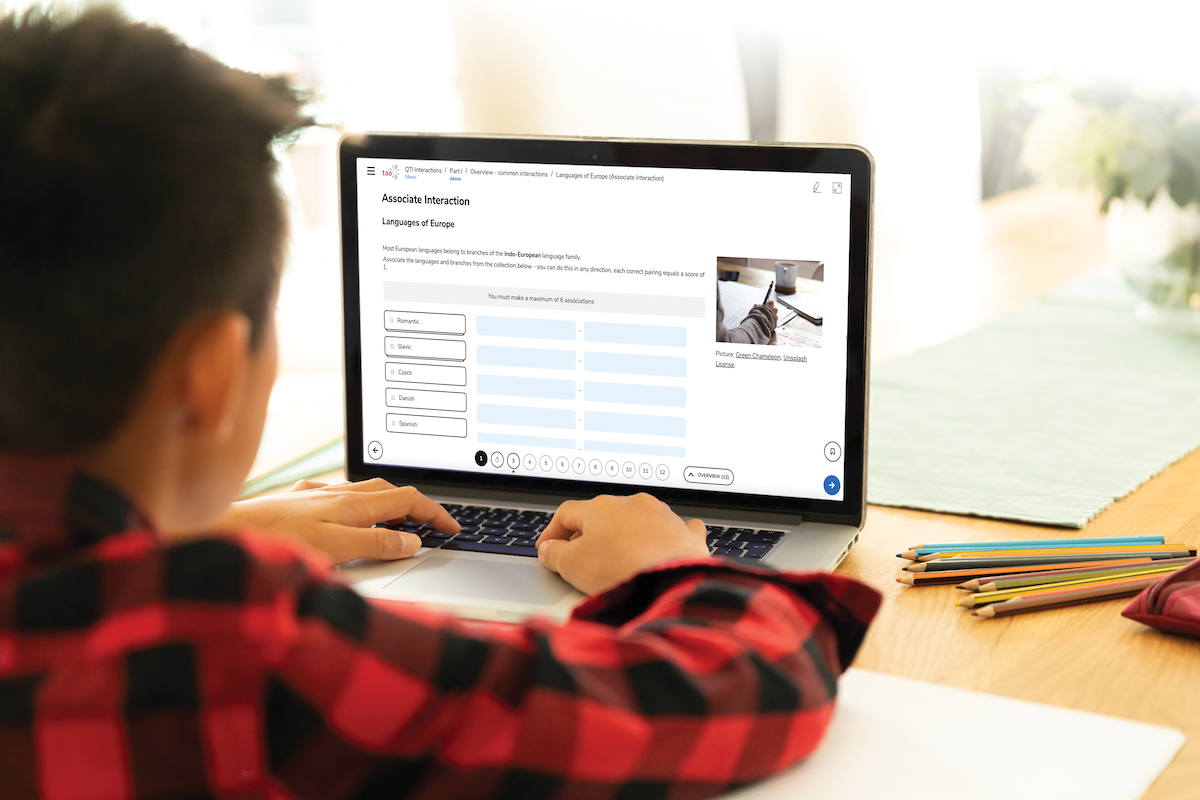
Luxembourg, December 5, 2025 – Open Assessment Technologies (OAT), creators of TAO – the world’s leading open-source digital assessment platform, today announced the upcoming release of the new TAO Community Edition (TAO CE), the world’s leading open-source educational assessment platform. The new version will be available for free downloadglobally on January 5, 2026. This milestone release marks a transformative step toward open, extensible, and community-driven innovation in digital assessment and educational ecosystem.
The TAO CE includes an expanded suite of modular products–TAO Advance, TAO Grader, TAO Insights, and TAO Portal–providing a powerful, end-to-end integrated stack that enables institutions and developers to own, customize, and manage their assessment infrastructure fully.
This release is part of the TAO Community Forum, a movement bringing together developers, assessment experts and institutions to co-create more effective, scalable and transparent assessment solutions. Through this ecosystem, users will gain direct access to collaborative tools, community-driven feature requests, roadmap discussions, and upcoming contribution opportunities.
With the TAO Community Edition and its suite of modular tools, institutions and developers gain complete software ownership, free from vendor lock-in and per-user licensing constraints. The platform’s modular architecture enables users to integrate only the components they need, ensuring maximum flexibility and scalability.
Thanks to its multilingual interface, supporting over18 languages, TAO empowers organizations to deliver assessments globally, promoting equity, accessibility, and inclusion in education systems worldwide.
“Digital assessment thrives when it’s open, extensible, and community-driven, not confined to proprietary systems.” said Mack K. Machida, Co-CEO, Open Assessment Technologies. “With the TAO Community Edition and our upcoming new developer forum, we’re empowering the global community to own their infrastructure, scale their solutions, and shape the next generation of learning from the inside out.”
Built on open standards like QTI®, LTI®, and WCAG, TAO ensures interoperability and accessibility by design. Most importantly, it offers a platform for community-powered digital transformation, enabling contributors to directly influence the roadmap and functionality. All of this is orchestrated through the TAO Community Forum, offering streamlined oversight across the entire assessment ecosystem. TAO Community Edition and extended modules will be available under the Affero General Public License v3 (AGPLv3).
How TAO Benefits Educational institutions
Own your assessment software, not rent it
Open-source code and transparent licensing keep you in control of your platform, roadmap and data, without black-box dependencies. Standards-first alignment (QTI®, LTI®, xAPI) ensures TAO plugs cleanly into existing LMS, identity, reporting, and proctoring ecosystems.
Modular, end-to-end stack
Adopt what you need–TAO Advance (delivery), TAO Grader (manual scoring), TAO Insights (analytics), and TAO Portal (admin)–including built-in, on-site proctoring. Scale capabilities at your pace.
Community velocity & transparency
A public developer forum (launching with TAO Community Edition) and contribution model let institutions influence features, share extensions, and accelerate fixes, turning users into co-builders.
Equity at scale
WCAG-aligned accessibility and a multilingual experience support inclusive delivery across regions, devices, and bandwidth conditions.
Data portability & sovereignty
Open standards and transparent formats simplify export, migration, and long-term stewardship to meet regulatory and archival requirements. Meet country data residency requirements by deploying TAO at the core of your infrastructure.
About TAO
TAO, from Open Assessment Technologies, is the leading digital assessment solution for education and career advancement. Modular, customizable, and interoperable by design, TAO empowers users to break free from proprietary constraints, eliminate costly licensing fees, and take full control of their testing resources. With its student interface available in more than 82 languages, TAO delivers over 30 million tests worldwide every year.
Media Contact: Miguel Prieto Vice President Corporate Strategy [email protected]
*QTI®: Question and Test Interoperability *LTI®: Learning Tools Interoperability *WCAG: Web Content Accessibility Guidelines. *QTI® and LTI® are trademarks of the 1EdTech® Consortium, Inc. (1edtech.org)
In today’s highly competitive education landscape, schools at every level, from K–12 academies to public universities, must embrace modern, digital-first marketing strategies to attract and retain students. The era of relying solely on word-of-mouth or physical brochures is long gone. Today’s families and prospective students are browsing school websites, scrolling through social media, and watching virtual campus tours before they fill out an inquiry form or attend an open house.
To stay relevant and competitive in 2025 and beyond, schools need to meet their audiences where they are: online. That means showing up with targeted, compelling content and a clearly articulated value proposition. This is especially true for private and independent institutions, where high tuition fees and rising parental expectations demand a more persuasive, proactive approach to enrollment marketing.
So, how can your school stand out in an increasingly crowded space?
In this article, we break down 10 of the most effective marketing strategies for schools, with a strong emphasis on digital tactics. From strengthening your web presence to leveraging alumni stories and optimizing for SEO, these proven approaches help build awareness, trust, and engagement. Each strategy includes real-world examples from schools and colleges around the world to inspire your next campaign.
Whether you’re marketing a small language institute or a large university, these strategies are adaptable to your goals and designed to drive results.
Struggling with enrollment and retention?
Our innovative marketing strategies can help you generate more leads.
1. Understand Your Audience and Craft Your Message
A strong school marketing strategy begins with clarity: who exactly are you trying to reach, and what do they need to hear from you? Whether you’re a K–12 school or a higher ed institution, knowing your audience inside and out is essential. That means digging deeper than just age or location. Consider their priorities, concerns, motivations, and communication preferences.
Creating audience personas helps bring these insights to life. Is your ideal family looking for academic rigor, a supportive community, or flexible scheduling? Are your prospective students career changers seeking fast-track credentials, or teens drawn to innovation and student life? When you define who you’re speaking to, you can tailor your messaging to resonate and avoid generic outreach that falls flat.
Your next step is to articulate your school’s unique value proposition. What makes you different? Highlight that core message consistently across all channels. For some schools, it might be small class sizes and a nurturing environment. For others, it could be career outcomes, cutting-edge labs, or global learning opportunities.
Finally, data can deepen your understanding of your audience. Track behavior, segment leads, and personalize your outreach accordingly. The more relevant your message, the more likely it is to convert.
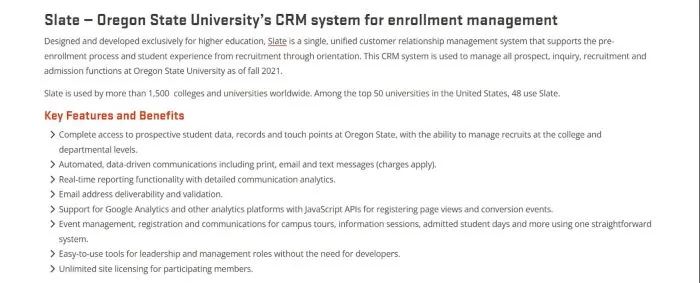
Example:Oregon State University (OSU). OSU’s enrollment team uses a CRM (Slate) to segment prospective students by factors like academic interests, intended majors, and geographic location. This lets OSU deliver tailored messages to each audience segment. For example, sharing engineering content with STEM-interested prospects or inviting nearby students to local events. By defining clear audience personas and emphasizing OSU’s unique offerings (like its “Beaver Nation” community and research opportunities) in communications, OSU ensures its outreach resonates more and converts better than one-size-fits-all marketing.
In a nutshell, how do you create a marketing strategy for a school? A strong school marketing strategy starts by defining your goals and audience, then clarifying your unique value proposition. Choose the right channels: website, SEO, social media, email, events, etc., all while keeping messaging consistent. Implement your plan, track performance with analytics, and adjust as needed to improve enrollment results.
2. Turn Your Website into a Top-Performing Recruiter
Your school’s website is more than just a digital brochure. It’s your hardest-working recruiter, available 24/7. In most cases, it’s the first real impression you make on prospective students and their families. If it’s outdated, hard to navigate, or slow to load, visitors may bounce before they ever reach your inquiry form. On the other hand, a fast, intuitive, and compelling site can drive real results: inquiries, campus visit bookings, and applications.
To make your website enrollment-friendly, focus on these key areas:
Navigation and user experience: Make it easy for visitors to find what matters most: admissions, tuition, programs, and deadlines, within one or two clicks. Prioritize clarity and mobile optimization, since the majority of users now browse on their phones.
Engaging content: Use vibrant photos, student stories, and program highlights to showcase your school’s personality and value. Don’t just state facts; tell stories that build emotional connection.
Clear CTAs: Every page should lead users to the next step, whether it’s “Book a Tour” or “Start Your Application.” Make buttons visible, and forms short and intuitive.
SEO and visibility: Build search-friendly content using keywords like “STEM high school Toronto” or “MBA in Montreal.” This boosts your visibility when families search online.
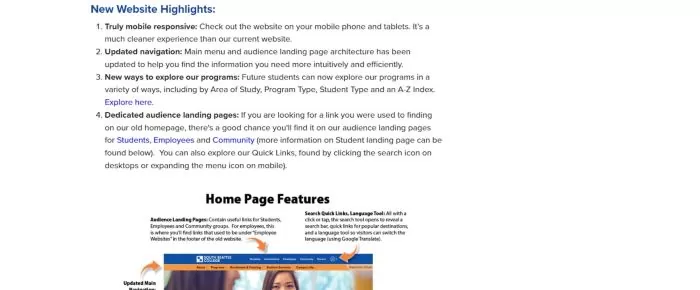
Example:South Seattle College. This college launched a fully redesigned, mobile-responsive website to serve as a “24/7 digital front door” for prospective students. The new site features simplified navigation (with intuitive menus and audience-specific landing pages), fast load times, and engaging content like student stories and virtual tour videos. Key information: admissions steps, programs, costs etc., is now accessible within one or two clicks. After the revamp, South Seattle College saw improved user engagement and more inquiries, validating that an optimized website can effectively guide visitors from interest to application.
3. Meet Students Where They Scroll: Social Media Engagement
If you’re wondering how to effectively reach today’s students, social media is your answer. Teenagers, young adults, and even their parents spend hours every day scrolling through platforms like Instagram, TikTok, Facebook, YouTube, and LinkedIn. That’s why a modern marketing strategy for schools must go beyond occasional polished posts. It also requires consistent, authentic, and engaging content that brings your school community to life online.
Social media allows prospective students to virtually experience your school before they set foot on campus. They can witness student life, explore your values, and interact with your team through comments and DMs. It’s a space where schools can showcase achievements, run virtual events, answer questions, and create lasting impressions, all within the platforms students already use. Social media engagement fosters emotional connection, builds trust, and nudges prospective students closer to applying.
Here are some proven tactics to strengthen your social media presence:
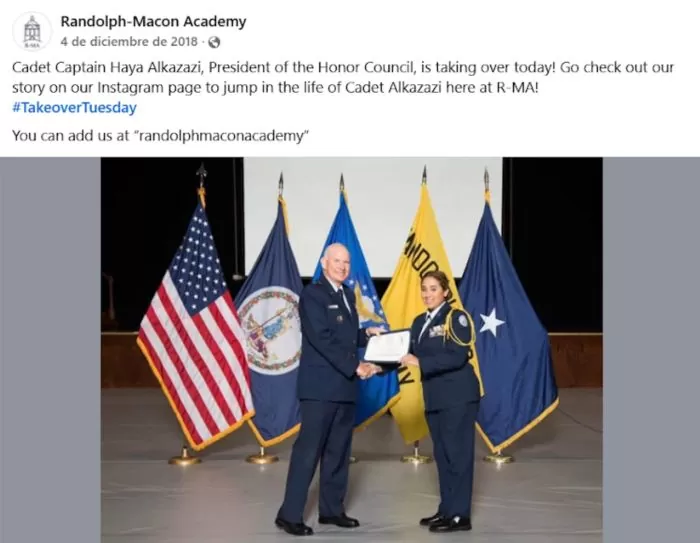
Student Takeovers: Give students the reins of your Instagram or TikTok for a day to showcase a “real life” perspective of your campus.
Interactive Campaigns: Launch challenges, quizzes, or hashtag contests to generate user content and boost engagement.
Alumni & Academic Outcomes: Share stories of success to inspire and build credibility with prospective students and their families.
Paid Targeted Ads: Reach niche audiences with specific messaging using Facebook, YouTube, or TikTok ad campaigns.
Responsive Community Management: Monitor comments and messages daily. Prompt, friendly responses go a long way in reinforcing your school’s reputation.
Above all, be authentic. Today’s students crave realness. A spontaneous student dorm tour recorded on a phone often outperforms a high-production video. Showcasing your campus culture in a way that’s natural and not overly scripted can drive stronger connections and higher conversions.
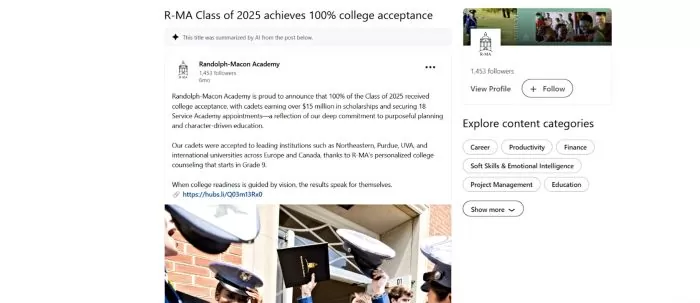
Example:Randolph-Macon Academy (R-MA). This college-prep boarding school brings campus life directly to student prospects through interactive social media campaigns. On Instagram, R-MA runs “Takeover Tuesday” events where a student cadet literally “takes over” the school’s Story for the day, posting candid glimpses of classes, dorm life, and activities. This unfiltered, student-eye view generates high engagement from peers. R-MA also leverages LinkedIn to celebrate outcomes with a recent post that 100% of its senior class earned college acceptances and over $15 million in scholarships. By showcasing real student experiences and achievements on the platforms teens (and their parents) already use, R-MA humanizes its brand and builds trust.
4. Bring Your Campus to Their Couch: Virtual Tours and Online Events
For many families, a campus visit is a pivotal moment in the school decision process. It’s their chance to imagine themselves in your hallways, dorms, and classrooms. But not every prospective student can visit in person, whether due to distance, cost, or scheduling. This is where virtual tours and online events come into play, offering an immersive, flexible way to connect with your audience.
Virtual campus tours can now offer interactive 360° experiences that let students “walk” the grounds from their laptop or phone. These tours help build familiarity and emotional connection, especially for international or out-of-state students who might otherwise never see your campus. To boost engagement, add clickable info points, video testimonials, or even voiceover guides.
Online events like virtual open houses or themed webinars allow families to meet admissions teams, ask questions, and hear directly from current students, all from home. They not only replicate key elements of in-person experiences but also allow for on-demand access after the event.
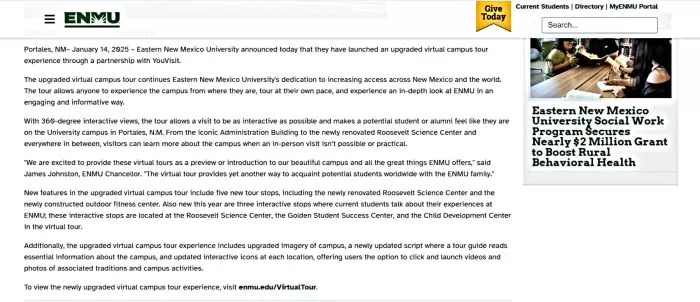
Example:Eastern New Mexico University (ENMU). ENMU launched an upgraded 360° virtual tour that lets prospective students explore the campus from anywhere in the world. This immersive tour includes interactive 360° views of key locations (from dorms to labs), pop-up info points with photos/videos of traditions, and even student-narrated segments sharing personal stories. A voiceover guide leads viewers through the experience, making it feel like an actual guided tour. ENMU’s chancellor noted the virtual tour “makes a potential student feel like they are on campus” and has become invaluable for out-of-state and international recruits. The tour’s engaging features (clickable videos, student testimonials embedded at certain stops) have driven higher web engagement and helped ENMU widen its reach beyond those able to visit in person.
5. Let Video Tell Your Story: Content Marketing That Connects
There’s a reason platforms like YouTube, Instagram Reels, and TikTok dominate attention spans. Video provides an immersive, emotional, and memorable experience. For schools trying to reach prospective students and families, video marketing is one of the most powerful tools available. Whether it’s showcasing campus energy, highlighting academic strengths, or sharing personal student journeys, video content brings your story to life in a way text and photos simply can’t.
To make the most of this format, consider these video types:
Campus Tour Highlights: Condense your full tour into a 2–3 minute walkthrough with student narration. Post it on your homepage and YouTube channel for first-time visitors.
Student Testimonials and Success Stories: Capture authentic, unscripted interviews with students or alumni. These peer voices create trust and make your school’s impact tangible.
Faculty and Program Spotlights: Let your passionate educators shine. A quick feature on a robotics project or an art studio session can attract students with similar interests.
Event Recaps: Turn school events into fast-paced highlight reels for Instagram and Facebook. It shows your community is vibrant and active.
Explainer Videos: Break down complex topics, like admissions or financial aid, into short, helpful animations or on-camera guides.
Authenticity beats polish. Videos filmed on smartphones by students or “vlog ambassadors” can feel more relatable than professional productions. Consistent content, especially when optimized with keywords on YouTube, also improves discoverability in search.
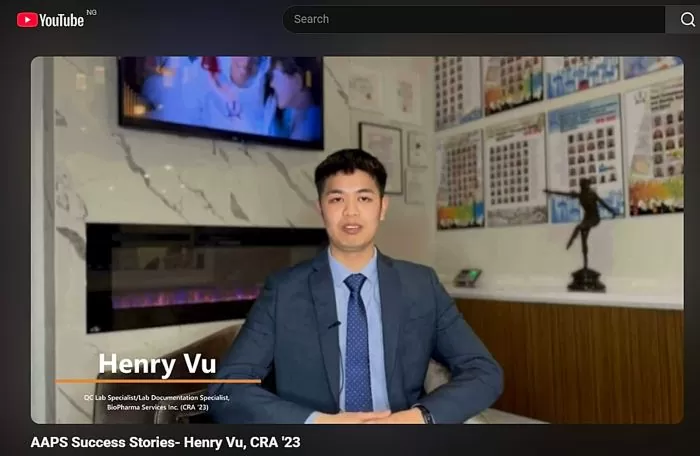
Example: Academy of Applied Pharmaceutical Sciences (AAPS, Canada). AAPS relies heavily on short-form video content to showcase student life and outcomes viscerally. The college regularly produces “Student Success Story” videos – for example, a 2-minute clip of an alum describing how AAPS training led to their new career in clinical research. It also shares behind-the-scenes footage of lab sessions and student projects on its YouTube channel and Instagram. These authentic clips (often featuring actual students and instructors) put a human face on AAPS’s programs and build credibility.
In short, video marketing allows your school to connect emotionally and visually with prospective students, meeting them where they already spend time. If you want to advertise in a way that engages and inspires, video is essential.
6. Be There 24/7 with Smart Chatbots and Live Chat
Imagine a student browsing your website at midnight, wondering, “Does this college offer scholarships for international students?” If no one’s there to answer, that potential lead might bounce and never return. This is where chatbots and live chat tools step in, transforming your website into a 24/7 support hub.
Modern AI-powered chatbots go far beyond basic FAQ responses. They’re now capable of delivering personalized answers based on user input, guiding visitors to the right pages, and capturing lead information in real time. In fact, some bots can handle up to 80% of standard inquiries, freeing your admissions team to focus on complex cases or high-touch prospects.
Schools use chatbots to address questions about tuition, program options, campus life, deadlines, and more. Better still, if a query goes beyond the bot’s programming, it can prompt a human follow-up, keeping the conversation going instead of losing the lead.
Live chat is another powerful layer. Having staff available during business hours to chat in real time, whether on your site or via Messenger, feels like having a front-desk greeter online. Quick answers build trust and reduce friction in the inquiry process.
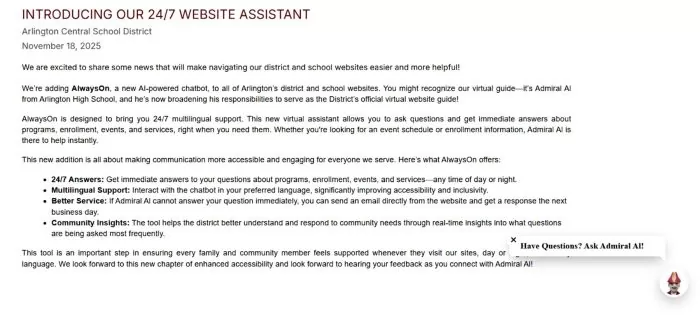
Example:Arlington Central School District (New York). This K–12 district rolled out an AI virtual assistant named “AlwaysOn – Admiral Al” across all its school websites to ensure families can get information anytime. The friendly chatbot (branded with the high school’s mascot) offers 24/7 multilingual support, answering common questions about programs, enrollment procedures, event schedules, and more in English or Spanish. If the question is too specific, “Admiral Al” even lets the user submit an email query right within the chat, guaranteeing a human follow-up by the next business day. The district implemented this tool to improve customer service for busy parents and saw immediate benefits – families could instantly find out, say, how to register a new student or the date of graduation, without calling the office.
To make your chatbot successful, keep it friendly and transparent (let users know it’s a virtual assistant), program it with up-to-date FAQs, and offer a handoff to a real person when needed. For international recruitment, consider a multilingual bot to expand your global accessibility.
Ultimately, integrating chatbot and live chat tools into your school’s marketing strategy ensures you never miss a lead because of timing. Today’s students expect immediate answers. With the right tools, your school can be ready.
7. Leverage Testimonials and Reviews (Let Your Community Do the Talking)
Word-of-mouth has long been a trusted marketing strategy for schools, and in today’s digital world, it has taken on new forms, testimonials, reviews, and social proof. These are powerful tools that lend credibility to your school’s messaging by showing that real families and students have had positive experiences.
Start by gathering testimonials from students and parents. A few genuine quotes or short videos can build trust quickly. Display these across your website, especially on admissions pages and brochures. A heartfelt statement like, “After enrolling here, my daughter blossomed academically and socially,” resonates more than polished ad copy.
In parallel, encourage online reviews on platforms like Google or Facebook. Higher ratings improve visibility and ease prospective families’ doubts. Politely prompt current families to share feedback after positive experiences, such as school events or parent meetings.
Social media also plays a role. Repost authentic student or alumni praise, and consider launching hashtags to gather testimonials organically.
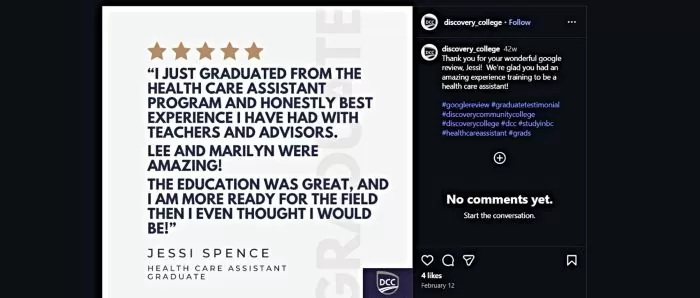
Example:Discovery Community College (Canada). This career college amplifies positive word-of-mouth by actively sharing student reviews on social media. For example, Discovery CC monitors its Google Reviews, and when a 5-star review comes in, the marketing team creates an Instagram post thanking the student by name and highlighting their feedback. One such post reads: “Thank you for your wonderful Google review, Jessi! We’re glad you had an amazing experience training to be a health care assistant!” – accompanied by a screenshot of the review. By publicly celebrating real student voices, the college not only boosts morale but also provides authentic social proof to prospective students scrolling by.
Letting your community advocate for you builds trust faster than any ad campaign, and it costs nothing.
8. Nurture Leads with Email Marketing and Personal Touches
What is the best marketing for independent schools? Independent schools succeed with targeted, budget-friendly inbound marketing. The best approach is a strong online presence: a content-rich, search-optimized website, active social media that highlights student life, and helpful emails or blogs that build trust. These tactics attract the right families and strengthen community engagement.
Once an inquiry is made, the follow-up becomes mission-critical. One of the most effective marketing strategies for schools includes consistent, personalized nurturing, especially through email and SMS.
Email remains a powerful tool when tailored. Instead of generic blasts, use segmentation to send relevant content. For instance, a prospect interested in Nursing should receive a series featuring faculty profiles, student success in healthcare, and clinical placement details. Someone focused on Athletics? Highlight sports facilities, team achievements, and balancing academics with sports.
Drip campaigns work best: Day 1, a welcome email; Day 3, value-focused content; Day 7, a testimonial or event invite. Marketing automation tools like HubSpot or Mailchimp make this scalable and adaptive based on user behavior.
Complement email with timely SMS reminders for events or deadlines. Use sparingly for impact.
Finally, add a personal touch. A call or handwritten note after a campus visit or audition can leave a lasting impression. These gestures build trust and demonstrate care, key ingredients in a family’s final decision. Effective nurturing turns interest into action and inquiries into enrollments.
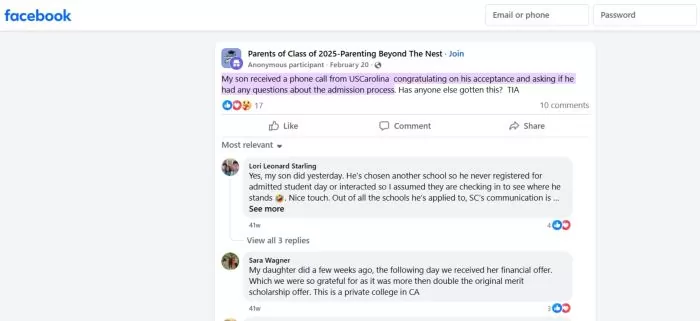
Example:University of South Carolina (USC). USC’s admissions team adds a decidedly personal touch to lead nurturing by picking up the phone to congratulate admitted students. These informal chats help admitted students feel valued and give them a chance to voice any concerns. USC also involves faculty and current students in the follow-up process; for instance, an admitted engineering major might get an email or call from an engineering professor or student ambassador.
9. Host Events (On-Campus and Virtual) That Educate and Inspire
Hosting well-crafted events is one of the most effective ways to turn interest into enrollment. On-campus events like open houses and shadow days allow families to experience your community firsthand. Keep them interactive, offer student-led tours, informal chats with faculty, and performances to showcase school spirit. These real-world interactions make your school more memorable.
Virtual events also carry weight, especially for international or out-of-town prospects. Live webinars, themed Q&A panels, and online workshops let families connect from anywhere. Consider sessions like “How to Write a Great Application Essay” or alumni panels sharing career outcomes.
Each event is also a content opportunity. Record webinars, collect quotes, and share visuals across your channels. Personalized follow-ups (“Thanks for attending, here’s what’s next”) help nurture those leads further.
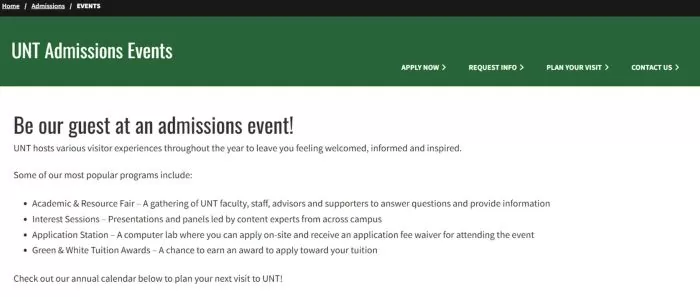
Example:University of North Texas (UNT). UNT offers an array of admissions events designed to welcome and inform prospective students, including both in-person programs and online sessions. One flagship initiative is the UNT Admissions Webinar Series – live virtual information sessions “designed just for students who haven’t applied yet.” These free webinars walk attendees through what makes UNT unique, tips on the application process, and key deadlines, all from the comfort of home. Admissions counselors appear on camera to answer questions in real time, so participants leave with personalized info and confidence about next steps. For those who can visit campus, UNT also hosts large open-house events like “UNT Preview,” a conference-style open day with academic fairs, tours, and even an on-site Application Station where students can apply and get the fee waived.
10. Showcase Outcomes and Alumni Success (Paint the Long-Term Picture)
When families invest in an education, whether paying private tuition or college fees, they want proof that it leads to success. That’s why one of the most compelling marketing strategies for schools is to showcase outcomes. You’re not just selling a school experience; you’re selling what it makes possible.
For K–12 and college-prep institutions, highlight metrics like college acceptance rates and scholarship totals. Randolph-Macon Academy (R-MA), for example, proudly advertises a 100% college acceptance rate and over $15 million in scholarship offers for its 2025 graduates. That kind of evidence quickly signals ROI to prospective families.
Example:Randolph-Macon Academy (R-MA). R-MA prominently advertises its student outcomes to give families confidence in the long-term ROI of its program. For example, the academy proudly announced that 100% of its Class of 2025 earned college acceptances, collectively securing over $15 million in scholarships and 18 appointments to prestigious U.S. Service Academies. This kind of outcome data is highlighted on R-MA’s website and social media, signaling to prospective parents that an R-MA education leads to tangible success. The school also regularly publishes lists of colleges and universities its graduates attend (Ivies, top public universities, military academies, etc.), and shares alumni spotlights – like profiles of graduates who have become pilots, doctors, or entrepreneurs. By showcasing these results, R-MA helps future students (and their parents) visualize their own potential trajectory and trust that the tuition investment will pay off in opportunities.
Vocational or language schools should spotlight relevant results: job placement rates, certifications earned, or skill development gains.
Don’t just rely on stats. Share alumni stories that reflect diverse paths: scientists, entrepreneurs, activists, artists. Feature them on your blog or social channels, and invite them to participate in webinars or info sessions.
On your website, dedicate a section to “Success After Graduation,” including employer logos, testimonials, or infographics. And use social media to celebrate alumni news. These stories build credibility, trust, and vision, which help future students imagine their path through your school.
Turning Strategy into Enrollment Success
In today’s dynamic and competitive education landscape, schools can no longer rely on traditional tactics or word-of-mouth alone. To thrive, they need a strategic, student-centric marketing approach that speaks to modern families across digital platforms. The ten strategies outlined in this article, from optimizing your website and leveraging social media to showcasing alumni outcomes, offer a blueprint for schools to increase visibility, build trust, and convert interest into enrollment.
Whether you’re a K–12 academy, career college, language school, or university, the key is to meet prospective students where they are, communicate your unique value clearly, and guide them confidently through their decision-making journey. When implemented with authenticity and consistency, these strategies not only help fill seats, they strengthen your school’s brand and foster lasting relationships with students and families. In short, great marketing helps the right students find their right-fit school.
Struggling with enrollment and retention?
Our innovative marketing strategies can help you generate more leads.
Frequently Asked Questions
Question: How do you create a marketing strategy for a school?
Answer: A strong school marketing strategy starts by defining your goals and audience, then clarifying your unique value proposition. Choose the right channels: website, SEO, social media, email, events, etc., all while keeping messaging consistent. Implement your plan, track performance with analytics, and adjust as needed to improve enrollment results.
Question: What is the best marketing for independent schools?
Answer: Independent schools succeed with targeted, budget-friendly inbound marketing. The best approach is a strong online presence: a content-rich, search-optimized website, active social media that highlights student life, and helpful emails or blogs that build trust. These tactics attract the right families and strengthen community engagement.
One of the most common questions we hear from parents and students at The College Planning Center is: “Will financial aid cover summer classes?”
The honest answer is: 👉 Yes, financial aid can cover summer classes—but not always.
Whether financial aid for summer classes is available depends on:
How much aid the student has already used in fall and spring
How the college structures its academic year
Whether the summer classes count toward the degree
The student’s academic standing (especially SAP)
In this guide, we’ll walk through when financial aid covers summer classes, common myths, real-life student stories, and the steps families should take before signing up.
The #1 Misconception About Summer Financial Aid
A huge source of confusion is this assumption:
“FAFSA automatically gives us new aid for summer.”
This leads to questions like:
Does financial aid cover summer classes the same way it does fall and spring?
Will my fall financial aid cover my summer classes if I already used it during the year?
Can you get financial aid for summer classes without submitting anything extra?
Most families don’t realize:
Summer aid usually comes from the same academic year’s funds, not a brand-new pool.
Summer is often attached to the prior academic year, not treated as a fresh start.
Federal loans do not “refresh” for summer—annual limits still apply.
Colleges do not all treat summer the same. Each school sets its own policies.
This is why families are often surprised when they ask, “Will my financial aid cover summer classes?” and the answer is “maybe—depending on what’s left.”
Who We See Taking Summer Classes (and Why It Matters for Aid)
At The College Planning Center, we most often advise:
Rising high school juniors and seniors taking dual-enrollment summer classes
College freshmen and sophomores who need to catch up, boost GPA, or stay on track
Students changing majors who must complete prerequisite courses quickly
Transfer students trying to finish missing credits before enrolling at a new school
Students targeting competitive programs (nursing, engineering, education, etc.)
Students trying to graduate early and reduce overall tuition and housing costs
Our recommendations always depend on:
Academic readiness
Financial aid eligibility (including summer)
Long-term college goals
When a family asks us, “Can you get financial aid for summer classes in this situation?”, we don’t just check one box—we look at the entire academic and financial picture.
What Types of Financial Aid Can Cover Summer Classes?
So, does financial aid cover summer classes at all? In many cases, yes—but with limits.
Depending on the school and student, financial aid for summer classes may come from:
1. Federal Aid (FAFSA-Based)
Pell Grants – If the student is Pell-eligible and hasn’t used their full annual amount, some may be available for summer.
Federal Direct Loans – If the student has not used their full annual loan limit in fall and spring, remaining eligibility may be applied to summer.
This is often the real answer behind “Will my financial aid cover summer classes?” It depends on what’s left in the federal aid bucket.
2. Institutional Aid
Some colleges offer:
Summer scholarships or tuition discounts for students who stay on track in their major
Limited institutional grants for summer enrollment
Policies vary widely, so you must ask each school directly.
3. State Aid & Private Scholarships
State grants or scholarships sometimes apply to summer—but not always.
Private scholarships may or may not allow funds to be used in summer; this depends on the scholarship rules.
4. Work-Study
Some schools offer summer work-study positions, but slots are often limited and may require separate applications.
Real-Life Example: When Summer Aid Was Approved
Student A – Rising Sophomore at Clemson University
Question they came in with: “Can you get financial aid for summer classes if you still have some loans left?”
Situation: Student A had worked with The College Planning Center through high school. Strong merit scholarships (thanks to improved SAT scores and a standout application) reduced how much they needed to borrow.
Summer Goal: Take two summer courses to stay ahead in their major.
Why Summer Aid Was Approved:
They did not use their full federal loan eligibility in fall and spring.
The summer classes were degree-applicable, which is required for federal aid.
They were meeting SAP (Satisfactory Academic Progress) with strong grades.
Outcome:
The college approved:
A portion of their remaining federal loans for summer
A small amount of institutional scholarship aid tied to their major progress
How CPC Helped:
Confirmed remaining loan eligibility
Verified that selected classes counted toward the degree
Compared the cost of taking those courses in summer vs. fall
In this case, the answer to “Will financial aid cover summer classes?” was a clear yes—because funds and eligibility were still available.
Real-Life Example: When Summer Aid Wasn’t Available
Student B – First-Year at University of South Carolina
Question their family asked: “Will my fall financial aid cover my summer classes if we already used everything we were offered?”
Situation: Student B had some merit aid but needed maximum federal loans during the year to cover tuition and housing.
Summer Goal: Take a required math class in summer to get back on track.
Why Summer Aid Was Denied:
They had no remaining federal loan eligibility for that academic year.
Their merit scholarship applied to fall and spring only.
Their academic record triggered a SAP review, temporarily blocking federal aid eligibility.
Outcome:
The financial aid office denied summer aid.
The student delayed the class until fall and focused on academic recovery.
How CPC Helped:
Guided the family through a SAP appeal
Created a study and support plan
Restructured the fall course load to protect future aid
Here, the honest answer to “Does financial aid cover summer classes?” was no—because the student had already used up the year’s resources and lost eligibility temporarily.
Common Pitfalls That Block Financial Aid for Summer Classes
We see the same problems over and over when families ask, “Why won’t my financial aid cover summer classes?”
1. Using 100% of Loan Funds in Fall and Spring
If a student maxes out their annual loan limit during the regular school year, there may be nothing left to apply toward summer.
2. Dropping Below Half-Time Enrollment
Many forms of aid require students to enroll at least half-time. If a student drops a class or withdraws, they can fall below half-time and lose summer aid they were counting on.
3. SAP (Satisfactory Academic Progress) Problems
Low GPA, too many withdrawals, or not completing enough credits can all cause SAP issues. If SAP isn’t met, even summer aid may be blocked.
4. Assuming Scholarships Automatically Apply in Summer
Most merit scholarships are fall/spring only, even if the letter doesn’t say “no summer” in big bold letters.
5. Taking Classes That Don’t Count Toward the Degree
Federal aid usually only covers degree-applicable courses. Random electives or “extra” classes may not qualify.
6. Missing the Summer Aid Request Deadline
Some colleges require:
A separate summer aid application, or
An earlier priority deadline
Missing this can turn a possible yes into a no.
When Are Summer Classes Financially Wise?
At The College Planning Center, we take a balanced, realistic approach. We don’t just ask, “Can you get financial aid for summer classes?” We ask:
“Does it make academic and financial sense for your student?”
Summer Classes Are Often Worth It When They:
Help a student graduate early, reducing an entire semester of tuition, housing, and fees
Protect or restore FAFSA eligibility by maintaining or improving SAP
Make a major change possible without delaying graduation
Improve GPA for selective programs
Reduce fall/spring overload, decreasing burnout and grade risk
Summer Classes May Not Be Wise When:
The student has no remaining aid and summer would mean high out-of-pocket costs
Tuition per credit is significantly higher in summer
The classes don’t count toward the degree
The student is struggling academically and needs a break more than another course
by Jackie Mader, The Hechinger Report December 10, 2025
Close to 40,000 foreign-born child care workers have been driven out of the profession in the wake of the Trump administration’s aggressive deportation and detainment efforts, according to a new study by the Better Life Lab at the think tank New America. That represents about 12 percent of the foreign-born child care workforce.
Child care workers with at least a two-year college degree are most likely to be leaving the workforce, as well as workers who are from Mexico, a demographic targeted by ICE, or those who work in center-based care, the left-leaning think tank found. The disruption has worsened an already deep shortage of child care staffers, threatening the stability of the industry and in turn is contributing to tens of thousands of U.S.-born mothers dropping out of the labor market because they don’t have reliable child care.
In addition to workers facing detainment or deportation, many people are staying home to avoid situations where they may encounter Immigration and Customs Enforcement (ICE), the report found. Agents are detaining people who have not traditionally been the focus of ICE actions, including those following legal pathways like asylum seekers and green card applicants. Child care centers were once considered “sensitive locations” exempt from ICE enforcement, but the White House rescinded that in January. In at least one example, a child care worker was detained while arriving for work at a child care program.
“What’s different now is the ferocity of the enforcement,” said Chris Herbst, a professor at Arizona State University’s School of Public Affairs and one of the authors of the report, in an interview with The Hechinger Report. “ICE is arresting far more people, the number of deportations has risen dramatically,” he added. “People are scared out of their minds.”
Related: Young children have unique needs and providing the right care can be a challenge. Our free early childhood education newsletter tracks the issues.
America has long relied on immigrants to fill hard-to-staff caregiving positions and enable parents to work. Across the country, around 1 in 5 child care workers is an immigrant. In Florida and New York, immigrants account for nearly 40 percent of the child care workforce. One study that compared native-born and immigrant child care workers found that nearly 64 percent of immigrants had a two- or four-year college degree, compared to 53 percent of native-born workers. The study also noted that immigrant workers are more likely than native-born workers to have child development associate credentials and to invest in professional development activities.
Overall, the child care industry supports more than $152 billion in economic activity.
In Wisconsin, Elaine, the director of a child care center, said her program has benefited greatly from a Ukrainian immigrant who has been teaching there for two years, ever since arriving in the United States as part of a humanitarian parole program. (The Hechinger Report is not using Elaine’s last name or the city where her child care center is located because she fears action by immigration enforcement.) Elaine’s center has experienced a teacher shortage for the past 13 years, and the immigrant, who has a college degree and past experience in social services, has been a steady presence for the children there.
“She’s their consistent person. She spends more time than a lot of the parents do with the children during their waking hours,” Elaine said. “She’s there for them, she’s loving, she provides that support, that connection, that security that young children need.”
In January, the Trump administration suspended the Uniting for Ukraine program, which allowed Ukrainians fleeing the Russian invasion to live and work in the United States for two years. While the program later opened up a process to apply for an extension, Elaine’s employee has encountered delays, like many others.
The teacher’s parole expired this month. Under the law, she is now supposed to return to Ukraine, where her home city in southeast Ukraine is still under attack by Russian forces.
Elaine fears what will happen if the center loses her. “As a business, we need her. We need a teacher we can count on,” Elaine said. “For our teachers’ mental health, to have her leave and knowing where she would go would be really difficult.”
Elaine has decided to allow the employee to keep working, and is appealing to state lawmakers to help extend her stay. Several parents have also joined in the effort, writing letters to Democratic U.S. Sen. Tammy Baldwin telling her how much their children love the teacher — and how important she is to the local economy. One factor in granting an extension is that the person offers a “significant public benefit” to the country.
The authors of the new report found immigrants are not the only caregivers affected by ICE enforcement this year. There has also been a drop in U.S.-born child care workers in the industry, especially among Hispanic and less-educated caregivers. This could be the result of a “climate of fear and confusion” surrounding enforcement activity, according to the report, as well as a “perceived pattern of profiling or discriminatory enforcement practices.”
“These deportations have been sold under the theory that they are going to be a boon for U.S.-born workers once we sort of unclog the labor market by removing large numbers of undocumented immigrants,” Herbst said. “We’re finding at least in the child care industry, and at least in the short run, that appears not to be the case.” Some foreign-born and U.S.-born workers have different skills and do not seem to be competing for the same caregiving jobs, he added.
Not all workers are leaving the caregiving industry altogether. Some immigrants are shifting to work as nannies or au pairs, Herbst said, “finding refuge” in private homes where they are less likely to come into contact with state child care regulators or be part of formal wage systems. (Already, an estimated 142,000 undocumented immigrants work as nannies and personal care or home health aides nationwide.) That contact with regulators and other authorities may be a reason why center-based early childhood educators are leaving the field in greater proportions now, Herbst said.
These findings come at the end of a difficult year for the child care workforce, which has long been in crisis due to dismally low pay and challenging work conditions. More than half of child care providers surveyed this year by the RAPID Survey Project at Stanford University reported experiencing difficulty affording food, the highest rate since the survey started collecting data on provider hunger in 2021. Other recent reports have found child care providers are at a higher risk for clinical depression, and in some cities an increasing number are taking on part-time jobs to make ends meet.
Across the country this year, early childhood providers have seen drops in enrollment as families pull their children out of schools and programs to avoid ICE. Child care centers are losing money and finding that some staff members are too scared to come to work or have lost work authorization after the administration ended certain refugee programs. Many child care workers have taken on additional roles driving children to and from care, collecting emergency numbers and plans for children in their care in case parents are detained and dropping off food for families too scared to leave their homes.
This story about immigration enforcement was produced by The Hechinger Report, a nonprofit, independent news organization focused on inequality and innovation in education. Sign up for the Hechinger newsletter.
This <a target=”_blank” href=”https://hechingerreport.org/immigration-enforcement-is-driving-away-early-childhood-educators/”>article</a> first appeared on <a target=”_blank” href=”https://hechingerreport.org”>The Hechinger Report</a> and is republished here under a <a target=”_blank” href=”https://creativecommons.org/licenses/by-nc-nd/4.0/”>Creative Commons Attribution-NonCommercial-NoDerivatives 4.0 International License</a>.<img src=”https://i0.wp.com/hechingerreport.org/wp-content/uploads/2018/06/cropped-favicon.jpg?fit=150%2C150&ssl=1″ style=”width:1em;height:1em;margin-left:10px;”>
On Tuesday, the Trump administration announced that it would require foreign tourists to the United States to provide five years of social media history to enter the country. Americans have 60 days to comment on the proposal. FIRE plans to publish a formal comment outlining why this is a serious threat to free expression.
The following can be attributed to Sarah McLaughlin, FIRE’s senior scholar for global expression:
Those who hope to experience the wonders of the United States — from Yellowstone to Disneyland to Independence Hall — should not have to fear that self-censorship is a condition of entry. Requiring temporary visitors here for a vacation or business to surrender five years of their social media to the U.S. will send the message that the American commitment to free speech is pretense, not practice. This is not the behavior of a country confident in its freedoms.
Americans should not feel that they must silence themselves at home for fear that their online expression will bar their access to travel overseas. Therefore we shouldn’t put tourists coming here in that bind. Call it the golden rule of free expression: Treat the speech of visitors the way we want to see Americans’ expression treated abroad.
Credo, Powered by Carnegie is pleased to announce that Elon University President Connie Ledoux Book has been selected as the recipient of the 2026 Courageous Leadership Award. The annual award honors a college or university president whose strategic vision, student focus, and collaborative spirit have moved their institution forward in meaningful ways.
President Book embodies the very best of courageous leadership. Her clarity of vision, steady hand and deep commitment to student success have positioned Elon for long-term strength. She leads with purpose and partnership, and the impact of that leadership is felt across the higher education landscape.
Bill Fahrner
President of Credo, Powered by Carnegie
Leadership and Impact at Elon University
Elon has continued to grow and flourish since Book began her presidency in 2018. Under her leadership, the University has been consistently ranked among the best in the United States. Elon earned its fifth consecutive #1 national ranking for undergraduate teaching from U.S. News & World Report this year and is recognized as the only university in the country ranked in the top 10 of all eight categories of academic programs linked to student success and positive learning outcomes.
A Decade of Strategic Vision: Boldly Elon
Student success has been a hallmark of Book’s presidency. She led the creation of the 10-year Boldly Elon strategic plan, a comprehensive roadmap that:
Strengthens engaged and experiential learning
Expands academic excellence and global study
Deepens Elon’s commitment to mentoring and support
The plan has guided major institutional investments that collectively advance Elon’s nationally recognized model of high-impact learning, including:
The Innovation Quad
The HealthEU Center
Expanded health sciences programs
New residential facilities
Strengthened student life initiatives
Under her leadership, Elon has continued to build systems that support every student’s journey, ensuring they have the relationships, resources, and opportunities needed to thrive.
Forward-Looking Expansion in Charlotte
A recent example of Book’s forward-looking leadership is Elon’s expansion in Charlotte through:
The establishment of a part-time law school
The addition of a physician assistant program
A proposed merger with Queens University of Charlotte
These strategic moves extend Elon’s reach into one of the Southeast’s fastest-growing metropolitan areas and position the university to bring its nationally recognized model of engaged learning to a broader community of students. The Charlotte initiatives reflect Book’s commitment to bold, future-focused action—strengthening student opportunity, deepening industry partnerships, and enhancing Elon’s regional impact.
National Leadership in Higher Education
Book has established herself as a national leader advocating for access to higher education. She recently served as board chair for the National Association of Independent Colleges and Universities (NAICU). She currently serves as NAICU’s representative to the board of the American Council on Education (ACE).
Prior to being named Elon’s ninth president, Book served as the first woman provost of The Citadel. She previously served Elon University as an associate provost and as a faculty member in the School of Communications.
Award Presentation
The award will be presented at the Council for Independent Colleges (CIC) Presidents Institute Presidential Appreciation Dinner to be held January 5, 2026, in Orlando, Florida.
Previous Recipients of the Courageous Leadership Award
2025 | Richard Dunsworth, University of the Ozarks
2024 | Barbara Farley, Illinois College
2023 | Burton Webb, University of Pikeville
2022 | Tiffany Franks, Averett University
2021 | Mary Hinton, Hollins University
2020 | Tom Flynn, Alvernia University
2019 | Amy Novak, Dakota Wesleyan University
2018 | Daniel Elsener, Marian University
2017 | Kim Phipps, Messiah College
2016 | Mary Meehan, Alverno College
2015 | Mark Lombardi, Maryville University
2014 | Joanne Soliday, Credo
About Credo, Powered by Carnegie
In 2025, Carnegie expanded its impact through the acquisition of Credo, integrating presidential strategy, institutional planning, and student success partnerships into its comprehensive suite of offerings. Today, Credo, Powered by Carnegie provides holistic, future-focused solutions that strengthen institutional health and support transformative student experiences.
About the Courageous Leadership Award
The Courageous Leadership Award is presented annually to a college or university president who exemplifies bold, visionary, and student-centered leadership. Established by Credo, the award honors presidents who demonstrate remarkable dedication to moving their institutions forward—academically, operationally, and culturally—through strategic vision, collaborative partnership, and an unwavering commitment to student success.
Why Higher Ed Institutions Should Use Annual Reviews to Refocus Their Strategy
Organizational development principles teach us that long-term, sustainable change is achieved through making data-driven decisions, continuously learning and adjusting, and intentionally planning for growth. Which is why an annual review of your existing higher education programs and operations is an essential step in the process for building your institution’s success.
Skipping a review in the planning process puts your institution at risk of repeating mistakes and missing crucial opportunities due to an outdated approach.
In every area and at every level, institutions benefit from looking back at data from the previous year for clues into what adjustments are needed for improvement. From holding project retrospectives and conducting marketing audits to tracking enrollment trends and having individual performance check-ins, regular rituals that facilitate reflection on what’s working and what isn’t encourage continuous growth.
Similarly, creating an annual review process for your degree programs empowers your institution to assess its efficiency while using data-driven insights to build a strategic road map for the future.
Change starts from within. The best way to achieve growth is by being honest about where you are now and where you want to be. At Archer, we go through a robust discovery process with our partner institutions to understand the unique challenges and opportunities their online programs and the institutions themselves face in today’s dynamic higher ed landscape.
Common Pitfalls in Strategy Resets
Strategy resets often simply recycle old plans instead of applying lessons learned. Contrary to what you may think, plans built on evidence from the past are much easier to implement and keep on track than recycled plans. Here are three common pitfalls your institution should avoid when planning for the future.
Pitfall #1: Following Assumptions Over Evidence
When leaders fail to connect data and insights from past performance to future goals, important trends are missed and errors are doomed to be repeated. Analyzing available metrics and assessing risks ultimately leads to more intelligent plans that can increase enrollment and support positive student outcomes. Marrying your intuition and insights with data makes for a stronger strategy.
Pitfall #2: Allowing Siloed Departments to Slow Progress
Honest assessments across functional areas only happen when teams work together. Every corner of the university should be represented in the review process; marketing, information technology, enrollment, financial aid, the registrar, faculty, administration, and leadership all need to be aligned.
This is hard work, but you can start by finding ways to collaborate with a department that you work with regularly and then expand that collaboration to other departments. Look for more opportunities throughout the year for better cross-departmental communication and collaboration.
Pitfall #3: Limiting Plans to the Near Future Without Considering the Bigger Picture
Institutions should prevent letting their short-term tactics override their long-term goals. When you tie your institutional goals to your departmental goals, you create a natural flow of work and have an easier time communicating your successes up the chain of command. By regularly reviewing their goals and assessing if their work is on track or needs revisiting, teams are able to course-correct when necessary — before reaching the end of the year.
Using Postmortem Frameworks for Smarter Growth
Fortunately, there are plenty of techniques that can be used to create an effective review process. Postmortem meetings, data analysis, planning worksheets, and open communication can fuel an insightful retrospective.
When approached with the intent to learn from the past and find areas for improvement, a postmortem meeting offers a crucial opportunity for an organization to reflect on its progress. In postmortem meetings, individuals and teams consider how successful a project or period of time was and pinpoint what to change moving forward. Risk assessments are also particularly useful to help teams prepare for possible enrollment and market shifts in the future.
By harnessing the power of analytics reporting and postmortem agreements, teams can co-create realistic road maps that connect their vision with the institution’s operational capacity. Getting buy-in from all departments by engaging them in cooperative planning gives everyone the chance to discuss their team’s areas of strength and the areas where additional support may be needed.
Institutions that follow Archer’s Good, Better, Best framework are able to get a clear view of where they currently stand and what they should prioritize next to achieve consistent growth.
Key Takeaways
Avoid common strategy reset pitfalls by first taking account of where you are now and then determining where you want to be.
By leveraging data, collaboration, and iterative improvement strategies, institutions use proven organizational development techniques to stay competitive.
Postmortems, planning tools, and governance help leaders sustain their institution’s progress.
Let Archer Support Your Year-in-Review Process
Institutional growth requires a tailored approach, and the path looks different for every organization. At Archer Education, we understand that deep discovery, organizational development, sufficient investment, best-in-class technology, and a laser focus on the student experience are essential.
Are you ready to expand your institution’s online program offerings, elevate your student enrollments, future-proof your teams, or all of the above? Then allow the talented Archer team to support your institution by helping you establish a year-in-review process and uncover new possibilities for sustainable growth.
If you’d like to learn more, contact our team and explore our technology-enabled strategy marketing, enrollment, and retention services today.
Changes at the Pentagon, Charlie Kirk and cancel
culture, free speech and misinformation, globalized censorship,
Indiana University, how to support FIRE, and more!
Timestamps:
00:00 Introductions
02:11 What is the Press Clause, and who does it apply
to?
05:53 FIRE’s position on Oklahoma student grading
incident
08:50 What does FIRE need from Members besides
financial support?
Become a paid subscriber today to receive invitations
to future live webinars.
If you became a FIRE Member through a donation to FIRE
at thefire.org and would
like access to Substack’s paid subscriber podcast feed, please
email [email protected].
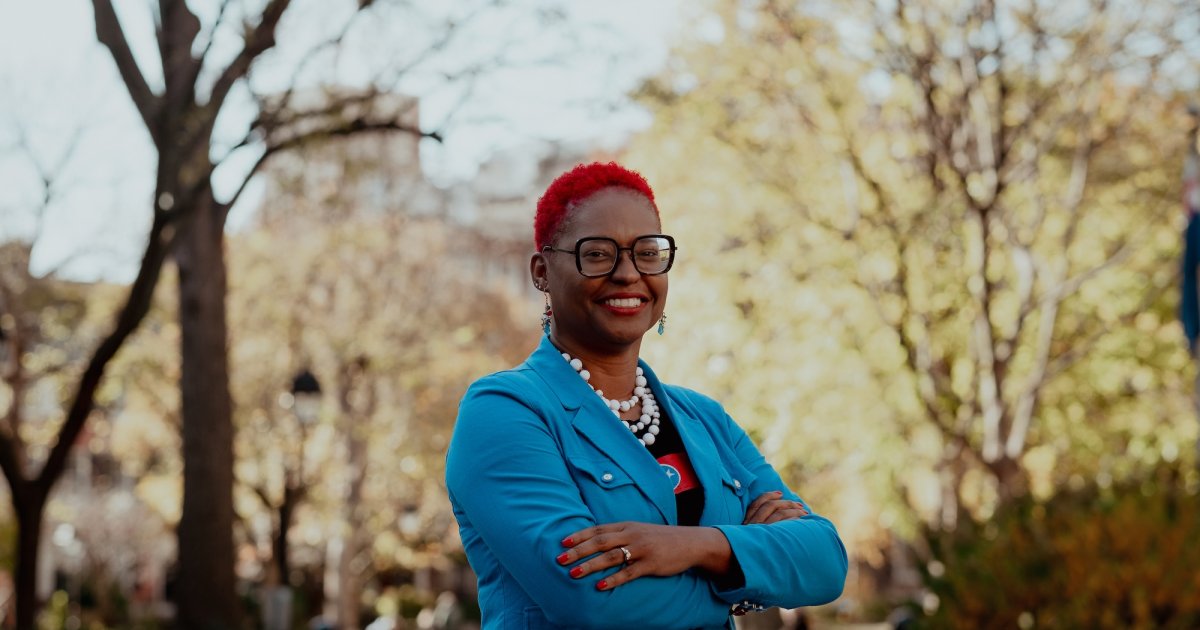
Monica Meeks is a combat veteran and lifelong public servant fired for criticizing Charlie Kirk from her personal Facebook shortly after his assassination.
Under the First Amendment, public employers can’t fire people simply because the government doesn’t approve of their off-duty speech.
FIRE is suing the Tennessee Commissioner of Commerce and Insurance on Monica’s behalf, seeking reinstatement and damages.
NASHVILLE, Dec. 10, 2025 — The Foundation for Individual Rights and Expression filed a federal lawsuit today on behalf of Monica Meeks, a Tennessee public employee unlawfully fired from her state government job solely for criticizing Charlie Kirk in a Facebook comment after his assassination.
“Our democracy suffers when public employees fear to voice what they are free to think,” said FIRE senior attorney Greg Greubel. “There are more than 23 million government employees across the country — and they can’t be fired simply because their boss or folks online don’t like the opinions they share off the clock.”
After serving 20 years in the U.S. Army, including a tour of duty in Iraq, Monica joined the Tennessee Department of Commerce and Insurance in 2016. Since joining the department, Monica has received stellar performance reviews and regular raises.
“I’ve never backed down from a fight in my life, and I don’t plan to start now,” said Monica. “I took an oath to defend the Constitution. Now, it’s time to stand up for it again.”
In her private life, Monica is politically engaged and even ran for the Tennessee House of Representatives in 2022 as an independent candidate. In her free time, she enjoys joking around and trading hot takes with her old Army “battle buddies” on Facebook. After the assassination of conservative activist Charlie Kirk, Monica responded to a friend’s post about Kirk with the remark, “The way you tap dance for White Supremacist should be studied!”
Monica’s post was never intended to go further than two friends amiably sparring over politics — as millions of Americans do every day. But the post escaped her personal circle, and she quickly became swept up in the wave of cancellation attempts that followed the Kirk assassination.
Only 15 or so X accounts called for Monica to be fired in response to an unrelated post by the Department on the afternoon of September 12. That includes comments marked as “probable spam,” and posts from anonymous accounts like “Bonerville Asskicker” and “NonGMOKaren.” But Tennessee Department of Commerce and Insurance Commissioner Carter Lawrence publicly announced her firing mere hours later, and sent a termination letter to Monica’s inbox. Lawrence’s letter mentioned no other performance issues whatsoever, nor any disruption to department operations, and made clear he was firing Monica solely for her lone “inflammatory and insulting comment” on Facebook.
“You may disagree with Monica’s take on Charlie Kirk. But letting a few angry individuals get a public employee fired for off-the-clock speech, even when it has no impact on the workplace, will inevitably boomerang back on people with views you do support,” said FIRE staff attorney Cary Davis. “When public employees are forced into silence for fear of offending someone on the internet, we all lose.”
Lawrence’s rush to fire Monica violated Supreme Court precedent, which established a three-prong test to determine when a government employee’s speech is constitutionally protected and cannot be punished by the state. First, the employee must speak “as a citizen” rather than as an employee. Second, the speech must involve “a matter of public concern.” Third, the employee’s interest in exercising their right to free expression must outweigh the state’s interest in ensuring effective government operations.
Monica’s post easily clears all three hurdles:
Monica clearly went to great lengths to establish that she was speaking as a private citizen. Her Facebook had a disclaimer that her views were hers and hers alone, and her profile didn’t even mention that she worked for the department.
Monica’s post obviously involved a matter of public concern. The fact that others might vehemently disagree with her view of Kirk doesn’t change the fact that it was a major news story with political reverberations across the country.
There is no evidence Monica’s post had any disruptive effect on the department or her work for it. Lawrence’s letter cited complaints about the post by members of the public, but there’s no evidence any coworkers complained, or that her opinions on Kirk would in any way impede her ability to investigate financial services fraud. It was hostility to Monica’s politics that drove the decision — not any legitimate government concern.
FIRE is asking the U.S. District Court for the Middle District of Tennessee to find that Lawrence retaliated against Monica for exercising her clearly established First Amendment rights, and to award her damages and reinstate her to her position. And because Lawrence clearly disregarded her constitutional rights, FIRE is also seeking punitive damages for Monica. Melody Fowler-Green of Yezbak Law Offices is serving as local counsel in the case.
The Foundation for Individual Rights and Expression (FIRE) is a nonpartisan, nonprofit organization dedicated to defending and sustaining the individual rights of all Americans to free speech and free thought — the most essential qualities of liberty. FIRE educates Americans about the importance of these inalienable rights, promotes a culture of respect for these rights, and provides the means to preserve them.
CONTACT:
Alex Griswold, Communications Campaign Manager, FIRE: 215-717-3473; [email protected]