
I’m in San Diego at the POD Network conference this week, which means I get to observe myself in action as I attempt to moderate all the wonderful nuggets of potential learning coming my way, while recognizing that I need to keep some type of self restraint, lest I get too overwhelmed with all that is coming at me at one time. This conference brings together people in the field of educational development, who work closely with faculty to heighten teaching effectiveness in a higher education context.
This topic from Harold Jarche’s PKM workshop focuses on adding value. Jarche shares 14 ways to acquire knowledge from the quintessential PKM practicer, Maria Popova at The Marginalian, and her review _You Can Do Anything_ by James Mangan, written in 1936. He then categorizes the methods in terms of how they align with PKM in this graphic from Jarche: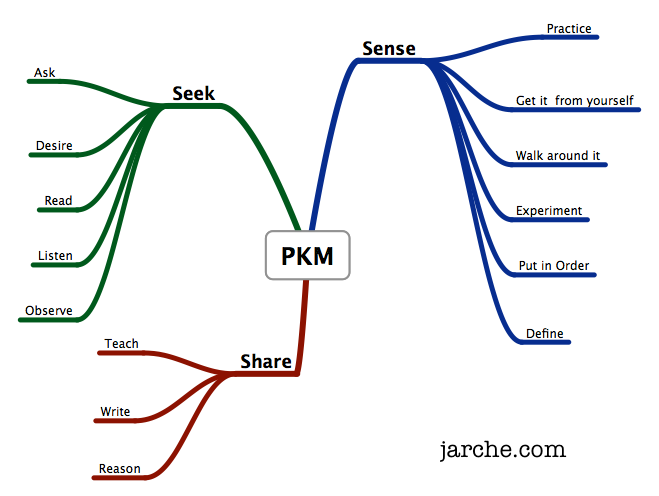 ]
]
Much of what I have thought of as the seek part of my PKM practice has to do with receiving (which may be classified here as reading and listening). What I realize I have been doing for more than a decade through podcasting also fits well here: asking. Had you asked me to map out my podcasting adventures on top of the seek-sense-share model, I certainly could have given you a rudimentary framework with examples, but I’m enjoying this far more expansive way of thinking about those practices specific to the work I do for the podcast. The PKM I do more as a solo endeavor (reading RSS feeds and bookmarking a bunch of items each day) compliments the more regular, public sharing I do through the podcast.
Since I’m at the POD Conference this week, trying to balance out the desire to capitalize on the many opportunities to connect with a need for alone time, as well, I accepted a dinner invitation that I knew would go past my normal bedtime. I tend to wake up super early and therefore head to bed far earlier than most people. However, I had a sense that this dinner would be worth it and it was.
One of the people I got to sit and talk a long while with was Bryan Alexander. I know him from having interviewed him twice, now, for Teaching in Higher Ed. He brilliantly exemplifies what a long-term PKM habit looks like through his hosting of The Future Trends Forum, the Future Trends in Technology and Education Report (FTTE Report), and his blog. At the dinner, I witnessed Bryan’s voracious curiosity and his embodiment of what it looks like to ask, as part of one’s PKM pursuits.
Popova writes about asking:
Every person possessing knowledge is more than willing to communicate what he knows to any serious, sincere person who asks. The question never makes the asker seem foolish or childish — rather, to ask is to command the respect of the other person who in the act of helping you is drawn closer to you, _likes you better_ and will go out of his way on any future occasion to share his knowledge with you.
Bryan asked questions throughout dinner and peaked my curiosity about the others’ video watching, podcast listening, tv/movie watching, and book reading habits, among other things. I enjoyed adding a couple of items to my Sequel App queue. I wish the app had a listing of items I have added, presented chronologically, as unless I add a note to an item, I don’t wind up remembering who suggested something to me. I’m pretty sure Bryan suggested Pluribus to us, though it also easily could have been Tom Tobin, from earlier in the evening. Actually, now that I think about it, whatever Tom had suggested did get a note added to it, at the time, so I’ve added a h/t note re: Bryan Alexander for Pluribus (h/t = tip of the hat, on internet parlance, as in who do you want to give credit to for suggesting something to you, as you share it).
It may seem strange that I like remembering who recommended things to me, after the fact. To me, that’s part of my sensemaking and ongoing relationship deepening habits. In this case, Pluribus is a scifi show, which is a genre I used to think that I didn’t like, which I’m quickly realizing was probably never the case, I just didn’t explore it much in the past. Since Bryan is a futurist, I’m intrigued by the sorts of fictional works that shape his thinking on an ongoing basis. Now I’m wondering if it was Tom Tobin who recommended the show, or maybe both of them did. Hmmm…
As I review all of the ways Mangan articulated for acquiring knowledge, I’m realizing the extent to which Bryan Alexander embodies all of those in his practice. It was such a delight to get to talk to him for an extended period of time, without the normal nerves of getting ready to press record for a podcast interview, or to have just finished talking with him for an episode and then needing to quickly close down the conversation at the end of our scheduled time together (I could talk with him for hours, which was proven this week!). I’m excited to talk to him at the beginning of December for an episode that will air in January about his forthcoming book:
Peak Higher Ed: How to Survive the Looming Academic Crisis, by Bryan Alexander
He gave a keynote here at POD25 about the book’s themes, as well, so between reading it in the coming ten days and having heard him share via his address, I feel that much more excited about our upcoming conversation.
One might think that someone who knows as much as Bryan does would be the person doing the most talking at the dinner table. However, close observation of Bryan’s conversational habits would quickly reveal his heightened curiosity in settings like that, taking in what’s being shared, and setting up even more possibilities for each person to engage in the conversation.
I’m going to look forward to returning to these 14 ways to acquire knowledge and considering even more the ways in which I get to witness them in practice during events like the one I’m at this week.
PS. My deep gratitude to Olivia from OneHE who extended the invitation for the wonderful dinner with such curious, interesting people, including Bryan.