
Join our zero2eight Substack community for more discussion about the latest news in early care and education. Sign up now.
PIERRE — For the past five years, conversations about prisons and how to manage them have played out as one tumultuous bout of realignment and soul-searching after another for South Dakota’s leaders.
Wardens were expelled. Structural deficiencies were exposed. New wardens and corrections secretaries came and went. Lawmakers fought bitterly over how to spend money they set aside for prisons.
Assaults and overdoses spiked. When the dust settled, the state had endorsed a new women’s prison in Rapid City, a new men’s prison in Sioux Falls, and a correctional rehabilitation task force.
But something else happened along the way: Prison officials quietly stood up a program they now view as a solid win for some inmates and their families.
Since 2022, qualifying inmate mothers have lived full-time with their children in a house on the campus of the South Dakota Women’s Prison in Pierre that looks nothing like a prison.
In the three years since its launch, none of the women who’ve left prison after participating in South Dakota’s Mother-Infant Program have returned to state custody.
It’s too early to calculate any long-term impact, but Corrections Secretary Nick Lamb told the Legislature’s budget-setting committee recently that he likes the odds for success.
More than 40% of South Dakota parolees return to prison within three years of their release. In states with similar programs, Lamb said, the repeat offense rate for participating moms “is something like 2%.”
Through fiscal year 2025, which ended on June 30, 17 women had participated, according to the Department of Corrections Annual Statistical Report. Ten had been released at the time the report was issued, and corrections spokesman Michael Winder said none have returned to prison.
Another mother-infant house is nearing completion at the new women’s prison in Rapid City, which is set to open this year. The program in Pierre will continue.
“There’s a beautiful new building out there built just for this,” Lamb told lawmakers.
A new program for an old building
The program began under former Department of Corrections Secretary Kellie Wasko.
To be eligible, the mothers must be on minimum custody status, have 30 months or less remaining on their sentence and be serving time for a nonviolent offense.
The women and their children live in two fused-together Governor’s Houses just outside the main prison complex in Pierre. The homes are prefabricated dwellings, built at Mike Durfee State Prison in Springfield and typically sold to low-income families.
The structure had been there for years.
Until around five years ago, it was known as the “PACT” house, a nod to its use for a less-expansive familial bonding program called Parents and Children Together that was launched by former Gov. Bill Janklow to allow female prisoners weekend-long visits with their kids.
Interest in PACT had waned by the early days of the COVID-19 pandemic, Warden Aaron Miller told South Dakota Searchlight during a recent tour. The pandemic shuttered it altogether.
Wasko moved to reopen its doors as a full-time home for inmate moms and their kids shortly after her arrival in March of 2022. Colorado, the state where Wasko had worked in corrections previously, has a mother-baby unit for inmate moms.
‘Just learning’
On a recent Friday, the moms were gathered in the shared living area at lunchtime, sitting in a semicircle of couches as an episode of the children’s program “Bluey” played on a flat-screen television.
There were seven women living in the house with their kids that day — four boys and three girls, ranging in age from two months to 18 — but the building can hold up to 10. Women typically stay in the program for 30 months.
One of the moms, Sara Bernie, said it can feel “pretty cramped” with 10 families, but “we make it work.”
Bernie’s daughter, Spiryt, turns 1 this month. They’ve been there since Spiryt’s birth.
“We’re just learning to walk,” Bernie said of her daughter, wearing a fresh-looking pair of Minnie Mouse sneakers and a long-sleeved Minnie Mouse shirt.
Bernie moved from Michigan to Yankton to work at a restaurant. She’d been in South Dakota less than a month when she was charged with drug distribution. She’d been pregnant about a month, too, and spent the start of her sentence in the main women’s prison, transitioning to the mother-infant program when Spiryt was born.
“Coming over here, it is a totally different world,” said Bernie.
Having Spiryt right there, she said, has served to motivate her. Bernie has completed a kitchen management program. The program, run by food service provider Aramark, earned her early discharge credits and put her in a position to make federal minimum wage working in the prison kitchen and save money for her future. Most inmate jobs pay around 50 cents an hour.
With Spiryt at her side as a motivator, Bernie said, “I am 100% focused on going back out.”
Her other two children, ages 6 and 14, are in Michigan. She wants to go back there when her sentence is up in early 2028.
Sometimes, prison staff will clear the adults from the prison’s recreation gym so the littles can take over. Aside from those moments, the children don’t see the inside of the prison. When it’s warm, they play outside.
Sitters fill role for moms, prison system
A babysitter or correctional officer watches Spiryt when Sarah goes to work, leaves for recreation time or goes to church. The babysitters are the only other women in the house most evenings. Overnight, it’s often just the moms and babies.
Bernie is CPR certified, as are all the mothers in the house. That’s also a qualification for the babysitters, who are minimum security inmates interviewed first by the staff, then by the moms.
“We vote on the babysitters,” Bernie said. ” They usually work out pretty well.”
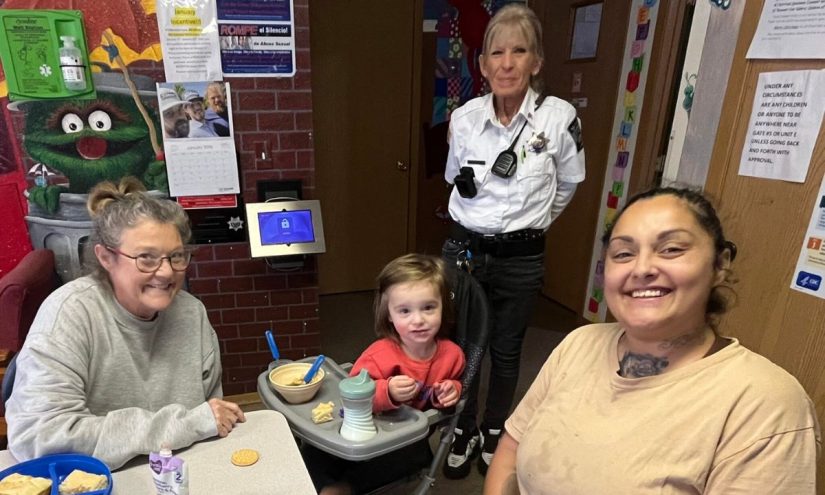
The daytime correctional officer, Karen Boyer, often relies on the babysitters to help manage the chaos of a seven-family house. On some days, Boyer spends a lot of time away from the building, taking babies to doctor visits outside the prison in a Chevrolet Suburban packed with car seats.
“It’s kind of like school,” she said. “When one gets sick, they all get sick.”
The children start to feel like grandkids after a while, she said.
It’s a feeling the babysitters get, too.
“When the kids leave, it’s like they’re losing someone in their family,” Boyer said.
Kay Cain has been a sitter since November. On the outside, Cain was a pediatric nurse, so working with kids came naturally. She typically takes care of Dennis, an 18-month-old with a mop of curly hair who gives fist bumps when asked for “knuckles.”
“You’ve kind of grown on me, haven’t you?” she said to Dennis when asked about her favorite part of the job.
Like Bernie, Dennis’ mother came from out of state, and was living in Yankton when she was arrested. Destiny Hogan said she was pregnant and using fentanyl and methamphetamine at the time.
“If I wouldn’t have gotten arrested, I don’t know if either of us would be here,” Hogan said.
Now, having lived side-by-side with Dennis his whole life, she’s closer to him than she’s been with any of her five other children.
“He’s the only one I’ve been there with from day one,” Hogan said.
Birthdays, holidays
Cameras in the corners, khaki prison-issued pants and the supervising correctional officer’s uniform are the only outward signs that the house doubles as a prison facility.
There are two bathrooms, one with a Peter Pan theme and another with a unicorn theme, on either side of the building. Each bedroom has a theme, as well, and there are hand-painted cartoon images on every wall outside the bedrooms. Every painting was done by an inmate.
Meals are delivered each day for the women and children. Every month or so, everyone will have what Bernie called a “big meal” together.
The children get birthday parties, and Bernie wrote out a wishlist for Spiryt. A little boy got an electric drum kit at the last birthday party.
Christmas gifts come by way of an angel tree, where community members buy the toys listed on tags hanging from a tree.
A lot of the gifts come in a similar fashion, originating with community members or community partners. Others come from prison staff members.
Wasko, the former corrections secretary, took particular pleasure in playing Santa Claus, Corrections spokesman Michael Winder said.
By policy, kids are allowed one bag of gifts at gift-giving time, Winder said.
“You’d never seen a bag so big,” as the ones Wasko would deliver, he said.
Community support
That the PACT house was available at the time of the program’s launch was a big help, allowing the state to avoid building space from scratch or retrofitting areas inside the women’s prison to make them function more like living spaces appropriate for infants.
As with gifts for the kids, a lot of supplies come through community support, said Miller, the warden at the women’s prison.
Churches pitch in for car seats, collapsible cribs, toys or furniture, he said, as do local supporters like the Pierre office of a Canadian nonprofit called Birthright, founded in 1968 to support women with unplanned pregnancies.
Birthright has kept the building stocked with diapers and wipes since the program’s launch.
An organization called Right Turn offers educational programming to the mothers, Head Start offers early childhood educational materials and teaches moms how to bake and cook, CPR training comes from the Sanford Frontier and Rural Medicine (FARM) Project, and the group Disability Rights of South Dakota helps mothers connect with the resources they’ll need on the outside as they prepare for release.
The program costs the Department of Corrections $15,000 a year, a figure folded into the $8.8 million budget for the women’s prison in Pierre.
Building bonds
Spiryt got restless as she sat on her mom’s lap during her conversation with a reporter and prison administrators. The tot’s eye was drawn to the neon cord of the earbuds plugged into Bernie’s inmate-issued tablet. Spiryt flopped to her left and grabbed the cord.
Reflexively, Bernie stretched a hand to her window sill, grabbed an identical but non-functioning pair of earbuds and swapped them into Spiryt’s tiny hands.
“I hide these up here and give them to her when she does this,” Bernie said, smiling down at Spiryt. “That way she still thinks she’s getting away with something.”
That’s precisely the kind of attentive understanding the program wants mothers to develop with their children.
“The premise of the program is that they will be able to bond with their child,” Miller said. “It’s teaching moms how to be moms.”
Miller was around in 1997, when the Pierre women’s prison first opened. At that point, former Gov. Janklow’s move to create a weekend visitation house for inmate mothers was viewed with scrutiny.
The prison houses women at all security levels and has a minimum security unit, but the main building was designed to house maximum-custody inmates.
“At the time, no one could imagine having kids in a maximum security facility,” Miller said, even if the overnight visits took place in a conventional house designed for families outside prison walls.
The women who stayed there through the years tended to do better on the outside, Miller noted, but “when they were only there for the weekend, it was totally different.”
South Dakota is one of at least nine states with prison nursery programs, Stateline reported last month, the oldest of which is in New York. The programs have expanded as the number of women entering prisons has grown, from around 13,000 in 1980 to nearly 86,000 in 2023.
‘Not here to punish inmates’
The program came up as the Legislature’s budget committee got an update last month on construction at the new women’s prison in Rapid City. The mother-infant program building was nearing completion, Lamb told the committee.
One senator, Piedmont Republican John Carley, asked Lamb how the prison keeps the program from feeling like a prize for the participating moms.
“What’s the difference between them truly feeling they’re incarcerated and dealing with the crime maybe they committed versus, ‘hey, this is a lot of wonderful free stuff,’” Carley said.
Lamb told Carley that his job is not to punish inmates. The incarceration is the punishment, he said.
“The ladies that are back there no longer have their freedom,” Lamb said. “So they’re serving their punishment by being with us.”
The low rate of repeat offenses from women who’ve gone through similar programs across the U.S. shows its value as a rehabilitation tool, Lamb told Carley as he invited the senator and anyone else on the committee to visit the shared family space on the Pierre prison campus.
Lamb, a father of seven, also said there’s a moral component at play. Babies, he said, should not be separated from their mothers for a mother’s misdeeds.
“Harming the mother is one thing,” Lamb said. “But separating the child from the mother is something totally different.”
South Dakota Searchlight is part of States Newsroom, a nonprofit news network supported by grants and a coalition of donors as a 501c(3) public charity. South Dakota Searchlight maintains editorial independence. Contact Editor Seth Tupper for questions: [email protected].
Did you use this article in your work?
We’d love to hear how The 74’s reporting is helping educators, researchers, and policymakers. Tell us how