
The U.S. Supreme Court on Monday allowed the Trump administration to proceed with laying off nearly half the U.S. Department of Education’s staff — a significant victory for the administration’s mission to dissolve the department to the greatest extent possible.
The decision in New York v. McMahon green-lights the department’s reduction in force initiated in March as the original question of the layoffs’ legality works its way through the lower courts. The layoffs closed department offices and spurred concerns from public school advocates that the education system would descend into chaos with little federal oversight.
The Monday order allowing the reduction in force to continue was met with dissent from liberal justices Sonia Sotomayor, Elena Kagan and Ketanji Brown Jackson, who called the majority’s decision “indefensible” in their 18-page dissent.
“When the Executive publicly announces its intent to break the law, and then executes on that promise, it is the Judiciary’s duty to check that lawlessness, not expedite it,” they said.
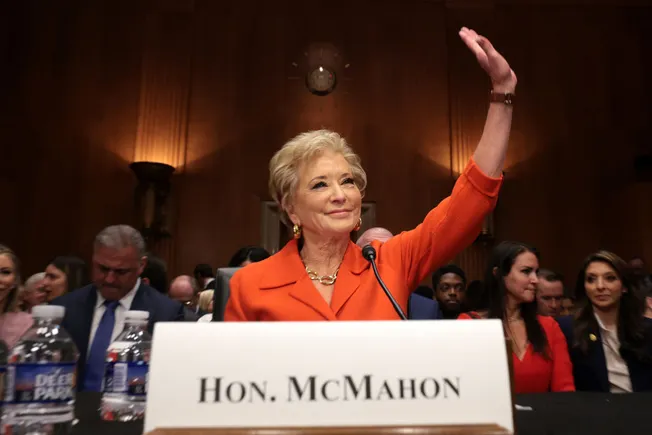
U.S. Secretary of Education Linda McMahon, who was tasked with shutting down the department to the greatest extent “permitted by law,” celebrated the decision.
“Today, the Supreme Court again confirmed the obvious: the President of the United States, as the head of the Executive Branch, has the ultimate authority to make decisions about staffing levels, administrative organization, and day-to-day operations of federal agencies,” McMahon said in a statement.
Until now, the department’s RIF had left staff — who were technically still employed but had been on administrative leave since March — in limbo. The Trump administration had planned to lay off employees June 9, but U.S. District Judge Myong Joun ruled in May that the layoffs left the department as “a shell of itself” and required that staff remain employed in a preliminary injunction.
The layoffs leave the department with only about 2,183 employees out of its previous approximately 4,133.
“A department without enough employees to perform statutorily mandated functions is not a department at all,” Joun wrote. In a separate case, the same judge last month also ordered that the department’s Office for Civil Rights be restored to its former self.
Joun’s May order required the department to routinely report to the district court the steps it was taking to restore its staff — which it did by sending out multiple surveys to employees on administrative leave as a way of “actively assessing how to reintegrate you back to the office in the most seamless way possible.” At the same time, the department was appealing its case to the Supreme Court, hoping its RIF would be allowed through.
The Monday order from the Supreme Court means those employees can be terminated even as the case over the legality of the layoffs proceeds in the lower court.
The Supreme Court’s decision to allow the layoffs was preceded by another decision from the high court in April that also bolstered the Trump administration’s attempts to close the department. That ruling maintained a freeze on over $600 million in teacher training grants that the administration called “divisive.”
It also follows a Supreme Court decision last week allowing mass terminations to move forward across other federal agencies.
Are statutory obligations impacted?
The department argued that depleting its staff by almost half — including closing down civil rights offices and leaving only a handful of employees in the office that administers the National Assessment of Educational Progress — does not impact its statutory obligations. McMahon has told concerned lawmakers that NAEP is administered through contracts that remain in place.
In the meantime, however, former employees and Democratic lawmakers allege the department has already missed key deadlines on tasks that are required by law, and that no one remains in place to oversee the contracts and ensure the quality of the work.
The annual Condition of Education report, for example, was due to Congress by June 1 — an obligation that the department missed “for the first time ever,” according to Sen. Patty Murray, D-Wash.
In place of fresh data analysis that the National Center for Education Statistics released each year on over 20 topics — including those relevant to current events such as the COVID-19 pandemic and school shootings — the department repurposed already-released analysis on a handful of topics, former NCES employees said.
The department said on its website it would be ”updating indicators on a rolling basis” due to its “emphasis on timeliness” and would determine “which indicators matter the most.” More than a month after the missed June 1 deadline, however, the report still only includes a highlights page with five topics linking to data tables.
Democratic lawmakers also sounded alarm bells over the agency’s delay in distributing grant funding, including Title I-A grant funds, saying it took three times as long to distribute the money than under the Biden administration’s fully staffed department.
The Title I-A program provides $18.4 billion by formula to more than 80% of the nation’s school districts.
As a result of the delay, lawmakers said, states and districts would have less time to allocate funds meant to help students experiencing homelessness and other underserved students.
Decision sparks outcry
The order sparked outcry on Monday from the American Federation of Government Employees Local 252, the union representing the more than 1,000 Education Department employees laid off.
“This effort from the Trump administration to dismantle the Department of Education is playing with the futures of millions of Americans, and after just four months, the consequences are already evident across our education system,” said Sheria Smith, the union’s president, in a statement. Smith called the Supreme Court decision “deeply disappointing.”
A union official said the decision could also negatively impact federal education funding and services, a concern shared by the American Federation of Teachers, which is part of a coalition of parties in the lawsuit challenging the layoffs.
“This unlawful plan will immediately and irreparably harm students, educators and communities across our nation,” the coalition said in a statement.
However, the U.S. Department of Education said in a Monday statement that it “will now deliver on its mandate to restore excellence in American education.”
“As we return education to the states, this Administration will continue to perform all statutory duties while empowering families and teachers by reducing education bureaucracy,” the department said.