
Tag: 50M

  • Private New York colleges get $50M in state financing for capital projects

    Private New York colleges get $50M in state financing for capital projects

    This audio is auto-generated. Please let us know if you have feedback.

    Dive Brief:

    • New York is contributing $49 million in capital grants to 35 of the state’s private nonprofit colleges to help fund upgrades to facilities, build new labs and research spaces, and invest in new technology and equipment. 
    • The state’s Higher Education Capital Matching Grant Program — led by a three-person board composed of political appointees — last week awarded grants ranging from tens of thousands of dollars to $5 million, New York Gov. Kathy Hochul announced on Friday.
    • Under the 20-year-old program, eligible colleges must invest $3 of their own money for every $1 of public funds. The next round of applications for projects is set to open in mid-December.

    Dive Insight:

    Since 2005, HECap has directed $369.8 million in state funding toward over 300 projects at private nonprofit colleges in New York, the governor’s office said. 

    The program makes the state a financial partner for private colleges, many of which were established well before the 1948 creation of the State University of New York system. 

    After a more than yearlong application process, the state’s HECap Board approved the latest round of projects at an Oct. 20 meeting. Colleges can use the funds to design, acquire, build, rebuild, renovate or equip buildings. Selected projects are meant to support a college’s academic offerings or student life, as well as to drive economic development in the state.

    These projects stand for our ongoing commitment to keeping New York at the forefront of education and economic opportunity,” Hochul said in a Friday statement

    The current round of combined public and institutional funds represents a $195 million capital investment in independent higher education facilities, according to Hochul’s office. 

    The grants cover a wide range of amounts to nearly three dozen institutions, including:

    • $1.8 million to Albert Einstein College of Medicine for renovations to a commons area and recreation center. 
    • $5 million to Clarkson University for the first phase of renovations to an engineering and science complex.
    • $69,800 to Maria College to purchase and install technological equipment. 
    • $1.8 million to Cornell University to build a large classroom space in a library.
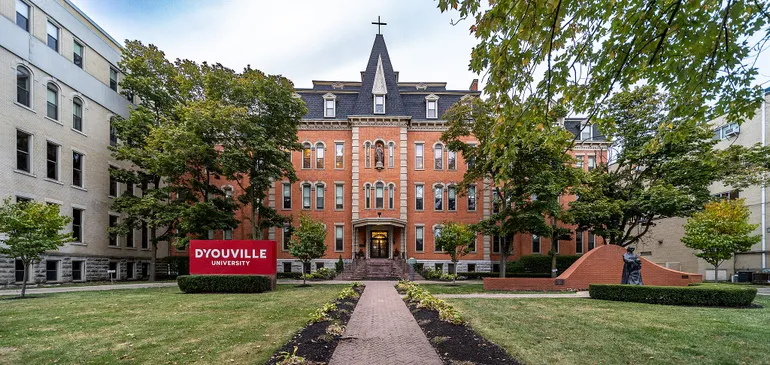
    • $5 million to D’Youville University for renovations to a facility supporting its osteopathic medicine college. 
    • $5 million to Hobart and William Smith Colleges for construction of a new science building and renovation of three adjacent facilities.
    • $1.8 million to the Rochester Institute of Technology to upgrade its electrical infrastructure. 
    • $1.6 million to Sarah Lawrence College to create an experiential learning center.

    New York’s continued public financing of capital projects comes while colleges across the country wrestle with sizable backlogs of deferred maintenance and facilities needs, many left over from the pandemic era as institutions put off those investments.

    Last year, analysts with Moody’s Investor Service estimated a “hidden liability” of deferred maintenance needs at colleges potentially amounting to nearly $1 trillion — and just among the roughly 500 institutions Moody’s rated at the time. 

    Rising costs, high interest rates and financial pressures can make those needs all the more difficult to meet.

    Few have the necessary resources and credit strength to sustain the higher amounts needed to tackle the full extent of their infrastructure needs,” Moody’s analysts said in their report. Colleges that can’t afford upgrades face recruitment risks in enrollment and staff talent as buildings continue to deteriorate. 

    The backlog of projects is so large that capital spending increases on existing facilities have served only to slow the growth of unmet need, according to a report earlier this year from the building intelligence firm Gordian.


    Source link

  • ASU Receives $50M Gift to Develop Energy Institute

    ASU Receives $50M Gift to Develop Energy Institute

    Arizona State University has received a $50 million donation to launch the Global Institute for the Future of Energy, a collaboration between its Julie Ann Wrigley Global Futures Laboratory and the Thunderbird School of Global Management that seeks to promote education and innovation regarding energy production and use.

    The gift comes from Bob Zorich, who earned his master’s degree in international management in 1974 from Thunderbird’s predecessor, the American Graduate School of International Management.

    “ASU has long been a pioneer in building bold, pragmatic solutions for the future,” said Zorich, founder and managing partner of the Texas-based private equity firm EnCap Investments. “President Michael Crow has taken a visionary and action-oriented approach to positioning the university as a leading center for research, educational excellence and global influence. For these reasons, I was excited to fund the formation of this energy institute at ASU because of the university’s unique ability to scale and reach a global audience.”

    Zorich’s gift will help the institute recruit a chair and staff and start developing curriculum for students, executives and the public. In the second year, the institute aims to launch a fellowship and executive-in-residence program, as well as a series of public programs, including lectures, summer camps and a global energy conference.

    In addition, some of the funds will support Energy Switch, a point-counterpoint show on Arizona PBS that brings together experts from government, NGOs, academe and industry to debate energy-related topics.

    “Energy is central to nearly every facet of our daily lives, and we have to prepare now for an evolving energy future,” Crow said in a statement. “With the rapid growth of AI and other fast-moving innovations, we have a responsibility to ready the next generation of energy leaders and solutions. Bob Zorich’s visionary investment will empower our global understanding of energy, our vital literacy and how we can work together to develop the best paths forward.”

    Source link

  • Bowdoin to Devote $50M Gift to AI Learning, Teaching

    Bowdoin to Devote $50M Gift to AI Learning, Teaching

    Bowdoin College has received a $50 million gift from Reed Hastings, 1983 alumnus, Netflix cofounder and Powder Mountain CEO, to create the Hastings Initiative for AI and Humanity.

    The gift, the largest in the college’s 231-year history, will be used largely to support teaching and research related to artificial intelligence. It will pay for 10 new faculty members, expand faculty-led research and curriculum offerings, and drive campuswide conversations about the benefits and challenges of AI.

    “This donation seeks to advance Bowdoin’s mission of cultivating wisdom for the common good by deepening the College’s engagement with one of humanity’s most transformative developments: artificial intelligence,” Hastings said in a press release. “As AI becomes smarter than humans, we are going to need some deep thinking to keep us flourishing.”

    Hastings credited a late Bowdoin mathematics professor, Steve Fisk, for first encouraging him to study AI. “Steve was about forty years too early, but his perspective was life-changing for me,” Hastings said.

    “We are thrilled and so grateful to receive this remarkable support from Reed, who shares our conviction that the AI revolution makes the liberal arts and a Bowdoin education more essential to society,” Bowdoin president Safa Zaki said in a statement.

    Source link

  • OpenAI invests $50M in higher ed research

    OpenAI invests $50M in higher ed research

    OpenAI announced Tuesday that it’s investing $50 million to start up NextGenAI, a new research consortium of 15 institutions that will be “dedicated to using AI to accelerate research breakthroughs and transform education.”

    The consortium, which includes 13 universities, is designed to “catalyze progress at a rate faster than any one institution would alone,” the company said in a news release.

    “The field of AI wouldn’t be where it is today without decades of work in the academic community. Continued collaboration is essential to build AI that benefits everyone,” Brad Lightcap, chief operating officer of OpenAI, said in the news release. “NextGenAI will accelerate research progress and catalyze a new generation of institutions equipped to harness the transformative power of AI.”

    The company, which launched ChatGPT in late 2022, will give each of the consortium’s 15 institutions—including Boston Children’s Hospital and the Boston Public Library—millions in funding for research and access to computational resources as part of an effort “to support students, educators, and researchers advancing the frontiers of knowledge.” 

    Institutional initiatives supported by NextGenAI vary widely but will include projects focused on AI literacy, advancing medical research, expanding access to scholarly resources and enhancing teaching and learning. 

    The universities in the NextGenAI consortium are: 

    • California Institute of Technology
    • California State University system
    • Duke University
    • University of Georgia
    • Harvard University
    • Howard University
    • Massachusetts Institute of Technology
    • University of Michigan
    • University of Mississippi
    • Ohio State University
    • University of Oxford (U.K.)
    • Sciences Po (France)
    • Texas A&M University

    Source link