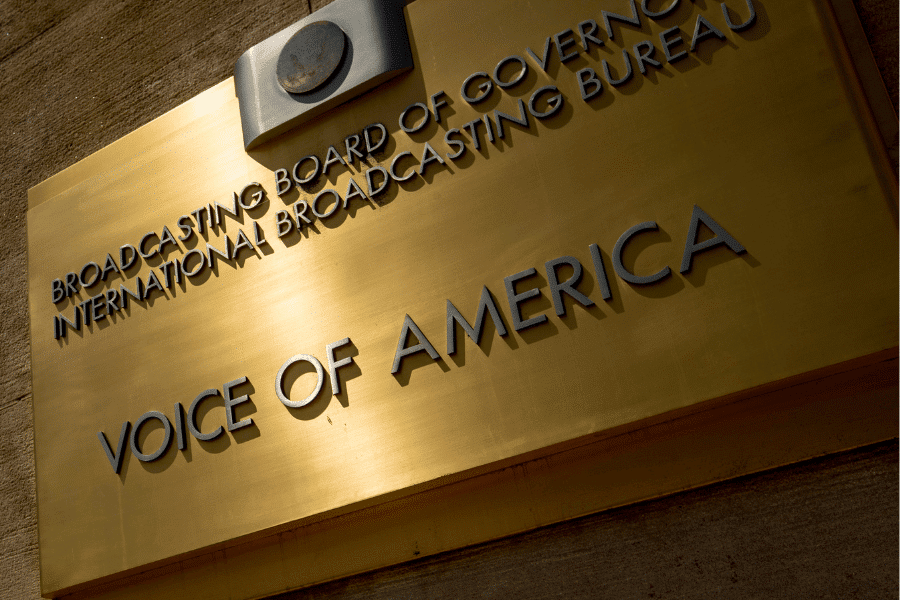
On 28 March, several journalists in South Asia opened their inboxes and found messages that changed their lives. Reporting assignments were cancelled. Email access revoked. For many, it marked the end of years of work with Voice of America — without explanation, without notice.
Nazir Ahmad is a journalist. For 11 years, Ahmad worked for Voice of America as a multimedia journalist. He documented protests, crackdowns and mass detentions. That morning, his email account was suspended. His press card was no longer valid.
“It ended without warning,” he said. “No notice, no call. Just a message that my services were no longer needed. I had been filing reports even a week before this.”
Nazir Ahmad is not his real name. We changed it for this article to protect his identity. And we offered anonymity to all the journalists we interviewed for this story because their reporting for Voice of America has put them in danger.
Ahmad is one of several South Asian journalists who lost their jobs after the Trump administration signed an executive order to downsize multiple U.S. government agencies, including the U.S. Agency for Global Media, which oversees Voice of America.
On 22 April, a federal district judge in Washington, D.C. ruled that the administration illegally required Voice of America to cease operations and ordered it be temporarily restored until the lawsuits challenging the closure have run their course. How this will affect Ahmad and the other reporters who were dismissed remains to be seen.
Shutting down a news network
The Trump Administration’s decision to end Voice of America affected journalists across Asia who have been covering sensitive political developments for years.
“I covered the Delhi riots, Punjab farmers’ protests, and the elections,” said another Voice of America journalist. “These were not easy stories. I often worked without backup and sometimes without formal protection. Now, I’m being told to stop working.”
Trump’s executive order resulted in mass administrative leave across Voice of America’s global network. Michael Abramowitz, Voice of America’s director, confirmed that nearly all 1,300 journalists and staff were placed on leave.
The White House said the order was intended to reduce government spending and eliminate what it called “radical propaganda.” It accused outlets like Voice of America of political bias, despite decades of bipartisan support for the agency.
For many South Asian journalists, the move came at a personal and professional cost. Several freelancers and stringers in India, Pakistan, Nepal, Bangladesh and Sri Lanka had worked with Voice of America for over a decade.
Telling important stories to the world
Besides reporting on protests, these reporters covered elections, environmental disasters and rights violations in hard-to-reach areas.
“I reported from Punjab’s border villages during the height of the farmers’ protests,” said yet another journalist who worked with Voice of America since 2014. “I was there when the police fired tear gas. I was there when elderly protesters braved the winter cold. And now I’m unemployed.”
These journalists say they received no formal termination letters, only a message from editors citing administrative leave and funding suspensions. They have not been told when or if their jobs will resume.
“There was a clear line in the message: stop all reporting,” said a Voice of America contributor from New Delhi. “I depend on this income to support my family. I’ve been sending stories every week for eight years.”
Voice of America was established in 1942 during World War II to counter Nazi propaganda. It has since expanded to reach 360 million people weekly in nearly 50 languages. In South Asia, it provided a platform for independent voices, especially in regions where domestic media faced political pressure or censorship.
Press coverage where the press is muzzled
Experts say the funding freeze, if ultimately allowed by the courts, could silence important coverage from conflict zones. In regions like Kashmir, where local journalists already face surveillance and restrictions, international media partnerships like Voice of America provided both visibility and a layer of protection.
“Working with VOA allowed us to tell local stories without fear of censorship,” says a journalist based in Srinagar. “Now that channel is gone.”
The impact also extends beyond journalists. Translators, video editors and fixers who worked with Voice of America in the region say their contracts have been halted.
“I’ve been working as a video editor for their South Asia bureau for six years,” said a technician based in Lahore, Pakistan. “We’ve stopped getting assignments. I haven’t been paid for last month’s work.”
Some journalists say they are now exploring alternate work, but few opportunities exist for those with years of specialized international reporting experience.
“I’m being told to apply to local newspapers, but they don’t have the budget or the editorial independence,” said a journalist from Kathmandu. “It feels like I’m starting over after 12 years.”
Stories the domestic press hesitates to cover
The Executive Order also affected coverage of religious freedom, caste violence and press crackdowns in India. Journalists who regularly filed in-depth features say important stories are now going untold.
“I was working on a long story about attacks on Christian communities,” said a reporter based in Tamil Nadu. “It’s not something mainstream outlets want to cover. Voice of America gave me space to explore that. Now it’s shelved.”
The global press watchdog Reporters Without Borders has described the shutdown as a serious setback for journalism, warning that it could encourage political interference in media operations across the world.
Stephen Capus, head of Radio Free Europe/Radio Liberty, which also lost funding, said the move would leave millions without access to independent reporting.
In South Asia, journalists say this is about more than losing a paycheck. For them, it’s the breakdown of a reporting network that allowed them to cover sensitive stories in challenging environments.
“We weren’t just sending news reports,” says a journalist who covered the Indian government’s 2019 decision to revoke Kashmir’s autonomy. “We were capturing what was happening when few others could. And now someone in Washington has pulled the plug.”
With no clarity on whether the shutdown is permanent, most contributors are in limbo. Some are looking for freelance work. Others are applying for short-term grants. But many say the abrupt stop has left them disoriented.
“I always thought if I stopped reporting, it would be because of risks here,” one journalist said. “I didn’t expect to be cut off by a government halfway across the world.”
Questions to consider:
• What is the Voice of America?
• Why has the U.S. government long funded foreign journalists outside the United States?
• Do you think governments should pay journalists to cover events and other stories? Why?