Tag: ABC

  • Carr’s threats to ABC are jawboning any way you slice it

    Carr’s threats to ABC are jawboning any way you slice it

    In 1867, the Supreme Court ruled in Cummings v. Missouri that the state could not use loyalty oaths to bar ex-Confederates from teaching, preaching, or practicing law. The oaths themselves were (at the time) lawful, but Missouri was using them to unlawfully punish past conduct — and that was the problem.

    “What cannot be done directly cannot be done indirectly,” Justice Stephen Johnson Field wrote for the majority. “The Constitution deals with substance, not shadows.”

    Over 150 years later, ABC suspended Jimmy Kimmel hours after FCC Chair Brendan Carr suggested they could face consequences for remarks Kimmel made in the aftermath of Charlie Kirk’s murder.

    Unlike the formal government pressure in Cummings, this was informal government pressure to influence private action, otherwise known as jawboning. But the age-old principle is the same. It was echoed in last year’s landmark jawboning case NRA v. Vullo “a government official cannot do indirectly what she is barred from doing directly.”

    Carr’s defenders try to deny any connection between Carr’s threats and Kimmel’s ouster.

    This has one big problem. Courts have said it doesn’t matter whether a threat produces results. In Backpage.com v. Dart, the Seventh Circuit held that the constitutionality of government conduct turns on what the threat tries to accomplish, not whether it accomplishes it.

    Given that, Carr’s threat still runs headlong into the First Amendment. 

    The bar was laid out clearly in last year’s Vullo: “to state a claim that the government violated the First Amendment through coercion of a third party, a plaintiff must plausibly allege conduct that, viewed in context, could be reasonably understood to convey a threat of adverse government action in order to punish or suppress the plaintiff ’s speech.”

    Let’s see how that squares with the timeline. 


    July 22 – Days after CBS cancels the Late Show with Stephen Colbert, with the question of FCC approval for parent Paramount Global’s merger with Skydance looming large over it, Trump posts:

    August 6 – Trump tells the press pool regarding Kimmel and Late Night host Jimmy Fallon, “They’re next, they’re going to be going — I hear they’re going to be going.” 

    August 11 – Sinclair Broadcast Group shares surge 27% after it announces efforts to explore merger-and-acquisition opportunities in broadcast TV. Any transfer of broadcast licenses requires FCC approval, which FIRE has written extensively about regarding Carr using the government as a “point of leverage.”

    August 19 – Nexstar Media Group, the nation’s largest TV station owner, announces plans to buy rival media giant Tegna in a deal that will require FCC approval and FCC willingness to lift their 39% cap on how many households one company can reach through TV station ownership. Nexstar now has 38.9% of stations covered by the FCC.

    September 4 – The Center for American Rights files a complaint with the FCC over Jimmy Kimmel’s alleged bias and conflict of interest towards Democrats. CAR’s 60 Minutes complaint launched the now infamous FCC probe into CBS, which informed Trump lawsuit, and their complaints against ABC and NBC were revived by Carr early this year. 

    September 10 – Charlie Kirk is murdered while giving a talk at Utah Valley University.

    September 15 – Kimmel says in his opening monologue:

    We hit some new lows over the weekend with the MAGA gang desperately trying to characterize this kid who murdered Charlie Kirk as anything other than one of them and doing everything they can to score political points from it.

    It’s worth noting the accuracy of his statement hinges on whether the “MAGA gang” was trying to avoid association with Kirk’s killer, not on whether the killer was part of the “MAGA gang.” It’s an important distinction when official actions are being considered.

    September 17 – Carr appears on The Benny Johnson Show, with Johnson posting a summary at 1:01 pm, Carr addressing ABC parent Disney says:

    This is a very, very serious issue right now for Disney. We can do this the easy way or the hard way. These companies can find ways to take action on Kimmel or there is going to be additional work for the FCC ahead.

    Carr also addresses the station owners: 

    Disney needs to see some change here, but the individual licensed stations that are taking their content, it’s time for them to step up and say this, you know, garbage, to the extent that that’s what comes down the pipe in the future, isn’t something that we think serves the needs of our local communities.
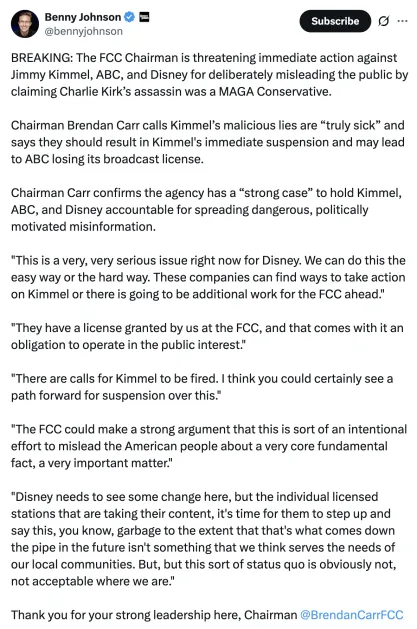
    Benny Johnson post on X describing interview with FCC Chair Brendan Carr

    6:18 pm – Later that day, it’s reported that Nexstar has said it will suspend Kimmel’s show “indefinitely beginning tonight.”

    6:24 pm – Minutes later, it’s reported that Disney’s ABC says it is pulling the show.

    6:49 pm – Sinclair joins Nexstar in indefinitely suspending Kimmel’s show.

    6:59 pm – CNN reporter Brian Stelter says when asked about ABC pulling Kimmel’s show, Carr sent him a celebratory GIF:
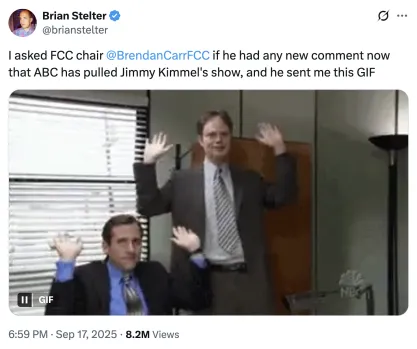
    Brian Stelter post on X.com: "I asked FCC chair @BrendanCarrFCC if he had any new comment now that ABC has pulled Jimmy Kimmel's show, and he sent me this GIF"

    7:00 pm – Carr writes on X, “I want to thank Nexstar for doing the right thing … I hope that other broadcasters follow Nexstar’s lead.”

    8:04 pm – Trump celebrates:
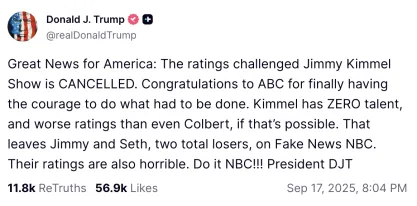
    Donald Trump post on Truth Social celebrating the cancellation of Jimmy Kimmel's show

    8:38 pm – Sinclair says its ABC stations will air a special remembrance of Charlie Kirk this Friday during Jimmy Kimmel Live’s timeslot, adding: “Sinclair also calls upon Mr. Kimmel to issue a direct apology to the Kirk family. Furthermore, we ask Mr. Kimmel to make a meaningful personal donation to the Kirk Family and Turning Point USA.”

    11:43 pm – Carr responds to a post on X saying, “This was all in Project 2025, btw”:
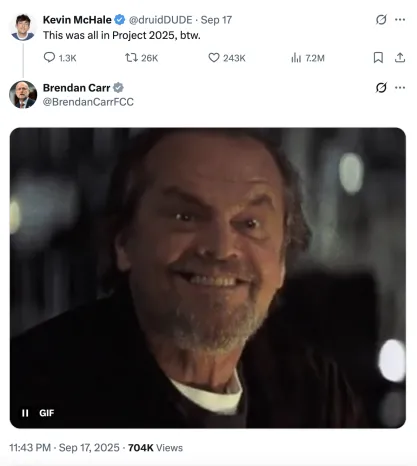
    Brendan Carr GIF response to post on X.com claiming that Project 2025 called for cancelling late night hosts

    September 18 – Carr replies to a post from British commentator Piers Morgan, attributing Kimmel’s suspension to “outrage all across America.” It’s difficult to find evidence of “outrage all across America” before September 17. 
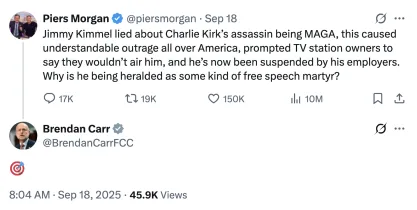
    Brendan Carr responds to a Piers Morgan post on X claiming Jimmy Kimmel lied about Charlie Kirk with a dart hitting a bullseye

    That’s the timeline, so let’s break it down.

    Carr tells ABC that “we can do this the easy way or the hard way” and that “there’s going to be additional work ahead for the FCC” if they don’t “take action.” There’s the threat and the adverse action — possibly in the form of an FCC probe into Carr’s complaint — if they don’t accede to the threat. 

    We also see Carr prompt affiliate station owners like Nexstar and Sinclair — seeking regulatory favor in pressing business before the government — to dial up the pressure on Disney in the lead up to Kimmel’s ouster. The specter of disfavorable treatment from the government poisons the chain from top to bottom. Finally, Trump and Carr celebrate after ABC suspends Kimmel indefinitely. 

    Asked to respond to those condemning him for “bullying ABC” on The Scott Jennings Show, Carr says “we’re reinvigorating the public interest standard for broadcasters. If people don’t like that … If  you’re a broadcaster and you don’t like being held accountable for the first time, in a long time, to your public interest standard, you can turn your broadcast license in to the FCC.”

    The public-interest standard is the nearly century-old mandate that broadcasters use the spectrum medium in service of the public. But the FCC’s public-interest standard has never made it okay to censor people. Even the FCC clearly states in no uncertain terms that “the public interest is best served by permitting free expression of views.”

    That’s because the public interest standard is a creature of statute, subordinate to the Constitution and the First Amendment. The FCC’s governing rules accordingly deny the FCC “the power of censorship” as well as the ability to promulgate any “regulation or condition” that interferes with freedom of speech.

    And Carr has long understood this. As he wrote in 2019, “The FCC does not have a roving mandate to police speech in the name of the ‘public interest.’”

    He’s not alone either. 

    Republican members of Congress leading telecommunications regulation share his familiarity with the limits on the FCC’s power to regulate speech, as demonstrated by their cold reception to his recent threats. Brett Guthrie, chair of the House Committee on Energy and Commerce, said: “We have to be extremely cautious to try to use the government to influence what people say.” 

    Senator Ted Cruz, chair of the Senate Committee on Commerce, Science, and Transportation, was more explicit. “That’s right out of Goodfellas. That’s right out of a mafioso coming into a bar going, ‘Nice bar you have here. It’d be a shame if something happened to it’” he said, referring to Carr’s threats.

    He went on to make an important point, recognizing that Carr’s “dangerous as hell” action was setting a troubling precedent because his Republican Party won’t always hold the keys to the FCC. 

    Three years ago, Carr wrote: “The government does not evade the First Amendment’s restraints on censoring political speech by jawboning a company into suppressing it—rather, that conduct runs headlong into those constitutional restrictions, as Supreme Court law makes clear.” 

    That’s exactly right, and if anyone knows what Brendan Carr is doing right now is unconstitutional jawboning — it’s Brendan Carr, as the record clearly shows.

    Source link

  • FIRE statement on FCC threat to revoke ABC broadcast license over Jimmy Kimmel remarks about Charlie Kirk

    FIRE statement on FCC threat to revoke ABC broadcast license over Jimmy Kimmel remarks about Charlie Kirk

    FCC Chairman Brendan Carr is once again abusing his position to try to assert government control over public discourse, spuriously invoking the “public interest” standard to selectively target speech the government dislikes.

    President Trump has recently called for the FCC to revoke ABC’s broadcast license because he does not like the way the network — and Jimmy Kimmel in particular — speaks about him. Just yesterday, Trump suggested to a reporter that Attorney General Pam Bondi’s statement about prosecuting “hate speech” might mean she will “go after” ABC “because you treat me so unfairly. It’s hate.”

    Now, Carr is threatening ABC for comments about Charlie Kirk’s shooter that Kimmel made during his opening monologue on Monday, insinuating that the shooter was part of “the MAGA gang.”

    The FCC has no authority to control what a late night TV host can say, and the First Amendment protects Americans’ right to speculate on current events even if those speculations later turn out to be incorrect. Subjecting broadcasters to regulatory liability when anyone on their network gets something wrong would turn the FCC into an arbiter of truth and cast an intolerable chill over the airwaves.

    Source link

  • 700 US Marines in California ordered to assist in Los Angeles during protests (ABC News)

    700 US Marines in California ordered to assist in Los Angeles during protests (ABC News)


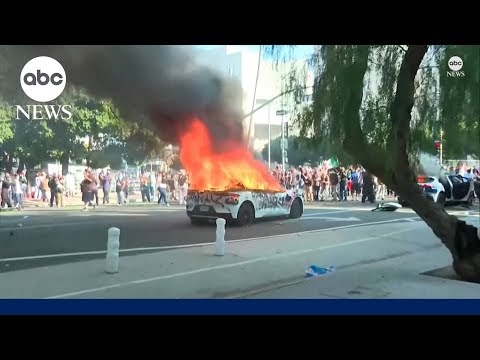
    Seven-hundred Marines in California have been ordered to assist in Los Angeles and they’re expected to arrive over the next 24 hours, a U.S. official confirmed. The Marines are from the 2nd Battalion, 7th Marines at Twentynine Palms, California, whom U.S. Northern Command had said Sunday were on a “prepared to deploy status” if the Defense Department needed them.

    Source link

  • Eliminating grade inflation isn’t as easy as ABC

    Eliminating grade inflation isn’t as easy as ABC

    A perfect grade point average isn’t what it used to be. As grade inflation continues worldwide, more students are earning top marks, but it isn’t always deserved. Critics argue that inflated grades make it harder to distinguish truly exceptional students, while supporters say they reduce stress and improve confidence. 

    From high schools in the United States to universities in Europe, the debate over grade inflation is shaping education systems and college admissions. But is this trend helping students succeed, or is it setting them up for failure?

    Grade inflation is the trend of rising student grades over time without a corresponding increase in academic achievement, often making higher grades less reflective of actual learning or ability. 

    High school is meant to prepare students for higher education, but with grade inflation, many students feel unprepared. 

    Take high school senior Ruby Schwelm. “As a student who has dealt with inflation, I’ve noticed I don’t receive grades and feedback that reflect my actual understanding of the content,” Schwelm said. “I feel like I’m just going through the motions of my courses, completing assignments without really engaging with the material. This makes it hard to track progress, see where I need improvement and feel prepared for college.”

    The rising GPA

    According to a study by ACT, a non-profit organization that runs one of two standardized tests used in the United States used for college admissions, the average adjusted grade point average (GPA) of students in the United States has risen from 3.17 in 2010 to 3.36 in 2021. 

    The report said that grade inflation “calls into question the degree to which we should rely on grades to measure academic achievement or predict future grades.” This shift challenges the typical role of grades as a reliable measure of knowledge, starting a debate over whether they still hold value in measuring students’ abilities.  

    Many educators believe that the shift in grading has led to a lack of rigor and academic accountability. Josh Hsu, a high school English teacher at the Tatnall School in Wilmington, Delaware where I go to high school, said that many students now equate a C with failure, despite it being historically recognized as an average grade.

    “There seems to be a threshold of how low grades will go, and that bar gets pushed higher and higher,” Hsu said.

    This trend has caused concern among educators who feel that the traditional grading system no longer differentiates students based on their academic performance. 

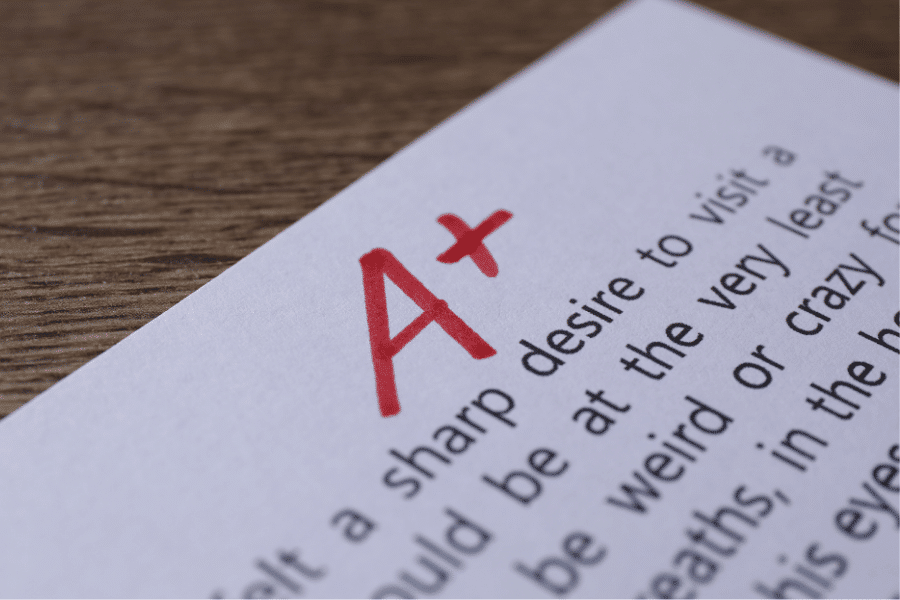
    “What does an A mean if everybody has an A, right?” Hsu said. 

    The psychological effects of grade inflation

    Proponents of grade inflation argue that it helps students maintain self-confidence and reduces academic stress. 

    Sara Gartland, a high school math teacher at the Tatnall School and adjunct professor at the University of Delaware School of Education, said that “there’s a lot of tension in what a grade is.” 

    She worries that students today see grades as a measure of their worth rather than as a tool for learning. Grades should function as a feedback loop between teachers and students rather than a rigid measure of success, Gartland said. 

    She also emphasized the importance of second chances. “I tend to see that really what students are looking for is, ‘Do I have a second chance if today is not my best day?’,” she said. 

    This perspective aligns with educational philosophies that prioritize mastery over memorization. Many teachers now allow students the opportunity to make corrections and retake assessments to make sure that students truly understand the material, which can also lift the burden of test stress off of students. 

    Elevated grades and equity

    While grade inflation is happening across the country, there have been concerns over whether grade inflation is proportionally impacting students of different incomes and communities. 

    Hsu said that parents of students in private schools often expect their children to earn high grades to get into a top college in return for the price of tuition. While this belief may lead people to assume that wealthier students have proportionately higher grades than lower-income students, this actually is not the case. 

    The ACT’s study shows that the average GPA of students in a household with an income of under $36,000 a year has grown much faster than the GPA of students in a household with an income of $100,000 from 2012 to 2021. This could be due to teachers inadvertently trying to give a break to students from low-income families to try and level the playing field. 

    Gartland argues that teachers should provide students with the tools they need for success and take into consideration things that may impact a student’s performance outside of the classroom. 

    “That [grade on a test] doesn’t necessarily take into consideration your drive to school that day, whether or not you forgot your lunch that day, or let’s say you had a particularly exciting life event or a particularly upsetting life event, and you didn’t get to spend the amount of time studying that other students did, all sorts of other things,” she said. 

    With this mindset in education, students are being treated with equity, allowing them the opportunity to experience the same academic success, even if there are barriers in their way. 

    Global patterns in how students are graded

    While the issue of grade inflation is often discussed in the context of schools in the United States, grade inflation is a global issue. A 2024 study, by researchers at the College of New Jersey, found that many countries, including the United Kingdom, Germany and Canada have all experienced rising average grades over time. 

    However, the extent of grade inflation varies from country to country. Australia, for example, maintains relatively strict grading standards through the use of relative grading and limited reliance on student achievement.

    This study also showed that there are many differences in grading practices from region to region. In the United States, professors were significantly more likely to use curved grading, a practice strongly associated with grade inflation. 

    In contrast, educators in Europe and the South Pacific gave lower average grades and curved fewer grades, suggesting a more conservative approach to grading. Asian countries showed grading patterns similar to the United States, with higher usage of grade curves and slightly elevated grade averages.

    These disparities have real implications. Grade inflation complicates international admissions, making it harder to fairly compare students from different educational systems. 

    It can also distort hiring practices. The international study on grade inflation found that in Sweden, students from schools with inflated grades were shown to earn up to 5% more than peers with equivalent abilities. Ultimately, when grades become inflated, they lose their value as an objective measure of performance, creating global challenges in education, employment, and equity. 

    A shift in college admissions 

    As I went through the process of applying to college, I learned from my college counselors how grade inflation has affected the college admissions process. As grade inflation rises, colleges and employers are shifting their focus away from GPAs and toward other indications of student potential. Admissions officers are increasingly looking at extracurricular activities, personal essays and recommendation letters to evaluate applicants.

    According to a report by the group FairTest, which works for equity in educational assessments, standardized tests, which once served as a counterbalance to inflated grades, are also becoming optional at many colleges and universities, further complicating the process of evaluating students.

    Hsu said he worries that without clear academic standards, the education system could lose its credibility. “If you don’t have a set of standards, then it just becomes the Wild West, and then you have everyone getting A’s and B’s and you have students with GPAs that they didn’t earn,” he said.

    Employers, too, are placing greater emphasis on internships and real-world experience rather than assuming high grades equate to a strong work ethic and mastery of material. 

    With the recent trends of grade inflation, we can expect the average GPAs of students across the country to continue to rise. Hsu worries some students have become lazier in recent years. This raises concerns about how this will impact the future of education and if students will be prepared for life post-graduation.

    “Everyone wants instant gratification now,” Hsu said. “They don’t want to work at things as hard because if they have challenges, they’re not willing to stumble through those challenges or fight through them.”


    Questions to consider:

    • What is meant by grade inflation?

    • How can student achievement be measured without letter or number grades?

    • Do you think that getting an A on an assignment should be difficult? Why?


    Source link

  • Lawyer for Columbia University student detained by ICE for pro-Palestine protests speaks out (ABC News)

    Lawyer for Columbia University student detained by ICE for pro-Palestine protests speaks out (ABC News)

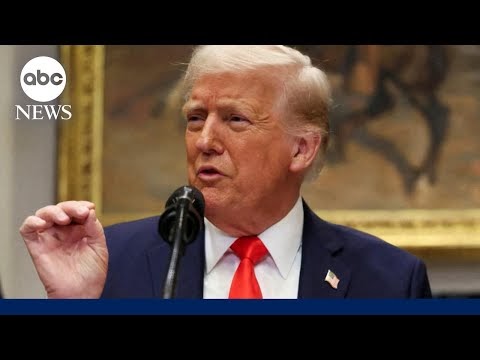
    ABC News’ Linsey Davis speaks with Baher Azmy, the lawyer for Columbia University student Mahmoud Khalil, who was arrested by Immigration and Customs Enforcement (ICE) despite having a green card. Khalil is currently detained in a Department of Homeland Security (DHS) facility in Jena, Louisiana.  A judge has temporarily blocked Khalil’s deportation. President Trump says that this action is just the beginning of such actions by the government.  

    A petition to release Mahmoud Khalil from DHS detention is here

    Source link

  • College Students Guide to Mental Health (ABC News)

    College Students Guide to Mental Health (ABC News)

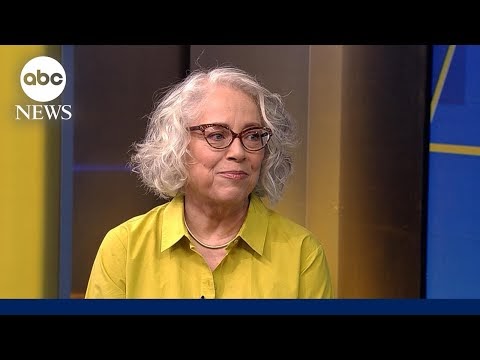
    According to the Substance Abuse and Mental Health Services Administration, nearly one in three young adults 18 to 25 have experienced a mental illness. Psychologist Mia Nosanow joins “GMA” for more.

    Source link