Get stories like this delivered straight to your inbox. Sign up for The 74 Newsletter
When Rachel Marshall was growing up in Virginia, her parents kept a magnet on the refrigerator from a national homeschooling advocacy group, with a phone number to call if local school officials tried to interfere with their decision to educate their children at home.
“You tell [the organization] the state’s after you, and they will come in with their lawyers and defend your right to homeschool and do what you want with your kids,” said Marshall, now a licensed counselor in Utah. “The state should be hands-off, that was their goal.”
Marshall wishes the state had been more hands-on. When she was a child, she said, her education and her safety were at the mercy of her parents, who struggled with mental illness and addiction.
“It was an ugly situation,” Marshall told Stateline. “But I think had there been some sort of regulation, some expectations from the state, I would not have been exposed to that as much.”
As homeschool enrollment has risen in recent years, so have concerns about oversight.
Recent high-profile child abuse deaths in several states have led to renewed calls from lawmakers for stronger regulations. They warn that some abusers claim they are homeschooling their kids when they pull them out of school, but really want to hide their crimes from teachers and other so-called mandatory reporters in public schools. Mandatory reporters are legally obligated to speak up about abuse if they suspect it.
But the push has inflamed a broader debate over parental rights and galvanized hundreds of homeschool groups to rally at statehouses around the country.
In every state, parents or guardians can withdraw their children from public or private school to be homeschooled. States allow this even if the caregiver has been the subject of a substantiated child welfare investigation, according to the Coalition for Responsible Home Education, an advocacy group. Nearly every state allows parents to withdraw children in the middle of an active investigation, and most states don’t prevent people convicted of crimes against children from homeschooling their kids.
Lawmakers in states such as Connecticut, Illinois and West Virginia have attempted to pass additional reporting requirements to guard against child abuse in homeschool settings.
They’re running up against parents’ rights groups and homeschooling advocates who argue that such regulations treat all homeschooling parents as potential criminals and aren’t necessary because many children in such situations are already on the radar of social service agencies. They say the additional requirements don’t address problems inside child protection agencies that allow such abuse to go unaddressed.
“When bad things happen, people feel compelled to do something, whether it makes a difference or not,” said Connecticut state Rep. Anne Dauphinais, a Republican who opposes homeschool regulation. “It’s often overreach of government, just because [lawmakers] want to feel good about doing something.”
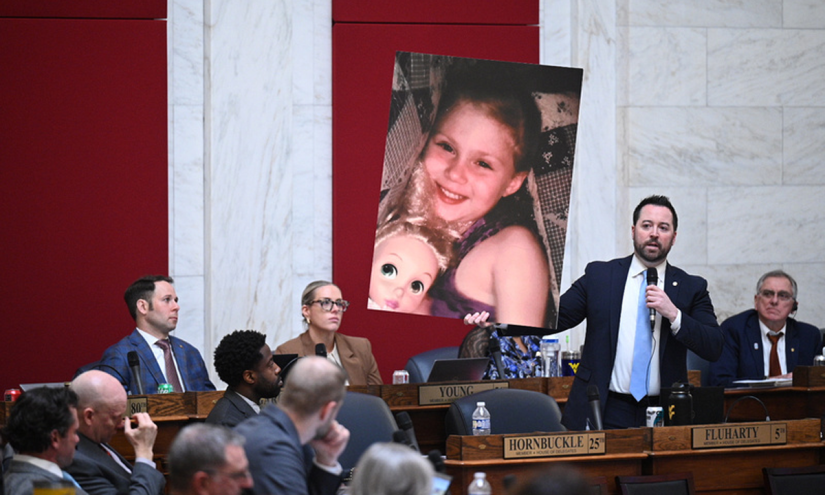
In West Virginia, Democratic state Del. Shawn Fluharty said in an interview that he’d lost track of how many times he’s tried to get a bill passed that would prevent a parent from pulling a child out of public school to homeschool if social services is investigating the parent for possible child abuse or neglect. According to Stateline’s sister publication, West Virginia Watch, this year will mark the seventh year he’s tried.
Fluharty calls his bill “Raylee’s Law,” after an 8-year-old girl who died from severe abuse and neglect in 2018. Before her death, her abusers had pulled her out of public school after teachers and school administrators began noticing signs of abuse.
“At this point, I’m just pissed off,” Fluharty told Stateline. “We’ve had at least two other circumstances very similar to Raylee’s situation since I’ve been pushing this legislation.”
Fluharty said he’s considering revising the law’s name to also memorialize Kyneddi Miller, a West Virginia 14-year-old who starved to death in 2024. Her mother had pulled her from public school in 2021 to homeschool her.
The bill passed the House twice in recent years, with bipartisan support, but died in a Senate committee each time. It faces opposition from homeschooling advocates in the legislature, he said, as well as lobbying efforts from national homeschool groups.
“It’s not a complex situation,” said Fluharty. “It’s a glaring loophole that needs to be closed. The longer it stays open, the more vulnerable children are in West Virginia.”
Homeschool explosion
But interest is on the rise. In recent years, the 30 states that publicly report homeschool participation have seen those numbers grow. More than a third of those states recorded their highest homeschool enrollment ever in the 2024-2025 school year, even exceeding pandemic-era peaks, according to a study published in November.
Homeschooling has increasingly been framed as a political and cultural choice, particularly in conservative circles where it’s promoted as a way to exercise control over children’s education amid anger over how schools address racial equity, gender identity and sexuality, school violence and vaccine requirements. Homeschool supporters praise its flexibility and safety. Others warn that minimal regulation can leave some children isolated from the visibility and protections built into public school systems.
Before the COVID-19 pandemic, homeschool participation hovered around 2-3% of K-12 students. It exploded during the pandemic to a high of 11% of families, as learning outside of traditional schools became normalized. Now about 6% of school-age children in the United States are homeschooled, according to the most recent data from the U.S. Census Bureau.
The issue doesn’t always fall neatly along party lines. In Georgia, the 2018 deaths of two siblings prompted a Republican-sponsored bill that prohibits caregivers from withdrawing a child from school for the purpose of evading detection of child abuse and neglect. It became law in 2019.
In Hawaii, Republican state Sen. Kurt Fevella filed a resolution in 2024 calling for the state to conduct a wellness visit for any child removed from school to be homeschooled. He was motivated by the deaths of two unrelated children in Hawaii who had been taken out of school for homeschooling. It died in committee.
Last year, Rachel Marshall gave testimony before Utah legislators who were considering a controversial bill that would remove part of a 2023 law requiring parents to attest they’ve never been convicted of child abuse before they’re allowed to homeschool their children.
Marshall opposed the bill, worried the state was erasing one more safeguard protecting the small subset of homeschooled children who are at risk of abuse or neglect. But as she sat listening to the homeschooling parents speaking in favor of it, their words sounded familiar.
“I could hear the fear and rage that someone would take away your rights,” she said. “But I think if you are being investigated by [child protective services], you should not be allowed to withdraw your children from daily mandated reporters like schoolteachers.”
The bill’s chief sponsor, Republican state Rep. Nicholeen Peck, said her goal was to remove a portion of state homeschooling law that was ineffective, had created confusion for school districts, and unfairly stigmatized homeschooling families.
The Utah legislature passed the bill and it was signed into law last spring.
Statehouse rallies
Studies are mixed on whether children who are homeschooled are more likely to be victims of abuse.
A 2022 survey of homeschooled and conventionally schooled adults found homeschooled children aren’t necessarily more likely to report experiencing abuse or neglect.
But among abuse victims, isolation from mandated reporters — like school teachers — is a common thread. A 2014 study found that nearly half of child torture victims had been pulled from school to be homeschooled to evade suspicions of abuse. Withdrawal from school to homeschool under suspicious circumstances is a red flag for abuse and is associated with higher risk factors for abuse, according to a report from the Coalition for Responsible Home Education.
More than 1 in 5 children withdrawn from school for homeschooling in Connecticut lived in families with at least one substantiated report from the state’s child services agency, according to a report released last year from Connecticut’s Office of the Child Advocate. The office based its findings on a sample of more than 700 children aged 7-11 who were withdrawn from school for homeschooling between July 2021 and June 2024.
For homeschooling families who’ve been providing their children with a high-quality education without oversight, “I can understand why they might feel they don’t need to be regulated,” said Christina Ghio, Connecticut’s child advocate.
“But as a state, we have an obligation to all children,” she told Stateline. “We know there are children whose parents say they’re homeschooling who are not. The challenge is, there’s one set of rules that has to apply to everybody.”
Her office’s report recommended state lawmakers create requirements for annual assessments of homeschoolers.
The report was issued in the wake of a high-profile abuse case: A Connecticut man was rescued in February 2025 after authorities say he’d been held captive and abused for two decades. His stepmother had pulled him from public school in fourth grade after school officials contacted authorities with concerns he was being abused.
But when lawmakers gathered for hearings on homeschooling regulation last May, after Ghio’s report, more than 2,000 people, most of them homeschool families, flooded the state’s Legislative Office Building to protest, according to the CT Mirror.
In Illinois, Democratic lawmakers introduced a sweeping homeschool regulation bill last year that, among other things, would have banned those convicted of sexual abuse crimes from homeschooling. It was prompted by an investigation from Capitol News Illinois and ProPublica into the state’s nearly nonexistent homeschool regulation.
But while the bill cleared its committee, hundreds of homeschool families and supporters packed the Illinois State Capitol to oppose it. It never made it to a full vote in the House.
Despite pushback, Connecticut House Speaker Matt Ritter, a Democrat, has signaled his interest in revisiting some kind of oversight during this legislative session.
“I don’t think this is a fight about homeschooling,” he said during a public Q&A earlier this month, citing cases like the highly publicized death of 11-year-old Jacqueline “Mimi” Torres-Garcia.
In October, the girl’s remains were found on an abandoned property in Connecticut. The family had prior history with the state’s social services, but her mother emailed school officials in July 2024 to tell them she planned to homeschool her daughter. Authorities say that less than two months later, the girl was dead. An autopsy confirmed her death was caused by abuse and starvation.
Dauphinais, the Connecticut Republican, told Stateline she doesn’t believe any of the proposed homeschool requirements she’s heard from her Democratic colleagues would have saved children like Mimi Torres-Garcia.
“If you want to abuse your child, you’re going to abuse your child and you are never going to show up for any kind of annual evaluation,” she said. “They will game the system. We’re not talking about the 99.9% of homeschoolers doing it genuinely. We’re talking about people doing evil things.”
Ritter said families that have been investigated by child protective services or law enforcement need more follow-up. But he was candid about the long road that regulation might face: “That might get really ugly, Republican versus Democrat. I think it depends on how it gets drafted.”
National advocacy
In Utah, some of the speakers supporting removing reporting requirements from state law included representatives from the same organization that was on Marshall’s family’s refrigerator magnet: the Home School Legal Defense Association.
It’s one of the most visible homeschooling organizations in statehouses around the nation, fighting homeschool regulation of all kinds.
The group argues that the intent behind such regulation is good, but misplaced, and that such regulations unfairly burden homeschooling families without meaningfully overhauling the systems — like social services agencies — that are tasked with protecting kids from abuse.
Homeschool families struggle with “being treated as though they were being lumped in with felons, being lumped in with kidnappers, being lumped in with people who had harmed their children,” said Peter Kamakawiwoole, an attorney with the Home School Legal Defense Association, during a Utah House committee hearing last January.
Also tracking such legislation are groups like the Coalition for Responsible Home Education, which was founded by former homeschoolers and advocates for oversight and accountability in homeschooling. The group drafted a model bill it calls the Make Homeschool Safe Act that proposes certain state reporting requirements for homeschooling families. The Home School Legal Defense Association opposes it.
Fluharty, the West Virginia lawmaker, said that when he’s accused of “going after homeschoolers,” he encourages them to read the bill. He believes the national homeschooling lobbyists are lying to families about what his legislation really does.
The goal of such regulation isn’t to take away homeschoolers’ rights, said Marshall. It’s not even necessarily for the kids whose cases wind up in front of child protective services. Instead, she said, it’s for the kids that no one can see.
“These kids are invisible,” she said. “Homeschooling is inherently isolating. Other kids are going to school and have teachers in their lives, a bus driver in their life.”
But for homeschooled kids, “If you are being abused or your education is being neglected, your parents aren’t telling others that. Nobody knows. It feels like the state doesn’t care.”
Did you use this article in your work?
We’d love to hear how The 74’s reporting is helping educators, researchers, and policymakers. Tell us how