There’s nothing worse than somebody attempting to answer a fascinating question with inappropriate data (and if you want to read how bad it is I did a quick piece at the time). But it occurred to me that there is a way to address the issue of whether graduate repayments of student loans do see meaningful differences by provider, and think about what may be causing this phenomenon.
What I present here is the kind of thing that you could probably refine a little if you were, say, shadow education minister and had access to some numerate researchers to support you. I want to be clear up top is that, with public data and a cavalier use of averages and medians, this can only be described as indicative and should be used appropriately and with care (yes, this means you Neil).
My findings
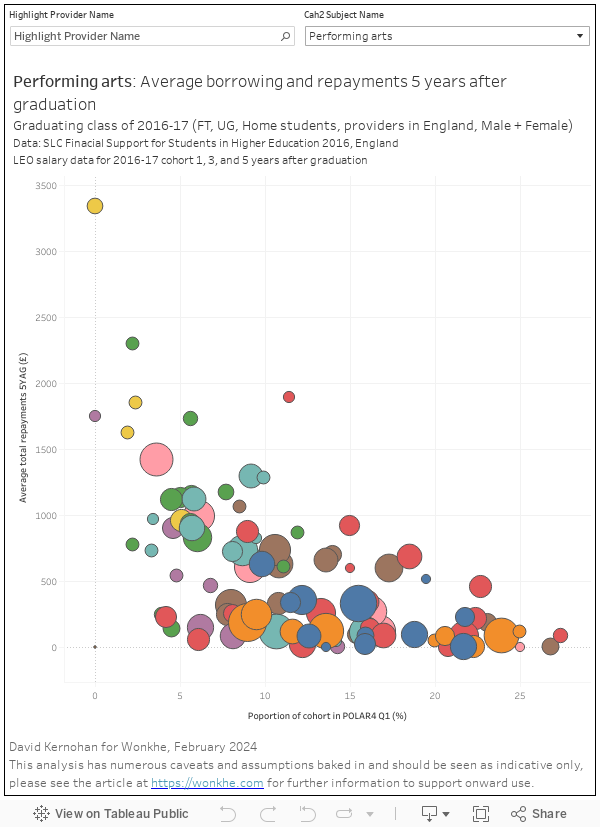
There is a difference in full time undergraduate loan repayment rates over the first five years after graduation by provider in England when you look at the cohort that graduated in 2016-17 (the most recent cohort for which public data over five years is available).
This has a notable and visible relationship with the proportion of former students in that cohort from POLAR4 quintile 1 (from areas in the lowest 20 per cent of areas).
Though it is not possible to draw a direct conclusion, it appears that subject of study and gender will also have an impact on repayments.
There is also a relationship between the average amount borrowed per student and the proportion of the cohort at a provider from POLAR4 Q1.
The combination of higher average borrowing and lower average earnings makes remaining loan balances (before interest) after five years look worse in providers with a higher proportion of students from disadvantaged backgrounds..
On the face of it, these are not new findings. We know that pre-application background has an impact on post-graduation success – it is a phenomenon that has been documented numerous times, and the main basis for complaints about the use of progression data as a proxy for the quality of education available at a provider. Likewise, we know that salary differences by gender and by industry (which has a close but not direct link to subject of study).
Methodology
The Longitudinal Educational Outcomes dataset currently offers a choice of three cohorts where median salaries are available one, three, and five years after graduation. I’ve chosen to look at the most recent available cohort, which graduated in 2016-17.
Thinking about the five years between graduation and the last available data point, I’ve assumed that median salaries for year 2 are the same as year 1, and that salaries for year 4 are the same as year 3. I can then take 9 per cent of earnings above the relevant threshold as the average repayment – taking two year ones, two year threes, and a year five gives me an average total repayment over five years.
The relevant threshold is whatever the Department for Education says was the repayment threshold for Plan 1 (all these loans would have been linked to to Plan 1 repayments) for the year in question.
How much do students borrow? There is a variation by provider – here we turn to the Student Loans Company 2016 cycle release of Support for Students in Higher Education (England). This provides details of all the full time undergraduate fee and maintenance loans provided to students that year by provider – we can divide the total value of loans by the total number of students to get the average loan amount per student. There’s two problems with this – I want to look at a single cohort, and this gives me an average for all students at the provider that year. In the interests of speed I’ve just multiplied this average by three (for a three year full time undergraduate course) and assumed the year of study differentials net out somehow. It’s not ideal, but there’s not really another straightforward way of doing it.
We’ve not plotted all of the available data – the focus is on English providers, specifically English higher education institutions (filtering out smaller providers where averages are less reliably). And we don’t show the University of Plymouth (yet), there is a problem with the SLC data somewhere.
Data
This first visualisation gives you a choice of X and Y axis as follows:
POLAR % – the proportion of students in the cohort from POLAR4 Q1
Three year borrowing – the average total borrowing per student, assuming a three year course
Repayment 5YAG – the average total amount repaid, five years after graduation
Balance 5YAG – the average amount borrowed minus the average total repayments over five years
You can highlight providers of interest using the highlighter box – the size of the blobs represents the size of the cohort.
Of course, we don’t get data on student borrowing by provider and subject – but we can still calculate repayments on that basis. Here’s a look at average repayments over five years by CAH2 subject (box on the top right to choose) – I’ve plotted against the proportion of the cohort from POLAR4 Q1 because that curve is impressively persistent.
For all of the reasons – and short cuts! – above I want to emphasise again that this is indicative data – there are loads of assumptions here. I’m comfortable with this analysis being used to talk about general trends, but you should not use this for any form of regulation or parliamentary question.
The question it prompts, for me, is whether it is fair to assume that providers with a bigger proportion of non-traditional students will be less effective at teaching. Graduate outcome measures may offer some clues, but there are a lot of caveats to any analysis that relies solely on that aspect.
The wave of new executive orders on DEI, immigration and gender identity has already significantly impacted the higher ed workplace. While the pace of change may feel overwhelming, HR departments are taking a leading role — just as they did during the COVID-19 pandemic — in navigating change and making sure all employees feel valued and supported at work.
As CUPA-HR President and CEO Andy Brantley affirmed in his message about the recent executive orders, higher ed workplaces can still:
Promote equitable work and career pathing opportunities and pay for all employees.
Cultivate inclusive learning and working communities.
Create a workplace culture that embraces respect and civil discourse.
Level the playing field for everyone by working to remove bias, reviewing outdated policies, and creating transparency.
Reinforce institutional values by ensuring that all employees feel connected and supported.
As you strategize your response to changes taking place on your campus, here are some considerations for ensuring that you are providing equal access and opportunity for all.
Conduct an Audit of Your Institution’s DEI Efforts
If you haven’t started already, conducting an audit of programs, policies and procedures can help identify areas of concern. Design a simple spreadsheet to help you organize and track your findings in areas such as training and development, hiring, performance management, communications and website content. For each item, indicate where it falls on the legal spectrum. Does it violate the law? Is it in compliance but in need of adjustments? Is it in compliance and effective as it stands?
When reviewing your programs and processes, the central question to ask is, do they provide equal access and opportunity to all employees without giving special advantages to any one person or group?
Here’s one example. The language of the recent DEI-focused executive orders emphasizes merit. Merit has always been critical to hiring, reviewing performance and making promotion decisions. Do your policies around hiring and promotion reflect that focus on merit? Are hiring and promotion processes fair and transparent? Are hiring and promotion decisions documented, and do they reflect those policies and processes?
Connect with Campus Partners
Your institution’s general counsel can help ensure any changes made to policies and procedures are in compliance with the new executive orders and mitigate risk for your institution.
If you’re undertaking a website audit, consult your chief information officer. Is there AI-enabled software that might help identify noncompliant wording or outdated programs?
Is your institution a federal contractor or subcontractor? If so, you may face additional oversight, including new contract terms certifying that your institution is following federal antidiscrimination laws. If your status is unclear, first check with the office of research.
Consider creating a neutral body of campus stakeholders to help suggest, implement and communicate changes in response to the executive orders, but also expect that employees and administrators will have strong opinions and feelings about these changes.
Reframe Inclusion
As you review policies and communications to ensure compliance, take the opportunity to make your workplace even more welcoming and accessible.
Align with your institution’s values. What are your institution’s core values and mission? It’s likely they involve respecting diversity of thought and perspective, creating a welcoming environment, and providing equal access and opportunity to all regardless of identity. Affirming and communicating these values can be an important way to stay focused on what matters during times of change.
Consider accessibility. When revising programs and processes to be more inclusive, envision accessibility for all. For example, if your goal is to make career development programs accessible to all employees, look for gaps in access across your employee population. Just as holding trainings in non-ADA compliant buildings may limit the ability of some people to participate in career development, so might neglecting the needs of groups like non-exempt employees and working parents and caregivers. Are there more flexible options? Can you support supervisors to make it easier for an employee to take time away from regular duties?
Ensure clarity and transparency. Equity in compensation, hiring and promotion is an effective way to bolster recruitment and retention. For example, hiring and promotion practices that are not transparent, written down, and consistently followed can negatively affect the workforce. Women are less likely than men to be promoted if clear, fair criteria aren’t used. Neurodivergent candidates are disadvantaged when job interviews rely on indirect measures like succeeding at small talk rather than a skills-based assessment. In both of these instances, vague criteria such as “culture” and “fit” may prevent qualified, highly skilled employees from being hired and from moving up the ladder. Finally, be sure that your institution’s job descriptions and job requirements are up to date and are being used as the basis for decisions related to hiring and pay.
Focus on purpose. To avoid misinterpretation, your efforts at creating an inclusive workplace should be characterized in ways that are purpose driven. For example:
Communities of people with varied backgrounds and life experiences create opportunities for community members to grow personally and professionally. When employees thrive, institutions thrive.
Parity and equity, in opportunity and pay, support job satisfaction, recruitment and retention.
A safe and welcoming work environment fosters community and collaboration.
Emphasize outcomes. Lily Zheng, author of the book DEI Deconstructed, encourages those invested in fair and healthy workplaces to strengthen outcomes. Zheng recommends an outcomes-based approach “focusing on measurable results like pay equity, physical and psychological safety, wellness, and promotion rates, rather than … a one-time training, posting on social media, or other behaviors that signal commitment without demonstrating results.”
Take Steps to Educate Employees
Review the ways managers and senior leadership are implementing the policies and processes that are in place. Is additional training required? If you have made changes to policies and processes, how will you communicate those to supervisors and other campus leaders?
Be sure to evaluate anti-harassment and antidiscrimination trainings you have in place. These trainings should continue, although they may need to be adjusted to emphasize even more strongly the importance of opportunity and respect for all.
Know That You’re Not Alone
The higher ed HR community has been through challenging times before, most recently as the pandemic reshaped the workplace. If you have resources or ideas to share with other CUPA-HR members regarding ways that you and your HR colleagues are creating and sustaining an inclusive campus community, please email them to [email protected]. Your submission will be treated as confidential and, if shared, will be described in terms that will not identify your institution.
Resilience in the Workplace — This CUPA-HR webinar, recorded in 2021, was designed to serve as resilience training for attendees, as well as a model that could easily be replicated at your institution for HR teams and other employees.
The University of California Student Association’s request to block Department of Government Efficiency staffers from accessing student data at the Department of Education was denied Monday by a federal district judge.
The lawsuit, filed earlier this month, accused the department of illegally sharing confidential student data, arguing it violated the 1974 Privacy Act and confidentiality provisions of the Internal Revenue Code by giving DOGE access to records that contain tax information.
But Judge Randolph D. Moss of the District Court for the District of Columbia said there wasn’t an immediate threat, citing testimony from Adam Ramada, a DOGE staffer, who said that he and his team were only assisting the department with auditing for waste, fraud and abuse and that DOGE staffers understood the need to comply with data privacy laws.
“None of those initiatives should involve disclosure of any sensitive, personal information about any UCSA members,” Moss, an Obama appointee, wrote in his ruling. “The future injuries that UCSA’s members fear are, therefore, far from likely, let alone certain and great.”
Other higher education groups have raised concerns about DOGE’s access to education data, as the department’s databases house students’ personal information, including dates of birth, contact information and Social Security numbers. Some student advocates worry the data could be illegally shared with other agencies and used for immigration enforcement. Moss, however, called those harms “entirely conjectural,” saying Ramada had attested that the data was not being used in such ways.
Although the temporary restraining order was denied, the overall lawsuit will continue to work its way through the courts, and other legal challenges are emerging, The Washington Post reported.
A coalition of labor unions, including the American Federation of Teachers, is also suing to block DOGE’s access to the sensitive data. This latest lawsuit argues that agencies—including Education, Labor and Personnel Management—are improperly disclosing the records of millions of Americans in violation of the Privacy Act.
NEW YORK, NY –Counslr, a leading B2B mental health and wellness platform, announced today that it has expanded its footprint into the State of New Mexico starting with a partnership with Vista Nueva High School, Aztec, NM; and into the State of Illinois starting with a partnership with Big Hollow School District, Ingleside, IL. These initial partnerships will empower students and staff to prioritize their mental health by enabling them to access unlimited wellness resources and live texting sessions with Counslr’s licensed and vetted mental health support professionals, who are available on-demand, 24/7/365. By increasing accessibility to Counslr’s round-the-clock support, Vista Nueva and Big Hollow aim to bridge gaps in mental health support for students and staff, enabling those who previously did not or could not access care, whether due to cost, inconvenience, or stigma, to receive the support they desire.
1 in 6 youth suffer from a mental illness, but the majority do not receive mental health support due to substantial obstacles to care. Additionally, mental health is even a bigger challenge in rural America due to unique barriers, including fewer providers resulting in longer wait times or insufficient access to crucial mental health services. This resource scarcity underscores the urgency for additional resources and innovative solutions to bridge this critical gap in mental health care for school communities.
“We are happy to be able to offer students another tool that they can use to support their mental well-being. Knowing that students have been able to speak with a professional outside of school hours helps us know this app was needed and is useful,” states Rebekah Deane, Professional School Counselor, Vista Nueva High School. “We hope this tool also assists students in learning how to navigate systems so that when they graduate high school they know these options exist and they can continue to seek out support when necessary.”
As factors such as academic pressures, social media influence, burnout and world events contribute to heightened stress levels and mental health challenges, schools throughout the country are recognizing the growing need to offer more accessible resources and preventative mental health services to both students and staff.
“Counslr provides an extremely easy-to-access platform for those who otherwise may not seek the help they need, and we are very excited to join Counslr in this partnership. We are all very well aware of the impact that technology has had on the mental health of our students and we feel that Counslr can meet our students in a setting they are comfortable with,” states Bob Gold, Big Hollow School District Superintendent. “Outside of our students, we are thrilled to be able to offer this service to the amazing adults who work with our students every day. There are so many families dealing with some sort of trauma, and the life of an educator is no different. These adults tend to give so much of themselves to their students, so we strongly feel that our efforts here to join with Counslr is our way of providing an opportunity for our educators to focus on their own mental health.”
In addition to the geographic expansion,Counslr has also expanded its existing footprint in states like New York, most recently partnering with the Silver Creek Central School District to support its students and staff.
“We know mental health needs are on the rise, for students and adults. To me, Counslr is a resource our students and staff both deserve,” states Dr. Katie Ralston, Superintendent, Silver Creek Central. “In the beginning stages at Silver Creek Central, it has proven to be an asset, as it offers access to everyone on the spot, any day, for any situation.”
“Supporting diverse populations of students and faculty across the country clearly illustrates that mental health knows no boundaries,” said Josh Liss, Counslr CEO. Adding that, “With 86% of Counslr’s users being first-time care seekers, we strive to reach these silent sufferers who need help, but do not or cannot access it, no matter where they are located.”
ABOUT COUNSLR
Counslr is a text-based mental health support application that provides unlimited access to robust wellness resources and live texting sessions with licensed professionals, 24/7/365. Users can access support on-demand within two minutes of opening the app, or by scheduled appointment. Through real-time texting, users enjoy one-on-one, private communication with a licensed counselor that can be conducted anytime, anywhere. Counslr was designed to help individuals deal with life’s day-to-day issues, empowering individuals to address concerns while they are “small” to help ensure that they stay “small”. Counslr partners with organizations of all shapes and sizes (companies, unions, nonprofits, universities/colleges, high schools, etc) so that these entities can provide Counslr’s services to their employees/members/students at no direct cost. For more information, please visit www.counslr.com.
eSchool Media staff cover education technology in all its aspects–from legislation and litigation, to best practices, to lessons learned and new products. First published in March of 1998 as a monthly print and digital newspaper, eSchool Media provides the news and information necessary to help K-20 decision-makers successfully use technology and innovation to transform schools and colleges and achieve their educational goals.
Just last month, Lorena Tule-Romain was encouraging families with mixed citizenship to fill out the Free Application for Federal Student Aid. She and her staff at ImmSchools, a nonprofit dedicated to improving educational access for immigrants in Dallas, walked students and parents through the complicated federal aid process. Along the way, they offered reassurance that information revealing their undocumented status would be securely held by the Department of Education alone.
Two weeks ago, ImmSchools stopped offering those services. And Tule-Romain said they’re no longer recommending families fill out the FAFSA.
That’s because the Department of Government Efficiency, a White House office run by Elon Musk, now has access to Education Department data systems, potentially including sensitive student loan and financial aid information for millions of students, according to sources both outside and within the department who spoke with Inside Higher Ed.
With immigration officers conducting a blitz of deportations over the past few weeks—and the new possibility of ICE raids at public schools and college campuses—Tule-Romain is worried that applying for federal aid could put undocumented families in jeopardy. Instead of answering parents’ questions about the FAFSA contributor form, she’s hosting Know Your Rights workshops to prepare them for ICE raids.
“Before, we were doing all we could to encourage families to apply for federal aid, to empower students to break cycles and go to college,” she said. “Now we are not in a position to give that advice. It’s heartbreaking.”
Student data is technically protected by the Privacy Act of 1974, which prevents departments from sharing personally identifying information unless strict exceptions are met or a law is passed to allow it. The FUTURE Act, for example, gave the IRS access to financial aid data to simplify the FAFSA process.
Karen McCarthy, vice president of public policy and federal relations at the National Association of Student Financial Aid Administrators, told Inside Higher Ed that because DOGE has not said why they might be interested in department data or what data they have access to, it’s unclear if they’re acting in accordance with the law.
In the past, that law has been strictly enforced for federal employees. In 2010, nine people were accused of accessing President Barack Obama’s student loan records while employed for an Education Department contractor in Iowa. The charges levied against them in federal court were punishable by up to one year in prison and a fine of up to $100,000, according to the Associated Press.
On Thursday, Democratic Representative Bobby Scott of Virginia wrote to the Government Accountability Office requesting a review of the Education Department’s information technology security and DOGE’s interventions in the department in order to determine their legality and the “potential impact on children.” On Friday, a group of students at the University of California sued department officials for allowing potential privacy act violations.
“The scale of the intrusion into individuals’ privacy is massive, unprecedented, and dangerous,” the plaintiffs wrote.
In recent days, labor unions and other groups have sued to block DOGE”s access to databases at several federal agencies and have secured some wins. Early Saturday morning, a federal judge prohibited DOGE from accessing Treasury Department data, ordering Musk’s team to “immediately destroy any and all copies of material” from the department’s systems.
Concerns about DOGE’s use of private student data come as Musk and his staff take a hacksaw to agencies and departments across the federal government, seeking to cut spending and eliminate large portions of the federal workforce. The Trump administration has singled out the Education Department in particular, threatening to gut its administrative capacity or eliminate the department all together.
Spokespeople for DOGE did not respond to a list of questions from Inside Higher Ed. Madi Biederman, the Education Department’s deputy assistant secretary for communications, wrote in an email that DOGE staff “have the necessary background checks and clearances” to view department data and are “focused on making the department more cost-efficient, effective and accountable to the taxpayers.”
“There is nothing inappropriate or nefarious going on,” she added. She did not respond to questions about what data DOGE has access to or how they plan to use it.
A ‘Gaping Hole’ in Data Security
The Education Department’s student financial aid systems contain unique private information that families submit through FAFSA: not only social security numbers but also addresses of relatives, property taxes, sources of income and more. The National Student Loan Database, which tracks loan borrowers’ repayment history and which DOGE may also have access to, includes a wealth of personally identifying information for many more millions of current and former students.
A current department staffer provided Inside Higher Ed with a screenshot from the department’s email address catalog containing the names of 25 DOGE employees who may have access to student data—including a 19-year-old who, according to a Bloomberg report, was once fired by a cybersecurity firm for allegedly leaking internal data. And the Washington Post reported that DOGE employees fed sensitive education department data through artificial intelligence software.
“It could become a gaping hole in our cybersecurity infrastructure,” a former department official said. “I cannot stress enough how unusual it is to just give people access willy-nilly.”
Two former department officials told Inside Higher Ed it is unclear how the DOGE officials could have legally gained access to department data. McCarthy compared DOGE’s murky activity in the department to a “massive data breach within the federal government.”
“Normally, there’d be a paper trail telling us what they’ve requested access to and why,” she said. “We don’t have that, so there’s a lot of uncertainty and fear.”
A current department official told Inside Higher Ed that DOGE staff have been given access to PartnerConnect, which includes information about college programs that receive federal financial aid funding; and that they have read-only access to a financial system. Neither of those databases contain personally identifying information, but the official wasn’t sure DOGE’s access was limited to those sources—and said department staff are worried sensitive student information could be illegally accessed and disbursed.
“It just creates a kind of shadow over the work that everyone’s doing,” a prior department official said.
Fears of a FAFSA ‘Chilling Effect’
Families with mixed citizenship status were some of the hardest hit by the error-riddled FAFSA rollout last year, with many reporting glitches that prevented them from applying for aid until late last summer.
Tule-Romain said mixed-status families in her community had only just begun to feel comfortable with the federal aid form. In the past few weeks that progress has evaporated, she said, and high school counselors working with ImmSchools report a concerning decline in requests for FAFSA consultations from mixed-status students.
“If they weren’t already hesitant, they are extremely hesitant now,” Tule-Romain said.
It’s not just mixed-status families who could be affected if data is shared or leaked. McCarthy said that concerns about privacy could have a wide-spread “chilling effect” on federal aid applications.
“There have always been parents who are reluctant to share their information and the counterargument we always fall back on are the privacy laws,” she said. “A lot of Pell money could get left on the table, or students could be discouraged from going to college altogether.”
Kim Cook, CEO of the National College Attainment Network, said that after last year’s bungled FAFSA rollout, community organizations and government officials had worked hard to rebuild trust in the system and get completion rates back to normal. She worries that fears about privacy could set back those efforts significantly.
“Chaos and uncertainty won’t give us the FAFSA rebound we need,” she said.
The confusion could also affect current college students who need to renew their FAFSA soon. Tule-Romain said one undocumented parent who filled out her first form with ImmSchools last year came back a few weeks ago asking for advice.
She was torn: on the one hand, she didn’t trust Musk and Trump’s White House not to use the information on the form to deport her. On the other, if her son didn’t receive federal aid, he’d have to drop out of college. Ultimately, she chose to renew the application.
“If you came [to America] for a better life, you cannot let fear stop you from pursuing that,” Tule-Romain said. “Instead, you arm yourself with knowledge and you move forward—maybe with fear, but you move forward anyway.”
It has been reported that decision to lower the fee cap on foundation year fees may lead some providers reluctantly to withdraw from that provision, while others will continue to offer those courses at a loss.
In November, the Office for Students’ Director for Fair Access and Participation announced that the access mission would renew its focus upon “ensuring universities and colleges can play their part in giving all aspiring students the opportunity to gain the knowledge, skills and experiences they need to be confident in the choices they make on their pathway to achieving their aspirations, at multiple points along their journey”.
There is clearly a strong appetite among providers, policymakers and regulators to enhance efforts to promote access in line with the Secretary of State’s emphasis on the importance of widening participation as an instrument of social mobility.
During 2024, we at QAA published a range of resources and policy papers supporting this access agenda, including work on degree apprenticeships, lifelong learning, awarding gaps and credit transfer. We also in 2024 celebrated the registration of the millionth student onto an Access to Higher Education Diploma (AHE) course since we started managing the scheme for the recognition and quality assurance of this provision in 1997.
All about access
This qualification is widely recognised in universities’ entry criteria as an alternative to more traditional Level 3 qualifications such as A Levels and BTECs. It is designed to cater for learners from diverse educational and socioeconomic backgrounds and to offer degrees of flexibility to suit the lifestyles of these returners to learning – who often devote their time and energies to family and work commitments on top of their studies.
AHE provision makes a significant contribution to widening participation. Each year around five per cent of all UCAS applications come from AHE students. More than 36,000 students are currently registered on AHE courses.
The latest figures show that 19,320 AHE students were accepted for entry into higher education in 2023. Nearly a quarter of those progressed to nursing and midwifery courses, and another 23 per cent to programmes in health and social care.
Twenty-four per cent of 2023’s cohort of AHE students entering higher education came from areas of disadvantage – compared with only 11 per cent of students with other Level 3 qualifications entering HE. Fifty-two per cent of that Access cohort entering HE were over 25 years old, compared with just 11 per cent of students with other Level 3 qualifications. These people have overcome barriers to participation in practice and in droves.
Understanding the barriers
We recently conducted a survey of more than 700 Access students. We asked what barriers they had perceived when considering applying for their course. Our research revealed their concerns had often focused on the amount of time they would need to devote to their studies. Those aged 20-34 identified the cost of living as having been a key consideration, while those aged over 35 were more worried about the impact their studies would have on their families and their family lives.
New research conducted by Laser Learning Awards has found that 48.3 per cent of 116 of their own AHE students surveyed saw family commitments as a barrier to learning, and 31.3 per cent identified carer responsibilities – while 63.2 per cent flagged work scheduling issues.
These findings chimed with a recent Open University study which found that, although nearly two-thirds of mothers aspire to retrain for new careers, anxieties about money, time and parental responsibilities tend to hold them back. As about three-quarters of AHE students are female, it seems likely that they experience similar barriers.
Flexibility is key
It is increasingly vital to address these barriers to widening participation: not simply by offering access routes but by ensuring that those routes are sufficiently flexible to be viable for aspiring learners. These flexibilities may, for example, take place through varying modes, paces and dates of delivery.
The Covid-19 crisis taught providers across the tertiary sector ways to deliver programmes online. Now, online engagement can free learners with busy schedules and finite resources from time-constraints and from the costs of travel. Remote and hybrid study modes have proven increasingly popular with AHE students.
Part-time study can also help to overcome barriers facing non-traditional learners. In 2018-19, only 16 per cent of AHE students were studying part-time. But in the three years following the 2020 lockdown the proportion of part-timers increased from less than a third to more than half of all AHE learners.
During 2023-24, 54 per cent of AHE students paced their learning over more than a single academic year, often spreading their studies over about 18 months. The proportion of part-time Access learners peaked at this point – right at the height of the cost-of-living crisis, a period during which learners often needed to increase their working hours and to limit their childcare costs. This current academic year, with inflationary pressures somewhat diminished, our proportion of part-time learners has settled at 42 per cent – the same level as two years ago – and more than two-and-a-half times what it was six years ago.
AHE providers have found value in offering January start-dates, affording part-time learners the opportunity to synchronize with traditional autumn starts as they progress into higher education. Of approximately 1,300 AHE courses running this year, 180 are currently open to new registrations commencing in early 2025.
As we continue to learn the value of flexibilities in overcoming the barriers to widening participation, we hope such lessons will help to inform the development of policies and strategies designed to promote higher education’s value as a key driver of social mobility and to transform learners’ lives.
As a first-year college student, Sarah Ellison never imagined working in higher education or earning a doctorate, but her experiences have developed her passion for helping students identify their strengths and build strong foundations for their futures beyond graduation.
Sarah Ellison, Sonoma State University’s associate vice president of student affairs
Sarah Ellison, Sonoma State University
Since Jan. 8, 2024, Ellison has served as associate vice president for student affairs at Sonoma State University, part of the California State University system, overseeing the university’s student access and success team. Ellison spoke with Inside Higher Ed about her work in and outside higher education, her portfolio at Sonoma State, and her goals for the future.
Q: What led you to a career in higher education?
A: I’ll have to say, it wasn’t something I was looking for.
I, right out of high school, went to the University of Hawaii and was planning to do a business degree. I failed my entire freshman year and went to community college. In community college, I thought I would do a focus still in business, so I did do my associate’s, and then continued on to my bachelor’s at the University of La Verne in business.
My whole entire plan was to go into sales. That’s what I thought I would do. I was really fascinated with companies like Coach and Michael Kors, Macy’s.
But throughout that time, life just happens while you’re in college, right? You’re learning about yourself, you’re learning about your goals, defining them, more and more.
During that time, I was very fortunate to meet my husband, and life started to happen during that time as well when I was finishing my undergrad. I actually went to work for a nonprofit organization, Goodwill, in California and got to work at Fort Irwin, which is a military base, serving as a career adviser for transitioning veterans. And I really loved it.
Career services was a new field to me, and I really thought that’s what I wanted to do. And so I ended up doing my master’s in career services, and was trying to think about how I would advance my career from that role into career services in higher education. I really couldn’t find a direct path, but I got into academic advising, and fell in love with academic advising. I met a recruiter at one of our fairs for military folks, and she really introduced me to the whole field of higher education. I had been exposed through going to college and meeting with different mentors. I did my internship in career services at the University of La Verne, and the director there was phenomenal, and that’s what kind of started that piece.
But that’s how I found myself working directly in higher education. I started at a small private university, then went into the Cal State system, then went to University of Kentucky, and then now I found myself back in the Cal State system. It’s been a bit of a wild ride, but it’s been a lot of fun.
Q: Would you say that you’ve brought any of your career services experiences into the work that you do now?
A: I felt that my experience working with transitioning veterans and working in career services really helped my advising platform and role working with students from the advising standpoint, because I was able to better connect with students, with their plans for their degree, and then all of the opportunities that come from different knowing different career fields and aspects, and then helping them leverage all of their experience.
I worked with nontraditional students, first-generation students [and] traditional students, and it’s just amazing how much students can learn from the career aspect that helps with their finishing of their degree, so working towards retention and degree completion.
While I don’t directly find myself in career services in higher education in my current role as associate vice president, I have a pretty large portfolio, and one of those areas being career services now. Now I get to oversee both academic advising [and] career services, as well as many other parts of my portfolio that include advising for equity and access program, disability services, and then also precollegiate programs. It is cool to find myself now directly overseeing those aspects.
Q: Who are your learners at Sonoma State and what are some of the challenges and opportunities at the university based on your student population?
A: Sonoma State has a very diverse student population. We are an HSI, so we do serve a large proportion of Hispanic students. We do have a large proportion of first-generation students, but our makeup is really, really diverse.
I think with anything, like most institutions are facing right now in terms of serving our students, it’s really about showing that pathway, so really working within the community, so that our [high school] students see a path directly into a four-year institution.
[Through] a lot of my precollegiate programs, which serve our K-12 setting, we’re really trying to strengthen and build pathways for those students who typically come from low income, and also our will-be first-generation college students, really helping them to define that pathway and see a clear vision for going into a four-year institution.
I also think it’s the life after, it’s the career trajectory, it’s the employability plans for students that they see the value in their degree. That’s what we’re really working with here, with our students, is really helping them see the value of their degree, retaining them and helping them move them into careers that are both fruitful, exciting and in line with how they saw themselves, with their goals and what they wanted to do.
Q: One of the cool things about working at a public institution is you get to serve your region and the state as a whole. How is that incorporated into your vision for student success?
A: That is one thing I’ve always enjoyed about the Cal State system is that regional perspective and focus that we have.
My first Cal State experience was at Cal State San Bernardino, and then now being here at Sonoma State, it’s amazing how different the Northern California and Southern California regions are—even the issues that we face with those students—but coming together in the system is always really exciting, because we do get to collaborate and think about how we serve the state, but then also, again, focus in on initiatives specific to the regions that all of the Cal State [institutions] are in.
In the work that I do now, I find myself in the community a lot more: serving on different boards, working with different local employers, local community agencies. I will say that Sonoma State has had a pretty good grounding in that prior to my time here.
Before coming to Sonoma State, I worked at the University of Kentucky, which is a land-grant–serving institution, and [that] also gave me a lot of experience to what it is to serve the community in the region and meet the needs of the state as well, too. I spent about three years there learning a lot about extension work.
I strongly believe that it’s amazing to have those ties to the community, because it helps us keep a pulse on what the needs are of the community, helping to prepare our students to go into different career fields, but also have a civic tie as well to what they’re doing.
Q: “Access” is a key word in your list of responsibilities, managing the student access and success team. How is access central to your role?
A: When it comes to access, I think it’s critical for students, because when we think about the different student populations we serve, there’s also these technology pieces. In higher ed—at least at all of the institutions I’ve worked at—we love new technology. We love starting new programs and new platforms.
I think it’s always really critical that we ensure our students understand and have a knowledge base as well, and that the technology works for them. So how they schedule appointments, the flexibility to do Zoom, and then also thinking about some of our students who are native in other languages. Do we have opportunities and space for students to be able to speak with advisers and faculty and have support in their native language? That’s always been really critical, because the meaning is different.
When I was at Cal State San Bernardino, we had some really great faculty from our Spanish department who would come in and help in group advising sessions and do it in Spanish, which is really helpful for our students.
When we think about the technology pieces, that’s critical, how they apply to come to any university. And then when they get to campus, and that consistent communication from the time that they’re interested to … actually enrolling, and then when they’re here, can I get ahold of and work with folks in all of the offices that I need to? That’s critical for us in higher ed to always consider and be mindful of, because that is another part of the student experience.
Q: What are some of your short- and long-term goals at Sonoma State?
A: I’m a year in, so I still consider myself very new in my role.
In terms of some short-term goals … we’re really looking at making sure students have an adviser, someone they can connect with. That we’re breaking down silos within the institution, so that way, advisers, faculty, staff [and] directors feel comfortable working with each other and communicating and supporting each other.
In terms of long term, it’s really strengthening that career side. We have a lot coming down from the governor here in California related to workforce development and those things. I’m partnering with our vice president for student affairs and our provost and associate provost, building out and strengthening our career services programming. So that’s another focus, and some long-term planning that we really need to think about for the future here at Sonoma State, while still continuing to focus on improving equity gaps, retention rates, graduation rates and enrollment as well.
Q: Career services is a growing focus nationally within higher education. What are some of those barriers that you’re facing, or where do you need those resources to really strengthen that arm of the institution?
A: I would say, throughout my time in higher ed for all the institutions I’ve worked at, I think staffing is a huge piece of career services, being able to have enough career staff to meet the needs of the campus.
I also think there’s a training and development piece, and that, to me, ties in to the connection with the faculty and academic departments to make sure that the career advising aligns with the major and department and career pathways.
Leveraging the network as well, I think that’s another thing with career services, is really building strong portfolios for professional networks, and that can be an issue depending on the institution, what their access, their leadership, being embedded in the community and those things, as well as embedded nationally to see new trends, new careers.
That’s another exciting piece about careers, that there are jobs that we don’t even know of that are going to be created here soon. How do we think about skill sets and plans and helping students see their strengths in everything that they’ve accomplished throughout their time, in their academics and at the institution, to prepare for [future] fields? And then we have emerging fields, in AI, green technology, agriculture, health services and all of that.
That’s what’s kind of the fun side of career services, but also creates the challenges, because you’re thinking about current trends, emerging trends and then the trends that you don’t even know are going to exist yet. Helping students define and understand the skill sets that they have, and making sure they’re building and aligning those to those professional fields.
Do you have a career preparation program that impacts student success? Tell us about it.