
Tag: accounts
-
US study visa applicants told to make social media accounts ‘public’ amid vetting crackdown
- New social media privacy requirements come just as US government lifts four week-long study visa interview freeze, leading to fears of a backlog.
- Concerns of added complications where consular officers responsible for social media vetting do not speak the applicant’s language.
- Policy extends even to those who have been issued US visas in the past.
In an update sent to consulates last week, the US government has advised that all those applying for F, M or J nonimmigrant visas are “requested” to make their social media accounts available to view by anybody so that their identity can be verified and they can be thoroughly vetted before entering the country.
Immigration experts have criticised the move because of the huge additional workload it will place on immigration officers, meaning that visa issuance is likely to slow down considerably.
US immigration lawyer James Hollis said he “almost [felt] bad” for consular officers.
“It’s going to grind processing to a halt and will likely result in increased wait times for all nonimmigrant visas, let alone the student and exchange visitor applicants,” the business immigration specialist at the McEntee Law Group warned – noting that there are added complications where applicants were posting on social media in their own local language if officers do not understand what they have written.
It appears that the new policy will be mandatory from June 25 onwards, and all applicants will be vetted in this way even if they have been issued a US visa in the past.
It’s going to grind processing to a halt and will likely result in increased wait times for all nonimmigrant visas, let alone the student and exchange visitor applicants
James Hollis, McEntee Law GroupConsulates are advised that they should consider whether active social media privacy settings “reflect evasiveness or otherwise call into question the applicant’s credibility”.
Officers have been told to reject a visa application in cases where the applicant has:
- expressed “hostile attitudes” toward the US in terms of its citizens, culture, government, institutions, or founding principles;
- advocated for or supported “designated foreign terrorists and other threats to US national security”;
- shown or supported anti-semitism;
- even if they have otherwise proven they are not an immigration risk;
- and are not already ineligible for a visa (ie does not post a risk to US national security).
In these cases, the US can deny entry on national security or foreign policy grounds.
The US has asked visa applicants to provide social media information on their application forms for the past five years – including all social media names or handles of every platform they have used over the past five years. Failing to include this information could lead to an applicant’s visa being denied and being ineligible for future visas.
It comes after a tumultuous few weeks for prospective international students eyeing a place at US institutions. After stretching a study visa interview freeze into its fourth week – despite assurances that the pause would be quick – officials last week resumed interviews with additional social media vetting for applicants.
US stakeholders have repeatedly expressed concerns that the Trump administration’s extreme social media crackdown could inflict untold damage upon the country’s international education sector.
-
Student loans: what counts as expenditure in national accounts
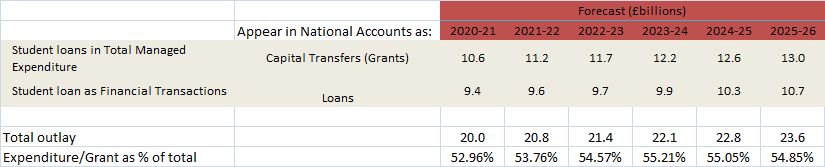
Economic & Fiscal Outlook, Office for Budgetary Responsibility (March 2021), adapted from Tables 3.14 & 3.26 I have constructed the table above from forecasts for Total Managed Expenditure and Financial Transactions taken from the Office for Budgetary Responsibility’s latest publication (it accompanied Wednesday’s Budget).
It shows how newly issued student loans are now split into two components for the purposes of presentation in the National Accounts. The portion of loans that are expected to be repaid are classed as “financial transactions”, while the portion expected to be written off is recorded as capital expenditure. The latter scores in “public sector investment”, which was adopted as a new fiscal target prior to the pandemic (net investment cannot exceed 3% of national income), though the rules are currently under review.
We can see that student loan outlay is expected to reach £20billion in the year to March 2021, rising to £23.6billion in five years’ time.
The majority of new outlay is now expected to be written off and that share rises over the forecast period.
By 2025/26 repayments on all existing loans are projected to re000000000000000ach nearly £5billion per year. (This figure has improved since the sale programme for post-2012 loans was abandoned, since the treasury now gets the receipts that would have gone to private purchasers).As mentioned in recent posts on here, the Department for Education only currently has an allocation of £4billion to cover the capital transfer / grant element of new loans and so it has to be granted large additional budgetary supplements each year. This situation has dragged on as the planned spending review has been postponed. We can now expect developments in the Autumn.
