Tag: Accuses

  • Congress Accuses GMU President of Lying About DEI Efforts

    Congress Accuses GMU President of Lying About DEI Efforts

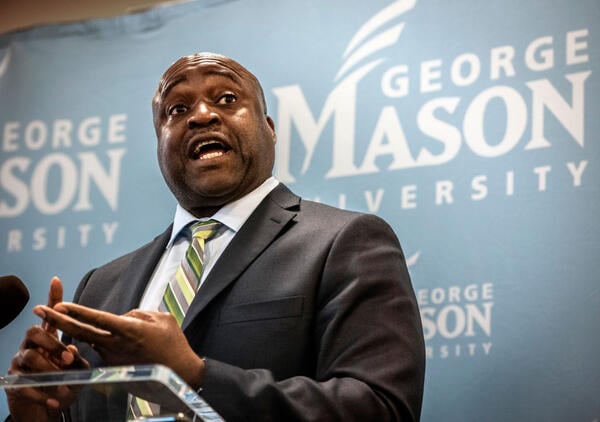
    House Republicans have accused George Mason University President Gregory Washington of lying to Congress about diversity practices at his institution, ratcheting up pressure on the president to step down.

    The Republican-led House Judiciary Committee alleged in a report released Thursday night that Washington made “multiple false statements to Congress” in testimony about diversity, equity, and inclusion efforts at GMU. The public university has been under fire for months over allegedly illegal DEI practices as the Trump administration has sought to crack down on such initiatives, claiming they are discriminatory and violate federal civil rights law. The Judiciary Committee report also alleged that the university “likely violated federal civil rights law by discriminating based on race in its hiring practices to advance Dr. Washington’s diversity, equity, and inclusion initiative.”

    Washington has denied breaking the law through efforts to diversify GMU’s faculty and staff, telling Congress that the university did not practice illegal discrimination under his leadership.

    The report is the latest salvo from Republicans who have launched federal investigations into GMU over its hiring policies, including demands that the embattled president apologize for allegedly discriminatory practices, which he has refused to do as he denies any wrongdoing.

    What’s in the Report

    The House Judiciary Committee’s report zoomed in on an effort by GMU, launched shortly after Washington took office in July 2020, to diversify employee ranks. The Anti-Racism and Inclusive Excellence initiative the president introduced aimed to make faculty and staff “mirror student Demographics” at GMU, which is among the most diverse institutions in the country. As part of that effort, GMU tasked schools and departments with hiring more underrepresented individuals.

    But in Congressional testimony, Washington denied the initiative was a strict mandate.

    “These are overall goals and they’re aspirational in focus,” Washington said, according to a transcript of his Sept. 17 interview released by the House Judiciary Committee Thursday.

    Though the Anti-Racism and Inclusive Excellence initiative stemmed from his office, Washington told Congress that faculty in each department developed plans for their unit. He also cast the creation of such plans as optional, telling Congress “if units did not want to develop a plan, they did not have to.”

    But the House Judiciary Committee claimed Washington lied about that.

    “Documents and testimony obtained by the Committee … show that Dr. Washington and his deputies actively sought to punish schools that did not comply with his racial discrimination mandates,” the committee report states. “A senior GMU official told the Committee that GMU financially punished any school that resisted Dr. Washington’s unconstitutional initiative.” 

    Congress pointed to testimony from Ken Randall, the dean of George Mason University’s Antonin Scalia Law School, as evidence that Washington lied about the plan being optional.

    “You’d get fired if you didn’t have a plan,” Randall said, according to an interview transcript.

    Washington also denied the administration formally reviewed plans to diversify faculty hiring. Republicans accused him of lying about that, too, pointing to internal remarks from then-vice president of Diversity, Equity, and Inclusion Sharnnia Artis (who now has a different title), in which she said the DEI team “consistently reviewed, monitored, and supported” such plans.

    “Again, the evidence contradicts Dr. Washington’s testimony,” the report states.

    However, Douglas Gansler, a lawyer representing the GMU president sharply disrupted claims that his client lied to Congress, which he accused of carrying out a “political lynching” in an emailed statement to Inside Higher Ed.

    “The political theater of the politicians accusing Dr. Washington of misrepresenting anything to them is unadulterated nonsense. Dr. Washington has never discriminated against anybody for any reason and did not utter one syllable of anything not verifiably completely true,” Gansler wrote.

    What Happens Next

    The GMU Board of Visitors has said little in the immediate aftermath of the report.

    “Today, the Board of Visitors received an interim staff report from the U.S. House of Representatives Committee on the Judiciary. We are reviewing the report and consulting with University counsel and counsel for Dr. Washington,” board members wrote in a brief statement. “The Board remains focused on serving our students, faculty and the Commonwealth, ensuring full compliance with federal law and positioning GMU for continued excellence.”

    While the board is reviewing the report, it appears unlikely members would be able to take action against Washington. GMU’s board, which is stocked with GOP donors and political figures appointed by Republican Governor Glenn Youngkin, is currently without a quorum after Virginia Democrats blocked multiple appointments in recent months. Now a legal battle over those blocked appointments is slowly winding its way through the judicial system. While the Virginia Supreme Court heard arguments in the case last month, it has yet to issue a ruling on the matter. In the meantime, with only six of its 16 seats filled, GMU’s board is hobbled.

    Youngkin’s office did not immediately respond to a request for comment from Inside Higher Ed.

    The George Mason chapter of the American Association of University Professors offered a fiery defense of Washington, arguing in a statement the committee was carrying out a politically motivated attack designed to erode institutional autonomy and impose partisan control over the public university.

    “The Committee’s unfounded accusations, dependence on clearly compromised sources, and selective presentation of ‘evidence’ represent an unprecedented abuse of congressional power—designed not to find the truth, but to silence leadership that refuses to yield to political pressure,” the GMU-AAUP chapter wrote in an emailed statement to Inside Higher Ed.

    GMU students, employees and community members rallied in support of president Gregory Washington earlier this year, amid concerns the board would fire him.

    With Washington under pressure from Congress, state and national Democrats have rallied to his defense, accusing the GOP of waging an ideological war on universities and hypocrisy by focusing on the GMU president’s alleged dishonesty while federal officials brazenly lie in court.

    “In Donald Trump’s Gangster State, they pick the target first and figure out the charges later,” House Judiciary Democrats wrote on X. “Today’s target: GMU President Gregory Washington. The Trump Education Department failed to find evidence of employment discrimination at GMU. So [House Judiciary committee] Chairman [Jim] Jordan opened his own investigation. When that one only confirmed Dr. Washington followed Virginia law, Jordan pivoted and conjured up an absurd and convoluted criminal referral based on an alleged lie that takes 8 pages to explain.”

    Representative James Walkinshaw—a Democrat in Virginia’s 11th district, which includes GMU—called Washington “an exemplary leader” in a biting statement posted on Bluesky.

    “Make no mistake, this is an attack on free speech and academic freedom,” Walkinshaw wrote. “It’s cancel culture at its worst and the American people are tired of right-wing snowflakes like Jim Jordan trying to silence anyone who doesn’t bend the knee to their bizarre MAGA ideology.”
    Source link

  • AAUP Accuses Trump of Weaponizing Civil Rights Law

    AAUP Accuses Trump of Weaponizing Civil Rights Law

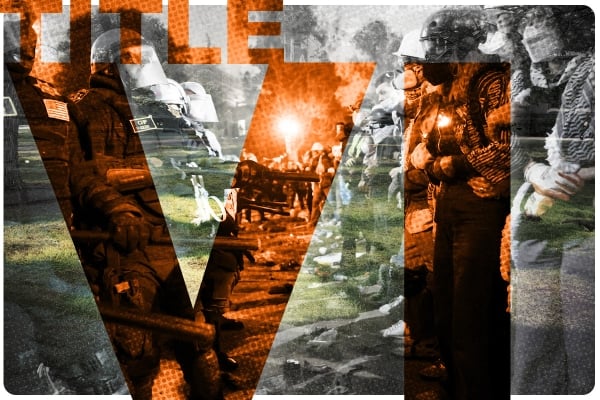
    Photo illustration by Justin Morrison/Inside Higher Ed | Etienne Laurent/AFP/Getty Images | Scott Olson/Getty Images

    A new report released Monday by the American Association of University Professors and its Committee A on Academic Freedom and Tenure argues that the Trump administration has weaponized federal civil rights laws with a goal of discrediting colleges and compromising their academic freedom and institutional autonomy.

    The report focuses in part on a surge of investigations that have been launched by the Department of Education since Oct. 7, 2023, especially those that involve national origin and religion. Based on an analysis of those cases, AAUP argues that in many instances the Trump administration has targeted types of speech or programming that do not actually qualify as legally actionable discrimination. Rather, the association says, the Trump administration has used this surge to sidestep historical procedures and enforce its own interpretation of the law.

    Both the Biden and Trump administrations stepped up their enforcement of Title VI of the Civil Rights Act of 1964, which prohibits discrimination based on race, color, religion, sex or national origin, after the Hamas attack on Israel prompted a number of protests on college campuses and an increase in reports of antisemitism. Their approaches, however, have been quite different.

    Biden civil rights officials took issue with how colleges responded to reports of antisemitic harassment and found several colleges in violation of that law.

    However, the Trump administration has moved aggressively to cut off funds and to demand sweeping changes at institutions—all in the name of combating antisemitism. More recently, the administration has used Title VI as a way to restrict and investigate race-based practices and programs as well as admissions decisions.

    “In a perverse reading of DEI, the administration makes it an instance of racial discrimination rather than an attempt to dismantle the structures of discrimination based on race,” the report notes.

    Over all, the AAUP argues that the Trump administration is attempting to “unmake” and “hijack” Title VI.

    The Trump administration is “unmooring the Civil Rights Act from its foundational commitments to addressing structures of discrimination that prevent educational access,” the report stated. And doing so “is nothing less than an attempt to rewrite the history of the nation.”

    Source link

  • HHS Accuses Harvard of Thwarting Investigations

    HHS Accuses Harvard of Thwarting Investigations

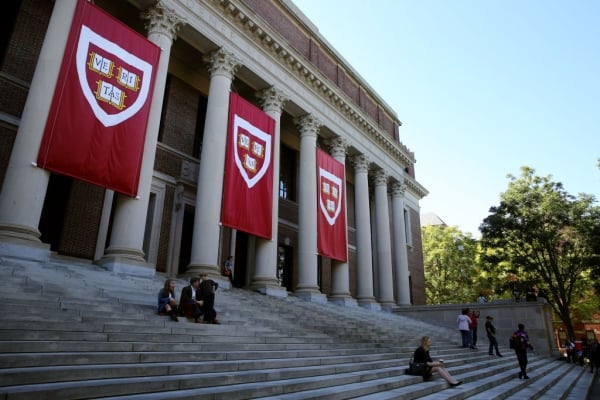
    The Trump administration has accused Harvard University officials of failing to comply with an ongoing civil rights investigation into alleged campus antisemitism, The Boston Globe reported.

    The U.S. Department of Health and Human Services said in a letter to Harvard president Alan Garber that it was referring the civil rights investigation to the U.S. Department of Justice, which it is permitted to do in cases where “compliance under Title VI cannot be obtained voluntarily.” 

    The letter, written by Paula Stannard, director of the HHS Office for Civil Rights, also referenced legal actions taken by Harvard, which has fought back against frozen federal research funding and other matters.

    “Rather than voluntarily comply with its obligations under Title VI, Harvard has chosen scorched-earth litigation against the Federal government,” Stannard wrote. “The parties’ several months’ engagement has been fruitless.”

    Harvard did not respond to a request for comment from Inside Higher Ed.

    The letter comes as Harvard is reportedly considering a $500 million settlement with the Trump administration to close current investigations and unfreeze $2 billion in federal research funding. Harvard is reportedly mulling a settlement even though a judge appears to view its case favorably.

    If Harvard settles, it will add to the list of wealthy and highly visible institutions that have yielded to the Trump administration’s demands in recent weeks. Columbia University agreed to far-reaching changes and a $221 million settlement to restore federal funding and close investigations into antisemitism on campus that stemmed from pro-Palestinian protests in 2024. Brown University also struck a deal with the Trump administration to restore $510 million in research funding, agreeing to various concessions but no payout to the federal government.

    As a potential settlement with the Trump administration looms, some Harvard faculty members sent a letter to the president and board, urging Garber to push back on what they called “the Trump administration’s assault on the vibrancy and inclusiveness of U.S. higher education.”

    Signed by multiple well-known scholars, the letter exhorted Garber not to “compromise core university and academic-freedom values that generations before us have worked to define and sustain,” and to resist ceding power to the federal government over hiring and admissions.

    Source link

  • Education Department Accuses 51 Colleges of Discrimination

    Education Department Accuses 51 Colleges of Discrimination

    The Education Department’s Office for Civil Rights launched investigations into 51 colleges on Friday, accusing them of violating Title VI of the Civil Rights Act and flouting guidance put forth in the department’s Dear Colleague Letter last month, which warned colleges that all race-conscious programs and policies would be considered unlawful.

    “The Department is working to reorient civil rights enforcement to ensure all students are protected from illegal discrimination,” Education Secretary Linda McMahon wrote in a statement. “Today’s announcement expands our efforts to ensure universities are not discriminating against their students based on race and race stereotypes.”

    According to the department’s statement, all but six of the investigations revolve around colleges’ partnerships or support for The PhD Project, a nonprofit organization that connects prospective business doctoral candidates from underrepresented backgrounds with academic networks and hosts recruitment events for business school faculty. In its statement, the Education Department said the organization “limits eligibility based on the race of participants.”

    A spokesperson for the PhD Project told Inside Higher Ed the organization works “to create a broader talent pipeline of current and future business leaders…through networking, mentorship, and unique events.” 

    The spokesperson also said they changed their membership requirements “this year” to include “anyone who shares that vision,” but did not say exactly when the change was made. Snapshots of the organization’s website, captured on the WayBack Machine, show different language as recently as two weeks ago, including a section on the homepage titled “we believe inclusion is critical,” which has since been scrubbed.

    The OCR is also investigating five additional colleges for allegedly using race in scholarship eligibility requirements. One institution, the department said, was included for “administering a program that segregates students on the basis of race.”

    Representatives for the education department did not respond to multiple questions from Inside Higher Ed in time for publication. 

    Inside Higher Ed also contacted the two dozen institutions under investigation, and their responses varied. The University of Wisconsin-Madison and Carnegie Mellon University said they had yet to be formally notified of any complaint by the OCR, and were awaiting more information to determine how to comply with an investigation.

    A spokesperson for the University of Notre Dame, which is still listed as a PhD Project partner, said the university “follows the law and in no way practices or condones discrimination.”

    As a Catholic university, we are fully committed to defending the dignity of every human person and ensuring that every person can flourish,” the spokesperson added. 

    At least one university on the list has already terminated its partnership with the PhD Project. A spokesperson for Arizona State University said the business school “would not be supporting [faculty] travel to the upcoming PhD Project Conference.”

    “The school also this year is not financially supporting the PhD Project organization,” the spokesperson added. 

    A spokesperson for Ithaca College, one of the five institutions accused of limiting scholarship eligibility based on race, denied that the scholarships the department cited violated Title VI. The department targeted two scholarships, the spokesperson said: the African Latino Society Memorial Scholarship and the Rashad G. Richardson “I Can Achieve” Memorial Scholarship. Both recognize students who work with the college’s BIPOC Unity Center, but don’t list any racial eligibility requirements on their respective webpages

    The Dear Colleague Letter released by the OCR last month aimed to greatly expand the scope of the Supreme Court’s affirmative action ruling in Students for Fair Admissions v. Harvard and University of North Carolina Chapel Hill, from one squarely focused on the policies and practices of admission offices to a sweeping decree on the illegality of all educational programs that consider race. 

    In its aftermath, colleges have struggled to understand how to comply with such a broad mandate—or whether they are even legally required to. Many have made surface-level changes, altering the names of programs and scrubbing websites of language associated with diversity, equity and inclusion. Some have gone further, eliminating DEI offices, shuttering residential housing for student groups or cutting race-based scholarships. 

    Jon Fansmith, senior vice president of government relations and national engagement at the American Council on Education, said the investigations were “cause for concern” among higher ed institutions that may have thought they were in compliance with the Dear Colleague Letter. But he said institutions shouldn’t panic yet. 

    “This is very clearly [the administration’s] first effort to try and enforce their interpretation of SFFA, as opposed to what most legal scholars accept that case means,” Fansmith said. “I think that schools understand, especially post-SFFA, what constitutes an impermissible benefit to a student based on race…it seems to me that they will probably be on solid ground defending their actions in these cases.”

    Recruitment in the Crosshairs

    The PhD Project has been a target of conservative activists in the past. In January, Christopher Rufo—a stalwart anti-DEI crusader who Florida Gov. Ron DeSantis appointed to the board of New College in 2023—brought attention to institutions attending the organization’s annual recruiting conference. 

    In a tweet, Rufo showed screenshots of the organization’s eligibility requirements for attendance, which stated that applicants had to be Black, Hispanic or Indigenous. Shortly after, Texas A&M University announced it would not send business faculty to the conference, following a threat by Texas Gov. Greg Abbott to fire the university president. Rufo did not respond to Inside Higher Ed’s request for comment.

    On Friday morning, the PhD Project website included a list of all university partners, accessible via drop-down menu. By that evening, the list had disappeared from the site. A spokesperson for the organization did not say why it was removed. 

    Inside Higher Ed catalogued the list before its removal. Of the 45 institutions that the department alleges violated civil rights by partnering with the PhD Project, 31 were listed as partners on the organization’s website Friday morning, including ASU. It’s not apparent what connection the other 14 institutions have to the PhD Project, and the education department did not respond to requests for clarification. But more than half of the 97 U.S. partner colleges the organization had listed on its website are not included in the OCR’s investigation. Its unclear why some PhD Project partners are under investigation while others are not.

    A spokesperson for Boise State University, which is under OCR investigation but not on the PhD Project’s list of partners, told Inside Higher Ed the institution isworking with our general counsel’s office to look into the matter.” A spokesperson for the California State University system, which has two campuses under investigation—CSU San Bernadino and Cal Poly Humboldt—said the system “continues to comply with longstanding applicable federal and state laws.” A spokesperson from the University of North Texas, also under investigation, said they are “fully cooperating” with investigations but are “not affiliated with the PhD Project.” 

    The PhD Project’s annual conference is set to start next week in Chicago. A spokesperson for the organization did not say how many universities have pulled their support for attendees, or if they’d seen an uptick in requests to cancel registrations. 

    Fansmith said that initiatives to recruit a more diverse applicant pool shouldn’t be viewed as discriminatory—especially in academic fields that have struggled to diversify. Only 35 percent of doctoral candidates in business, and 26 percent of business school faculty, are people of color, according to a 2023 report from the Association to Advance Collegiate Schools of Business. 

    “There’s lots of admissions initiatives seeking to put institutions in front of groups of students so they become aware of the programs they offer. Those are not discriminatory,” Fansmith said. “The reason these programs exist is because there are categories of students who are underrepresented in many fields… it would be a shame to see schools walk away from them.”

    Source link

  • “AI-Empowered” Site Accuses Yale Scholar of Terrorism Connection

    “AI-Empowered” Site Accuses Yale Scholar of Terrorism Connection

    Yale University suspended an instructor after a news site powered by artificial intelligence accused her of being part of a terrorist group, The New York Times reported.

    The news site, Jewish Onliner, said that the scholar was connected to Samidoun, a pro-Palestinian organization that the United States government has labeled a terrorist organization. Jewish Onliner said Helyeh Doutaghi, who is an associate research scholar at Yale and deputy director at Yale Law School’s Law and Political Economy Project, spoke on panels at events sponsored by Samidoun, according to the Times.

    Doutaghi told the Times that she’s not part “of any organization that would constitute a violation of U.S. law.” Yale put Doutaghi on administrative leave last week and barred her from campus. In a statement to the Times, Yale officials said they take the allegations seriously and are investigating.

    Jewish Onliner bills itself as an “AI-empowered, trusted online hub for insights, actionable intelligence, exposés, and essential updates about issues impacting the Jewish community worldwide,” according to its Substack page. The organization told the Times that humans, not AI, make the final edits on stories.

    Source link