This audio is auto-generated. Please let us know if you have feedback.
Dive Brief:
Coursera is acquiring fellow MOOC provider Udemy to create an online education and upskilling giant valued at$2.5 billion, the companies announced Wednesday.
The combined company is poised to generate $1.5 billion in annual revenueand eliminate some $115 million in costs,Coursera and Udemy said in a press release.
In explaining the deal — expected to close in the second half of 2026 — the companies pointed to their complementary consumer-facing and business-to-business offerings, as well as rising demand for artificial intelligence skills training.
Dive Insight:
Coursera and Udemy featured AI prominently in their merger rationale, saying that their combination would provide skills training for the emerging technology to the global workforce.
Elaborating, the companies said the combination would enhance “capacity for sustained investment in AI-driven platform innovation, rapid product development, and durable growth initiatives.”
The messaging tracks with each company’s emphasis on the technology prior to the merger announcement.
AI was mentioned over 50 times on an outlook and strategy call with Coursera executives in November. On the call, CEO Greg Hart touted Coursera’s “AI-enabled platform,” which includes an AI tutor called Coursera Coach.
“We need to continue to accelerate our development cycles to leverage AI and data to improve the learner experience and continuously enhance our capabilities across all areas of the platform,” Hart said.
On the company’s latest earnings call, Hart described generative AI as “the most in-demand skill in Coursera’s history.”On average, 14 users per minute were enrolling in one of the company’s roughly 1,000 generative AI courses, he said.
Meanwhile, Coursera recently partnered with OpenAI to embed the MOOC provider’s platform directly into ChatGPT, making its videos and information available to the AI platform.
Likewise, Udemy CEO Hugo Sarrazin emphasized AI’s importance to the company’s business on its latest earnings call in October.
Framing AI as a demand driver for Udemy’s offerings, he said that “companies are heavily invested in AI transformation” but are “struggling to demonstrate ROI because many haven’t developed the core workforce capabilities required to extract value from their investments.”
At the same time, both companies also acknowledge potential downsides to AI. In Coursera’s latest earnings report with the U.S. Securities and Exchange Commission, its list of risk factors pointed to the novelty of AI andcautioned that the market for AI skills and Coursera’s own AI products may not grow as planned.
Moreover, the company said, AI could “displace or otherwise adversely impact the demand for online learning solutions, including our offerings.”
That is exactly what has happened to ed tech specialist Chegg, which operates in an adjacent space with online learning tools.The company recently announced it would lay off nearly half its staff after multiple quarters of cratering revenue, which Chegg executives have attributed to loss of traffic — and thus subscribers — with the release of Google’s AI summaries in the search giant’s results.
For now, Coursera and Udemy are relatively stable financially for tech companies in a dynamic, ever-changing market. Both companies logged over $550 million in revenue for the first nine months of their fiscal years. In both cases, that represented growth from the previous year.
While Coursera is historically unprofitable, Udemy made $6.1 million in net income for the first three quarters of its fiscal year after a $75.4 million loss for the same period last year.
Coursera is valued more highly, with a market cap of $1.3 billion to Udemy’s $948.7 million as of Wednesday afternoon. Under the transaction, which requires regulatory and shareholder approvals, Udemy shareholders will receive 0.8 shares of Coursera stock for each of their Udemy shares.
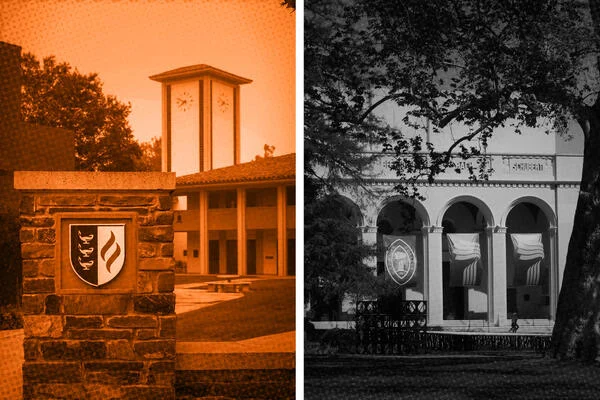
Pomona College is in talks to acquire Claremont Graduate University as the latter seeks a strategic partner amid financial challenges, according to reports in local and student media.
The two institutions, both part of California’s seven-institution Claremont Colleges consortium, are reportedly set to strike a preliminary agreement by the end of this week. But so far, neither institution has said much publicly about the potential deal.
“CGU has entered a process to ensure its long-term viability. We’re aware of that process, and to maintain its fairness, we cannot offer comment at this time,” a Pomona spokesperson wrote in an email to Inside Higher Ed, sharing the same statement sent to other news organizations.
CGU officials were similarly tight-lipped.
“Claremont Graduate University continues to explore a range of potential partnerships as part of our long-term strategic planning. These conversations are ongoing and confidential, and we want to ensure that any information we share is accurate and complete,” CGU vice president of strategy Patricia Easton wrote in an emailed statement provided by the university. “Once there are updates appropriate for release, we will share them through our official channels.”
Claremont Graduate University has been seeking a partner since at least April 2024, when it sought out consulting firms to help with that process, according to an April 2025 announcement.
“After much debate, we came to a consensus that we do not have the financial resources to continue going it alone as a graduate-only, comprehensive university. It was time to seek out a strategic partner or partners with a strong financial and academic foundation that by joining together would expand our opportunities for the future,” Easton wrote in the April 2025 communiqué about where partnership efforts stood at the time.
Officials said in that announcement that a consulting firm had contacted more than 100 prospective partners on behalf of the university in January. Arizona State University, Loyola Marymount University and Northeastern University all reportedly considered acquiring CGU. But now it appears that nearby Pomona College has emerged as the top pick.
The acquisition is reportedly moving ahead despite financial strain for both institutions.
CGU has operated with a persistent deficit for more than a decade, which is expected to continue in fiscal year 2026; the college anticipates an operating loss of nearly $8.7 million, according to a public filing.
Pomona, meanwhile, has enacted cost-saving measures in recent years despite its deep pockets: It had an endowment valued at nearly $3 billion in fiscal year 2024. Officials wrote in November that “Pomona has faced financial uncertainty amid changes in federal funding and policy since early 2025,” and it is being squeezed by inflation, tariffs and rising operational costs. Recent challenges follow financial modeling in 2023 that projected expenses were on pace to grow faster than revenues, prompting a five-year “college-wide savings and reallocation program.”
Any potential merger would still need regulatory approval before it becomes official.
New College of Florida could soon expand its footprint in a significant way if plans to absorb a nearby museum and local branch campus of the University of South Florida come to fruition.
Current proposals would see New College taking over stewardship of the John and Mable Ringling Museum of Art in Sarasota and other associated properties and merging with USF Sarasota–Manatee. Such moves would nearly double New College’s acreage and triple its enrollment at a time when critics have raised questions about spending at NCF, where the cost to Florida taxpayers per student is roughly 10 times higher than any other institution in the State University System.
The proposed expansion would continue efforts to grow NCF after state leadership tasked a new board in 2022 with shifting the small liberal arts college in a conservative direction and growing its student body, which the administration has so far aimed to do by adding athletic programs.
But critics have raised concerns about a lack of transparency around both potential acquisitions and whether New College has the capacity to manage another campus and a sprawling art museum.
A Contested Acquisition
New College officials have quietly been preparing for a merger with USF Sarasota–Manatee for at least several months, according to public records obtained by WUSF, the local NPR affiliate.
A WUSF public records request turned up a draft press release from New College announcing the merger between the two institutions as well as talking points and details on the transition.
Details in the documents make the deal sound more like an acquisition than a merger.
Students will have the option to transfer to another USF campus “or remain at New College,” according to the documents. Under the proposed plan, USF Sarasota–Manatee employees would possibly be reassigned to other USF campuses or “to comparable roles” at New College.
University of South Florida Sarasota–Manatee main building.
Alaska Miller/Wikimedia Commons
Although it appears that New College would absorb USF Sarasota–Manatee in the merger, New College is the much smaller of the two institutions. In fall 2023, it enrolled 731 students compared to more than 2,000 at USF Sarasota–Manatee, according to details on the university website.
“As we reimagine the future of higher education in Florida, this integration is a testament to the power of collaboration,” New College of Florida president Richard Corcoran said in the news release obtained by WUSF. “Governor [Ron] Desantis [sic] has shown exceptional leadership in enabling this bold vision, one that positions New College to advance as a model of academic excellence while fostering economic innovation and impact in the Sarasota-Manatee region.”
The news release adds, “This collaboration is more than a merger,” casting it as “an opportunity to design a singular institution that meets the demands of the 21st century” and allows USF to focus on its mission as a research university and NCF to become the nation’s top liberal arts college.
“The integration also addresses longstanding inefficiencies, consolidating administrative functions and aligning academic offerings. USF-SM’s programs often overlap with those offered by other public higher education institutions in Sarasota and Manatee counties, including New College and State College of Florida,” part of the draft press release from New College reads.
New College officials did not respond to requests for comment from Inside Higher Ed.
USF president Rhea Law is also quoted in the draft press release, stating that “by coming together, we honor the distinct institution while creating a stronger foundation for the future of both institutions and our communities.”
But USF officials have distanced themselves from the announcement since it emerged publicly.
“Please be aware that the documents are several months old and include a draft press release and talking points that were prepared by New College. USF did not approve the proposal or communications drafted by New College. There have been no plans made to make any such announcement,” USF spokesperson Althea Johnson wrote to Inside Higher Ed by email.
However, Johnson noted that the two institutions have engaged in talks since last fall, when Florida Board of Governors chair Brian Lamb asked them to “identify additional synergies.”
Asked if NCF invented quotes attributed to Law and other USF officials, Johnson reiterated, “USF did not draft or approve of the communications. They were prepared by New College.”
Community members have also opposed the move. Last week more than a dozen former USF Sarasota–Manatee officials and community partners signed on to an open letter against the merger, calling the move “a bad deal for our students and families, employers and community.” They wrote, “There has been no community consultation on the impacts” of the proposal.
The merger proposal would require legislative approval. Although no bill has been filed, Republican state senator Joe Gruters—whose wife works at NCF—has thrown support behind the idea in interviews. Gruters did not respond to a request for comment from Inside Higher Ed.
Expanding Into the Arts
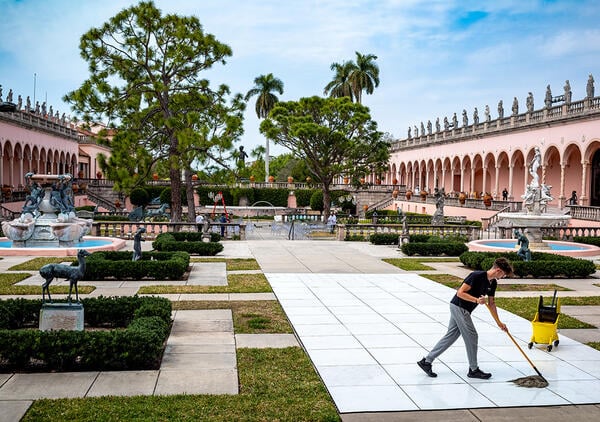
While NCF quietly planned to absorb USF Sarasota–Manatee, an effort to take stewardship of the Ringling Museum, currently administered by Florida State University, was also underway.
Visitors view paintings in the Ringling Museum of Art’s Peter Paul Rubens room.
When DeSantis unveiled his state budget plans in February, many observers were shocked to see a proposal for New College to take over the Ringling art museum and affiliated properties, which includes a former home of the namesake founder, and the Ringling Museum of the Circus.
Florida State has had stewardship of the Ringling properties since 2000. FSU’s responsibilities include managing the Ringling’s endowment and employing the staff that operate the facilities, which does everything from curate collections to provide security and other functions. One recent report counted 229 employees on the FSU payroll at the Ringling.
Many museum supporters are appalled at the idea of a New College takeover, including Nancy Parrish, a former member of its board and president of the nascent Citizens to Protect the Ringling. She argues FSU has transformed the Ringling from a property that had fallen into disrepair when it took over stewardship in 2000 to a thriving institution with annual surpluses. Parrish worries that NCF is incapable of taking on the same role and would upend that progress.
“New College is in a costly, complicated, precarious transition. How can it possibly manage an institution larger than itself? And an institution as complicated as a museum was never in its business plan. It’s outrageous government overreach and an outrageous waste of taxpayer money, because it would take millions to replace what FSU provides the museum,” Parrish said.
The timeline for the proposed transition from FSU to NCF by Aug. 1 is also rushed, she argues.
Amid the uncertainty over the Ringling’s future, she said that “donors are fleeing in panic.”
Details on how NCF would take over the operations are not laid out in the DeSantis proposal, and NCF officials did not fulfill a public records request about the transition prior to publication.
“This transition is not only sensible; it is a collective win. It is a win for Sarasota, reinforcing its reputation as a global leader in the arts and higher education; boosting tourism, cultural engagement and economic growth—all while preserving a historical gem,” Corcoran wrote.
He added that NCF stewardship would both expand “research partnerships, student engagement and statewide academic initiatives in the arts and humanities” and provide “an infusion of resources” to allow it “to elevate its world-class exhibitions, research and outreach.”
FSU did not respond to requests for comment from Inside Higher Ed.
The Financial Picture
New College’s potential expansion comes as it has grown in other ways since DeSantis appointed a conservative board that tapped Corcoran, a former GOP lawmaker, as president.
Since 2022, NCF has added six intercollegiate teams and plans to field 24 altogether by 2028. Beyond the inaugural programs in sports such as basketball, baseball and soccer, New College plans to expand to tennis, golf, bass fishing and various other athletic pursuits. NCF is investing in developing its athletic facilities in addition to paying for coaches and athletic scholarships.
New College’s strategic transformation has come with a substantial price tag for taxpayers. The state has already infused New College with millions of dollars since the change in leadership. And NCF’s leaders want more state money—at least $200 million over the next decade.
But that spending has prompted some pushback from the DeSantis-appointed Florida Board of Governors, which oversees New College and other members of the State University System.
FLBOG member Eric Silagy has challenged Corcoran at times on financial transparency and the high cost per student, calculating that NCF spent $91,000 per student in the 2023–24 academic year. The system average is $10,000, Silagy said at a September board meeting.
Corcoran initially disputed that number, arguing it was $68,000 per head.
But at a January meeting, Silagy said he had spoken with Corcoran, who now agreed that figure was between $88,000 and $91,000 per student, a figure Silagy said continues to climb. He projects that NCF could soon spend between $114,000 and $140,000 for each student.
Concerns about fiscal management also prompted a shake-up at the New College Alumni Association last month, when then-director Ben Brown resigned in protest because of “a deteriorating institutional relationship” between the college and alumni, and concerns that Corcoran had squandered funds. Brown also wanted more transparency.
Brown told Inside Higher Ed he is concerned about the state giving Corcoran more power.
“There’s no ingrained alumni opposition to the idea of being part of USF or doing things jointly with USF, but the current alumni sentiment is very clear that for this administration, operating the way it is, to take responsibility for part of USF is dangerous to the state and to the taxpayers,” Brown said.