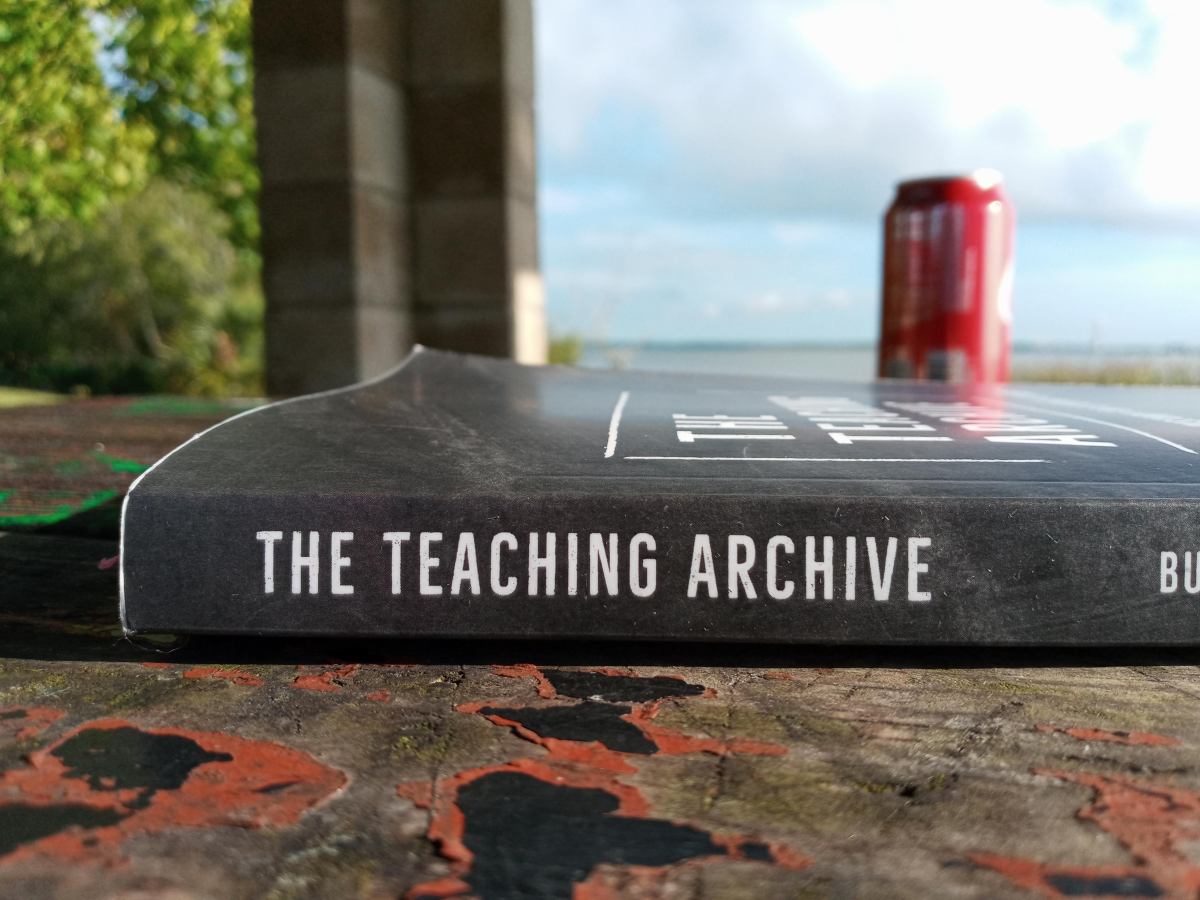
In The Teaching Archive: A New History for Literary Study Dr. Rachel Sagner Buurma, Associate Professor of English at Swarthmore College, and Dr. Laura Heffernan, Associate Professor of English at the University of North Florida, turn to archives from the actual classrooms of major literary critics of the past century to see what the available course documents tell about the history of the teaching of literature. This approach contrasts with existing histories, such as Gerald Graff’s Professing Literature, which are based on archives of published works about teaching rather than archives of teaching itself. While this book will naturally interest literature teachers most, I think that Buurma and Heffernan’s methods and findings have wider implications across academia. Every discipline has a pedagogical past to learn from and a future to archive for. One of the most surprising findings in the book is that landmark works of literary scholarship often had tangible roots in classrooms. Seeing this documented helps us better appreciate that the classroom is a site of disciplinary scholarship in its own right. I’m grateful to Buurma and Heffernan for this fascinating historical work and for responding to my questions over email.
CORRIGAN: I’m interested in the origin of the project. What prompted you to turn to archives of actual classrooms? What gave you the idea that you might find a different history of literary study there than what has previously been found based on archives of scholarly publications?
BUURMA & HEFFERNAN: Well, the project really began as an attempt to investigate how the New Critics actually taught. We had both heard New Critical pedagogy invoked over and over again as the foundation for how literary scholars teach, even if they are practicing historicism in their scholarship. And mentioning the New Criticism immediately brought to mind the familiar image of a professor leading students in a close reading of a single poem on a page. But what, we wondered, was this imaginary of the New Critical classroom predicated upon? New Critics wrote *about* teaching in their major works: Cleanth Brooks’s The Well Wrought Urn, for example, begins with a classroom scene in which the student senses the aesthetic value of Wordworth’s Westminster Bridge sonnet but needs to have that native critical judgment nurtured and amplified and modeled by the teacher through practices of closely attending to not just what the poem says but how he says it. But how did Brooks actually teach?
So we started there, and luck had it that Brooks’s papers at the Beinecke Library at Yale included transcriptions of not just his lectures but his students’ comments and questions from his Modern Poetry course (he had planned to publish a book of his lectures, and these complete transcripts were to be the basis). So, we were able to get a real sense of the ups and downs of his classroom hour; the kinds of unexpected queries he fielded from students; the historical facts he included or even misreported; and the ways that the sheer time that he spent on certain poems (like Marianne Moore’s “Poetry,” which he deemed a “failure”) belied a different kind of literary valuation at work than his stated theoretical account of what makes good poems good.
From there, we saw that there was a lot to be learned—indeed a whole other disciplinary narrative—by witnessing how scholars taught alongside what they wrote. We went to see, in the same spirit, how other foundational formalist critics including Eliot and Richards taught in their classrooms. But we also began to wonder and investigate what kinds of teaching were happening in other kinds of institutions in these same moments. Scholarly publications—particularly those manifestoes or arguments over how we should teach or read or research—tend to overrepresent figures at elite institutions. So looking at teaching instead gives us back a sense of the much bigger field of practice in these eras.
CORRIGAN: Early in the book, you stress that your book is a history of teaching—not an endorsement of how the particular teachers in your study taught (p. 17). But as I read, I kept finding things these teachers were doing really creative and interesting, such as Edith Rickert having her students create visual representations of elements of style in a text (p. 99). Were there times in your research where you thought, “Oh, that is good teaching” or even “I’m going to use that in my classroom”?
BUURMA & HEFFERNAN: Yes—and we think it’s actually a testament to how creative and interesting and maybe above all experimental literature teaching has been—we weren’t looking for model practices or assignments, but so much of what we came across seems worth stealing for our own classrooms, even though we try hard in the book to point out that we’re not holding up these figures as examples of Great Teachers or—what would be even less useful—suggesting that somehow teaching in the past used to be better and that we need to return to some previous, unfallen state of literature teaching! Because we don’t think that at all. In fact, one of the things that prompted us to write the book in the first place was knowing how hard we were working to learn to teach well in our own classrooms, how much time we were spending inventing new courses and assignments and little strategies for solving problems we ran into in the classroom, and how we saw that—despite omnipresent messages in higher ed about how bad college and university teaching is!—most of our colleagues and friends in the profession were working hard at being engaged, effective teachers and were often using really inventive methods to help their students learn. And we realized that no matter how many professors of literature were doing that, somehow engaged, effective teaching was always being framed as exception or unusual, and not the norm—and the norm, despite what we saw in our everyday professional lives, was always framed as this boring unengaged research who hating being in the classroom and just droned on to a lecture hall of bored students. So we thought that it was likely that if the present of teaching looked very different than official stories about it, there was a good chance that the past of teaching would look very different as well, if we could figure out how to find it.
And like you, other people also seem to have found the practices we document in the book useful. In his review of the book, Ben Hagen writes that:
The Teaching Archive is not a “How To” guide, yet Buurma and Heffernan acknowledge that “some of the past teaching [they] describe seems new and exciting now” (17). I can confirm that reading and rereading The Teaching Archive is pedagogically generative. This past semester (Spring 2021), inspired by the example of Spurgeon, I asked graduate students to create personal indexes of The Norton Anthology of Theory and Criticism. As we learn in chapter one, Spurgeon’s 1913 Art of Reading course did not conclude with an academic research paper but led students “just [up to] the point where [they] would begin to write a research paper,” working slowly through a process of studying, note taking, and “coordinat[ing] information into knowledge” (30, 31). Index-making, according to Spurgeon, is far from a “banal scholarly practice[]”; it is, rather, a “thoughtful” activity that “encode[s]” the values and perspectives of any given indexer—“recording this and not that, subordinating one point to another” (36). Building an index of a text, or an anthology, reveals networks of ideas as well as chains of citations and references, “set[s] of strands that you can reorder and reconnect” (36). This research emphasis on note taking and indexing—not paper writing—encourages students to make something and also to acquire a personal hold on obscure or difficult material; moreover, this activity leaves students (including mine, I hope) with a surviving record of what mattered to them in their studies, an organized set of data that they can “then recompose . . . into the shapes of [later] interpretations and arguments” (37).
CORRIGAN: One practical takeaway from your book might be an encouragement for teachers to more carefully archive our teaching materials. You mention, for instance, how rare it was to have “meticulously preserved” teaching notes like those of Caroline Spurgeon (p. 25). Do you document your own teaching any differently now that you’ve written this book?
BUURMA & HEFFERNAN: Haha, no! We should but we don’t, really. We always mean to take good notes about a class—what worked and what didn’t—but fail to do so nearly every term. (Josephine MIles, one of the poet-scholar-teachers we write about, jotted a very short and charming version of this end-of-term notes-for-next-time in one of her English 1A notebooks, which simply read: “Kill error + model style / Rouse C’s / Personal confs before midterms.”) Our teaching documents themselves are well stored because they’ve been made in word processors from the beginning. And of course, that big archive is keyword searchable—we’ve both had the uncanny experience of discovering a document of teaching notes on a relatively obscure text that we were looking up to cite or read for the first time (no kidding!).
CORRIGAN: On a related note, it strikes me that, just as your book was coming out, the pandemic forced so many teachers to do some pretty intensive archiving by making all aspects of our courses available electronically in various online, remote, and hybrid formats. Of course, intentionally online courses existed before the pandemic. But the scale we just saw was unprecedented. Do you have any thoughts on what this past year or so of teaching under these conditions might mean for cultivating “the teaching archive” going forward?
BUURMA & HEFFERNAN: Well, one thing we worry about is how much of that archive now exists within Learning Management Systems. Canvas, for example, is set up to encourage you to build out your “How to Revise a Thesis” handouts or your introductory notes on a novelist within the platform itself rather than linking to or embedding external documents. Feedback, too, often happens within the LMS. Laura, for example, has had to be really mindful about all of this because she saw how much of her own teaching record was disappearing from her personal computer—she’d go to write a recommendation letter for a former student and realize she had no record of the students’ work or her feedback on it to access. And another thing we worry about is the extent to which universities have tried to capture intellectual property in individual instructors’ courses in the chaos of everything going remote; we probably don’t even yet know to what extent this has happened at various universities. That’s an issue that faculty and faculty unions are paying more and more attention to, we think, but there aren’t really uniform practices or policies around this yet—and of course, many people don’t have a union and then advocacy for faculty around this issue can end up getting lost, or happening in piecemeal ways.
But you’re right that all of those issues and attendant dangers aside, there are a lot of exciting possibilities for what we might be able to know about teaching during this moment because of how much of it was happening remotely and has left more traces than usual—video recordings and transcripts and probably millions of hours of voicethreads and video assignments and blog posts and text chats. And we also noticed that more instructors were entering into the classrooms of instructors at other institutions. The two of us, for example, recorded lectures together, podcast style, for one of Laura’s UNF classes earlier this year, and we saw many other visits and guest lectures being organized on social media during that time. This kind of growing awareness of what’s going on not just within your colleagues’ classrooms but across different kinds of institutions seems really, really promising to us because it could serve not just as a foundation for stronger subfield scholarship but potentially also a foundation for the kind of cross-institutional labor organizing that disciplinary formations will need to nurture more and more.
CORRIGAN: Your history of literary study focuses on the teaching of “major literary scholars” (p. 3), in part so that you can contrast their writing about the discipline with their teaching of the discipline and in part (I’m imagining) because major scholars are the ones most likely to have their papers archived. But I’m curious, do you have any guesses about how different your history might look if it had been possible or practical to look at an even broader range of teachers—especially the great majority who are not major literary scholars, not well known at all?
BUURMA & HEFFERNAN: Yes—we focus on major literary scholars for exactly the reasons you describe, but part of what we found is that research is happening in tandem with teaching for everyone, whether they are writing major critical monographs, editing important collections, and publishing widely read public writing or not. This is partly because teaching itself requires research—when we prepare to teach classes, most of us find ourselves reading scholarly articles, tracking down new sources and texts, and searching out how peers past and present have taught a given text, topic, or course. All of that is literary studies research, even though we might not always recognize what we do when we prepare classes as research, and even though there’s no way to put that work down as research on a cv or make it count as research in an annual review. So we’re hopeful that we’ve written a history that opens up to the work of the great majority you mention.
CORRIGAN: I love your observation that most of literary studies takes place in classrooms. You write, “literary value seems to emanate from texts, but is actually made by people. And classrooms are the core site where this collective making can be practiced and witnessed” (p. 6). When we teach, we’re not transmitting literary studies to students for later. We’re doing literary studies with them right now. That feels revolutionary. What might change, would you guess, if more of us who teach literature consciously adopted this stance—that our courses are not about the discipline, they are the discipline?
BUURMA & HEFFERNAN: We’ve thought about this question a lot. We think it’s an insight that a lot of teachers understand, in a tacit way, through their practice. For example, there’s a line in our introduction just past what you quote here that reads, “The answer to the question, ‘Did I miss anything last week?’ is ‘Yes, and you missed it forever’” that REALLY resonated with readers. People shared that excerpt on Twitter more than any other part of the book. Because we all do know that what we’re doing in these classrooms is much more than content transfer—we’re creating knowledge!—but it’s relatively rare to see that insight ratified within the institutions in which we work, and so it’s difficult for teachers to really keep hold of it as a conscious insight about our everyday work. And if we could really hang on to the fact that we are actually creating literary value in our classrooms, we think we’d not only see new differences AND new connections to the work of other disciplines, but we’d also have a better sense of how literary studies is in some ways distinct—and so perhaps we’d be more consistent at describing and claiming the expertise we exercise in our teaching, and thus better equipped to advocate for the conditions we need in order to do that teaching well.
Because if it’s rare for the institutions in which we work to ratify (or even be able to get out of the way of) that insight, it’s even rarer to have the kind of labor this teaching entails valued by those institutions. In her “Money on the Left” podcast appearance about her book, The Order of Forms, Anna Kornbluh pointed to just this section of The Teaching Archive:
But people need time for teaching. And that means that they need small class sizes, they need workable loads, and they need the ability to have preparation that involves reading new things and changing their course syllabi all the time and like genuinely encountering and making ideas happen in the classroom. There’s this line in Rachel Buurma and Laura Heffernan’s book, The Teaching Archive, about how like in the humanities you deal with students saying like, “I couldn’t make it to class, what did I miss?” And they say, “You missed everything and you missed it forever.” Because we make the knowledge happen in that haptic, collaborative, and dynamic moment of mutual determination of meaning. That is what you missed. So I think we need time for research driven teaching and research generative teaching. And what we also know is that it is just emphatically and empirically good for students, about small class sizes, about a lot of individual attention, about a lot of dynamic kind of evolution of what’s on the syllabus, and a lot of in-person collective work.