To lift a line from the songwriter extraordinaire of our era, “the times they are a- changin’.” Indeed, they are — and this is certainly true in our own corner of the world, the world of free speech.
For better and worse, Donald Trump and his agents are rearranging the structure of free expression in America. Only a few weeks into his presidency, things are proceeding at a breakneck speed, with a flurry of executive orders flying out the windows of the White House. Even early on, there is a sense that what will follow may well mark one of those pinpoints in our history when that “experiment” of which Holmes spoke is tested. Whatever else happens, it is important that there is some record of these times and what happened in them. To that end, we will soon launch a new segment within FAN called “Executive Watch” to track it all: the President’s orders, the executive agencies’ actions, the activities of the President’s affiliates, and Mr. Trump’s personal undertakings.
Enter Professor Timothy Zick, the William and Mary Law School Robert & Elizabeth Scott Research Professor and John Marshall Professor of Government and Citizenship.
Zick is the author of five books on the subject: “Speech out of Doors: Preserving First Amendment Liberties in Public Places,” “The Cosmopolitan First Amendment: Protecting Transborder Expressive and Religious Liberties,” “The Dynamic Free Speech Clause: Free Speech and its Relation to Other Constitutional Rights,” “The First Amendment in the Trump Era,” and “Managed Dissent: The Law of Public Protest.” He is also the co-author of a First Amendment casebook, “The First Amendment: Cases and Theory.”
For all of the above reasons and others, Professor Zick is well suited to undertake the “Executive Watch” bi-monthly feature of First Amendment News.
Even at this early stage, this project comes a time when news stories like the following 21 surface with increasing frequency:

- Will Creeley, “Media outlets must not cave to Trump’s lawfare,” FIRE (Feb. 4)
- Robert Davis, “Colorado public media outlets express concern at Trump’s FCC investigation threat,” The Colorado Sun (Feb. 4)
- Mike Masnick, “Musk Shows Us What Actual Government Censorship On Social Media Looks Like,” Techdirt (Feb. 3)
- Kendall Tietz, “Jewish community responds to Trump executive order vowing to deport pro-Hamas activists with student visas,” Fox News (Feb. 2)
- Brian Bennett, “Federal Webpages Go Dark as Trump Administration Removes Public Data,” Time (Jan. 31)
- Sarah McLaughlin, “Trump’s threat to deport anti-Israel protesters is an attack on free speech,” MSNBC (Jan. 31)
- Greg Gonzalez, “Analysis: Early flurry of executive orders a mixed bag for free speech,” FIRE (Jan. 31)
- Joseph A. Wulfsohn, “WaPo writer accuses Trump of ‘government censorship’ after backing social media crackdown of ‘misinformation’,” Fox News (Jan. 31)
- Brian Stelter, “CBS staff alarmed by reports of settlement talks with Trump over ‘60 Minutes’ Harris interview,” CNN Business (Jan. 31)
- “Trump restores crucial due process rights for America’s college students,” FIRE (Jan. 31)
- “POLL: Conservatives more optimistic, liberals more concerned about free speech in 2025,” FIRE (Jan. 30)
- “Trump’s Orders Take Aim At Critical Race Theory, Antisemitism on Campuses,” First Amendment Watch (Jan. 30)
- Joe Harris, “Sweeping Trump changes could render First Amendment labor challenge in Sixth Circuit moot,” Courthouse News Service (Jan. 30)
- Juan Perez Jr. and Mackenzie Wilkes, “Trump issues orders on K-12 ‘indoctrination,’ school choice and campus protests,” Politico (Jan. 29)
- Bobby Allyn, “Meta agrees to pay Trump $25 million to settle lawsuit over Facebook and Instagram suspensions,” NPR (Jan. 29)
- Andy Craig, “The new free speech crisis hiding in plain sight,” MSNBC (Jan. 28)
- “Department of Education Calls Book Bans a ‘Hoax,’ Alarming Free Speech Advocates,” First Amendment Watch (Jan. 27)
- Alex Abdo, “A Free Speech View on the ‘Free Speech’ Executive Order,” Knight First Amendment Institute (Jan. 21)
- Ian Bassin and Maximillian Potter, “On anticipatory obedience and the media,” Columbia Journalism Review (Oct. 8, 2024)

By chronicling such information and then analyzing it, the hope is that our readers will have a more informed sense of the state of free speech at a time when so much is in flux. There is the hope that “Executive Watch” will prompt further discussion of that vital freedom that is at the core of constitutional government in America.
FBI agents file First Amendment class action
While FBI agents may be at-will employees who can, generally speaking, be fired for “any reason or no reason,” they can’t be fired for an unconstitutional reason, or as punishment for the exercise of their constitutional rights (e.g. he can’t fire all the African-American agents, or all the agents registered as Democrats).
The Complaint, filed in DC District Court, is posted here. Plaintiffs are “employees of the FBI who worked on Jan. 6 and/or Mar-a-Lago cases, and who have been informed that they are likely to be terminated in the very near future for such activity.” They “intend to represent a class of at least 6,000 current and former FBI agents and employees who participated in some manner in the investigation and prosecution of crimes and abuses of power by Donald Trump, or by those acting at his behest.”
Knight Institute on need for fact-checking platform
[Recently] Meta announced changes . . . to its content moderation policies, including that it’s replacing third-party fact checking with a Community Notes model that allows users to publicly flag content they believe to be incorrect or misleading.
The following can be attributed to Katherine Glenn Bass, the Knight Institute’s research director:
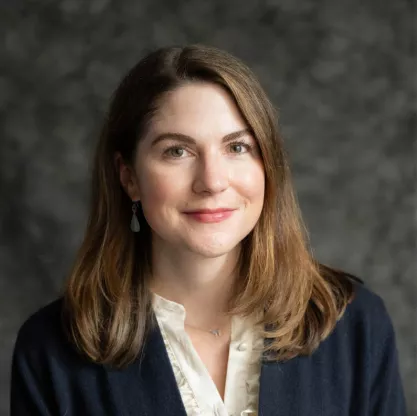
“Mark Zuckerberg’s announcement today is a stark reminder that many of the biggest platforms we use to communicate about issues of public importance are owned by billionaires who are not accountable to us. Apart from the obvious effort to signal political allegiance, the impact of the announced changes will not be clear for some time. But if we have any hope of measuring or understanding what is happening on these platforms, we need strong protections for the independent researchers and journalists who study them, and better mechanisms for ensuring they can access platform data.”
In 2019, more than 200 researchers signed an open letter in support of the Knight Institute’s efforts to persuade Facebook to amend its terms of service to establish a “safe harbor” for public-interest journalism and research on the platform. Read more about that effort here.
Shibley on Harvard’s anti-Semitism settlement
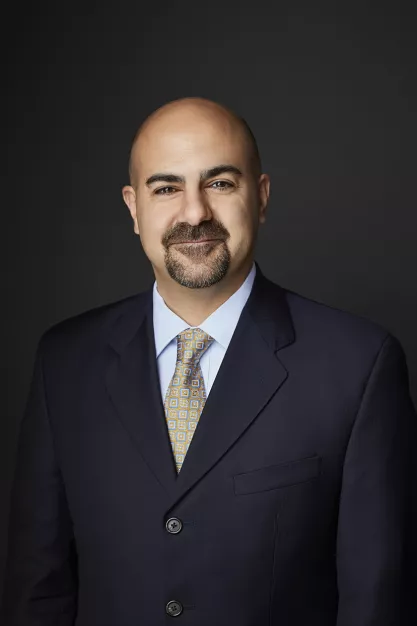
Just one day after President Trump took office, Harvard agreed to settle two lawsuits brought against it by Jewish students that alleged the university ignored “severe and pervasive anti-Semitism on campus” and created “an unbearable educational environment” in the wake of the October 7, 2023, Hamas attack on Israel and the ongoing war in Gaza.
While the settlement language itself does not appear to be public, a press release filed on the official docket of The Louis D. Brandeis Center for Human Rights Under Law v. President and Fellows of Harvard College included some details. Most notably, Harvard agreed to adopt the International Holocaust Remembrance Alliance’s (IHRA’s) definition of anti-Semitism. FIRE’s worry, shared by many others — including the definition’s primary author — is that, when added to policies used to punish discriminatory harassment on American campuses, the definition is too likely to be used to punish speech that is critical of Israel or its government but that is not motivated in animus against Jews or Israelis.
FIRE has repeatedly proposed steps to address anti-Semitic discrimination on campus that would safeguard students from harassment while protecting freedom of speech, most recently in our inauguration-day letter to President Trump. Getting this right is important; any proposal that chills or censors protected speech on campus won’t pass constitutional muster at public universities, won’t square with free speech promises at private universities (like Harvard), and won’t effectively address anti-Semitism.
Nevertheless, attempts to codify the IHRA definition of anti-Semitism into laws or regulations are nothing new. FIRE posted a roundup of the widespread civil libertarian opposition to its codification last year, when Congress considered adopting it as federal law. Among those opponents is the definition’s primary author, Kenneth Stern, who spoke at length with FIRE’s Nico Perrino on our So to Speak podcast about why it’s not the right tool for the job of regulating speech. As Stern wrote back in 2016 for The New York Times: “The definition was intended for data collectors writing reports about anti-Semitism in Europe. It was never supposed to curtail speech on campus. . . . And Jewish students are protected under the law as it now stands.” (Perhaps “as it is now written” would have been more precise; whether colleges follow the law is a different issue.)
As Stern predicted in that piece:
If this bill becomes law it is easy to imagine calls for university administrators to stop pro-Palestinian speech. Even if lawsuits alleging Title VI violations fail, students and faculty members will be scared into silence, and administrators will err on the side of suppressing or censuring speech.
Stern’s prediction is about to receive ground testing at Harvard, and likely at other universities that may follow its lead.
Forthcoming book: New edition of Neier’s ‘Defending My Enemy’
A new edition of the most important free speech book of the past half-century, with a new essay by the author on the ensuing fifty years of First Amendment controversies.
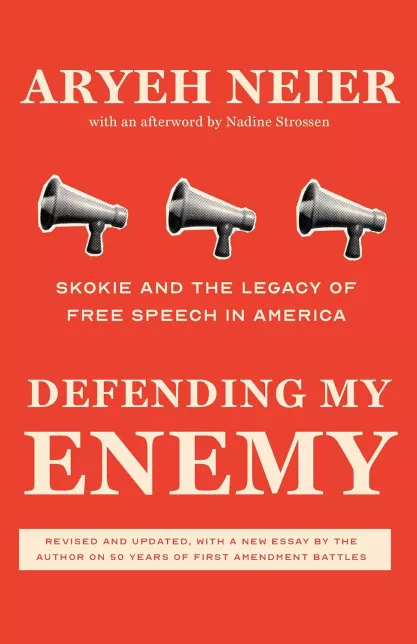
When Nazis wanted to express their right to free speech in 1977 by marching through Skokie, Illinois — a town with a large population of Holocaust survivors — Aryeh Neier, then the national director of the ACLU and himself a Holocaust survivor — came to the Nazis’ defense. Explaining what many saw as a despicable bridge too far for the First Amendment, Neier spelled out his thoughts about free speech in his 1977 book Defending My Enemy.
Now, nearly fifty years later, Neier revisits the topic of free speech in a volume that includes his original essay along with an extended new piece addressing some of the most controversial free speech issues of the past half-century. Touching on hot-button First Amendment topics currently in play, the second half of the book includes First Amendment analysis of the “Unite the Right” march in Charlotteville, campus protest over the Israel/Gaza war, book banning, trigger warnings, right-wing hate speech, the heckler’s veto, and the recent attempts by public figures including Donald Trump to overturn the long-standing Sullivan v. The New York Times precedent shielding the media from libel claims.
Including an afterword by longtime free speech champion Nadine Strossen, Defending My Enemy offers razor-sharp analysis from the man Muck Rack describes as having “a glittering civil liberties résumé.”
Praise for Defending My Enemy
“Aryeh Neier’s Defending My Enemy is as relevant today as it was when it was first published. The book is a powerful reminder of why free speech matters—not just for the voices we agree with, but for the voices we abhor. Neier’s story of defending Nazis’ rights to speak in Skokie underscores a timeless truth: If we want to preserve freedom for ourselves, we must be willing to defend it for others, no matter how deeply we disagree. At a time when censorship is on the rise globally, Defending My Enemy stands as a bold and principled call to action. Every advocate of free expression needs to read this book—and more importantly, live its lessons.” — Greg Lukianoff
Forthcoming scholarly article: ‘Output of machine learning algorithms isn’t entitled to First Amendment protection’
Machine learning algorithms increasingly mediate our public discourse – from search engines to social media platforms to artificial intelligence companies. And as their influence on online speech swells, so do questions of whether and how the First Amendment may apply to their output. A growing chorus of scholars has expressed doubt over whether the output of machine learning algorithms is truly speech within the meaning of the First Amendment, but none have suggested a workable way to cleanly draw the line between speech and non-speech.
This Article proposes a way to successfully draw that line based on a principle that we call “speech certainty” – the basic idea that speech is only speech if the speaker knows what he said when he said it. This idea is rooted in the text, history, and purpose of the First Amendment, and built into modern speech doctrines of editorial discretion and expressive conduct. If this bedrock principle has been overlooked, it is because, until now, all speech has been imbued with speech certainty. Articulating its existence was never necessary. But machine learning has changed that. Unlike traditional code, a close look at how machine learning algorithms work reveals that the programmers who create them can never be certain of their output. Because that output lacks speech certainty, it’s not the programmer’s speech.
Accordingly, this Article contends that the output of machine learning algorithms isn’t entitled to First Amendment protection. With the Supreme Court signaling its intent to address unresolved questions of online speech, we are poised to enter a new era of First Amendment jurisprudence in the coming years. As we do, scholars, practicing attorneys, and judges can no longer ignore how the algorithms underlying online speech actually work – and how they have changed with the advent of machine learning.
Without recognizing this paradigm shift in algorithmic speech, we risk sleepwalking into a radical departure from centuries of First Amendment jurisprudence. By failing to distinguish between traditional and machine learning algorithms, current consensus about algorithmic speech suggests that the Constitution should, for the first time in its history, protect speech that a speaker does not know he has said. Speech certainty provides a novel and principled approach to conceptualizing machine learning algorithms under existing First Amendment jurisprudence.
Related
More in the news
- “ACLU Sues University of Michigan Over Campus Bans for Pro-Palestinian Protesters,” First Amendment Watch (Feb. 4)
- Andrew DeMillo, “ACLU files lawsuit on behalf of Ark. librarian fired after opposing book censorship,” Free Speech Center (Feb. 4)
- Eugene Volokh, “Harvard / Dep’t of Ed Settlement Chilling Anti-Israel, Anti-Zionist, and Anti-Anti-Zionist Speech,” The Volokh Conspiracy (Feb. 4)
- Eugene Volokh, “Alien Tort Statute Liability for American Publisher Would Turn on Whether It Knew Author It Paid Was Hamas Hostage-Holder,” The Volokh Conspiracy (Feb. 4)
- Eugene Volokh, “Publishing Pro-Hamas Propaganda Is Protected by First Amendment,” The Volokh Conspiracy (Feb. 4)
- Lauren Feiner, “NetChoice sues to block Maryland’s Kids Code, saying it violates the First Amendment,” The Verge (Feb. 3)
- “Salt Lake City Journalist Fights for Freedom of the Press,” Institute For Free Speech (Jan. 23)
2024-2025 SCOTUS term: Free expression and related cases
Cases decided
- Villarreal v. Alaniz (Petition granted. Judgment vacated and case remanded for further consideration in light of Gonzalez v. Trevino, 602 U. S. ___ (2024) (per curiam))
- Murphy v. Schmitt (“The petition for a writ of certiorari is granted. The judgment is vacated, and the case is remanded to the United States Court of Appeals for the Eighth Circuit for further consideration in light of Gonzalez v. Trevino, 602 U. S. ___ (2024) (per curiam).”)
- TikTok Inc. and ByteDance Ltd v. Garland (The challenged provisions of the Protecting Americans from Foreign Adversary Controlled Applications Act do not violate petitioners’ First Amendment rights.)
Review granted
Pending petitions
Petitions denied
Last scheduled FAN
FAN 455: “Eight free expression cases pending on SCOTUS docket”
This article is part of First Amendment News, an editorially independent publication edited by Ronald K. L. Collins and hosted by FIRE as part of our mission to educate the public about First Amendment issues. The opinions expressed are those of the article’s author(s) and may not reflect the opinions of FIRE or Mr. Collins.