Tag: Administrative

  • LAVC Media Arts Faculty Stripped of Administrative Roles Amid Fraud Scandal (LACCD Whistleblower)

    LAVC Media Arts Faculty Stripped of Administrative Roles Amid Fraud Scandal (LACCD Whistleblower)

    Faculty members in the Los Angeles Valley College (LAVC) Media Arts Department implicated in decades of fraud and misconduct have been removed from administrative positions, though they remain in teaching roles.

    Over the summer, longtime department head Eric Swelstad, who had led Media Arts since 2008, was replaced as chair by Chad Sustin, a full-time professor of Cinema and Media Arts. The change followed a notification from the LACCD Whistleblower Movement to new Chancellor Alberto J. Roman, alleging that Swelstad falsely claimed membership in the Writers Guild of America – West for more than 20 years and used this misrepresentation in official LACCD promotional materials.

    Sustin, a tenured faculty member since 2016 and a former Technicolor post-producer, now leads the department.

    The reshuffling comes amid years of internal turmoil. In 2022, full-time cinema professor Arantxa Rodriguez resigned and was replaced by Jonathan Burnett as assistant professor. Rodriguez had previously been implicated in department infighting and, alongside Swelstad, was named as a co-defendant in a 2008 case alleging failure to provide advertised technical training and education. Burnett’s hiring bypassed longtime adjunct and former grant director Dan Watanabe.

    Watanabe previously administered several Media Arts training grants, the last of which—ICT & Digital Media, LA RDSN—was reported as fraudulent in 2016. The 2013 grant proposal promised courses such as The Business of EntertainmentAdvanced Digital Editing, Photoshop, and After Effects. Yet once funding was approved, The Business of Entertainment and Advanced Digital Editing were archived by LAVC’s Academic Curriculum Committee and Senate. Photoshop and After Effects were offered only minimally, with After Effects disappearing after 2015 and Photoshop shifting to online-only by 2017.

    Students reported the suspected fraud to the State of California in 2016, prompting a review of the grant. Renewal applications submitted by Watanabe in 2018 and 2021 were both denied.

    Grant Record (Denied Renewal, 2018):

    • Project Title: ICT & Digital Media – LA RDSN (Renewal)

    • Funding Agency: CCCCO EWD

    • Grant Amount: $165,000

    • Funding Period: Oct. 1, 2018 – June 30, 2019

    • Project Director: Dan Watanabe

    • Description: Proposed renewal of the Deputy Sector Navigator grant under the California Community Colleges Chancellor’s Office, focused on curriculum development and alignment with universities and K–12 schools.

    https://services.laccd.edu/districtsite/Accreditation/lavc/Standard%20IVA/IVA1-02_Grants_History.pdf

    Despite this, Watanabe (who was also passed over for a full-time position at Los Angeles Pierce College) remains an adjunct faculty member slated to teach Cinema 111, Developing Movies – a field he reportedly last worked in twenty years ago. Arantxa Rodriguez and Eric Swelstad have both been scheduled to teach Fall 2025. Despite falsifying his credentials as a member of the Writer’s Guild of America – West, and implying he was a Primetime Emmy Winner (he in fact was the director of a movie that received a local Los Angeles Emmy in the 1990s), he is slated to teach Cinema 101 and screenwriting core class Media Arts 129. Rodriguez will a remote History of Film Class. 

    Reportedly the new full-time faculty in the department have started working to reverse the damage. Fall 2025 schedule includes Media Arts 112, Creative Sound Design Workshop. 
    Source link

  • Check-in on Administrative Bloat, 2025 Edition

    Check-in on Administrative Bloat, 2025 Edition

    Check-in on Administrative Bloat, 2025 Edition

    It’s been a little over five years since I took a serious dive into the question of “administrative bloat,” which apparently exists everywhere but in the statistics. Still, always good to check assumptions every once in a while, and I thought five years was long enough to make a new look at the data worthwhile. So here goes:

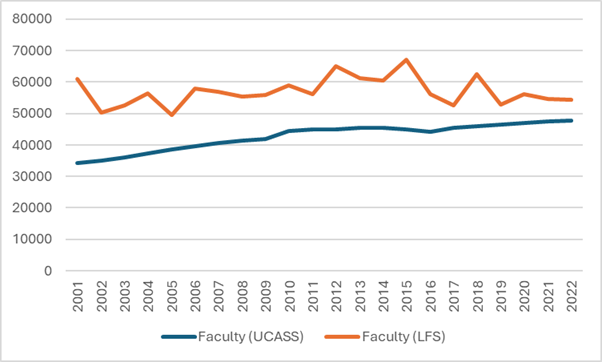
    Let’s start by reviewing what we can and cannot know about staffing at Canadian universities. StatsCan tracks the number of permanent ranked faculty pretty accurately through its University and College Academic Staff Survey (UCASS), and in a loosey-goosier fashion through the Labour Force Survey. The latter gives much higher numbers than the former, as shown below in Figure 1, which compares the number of “ranked” academics from UCASS with the number of permanent, full-time academics from the LFS.

    Figure 1 – Full-time Academic Staff Numbers According to LFS and UCASS

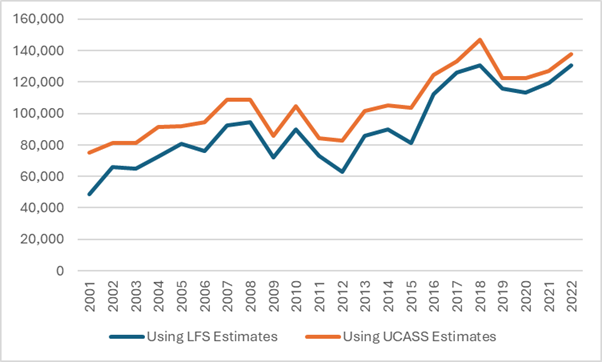
    StatsCan also tracks the total number of employees—both salaried and hourly—in the university sector using the Survey of Employment, Payroll and Hours (SEPH). However, in theory, if you subtract the number of FT academic staff from the number of total staff, you should be able to get the total number of non-academic staff, right? Well, unfortunately, this is where the discrepancy between UCASS and LFS runs into some problems. In Figure 2, I show the implied number of non-academics using both methods. The growth rates are different because of the difference in observations in the early period, but the two estimates do both converge on the observation that there are about 130,000 non-academic staff at Canadian universities, or about two and a half times the complement of academic staff.

    Figure 2 – Implied Non-Academic Staff Numbers using SEPH, LFS and UCASS

    So, that’s evidence of bloat, right? Well, maybe. Personally, what I take from Figure 2 is that either (or both) the LFS numbers and the SEPH numbers are probably flaming hot garbage. There’s simply no way that the number of non-academic staff has increased by 170% in the past twenty years, as a combination of the SEPH and LFS data suggests. For reasons that will become apparent shortly, I also have serious doubts that it’s increased by 85% either, as the combination of SPEH and UCASS suggests. Because there is a second set of data available to look at this question, one that shows expenditure on salaries, and it shows a much different picture.

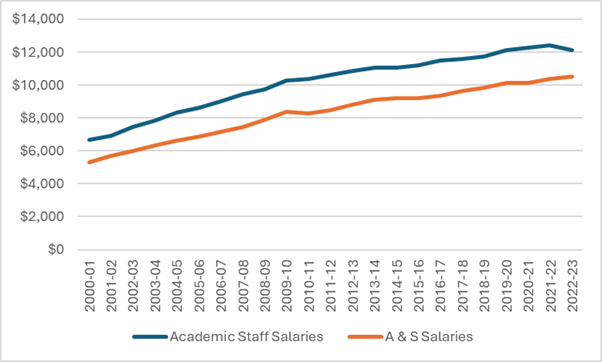
    The annual FIUC survey shows how much money is spent on wages for ranked academics as well as how much is spent on non-academics (it also shows wages for instructional staff without academic rank,” but I exclude this here for ease of analysis). Over the past three years, it is true that non-academic salary mass has risen, and academic ones have not (score for the bloat theory!), but looked at with a 25-year lens, Figure 3 shows that the rate of increase is about the same (score one against).

    Figure 3 – Total Expenditures on Salaries by Employee Group, in millions of $2023

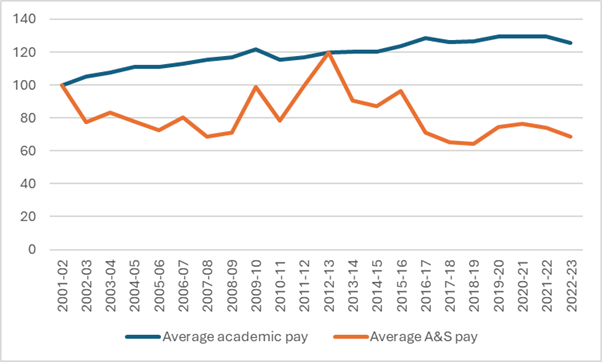
    Basically, the salary data in Figure 3 tells a completely different story than the SEPH/LFS/UCASS data in Figure 2. All you do is divide the spending data by the implied headcounts to see what I mean (which I do below). Figure 4 shows the implied change in average academic pay and average A&S pay, dividing total FIUC pay by the UCASS academic staff numbers and the A&S staff numbers implied by subtracting the UCASS numbers from the SEPH numbers, i.e., the orange line from Figure 2. To believe both sets of data, you have to believe that average academic salaries have increased substantially while average salaries for non-academics have declined substantially.

    Figure 4 – Change in Implied Average Pay, Academic Staff vs. A&S Staff, 2001-02 = 100

    In Figure 4, the blue line representing academic salaries is more or less consistent with the long-term trend in salaries we have seen by looking at salary survey data (which I last did back here): significant growth in the 00s and much slower growth thereafter. There are no staff salary surveys to use for comparison, but let’s put it this way: when people talk about “bloat” in non-academic staff positions, they normally mean it in the sense that the bloat is coming from expensive A&S staff, overpaid A&S staff, etc. For Figure 4 to be true, the growth in staff numbers would need to come almost entirely from more junior, less well-paid staff. It’s not impossible that this is true, but it’s not consistent with the general vibe about bloat, either

    So who knows, really? There’s a lot of contradictory data here, some of which argues strongly in favour of the bloat argument, but quite a bit of which points in the other direction. Better data is needed to answer this question probably isn’t forthcoming.

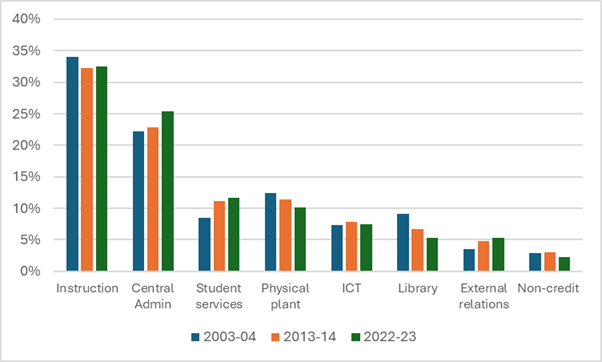
    Meanwhile, we can take one last look at A&S expenditure data. We can check to see if the pattern of A&S salary expenditures across university operating functions has changed over time. As Figure 5 shows, the answer is “a little bit.” Central Administration now takes up 25% of total A&S salary expenditures, up from 22% 20 years ago. Student services and external relations are up much more sharply in proportional terms, but since they were both starting from a low base, they don’t impact the overall numbers that much. Libraries, physical plant, and non-credit instruction are the categories losing share.

    Figure 5: Share of Total A&S Salary Mass by Function, Canadian University Operating Grants, Select Years

    And there you have it: more data than you probably needed on administrative bloat. See you back here again in 2030.

    Source link