Tag: Admission

  • Kamehameha Schools’ Admission Policies May Face Legal Challenge – The 74

    Kamehameha Schools’ Admission Policies May Face Legal Challenge – The 74


    Get stories like this delivered straight to your inbox. Sign up for The 74 Newsletter

    A conservative mainland group whose lawsuit against Harvard University ended affirmative action in college admissions is now building support in Hawaiʻi to take on Kamehameha Schools’ policies that give preference to Native Hawaiian students.

    Students for Fair Admissions, based in Virginia, recently launched the website KamehamehaNotFair.org. It says that the admission preference “is so strong that it is essentially impossible for a non-Native Hawaiian student to be admitted to Kamehameha.”

    “We believe that focus on ancestry, rather than merit or need, is neither fair nor legal, and we are committed to ending Kamehameha’s unlawful admissions policies in court,” the website says.

    Kamehameha’s Board of Trustees and CEO Jack Wong said in a written statement that the school expected the policy would be challenged. The institution — a private school established through the estate of Princess Bernice Pauahi Bishop to educate Hawaiians — successfully defended its admission policy in a series of lawsuits in the early 2000s. The trustees and Wong promised to do so again.

    “We are confident that our policy aligns with established law, and we will prevail,” the statement said.

    The campaign also drew criticism from the Office of Hawaiian Affairs, established in the late 1970s for the betterment of Native Hawaiians. OHA’s Board of Trustees called it an “attack on the right of Native Hawaiians to care for our own, on our own terms.”

    “These attacks are not new — but they are escalating,” the trustees said in a written statement. “They aim to dismantle the hard-won protections that enable our people to heal, rise, and chart our future.”

    Several groups have tried and failed in the past to overturn Kamehameha’s admissions policy. Federal courts, siding with Kamehameha, have ruled that giving preference to Native Hawaiians helps alleviate historical injustices they faced after the overthrow of the Hawaiian Kingdom in 1893.

    In the 2006 decision upholding Kamehameha Schools’ admissions policy, a 9th Circuit Court of Appeals panel pointed to longstanding challenges Native Hawaiian students have faced in schools. 

    “It is clear that a manifest imbalance exists in the K-12 educational arena in the state of Hawaiʻi, with Native Hawaiians falling at the bottom of the spectrum in almost all areas of educational progress and success,” Judge Susan Graber wrote in the majority opinion. 

    These disparities persist. Just over a third of Native Hawaiian students in public schools were proficient in reading in 2024, compared to 52% of students statewide. Less than a quarter of Native Hawaiian students were proficient in math.

    The state education department has also fallen short of providing families with adequate access to Hawaiian language immersion programs, according to two lawsuits filed against the department this summer. The Hawaiian immersion programs are open to all students, not just those of Hawaiian ancestry.  

    Moses Haia III, a lawyer and former director of the Native Hawaiian Legal Corp., said that improving outcomes for Hawaiian students is Kamehameha’s primary reason for existing. He said this new challenge appears to be based on ignorance of Hawaiʻi’s history.

    “Ultimately, what I see is these people being uneducated,” Haia said of the mainland group. “Not knowing the history of Hawaiʻi, not knowing the reasons for Kamehameha’s existence, and just once again trying to push Hawaiians into this box… and wanting to be on top.”

    Past Challenges 

    The U.S. Supreme Court ruled in 1976 that private schools can’t discriminate based on race in a case called Runyon v. McCrary, which involved Black school students trying to gain admission to private schools that had yet to integrate non-white students.

    An anonymous student sued Kamehameha in 2003, invoking the 1976 ruling and alleging that the school’s policy of giving preference to Hawaiian children was discriminatory. The case eventually landed in the 9th U.S. Circuit Court of Appeals.

    A majority of the appeals court judges sided with Kamehameha. They used a part of the Civil Rights Act that prohibits discrimination in the workplace as a legal framework for looking at the admissions policy.

    Judge Graber wrote that a preference for Native Hawaiian students “serves a legitimate remedial purpose by addressing the socioeconomic and educational disadvantages facing Native Hawaiians, producing Native Hawaiian leadership for community involvement, and revitalizing Native Hawaiian culture, thereby remedying current manifest imbalances resulting from the influx of western civilization.”

    But it was a narrow victory for Kamehameha, an 8-to-7 vote. Dissenting judges wrote that admitting mostly Hawaiian students didn’t create a diverse student body; others said that the policy was clearly discriminatory.

    The anonymous student appealed to the U.S. Supreme Court. But Kamehameha entered a $7 million settlement with the student and their mother before the court decided whether to take up the case.

    While the settlement safeguarded the admission policy from a ruling by the nation’s highest court it also meant lawyers punted the issue.

    Another group of anonymous students challenged the admissions policy a few years later and again took that case to the Supreme Court. But the court declined to take up that case in 2011.

    Students for Fair Admissions previously brought two landmark cases against Harvard and the University of North Carolina, arguing that the two schools’ race-conscious admissions policies discriminated against Asian American and white applicants. The Supreme Court ruled in 2023 that colleges cannot use race as a factor in their admissions, although the decision didn’t specify what this could mean for K-12 schools.

    Last fall, the number of Black students enrolled at both universities fell, although some researchers cautioned that colleges might not see the full impact of the Supreme Court ruling until a few admissions cycles have passed. 

    The challenge to Kamehameha Schools’ admissions policies comes amid national pushback on efforts to promote diversity in schools. In February, the U.S. Department of Education said any colleges and K-12 schools using race-based practices in hiring and admissions could lose federal funding, although a court subsequently prevented the department from enforcing those requirements. 

    Kamehameha receives no funding from the federal government, according to its tax filings. The school, which is the state’s largest private landowner, has assets valued at about $15 billion.

    This story was originally published on Honolulu Civil Beat.


    Get stories like these delivered straight to your inbox. Sign up for The 74 Newsletter

    Source link

  • Let’s Talk About Proxies and Admission (opinion)

    Let’s Talk About Proxies and Admission (opinion)

    The Trump administration has stepped up government scrutiny of college admission. Settlements reached with Brown and Columbia Universities each included a requirement that they pursue “merit-based” admission policies. On Aug. 7, President Trump issued a memorandum requiring colleges and universities to submit data to IPEDS (the Integrated Postsecondary Education Data System) demonstrating that they are not considering race in admission decisions. The Department of Education has since published in the Federal Register details about the planned data collection, with the public having 60 days to comment. And Attorney General Pam Bondi has entered into the fray by publishing a memo outlining what constitutes unlawful discrimination.

    I will leave it to others to rail against the unprecedented federal attack on higher education and the incursion into admission policies at individual institutions. I would prefer to examine some of the issues and underlying assumptions suggested by these documents.

    The Aug. 7 Presidential Memorandum

    Trump’s memorandum calls for increased transparency to expose practices that are “unlawful” and to rid society of “shameful, dangerous racial hierarchies.” For some reason, it doesn’t say that all racial hierarchies are shameful and dangerous. Is that an oversight or a meaningful omission? The memorandum also asserts without explanation that race-based admission policies threaten national security.

    The call to get rid of “shameful, dangerous racial hierarchies” is ironic. It is easy to imagine previous administrations using the same phrase to defend the very race-based admission policies that the executive order now seeks to abolish. “Shameful” and “dangerous” are in the eye of the beholder, and may not be color-blind.

    What is not clear is how the administration intends to collect and analyze the data, given its efforts to gut the Department of Education. As Inside Higher Ed has reported, the National Center for Education Statistics had been decimated, with a staff of more than 100 reduced to a skeleton crew of three employees.

    The Bondi Memo

    Attorney General Bondi’s July 29 memorandum offered guidance to federal agencies about practices that may constitute illegal discrimination at colleges and other entities receiving federal funds. A lot of it is rehashed, targeting popular straw men/persons like DEI programs and transgender athletes (and bathrooms).

    What is interesting is Bondi’s take on what she calls “unlawful proxy discrimination,” defined as the use of “facially neutral criteria” that function as “proxies” for race or other protected characteristics. Per the memo, examples in higher education may include things like requiring diversity statements in hiring or essay questions asking applicants to reflect on their unique identity or to write about obstacles they have overcome.

    On a surface level, Bondi is right that those can become back doors to identify an individual’s race. At the same time, knowing the obstacles an individual has overcome is essential to understanding his or her unique story, and race would seem to be one of the factors that can heavily influence that story.

    Where Bondi goes off the rails is in maintaining that what she calls “geographic targeting” may constitute a potentially unlawful proxy. She is suggesting that recruitment or outreach in schools and communities with high levels of racial minorities may be illegal. That is preposterous. Trying to expand access to education through outreach is in no way comparable to reverse engineering an admission process to arrive at a desired class composition.

    Taken to its logical extreme, Bondi’s guidance would prevent colleges from recruiting not only at inner-city schools with a large percentage of Black students, but also at suburban schools with a large percentage of affluent white students. Both could be examples of what she calls “geographic targeting.” For that matter, colleges might be in violation for asking for an applicant’s address, because ZIP code information can be used as a proxy for determining race and socioeconomic status.

    New Data Collection Requirements

    As for data collection for IPEDS, the administration has proposed a new “Admissions and Consumer Transparency Supplement,” or ACTS. ACTS will require targeted colleges and universities to report data in the following categories, disaggregated by race and sex:

    • Admissions test score quintile
    • GPA quintile
    • Family income range
    • Pell Grant eligibility
    • Parental education

    It will also ask for information to be broken down for early decision, early action and regular admission as well as institutional need-based and merit aid. What’s missing? Legacy status and athletic recruits, both categories that benefit white applicants. At some of the Ivies, between 10-20 percent of the undergraduates are athletes, many in “country club” sports where most of the competitors are wealthy and white, and the proportion of athletes is even higher at the highly selective liberal arts colleges that make up the New England Small College Athletic Conference. Discovery in SFFA v. Harvard revealed that recruited athletes had an 86 percent admit rate. You don’t have to have had an uncle who taught at MIT to know that is substantially higher than the overall admit rate.

    ACTS will apparently apply only to “all four-year institutions who utilize selective college admissions,” which the administration maintains “have an elevated risk of noncompliance with the civil rights laws.” That may at first glance seem to be singling out elite, “name” colleges, and that’s probably the intent, but it also reflects a recognition that the vast majority of institutions couldn’t practice race-based admission even if they wanted to because they are too busy filling the class to worry about crafting the class.

    The focus on selective institutions will both make it easy to score political points and hard to derive meaning from the data. Selectivity, especially at the 5-10 percent level, makes it impossible to know why any individual is or isn’t admitted. Admission deans at the highly-selective (or rejective) universities report that they could fill several additional freshman classes from among those applicants who have been waitlisted or denied.

    Merit-Based Admission

    The real target of the push for “merit-based” admission may be holistic review. A holistic admission process allows colleges to take into consideration nuances in an individual’s background and life experiences. It can also be frustrating for applicants, since different individuals are admitted for different reasons. The government may be pushing consciously or unconsciously for a more formulaic selection process.

    But would that be any better? Even if you focus only on grades and test scores, should you put more weight on a three-hour test or on four years of high school? How do you compare applicants from schools with different grading scales and levels of academic rigor? Should a test score obtained after thousands of dollars in test prep count the same as an identical score without coaching?

    How do we distinguish between merit and privilege? Those who have strong test scores may be more likely to believe that test scores are a measure of merit, and yet test scores are strongly correlated with family income. Those who are born into wealth and privilege may come to believe that their good fortune is a proxy for merit, buying into a perverse and self-serving interpretation of John Calvin’s doctrine of the elect. They may see themselves as deserving rather than lucky.

    Proxies in Admission

    We need a larger discussion about proxies in college admission. Advanced Placement courses are a proxy for a rigorous curriculum. GPA is a proxy for academic accomplishment, and yet means little without understanding context. Similarly, SAT scores are often seen as a proxy for ability, despite the fact that the College Board long ago abandoned the pretense that the SAT measures “aptitude.” The U.S. News & World Report college rankings have always relied on proxies, such as alumni giving as a proxy for alumni satisfaction when it may be more a measure of the effectiveness of the development office. Selectivity is a proxy for academic quality—feeding into the belief that the harder a place is to get in, the better it must be. Are proxies for race any more problematic than these other proxies?

    The larger question here is what should the selective college admission process be a proxy for. Should we seek to reward students for past performance? Predict who will earn the best grades in college? Identify those students who will benefit the most from the college experience? Or predict who will make the greatest contribution to society after college?

    I’m waiting for an executive order or memo or even a discussion among college admission professionals about what the selective admission process should represent and what proxies will support those goals.

    Jim Jump recently retired after 33 years as the academic dean and director of college counseling at St. Christopher’s School in Richmond, Va. He previously served as an admissions officer, philosophy instructor and women’s basketball coach at the college level and is a past president of the National Association for College Admission Counseling. He is the 2024 recipient of NACAC’s John B. Muir Excellence in Media Award.

    Source link

  • North Carolina Launches Expanded Direct Admission Program for 62,000 High School Seniors

    North Carolina Launches Expanded Direct Admission Program for 62,000 High School Seniors

    North Carolina is taking bold steps to democratize college access with the expansion of its NC College Connect program, which will offer direct admission to more than 62,000 public high school seniors this fall. The initiative represents a significant shift toward equity-focused admissions practices that prioritize accessibility over traditional application barriers.

    The program targets students who complete their junior year with a weighted GPA of 2.8 or higher. By eliminating the often overwhelming application process, NC College Connect removes financial and procedural obstacles that disproportionately affect first-generation college students and those from underrepresented communities.

    “NC College Connect represents a fundamental shift in how we approach college admissions in North Carolina,” said Peter Hans, President of the University of North Carolina System. The initiative reflects growing national recognition that traditional admissions processes can perpetuate educational inequities.

    Maurice “Mo” Green, State Superintendent of Public Instruction, praised the collaborative nature of the effort.

    “When our entire education community works together like this, students win. NC College Connect removes barriers and creates clear pathways to college for thousands of our students,” he said.

    The program’s inclusive design addresses systemic challenges that have historically limited college access for students from diverse backgrounds. By providing direct admission letters and eliminating complex application requirements, the initiative particularly benefits students who might otherwise be deterred by navigating multiple institutional processes.

    Participating institutions span the full spectrum of North Carolina’s higher education landscape, including UNC System universities, independent colleges and universities, and community colleges. This comprehensive approach ensures students have pathways to various types of post-secondary education that align with their academic goals and financial circumstances.

    Dr. Jeff Cox, President of the North Carolina Community College System, highlighted the program’s potential to transform access to affordable education. 

    “By removing barriers and simplifying the process, we’re helping more students access the life-changing opportunities our community colleges provide—close to home and at a price they can afford,” he said.

    Community colleges have long served as crucial entry points for students from diverse socioeconomic backgrounds, offering both career preparation and transfer pathways to four-year institutions. The inclusion of community colleges in NC College Connect recognizes their vital role in democratizing higher education access.

    The program’s commitment to equity extends beyond admissions to address affordability concerns through targeted financial aid initiatives. The Next NC Scholarship and NC Need-Based Scholarship specifically support students from households earning $80,000 or less, covering tuition and fees at participating institutions.

    Additionally, students attending Elizabeth City State University, Fayetteville State University, University of North Carolina at Pembroke, and Western Carolina University benefit from the NC Promise plan’s $500 per semester tuition rate. These historically Black institutions and regional universities serve particularly diverse student populations, making the affordable tuition structure especially impactful for underrepresented students.

    Hope Williams, President of North Carolina Independent Colleges and Universities, noted the unique value proposition of smaller institutions: the personalized attention and specialized programs that can be particularly beneficial for students who might struggle in larger university environments.

    The program builds on a successful pilot year that served more than 70,000 students, demonstrating the demand for streamlined college access. The expansion indicates that initial outcomes validated the approach’s effectiveness in connecting students with higher education opportunities.

    Students can verify their eligibility through the NCCollegeConnect.com portal or by consulting with high school counselors, ensuring multiple touchpoints for information and support. Eligible seniors will receive official admission letters this fall for the 2026-27 academic year, providing ample time for planning and preparation.

    NC College Connect positions North Carolina as a leader in reimagining college admissions to prioritize access and equity. As higher education institutions nationwide grapple with declining enrollment and questions about traditional admissions practices, North Carolina’s comprehensive approach offers a replicable model for other states.

    The initiative’s success will likely be measured not just in enrollment numbers, but in its ability to diversify the state’s college-going population and create pathways for students who might otherwise forego higher education. By removing procedural barriers and addressing financial constraints, NC College Connect represents a holistic approach to educational equity that extends well beyond the admissions office.


    Source link

  • Who Benefits Most From New Admission Tactic? (opinion)

    Who Benefits Most From New Admission Tactic? (opinion)

    I am not currently on a 12-step program of any kind, but recently I felt the need to seek forgiveness for a transgression committed 50 years ago. This summer is the 50th anniversary of the release of Jaws, the movie that redefined the definition of blockbuster and made a whole generation think twice before stepping into the ocean for a quick dip.

    I took my little sister to see Jaws that summer, having already seen it. As big brothers do, I waited until the exact moment when the shark leaps out of the water while Roy Scheider is casually ladling chum into the ocean behind the boat and either grabbed or pinched her. All to make the movie-watching experience more realistic, of course.

    A recent article in The Washington Post explored why, despite three sequels, Jaws never became a money-making franchise in the way that Star Wars or the Marvel movies have. The obvious reason is that Steven Spielberg elected not to be involved after the original movie. Thus, while I find myself humming John Williams’s simple but ominous theme music every time I read the latest news, the only thing I remember from any of the other three movies is the tagline for Jaws 2: “Just when you thought it was safe to go back in the water.”

    I thought about that tagline from a college admission perspective last week when I learned that Cornell College (the one in Iowa, not the Ivy) has launched what is either an innovative financial aid initiative or a gimmick.

    As detailed by several other publications, Cornell College emailed 16,000 soon-to-be high school seniors in its inquiry pool. Nothing unusual about that. What was different about this email was that it included a link to a personalized estimated financial aid package. Sending out financial aid offers/estimates to students who haven’t applied for financial aid or admission is the new twist in what Cornell calls its “Save Your Seat” initiative.

    If you are wondering how Cornell was able to send an estimated aid package to students who haven’t completed a FAFSA, the college started by mining ZIP code data for its inquiry pool. The nine-digit ZIP+4 code in student addresses provides precise information about where they live and allows Cornell to guesstimate a family’s economic circumstances. It might therefore be more accurate to say that the estimated financial aid package is individualized rather than personalized, because there is an element of geographic or ZIP code profiling taking place. The ZIP+4 information is supplemented by aggregated data provided by College Raptor, the consulting firm engaged by Cornell, along with historical internal data on financial aid packages.

    There are some kinks to work out and questions to be considered, of course. How will Cornell factor in Pell Grants and other governmental financial aid? Will the college make up the difference if the student’s Student Aid Index turns out to be higher than Cornell’s estimate? Apparently Cornell did some testing using applicants from last year and found that the estimates were reliable in the vast majority of cases.

    The Save Your Seat financial aid package for every student includes a $33,000 National Academic Scholarship covering nearly half of Cornell’s list price. To guarantee access to the aid, Cornell is asking students to apply by the end of this month and submit an enrollment deposit by Sept. 1. As The Chronicle of Higher Education explains, “students who apply by the end of July and submit a deposit by September 1 are guaranteed to receive the $33,000 scholarship, plus any institutional need-based grants for which they might qualify, based on their estimate. They will also get first dibs on housing and first-year seminars. (Those who deposit by November 8 will get the same deal, minus the guaranteed need-based grants and priority registration for the seminars.)”

    So what should we make of Save Your Seat? Is Cornell College on to something, or is this another marketing gimmick intended to differentiate Cornell from the mass of small liberal arts colleges? (Its one-course-at-a-time curriculum already distinguishes it.)

    I applaud Cornell for trying to introduce some transparency about cost up front. We know that affordability is both a major concern and a major impediment for many families in considering colleges, and particularly private colleges. Having a way to estimate cost early in the college search rather than at the very end is potentially a huge step forward for college admission. Cornell’s initiative might be thought of as an updated version of the net price calculator, with someone else doing the calculations for you. Save Your Seat might also be seen as the next iteration in the direct admission movement.

    But let us stop for a moment to acknowledge that Cornell’s new initiative, while more transparent, isn’t truly transparent. It does nothing to illuminate the high-cost, high-discount model that higher education relies on.

    There are good reasons for that. There have been several colleges that have tried to lead a movement to reset tuition, substantially reducing their sticker price but also substantially reducing discounts. They learned two things. The first was that they were willing to lead, but other colleges were not willing to follow.

    The bigger issue is that they learned that families are more than happy to pay lower tuition but are not happy to lose their “merit” scholarships. As it turns out, merit scholarships are among the least transparent and most misunderstood contrivances in college admission—perhaps deliberately so.

    Just last week, I spoke with someone who was surprised that a nephew had been admitted to college and then shocked when he received a merit scholarship. That conversation brought to mind a phone call I had with the mother of one of my students years ago. The son was a good kid but not a strong student, and he had just received merit scholarships to two different colleges. I finally figured out that the point of her call was to ask what was wrong with the two colleges that were awarding her son merit scholarships.

    The $33,000 National Academic Scholarships offered to every Save Your Seat email recipient might be thought of as the higher education equivalent of Oprah’s “You get a merit scholarship! You get a merit scholarship!” Cornell is far from alone in giving a discount to most or all students, but the potential pickle in which it finds itself is a situation where it tells students they are not admitted after already telling them they have won a merit scholarship.

    That is far from the biggest ethical issue raised by the new plan. If the move toward greater financial aid transparency, at least in theory, is a positive step, asking students to apply by the end of July and deposit by September is anything but.

    When the National Association for College Admission Counseling was forced to abandon key aspects of its code of ethics as part of a consent decree with the antitrust division of the U.S. Department of Justice, there were fears that college admission might deteriorate into a lawless Wild West, with colleges coming up with new strategies and incentives to coerce vulnerable students into decisions they weren’t ready to make. Thankfully that hasn’t happened to the degree predicted.

    Cornell’s decision to tie the Save Your Seat financial offers to an earlier application and enrollment deadline represents another leap forward in the acceleration of the college admission process. Who thinks that’s a good idea for students? It ignores the fact that many high school counseling offices are closed during the summer and won’t be able to send transcripts (perhaps Cornell will use self-reported grades). It is also significantly earlier than the provision in the now-defunct NACAC Statement of Principles of Good Practice prohibiting an application deadline before Oct. 15. Just when you thought it was safe to go back in the water.

    It’s not clear to me why the earlier deadlines are necessary for the program to work. It’s clear that there are benefits for Cornell, but students should be allowed to choose where to go to college thoughtfully and freely, without coercion or manipulation. Whose seat is being saved here?

    Jim Jump recently retired after 33 years as the academic dean and director of college counseling at St. Christopher’s School in Richmond, Va. He previously served as an admissions officer, philosophy instructor and women’s basketball coach at the college level and is a past president of the National Association for College Admission Counseling. He is the 2024 recipient of NACAC’s John B. Muir Excellence in Media Award.

    Source link

  • More Gender Breakouts of Admission Data

    More Gender Breakouts of Admission Data

    I’ve written a lot about yield rates over time, and I’ve also written about differences in admission patterns among male and female applicants here and here; I’ve decided to take a fresh look at both based on some continuing discussions I’ve heard recently. 

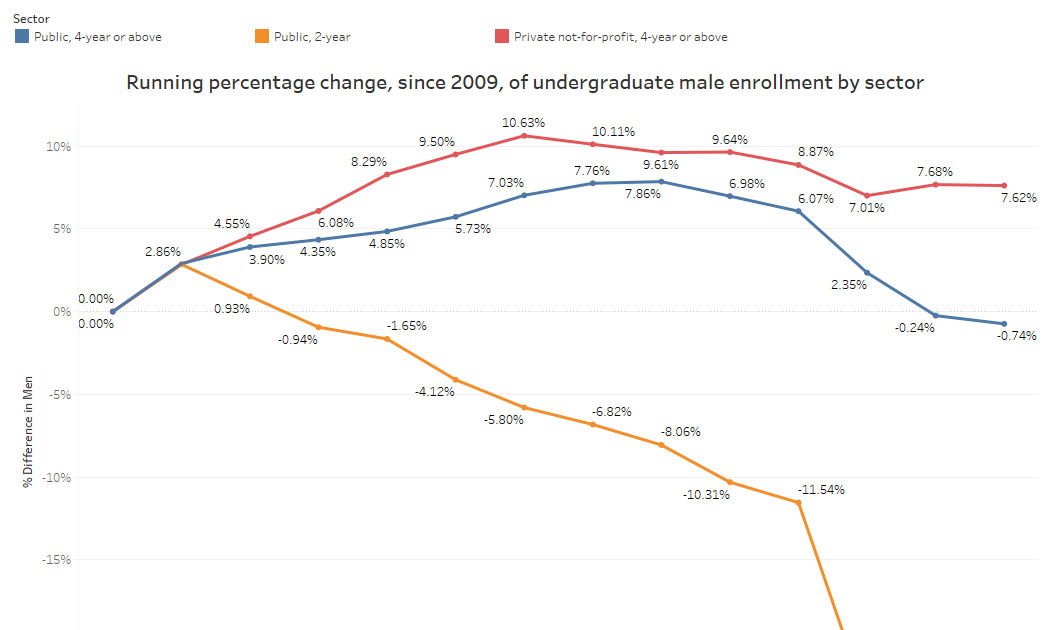
    You have, of course, heard about the crisis of male enrollment in American colleges, which, if you look at the data, is really a crisis of enrollment at Community Colleges.  Far be it from me to insist on data, however.

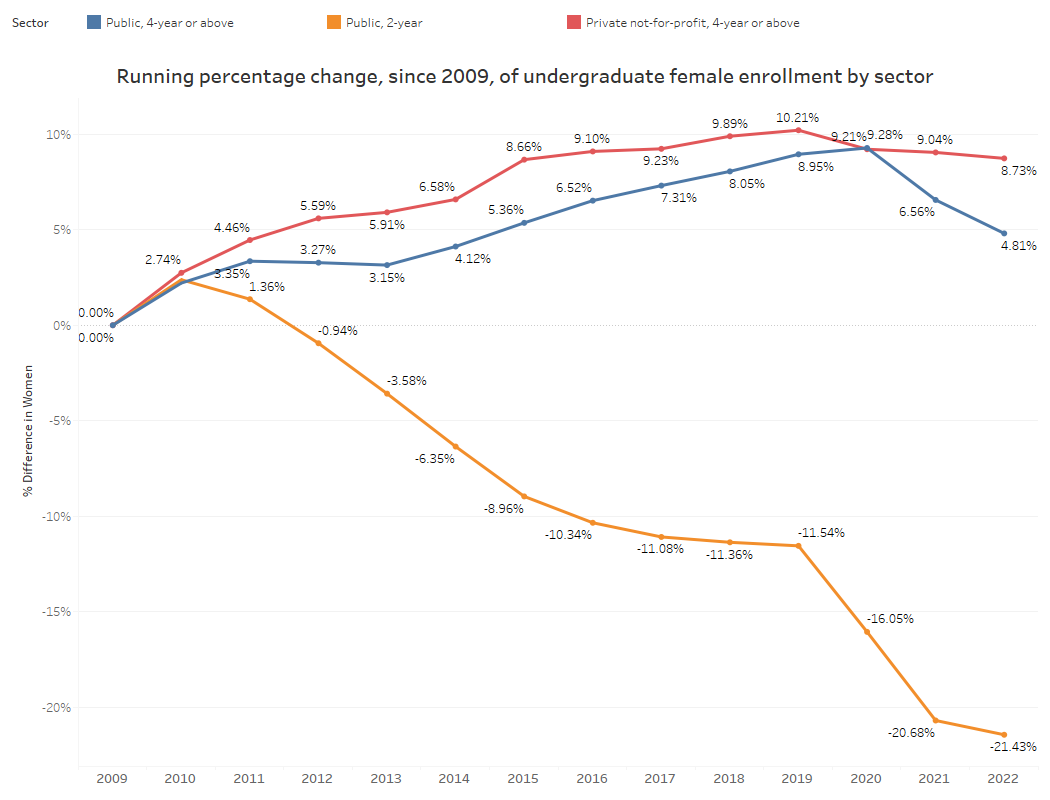
    Here is the same data for women, just to point out that there are differences.  Whether we should celebrate increasing attainment among young women or decry the inability of young men to keep up is your choice. 

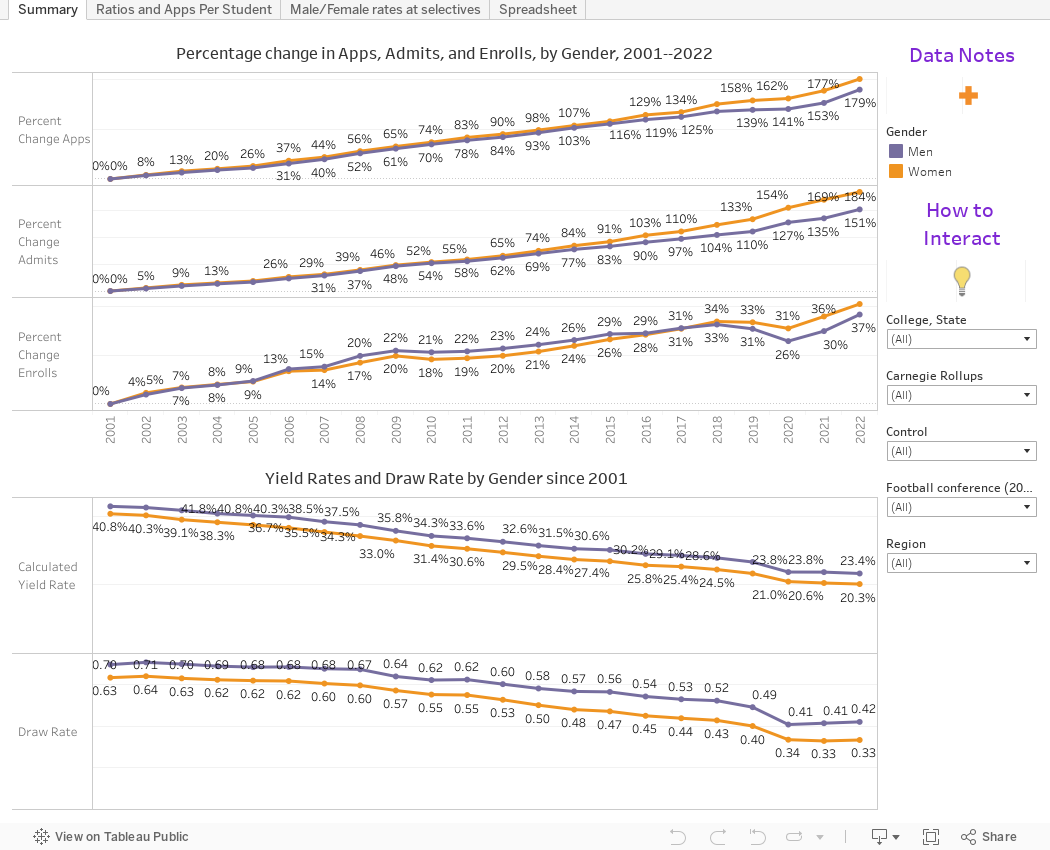
    Regardless, here is a detailed breakout of these patterns as they show up in admissions over time.  There are four views here: A summary on tab one (using the tabs across the top); ratios of women to men at all stages of the process and estimated applications per student; gender-specific admission rates at the highly rejectives over time; and, for anyone who wants to download the data using the little icon at the bottom, a spreadsheet format.  Note: IPEDS just started collecting application data on non-binary students, so it will be a while before any trend analysis is possible.  For 2022, I only included students who self-identified as male or female.)

    Rather than explain the interactivity, I’ve put two buttons on the first view: Hover over the Orange Plus Sign to read some caveats about the data; and hover over the lightbulb for information about how to interact.

    As always, I’d love to hear what you see.

    Source link

  • Medical College Admission Data, 2023

    Medical College Admission Data, 2023

    This is a reboot of a visualization I did in 2018, which I found fascinating, but which didn’t get much traffic at the time, and thus, I’ve not refreshed it.  But I still find it compelling and instructive.

    Each year, the Association of American Medical Colleges publishes a lot of data about admission to medical colleges in the US. But frankly, it’s a mess, and takes a lot of effort to clean up and visualize: Each link is a separate spreadsheet, and each spreadsheet has spacer rows and merged cells and lots of stuff that needs to be scrubbed (carefully) before analyzing and visualizing.  So, if you use this work in a professional capacity, I’d appreciate your support for my time, software and hosting costs at this link. As a reminder, I don’t accept contributions from high school counselors, students, or parents who are using the site.  (And if you know anyone at AAMC, tell them raw data would be much appreciated).

    There are seven views here, some of which combine several data sets.  Use the tabs across the top to access the views.

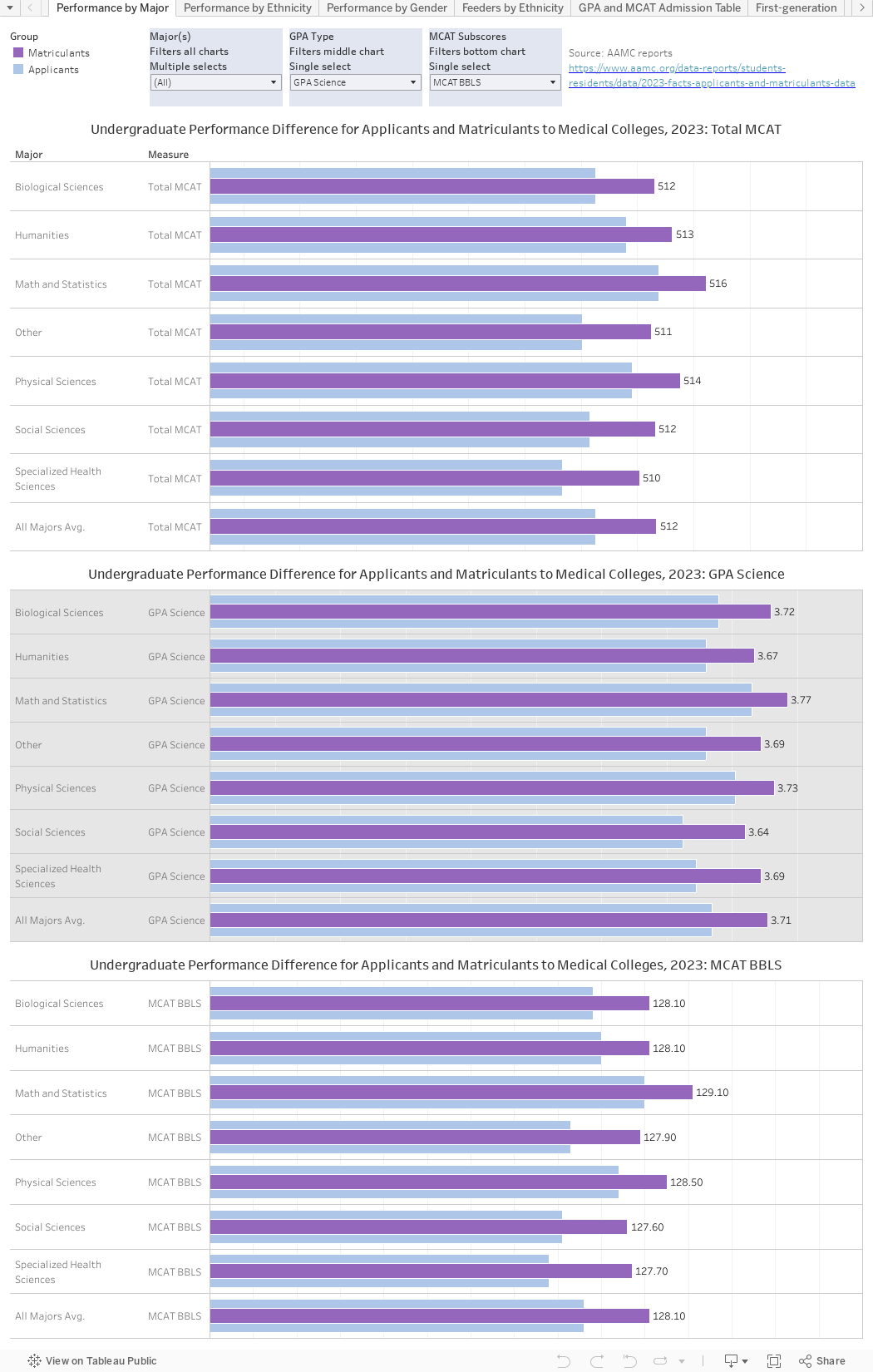
    The first three tabs show similar data, broken out three ways: By undergraduate major, by ethnicity, and by gender for applicants and matriculants. Don’t be afraid to use the filters to get what you want; you won’t break anything, and there is a reset button at the bottom.

    The top chart on these three views shows Total MCAT scores for applicants (blue) and matriculants (purple).  The middle chart shows your choice of GPA, using the filter at the top: Science, Non-Science, and Overall.  And the bottom chart shows sub-scores on the MCAT, again, based on the filter you choose.  Hover over a bar for details. 

    Total MCAT scores range from 472 to 578 with 500 being the mid-score, and each of the four sections–Biological and Biochemical Foundations of Living Systems; Chemical and Physical Foundations of Biological Systems; Psychological, Social, and Biological Foundations of Behavior; and Critical Analysis and Reasoning Skills–is scored from a low of 118 to a high of 132, with a midpoint of 125. Read about them here, whence I shamelessly stole this information.

    The fourth tab shows which undergraduate institutions sent applications to US Medical Schools in what quantity, based on student ethnicity.  Note that the data are not complete, but rather a compilation of five different reports, for colleges sending applications from at least 100 White students, 50 Asian students, 15 African-American students, 10 Hispanic students, or five Native American/Alaska Native students.  A college can be on one list but not another: For instance, the University of Oklahoma is #1 for Native students, but not on the list of institutions sending at least 50 Asian students.

    When you hover over the bars, you can see that institution in larger context, like this:

    The fifth tab gets into the nitty-gritty, and show the distribution of applicants and admits by GPA and MCAT ranges (top two charts), as well as the admission rate (bottom), showing the success of being admitted to at least one medical college.

    The sixth and seventh tabs are simple summaries by first-generation status, and gender over time.

    There is an awful lot of data here, and again, if you have any sway with the AAMC, tell them I’d sign my life away to get raw data in one big file.  As always, let me know what you see here.

    Source link