This audio is auto-generated. Please let us know if you have feedback.
Dive Brief:
This fall, an Alabama initiative will begin offering interested high school students direct admissions to 16 of the state’sfour-year institutions and 23 of its community colleges based on their transcripts.
Under the newly announced Alabama Direct Admission Initiative,high school seniors mustupload their transcripts to an online portal to receive automatic admissions offers. The process will neither charge students application fees nor require them to upload additional materials like essays or recommendation letters.
States have increasingly turned to direct admissions as a way to reach out to students who may not have considered higher education or don’t view themselves as college material.
Dive Insight:
The direct admissions portal is set to open to students on Aug. 26. To participate in the first round of offers, interested students must upload their transcripts by Sept. 23 to receive their acceptances by Oct. 6.
The participating colleges are primarily public institutions, like Alabama State University,the University of Montevallo and the state’s community colleges.The list also includes some historically Black institutions, such as Alabama A&M University and the private Tuskegee University. The University of Alabama, the state’s flagship, and Auburn University are not participating.
Many participating colleges will include merit-based scholarships with their offers, according to the initiative’s website.
“The goal is to make college more affordable from the start,” it said.
Students will also have the opportunity to indicate interest in acceptance notifications from out-of-state institutions, per the website. Those offers would come later in October, it said.
In a Thursday statement, Alabama Gov. Kay Iveycalled the initiative “a smart, student-centered solution” that demonstrates the state’s focus on educational opportunities and workforce readiness.
Alabama Possible,a nonprofit that’s focused on educational attainment and economic opportunity in the state, is leading the direct admissions initiative in partnership with the Alabama Department of Education and the state community college system. The student-college matching software, Appily Match, is a product of education company EAB.
Chandra Scott, executive director of Alabama Possible,said Thursday that direct admissions supports thestate’s workforce and economic mobility goals.
“Direct admissions eliminates uncertainty and sends a clear message to Alabama students: you are college-ready and you belong,” Scott said in a statement.
One of the earliest statewide direct admissions programs, started by Idaho in 2015, raised first-time undergraduate enrollment by a little over 8%, according to a 2022 study.
Since Idaho, several other states have pursued direct admissions programs to both boost college attendance among residents and increase enrollment at public institutions.
One of Alabama’s neighbors similarly invested in direct admissions this summer. Last month, Tennessee announced it would launch a direct admissions pilot this November, automatically offering college acceptance to students based on their academic records and their completion of the Tennessee Promise application.
The Tennessee pilot, which includes students from a randomly selected pool of high schools, will also provide roughly half of the recipients with personalized financial aid information to see if that increases their chances of enrolling in college.
Last year, The Common Application expanded its direct admissions program to send automatic acceptance letters from 116 colleges to first-generation and low- and middle-income students.
And Utah launched a similar acceptance program last year, offering the state’s high school students guaranteed admissions to at least one of its public colleges.While direct admissions offers students college acceptances without an application, guaranteed admissions promises eligible students that they will be accepted if they apply.
Tennessee is joining the ranks of states with direct admissions programs by launching a pilot this fall that will automatically offer certain high school students spots at the state’s two- and four-year colleges based on their academic records.
The program, led by the Tennessee Higher Education Commission, will pair admissions offers with financial aid information for about half the high school students to test whether that boosts their chances of enrolling.
In a statement Wednesday, THEC Executive Director Steven Gentile cast the initiative as a way to simplify the path to college. “For the first time in the nation, we are pairing direct admissions with personalized financial aid information, so students not only know where they’ve been accepted — they’ll also know how they can afford to go.”
Dive Insight:
The TN Direct Admissions pilot is to launch in November, when roughly 41,000 students from more than 230 randomly selected high schools in the state will receive letters listing which participating colleges have automatically accepted them. Around half of those students will also get information about available state and institutional financial aid tailored to them based on their GPA, test scores or other criteria.
To participate, students will need to complete an application for the Tennessee Promise program by Nov. 1.
Researchers will use the information from the pilot to study how providing this information influences college-going behavior.
They aim to find out whether high school students who receive both financial aid information and direct admissions bids are more likely to attend college than those who just get automatic admissions offers. They will also compare the data against that for students who don’t receive direct admissions letters at all.
“Through this study, we will learn not only about the impact of direct admissions and financial aid on students’ college enrollment, but how students feel about their direct admission experience,” Trisha Ross Anderson, a Harvard University researcher working on the project, said in a Wednesday statement.
The financial aid component — which THEC said in a Wednesday statement is the first of its kind for a direct admissions program — will inform students of their eligibility for institutional grants and scholarships, as well as for state programs such as the Tennessee Promise. That program covers remaining tuition and fees for students at state community or technical colleges after all other grant aid has been applied.
Overall, 53 colleges are participating in the fall pilot. That includes all 13 of the state’s community colleges and its 23 technical colleges, as well as 17 public and private universities.
Tennessee joins several other states that have recently launched direct admissions programs. Earlier this year, Illinois Gov. JB Pritzker signed a bill into law to send high school and community college students direct admissions offers to the state’s universities depending on their academic performance.
And last October, New York launched an effort to guarantee fall 2025 spots to at least one of its public universities for high school students graduating in the top 10% of their class. The nine initial participating colleges included the state’s two flagships, University at Buffalo and Stony Brook University.
HEPI Director, Nick Hillman, looks at the latest row on admissions to the University of Oxford.
In a speech on Friday, the Minister for Skills, Baroness Smith, strongly chastised her alma mater, the University of Oxford, for taking a third of their entrants from the 6% of kids that go to private schools.
In a section of the speech entitled ‘Challenging Oxford’, we were told the situation is ‘absurd’, ‘arcane’ and ‘can’t continue’:
Oxford recently released their state school admissions data for 2024.
And the results were poor.
66.2% – the lowest entry rate since 2019.
I want to be clear, speaking at an Oxford college today, that this is unacceptable.
The university must do better.
The independent sector educates around 6% of school children in the UK.
But they make-up 33.8% of Oxford entrants.
Do you really think you’re finding the cream of the crop, if a third of your students come from 6% of the population?
It’s absurd.
Arcane, even.
And it can’t continue.
It’s because I care about Oxford and I understand the difference that it can make to people’s lives that I’m challenging you to do better. But it certainly isn’t only Oxford that has much further to go in ensuring access.
This language reminded me of the Laura Spence affair, which produced so much heat and so little light in the Blair / Brown years and which may even have set back sensible conversations on broadening access to selective higher education.
I wrote in a blog over the weekend that the Government are at risk of forgetting the benefit of education for education’s sake. That represents a political hole that Ministers should do everything to avoid as it could come to define them. Ill-thought through attacks on the most elite universities for their finely-grained admissions decisions represent a similar hole best avoided. Just imagine if the Minister had set out plans to tackle a really big access problem, like boys’ educational underachievement, instead. The Trump/Harvard spat is something any progressive government should seek to avoid, not copy.
The latest chastisement is poorly formed for at least three specific reasons: the 6% is wrong in this context; the 33.8% number does not tell us what people tend to think it does; and Oxford’s current position of not closely monitoring the state/independent split is actually in line with the regulator’s guidance.
6% represents only half the proportion (12%) of school leavers educated at independent schools. In other words, the 6% number is a snapshot for the proportion of all young people in private schools right now; it tells us nothing about those at the end of their schooling and on the cusp of higher education.
The 33.8% number is unhelpful because 20%+ of Oxford’s new undergraduates hail from overseas and they are entirely ignored in the calculation. If you include the (over) one in five Oxford undergraduate entrants educated overseas, the proportion of Oxford’s intake that is made up of UK private school kids falls from from something like one-third to more like one-quarter. This matters in part because the number of international students at Oxford has grown, meaning there are fewer places for home students of all backgrounds. In 2024, Oxford admitted 100 more undergraduate students than in 2006, but there were 250 more international students – and consequently fewer Brits. We seem to be obsessed with the backgrounds of home students and, because we want their money, entirely uninterested in the backgrounds of international students.
The Office for Students dislikes the state/private metric. This is because of the differences within these two categories: in other words, there are high-performing state schools and less high-performing independent schools. Last year, when the University of Cambridge said they planned to move away from a simplistic state/independent school target, John Blake, the Director of Fair Access and Participation at the Office for Students, confirmed to the BBC, ‘we do not require a target on the proportion of pupils from state schools entering a particular university.’ So universities have typically shied away from this measure in recent times. If Ministers think it is a key metric after all and if they really do wish to condemn individual institutions for their state/independent split, it would have made sense to have had a conversation with the Office for Students and to have encouraged them to put out new guidance first. At the moment, the Minister and the regulator are saying different things on an important issue of high media attention.
Are independently educated pupils overrepresented at Oxbridge? Quite possibly, but the Minister’s stick/schtick, while at one with the Government’s wider negative approach to independent schools, seems a sub-optimal way to engineer a conversation on the issue. Perhaps Whitehall wanted a headline more than it wanted to get under the skin of the issue?
we do not require a target on the proportion of pupils from state schools entering a particular university
John Blake, Director for Fair access and participation
In February 2022, then Secretary of State for Education Nadhim Zahawi told Parliament the Johnson government’s decision on post-qualification admissions.
Clear as a welcome school bell, he stated “we will not be reforming the admissions system to a system of PQA at this time”.
But who says that we don’t already have PQA?
Admissions reform by stealth
The “Decline My Place” button introduced by UCAS instead of Adjustment basically introduced PQA anyway. The only reason we haven’t noticed is that we were not, then, very focused on undergraduate home numbers. How things change.
Let’s think about JCQ results day 2025. Let’s say I work at an institution in the Russell Group with good recruitment opportunities for UG home and some uncertainties (I enjoy understatement) about postgraduate international numbers. And let’s say I decide to make hundreds more spaces available than previously planned earlier in the cycle.
But let’s also say that my colleagues further north, west and east do the same. I have a wonderfully smooth confirmation, accepting lots of well qualified and soon-to-be happy young people. I arrive on results day less stressed and tired than usual which is just as well because all hell breaks loose.
From 8:00am until 1:00pm I am frantically confirming Clearing places and, I’m hitting refresh on our numbers forecast every 5 minutes. My blood pressure is rising as is my cake consumption (the renewable energy of choice for any self-respecting Admissions Office). I am desperately trying to work out if our gains are ahead of our losses.
That’s because hundreds (more?) of our nurtured, valued and cultivated unconditional firm offer-holders have hit a button at UCAS and declined their place to go elsewhere. On top of this, for the first time in 2025, some who are still conditional have released themselves too. Fine, I hear you say – If you haven’t processed a decision you deserve to lose the student. But several of these students are still awaiting results (excluded from the requirement that Decline My Place is only for those with a complete set of Level 3 results).
You may well ask where the problem is here.
A better offer
Well, these particular students are from schools and colleges where we have a partnership. Several have been on long-term aspiration-raising enrichment programmes with us for over two years. We have invested all we can in their (everyone must have one) journey. It’s just that they’ve had “a better offer”.
This may be an offer from an institution in London where “our” student has been offered a big financial incentive, and which grew its Clearing intake from zero to 200 in two years. An offer from a delightful campus in the Midlands where “our” student will be very happy and which would not have been an option when only 45 Clearing places were available – but now there are 500. An offer from an exciting and vibrant institution in the north which can take “our” student for Economics – a real surprise as spaces are not often available for a subject like that, but then this university grew its Clearing intake from 200 to 885 over the last two cycles.
These are all real examples from last year. Companies may well have to say that past performance is no guarantee of future results, but we wouldn’t select on the basis of predicted grades if it wasn’t to some degree – now would we?
Personally I have always been in favour of PQA in theory. It is just that the jeopardy I enjoy about admissions doesn’t quite extend to the levels of uncertainty I predict for the few days after 14 August 2025. I wonder how many members of the UCAS Board and how many vice chancellors realise that there is, in a theoretical model that may very well be tested this summer, every possibility that every single firm accept that we have all secured, conditional or unconditional, melts on or before Results Day.
They can all, with absolutely no controls (apart from a quick call to UCAS if you are still conditional) decline their place and go to the pub to celebrate “trading up”. If that isn’t PQA what is? I need another cake.
Last month the government cut $400 million in federal funding for Columbia University and sent a list of demands the university would have to meet to get it back. Among them: “deliver a plan for comprehensive admission reform.”
The administration sent a similar letter earlier this month to Harvard University after freezing $9 billion in funding, demanding that the university “adopt and implement merit-based admissions policies” and “cease all preferences based on race, color, ethnicity or national origin in admissions.”
And in March the Department of Justice launched investigations into admissions practices at Stanford University and three University of California campuses, accusing them of defying the Supreme Court’s decision banning affirmative action in June 2023’s Students for Fair Admissions v. Harvard.
Exactly what the Trump administration believes is going on behind closed doors in highly selective college admissions offices remains unclear. The University of California system has been prohibited from considering race in admissions since the state outlawed the practice in 1996, and both Harvard and Columbia have publicly documented changes to their admissions policies post-SFFA, including barring admissions officers from accessing the applicant pool’s demographic data.
Regardless, given the DOJ investigations and demands of Columbia and Harvard—not to mention potential demands at newly targeted institutions like Princeton, Northwestern and Brown—the federal government appears set to launch a crusade against admissions offices.
A spokesperson for the Education Department did not respond to multiple questions from Inside Higher Ed, including a request to clarify what “comprehensive admission reform” means and what evidence the administration has that admissions decisions at Columbia and Harvard are not merit-based, or that they continue to consider race even after the SFFA ruling.
Columbia acquiesced to many of the Trump administration’s demands, but it’s not clear if admissions reform is one of those concessions. When asked, a Columbia spokesperson said that “at this moment” the university had nothing to add beyond the university’s March 21 letter to the administration.
In that letter, Columbia officials wrote that they would “review our admissions procedures to ensure they reflect best practices,” adding that they’d “established an advisory group to analyze recent trends in enrollment and report to the President” on “concerns over discrimination against a particular group.”
Interestingly, Columbia officials also wrote that they would investigate “a recent downturn in both Jewish and African American enrollment.”
A Harvard spokesperson told Inside Higher Ed that the university’s “admissions practices comply with all applicable laws,” but they declined to answer additional questions about potential changes to admission policies or whether they’d received clarification from the Trump administration.
Angel Pérez, president of the National Association for College Admission Counseling, said the vague demands on college admissions offices are intentional, and that the administration is “setting institutions up for failure.”
“Institutions are certainly going to defend their process, but it’s going to be chaotic and it’s going to be noisy … it’s almost like we are seeing SFFA play itself out all over again,” he said. “Is there the potential that it could change some things about the [admissions] process? Absolutely. We just don’t know what that would look like.”
Orwell in the Reading Room
If the Trump administration’s specific grievances with selective admissions are murky, then its plan to enforce “reform” is downright opaque. However, officials have offered some hints.
In a December op-ed in The Washington Examiner, which outlined a plan that so far reflects the Trump administration’s higher education agenda with uncanny accuracy, American Enterprise Institute fellow Max Eden suggested “a never-ending compliance review” targeting Harvard and others to enforce the SFFA ruling. In his view, admissions officers should not discuss applicants or make decisions without a federal agent present to ensure they don’t even obliquely discuss race.
“[They] should assign Office of [sic] Civil Rights employees to the Harvard admissions office and direct the university to hold no admissions meeting without their physical presence,” Eden wrote. “The Office of Civil Rights should be copied on every email correspondence, and Harvard should be forced to provide a written rationale for every admissions decision to ensure nondiscrimination.”
Eden now works for the Trump administration, though it’s not clear in what capacity. Inside Higher Ed located a White House email address for him, but he did not respond to several interview requests in time for publication.
Edward Blum, the president of Students for Fair Admissions and the architect of the affirmative action ban, told Inside Higher Ed he thinks rigorous federal oversight of admissions offices is sorely needed.
“Requiring competitive colleges and universities to disclose in granular detail their admissions practices to various federal agencies is an important and wise decision,” he wrote in an email.
Pérez said that level of intrusion on a college admissions office’s process would effectively destroy the profession.
“If that were to happen, I can unequivocally tell you that we are not going to have people who want to do this work,” he said. “We know how critically important it is. But how many more headwinds can they face before they begin to ask themselves, is this really worth it?”
Crusade in Search of a Problem
Test-optional admissions policies are likely to become a magnet for federal scrutiny. In a February Dear Colleague letter instructing colleges to eliminate all race-conscious programming, the Education Department wrote that test-optional policies could be “proxies for race” to help colleges “give preference” to certain racial groups.
Personal essays may also fall under the Trump administration’s microscope. Hard-line affirmative action critics have suggested that colleges may be effectively circumventing the Supreme Court’s ban by imputing an applicant’s race from their essays. Chief Justice John Roberts’s majority opinion said that practice should be tolerated as long as an applicant’s identity is considered in the context of their personal journey. But his vaguely self-contradictory language—he added a caveat that said essays should not be used as a “proxy” for racial consideration—has engendered fierce debate over the role of the essay in applicant reviews.
Last month the University of Austin, an unaccredited new college in Texas with ideologically conservative roots, announced it would consider only standardized test scores when admitting applicants, disregarding essays, GPA and recommendation letters.
“Admissions at elite colleges now come down to who you know, your identity group or how well you play the game,” a university official wrote in announcing the policy. “This system rewards manipulation, not merit.”
Blum suspects many selective colleges of disregarding the affirmative action ban and said he was especially skeptical of those that reported higher or stable enrollments of racial minorities this fall, including Yale, Duke and Princeton. In an interview with Inside Higher Ed in February, he said he expects those institutions to invoke scrutiny from the courts and the Trump administration.
But both Columbia and Harvard reported declines in underrepresented minority enrollment last fall, especially Black students. At Harvard, Black enrollment fell by 4 percentage points, from 18 percent for the Class of 2027 to 14 percent of the Class of 2028; at Columbia Black enrollment fell by 12 points, from 20 percent to 8 percent. (This paragraph has been updated to correct Harvard’s Black enrollment figures.)
Pérez said that colleges that reported higher underrepresented minority enrollment have a simple explanation: demographic trends.
“The truth is that the majority of students applying to institutions right now are incredibly diverse and will only get more diverse,” he said. “You’re putting colleges in an impossible position if you’re penalizing them for having a more diverse applicant pool.”
Eric Staab, vice president of admissions and financial aid at Lewis & Clark College in Portland, Ore., said his institution isn’t concerned about drawing the Trump administration’s ire, despite going test-blind this year and maintaining a stable level of racial diversity.
For one, he said, he’s not sure the Office for Civil Rights will be staffed well enough to take on more than a handful of target institutions after the Education Department’s mass layoffs last month. Even if it is, Staab said he’s confident that post-SFFA, investigators wouldn’t find anything illegal or even objectionable at Lewis & Clark.
“Admissions has always been a merit-based process … with the [SFFA decision], pretty much all of us needed to do some tweaking or major overhaul of our admissions and financial aid policies, and we did that,” he said. “I’m not worried about them sending people into reading sessions, because we have nothing to cover up.”
But Pérez said there could be a broader chilling effect across admissions offices if the Trump administration pursues a more aggressive approach to its “admissions reform” agenda.
“Institutions are asking questions of the DOJ and other departments to try to get clarity, but therein lies the challenge: They have not been given clarity, so they don’t know how to prepare,” he said. “That lack of clarity is causing chaos.”
The Department of Justice launched investigations into admissions practices at four California universities on Thursday night, accusing them of flouting the Supreme Court’s ruling banning affirmative action in Students for Fair Admissions v. Harvard and University of North Carolina at Chapel Hill.
The “compliance reviews,” as the department called them, will target Stanford University and three University of California campuses: Berkeley, Los Angeles and Irvine.
In a statement announcing the investigations, the Justice Department wrote that the investigations are “just the beginning” of their efforts to “eliminate DEI” in college admissions.
“President Trump and I are dedicated to ending illegal discrimination and restoring merit-based opportunity across the country,” U.S. attorney general Pam Bondi wrote in the statement.
It’s unclear what prompted the investigations or what evidence the department has to support its suspicions of illegal racial preferences in admissions at the targeted institutions. Some affirmative action opponents have suggested that institutions that enrolled higher numbers of minority students last fall, the first class admitted after the Supreme Court decision, may have done so illegally.
Berkeley, UCLA and Irvine all reported upticks in the number of Black and Hispanic students enrolled in the Class of 2028 last fall: 45 percent of students who enrolled at a UC system campus this fall were underrepresented students of color, a 1.2 percent increase from 2023 and a record for the system.
Just hours before the DOJ announced its probe, the Department of Health and Human Services launched its own investigation into admissions practices at UCLA’s medical school, accusing it of illegally considering applicants’ race.
The UC system has been banned from considering race in admissions since 1996, when the state passed a referendum making the practice illegal at public institutions. That hasn’t stopped anti–affirmative action watchdogs from accusing the system of doing so secretly.
Last month, the newly formed public interest group Students Against Racial Discrimination filed a lawsuit accusing the system of practicing affirmative action behind closed doors, citing increases in Black and Hispanic enrollment at its most selective campuses, namely UCLA and Berkeley, and labeling recent admissions policies—like the decision in 2020 not to consider standardized test scores—proxies for affirmative action.
“Since Proposition 209 banned California’s public institutions from considering race in admissions, UC has implemented admissions practices to comply with it,” a UC spokesperson wrote in an email to Inside Higher Ed. “The UC undergraduate admissions application collects students’ race and ethnicity for statistical purposes only. This information is not shared with application reviewers and is not used for admissions.”
Stanford, unlike the UC schools, reported a marked decline in first-year underrepresented students last year, according to the university’s Common Data Set, released last month. Black enrollment at the university fell by nearly 50 percent, and Hispanic enrollment by 14.4 percent; meanwhile, white and Asian enrollment rose by 14.5 percent and 10 percent, respectively.
Luisa Rapport, Stanford’s director of media relations, said the university has not flouted the affirmative action ban, and that following the SFFA ruling, it “immediately engaged in a comprehensive and rigorous review to ensure compliance in our admissions processes.”
“We continue to be committed to fulfilling our obligations under the law, and we will respond to the department’s questions as it conducts this process,” she wrote in an email to Inside Higher Ed.
‘Just the Beginning’
Angel Pérez, president of the National Association for College Admission Counseling, said he’s heard “extraordinary concern” from admissions officers and deans in recent weeks that investigations could spread to their institutions. They don’t know how to prepare because “we have no idea what these compliance reviews even entail.”
What they do know, he said, is that investigations could throw their offices into chaos during the height of admissions season.
“These kinds of reviews are extremely disruptive. They’re also extremely expensive,” Pérez said. “There are some institutions that, you know, may not survive a compliance review given the legal costs.”
In an interview with Inside Higher Ed last month, Edward Blum, president of SFFA and the architect of the nationwide affirmative action ban, said he expected schools that reported higher enrollment of racial minorities in the fall to invoke legal scrutiny, both from the courts and the Trump administration. He said he believed a number of institutions could be “cheating” the SFFA ruling, including some that were not included in this first round of investigations: Yale, Duke and Princeton.
“So many of us are befuddled and concerned that in the first admissions cycle post-SFFA, schools that said getting rid of affirmative action would cause their minority admissions to plummet didn’t see that happen,” he said.
Some colleges are withholding demographic information about their incoming classes altogether. On Thursday, hours after the Justice Department probes were launched, Harvard admitted its Class of 2029 but did not release any information—including demographics, acceptance and yield rates, and geographic data—for the first time in more than 70 years.
In response to multiple questions from Inside Higher Ed about what the compliance reviews would entail or how the department plans to pursue its investigations into admissions offices, a Justice Department spokesperson referred to the initial statement announcing the investigations.
“No further comment,” he wrote via email.
There are some hints, though, as to what form a federal admissions investigation could take. In a December op-ed in The Washington Examiner outlining a plan that has reflected the Trump administration’s higher education agenda so far with uncanny accuracy, American Enterprise Institute fellow Max Eden suggested Bondi initiate “a never-ending compliance review” targeting Harvard University and others to enforce the SFFA ruling.
“She should assign Office of Civil Rights employees to the Harvard admissions office and direct the university to hold no admissions meeting without their physical presence,” Eden wrote. “The Office of Civil Rights should be copied on every email correspondence, and Harvard should be forced to provide a written rationale for every admissions decision to ensure nondiscrimination.”
For the four universities at the center of the investigations, this disruption could be especially pronounced right now, as colleges begin sending out acceptance letters and enter the busiest season for building their incoming classes.
“This could not come at a worse time. It is April; this is enrollment management season,” Pérez said. “For institutions to take the time, energy and resources to [respond to compliance reviews] means that they’re going to have a harder time enrolling their classes.”
‘Absurd’ Accusations
The Department of Justice is alleging that in the year and a half since the SFFA ruling, colleges have skirted the law by continuing to consider race in the admissions process. Those grounds make its targets particularly confusing, given that the University of California system hasn’t used affirmative action in admissions for nearly three decades.
In 1996, California voters passed Proposition 209, banning the practice at public colleges. In the application cycles immediately after, Black and Hispanic enrollment fell precipitously. Pérez said it took many years of experimenting with race-neutral admissions, financial aid and recruitment policies for UC campuses to bring Black and Hispanic enrollment back to their prior rates.
In the months following the SFFA decision, Pérez said college admissions professionals turned to California for lessons in how to maintain diversity without running afoul of the new law.
“Officials and admission professionals [at UC] have been helping other institutions across the United States comply with the Supreme Court decision,” he said. “They have actually served as leaders in this space. To accuse them of violating any law is absurd.”
According to Common App’s latest “Deadline Update” report released Thursday, college applications for the 2024-25 admissions cycle continue to show strong growth, particularly among underrepresented and first-generation students.
The report, which analyzes application data through March 1, 2025, reveals that 1,390,256 distinct first-year applicants submitted a total of 8,535,903 applications to 863 returning Common App member institutions—marking a 4% increase in applicants and a 6% increase in total applications compared to the same period last year.
One of the most significant trends is the substantial growth among underrepresented minority applicants, which increased by 12% over last year. Specifically:
Latinx applicants rose by 13%
Black or African American applicants increased by 10%
The share of domestic applicants identifying as Black or African American grew from 13.3% to 14%
White applicants’ share of the applicant pool continued its long-term decline, dropping from 48.2% to 45.7%
First-generation college students showed remarkable growth, with a 13% increase in applicants while continuing-generation applicants remained flat. Similarly, applicants eligible for Common App fee waivers increased by 9%, compared to just 2% for non-eligible students.
Students from lower-income communities also made strong gains:
Applicants from ZIP codes with below-median household incomes increased by 8%
Applicants from above-median income ZIP codes grew by only 3%
The report highlights several notable geographic patterns:
The Southwestern region experienced the fastest growth at 34%
Texas led state-level growth with a 37% increase in applicants
District of Columbia applicants grew by 18%
For the first time since 2019, domestic applicant growth (5%) outpaced international applicant growth, which declined by 1%
Applications to public institutions grew at 10%, significantly outpacing the 2% growth rate for private institutions. Additionally, less selective institutions (those with admit rates above 25%) saw application growth of 6-7%, while the most selective institutions (admit rates below 25%) experienced the slowest growth at 4%.
For the first time since the 2021-22 season, applicants reporting test scores (up 11%) outpaced those not reporting scores (down 1%). This reversal comes despite minimal change in the proportion of institutions requiring test scores (increasing only from 4% to 5% of member schools).
This comprehensive report offers valuable insights into college application trends as institutions finalize their incoming classes for the 2025-26 academic year. A more detailed analysis is expected in August when Common App releases its full end-of-cycle report.
Several colleges and universities are pausing admissions to some graduate programs, reducing class sizes or rescinding offers to students in an effort to cut costs amid uncertainty in federal funding.
The disruption to graduate school admissions is the latest cost-cutting move for colleges. After the National Institutes of Health proposed cutting reimbursements for costs related to research, several colleges and universities said they would pause hiring and cut spending, Inside Higher Edpreviously reported. (A federal judge has blocked the NIH plan from taking effect for now.)
In recent days, the University of Pittsburgh, the University of Pennsylvania and several other institutions have stopped doctoral admissions, at least temporarily. Some colleges are pausing admissions to some programs such as in the biomedical sciences, Stat Newsreported. At others, the pause is universitywide. The University of Southern California and Vanderbilt University temporarily paused graduate student admissions, though both universities latersaid that they’d ended the pause.
A University of Pittsburgh spokesperson told WESA, a local NPR station, that the university “temporarily paused additional Ph.D. offers of admission until the impacts of that [NIH] cap were better understood … the University is in the process of completing that analysis and expects to be in a position to resume offers soon.”
Meanwhile, the University of Pennsylvania is planning to cut graduate admissions rates, The Daily Pennsylvanianreported, citing an email from the interim dean of the School of Arts and Sciences, Jeffrey Kallberg, who wrote that the cuts were a “necessary cost-saving measure” to adjust to the NIH proposal.
“This is not a step any of us wanted to take,” Kallberg wrote, according to the Daily Penn. “We recognize that graduate students are central to the intellectual life of our school—as researchers, teachers, collaborators, and future scholars. However, we must ensure that we can continue to provide strong support for those students currently in our programs and sustain the school’s core teaching and research activities.”
Tom Kimbis, executive director of the National Postdoctoral Association, wrote in an email to Inside Higher Ed that academic institutions reliant on federal funding “are being forced to make tough decisions to support these researchers in a difficult environment.”
“The decisions in Washington to pause or cease funding for science and research is impacting early-career researchers across a wide range of disciplines,” Kimbis added. “Slowing or stopping their work, on topics from cancer and Alzheimer’s research to social science issues, hurts Americans in all 50 states.”
In the last week, some faculty began tracking the reductions in the biomedical sciences via a shared spreadsheet that includes verified cuts and unverified decisions based on word of mouth and internal emails. Faculty on social media said the cuts will have long-term ramifications for sciences as fewer students enter the field. On TikTok, several students who had applied to grad school shared their dismay at how the funding cuts meant they might have to say goodbye to their career plans and research.
Accepting graduate students, particularly for Ph.D. programs and in the biomedical sciences, requires universities to make a long-term financial commitment, which is more difficult now that the NIH has stopped making new grant awards and is aiming to cut funds. Colleges receive billions from the NIH to support research. If the proposed rate cuts move forward, institutions say they would have to shut down some labs and lay off employees.
“University research and scholarship operate on a time scale of years and decades,” the Rutgers AAUP-AFT chapter wrote in a letter to New Jersey senators Cory Booker and Andy Kim. “Higher education would become impossible in the face of capricious and arbitrary withholding of funding, elimination of entire areas of grant support for critical scientific research, and cancellation of long-held contracts.”
They went on to warn that the threat to funding would diminish the country’s strength as a research superpower. “The best scientists, the best scholars, and the best students will make the rational decision to take their talents elsewhere. Once lost, the historic excellence of United States universities, including world-leading institutions in New Jersey, both public and private, will not be easily regained.”
As a school administrator or marketer, you’re likely already familiar with the challenges of traditional admissions processes: manual paperwork, miscommunication, long timelines, and a lack of transparency.
Implementing an online enrollment system can revolutionize your institution’s operations. It can help you create a seamless experience for prospective students while significantly easing administrative burdens.
At Higher Education Marketing, we’ve spent years partnering with institutions to understand their unique needs. Our Student Portal is designed specifically for education providers like you, offering an all-in-one solution to streamline admissions and enhance the student journey.
Let’s explore ten benefits of adopting an online admissions and enrollment system and how HEM’s Student Portal can help you transform your processes. You’ll see how much value you can add to your student experience and how a sophisticated CRM can boost enrollment.
Simplify student management and boost recruitment efficiency!
Transform your student portal experience. Get a FREE HEM-SP demo today.
Understanding Online Enrollment Systems
What does an enrollment system do? An online admissions and enrollment system is a digital platform that streamlines student recruitment, application management, and enrollment. By moving these processes online, institutions can eliminate manual paperwork, reduce processing times, and improve the overall experience for students and staff.
These systems typically include customizable application forms, real-time tracking, automated communication tools, and integration with other institutional systems like CRMs and financial platforms. Now, let’s get to the good part–the many benefits of enrollment system tools.
Want to know what our Student Portal System can do for your school? Let’s connect!
A Brief Overview of the Enrollment Process
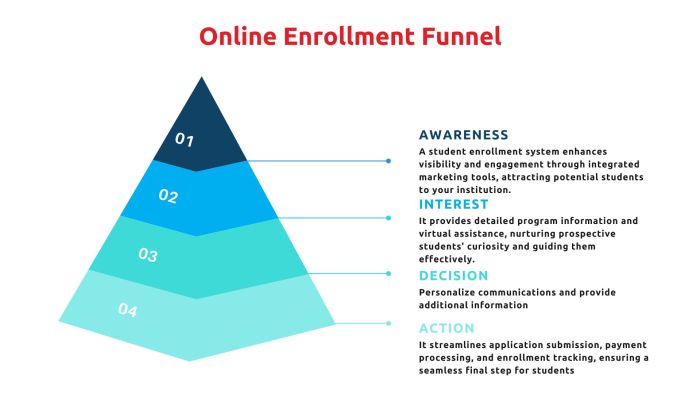
To maximize the benefits of an online admissions and enrollment system, it’s important to understand the enrollment funnel. What is the process for enrollment? It’s a framework that outlines the four key stages prospective students go through when deciding to enroll at your institution. These include awareness, interest, decision, and action.
Awareness is the first stage, where students become familiar with your school through marketing efforts, social media, or word-of-mouth. During this phase, you aim to make a positive impression and highlight what sets your institution apart.
Interest follows as students actively seek more information about your programs and offerings. At this stage, providing detailed program descriptions, virtual tours, and engaging content becomes crucial to capturing their attention.
Decision is the third stage, where students weigh their options and determine if your institution aligns with their goals. Clear application processes, transparent cost estimates, and personalized communication can help sway their decision.
Action is the final stage, where students commit by completing their application and enrollment. An intuitive and efficient online system, like HEM’s Student Portal, ensures this final step is seamless and stress-free, setting the tone for a positive student experience.
Source: HEM
1. Simplifying the Application Process
An online admissions system allows you to simplify and accelerate the application process, providing a smoother experience for prospective students. Instead of requiring students to navigate complex paper forms or disjointed systems, you can offer them a centralized, user-friendly portal where they can complete their applications step-by-step.
HEM’s Student Portal includes a customizable WYSIWYG (what you see is what you get) form builder, allowing you to tailor applications to your institution’s specific requirements. With options for e-signatures, document uploads, and guided prompts, your students can complete their applications quickly and confidently.
For administrators, this streamlined process means less time spent tracking incomplete applications and more time focusing on strategic initiatives. You can view, manage, and update application statuses in real time, ensuring nothing slips through the cracks.
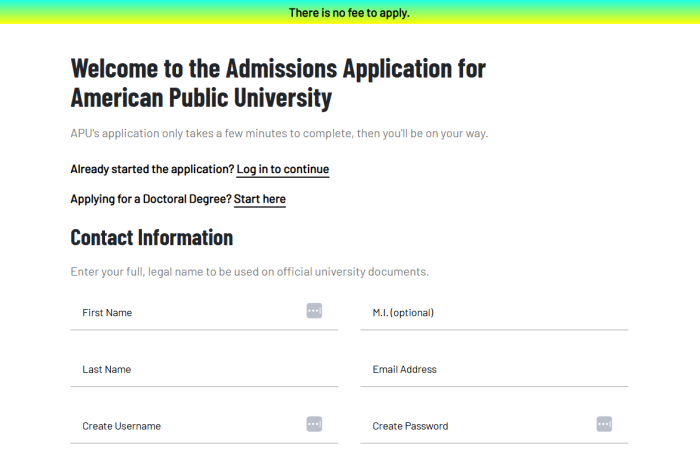
Example: The key benefit of online enrollment systems regarding the student journey is convenience. Here, American Public University is the perfect example.
At the click of a button, students can begin their applications.
They are immediately led to a simple, free application form where they’ll provide vital information needed for the American Public University to determine whether admission into their program will be granted and allow them to track their journey.
Source: American Public University
2. Enhancing Recruitment Efforts
With an online system, you can improve how you engage with prospective students from the beginning of their journey. HEM’s Student Portal integrates powerful marketing automation tools, allowing you to nurture leads with personalized communications at every stage of the admissions funnel. You can keep prospective students engaged and informed by sending timely emails, reminders, and updates, increasing their likelihood of completing enrollment.
Furthermore, the system’s data insights enable you to identify trends in student inquiries, monitor which marketing campaigns are most effective, and adjust your strategies accordingly. This data-driven approach ensures your recruitment efforts are consistently targeted and impactful.
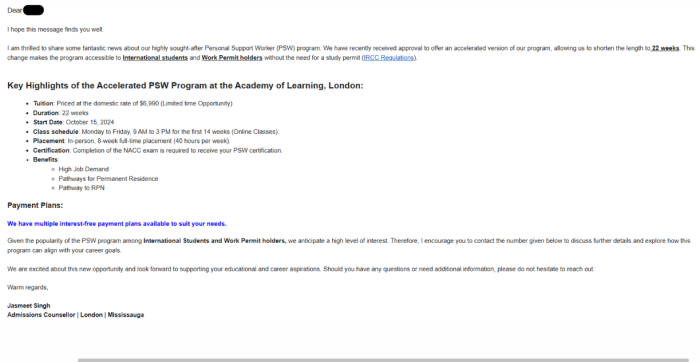
Example: Once a prospect has filled out a contact form or inquired about a program, they should receive a personalized follow-up message that provides program details and prompts them to follow the next steps.
Here, the Academy of Learning sends an automated email about its Accelerated PSW Program to a prospect who recently expressed interest. Our Student Portal integrates email and messaging services to facilitate and automate communication with prospects, a key part of the recruitment process.
Source: Academy of Learning | Gmail
3. Reducing Administrative Burden
One of the most immediate benefits of implementing an online admissions and enrollment system is the reduction in administrative workload. Manual processes can be time-consuming and prone to errors, but with an online platform like HEM’s Student Portal, you can centralize all tasks in one intuitive interface. From managing inquiries to processing payments, every step is organized and automated.
Staff members across departments can collaborate more effectively, ensuring seamless communication and reducing duplication of efforts. The result? A more efficient admissions team with more time to focus on higher-value tasks, such as building relationships with students and refining institutional strategies.
4. Offering Real-Time Insights
Making informed decisions is essential in a competitive education landscape, and real-time insights from your admissions system can give you a critical advantage. HEM’s Student Portal provides robust reporting and tracking tools, giving visibility into key metrics such as completed applications, outstanding payments, and enrollment trends.
Imagine identifying bottlenecks in your process as they happen, enabling you to resolve issues before they escalate. With this level of visibility, you can forecast enrollment numbers more accurately, allocate resources efficiently, and continuously optimize your processes.
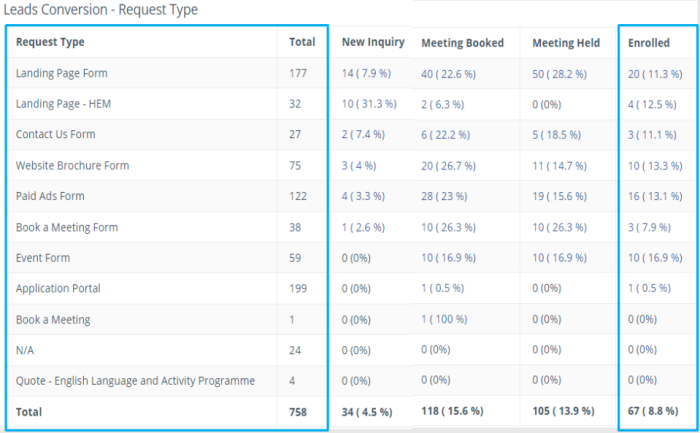
Example: The Student Portal allows you to create comprehensive, updated CRM reports to track enrollment data. Find out what kind of requests are being made, what desired action has been taken, and what’s next.
Source: HEM
5. Improving Communication and Transparency
A common frustration for both students and staff in traditional admissions processes is a lack of clarity. With an online system, communication becomes seamless and transparent. Students can log into their portal anytime to check their application status, access important updates, and even chat with a virtual admissions assistant for guidance.
HEM’s Student Portal goes a step further with its integrated communication tools. From automated notifications to direct messaging capabilities, the platform ensures that every student feels supported and informed throughout their journey. This transparency fosters trust and builds a stronger connection between students and your institution.
6. Enhancing the Student Experience
Your admissions process is often the first interaction prospective students have with your institution, making it crucial to leave a positive impression. An online admissions and enrollment system demonstrates that your school values convenience, efficiency, and modern technology, which resonate with today’s tech-savvy students.
HEM’s Student Portal includes features like virtual admissions assistance and a quote builder, which allows students to estimate program costs upfront. These tools empower students with the information they need to make confident decisions, enhancing their overall experience and reinforcing their trust in your institution.
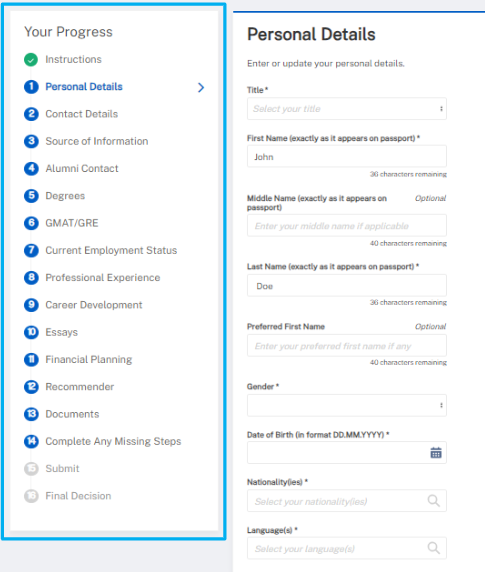
Example: The Student Portal prioritizes a seamless experience for students, guiding them from step to step, making it easy to share important files, and providing a full picture of their enrollment journey.
Source: HEM
7. Facilitating Financial Planning
Financial concerns are one of the most significant barriers prospective students face when considering enrollment. You can address these concerns head-on by incorporating tools like HEM’s quote builder and seamless payment gateway integration. The quote builder provides students and their families with transparent cost estimates for tuition and fees, enabling them to plan their finances effectively.
The payment gateway integration simplifies the payment process, allowing students to make secure transactions directly through the portal. You can also track real-time payment statuses, ensuring that financial records are always current.
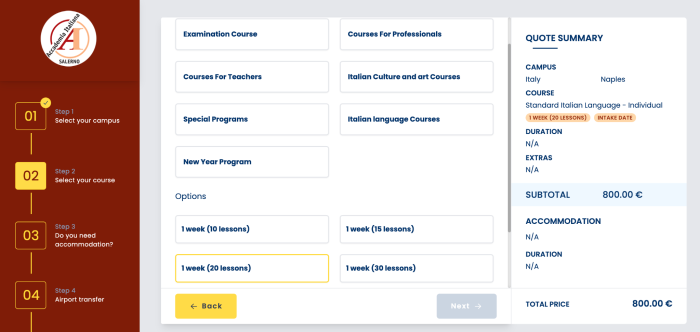
Example: Accademia Italiana Salerno utilizes our Student Portal’s Quote Builder feature, which provides students with a close estimate of their school expenses. Your students will appreciate being able to plan when making a significant investment in their education.
Source: HEM
8. Supporting Institutional Flexibility
Every institution is unique, with its own set of requirements and processes. That’s why customization is essential in any online admissions system. HEM’s Student Portal offers a flexible framework that adapts to your needs, whether you’re managing applications for a university, language school, or K-12 provider.
You can customize application forms, workflows, and communications to align with your institutional goals. This flexibility ensures that the system serves as a seamless extension of your team rather than a one-size-fits-all solution.
9. Boosting Efficiency with Integrated Tools
Efficiency is at the heart of any successful admissions process; integrated tools can make a significant difference. HEM’s Student Portal combines essential functionalities like CRM systems, marketing automation, and data analytics into one centralized platform. This integration eliminates the need for multiple disconnected systems, streamlining your operations and improving collaboration across departments.
For example, marketing teams can use the portal to track campaign effectiveness, admissions staff can manage inquiries and applications, and financial teams can monitor payments—all within the same system. This level of integration enhances productivity and ensures that every team member has access to the information they need.
10. Preparing for the Future
As the education sector evolves, embracing technology is no longer optional but essential! Implementing an online admissions and enrollment system positions your institution as a forward-thinking leader ready to adapt to changing student expectations and market demands.
HEM’s Student Portal is built with the future in mind, incorporating scalable features that grow with your institution. Whether you want to expand your programs, attract international students, or enhance your digital presence, the portal provides the tools you need to succeed.
Why Choose HEM’s Student Portal?
At Higher Education Marketing, we consider ourselves your partners in success. Benefit from the advantages of enrollment system technology, from simplifying application management to enhancing communication and providing real-time insights. Our platform empowers you to transform your admissions process. Request a demo today and discover how HEM’s Student Portal can help you achieve your institutional goals while creating a superior experience for students and staff.
Simplify student management and boost recruitment efficiency!
Transform your student portal experience. Get a FREE HEM-SP demo today.
Frequently Asked Questions
What does an enrollment system do?
An online admissions and enrollment system is a digital platform that streamlines student recruitment, application management, and enrollment.
What is the process for enrollment?
It’s a framework that outlines the four key stages prospective students go through when deciding to enroll at your institution. These include awareness, interest, decision, and action.
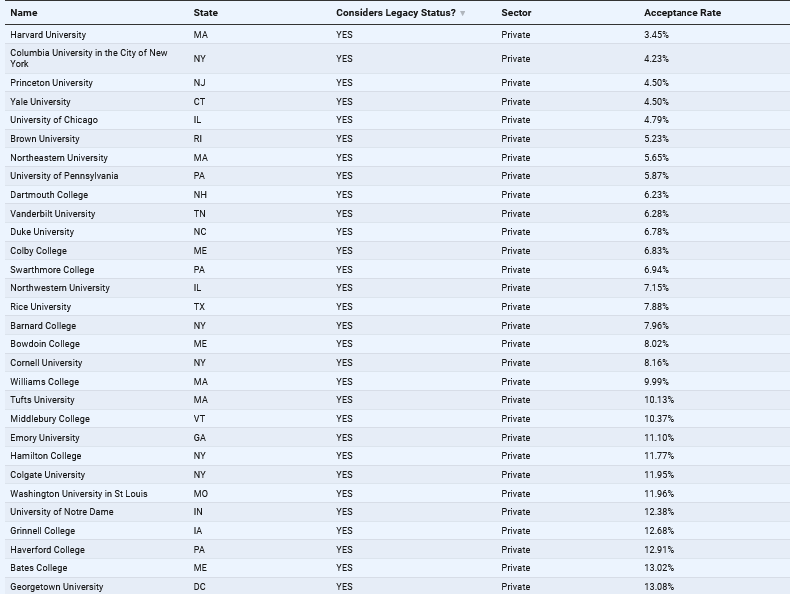
Here is a short list of US universities with legacy admissions. These elite and highly selective schools give preferential treatment to applicants who are related to alumni, which rewards parents, grandparents, and relatives of students rather than rewarding deserving students for their skills and efforts.
While it may not be just or fair, the process is not illegal in the
United States, nor is there much public outcry about this elitist tradition.
Without insider information, it’s also difficult to know how individual schools use legacy admissions and
how the murky process operates.