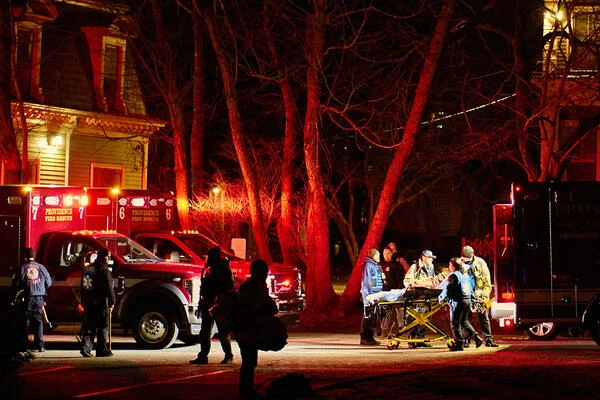
Transcripts from the videos in which Claudio Neves Valente admitted to the crimes were released Tuesday.
Bing Guan/AFP/Getty Images
The man accused of carrying out last month’s mass shooting at Brown University that left two students dead admitted to the crime in a series of four videos, the transcripts of which were released Tuesday by the U.S. Attorney’s Office for the District of Massachusetts.
Claudio Neves Valente, the 48-year-old suspect who previously attended Brown, was found dead by a self-inflicted gunshot wound at a storage facility in New Hampshire just days after the campus attack, preventing investigators from interrogating him. But in the videos, which were pulled from an electronic device at the storage facility and have been translated from Portuguese to English, Valente admitted to the Brown shooting and the subsequent killing of a Massachusetts Institute of Technology professor near Boston.
And while the suspect said that he would not apologize, the motives of the attack remain unclear.
Throughout the more than 11 minutes’ worth of video, he spoke about how he had planned the shooting for years. In multiple instances, Valente vaguely referenced “the people” his violent actions were made in response to, saying, “I did not like any one of you. I saw all of this shit from the beginning.”
He noted that he sent three emails, seemingly to “the people” he’d referenced. But beyond that, he was “not saying anything else.”
The Australian National University (ANU) admitted its has “much work to do” regarding its management and culture in a report it produced for the sector regulator’s ongoing investigation into its governance.
The Self-Assurance Report, completed for the Tertiary Education Quality and Standards Agency (TEQSA), is the first step in TEQSA’s current compliance assessment of the university’s leadership, council culture and financial position, which started in October, 2024.
“The report makes clear that we’re on a journey and that we still have much work to do in the areas of risk management, governance and culture,” vice-chancellor Genevieve Bell said in a statement.
“We recognise that ANU is at a critical point in its history – one where we need to reset not only our finances but also our operating and structural model.”
The university has reported an operating deficit every year since 2020, except 2021, and has forecast a $110 deficit for 2025 and a break-even for 2026.
The recurring deficits caused a major restructure, known as Renew ANU, that aims to save $250 million in yearly spending; $100 million in salary costs and $150m in non-salary costs.
There has 135 voluntary separations and 83 staff redundancies so far, which has saved $13 million, and $37 million has been saved from spending cuts.
From this point, there will be no more forced redundancies that haven’t already been announced, management has said. More salary savings will come from natural attrition.
It has also restructured its teaching operations, causing entire schools, such as its School of Music, to close.
“While the program of work has taken a strategic, phased approach to organisational change, guided by clear principles and extensive consultation, it has been a significant cultural shift and has caused anxiety and uncertainty in the university community,” the report said.
“Council has been regularly briefed about the progress of the work; and an internal governance board has maintained appropriate oversight … council has identified and is addressing the risks that led to the university’s current financial position, however, there remains work to be done to bring the whole university community along on this journey.
“Given the complexities with the university’s finances, this involves continuing to work with the university community in an enhanced way to ensure the finances are more easily understood.”
Vice-chancellor Genevieve Bell. Picture: Andrew Meares
The university’s ongoing deficits were not the result of one factor, the report said, but multiple, including the 2017-2021 strategic plan that called for an overall reduced, but more diverse, student base, and a had a projected increase in philanthropic donations. There were also costs associated with hailstorm and fire damage throughout 2019 and 2020.
The strategic plan initiated an ambitious philanthropic campaign that aimed to produce $1bn in donations over 10 years, which would make up for budget shortfalls relating to the overall reduction in student headcount.
The Self-Assurance Report said the philanthropic campaign “never eventuated and was quietly abandoned in late 2022.”
Professor Bell said the university council was very open to reflecting on its own practices and culture when it was discussed at a meeting in early August.
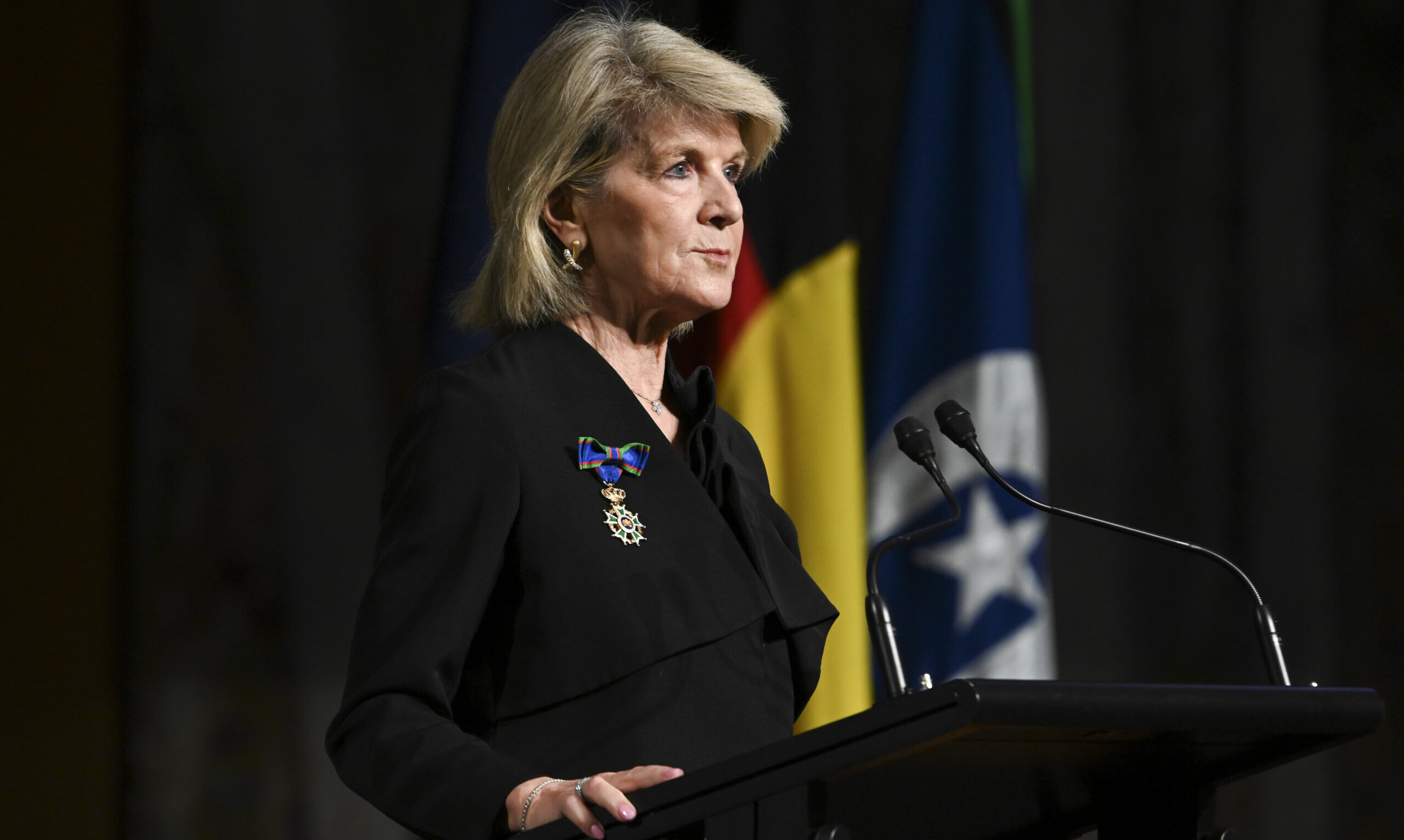
The Cover Letter, which was submitted alongside the Self-Assurance Report, also said ANU will set up an independent investigation into matters raised by academic Liz Allen, who alleged she was bullied and intimidated by ANU chancellor Julie Bishop at the Quality of governance at Australian higher education providers inquiry.
Dr Allen initially lodged a workplace complaint about the incident and the university agreed to appoint an external investigator, who eventually terminated the investigation on ethical grounds of ANU interference.
Professor Bell was absent with the flu on the day of the inquiry hearing, although she responded to the claims on the same day in a statement.
“Although we cannot address individual allegations publicly [due to ongoing investigations], I was really saddened to see members of our university in such distress, both those who appeared at the inquiry and those on our campus who have been impacted,” she said.
“Here on campus, I have now hosted nine ‘Facing the Future’ conversations and I want to thank staff who have made themselves available … I have been encouraged that people have been frank in their feedback, and most have turned up with a spirit of optimism and passion for the university which is a wonderful thing to hear in moments of change.”
The Self-Assurance Report assured TEQSA that ANU has a competent leadership team.
ANU’s executive leadership team. Source: ANU
“While the majority of the Executive Leadership Team are relatively new to their positions, they bring extensive experience to their roles from both within, and external to, ANU and the sector,” it said.
Only three out of nine members of its executive leadership team started their term before February, 2024.
The National Tertiary Education Union (NTEU) on Tuesday launched a petition urging the council to sack chancellor Julie Bishop and vice-chancellor Genevieve Bell and reverse the job and course cuts. It follows a vote of no confidence in the leadership pair by 800 ANU staff in March.
“We don’t need a new investigation, we need new leadership,” NTEU ACT division secretary Lachlan Clohesy said of the independent investigation into Dr Allen’s allegations.
“The matters raised during the Senate hearing are already being investigated by the regulator, TEQSA, and that is appropriate.
“This investigation is a distraction at a time when over one hundred people still face forced redundancies.”
The State Bar of California sparked outrage after it admitted to using artificial intelligence to help craft some of its multiple-choice exam questions, the Los Angeles Timesreported. The Monday announcement came after test takers complained of glitches and irregularities while taking the California bar exam in February.
In a news release, the State Bar of California promised to petition the California Supreme Court to adjust test scores for those who took the exam in February. The release detailed that the test’s multiple-choice questions were mostly developed by the test company Kaplan, while some were recycled from the First-Year Law Students’ Exam and others were developed by ACS Ventures, the State Bar’s independent psychometrician, hired to assess questions. ACS Ventures used AI.
But State Bar officials defended the veracity of the exam’s questions.
“We have confidence in the validity of the MCQs to accurately and fairly assess the legal competence of test-takers,” State Bar executive director Leah Wilson said in the release. “Lessons learned are being incorporated into the July exam, and all future tests will include additional levels of independent review and validation.”
Test takers and law school faculty have reacted with shock.
Katie Moran, an associate professor at the University of San Francisco School of Law who specializes in bar exam preparation, told the Los Angeles Times that the announcement was a “staggering admission.”
“The State Bar has admitted they employed a company to have a non-lawyer use AI to draft questions that were given on the actual bar exam,” she said. “They then paid that same company to assess and ultimately approve of the questions on the exam, including the questions the company authored.”
A North Carolina woman will face up to 20 years in prison after admitting that she scammed the Department of Education out of $5 million in financial aid, USA Today reported.
Cynthia Denise Melvin pleaded guilty Wednesday to conspiring with dozens of “straw students” through an elaborate, seven-year scheme, federal court records show. Melvin applied to colleges on the students’ behalf, submitted the Free Application for Federal Student Aid for them, and even went so far as to impersonate the students so it appeared they were attending class and completing assignments, according to charging documents. All the while, she pocketed any leftover aid dollars, giving a small portion to the individuals she was impersonating.
Melvin was charged with conspiracy to commit wire fraud. In addition to her time in prison, she will face three years of supervised release and be required to pay a $250,000 fine, as well as restitution.
The scam is among the biggest “straw student” schemes in years, according to a USA Today review of Department of Justice news announcements.