New research from UPCEA and Collegis Education reveals a growing misalignment between how institutions approach retention and what adult learners actually need to succeed. While many institutions are investing in retention, strategies still over-rely on structured oversight and under-deliver on the flexibility, visibility, and autonomy adult online learners say they need most.
The Retention Disconnect: What Adult Learners Need and What Institutions Miss Wednesday, February 11 1:00 pm ET / 12:00 pm CT
Join Dr. Tracy Chapman, Chief Academic Officer at Collegis Education, and Emily West, Senior Market Research Analyst at UPCEA, as they break down key findings from the national survey and explore how institutions can realign support strategies to improve outcomes, protect revenue, and meet adult learners where they are.
Expert Speakers
Dr. Tracy Chapman
Chief Academic Officer
Collegis Education
Emily West
Senior Market Research Analyst
UPCEA
What you’ll learn:
Why nearly half of institutional leaders can’t report their online retention rate — and why that matters
The disconnect between staff-led interventions and student-preferred tools like dashboards and self-service
How to shift from compliance-based models to empowerment-driven support
The importance of segmentation based on life stage, not just demographics
Three strategic shifts institutions can act on now
Who should attend:
This session is ideal for higher ed leaders focused on student success, enrollment, and retention strategy, including:
Academic leadership (CAOs, provosts)
Enrollment and student affairs leaders
Online and adult learner program managers
Institutional researchers and data strategists
IT decision-makers
Presidents, CFOs, and strategic planning teams
If you’re working to improve outcomes for adult online learners or reduce attrition, this webinar is for you.
Complete the form on the top right to reserve your spot. We look forward to seeing you on Wednesday,February 11.
Our mission is to enable impact in higher education. We help our partners achieve more, deliver superior experiences, and drive impact across the entire student lifecycle by leveraging and aligning data, technology, and talent.
The Adult Student Priorities Survey (ASPS) is the instrument in the family of Satisfaction-Priorities Surveys that best captures the experiences of graduate level students and adult learners in undergraduate programs at four-year institutions. The Adult Student Priorities Survey provides the student perspectives for non-traditional populations along with external national benchmarks to inform decision-making for nearly 100 institutions across the country.
Why the Adult Student Priorities Survey matters
As a comprehensive survey instrument, the Adult Student Priorities Survey assesses student satisfaction within the context of the level of importance that students place on a variety of experiences, both inside and outside of the classroom. The combination of satisfaction and importance scores provides the identification of institutional strengths (areas of high importance and high satisfaction) and institutional challenges (areas of high importance and low satisfaction). Strengths can be celebrated, and challenges can be addressed by campus leadership to build on the good where possible and to re-enforce other areas where needed.
With the survey implementation, all currently enrolled students (based on who the institution wants to include) can provide feedback on their experiences with instruction, advising, registration, recruitment/financial aid, support services and how they feel as a student at the institution. The results deliver external benchmarks with other institutions serving adult learners, including data that is specific to graduate programs, and the ability to monitor internal benchmarks when the survey is administered over multiple years. (The national student satisfaction results are published annually). The delivered results also provide the option to analyze subset data for all standard and customizable demographic indicators to understand where targeted initiatives may be required to best serve student populations.
Connecting ASPS data to student success and retention
Like the Student Satisfaction Inventory and the Priorities Survey for Online Learners (the other survey instruments in the Satisfaction-Priorities family), the data gathered by the Adult Student Priorities Survey can support multiple initiatives on campus including to inform student success efforts, to provide the student voice for strategic planning, to document priorities for accreditation purposes and to highlight positive messaging for recruitment activities. Student satisfaction has been positively linked with higher individual student retention and higher institutional graduation rates, getting right to the heart of higher education student success.
Ask for a complimentary consultation with our student success experts
What is your best approach to increasing student retention and completion? Our experts can help you identify roadblocks to student persistence and maximize student progression. Reach out to set up a time to talk.
About 3.8 million new high school graduates are expected to enroll in higher education next fall. The number of former students with some college credits but no credential is, at nearly 38 million working-age American adults, 10 times larger. If institutions could re-engage just 1 percent of the some college, no credential (SCNC) learners, they would net nearly 400,000 additional enrollments.
Stopped-out learners represent an enormous market—and colleges should be competing for them. But these former students and other adult learners require much different approaches from a postsecondary institution than do 18-year-olds straight out of high school. Here are three simple actions institutions can take to connect with adult learners and put them on a more direct path to enroll.
Start With Your Own Stopped-Out Students
The fiercely competitive market for adult students is dominated by national online universities that pump millions of dollars each year into sophisticated marketing campaigns. That makes it difficult for traditional colleges to make inroads with adult learners. But traditional institutions have a leg up on one subset of adult learners: their own former students.
These students know their institutions. They might remember some classmates, professors or classes they took. And they probably still live nearby—if not in the same community, then in the same state.
Institutions unsure about enrolling these students should look at the examples set by other nearby and national colleges that are successfully re-enrolling their own stop-outs. More likely than not, they’re emphasizing what they can do specifically for adult learners and offering a rapid and simplified admissions process. Successful institutions also apply credit for prior learning before a learner re-enrolls and can tell incoming students exactly how long a program will take and how much it costs. Institutions that can convince their former students to re-enroll can increase the odds of attracting other adults with no connection to the institution.
Make It Easier for Former Students to Enroll
Colleges should configure the re-enrollment process to address the particular situations of stopped-out students. That means colleges should map the start-to-finish re-enrollment process for stopped-out students just like they have for their first-time, first-year students, and then streamline it to meet the needs of returning adult learners. One key place to begin is identifying the academic, financial or procedural barriers that prevent adult learners from re-enrolling and then communicating options for remediation.
Before students begin classes, institutions should be ready to illustrate the most direct pathway for students to complete a credential, one that accommodates the complicated lives of time-crunched adult learners and leads to a postgraduation job in a high-demand, high-paying field. Institutions should clarify pathways and credit requirements for learners looking to change from their original major.
Institutions should also consider devoting a section of their website to their own stopped-out students. That webpage should contain detailed re-enrollment information tailored to the specific needs and support services that can assist with the transition back to college.
Assist Them Financially
Here’s a quiz for institutions: How does your tuition discount rate for re-enrolling students compare to that for first-time students? Chances are, it’s extremely low relative to other enrollment segments.
Unlike first-time, first-year students, adult learners are financially independent and must squeeze college expenses into already tight household budgets. Even a small increase in the discount rate for returning learners can increase the likelihood that they’ll re-enroll. Even better, calling it an “academic scholarship” confers prestige on the recipient and can give a stopped-out student the boost they need to come back strong.
If stopped-out students have outstanding balances from their previous enrollment, consider reducing or waiving those unpaid fees to eliminate one more barrier to re-enrollment. For institutions that spend millions of dollars annually to recruit and retain traditional-age students, small-dollar investments in adult learners can pay big enrollment dividends.
Adult learners and stopped-out students are no longer a niche population in the higher education ecosystem, and the data suggests that they’re a worthwhile investment for institutions concerned about evolving demographics, enrollment cliffs and their precarious bottom lines. If institutions can reconnect with their own stopped-out students, make it easier for them to enroll and provide some financial assistance, they can begin to bring back more of these learners and stand a little taller in the crowded higher education marketplace.
Scott Lomas is the chief strategy officer for ReUp Education.
Illinois has partnered with ReUp to bring stopped-out students back to college.
Photo illustration by Justin Morrison/Inside Higher Ed | rawpixel | Anand Raj/Pexels
Illinois has launched a statewide effort to re-enroll students who stopped out of college, in partnership with ReUp Education, a company focused on recruiting and supporting adult learners, according to a news release. ReUp has established a re-enrollment marketplace in Illinois that will connect stopped-out learners with 19 participating community colleges and universities and provide them with live coaching and other resources.
The platform will be accessible to 200,000 Illinois residents who have earned some college credits but not completed a degree. Nationwide, about 43 million Americans fall into that category.
Illinois joins several otherstates and institutions that have begun making a concerted effort to bring stopped-out individuals back to college. According to ReUp’s release, the company has supported 40,000 students in re-enrolling in college.
“Building a brighter future requires looking long and hard at the economic realities facing Illinois’ families and work force,” State Rep. Katie Stuart, chair of the Illinois House Higher Education Committee, said in the release. “Partnering with an established name in the adult education space to get more people skilled up for high-paying jobs is a big step in the right direction.”
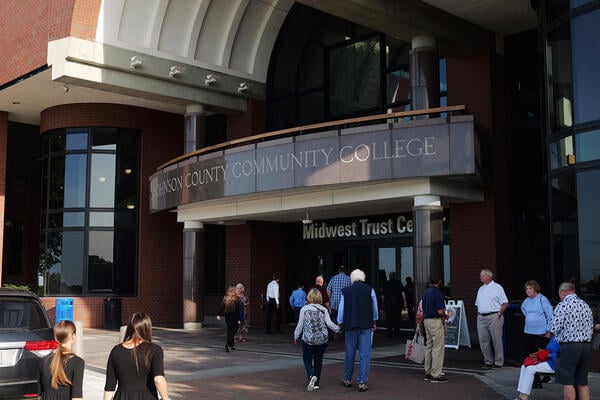
In response to federal guidance, Johnson County Community College no longer allows undocumented students to take adult education courses.
Matthew Fowler/iStock/Getty Images
An adult education instructor at Johnson County Community College in Kansas resigned after finding out the college would require proof of immigration status for adult ed programs in response to federal policy shifts, The Kansas City Star first reported.
Daniel Tyx, previously a middle school Spanish teacher, started teaching English to adults part-time at the college last year. He told the Inside Higher Ed that he took the job because he has a passion for working with immigrant students, and he planned to stay if not for the new policy. He described the college’s English language learner program as thriving, with over 800 students.
These students “always come to class. They’re always excited to be there. They’re full of questions. It’s just a dream job,” Tyx said.
But Tyx quit his job last Friday after he was told that he would have to verify students’ immigration statuses.
“That was not in alignment with my values,” Tyx said. “And I didn’t feel like, as a matter of conscience, that I was going to be able to continue.”
The college’s decision came after a February executive order demanded “no taxpayer-funded benefits go to unqualified aliens.” The U.S. Department of Education then announced in July that, to comply with the order, it would end Clinton-era guidance that allowed undocumented students to participate in adult and career and technical education programs. The department insisted that institutions receiving federal funds for these programs begin verifying that students are eligible to benefit from them.
“Under President Trump’s leadership, hardworking American taxpayers will no longer foot the bill for illegal aliens to participate in our career, technical, or adult education programs or activities,” U.S. Secretary of Education Linda McMahon said in the announcement. “The department will ensure that taxpayer funds are reserved for citizens and individuals who have entered our country through legal means who meet federal eligibility criteria.”
Checking a student’s immigration status is not a typical practice for community colleges, which are now grappling with how to comply with the federal edicts and continue to serve students, and staffers are uncertain how to move forward. Another complication for community colleges and other public institutions is the Trump administration’s crackdown on policies that allow undocumented students to pay in-state tuition if they meet other requirements. After Texas overturned its policy, state officials asked universities to identify undocumented students. At least one Texas institution, the University of Texas at Austin, now requires students to submit proof of immigration status, as well, KVUE reported.
The department’s guidance to bar undocumented students was the second blow to adult education programs after the Trump administration held up about $716 million in federal funds to these programs as part of a wider review of education-related grants in early July. The funds have since been released.
Johnson County Community College now has a message on its website saying that, starting in late July, students are required to show a Real ID, birth certificate, U.S. passport or their most recent immigration documents when they register for adult education classes.
Chris Gray, vice president of strategic communications and marketing at JCCC, said in an email to Inside Higher Ed that the college’s “compliance with federal requirements in this matter allows us to continue to serve qualified individuals” in adult education programs.
Tyx said he felt that college administrators were trying to get ahead of the federal guidance, which he considers “cruel and unjust.” He’s worried for his students, who have been peppering him with questions about whether their documents will suffice.
“My students make such sacrifices to come to class,” he said. “They have so many different reasons to want to learn English, and they’re all good ones. My students want to be able to connect better with their children or their children’s schools. They want to be able to employ the skills that they already have at work and progress in their work lives … It’s very weird that would be something that would be considered to be not desirable by our government.”
In Free Speech Coalition v. Paxton, the U.S. Supreme Court broke new ground in applying relaxed First Amendment scrutiny to state-imposed burdens on lawful adult access to obscene-for-minors content. The decision appeared outcome-driven to uphold laws that require websites with specified amounts of sexually explicit material to verify users’ ages. However, the Court indicated the holding applies only “to the extent the State seeks only to verify age,” such that, if handled in a principled manner, FSC v. Paxton should have relevance only for speech to which minors’ access may be constitutionally restricted.
FSC v. Paxton involved Texas HB 1181’s mandate that online services use “reasonable age verification methods” to ensure those granted access are adults if more than a third of the site’s content is “sexual material harmful to minors,” which the Court treated as content First Amendment law defines as “obscene for minors.” If an adult site knowingly fails to age-verify, Texas’ attorney general may recover civil penalties of up to $10,000 per day, and $250,000 if a minor actually accesses pornographic content. HB 1811 is one of over 20 state adult-content age-verification laws recently passed or enacted.
Obscenity is among the few categories of speech the First Amendment doesn’t protect. In 1973’s Miller v. California, the Court defined obscenity as speech that (1) taken as a whole appeals primarily to a “prurient interest” in sex (i.e., morbid, unhealthy fixation with it); (2) depicts or describes sexual or excretory conduct in ways patently offensive under contemporary community standards; and (3) taken as a whole, lacks serious literary, artistic, political, or scientific value. The Court has limited the test’s scope to what it calls “hardcore pornography.” Material that is “obscene for minors” is that which satisfies the Miller test as adjusted to minors. Sexually explicit material can thus be obscene for minors but fully protected for adults.
Under these tests, the government may ban obscene speech and restrict access by those under 18 to speech that is “obscene for minors,” but it cannot cut off adults’ access to non-obscene sexual material.
It’s long been accepted that, to access adult, potentially obscene-for-minors material in the physical world, showing identification to prove age may be required. So, a law requiring ID to access such content online might seem analogous on its face.
But online age-verification imposes risks physical ID checks do not. An adult bookstore clerk doesn’t save a photocopy of your license or track the content you access. Nor will hackers, therefore, try to access the ID. These are just some of the reasons surveys consistentlyshow a majority of Americans do not want to provide ID to access online speech — whether adult material or other content, like social media.
Texas’ HB 1181 is similar to two federal statutes the Supreme Court invalidated around the turn of the millennium. In 1997, the Court in Reno v. ACLU unanimously struck down portions of the Communications Decency Act that criminalized transmitting “obscene or indecent” content. And in 2002’s Ashcroft v. ACLU, it considered whether the Child Online Protection Act violated the First Amendment in seeking to prevent children’s access to “material harmful to minors” in a way that incorporated age verification.
For decades, the Court has held statutes that regulate speech based on its content must withstand judicial review under strict scrutiny, which requires the government to demonstrate that the law is necessary to serve a compelling government interest and is narrowly tailored to achieve it using the “least restrictive means.” For laws restricting access to online speech, the Court held the laws in Reno and Ashcroft unconstitutional because they failed strict scrutiny. These cases followed in the footsteps of Sable Communications vs. FCC (1989) and United States v. Playboy (2000), in which the Court applied strict scrutiny to invalidate laws governing adult material transmitted by phone and on cable television stations, respectively.
But in FSC v. Paxton, the Court subjected Texas’ age-verification law for online adult content to only intermediate scrutiny. Under this standard of review, a speech regulation survives if it addresses an important government interest unrelated to suppression of speech, directly advances that interest in a direct and material way, and does not burden substantially more speech than necessary. The Court justified applying a lower level of scrutiny on the ground that minors have no First Amendment right to access speech that is obscene to them. Accordingly, it reasoned, even if adults have the right to access “obscene for minors” material, it is “not fully protected speech.” From there, the Court concluded that “no person — adult or child — has a First Amendment right to access speech that is obscene to minors without first submitting proof of age.” And it upheld the Texas law under intermediate scrutiny, concluding the regulations only incidentally restrict speech that can be accessed by adults.
The upshot is, going forward, it will be easier to justify laws restricting minors’ access to off-limits expression even if the law burdens adults’ access to material that is otherwise lawful for them.
At the same time, the majority opinion sought to limit the type of content that can be restricted only to material that meets the legal definition of “obscene-for-minors” material, and not anything that might be considered generally inappropriate.
As the Court held in Brown v. Entertainment Merchants Assn. (2011), “minors are entitled to a significant measure of First Amendment protection, and only in relatively narrow and well-defined circumstances may government bar public dissemination of protected materials to them.” And in Reno, which involved similar attempts to limit provision of online content to minors, the Court held the government could not ban “patently offensive” and “indecent” (but not obscene) material for everyone in the name of protecting children.
Free Speech Coalition should not be read as approving age verification laws for online speech generally that do not specifically target “obscene for minors” material. Its narrow focus will not support the recent spate of social media age-verification laws that have met significant judicial disapproval. Such laws have been enjoined in Arkansas, Mississippi, California, Utah, Texas, Ohio, Indiana, Florida, and most recently last week, when a federal court held Georgia’s version “highly likely [to] be unconstitutional” because it interferes with minors’ rights “to engage in protected speech activities.”
The risk, of course, is that governments will seek to leverage FSC v. Paxton decision beyond its limited holding, and/or that lower courts will misuse it, to justify prohibiting or regulating protected speech other than that obscene as to minors. In defending laws that implicate the First Amendment, the government often argues it is regulating only conduct, or unprotected speech, or speech “incidental” to criminal conduct.
Courts for the most part have seen through these attempts at evasion, and where a speech regulation applies based on topic discussed or idea or message expressed, or cannot be justified without reference to its function or content, courts apply strict scrutiny. Under FSC, however, would-be regulators have another label they can use — “partially protected speech” — and the hope that invoking it will lead to intermediate scrutiny.
Only time will tell if the Court will keep the starch in its First Amendment standards notwithstanding what should be the purple cow of FSC v. Paxton.
Research shows that adults often enter college with a goal in mind, such as a career pivot, additional education in their current industry or completion of a degree they previously started. But returning to the classroom can be challenging, particularly for first-generation students or those who haven’t been in school for a while.
In 2024, Wichita State University launched a college bridge program, the Adult Learner Community and Connections Program, to ease the transition for adult and online learners. The program, part of the university’s Shocker Preseason series, offers eight modules of self-paced online content designed to assist them in their first term at the university.
In the most recent episode of Voices of Student Success, host Ashley Mowreader speaks with Brett Bruner, assistant vice president for student success and persistence at Wichita State, about adult learner pedagogy and lessons learned in the first year.
An edited version of the podcast appears below.
Q: Can you introduce us to your adult learner population? Whom do you serve and how does their makeup change how you serve them?
Brett Bruner, assistant vice president for student success and persistence
A: At Wichita State University, our adult learners come from various backgrounds. We know that two-thirds of our adult learners are first-generation college students. And when we think about being the first age friendly [University Global Network]–designated university in the state of Kansas, I think we’re really focused on how do we support learners of all ages, including adult learners of all ages?
When we think about the more than 2,200 adult learners and more than 1,600 online learners at Wichita State, our adult learners are enrolled in on-campus programs and fully online programs. We always approach our adult learners with that mindset of, how do we center this through our first-generation lens, recognizing that two-thirds of them will be first in their families to graduate from college?
Q: I’m also thinking about your orientation program focused on adult learners. I wonder if you can give us some background on, what does a Shocker Preseason look like across the board? And how does this look different for your adult learner populations, given all the backgrounds that you mentioned—first generation, online learners, et cetera.
A: Our Shocker Preseason programs were created from a university standpoint to really focus on building academic resource awareness, providing all our students with the academic skills they need to be successful and helping students make connections with each other. Our Shocker Preseason programs were also created as part of our strategic enrollment management plan, as well as one of our student success priorities.
We’ve grown [the program]; this fall, we’ll now have 20 different Shocker Preseason programs.
Q: Wow.
A: I know, it’s amazing to see growth from even just when I started here two years ago, from six programs now to 20. I think the beauty of our Shocker Preseason programs is this differentiated care. We talk about differentiated care at WSU from a student success standpoint, but it means the program modality—on campus versus online—program length, content, is really driven by each of the individual units that are designing their programs.
In spring of 2024, as the Office of Online and Adult Learning that I get the privilege of working with sat down to really look at career congruence of our adult learners’ transitions, health and well-being emerged as a topic, but really that overall support of, how do we form connections? Because so many times adult learners in the research cite that they aren’t finding peers, they aren’t finding friends, because they feel that they are the one and only older student, returning student or student who didn’t come fresh out of high school to college.
I’m so proud of our team, who said, “Let’s design a Shocker Preseason program, but let’s make it look different to meet the needs of our students.” And so as they rolled out this online format for our Adult Learner Community and Connections program, they really rooted it in health and well-being, because they were able to do that in meaningful ways that may look different from how we talk about health and well-being for an 18- to 22-year-old, but then also building in community and connection opportunities in different ways. Maybe they’re more likely to lean into conversations about how the Ulrich Museum of Art on campus can provide a means for social connection, and maybe that will resonate with our adult learners.
Q: I love that you’re focusing on community and that sense of belonging and engagement on campus. Because I think when we consider online learners’ needs, or adult learners’ needs, oftentimes we think it’s providing services expeditiously. We want them to get through their degree program, we want to get them into a job, which are great priorities to have. But students also want a college experience, and they do want to engage with their peers. And so I wonder if you can speak to that dimension of this, that it’s not just getting them to timely degree completion, but everything else as well.
A: It’s all about finding their people, helping them realize that with 2,200 adult learners across campus, you’re not the only one. So how can we connect you with others who are experiencing similar transitional pieces?
We think about the 83 students who engaged in our optional program last year, but then also the eight peer ambassadors that we hired who had lived these experiences and can bring some insight when we talk about social wellness and why it’s an important part of thriving in college as an adult learner, or financial wellness, or whatever dimension of wellness.
I think that’s the important part, because we’re seeing then these connections continue beyond just this orientation and transition experience. We’re seeing friendships bloom. We’re seeing opportunities to make connections in the classroom. After year one of the program, specifically related to the social wellness connection, students were saying, “I appreciated what you shared about how to make connections, but I want more. I want more about how to build my network. How do I invite people to my network and grow my network?”
And I don’t think that was something that we were intentionally designing. So as we think about the 2.0 version of this program, we’re really deepening the content about networking. Because I think we’re all always striving to build and grow our networks as we move throughout life. That desire for connections, that community, that sense of belonging, was clearly, clearly articulated in our postprogram surveys from the first year of the program.
Q: Can we talk about how the program works logistically for people who might not be familiar and how it’s scaffolded?
A: Our program is designed around the eight dimensions of wellness, and it is an online program. We built it in our learning management system so that it mirrors a lot of the other classes that an adult student is taking, whether they’re taking an online class or an in-person class that has the learning management system component to it. So they’re also getting access to the technology upskilling that we so often see in research about what adult learners want as they transition into college.
They move through the eight modules, which are all rooted in the eight dimensions of wellness. The beauty of the program is it’s self-directed and self-paced, so it doesn’t necessarily build upon one another. We’ve had some adult learners who are like, “I really want to jump in and dive into module five and start talking about physical wellness, or module eight and talking about occupational wellness.” So they can do that, or they can sequentially go module by module.
As a student completes each module, there is an incentive that was provided through the Urban Adult Learner Institute, [Wichita State] being the inaugural winners of an Accelerate Pitch Competition that funded a lot of these incentives. But one of the things that we learned in year one is that incentives are not a motivating factor for our adult learners. We know that adult learners are intrinsically motivated, and so a lot of times we had the extra incentives that they didn’t strive to pick up, but they were completing the modules.
We’ve got campus partners who provide content for the modules. Our Shocker Career Accelerator office is providing content for the module about occupational wellness. And Shocker Financial Wellness staff are providing content for the module about financial wellness. So each module connects individuals to campus resources. It’s providing some actual content and then some reflective experience. The modules open Aug. 1 and they close in December.
So students can move throughout that time however quickly they want, or maybe they just want to complete one module, whatever it may be. And then if they complete all eight modules, we’re able to provide an overall incentive with some merchandise from our Shocker store.
Q: You mentioned it’s self-motivated, and students can really opt in to which sections speak to them. I think it’s interesting that you’ve all chosen to make this optional. It’s an orientation program, but it’s something that they can do throughout their first term. Can you talk a little bit about that decision? Because I think some people might say, “No, you have to make it mandatory and make this something that they must complete before they start classes, because we know that this will be good for them.” What’s that balance of ensuring students are getting this information but letting them do it at their own pace and timing?
A: This program doesn’t replace our in-person or online adult learner orientation, but I think, as someone who spent 10 years as a new student orientation director before moving up, sometimes people say, “We can solve all the world’s problems just by adding five minutes in orientation.” And I like to say, “Sometimes orientation is like drinking from a fire hose,” there’s so much information. And it also doesn’t relate to three words: time, place and manner.
When we think about orientation, we have to know, what do we share with individuals? When do we share it, and especially with our adult learners, as we dive into andragogy [adult learner pedagogy]? And what we know from Malcolm Knowles in 1985, when he developed the six tenets of andragogy, is adult learners need to know what they need to know when they need to know it.
If we’re sharing resources about knowing your values and what’s your why, and we’re sharing that on June 13, when they’re on campus for adult learning orientation, is it really going to sink in and resonate with them versus in August or September, when they’re knee-deep in the semester? Or when we’re talking about intellectual wellness and we’re sharing all of the resources from our 13 different tutoring centers across campus—that may go in one ear and out the other ear in July when they’re here, but maybe they’re going to need it in week five or six, when they’re struggling with a certain class and trying to figure out “where do I go to get connected?”
Our team wanted to keep it optional, much like that kind of aligns with all of our Shocker Preseason programs, because the Shocker Preseason programs never take the place of orientation. They’re an additional element in a student’s transition. But as we lean into some of those core elements of andragogy, we lean into the need to know, and we lean into the readiness to learn that students—adult learners, specifically—when they see a need, that’s when they’re going to be ready to learn. We wanted to provide that in an asynchronous format, but they can still come back to and access those resources throughout the duration of that critical first semester at WSU.
Q: You’ve obviously rooted this program in pedagogy and the best understanding we have of adult learners, but I wonder how you’ve incorporated the student voice from this first season of the Shocker Preseason program and how you’re incorporating it into version two?
A: As we dug into assessment feedback from version one, not only looking at completion rates by each module, we definitely know 86 percent of all students who registered [for the program] and did something completed social wellness. That’s great. Is that because of the concept, is that because it was the first module? We don’t necessarily know.
As we look at the qualitative feedback, I think that’s been the most interesting thing. From the social wellness piece and students saying they appreciate it, but they want to know more about how to network. We think about the intellectual wellness model, and some of the feedback that we receive from that is … “Give us more information, we want all the additional apps, all the additional resources beyond basic technology. What are those apps or things that I need to do to succeed academically?” So we’re diving deep into that.
One of the most interesting things that caught us off guard, in a good way, was that the most popular session by students [who provided qualitative feedback] was the spiritual wellness module, because it was really rooted in helping students articulate, “What is your why?” Whether you’re coming back to school because you’re a career changer, you’re switching career paths in life or you want to finish a degree because you want to climb higher into the occupation that you’re in, but then also, then connecting that why to their values and continuing to drive that forward as a motivation factor.
Then I think we’re also taking some of the other elements of the areas and growth of opportunity. For example, when we think about occupational wellness and adult learners, we learned that we’re serving two very different groups within the adult learner piece: the career changers and the career climbers. And so we need to know, how do we go about approaching occupational wellness from both an individual who’s saying, “I’m going from industry to being a teacher at the age of 50” or “I need a degree to move up in this career path that I’ve been doing for quite some time”? So we have to almost take the differentiated care approach, if that makes sense, especially in that.
Or financial wellness, that was probably one of the most, I wouldn’t say, polarizing, but one we need to think a little bit more about. We got great opportunity for growth feedback that said, “I’ve been doing finances for quite some time” and recognizing the experiences, but the piece of finances that many adult learners said is, “Can you help me figure out where can I find additional scholarships? Where can I find additional ways to pay for all of my educational expenses?” So we need to focus a little bit more on scholarship resources rather than just maybe the general how to budget, how to manage finances that we may think about … our 18- to 22-year-old population.
Q: I think it’s interesting that the feedback you received, it seems to fall into a few categories, like, one, help me navigate the institution better, but two, help me navigate myself as a student better.
It seems like they know how to be an adult, and they know how to manage their own budgets or engage with one another on a social level. But when it comes to that professional networking, or when it comes to understanding what tools they might need to be a learner, again, that’s the piece where they’re really asking for feedback. And I think that’s so unique to our adult learner population at large. It might be our 18-year-olds who need more help figuring themselves out as people, but our adult learners need help figuring themselves out as students.
A: In version 2.0 we’re also trying to be much more intentional about providing some extended podcasts with campus partners. So someone who really wants to embrace the concept of social wellness and wants to engage in a podcast with our Student Engagement and Belonging Team or our Ulrich Museum of Art and really dive deep into those, we’re connecting this to various podcast episodes from our Shockers Learning Out Loud podcast series. It’s been around for quite some time. So how are we just connecting the pieces of the puzzle for students who want to deep dive a little bit more, recognizing that, once again, what we know about adult learners is they’re very problem-focused. And how can we provide those additional asynchronous resources for them to dive much deeper into the concept?
Q: I mean, I think podcasts are the best format ever.
When you talk to your peers in this space, because I know you’ve presented on this topic at conferences and really shared this with others who are working in similar roles, what are you hearing from them? What other ideas are you getting? Or what are some opportunities that you see for others to engage in this work as well?
A: I think the biggest piece that I’ve heard from others is this whole notion of differentiated care, and how can campuses lean in and not just replicate a transition experience that they may have for an 18- to 22-year-old, but they’re recognizing the needs of our adult learners, and we’re centering some of those elements. Adult learners bring a lot of experiences, so how do we harness that? How do we name that? How do we give them the opportunity to own that space and bring that into whatever content we design, whether it’s from a well-being [or] from a career standpoint, bring that into that space and recognize that that looks different? You can’t just copy and paste. You can’t just lift what we’re doing from a first-year, first-time-in-college student and apply that, because that’s doing a major disservice.
I think the other piece that I’m hearing from colleagues as we’re doing this is leveraging and leaning into making this a virtual space, because the lives of an adult learner look very different. You may be an adult learner that’s also a caregiver, and you may only have evenings to hop on and learn, or dive deep because you’re working full-time, trying to go to school full-time, maybe giving care to parents, to children, to partners, to spouses, etc. Or we’ve had some students who are adult learners who are working third shift. You may be available during the workday, but you may have just got off work at 8 a.m., so how are we leveraging technology in new ways? Because going back to that research, one of the biggest pieces that adult learners want in their transition and want from colleges universities is to help them upskill with the technology that they’re going to need to be successful.
I think those two pieces of really leaning into the adult learner needs, leveraging technology and leaning into this notion of differentiated care is needed and is the easy way to start thinking about, how do I take something like this and apply it to the adult learners on my own campus?
Q: As we think about the new age of college students or today’s learners, and how we’re seeing a larger population of adult learners, or more high school students are considering taking a break before going to college, I think this is going to be even more applicable, maybe for a 20-year-old who took a break and was working for a few years, and not just our traditional 25-, 35-year-old who’s coming back to school.
A: Absolutely. I think there are elements of this that can be applied to many facets of today’s learner.
Q: So what’s next for you all as you’re considering launching for the fall?
A: We have been taking all the feedback in from version 1.0 [and] we’re redesigning some of our modules. We’re bringing in new campus partners, which I think has been super exciting.
We’re leaning into this well-being concept, and we know health and well-being is important for all of today’s college learners. You can’t read any article, have a conversation at a conference or go to a meeting on your own campus where the concept of health and well-being of today’s college students is not at the forefront. I think as I’ve continued to share this data, we’ve gained lots of support from various entities across campus, especially those who really are approaching it from a health and well-being lens.
But we’re just really excited as we launch version 2.0 and engage some of those completers of version 1.0 in various peer ambassador roles to support the next generation of ALCC participants.
Q: Can you talk about how this program transitions into larger support on campus and making sure that students aren’t just getting these modules online, but that they’re translating it to in-person experiences or online experiences as it’s relevant?
A: Our peer ambassadors, I think, are great representatives of the Office of Online and Adult Learning, and so they have been a great resource to connect individuals in their small groups to our associate director of student engagement in the Office of Online and Adult Learning or online and adult learning retention specialist who’s providing some additional follow-up pieces. So I think the peer ambassadors have been great representatives to connect the students who are going through this experience with the amazing support staff and the network of individuals through our Office of Online and Adult Learning and across campus who are here to help them be successful, because we want all of our adult learners to successfully complete their first year, that first milestone, and then ultimately graduate with their degree from WSU.
Get more content like this directly to your inbox. Subscribe here.
The Trump administration is holding up hundreds of millions of dollars slated for adult education programs as part of a review of education spending.
The roughly $716 million was supposed to be disbursed to states July 1 and then divvied up among their adult education providers, such as community colleges. But the funding for high school equivalency classes, English as a second language programs and other adult education services never arrived. The news comes as the Trump administration continues to withhold $7 billion from states for K–12 education, including ESL classes and after-school programs, which includes the adult education money.
The freeze is part of a broader “ongoing programmatic review of education funding,” an unnamed spokesperson for the Office of Management and Budget wrote in a statement to Inside Higher Ed.
“Initial findings show that many of these grant programs have been grossly misused to subsidize a radical leftwing agenda,” wrote the OMB spokesperson, citing examples of states and schools using the money to support students in the country without proper documentation as well as for a seminar on “queer resistance in the arts,” though the statement made no mention of adult ed programs.
The fate of the withheld funding remains unclear. “No decisions have been made yet,” the spokesperson said.
Now states and their community colleges, which offer a significant share of adult education programs, are scrambling to figure out how to continue providing adult education services despite staggering funding shortfalls.
“If funding is not provided, there are nothing but bad options for institutions,” said David Baime, senior vice president for government relations for the American Association of Community Colleges. He predicts community colleges would have to reduce adult education services, lay off personnel and vie for funds to fill in the gap from states and other sources. But even so, “the funding is so substantial in a number of places that there’s no immediate source of replacing that money.”
He emphasized that adult education programs have received “broad support from both parties for decades”—and they were already underfunded relative to student need.
Adult basic education is “a core function and a core part of the mission of community colleges across the country,” he said.
Adult education is one of several programs on the chopping back in the Education Department’s proposed budget for fiscal year 2026. Officials wrote in budget documents that states and localities are “best suited to determine whether to support the activities authorized under this program or similar activities within their own budgets and without unnecessary administrative burden imposed by the federal government.”
Higher ed advocates worry other programs like the Child Care Access Means Parents in School program that are on the chopping block could suffer a similar fate.
Concerns Across the Country
Community colleges in red and blue states alike are anxiously waiting for the adult education funds to come through.
Heather Morgan, executive director of the Kansas Association of Community Colleges, said if the pause persists beyond two months with no alternative funding, Kansas’s 19 community colleges will have to make “tough decisions” about laying off or furloughing staff.
She added that college leaders were given no notice, leaving them with no time to prepare.
“Situations where funding doesn’t come as expected are real hardships on small colleges and really leave staff in a position of wondering and not knowing what’s coming next,” she said.
Joe Schaffer, president of Laramie County Community College in Wyoming, said the withheld funds risk hurting high-demand, successful adult education programs in the state.
He noted that, historically, the coal and oil industries in the state offered well-paying jobs that didn’t necessarily require a high school diploma. But now, because of changes in technology and the state’s diversifying economy, many jobs do require at least a high school education. Wyoming workers hit with that realization are coming to adult education programs later in life to earn high school equivalency certificates, commonly referred to as the GED.
And the programs work. Roughly 80 percent of Wyoming adult basic education students get a job or enroll in college after their programs, and 84 percent earn a credential beyond a GED. These programs graduate more people with a high school equivalency than any one high school in the state, making the programs arguably Wyoming’s “largest high school,” he said.
Because the state funds half of these programs, he believes Laramie County Community College can make do without the federal funds and continue to offer these programs for another year, with some belt-tightening measures.
But still, the move to withhold federal funds risks “reducing the flow of high school graduates at a time when the workforce pipeline, the talent pipeline, is a concern of everybody across the nation,” Schaffer said.
Morgan agreed that state economies would suffer if adult education programs took a permanent funding hit.
For many Kansans, “this is their option to get out of poverty and to get into a higher-paying job,” she said. “The ability for them to get skilled up is important, and we have to have the resources to do that, and the uncertainty that’s been injected into the system is not helpful in trying to meet our mission, which is to prepare citizens for the Kansas economy.”
Today, the Supreme Court ruled 6-3 to uphold Texas’s age-verification law for sites featuring adult content. The decision in Free Speech Coalition v. Paxton effectively reverses decades of Supreme Court precedent that protects the free speech rights of adults to access information without jumping over government age-verification hurdles.
FIRE filed an amicus brief in the case, arguing that free expression “requires vigilant protection, and the First Amendment doesn’t permit short cuts.” FIRE believes that the government’s efforts to restrict adults’ access to constitutionally protected information must be carefully tailored, and that Texas’ law failed to do so.
The following statement can be attributed to FIRE Chief Counsel Bob Corn-Revere.
Today’s ruling limits American adults’ access to only that speech which is fit for children — unless they show their papers first.
After today, adults in the State of Texas must upload sensitive information to access speech that the First Amendment fully protects for them. This wrongheaded, invasive result overturns a generation of precedent and sacrifices anonymity and privacy in the process.
Data breaches are inevitable. How many will it take before we understand the threat today’s ruling presents?
Americans will live to regret the day we let the government condition access to protected speech on proof of our identity. FIRE will fight nationwide to ensure that this erosion of our rights goes no further.
This audio is auto-generated. Please let us know if you have feedback.
NASHVILLE – Entering college with prior learning credits can be a huge boon to students, cutting down on the time and money required to complete their degrees. But the pathways to earning these credits may favor traditional college students from well-resourced high schools.
Since 2020, leaders from Salt Lake Community College have worked to improve prior learning credit options for prospective and current students, they told attendees Monday at the American Association of Community Colleges‘ annual conference in Nashville. The college put a special emphasis on pathways for adult learners — those aged 25 and older — as the average student on its eight campuses is 25 years old.
Over the past five years, the resulting cross-campus collaboration has yielded Salt Lake Community College some promising results, including more students receiving credit for their work experience and lowered financial barriers for prior learning assessment exams.
Then
In 2019, the Utah Legislature passed a law requiring the state’s higher ed board to create a plan aimed at boosting public colleges’ issuance of credit for prior learning, work-based skills and competency-based assessments.
Salt Lake Community College — which enrolls just under 37,000 credit-bearing students across eight campuses — began an evaluation of its process for awarding prior learning credits the following year.
Rachel Lewis, Salt Lake Community College’s associate provost of academic systems, said the existing process turned out to be hardly a process at all.
“It used to be, if you knew the one advisor who knew the process and could talk to this person in the registrar’s office, we could get your prior learning,” she said. “Good for the students who found it — not good for all the others.”
The college’s leaders also uncovered a gap in what kind of credits were awarded.
In 2019-20, about 80% of the prior learning credits that Salt Lake Community College awarded were through pathways typically used by high school students, said Andrea Tipton, the institution’s director of credit for prior learning.
For instance, 807 of the 1,291 students who received prior learning credits earned them through Advanced Placement tests offered by the College Board.
In comparison, only 13 students that year received credit for their professional certifications or licenses, and just one student earned credit for their previous work experience and portfolio.
Now
To address this disconnect, Salt Lake Community College standardized its prior learning credit process. That included a new hire.
“We made a crucial decision to create a position at the college dedicated to prior learning — one person at the college who could be the point of contact to serve in that role,” Lewis said, nodding to Tipton, who was hired for the new role.
Salt Lake Community College now emphasizes credits for prior learning as an option through improved communications to students. The institution also works to inform students that it’s free to have their credits evaluated and added to their transcripts.
Once a prior learning credit is added to a student’s transcript, it is transferable as if they earned it at Salt Lake Community College, according to college policy.
“When that student goes to the University of Utah, it’s now considered transfer credit,” Lewis said. “They don’t reevaluate it. They don’t look at it.”
Roughly three-fourths of Salt Lake Community College graduates, 72%, go on to transfer to a four-year institution.
The college is also highlighting CLEP tests, an exam option offered by the College Board open to learners ages 13 and older.
The tests can provide a viable alternative to AP tests. But the registration fee — upwards of $95 in 2025 — proved to be a barrier for many students, Tipton said.
This year, Salt Lake Community College began directing students to the Modern States Education Alliance, anonprofit that will cover test costs for students who complete its free prep courses.
First-year results are still pending, Tipton said. But the college is processing more CLEP exams than before, suggesting more students are taking advantage now that the financial barrier to testing has been addressed, she said.
In 2023-24, the college awarded 248 credits to 33 students for their professional licenses and certifications. This represented nearly triple the prior learning credits students earned this way only a few years before.
It granted another 100 credits to 18 students for their work portfolios and experience. The number is still low, but the jump from just one or two students a year is statistically significant,Tipton said. And it’s a population the college wants to grow.
One prior learning pathway more commonly used by nontraditional students has seen a more complicated transformation — military credits.
Back in 2019-20, Salt Lake Community College appeared to do quite well in this regard, with 137 students receiving a whopping 2,184 prior learning credits for military experience that year.
“But it was a lot of electives,” Tipton said. “It wasn’t easily applicable to their degree or transferable in a meaningful way.”
Since then, military prior learning credits have declined significantly, down to 34 students receiving 46 credits in 2023-24.
That drop resulted from the college shifting from “awarding just whatever the credit you can get” to prioritizing military credits that go toward a student’s desired degree, Tipton said. She is now working with academic departments to continue establishing better course equivalencies for military experience.