Tag: Advanced

  • Advanced Teaching Roles Program Shows Improved Test Scores, but Faces Funding Concerns – The 74

    Advanced Teaching Roles Program Shows Improved Test Scores, but Faces Funding Concerns – The 74


    Get stories like this delivered straight to your inbox. Sign up for The 74 Newsletter

    North Carolina’s Advanced Teaching Roles program, which allows highly effective teachers to receive salary supplements for teaching additional students or supporting other teachers, is having positive effects on math and science test scores, according to an evaluation presented by NC State University’s Friday Institute for Educational Innovation at the State Board of Education meeting last week.

    Since 2016, the ATR initiative has allowed districts to create new career pathways and provide salary supplements for highly effective teachers — or Advanced Teachers — who mentor and support other educators while still teaching part of the day. Their roles include Adult Leadership teachers, who lead small teams and receive at least $10,000 supplements, and Classroom Excellence teachers, who take on larger student loads and receive a minimum of $3,000 supplements. 

    Those in adult leadership roles teach for at least 30% of the day, lead a team of 3-8 classroom teachers, and share responsibility for the performance of all those teachers’ students. Classroom excellence teachers are responsible for at least 20% more students than before they enter the role.

    “Our ATR program was designed to allow highly effective classroom educators to reach more students and to support the professional growth of educators,” said Dr. Callie Edwards, the program’s lead evaluator, at the State Board of Education meeting last Wednesday. “ATR aims to improve the quality of classroom instruction, the recruitment and retention of teachers, as well as ultimately impact student academic achievement.”

    In the 2024-25 school year, 26 districts operated ATR programs across 400 schools — 56% of which were elementary schools — employing 1,494 Advanced Teachers who supported nearly 4,000 classroom teachers statewide, according to the evaluation. Edwards said that 88% of Adult Leadership teachers received at least $10,000, and 85% of Classroom Excellence teachers received $3,000 or more.

    Statistical analysis of the 2023-24 school year’s data found that students in ATR schools outperformed their peers in non-ATR schools in math and science, showing statistically significant learning gains. 

    “Across the various programs I’ve evaluated, these are positive results — especially in math and science — where the impact of ATR is equivalent to about a month of extra learning for students,” said Dr. Lam Pham, the leading quantitative evaluator. “The results in ELA are positive but not statistically significant, which has been consistent for the last three years,” Pham said, referring to English Language Arts.

    These effects on math and science grow over time, according to the evaluation. Math scores improved throughout schools’ first six years of ATR implementation — though they are no longer significant by the seventh year of implementation, according to the presentation. For science scores, statistically significant gains began in the fifth year after schools began implementing ATR.

    Additionally, math teachers in ATR schools reported higher EVAAS growth scores than their peers in comparable schools.

    Teachers in ATR schools also reported feeling like they have more time to do their work compared to teachers in non-ATR schools.

    This year’s report featured data on teachers supported by ATR teachers for the first time. The evaluation found no positive effects on test scores for students taught by supported teachers compared to students taught by teachers who are not in the program. The researchers also found no effect on turnover levels for teachers supported by Advanced Teachers. However, the report says additional years of data will be necessary to verify if those effects appear over time.  

    The evaluation recommended that principals in ATR schools should foster collaboration and communicate strategically about the program with staff, beginning during Advanced Teachers’ hiring and onboarding.

    “It’s important to integrate ATR into those processes,” Edwards told the Board. “That means introducing Advanced Teachers to new staff and making collaboration, especially mentoring and coaching, a structured part of the day.”

    Edwards said these practices have been adopted in some schools, but principals reported needing more time and support to build collaboration opportunities into the school schedule.

    The report also urges district administrators to coordinate with Beginning Teacher (BT) programs, advertise ATR in recruitment materials, and improve their data collection practices. It also calls on state leaders to standardize the program to ensure consistency across participating districts.

    “Districts need standardized messaging, professional learning opportunities, and technical assistance to support implementation,” Edwards said. “The state can also create more opportunities for districts to share what’s working with one another and expand the evaluation beyond test scores to capture things like classroom engagement, social, emotional development, and feedback from teachers and principals.”

    The evaluators also said “there’s more to do” to expand the program in western North Carolina after Board members raised concerns about uneven participation across the state’s regions.

    2026-27 participants

    After the Friday Institute’s presentation, Board members heard a presentation on proposals for the next round of districts to join the ATR program from Dr. Thomas R. Tomberlin, senior director of educator preparation, licensure, and performance.

    Tomberlin said DPI received 15 proposals representing 22 districts. These proposals have been evaluated by seven independent evaluators, Tomberlin said. The Board had to choose the program’s next participants by Oct. 15 to comply with a legislative requirement. 

    The state can only allocate $911,349 for new implementation grants in 2026-27 — less than one-sixth of the funding required to fund all applications. That level of funding is “very low” compared to previous years, Tomberlin said. In the 2023-25 state budget, the General Assembly appropriated $10.9 million in recurring funds for these supplements in each year of the biennium.

    Tomberlin recommended that the Board approve the three highest-scoring proposals for the 2026-27 fiscal year, and fund these districts at 85% of their request. If the Board approves this recommendation, the state would still have $37,981 in planning funds left over for districts approved during the 2026 proposal cycle.

    Tomberlin said districts are already struggling to pay for the program’s salary supplements. The Friday Institute’s report showed that, despite the high median supplements, some districts are offering supplements as little as $1,000.

    “Some districts are not able to pay the full $10,000 because they have more ATR teachers than the funding that we can give them in terms of those allotments,” Tomberlin said. “And we had requested the General Assembly, I think, an additional $14 million to cover those supplements, and we didn’t get any.”

    The Senate’s budget proposal this session included funds to expand the ATR program over the biennium, while the House proposal did not. The General Assembly has not yet passed a comprehensive state budget, and its mini-budget did not include ATR program funding.

    Tomberlin said DPI would be in touch with the three districts to verify if they can proceed with the program despite limited funding.


    This article first appeared on EdNC and is republished here under a Creative Commons Attribution-NoDerivatives 4.0 International License.


    Get stories like these delivered straight to your inbox. Sign up for The 74 Newsletter

    Source link

  • Advanced manufacturing expansion opens CTE opportunities for rural schools

    Advanced manufacturing expansion opens CTE opportunities for rural schools

    This audio is auto-generated. Please let us know if you have feedback.

    Dive Brief:

    • Through strong industry partnerships and career and technical education, rural schools can equip their students for growing workforce needs in advanced manufacturing.
    • Advanced manufacturing in the U.S. is undergoing a period of rapid expansion, with an anticipated $1 trillion investment in projects, 63% of which is expected to be allocated to facilities near rural communities, according to an analysis from the McKinsey Institute for Economic Mobility.
    • The McKinsey Institute also surveyed nearly 1,500 rural high school students and recent graduates, finding that 8 in 10 would like career-connected learning and apprenticeship opportunities. However, only 5 in 10 reported having access to career-connected learning in high school, and only 3 in 10 had access to apprenticeships.

    Dive Insight:

    The report highlights that as advanced manufacturers expand into rural America, they play a crucial role in fostering strong relationships with local school systems.

    Advanced manufacturing industry experts and companies are seeking workers with foundational, technical and durable skills, the report found. However, there seems to be a short supply of these skill sets across the manufacturing labor pool.

    One cause of this shortage, the report argues, is a lack of strong, established collaborations between the industry and K-12 schools. The industry’s need for well-equipped future workers could also meet the needs of K-12 schools to expand students’ career opportunities.

    Research has found that taking CTE courses can lead to higher graduation rates and greater employment opportunities, which is why industry and rural schools can work together to provide K-12 students with the necessary education and technical skills to enter the incoming workforce, the report noted.

    To ensure that students are learning these high-demand skills, employers and industry associations should provide apprenticeships and other workplace learning opportunities for rural schools, as well as help create industry-relevant curricula, the report explained. A strong collaboration benefits not just schools and students, but companies that are also securing a pipeline of prepared workers.

    The report recommends that school systems work with local governments and organizations to build connections with employers. Through strong partnerships with industry professionals, schools can develop more effective, career-connected and evidence-based models, the report said.

    CTE courses provide students with hands-on, real-world skills for a defined set of careers, and an effective course focuses on skills in demand in the local market. As manufacturing investments grow in rural communities, the report said, schools could offer CTE courses that prepare students with technical and other STEM-based skills necessary in the advanced manufacturing field.

    The report also emphasized that industry partners should have regular interaction with students and touch base with them at regularly scheduled intervals. This ensures students are consistently aware of the different career pathways available to them. These interactions can evolve as students advance through different grades, shifting from informational to more tangible resources like apprenticeships, summer jobs and postsecondary scholarships later in high school.

    Beyond industry partnerships, state legislatures can also offer incentives for CTE programming through policies and funding, the report recommends. States are already providing these types of incentives, with 40 states collectively approving more than 150 policies focused on boosting CTE programming in 2024.

    Source link

  • Howard University Taps Antiracist Scholar Ibram X. Kendi to Head New Advanced Studies Institute

    Howard University Taps Antiracist Scholar Ibram X. Kendi to Head New Advanced Studies Institute

    Howard University has appointed renowned historian and bestselling author Dr. Ibram X. Kendi to lead its newly established Institute for Advanced Study, marking aDr. Ibram X. Kendi significant expansion of the historically Black university’s research capabilities. The institute will focus on interdisciplinary research addressing global African diaspora issues, including studies on race, technology, climate change, and systemic disparities.

    Kendi, a MacArthur Fellowship recipient and one of Time magazine’s 100 most influential people, brings considerable scholarly credentials to the position. His appointment continues Howard’s legacy of housing influential Black intellectuals and fostering groundbreaking research on racial justice.

    “This is the most fulfilling career choice I have ever made,” said Kendi, who is currently a professor at Boston University but has held teaching positions at American University, University of Florida and SUNY Albany. “I have had my eye on the Mecca my entire career, studying its history and witnessing what Howard means to the culture.”

    The new institute will implement a competitive residential fellowship program, bringing together international scholars to pursue research projects across various disciplines. A unique aspect of the program pairs each fellow with a Howard student, creating mentorship opportunities while advancing research goals. The fellowship program will also be available to Howard’s faculty members.

    Howard’s Provost and Chief Academic Officer, Dr. Anthony K. Wutoh said there is a strong alignment between Kendi’s work and the university’s mission.

    “Dr. Ibram X. Kendi’s exceptional scholarship and unwavering commitment to social justice align perfectly with Howard University’s mission and values as we deepen our scholarship on the African Diaspora,” he said.

    The institute’s research agenda is ambitious, targeting persistent inequities across multiple sectors including technology, healthcare, education, environmental issues, economics, governance, and the criminal legal system. This comprehensive approach reflects Howard’s historical commitment to addressing systemic racism through scholarly inquiry.

    Kendi joins Howard at the height of his academic career. His work has significantly shaped contemporary discussions about racism, with his book How to Be an Antiracist achieving international bestseller status. His earlier work, Stamped from the Beginning: The Definitive History of Racist Ideas in America, won the National Book Award for Nonfiction and was recently adapted into an Emmy-nominated Netflix documentary.

    A trained historian, Kendi has also worked as a journalist and served for many years as a contributor to Diverse.

    His appointment connects to Howard’s rich tradition of housing influential scholars who have shaped American civil rights discourse. The university’s historical roster includes figures like Charles Hamilton Houston and William Hastie, who developed legal strategies against segregation, and Francis Cecil Sumner, whose research contributed to the landmark Brown v. Board of Education decision.

    Kendi’s publication record includes sixteen books, with ten reaching The New York Times bestseller list. His recent adaptation of Howard alumna Zora Neale Hurston’s “Barracoon” and his co-edited volume Four Hundred Souls: A Community History of African America, 1619-2019″ demonstrate his commitment to preserving and analyzing Black historical narratives.

    The establishment of the Institute for Advanced Study under Kendi’s leadership represents Howard’s continued evolution as a center for critical research on race and society. It also positions the university as a major powerbroker who can attract well-known Black scholars. Nikole Hannah-Jones, the Pulitzer Prize winning journalist is on Howard’s faculty as well as award-winning writer Ta-Nehesi Coates, who is the Sterling Brown Endowed Chair at the university.  As higher education grapples with questions of equity and inclusion, Howard’s new institute positions the university to lead scholarly discourse on these crucial issues while training the next generation of researchers and thought leaders.

    The institute’s focus on mentorship through its fellowship program suggests a commitment to developing future scholars while producing cutting-edge research. University leaders said that this approach aligns with Howard’s dual mission of academic excellence and community impact, creating opportunities for both established researchers and emerging scholars to contribute to the field.

    Source link

  • Advanced Software for Higher Education

    Advanced Software for Higher Education

    Tune In To Our Audio Blog


    Why Student Discipline Matters in Higher Education?

    Good discipline is essential to a secure and encouraging campus environment. According to NCES, colleges can easily monitor and address problems as they come up by using behavior-tracking software. This has resulted in a 15% increase in campus safety and a 20% increase in student satisfaction. It takes more than just following the rules to create an environment where students can succeed. Behavior monitoring is directly linked to higher retention rates, as evidenced by students in well-managed environments being 25 percent more likely to finish their education.

    Campus administrators will benefit from happier students, a safer and more encouraging environment, and continued vigilance about compliance standards.


    The Changing Landscape of Student Behavior in Higher Education

    Keeping an eye on student behavior gets harder as universities get bigger and more diverse. The days of having a few basic rules and occasionally checking in were long gone. Maintaining a courteous, secure, and welcoming campus community presents many challenges for today’s higher education institutions. 


    This is what adds to its complexity:

    • Handling Students from Diverse Populations: Managing Different Cultural Expectations.
    • Addressing plagiarism and cheating in the digital age is academic misconduct.
    • Behavioral Concerns: Dealing with disruptive behavior on the internet and in classrooms.
    • Campus Safety: Protecting students’ health from abuse and harassment.

    Behavior tracking plays a critical role in helping institutions confront these challenges head-on in this dynamic environment. Maintaining documentation is not enough; you also need to build an environment of responsibility, encourage good behavior, and eventually make a contribution.


    The Need for Efficient Behavior Tracking Software

    These days, handling student discipline with just paper records and spreadsheets is not going to be sufficient. Colleges should reconsider their strategy for the following reasons:

    Challenges of Outdated Practices: Paper trails and manual tracking can result in misplaced incidents and postponed actions, which makes it more difficult to provide students with timely support and responses.

    Consequences of Ineffective Discipline Oversight: Ineffective discipline management can drive away students and damage the institution’s reputation. Students who experience a lack of accountability may feel unsupported and insecure.


    Modern Behavior Tracking Software Advantages

    Improved Student Experience: Students can flourish in a more secure and caring environment when simplified discipline management is put into place.

    Improved Policy Adherence: A strong system makes sure that institutional rules are followed, reducing the possibility of possible legal issues.

    Data-Driven Insights: With the use of sophisticated tracking tools, organizations can examine patterns of behavior to make well-informed decisions and take preventative action.

    Adopting behavior monitoring software can transform educational institutions’ approaches to managing student behavior and promote a campus climate that puts safety and support first.


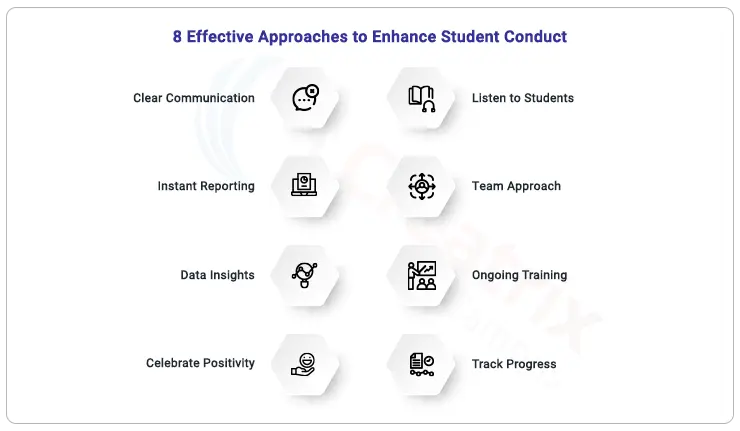
    Key Strategies for Improving Student Discipline


    strategies-for-improving-student-discipline


    • Establish the tone by making student conduct policies very apparent from the outset.
    • Give employees the tools they need to immediately report issues so that they can be addressed quickly.
    • Analyze behavior trends with analytics to adjust your strategy.
    • Highlight positive behavior because it inspires more of the same when it is acknowledged and rewarded.
    • Establish avenues for students to express their ideas and worries to promote a feeling of community.
    • Work together to present a unified front for discipline management with the staff, teachers, and parents.
    • Provide regular training to staff members on behavior management and conflict resolution techniques.
    • Put in place a system to keep an eye on incidents and their results so that changes and improvements can be made continuously.


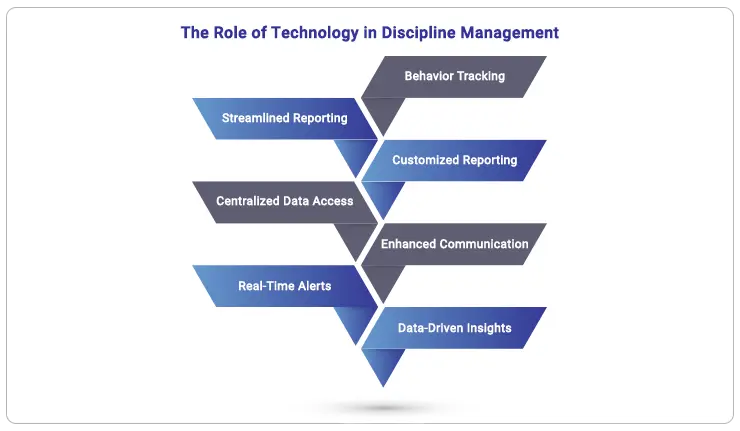
    How Technology Supports Discipline Management


    role-of-technology-in-discipline-management


    • When an incident occurs, you and your team can report it right away, focusing immediately on finding solutions. For example, a teacher could record a conflict in the hallway immediately rather than waiting for class to end.
    • You can quickly review and have educated discussions with ease when you have easy access to a student’s discipline history through a centralized system.
    • Parents and staff are kept informed about incidents instantly, allowing for timely action when necessary.
    • With the use of behavior tracking software, you can identify patterns over time and provide early interventions for students who consistently struggle.
    • Customized reports evaluate the success of disciplinary measures, enabling you to improve policies in light of actual outcomes.
    • Maintain open lines of communication among students, faculty, and parents as they work together to address discipline issues.
    • Use data insights to make informed decisions that improve behavior and campus safety. Institutions that implement technology solutions experience a 30% increase in compliance and satisfaction.


    Introducing Creatrix Campus Student Conduct Management System

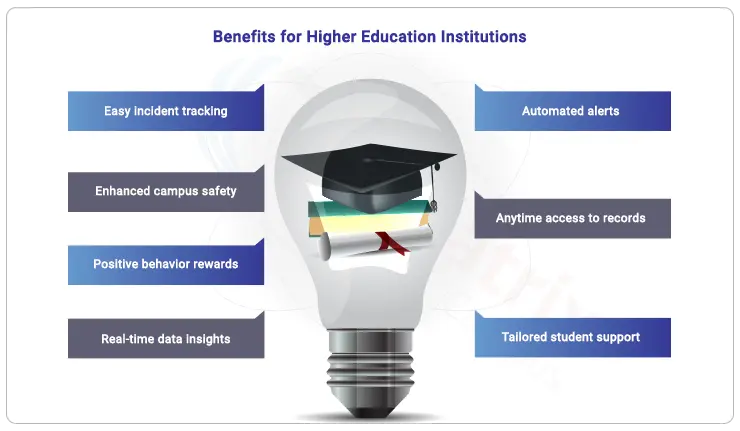
    • Log incidents quickly while on the go to simplify documentation.
    • Create customized reports with an emphasis on particular incident types, locations, and student demographics.
    • To inform parents, teachers, and students about significant incidents, send out automatic alerts.
    • Using your mobile device, you can view and edit incident records from anywhere on campus.
    • An integrated reward system that acknowledges and motivates students can help to promote positive behavior.


    Benefits for Higher Education Institutions


    benefits-for-higher-education-institutions


    Higher Ed Leaders, Take Action!

    We feel you definitely deserve a utopian campus where monitoring student behavior is a breeze for you! You can now effectively replace your legacy procedures with a more effective approach to handling student behavior when you use Creatrix Campus behavior tracking software. Want to know how it operates? Set up a demo with Creatrix now to see how it can help you and your team have a more seamless experience on campus! Let’s talk!

    Source link