Tag: Advocate

  • Texas A&M Requires Approval for Courses That “Advocate” Certain Ideologies

    Texas A&M Requires Approval for Courses That “Advocate” Certain Ideologies

    Courses that “advocate race or gender ideology, sexual orientation, or gender identity” now require presidential approval at Texas A&M system campuses, the system Board of Regents decided Thursday.

    Faculty members and external advocacy groups say the new rules violate academic freedom, and for many professors, questions remain about how the policies will be implemented and enforced. Approved in a unanimous vote after a lengthy public comment period, the policy changes fit a pattern of censorship at Texas A&M that escalated after a video of a student challenging an instructor about a lesson on gender identity went viral, leading to the instructor’s firing and the resignation of then-president Mark Welsh.

    Dan Braaten, an associate professor of political science at Texas A&M San Antonio and president of the campus American Association of University Professors chapter, said he was shocked “at the egregiousness” of the policies, but not surprised by them.

    “Faculty are extremely worried,” Braaten said. “They’re wondering, can they teach the classes they’re scheduled to teach in the spring? Who’s going to be looking at their syllabi? … Is the president of each A&M university going to have to approve every syllabus? Are there penalties for any of this? It’s just a complete … serious violation of academic freedom.”

    The board approved the new rules as revisions to existing system policies. A policy on “Civil Rights Protections and Compliance” will be amended to state that “no system academic course will advocate race or gender ideology, sexual orientation, or gender identity unless the course is approved by the member CEO.” It will also define “gender ideology” as “a concept of self-assessed gender identity replacing, and disconnected from, the biological category of sex.”

    Similarly, “race ideology” is defined as “a concept that attempts to shame a particular race or ethnicity, accuse them of being oppressors in a racial hierarchy or conspiracy, ascribe to them less value as contributors to society and public discourse because of their race or ethnicity, or assign them intrinsic guilt based on the actions of their presumed ancestors or relatives in other areas of the world. This also includes course content that promotes activism on issues related to race or ethnicity, rather than academic instruction.”

    Teaching Versus Advocacy

    A previous version of the revision proposed that no system academic course will “teach” race or gender ideology, but the verb was changed to “advocate” before the policies were presented formally to the full board. It’s unclear how the system will differentiate between advocacy and regular instruction on these topics. Representatives for the board on Wednesday declined to comment on the policies ahead of the board vote. They did not respond to Inside Higher Ed’s questions after the policies were approved.

    A second policy on “Academic Freedom, Responsibility and Tenure” previously stated that “each faculty member is entitled to full freedom in the classroom in discussing the subject that the faculty member teaches, but a faculty member should not introduce a controversial matter that has no relation to the classroom subject.” The approved amendment adds that faculty members may not “teach material that is inconsistent with the approved syllabus for the course.”

    In a partially redacted Nov. 10 email obtained by Inside Higher Ed, a Texas A&M faculty leader said that administrators at several universities were already discussing implementation plans ahead of the board vote. An administrator also told the faculty leader that the changes to the policy would not likely lead to a formal syllabus-approval process and instead are intended to keep course content aligned with learning outcomes.

    The board received 142 written comments ahead of Thursday’s vote, and eight faculty members spoke out against the policy changes during the meeting’s public comment period. Several of them also called for Melissa McCoul, the professor fired in September, to be reinstated.

    “This is not university-level education, it is cruelty and political indoctrination in wolf’s clothing,” said Leonard Bright, a professor of government and public service and president of the Texas A&M College Station AAUP chapter. “I would need to tell my students that ‘What you came here to learn, I’m unable to tell you, because I’m restricted to tell you that information, even though such knowledge is available at every major university in this world.’”

    Sonia Hernandez, a liberal arts professor who teaches about Latin American history, shared a past example that highlighted the pitfalls of the new policies.

    “I had a student once who took issue with my discussion of the importance of military history. He was against war and felt strongly about war’s damaging effects on society, yet it was full academic freedom—not cherry-picking of topics, not advocacy, not ideology—that allowed me to share research on the intersections of war and identity with my class,” Hernandez said.

    Two faculty members—finance professor Adam Kolasinski and biomedical engineering professor John Criscione—spoke in favor of the policy changes.

    “I don’t think somebody should be able to say that Germans born two generations after the Holocaust somehow bear guilt for the Holocaust, because that’s really what’s being prohibited here,” Kolasinski said. “My colleagues seem to think that the policy says something it doesn’t.” Kolasinski also suggested the board change the language back from “advocate” to “teach.”

    AAUP president Todd Wolfson urged the board to reject the proposed policy changes in a statement Tuesday. So did Brian Evans, president of the Texas Conference of the AAUP, which includes faculty at Texas A&M campuses.

    “By considering these policy changes, the Texas A&M University System Board of Regents is telling faculty, ‘Shut up and teach—and we’ll tell you what to teach,’” Evans said in the statement. “This language and the censorship it imposes will cause irreparable harm to the reputation of the university, and impede faculty and students from their main mission on campus: to teach, learn, think critically, and create and share new knowledge.”

    In a Monday statement, FIRE officials wrote, “Hiring professors with PhDs is meaningless if administrators are the ones deciding what gets taught … Faculty would need permission to teach students about not just modern controversies, but also civil rights, the Civil War, or even ancient Greek comedies. This is not just bad policy. It invites unlawful censorship, chills academic freedom, and undermines the core purpose of a university. Faculty will start asking not ‘Is this accurate?’ but ‘Will this get me in trouble?’ That’s not education, it’s risk management.”

    AI-Driven Course Review

    Also on Thursday, the board discussed a detailed, systemwide review of all courses using an artificial intelligence–driven process. The system has already piloted the review process at its Tarleton State University campus, where most of the courses that were flagged are housed in the College of Education, which includes the sociology and psychology departments, the Nov. 10 email from a faculty leader stated. Board members said they intend to complete the course review regularly, as often as once per semester.

    “The Texas A&M system is stepping up first, setting the model that others will follow,” Regent Sam Torn said about the course review at Thursday’s meeting.

    The system will also use EthicsPoint, an online system that will allow students to report inaccurate, misleading or inappropriate course content that diverges from the course descriptions. System staff will be alerted when a student submits an EthicsPoint complaint, and if the complaint is determined to be valid, it will be passed along to the relevant university.

    Source link

  • Charlie Kirk was a free speech advocate. His death shouldn’t lead to suppression.

    Charlie Kirk was a free speech advocate. His death shouldn’t lead to suppression.

    This article originally appeared in USA Today on Sept. 21, 2025.


    If you’re a believer in free speech, the past two weeks have been one of the longest years of your life. In fact, this might have been the worst fortnight for free expression in recent memory.

    It started Sept. 9, when the Foundation for Individual Rights and Expression (FIRE), where I work, released its sixth annual College Free Speech Rankings. The rankings revealed that a record 1 out of 3 students is open to the idea of using violence to stop campus speech.

    This sentiment was then frighteningly made flesh the next day, when conservative commentator Charlie Kirk was assassinated at Utah Valley University. 

    The fact that Kirk was killed while engaging in open debate on a college campus is a cruel irony. If the first person to hurl an insult rather than a spear birthed civilization, then anyone resorting to violence in response to speech is attempting to abort it.

    The free speech principles that are foundational to our democracy have been a candle in the dark – not just here at home, but across a world in the grip of a terrifying resurgence of authoritarianism.

    The difference between words and violence – and the civilizational importance of free speech – couldn’t have been more stark in that moment. No matter how hurtful, hateful or wrong, there is no comparing words to a bullet.

    To preserve that distinction, we must have the highest possible tolerance for even the ugliest speech. But that notion has landed on largely deaf ears, because what followed was a cacophony of cancellations.

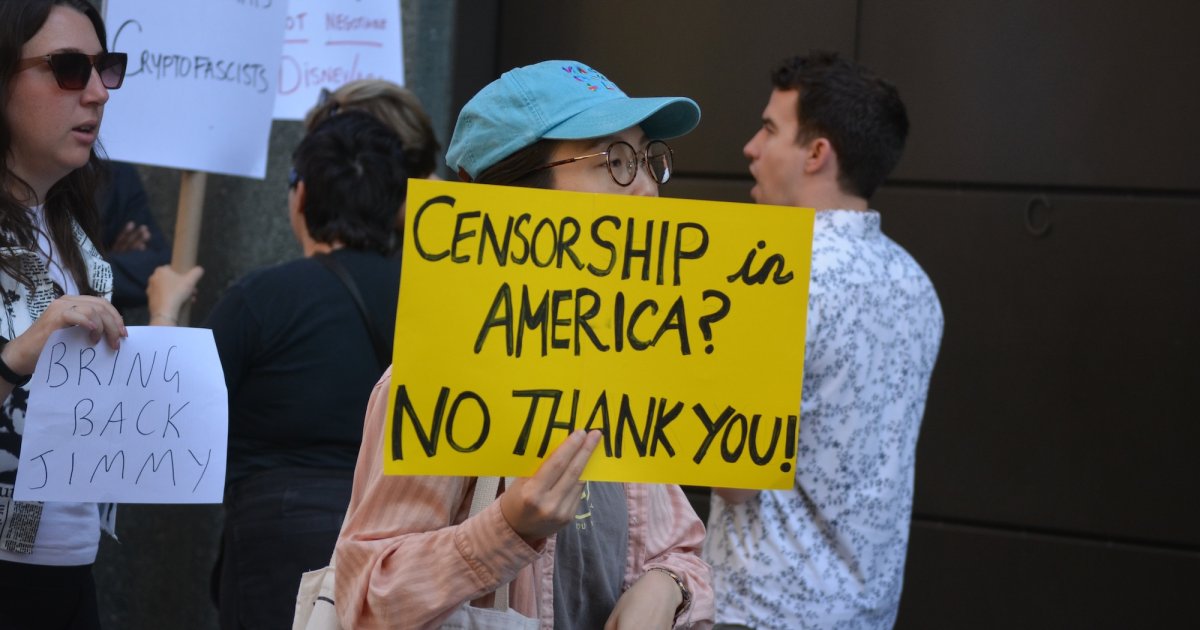
    Charlie Kirk was a free speech advocate. His death led to stifled speech.

    Scores of college professors, for example, have either been investigated, suspended or fired for comments they made regarding Kirk’s assassination. Even wildlife conservationistscomic book writers, retail workers and restaurant employees have been targeted for their speech.

    There are many more, and Vice President JD Vance, while stepping in to guest-host “The Charlie Kirk Show,” endorsed these efforts

    In some cases, the targeted speech was a criticism of Kirk and his views. In others, it was a celebration of his fate. In all cases, however, it has been First Amendment-protected speech – and far from violence.

    The government pressure didn’t end there, either. Secretary of Agriculture Brooke Rollins called for “a legal and rational crackdown on the forces that are desperately trying to annihilate our nation.”

    Carr’s threats to ABC are jawboning any way you slice it

    ABC suspended Jimmy Kimmel hours after FCC Chair Brendan Carr suggested they could face consequences for remarks Kimmel made in the aftermath of Charlie Kirk’s murder.


    Read More

    On Sept. 15, U.S. Attorney General Pam Bondi went on “The Katie Miller Podcast” and threatened, “There’s free speech, and then there’s hate speech. . . . We will absolutely target you, go after you, if you are targeting anyone with hate speech.”

    Given that there is no First Amendment exception or legal definition for “hate speech,” this can mean just about anything Bondi and President Donald Trump‘s administration consider “hateful.” Bondi walked back her comments after public outcry, notably from conservatives.

    The president, however, ran with it, threatening an ABC News reporter for having covered him “unfairly.” “You have a lot of hate in your heart,” Trump said Sept. 16. “Your company paid me $16 million for a form of hate speech. So maybe they’ll have to go after you.”

    Then Federal Communications Commission Chairman Brendan Carr publicly threatened action against host Jimmy Kimmel and ABC for “really sick” comments Kimmel made during his opening monologue. “We can do this the easy way or the hard way,” Carr said.

    Hours later, ABC suspended Kimmel’s show indefinitely, prompting celebration from TrumpCarr and others – and driving us from a free speech nightmare into a full-on hellscape.

    Social discourse needs a reset in America

    This is unsustainable.

    In the past two weeks alone, the state of free speech in our country has been battered almost beyond recognition.

    For years now, we have had a cultural climate where growing numbers of people are so intolerant of opposing viewpoints that they will resort to violence, threats and cancellation against their adversaries. Now we’re seeing the Trump administration flagrantly abusing its power and authority to punish criticism and enforce ideological conformity. 

    Yes, plenty of previous administrations have violated the First Amendment. But rather than repudiating those violations, the Trump administration’s actions over the past week have dramatically escalated how openly and aggressively that constitutional line is crossed.

    The core American belief that power is achieved through persuasion and the ballot box, and that bad ideas are beaten by better ones – not by bullets or bullying – is in serious danger.

    As former federal Judge Learned Hand once put it: “Liberty lies in the hearts of men and women; when it dies there, no constitution, no law, no court can even do much to help it.”

    That’s what’s at stake here: The free speech principles that are foundational to our democracy have been a candle in the dark – not just here at home, but across a world in the grip of a terrifying resurgence of authoritarianism.

    The ultimate tragedy would be if we extinguished them in our own hearts and by our own hands.

    Source link

  • Advocate for Investments in Arts Education for All Students

    Advocate for Investments in Arts Education for All Students

    Investing in Arts Education

    Arts engagement empowers youth by providing a vital outlet to express their thoughts, feelings, ideas, and passions, while also building their self-confidence, creativity, critical-thinking, and communication skills. This participation directly supports a student’s emotional well-being and academic success.

    Yvonne Johnson

    President, National PTA

    Research shows that students who participate in the arts have higher GPAs, higher standardized test scores, and lower dropout rates. Yet, there are great disparities in the access to quality arts education for many students across the country. It is critical that we advocate for investments in arts education so all students can benefit from participating in the arts.

    Here’s how you can help make arts more accessible to youth:

    • Ask your child’s school about current arts programs and funding. Talk to other parents about the barriers they face.
    • Email or call district leaders about expanding arts access.
    • Attend meetings with decision-makers and voice support for arts funding.
    • Meet with school administrators to discuss arts opportunities.
    • Share arts success stories on social media and with your local news media.

    Remember: Your voice matters. Even small actions like attending one meeting or sending an email can help build momentum for better arts access.

    If you aren’t already a member of PTA, join us! Our association has long advocated for access to arts education and our popular Reflections program encourages students to explore their talents and express their ideas by creating works of art for fun and recognition. 

    Together, we can ensure every child has the opportunity to experience the transformative power of the arts. Your voice and actions will help unlock creativity for generations to come.

    Source link

  • 5 Ways to Advocate for Your Students During The U.S. Election

    5 Ways to Advocate for Your Students During The U.S. Election

    Election Day in the U.S. is just around the corner. On top of carrying multiple academic and employment responsibilities, some students will also be voting for the first time. Others, such as those from marginalized or historically underrepresented populations, may be overwhelmed with what the election results could mean for them. In the lead up to Election Day, a healthy dose of empathy will be essential in ensuring students have a chance to fulfill their civic duty—and the opportunity to consider its consequences.

    Being flexible with due dates, considering students’ wellbeing and ensuring learners are armed with the resources needed to vote are the most important things you can do as Election Day nears. Read on to learn how professors advocated for their students during the 2020 election—and how you can do the same.

    Consider making November 4 and 5 free of assignments (or even classes)

    Exams can cause some students a great deal of stress and anxiety. Lillian Horin, Biological and Biomedical Sciences PhD student at Harvard University, urges educators to keep BIPOC students in mind when scheduling high-stakes tests.

    Consider swapping your exams or problem sets (Psets) with a trip to the ballot box. Jacob Light, Economics PhD student at Stanford University, writes that this simple gesture may allow students to exercise their civic duty.

    Other students like Anna-Sophia Boguraev, Bioengineering PhD student at Harvard Medical School and MIT, say that TAs have the power to amplify student concerns and requests—none of which should be ignored.

    If your assignments can’t wait, build in flexibility and timeliness

    Self-paced learning can allow students to visit the polls and complete coursework at a time that works for them—so says Jesse Fox, Associate Professor of Communication at Ohio State University.

    Election Day can also be a good opportunity to let students catch their breath in your course. Give students a chance to study and review material that they haven’t had a chance to look over, suggests Scott Grunow, Instructor in English and Religious Studies at the University of Illinois at Chicago.

    Should your institutions provide little leeway in your assessment choices, at least incorporate real-time events into your discussions. Derek Bruff, Associate Director, Center for Teaching Excellence at the University of Virginia, notes that relating course content to the election can help students see the value of what they’re learning.

    Real-time political events and policy proposals can make for discipline-specific conversations. This also allows students to apply what they’ve learned in your class to the real world, as Andrea Gomez Cervantes, Assistant Professor in the Department of Sociology at Wake Forest University, proposes.

    Mobilize your students to show up at the polls

    Gen Z students are motivated to vote. In the 2018 midterm elections, the student turnout rate increased by 20 percent compared to the 2014 midterms.1 Ensure students are equipped with the resources to vote as soon as possible, writes Wendy Christensen, Sociology Professor at William Paterson University.

    Similarly, ask students about their voting plans. Consider working with your class to ensure they know where to go on November 5, suggests Margaret Boyle, Associate Professor of Romance Languages and Literatures at Bowdoin College.

    Ensure your voter registration information and resources appeal to all students, regardless of what political party they support. Meghan Novisky, Assistant Professor of Criminology at Cleveland State University, emphasizes the importance of using non-partisan guidelines.

    Some scholars like Sara Wheeler-Smith, Associate Professor of Management at Manhattan College, even plan to offer a grading incentive for visiting the polls.

    Incorporate guest lectures and learn from your colleagues

    Navigating election week with students in mind might be an unfamiliar undertaking. Consider leaning on faculty at your institution for support, writes Heather Mayer, Director of Educational Technology at Everett Community College.

    Some students may be undecided voters, while others may have missed the presidential debates. Incorporate forms of debate in your classroom—with the support of scholars from other institutions, as Yujin Jung, Political Sciences PhD student at the University of Missouri, plans to do.

    Keep in mind the importance of mental and physical health

    Check-ins with students have gained new meaning in the midst of an election. Andrea Kelley, Sociology Professor at the University of Michigan, tends to her students’ socioemotional needs before assigning readings and lectures.

    Election Day can come with a range of emotions for many students. Cate Denial, Distinguished Professor of American History, Chair of the History department, and Director of the Bright Institute at Knox College, removes the expectation for students to pay attention and participate in class.

    References

    1. Thomas, N. et al. (2018). Democracy Counts 2018: Increased Student and Institutional Engagement. Tufts University. https://idhe.tufts.edu/sites/default/files/DemocracyCounts2018.pdf

    Tagged as:


    Source link