Tag: advocates

  • As EPA pulls back, advocates warn it’s schoolchildren who face the steepest risks

    As EPA pulls back, advocates warn it’s schoolchildren who face the steepest risks

    This story was produced by Floodlight and republished with permission. 

    President Donald Trump and his administration have called it the “Great American Comeback.” But environmental advocates say the U.S. Environmental Protection Agency’s reversing course on enforcing air and water pollution laws is more of a throwback — one that will exacerbate health risks for children who live and study in the shadows of petrochemical facilities. 

    The American Lung Association has found that children face special risks from air pollution because their airways are smaller and still developing and because they breathe more rapidly and inhale more air relative to their size than do adults.

    Environmental lawyers say Trump and EPA Administrator Lee Zeldin’s slashing of federal protections against toxic emissions could lead to increased exposure to dangerous pollutants for kids living in fenceline communities.

    Community advocates like Kaitlyn Joshua, who was born and raised in the southeast corridor of Louisiana dubbed “Cancer Alley,” say they are horrified about what EPA’s deregulation push will mean for the future generation.  

    “That is not an exaggeration; we feel like we are suffocating without the cover and the oversight of the EPA,” Joshua said. “Without that, what can we really do? How can we really save ourselves? How can we really save our communities?” 

    Kaitlyn Joshua is a native of the southeast corridor of Louisiana dubbed “Cancer Alley,” and has spent the last few years leading the fight against a hydrogen and ammonia facility being built within 2,000 feet of an elementary school in Ascension Parish. Joshua says she is ‘horrified’ about the recent deregulation measures the U.S. Environmental Protection Agency recently announced for the petrochemical industry.
    Credit: Claire Bangser/Floodlight

    Ashley Gaignard knows how hard it is to keep kids safe when pollution is all around. 

    When Gaignard’s son was in elementary school, a doctor restricted him from daily recess, saying the emissions from an ammonia facility located within 2 miles of his playground could be exacerbating a pre-existing lung condition, triggering his severe asthma attacks. 

    “I had asthma as a kid growing up, and my grandfather had asthma, so I just figured it was hereditary; he was going to suffer with asthma,” said Gaignard, who was born and raised in Louisiana’s Ascension Parish, also located within Cancer Alley. She’s now chief executive officer of the community advocacy group she created, Rural Roots Louisiana

    “I just never knew until the doctor said, ‘Okay, we have to think about what he is breathing, and what’s causing him to flare up the minute he’s outside’,” she said. 

    Gaignard said the further her son got away from that school, as he moved through the parish’s educational system, the less severe his attacks were. She said he’s now an adult living in Fresno, California — and no longer suffers from asthma.

    Related: How colleges can become ‘living labs’ for fighting climate change

    Zeldin sent shockwaves throughout the environmental justice sector on March 12 when he announced that the EPA was rolling back many of the federal regulations that were put in place under the administration of Joe Biden — many built around environmental justice and mitigating climate change. 

    Those included strengthening the Clean Air Act by implementing more stringent controls on toxic air emissions and increased air quality monitoring in communities near industrial facilities. The new standards were expected to reduce 6,000 tons of air toxins annually and reduce the emissions related to cancer risks in these communities in Texas, Louisiana, Delaware, New Jersey, the Ohio River Valley and elsewhere. 

    A new memo from the Office of Enforcement and Compliance Assurance, which serves as the law enforcement arm of the EPA — circulated the same day as Zeldin’s announcement — states that environmental justice considerations would no longer factor into the federal agency’s oversight of facilities in Black and brown communities. 

    Zeldin said the goal was “driving a dagger straight into the heart of the climate change religion.”

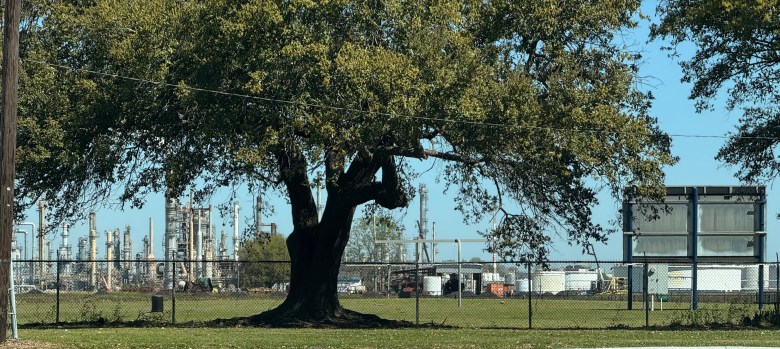
    Port Allen Middle School sits in the shadow of the Placid petrochemical refinery in West Baton Rouge Parish, La. A 2016 report found nearly one in 10 children in the U.S. attends one of the 12,000 schools located within 1 mile of a chemical facility, which for environmental advocates highlights the danger of the recently announced rollbacks of air and water pollution regulations by the U.S. Environmental Protection Agency. Credit: Terry L. Jones / Floodlight

    That means the EPA will no longer target, investigate or address noncompliance issues at facilities emitting cancer-causing chemicals such as benzene, ethylene oxide and formaldehyde in the places already overburdened with hazardous pollution. 

    “While enforcement and compliance assurance can continue to focus on areas with the highest levels of (hazardous air pollutants) affecting human health,” the memo reads, “…to ensure consistency with the President’s Executive Orders, they will no longer focus exclusively on communities selected by the regions as being ‘already highly burdened with pollution impacts.’”

    The agency also will not implement any enforcement and compliance actions that could shut down energy production or power generation “absent an imminent and substantial threat to human health.” 

    In is prepared video statement about the EPA’s deregulation measures, Zeldin said, “The agency is committed to fulfilling President Trump’s promise to unleash American energy, lower cost of living for Americans, revitalize the American auto industry, restore the rule of law, and give power back to states to make their own decisions. ”

    Related: How Trump is disrupting efforts by schools and colleges to combat climate change

    Top officials with the nonprofit environmental advocacy group Earthjustice recently said there is no way for the Trump administration to reconcile what it’s calling “the greatest day of deregulation” in EPA’s history with protecting public health. 

    Patrice Simms, vice president of litigation for healthy communities for Earthjustice, went a step further pointing out during a press briefing that the reason EPA exists is to protect the public from toxic air pollution. 

    “The law demands that EPA control these pollutants, and demands that EPA protect families and communities,” Simms said. “And these impacts on these communities most heavily land on the shoulders of children. Children are more susceptible to the harms from pollutants, and these pollutants are often happening right in the backyards of our schools, of our neighborhoods and our playgrounds.”

    A 2016 report published by the Center for Effective Government found that nearly one in 10 children in the country attends one of the 12,000 schools located within 1 mile of a chemical facility. These children are disproportionately children of color living in low-income areas, the report found. 

    For the past several years, Joshua has been leading the opposition to a hydrogen and ammonia facility being built within 2,000 feet of an elementary school in Ascension Parish. Air Products plans to start commercial operation in 2028 where an estimated 600,000 metric tons of hydrogen will be produced annually from methane gas.

    The $7 billion project has been touted as a clean energy solution because the company intends to use technology to collect its carbon dioxide emissions, and then transport them through pipelines to be stored under a recreational lake 37 miles away. 

    Carbon capture technology has been controversial, with skeptics highlighting the possibilities for earthquakes, groundwater contamination and CO2 leaking back into the atmosphere through abandoned and unplugged oil and gas wells or pipeline breaches. Pipeline ruptures in the past have also led to communities having to evacuate their homes. 

    Related: When a hurricane washes away a region’s child care system

    Joshua said these communities need more federal regulation and oversight — not less.

    “We had a community meeting … for our Ascension Parish residents, and the sentiment and the theme on that call was very much like ‘Kaitlyn, there is nothing we can do.’ Like, we just had to literally lie down and take this,” Joshua said. “We had to kind of challenge people and put them in the space, in time, of a civil rights movement. We have to get creative about how we’re going to organize around it and be our own version of EPA.”

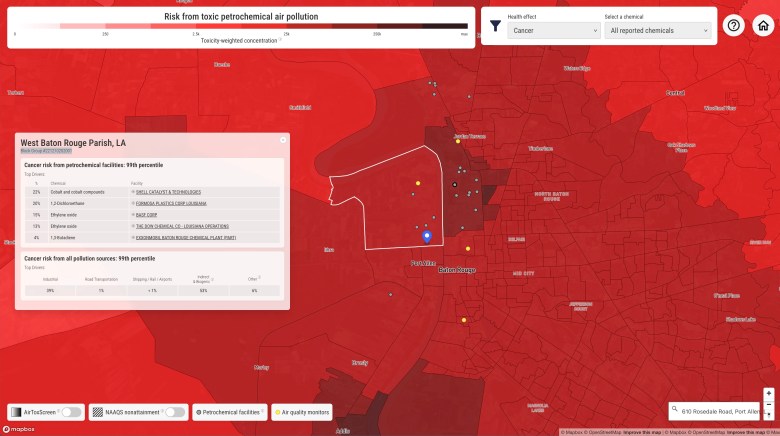
    This screenshot from CLEAR Collaborative’s Petroleum Pollution Map models health risks from hazardous air pollution from petrochemical facilities around West Baton Rouge Parish near Port Allen Middle School. The map uses U.S. Environmental Protection Agency data analyzed by the Environmental Defense Fund. Environmental advocates have sounded the alarm on the dangers of the EPA’s rollback of air and water regulations for children in fenceline communities. Credit: Provided by The Environmental Defense Fund

    Sarah Vogel, senior vice president of health communities with the Environmental Defense Fund, said the move toward deregulation comes as the U.S. Department of Justice announced on March 7 that it was dropping the federal lawsuit the Biden administration lodged against Denka’s Performance Elastomer plant in Louisiana. That plant had been accused of worsening cancer risks for the residents in the surrounding majority-Black community. 

    The DOJ said its decision was tied to Trump’s moves to dismantle all federal programs tied to diversity, equity and inclusion.

    “What they’re trying to do is just completely deregulate everything for oil and gas and petrochemical facilities, just absolutely take the lid off,” Vogel said. “We have long known that children are uniquely susceptible to air pollution and toxic chemicals. Like they’re huge, huge impacts. It’s why what they are doing is so devastating and cruel in my mind.”

    Floodlight, which produced this story, is a nonprofit newsroom that investigates the powers stalling climate action.

    The Hechinger Report provides in-depth, fact-based, unbiased reporting on education that is free to all readers. But that doesn’t mean it’s free to produce. Our work keeps educators and the public informed about pressing issues at schools and on campuses throughout the country. We tell the whole story, even when the details are inconvenient. Help us keep doing that.

    Join us today.

    Source link

  • Free speech advocates rally to support FIRE’s federal appeal to defend advocacy in public parks

    Free speech advocates rally to support FIRE’s federal appeal to defend advocacy in public parks

    Protesting in public parks is as American as apple pie. It’s at the heart of our First Amendment — and one of our nation’s most time-honored principles. That right does not disappear merely because a private entity operates the public park on the government’s behalf. 

    That’s why FIRE and the Law and Religion Clinic at the University of Texas School of Law are appealing a district court ruling that weakens this First Amendment right. And we are proud to be backed by a broad coalition of prominent organizations as “friends of the court.” 

    Here’s what happened. Several years ago, animal welfare advocates Daraius Dubash and Dr. Faraz Harsini took to Houston’s largest public park to raise awareness about the harms of industrialized farming. For Dubash, this activism is rooted in his Vedantic Hindu faith, which compels him to promote the teaching of ahimsa, or nonviolence. To communicate their message, Dubash and Harsini serve as co-organizers for an international nonprofit animal-rights group. Their signature event involves volunteers showing muted documentary footage of farming practices to passersby, while others remain available to answer questions.

    Dubash and Harsini’s right to peacefully advocate on this issue in a public park is beyond dispute. But on three separate occasions, the public park’s private management ordered them to leave. The fourth time, park management had Houston police arrest Dubash for criminal trespass and banned them both from showing their video footage in the park in the future. Why? Because the park’s private managers and city police deemed their message “offensive.”

    With the help of FIRE and the Law and Religion Clinic, Dubash and Harsini filed suit in 2023 against the City of Houston, the park management corporation, its then-president, and the arresting officers. But in September, 2024, the U.S. District Court for the Southern District of Texas dismissed their claims, ruling that none of the defendants were responsible for violating Dubash and Harsini’s constitutional rights in a public park. 

    We disagree. 

    FIRE and the Clinic appealed to the Fifth Circuit, arguing that the ruling effectively lets the government bypass the First Amendment by delegating the management of public spaces to private organizations. And the court’s limited interpretation of governmental liability would make it nearly impossible for anyone to challenge violation of their constitutional rights by municipalities or law enforcement. 

    Last week, 12 prominent organizations from across the ideological spectrum filed nine amicus curiae briefs in support of Dubash and Harsini:

     The ACLU of Texas argues the park management company was acting as a state actor and public-private partnerships “cannot serve as an end run around the First Amendment.” The brief also argues the district court erred by failing to hold the arresting officers accountable based on their “mistaken belief” that the park was private. As the brief explains, probable-cause findings must be based on “objective facts and circumstances rather than subjective beliefs.”

    Young America’s Foundation, Hamilton Lincoln Law Institute, and Advancing American Freedom explain that Houston cannot bypass its duty to protect free speech in its public spaces by granting oversight authority to a private third party. The brief also emphasizes the sweeping implications of the district court’s decision, including in the academic context where state universities are increasingly attempting to evade First Amendment protections by outsourcing park management to nominally private entities like student governments.

    Liberty Justice Center argues the district court’s decision “blurs the line between state and private actors,” allowing Houston to “contract out of its constitutional obligations.” We could not agree more.

     The Center for American Liberty, in a brief submitted through Reeves Law LLC, argues that maintaining a public park is a traditional and exclusive government function, with public parks serving “as public forums for the expression of speech,” whether or not they are managed by a private entity.

     The National Press Photographers Association, in a brief submitted through the First Amendment Clinic at Southern Methodist University Dedman School of Law, explains how the district court’s ruling “threatens the sanctity of the spaces where speech is deserving of the highest protection.”

     Law Enforcement Action Partnership and the National Police Accountability Project explain that accountability for law enforcement officers and municipalities is crucial to preserving public confidence in the police and the government, and that failing to hold police officers accountable “undermines public trust in law enforcement.” The brief also argues that municipalities should know their police officers “need training and guidance to appropriately respond” to peaceful expressive activity, and failing to provide that training is sufficient to establish municipal liability.

    Protect the First Foundation, in a brief submitted through the Religious Freedom Clinic at Harvard Law School and Schaerr Jaffe LLP, highlights that Dubash was motivated to proselytize nonviolence by his deeply held religious beliefs, and describes the long history and tradition of public proselytization, from the persecution of religious minorities in the colonies through the legal protections established by First Amendment jurisprudence.

    The Hindu American Foundation, in a brief submitted through Jackson Walker LLP, explains that Dubash’s religious motivation to advocate for nonviolence towards animals is consistent with Hindu teachings. The brief also argues that his “arrest, detention, and the ongoing prohibition on his method of proselytizing” do not pass constitutional muster.

    The American Hindu Coalition, in a brief submitted through the Free Exercise Clinic at Yale Law School, emphasizes the history of public parks and streets as centers of religious activity, how marginalized faiths rely on these spaces to exercise their faith, and that Dubash’s activism is rooted in his religious beliefs.

    Our clients and their counsel are grateful for the support of this impressive and diverse amicus coalition. This case will play a critical role in protecting the rights of other protesters and religious minorities to engage in protected expression as guaranteed under the First Amendment.

    Source link

  • VICTORY: FIRE lawsuit leads California to halt law penalizing reporters, advocates, and victims who discuss publicly known information about sealed arrest records

    VICTORY: FIRE lawsuit leads California to halt law penalizing reporters, advocates, and victims who discuss publicly known information about sealed arrest records

    SAN FRANCISCO, Dec. 19, 2024 — A federal court, acting on a stipulation agreed to by the California attorney general and San Francisco city attorney, today halted enforcement of a California law that officials deployed to suppress journalism about a controversial tech CEO’s sealed arrest records. 

    Under the law, any person — including journalists, advocates, witnesses, and victims of crimes — faced a civil penalty of up to $2,500 for sharing public information. The court order results from a First Amendment lawsuit filed by the Foundation for Individual Rights and Expression in November, which led the California attorney general and San Francisco city attorney to agree not to enforce the law while the lawsuit is pending.

    “The press and public have a constitutional right to discuss what’s publicly known,” said FIRE attorney Adam Steinbaugh. “Government officials can’t punish the press and public when officials fail to safeguard information. That responsibility starts and ends with the government.”

    In October 2023, journalist Jack Poulson published articles about a controversial tech CEO’s arrest, sharing a copy of the arrest report sent to him by an unidentified source. The San Francisco Police Department had previously made that report public, even though the executive had successfully petitioned a state court to seal the record. 

    Almost a year after Poulson published the report, the city attorney of San Francisco — working with the tech executive — sent three letters to Poulson and his webhost, Substack, demanding they remove articles and the sealed report. Those letters threatened enforcement of California’s anti-dissemination statute, Penal Code § 851.92(c). The law imposes a civil penalty of up to $2,500 on any person (except the government officials charged with maintaining the secrecy of sealed records) who shares a sealed arrest report or any information “relating to” the report — even if the information is already publicly available.

    Concerned by the implications of the statute, FIRE sued the San Francisco city attorney and the California attorney general on behalf of the Bay Area-based First Amendment Coalition, its Director of Advocacy Ginny LaRoe, and legal commentator Eugene Volokh. Each regularly comments on censorship campaigns precisely like the one the tech CEO and city attorney launched against Paulson and Substack. But the anti-dissemination statute prohibited them from covering the CEO story, even though the information has been publicly available for over a year.

    Today, the court entered a preliminary injunction agreed to by both California and the city attorney that prohibits them from enforcing the law with respect to publicly available information. 

    The preliminary injunction protects not only FAC and Volokh, but anyone — including journalists like Poulson — who publishes information made available to the public. 

    “Discussing and sharing lawfully obtained information about arrests is not a crime — it’s a core First Amendment right,” said FIRE Staff Attorney Zach Silver. “The rich and powerful shouldn’t have the luxury of deploying the government to put their skeletons back in the closet. By standing up for their own rights, the First Amendment Coalition and Eugene Volokh have helped to protect others from facing legal action under California’s anti-dissemination law.”

    The Foundation for Individual Rights and Expression (FIRE) is a nonpartisan, nonprofit organization dedicated to defending and sustaining the individual rights of all Americans to free speech and free thought — the most essential qualities of liberty. FIRE educates Americans about the importance of these inalienable rights, promotes a culture of respect for these rights, and provides the means to preserve them.

    CONTACT:

    Jack Whitten, Communications Campaign Specialist, FIRE: 215-717-3473; [email protected]

    Source link

  • Free speech advocates converge to support FIRE’s ‘Let’s Go Brandon’ federal court appeal

    Free speech advocates converge to support FIRE’s ‘Let’s Go Brandon’ federal court appeal

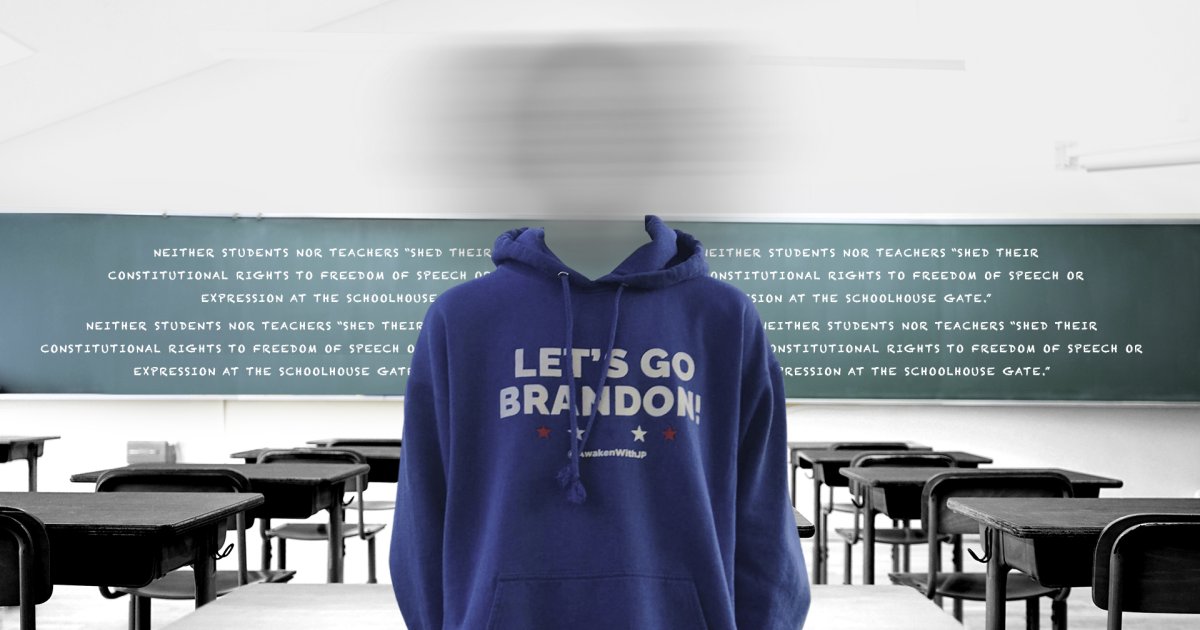
    FIRE, supported by a wave of prominent organizations and scholars as “friends of the court,” has appealed a district court’s ruling that limited the rights of students to attend middle and high school wearing clothes bearing the “Let’s Go Brandon” political slogan. FIRE is asking a federal appeals court to strike down the decision below and uphold freedom of expression for public school students, and a broad spectrum of free speech advocates and language experts are backing us up.

    So what happened? In April 2023, FIRE sued a west Michigan school district and two administrators for preventing two students from wearing “Let’s Go Brandon” sweatshirts. The “Let’s Go Brandon” slogan originated during an October 2021 NASCAR race. After the race, won by Brandon Brown, members of the crowd chanted “Fuck Joe Biden” during Brown’s post-race interview. A commentator remarked that the fans were shouting “Let’s Go Brandon!” 


    WATCH VIDEO: NASCAR fans chant “Fuck Joe Biden” after the race.

    Since then, the presidential campaign of Donald Trump and Republican members of Congress have used the phrase widely, including during Congressional floor speeches, to show their displeasure with the Biden administration. The “Let’s Go Brandon” slogan airs uncensored on broadcast television, national cable news, and broadcast radio for all to hear. In the case on appeal, FIRE’s clients wore their “Let’s Go Brandon” sweatshirts to school to express their disapproval of Biden and his administration. 

    During the lawsuit, the school acknowledged the students did not cause any disruption with their apparel. Yet this past August, the District Court for the Western District of Michigan upheld the school district’s censorship of “Let’s Go Brandon” apparel, holding “Let’s Go Brandon” is legally indistinguishable from “Fuck Joe Biden” and therefore constitutes “profanity.” 

    As FIRE’s appeal argues, that’s not how speech works. “Heck” is not the same as “hell,” “darn” is not the same as “damn,” and “Let’s Go Brandon” is not the same as “Fuck Joe Biden.” The government may not censor public school students’ political expression absent substantial disruption. Nor may school districts bypass this First Amendment protection by dubbing disfavored political speech “profane.” 

    This case will play a critical role in protecting the rights of other minor students to engage in non-disruptive political expression as guaranteed under the First Amendment.

    Last week, 18 individuals and organizations, including some of the world’s foremost linguistic experts, joined together to file eight amicus curiae, or “friend of the court” briefs in support of minors’ free speech rights. These briefs urge the Sixth Circuit to recognize what has long been understood outside the courtroom — sanitized expression is, by design, distinguishable from the profane language it replaces: 

    Linguistic Scholars: Dr. Melissa Mohr, Dr. Rebecca Roache, Professor Timothy Jay, Professor John H. McWhorter, and Professor Steven Pinker are internationally recognized linguistic scholars whose works focus on the history, psychology, and sociology of swearing. Each has written extensively on how language works and the role it continues to play in society. Together, they submitted a brief through Quinn Emanuel Urquhart & Sullivan, LLP, helpfully delineating the different types of “sanitized expression,” including euphemisms like “Let’s Go Brandon,” and describing their ubiquity and importance in political discourse. As they state at the beginning of their brief: “This case is not about swearing; it is about not swearing.”

    First Amendment Scholars: Dean Erwin Chemerinsky, Professor Clay Calvert, Professor Roy Gutterman, Professor Mary-Rose Papandrea, and Professor Joseph A. Tomain submitted an amicus brief through Cornell Law School’s First Amendment Clinic and attorney Michael Grygiel. Drawing on decades of study, the scholars methodically apply seminal First Amendment decisions to this particular case. Their brief argues: “the lower court failed to apply Tinker’s ‘substantial disruption’ test, as required when schools seek to prohibit student expression within the school environment that communicates a political message,” and thus “departed from longstanding public student constitutional free speech principles.”

    Liberty Justice Center: The Liberty Justice Center’s amicus brief asserts the district court’s decision represents an unprecedented expansion of “profanity” and is part of a nationwide increase in political censorship. The brief describes how “censorship of entirely mainstream political discourse has become all too common around the country” and school authorities increasingly seek to restrict free expression. The LJC argues that the district court’s opinion exacerbates this growing problem, by authorizing schools to treat “every euphemism . . . as the equivalent of its reference.”

    Dhillon Law Group, Young America’s Foundation, and Hamilton Lincoln Law Institute: These organizations submitted an amicus brief asserting the lower court’s failed to properly apply Tinker and its progeny to the students’ “Let’s Go Brandon” sweatshirts, which likewise represented political, non-profane student speech. Through careful analysis of First Amendment doctrine, their brief explains that the “district court erred in disregarding the political nature of appellants’ ‘Let’s Go Brandon’ apparel” and undervaluing the importance of First Amendment protections in K-12 public schools.

    National Coalition Against Censorship: The National Coalition Against Censorship submitted an amicus brief through Covington & Burling LLP to challenge the district court’s categorization of “Let’s Go Brandon” as unprotected “profane” expression. The brief argues that the “district court’s analysis would create a new, ill-defined category of ‘euphemistic’ profanity,” and “give school officials wide latitude to silence viewpoints they find objectionable, a result at odds with existing First Amendment doctrine.” The brief asserts that the lower court’s decision “represents a serious departure from our nation’s historical commitment to protecting political speech” and urges the Sixth Circuit to reverse. 

    Manhattan Institute: The Manhattan Institute’s amicus brief emphasizes the critical importance of preserving free speech rights in K-12 public schools, where students develop the skills necessary to productively engage in democratic society. The brief describes case law reflecting the importance of these freedoms in primary and secondary schools — and argues the district court’s opinion fails to “accurately reflect this understanding.”

    Parents Defending Education: Parents Defending Education submitted an amicus brief through Consovoy McCarthy PLLC arguing that the district court’s decision cannot be reconciled with First Amendment principles. The brief emphasizes how the school codes at issue in this case are part of a growing and concerning “trend of schools adopting speech codes prohibiting controversial speech.” And the brief asserts each of the cases relied on by the lower court are distinguishable.

    Buckeye Institute: The Buckeye Institute’s amicus brief contends that under established First Amendment doctrine, “[r]egulation of speech under the First Amendment should constitute a rare exception.” Yet, they argue, the Michigan school district, motivated by desire to censor what it deems undesirable speech, disregarded that doctrine in order to censor non-disruptive political speech “that does not fall within one of the Supreme Court’s approved exceptions” to the First Amendment’s protection. 

    Our clients and their counsel are grateful for the support of this impressive and diverse amicus coalition. This case will play a critical role in protecting the rights of other minor students to engage in non-disruptive political expression as guaranteed under the First Amendment.

    Source link