Tag: agency

  • Federal agency reportedly texts survey to professors asking if they’re Jewish or Israeli

    Federal agency reportedly texts survey to professors asking if they’re Jewish or Israeli

    This audio is auto-generated. Please let us know if you have feedback.

    Dive Brief:

    • Faculty members of Columbia University and Columbia-affiliated Barnard College received text messages from the U.S. Equal Employment Opportunity Commission asking them to complete a survey inquiring about whether they are Jewish or Israeli, multiple news outlets reported April 23.
    • According to a screenshot of a message posted by CNN, EEOC said responses to the survey would be kept confidential “to the extent allowed by law.” The screenshot said EEOC was conducting an inquiry into Barnard College and that, should the agency find that the college violated laws enforced by EEOC, some of the information of respondents may be disclosed.
    • In an email to HR Dive, EEOC declined to confirm that it had sent the messages. Columbia, in a separate email, declined to confirm that employees had received messages from EEOC.

    Dive Insight:

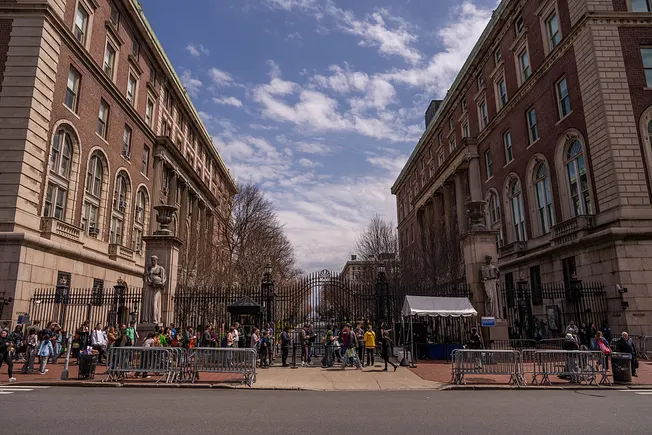
    Federal officials have scrutinized Columbia following a series of on-campus protests in 2024. In August of that year, Rep. Virginia Foxx, R-N.C., and former chairwoman of the House Committee on Education and the Workforce, issued several subpoenas to Columbia leaders as part of an investigation into antisemitism at the university and whether the protests had created a hostile environment in violation of the 1964 Civil Rights Act.

    Last month, EEOC Acting Chair Andrea Lucas issued a statement in which she pledged to hold universities and colleges accountable for workplace antisemitism. Lucas’ statement did not name any specific institutions, but it did cite “disruptive and violent protests in violation of campus policies” as an example of severe or pervasive antisemitic conduct that could violate Title VII of the Civil Rights Act.

    “Under the guise of promoting free speech, many universities have actually become a haven for antisemitic conduct, often in violation of the universities’ own time, place, and manner policies, as well as civil rights law,” Lucas said in the March 5 statement.

    EEOC did not confirm whether messages sent to Columbia and Barnard faculty were part of an ongoing investigation into either institution. “Per federal law, we cannot comment on investigations, nor can we confirm or deny the existence of an investigation,” the agency said.

    Similarly, Columbia declined to comment on a pending investigation, but a university official said Columbia had told staff that it gave “affected employees notice that the University was required to provide certain information in compliance with a subpoena. The University did not provide the information voluntarily.”

    Columbia did not respond to a request for comment on whether it had advised staff not to respond to EEOC’s messages.

    News of the inquiry drew criticism from one of EEOC’s administrative judges, Karen Ortiz, who sent an all-staff email directed to EEOC Acting Chair Andrea Lucas.

    Ortiz wrote that Lucas should consider resigning; in an interview with HR Dive, she said the email was in response to news of the text messages and other recent agency actions, including its decision to abandon gender-identity discrimination litigation and halting some claims processing. She said the survey arguably was not within Lucas’ authority to send and could be understood as an attempt to intimidate Columbia and Barnard.

    “It’s a complete overreach,” Ortiz said of the survey.

    Source link

  • Layoffs Gut Federal Education Research Agency

    Layoffs Gut Federal Education Research Agency

    Five years after the COVID-19 pandemic first forced schools and colleges into remote learning, researchers, policymakers and higher education leaders may no longer have access to the federal data they need to gather a complete picture of how those disruptions have affected a generation of students long term—or hold states and colleges accountable for the interventions they deployed to address the fallout.

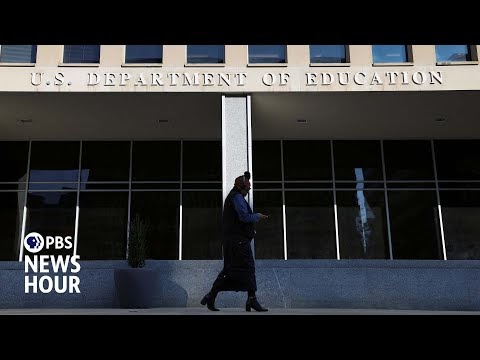
    That’s because the National Center for Education Statistics, the Education Department’s data-collection arm that’s administered surveys and studies about the state of K-12, higher education and the workforce since 1867, is suddenly a shell of itself.

    As of this week, the NCES is down to five employees after the department fired nearly half its staff earlier this week. The broader Institute of Education Sciences, which houses NCES, also lost more than 100 employees as part of President Donald Trump’s campaign to eliminate alleged “waste, fraud and abuse” in federal funding.

    The mass firings come about a month after federal education data collection data took another big blow: In February, the department cut nearly $900 million in contracts at IES, which ended what some experts say was critical research into schools and fueled layoffs at some of the research firms that held those contracts, including MDRC, Mathematica, NORC and Westat.

    Although Trump and his allies have long blamed COVID-related learning loss on President Joe Biden’s approval of prolonged remote learning, numerous experts told Inside Higher Ed that without some of the federal data the NCES was collecting, it will be hard to draw definitive conclusions about those or any other claims about national education trends.

    ‘Backbone of Accountability’

    “The backbone of accountability for our school systems begins with simply collecting data on how well they’re doing. The fact that our capacity to do that is being undermined is really indefensible,” said Thomas Dee, a professor at Stanford University’s Graduate School of Education and research associate at the National Bureau of Economic Research. “One could conceive this as part of an agenda to undermine the very idea of truth and evidence in public education.”

    But the Education Department says its decision to nearly eliminate the NCES and so many IES contracts is rooted in what it claims are the agency’s own failures.

    “Despite spending hundreds of millions in taxpayer funds annually, IES has failed to effectively fulfill its mandate to identify best practices and new approaches that improve educational outcomes and close achievement gaps for students,” Madi Biedermann, deputy assistant secretary for communications at the department, said in an email to Inside Higher Ed Thursday.

    Biedermann said the department plans to restructure IES in the coming months in order to provide “states with more useful data to improve student outcomes while maintaining rigorous scientific integrity and cost effectiveness.”

    But many education researchers disagree with that characterization of IES and instead view it as an unmatched resource for informing higher education policy decisions.

    “Some of these surveys allow us to know if people are being successful in college. It tells us where those students are enrolled in college and where they came from. For example, COVID impacted everyone, but it had a disproportionate impact on specific regions in the U.S. and specific social and socioeconomic groups in the U.S.,” said Taylor Odle, an assistant professor of educational policy studies at the University of Wisconsin at Madison.

    “Post-COVID, states and regions have implemented a lot of interventions to help mitigate learning loss and accelerate learning for specific individuals. We’ll be able to know by comparing region to region or school to school whether or not those gaps increased or reduced in certain areas.”

    Without uniform federal data to ground comparisons of pandemic-related and other student success interventions, it will be harder to hold education policymakers accountable, Odle and others told Inside Higher Ed this week. However, Odle believes that may be the point of the Trump administration’s assault on the Education Department’s research arm.

    “It’s in essence a tacit statement that what they are doing may potentially be harmful to students and schools, and they don’t want the American public or researchers to be able to clearly show that,” he said. “By eliminating these surveys and data collection, and reducing staff at the Department of Education who collect, synthesize and report the data, every decision-maker—regardless of where they fall on the political spectrum—is going to be limited in the data and information they have access to.”

    Scope of Data Loss Unclear

    It’s not clear how many of the department’s dozens of data-collection programs—including those related to early childhood education, college student outcomes and workforce readiness—will be downsized or ended as a result of the cuts. The department did not respond to Inside Higher Ed’s request for clarity on exactly which contracts were canceled. (It did confirm, however, that it still maintains contracts for the National Assessment of Educational Progress, the College Scorecard and the Integrated Postsecondary Education Data System.)

    A now-fired longtime NCES employee who asked to remain anonymous out of fear of retaliation said they and others who worked on those data-collection programs for years are still in the dark on the future of many of the other studies IES administers.

    “We’ve been out of the loop on all these conversations about the state of these studies. That’s been taking place at a higher level—or outside of NCES entirely,” said the terminated employee. “What these federal sources do is synthesize all the different other data sources that already exist to provide a more comprehensive national picture in a way that saves researchers a lot of the trouble of having to combine these different sources themselves and match them up. It provides consistent methodologies.”

    Even if some of the data-collection programs continue, there will be hardly any NCES staff to help researchers and policymakers accurately navigate new or existing data, which was the primary function of most workers there.

    “We are a nonpartisan agency, so we’ve always shied away from interpreting or making value judgments about what the data say,” the fired NCES worker said. “We are basically a help desk and support resource for people who are trying to use this data in their own studies and their own projects.”

    ‘Jeopardizing’ Strong Workforce

    One widely used data set with an uncertain future is the Beginning Postsecondary Students Longitudinal Study—a detailed survey that has followed cohorts of first-time college students over a period of six to eight years since 1989. The latest iteration of the BPS survey has been underway since 2019, and it included questions meant to illuminate the long-term effects of pandemic-related learning loss. But like many other NCES studies, data collection for BPS has been on pause since last month, when the department pulled the survey’s contract with the Research Triangle Institute.

    In a blog post the Institute for Higher Education Policy published Wednesday, the organization noted that BPS is intertwined with the National Postsecondary Student Aid Study, which is a comprehensive nationwide study designed to determine how students and their families pay for college and demographic characteristics of those enrolled.

    The two studies “are the only federal data sources that provide comprehensive insights into how students manage college affordability, stay enrolled and engaged with campus resources, persist to completion, and transition to the workforce,” Taylor Myers, assistant director of research and policy, wrote. “Losing these critical data hinders policy improvements and limits our understanding of the realities students face.”

    That post came one day after IHEP sent members of Congress a letter signed by a coalition of 87 higher education organizations and individual researchers urging lawmakers to demand transparency about why the department slashed funding for postsecondary data collection.

    “These actions weaken our capacity to assess and improve educational and economic outcomes for students—directly jeopardizing our ability to build a globally competitive workforce,” the letter said. “Without these insights, policymakers will soon be forced to make decisions in the dark, unable to steward taxpayer dollars efficiently.”

    Picking Up the Slack

    But not every education researcher believes federal data is as vital to shaping education policy and evaluating interventions as IHEP’s letter claims.

    “It’s unclear that researchers analyzing those data have done anything to alter outcomes for students,” said Jay Greene, a senior research fellow in the Center for Education Policy at the right-wing Heritage Foundation. “Me being able to publish articles is not the same thing as students benefiting. We have this assumption that research should prove things, but in the world of education, we have very little evidence of that.”

    Greene, who previously worked as a professor of education policy at the University of Arkansas, said he never used federal data in his assessments of educational interventions and instead used state-level data or collected his own. “Because states and localities actually run schools, they’re in a position to do things that might make it better or worse,” he said. “Federal data is just sampling … It’s not particularly useful for causal research designs to develop practices and interventions that improve education outcomes.”

    Other researchers have a more measured view of what needs to change in federal education data collection.

    Robin Lake, director of the Center on Reinventing Public Education at Arizona State University, has previously called for reforms at IES, arguing that some of the studies are too expensive without enough focus on educators’ evolving priorities, which as of late include literacy, mathematics and how to handle the rise of artificial intelligence.

    But taking a sledgehammer to NCES isn’t the reform she had in mind. Moreover, she said blaming federal education data collections and researchers for poor education outcomes is “completely ridiculous.”

    “There’s a breakdown between knowledge and practice in the education world,” Lake said. “We don’t adopt things that work at the scale we need to, but that’s not on researchers or the quality of research that’s being produced.”

    But just because federal education data collection may not focus on specific interventions, “that doesn’t mean those data sets aren’t useful,” said Christina Whitfield, senior vice president and chief of staff for the State Higher Education Executive Officers Association.

    “A lot of states have really robust data systems, and in a lot of cases they provide more detail than the federal data systems do,” she said. “However, one of the things the federal data provides is a shared language and common set of definitions … If we move toward every state defining these key elements individually or separately, we lose a lot of comparability.”

    If many of the federal data collection projects aren’t revived, Whitfield said other entities, including nonprofits and corporations, will likely step in to fill the void. But that likely won’t be a seamless transition without consequence.

    “At least in the short term, there’s going to be a real issue of how to vet those different solutions and determine which is the highest-quality, efficient and most useful response to the information vacuum we’re going to experience,” Whitfield said. And even if there’s just a pause on some of the data collections and federal contracts are able to resume eventually, “there’s going to be a gap and a real loss in the continuity of that data and how well you can look back longitudinally.”

    Source link

  • How cuts at U.S. aid agency hinder university research

    How cuts at U.S. aid agency hinder university research

    Peter Goldsmith knows there’s a lot to love about soybeans. Although the crop is perhaps best known in America for its part in the stereotypically bougie soy milk latte, it plays an entirely different role on the global stage. Inexpensive to grow and chock-full of nutrients, it’s considered a potential solution to hunger and malnutrition.

    For the past 12 years, Goldsmith has worked toward that end. In 2013, he founded the Soybean Innovation Lab at the University of Illinois at Urbana-Champaign, and every day since then, the lab’s scientists have worked to help farmers and businesses solve problems related to soybeans, from how to speed up threshing—the arduous process of separating the bean from the pod—to addressing a lack of available soybean seeds and varieties.

    The SIL, which now encompasses a network of 17 laboratories, has completed work across 31 countries, mostly in sub-Saharan Africa. But now, all that work is on hold, and Goldsmith is preparing to shut down the Soybean Innovation Lab in April, thanks to massive cuts to the federal foreign aid funds that support the labs.

    A week into the current presidential administration, Goldsmith received notice that the Soybean Innovation Lab, which is headquartered at the University of Illinois, had to pause operations, cease external communications and minimize costs, pending a federal government review.

    Goldsmith told his team—about 30 individuals on UIUC’s campus that he described as being like family to one another—that, though they were ordered to stop work, they could continue working on internal projects, like refining their software. But days later, he learned the university could no longer access the lab’s funds in Washington, meaning there was no way to continue paying employees.

    After talking with university administrators, he set a date for the Illinois lab to close: April 15, unless the freeze ended after the government review. But no review materialized; on Feb. 26, the SIL received notice its grant had been terminated, along with about 90 percent of the U.S. Agency for International Development’s programs.

    “The University of Illinois is a very kind, caring sort of culture; [they] wanted to give employees—because it was completely an act of God, out of the blue—give them time to find jobs,” he said. “I mean, up until [Jan. 27], we were full throttle, we were very successful, phones ringing off the hook.”

    The other 16 labs will likely also close, though some are currently scrambling to try to secure other funding.

    Federal funding made up 99 percent of the Illinois lab’s funding, according to Goldsmith. In 2022, the lab received a $10 million grant intended to last through 2027.

    Dismantling an Agency

    The SIL is among the numerous university laboratories impacted by the federal freeze on U.S. Agency for International Development funds—an initial step in what’s become President Donald Trump’s crusade to curtail supposedly wasteful government spending—and the subsequent termination of thousands of grants.

    Trump and Elon Musk, the richest man on Earth and a senior aide to the president, have baselessly claimed that USAID is run by left-wing extremists and say they hope to shutter the agency entirely. USAID’s advocates, meanwhile, have countered that the agency instead is responsible for vital, lifesaving work abroad and that the funding freeze is sure to lead to disease, famine and death.

    A federal judge, Amir H. Ali, seemed to agree, ruling earlier this month that the funding freeze is doing irreparable harm to humanitarian organizations that have had to cut staff and halt projects, NPR and other outlets reported. On Tuesday, Ali reiterated his order that the administration resume funding USAID, giving them until the end of the day Wednesday to do so.

    But the administration appealed the ruling, and the Supreme Court subsequently paused the deadline until the justices can weigh in. Now, officials appear to be moving forward with plans to fire all but a small number of the agency’s employees, directing employees to empty their offices and giving them only 15 minutes each to gather their things.

    About $350 million of the agency’s funds were appropriated to universities, according to the Association of Public and Land-grant Universities, including $72 million for the Feed the Future Innovation Labs, which are aimed at researching solutions to end hunger and food insecurity worldwide. (The SIL is funded primarily by Feed the Future.)

    It’s a small amount compared to the funding universities receive from other agencies, like the National Institutes of Health, also the subject of deep cuts by Trump and Musk. But USAID-funded research is a long-standing and important part of the nation’s foreign policy, as well as a resource for the international community, advocates say. The work also has broad, bipartisan support; in fiscal year 2024, Congress increased funding for the Feed the Future Initiative labs by 16 percent, according to Craig Lindwarm, senior vice president for government affairs at the APLU, even in what he characterized as an extremely challenging budgetary environment.

    Potential Long-Term Harms

    Universities “have long been a partner with USAID … to help accomplish foreign policy and diplomatic goals of the United States,” said Lindwarm. “This can often but not exclusively come in the form of extending assistance as it relates to our agricultural institutions, and land-grant institutions have a long history of advancing science in agriculture that boosts yields and productivity in the United States and also partner countries, and we’ve found that this is a great benefit not just to our country, but also partner nations. Stable food systems lead to stable regions and greater market access for producers in the United States and furthers diplomatic objectives in establishing stronger connections with partner countries.”

    Stopping that research has negatively impacted “critical relationships and productivity,” with the potential for long-term harms, Lindwarm said.

    At the SIL, numerous projects have now been canceled, including a planned trip to Africa to beta test a pull-behind combine, a technology that is not commonly used anymore in the U.S.—most combines are now self-propelled rather than pulled by tractor—but that would be useful to farmers in Africa. A U.S. company was slated to license the technology to farmers in Africa, Goldsmith said, but now, “that’s dead. The agribusiness firm, the U.S. firm, won’t be licensing in Africa,” he said. “A good example of market entry just completely shut off.”

    He also noted that the lab closures won’t just impact clients abroad and U.S. companies; they will also be detrimental to UIUC, which did not respond to a request for comment.

    “In our space, we’re well-known. We’re really relevant. It makes the university extremely relevant,” he said. “We’re not an ivory tower. We’re in the dirt, literally, with our partners, with our clients, making a difference, and [that] makes the university an active contributor to solving real problems.”

    Source link

  • Education nominee McMahon says she supports calls to dismantle the agency but that funding wouldn’t be affected

    Education nominee McMahon says she supports calls to dismantle the agency but that funding wouldn’t be affected

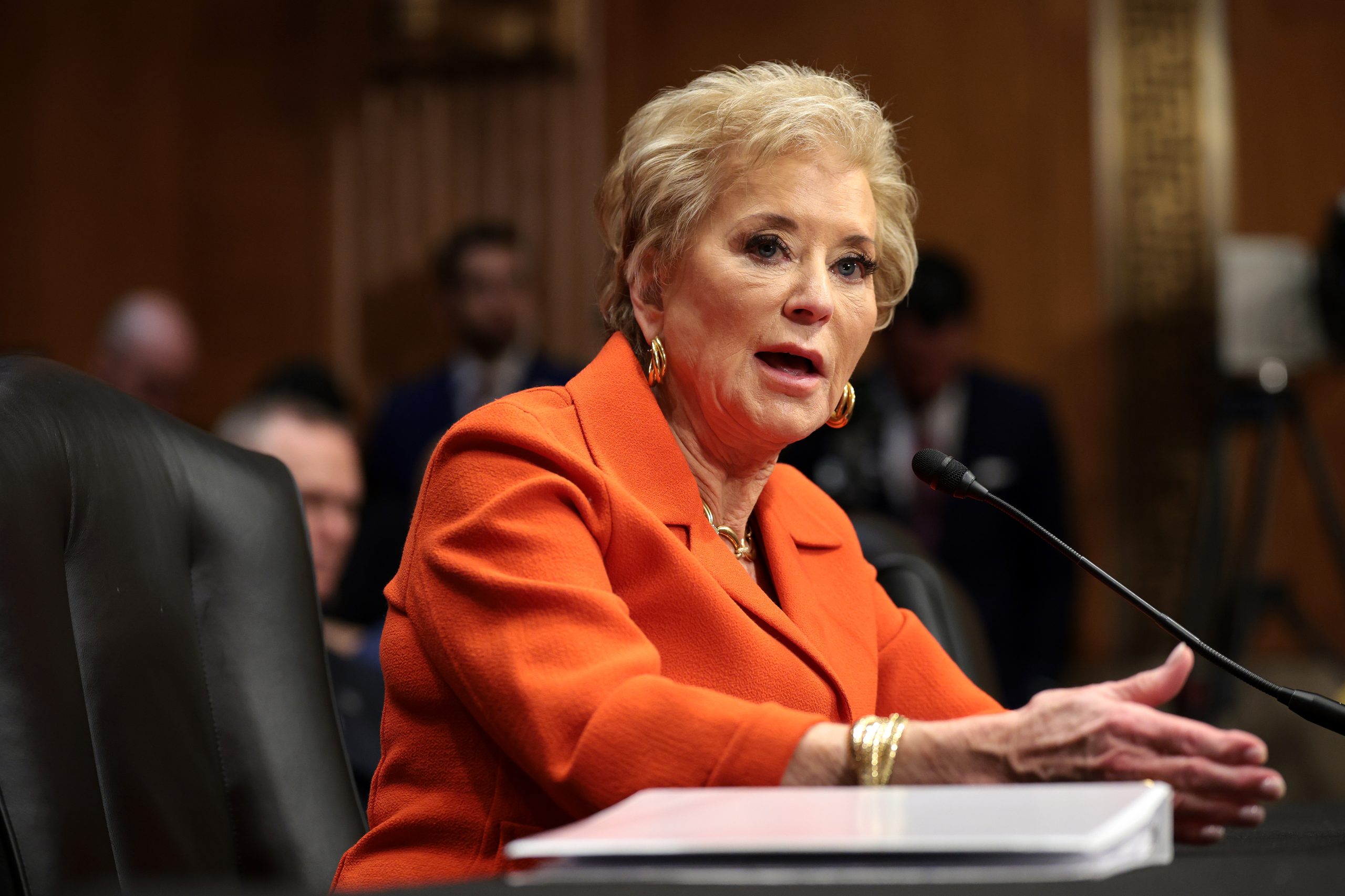
    Linda McMahon said she stands firmly behind President Donald Trump’s calls to gut the U.S. Department of Education at her confirmation hearing to lead the department.

    But she promised to work with Congress to do so — acknowledging some limits on the president’s authority as Trump seeks to remake the government through executive orders. And she tried to reassure teachers and parents that any changes would not jeopardize billions in federal funding that flows to high-poverty schools, special education services, and low-income college students.

    “We’d like to do this right,” McMahon said. “It is not the president’s goal to defund the programs, it is only to have it operate more efficiently.”

    Trump has called the Education Department a “con job” and said that McMahon, a former professional wrestling executive and billionaire Republican donor, should work to put herself out of a job. McMahon called this rhetoric “fervor” for change.

    The Trump administration’s chaotic approach to spending cuts so far raise questions about whether McMahon’s statements — an effort to neutralize the most significant criticism of plans to get rid of the Education Department — will prove true over time.

    Thursday’s hearing before the Senate Committee on Health, Education, Labor, and Pensions, punctuated by occasional protests, served as a referendum of sorts on the value of the Education Department. Republicans said it had saddled schools with red tape without improving student outcomes. Democrats said the department protects students’ civil rights and funds essential services.

    Democrats also pressed McMahon on Trump’s threats to withhold federal funding from schools that violate his executive orders and on the details of a potential reorganization — questions that McMahon largely deflected as ones she could better answer after she takes office.

    “It’s almost like we’re being subjected to a very elegant gaslighting here,” said Sen. Maggie Hassan, a Democrat from New Hampshire.

    Related: A lot goes on in classrooms from kindergarten to high school. Keep up with our free weekly newsletter on K-12 education.

    Even as Trump has called for the Education Department to be eliminated and schooling to be “returned to the states,” he’s also sought to expand its mission with executive orders threatening the funding of schools that employ diversity, equity, and inclusion practices or teach that racism and discrimination were part of America’s founding. The federal government is barred by law from setting local curriculum, as Republican Sen. Lisa Murkowski of Alaska pointed out during the hearing.

    In a tense exchange, Sen. Chris Murphy, a Democrat from Connecticut who’s championed school desegregation and diversity efforts in education, asked McMahon how schools would know if they were running a program that violates Trump’s executive order seeking to root out “radical indoctrination” in K-12 schools. Many schools have no idea what’s allowed, Murphy said, because the order doesn’t clearly define what’s prohibited.

    McMahon said in her view, celebrating Martin Luther King Jr. Day and Black History Month should be permitted, after Murphy noted that U.S. Department of Defense schools would no longer celebrate Black History Month in response to Trump’s order.

    But McMahon would not say that running affinity groups for students from certain racial or ethnic backgrounds, such as a Black engineers club or an after-school club for Vietnamese American students, was permitted. She also would not say whether schools might put their federal funding at risk by teaching an African American history class or other ethnic studies program.

    “That’s pretty chilling,” Murphy said. “You’re going to have a lot of educators and a lot of principals and administrators scrambling right now.”

    Later in the confirmation hearing, McMahon agreed schools should teach “the good, the bad, and the ugly” parts of U.S. history, and that it’s up to states, not the Department of Education, to establish curriculum.

    McMahon’s record on DEI has sometimes been at odds with the Trump administration. She backed diversity issues when she served on the Connecticut State Board of Education, the Washington Post reported.

    During her hearing, McMahon said DEI programs are “tough,” because while they’re put in place to promote diversity and inclusion, they can have the opposite effect. She pointed to examples of Black and Hispanic students attending separate graduation ceremonies — though those are typically held to celebrate the achievements of students of color, not to isolate them.

    Related: What might happen if the Education Department were closed?

    McMahon told the committee that many Americans are experiencing an educational system in decline — she pointed to sobering national test scores, crime on college campuses, and high youth suicide rates — and said it was time for a renewed focus on teaching reading, math, and “true history.”

    “In many cases, our wounds are caused by the excessive consolidation of power in our federal education establishment,” she said. “So what’s the remedy? Fund education freedom, not government-run systems. Listen to parents, not politicians. Build up careers, not college debt. Empower states, not special interests. Invest in teachers, not Washington bureaucrats.”

    Republican Senators reiterated these themes, arguing that bureaucrats in Washington had had their chance and that it was time for a new approach.

    They asked McMahon about Trump administration priorities such as expanding school choice, including private school vouchers, and interpreting Title IX to bar transgender students from restrooms and sports teams aligned with their gender identities.

    McMahon said she was “happy” to see the Biden administration’s rules on Title IX vacated, and she supported withholding federal funds from colleges that did not comply with the Trump administration’s interpretation of the law.

    Related: Trump wants to shake up education. What that could mean for a charter school started by a GOP senator’s wife

    Teachers unions and other critics of McMahon have said she lacks the proper experience to lead the Education Department, though McMahon and others have pointed to her time serving on the Connecticut State Board of Education, as a trustee of Sacred Heart University, and her role as chair of the America First Policy Institute, where she advocated for private school choice, apprenticeships, and career education.

    McMahon also ran the Small Business Administration in Trump’s first administration. Her understanding of the federal bureaucracy is an asset, supporters say.

    Sen. Tim Scott, a Republican from South Carolina, said McMahon’s background made her uniquely suited to tackle the pressing challenges facing the American education system today.

    Related: What education could look like under Trump and Vance 

    McMahon said multiple times that parents of children with disabilities should not worry about federal funding being cut for the Individuals with Disabilities Education Act, though she said it was possible that the U.S. Department of Health and Human Services would administer the money instead of the Education Department.

    But it appeared that McMahon had limited knowledge of the rights outlined in IDEA, the landmark civil rights law that protects students with disabilities. And she said it was possible that civil rights enforcement — a large portion of which is related to complaints about children with disabilities not getting the services to which they’re entitled — would move to the U.S. Department of Justice.

    Dismantling the education department by moving key functions to other departments is a tenet of Project 2025, the playbook the conservative Heritage Foundation developed for a second Trump administration. Most of these functions are mandated in federal law, and moving them would require congressional approval.

    McMahon struggled to articulate the goals of IDEA beyond saying students would be taken care of and get the assistance and technology they need.

    “There is a reason that the Department of Education and IDEA exist, and it is because educating kids with disabilities can be really hard and it takes the national commitment to get it done,” Hassan, the New Hampshire senator, said. “That’s why so many people are so concerned about this proposal to eliminate the department. Because they think kids will once again be shoved aside, and especially kids with disabilities.”

    McMahon also could not name any requirements of the Every Student Succeeds Act, the federal law that replaced No Child Left Behind. ESSA requires states to identify low-performing schools and intervene to improve student learning, but it gives states more flexibility in how they do so than the previous law.

    McMahon seemed open to reversing some of the cuts enacted by the U.S. DOGE Service, the cost-cutting initiative led by billionaire Elon Musk.

    She said, if confirmed, she would look into whether staff who’d been placed on administrative leave — including some who investigate civil rights complaints — should return. She also said she’d assess the programs that were cut when DOGE terminated 89 contracts at the Institute of Education Sciences and 29 training grants.

    Sen. Susan Collins, a Republican from Maine, said her office had heard from a former teacher who developed an intensive tutoring strategy that was used in a dozen schools in the state. The teacher had a pending grant application to evaluate the program and its effect on student outcomes, and the teacher worried it would be in jeopardy. Collins asked if the department should keep collecting that kind of data so it could help states determine what’s working for kids.

    “I’m not sure yet what the impact of all of those programs are,” McMahon said. “There are many worthwhile programs that we should keep, but I’m not yet apprised of them.”

    The Senate education committee is scheduled to vote on McMahon’s confirmation on Feb. 20.

    This story was produced by Chalkbeat and reprinted with permission. 

    The Hechinger Report provides in-depth, fact-based, unbiased reporting on education that is free to all readers. But that doesn’t mean it’s free to produce. Our work keeps educators and the public informed about pressing issues at schools and on campuses throughout the country. We tell the whole story, even when the details are inconvenient. Help us keep doing that.

    Join us today.

    Source link