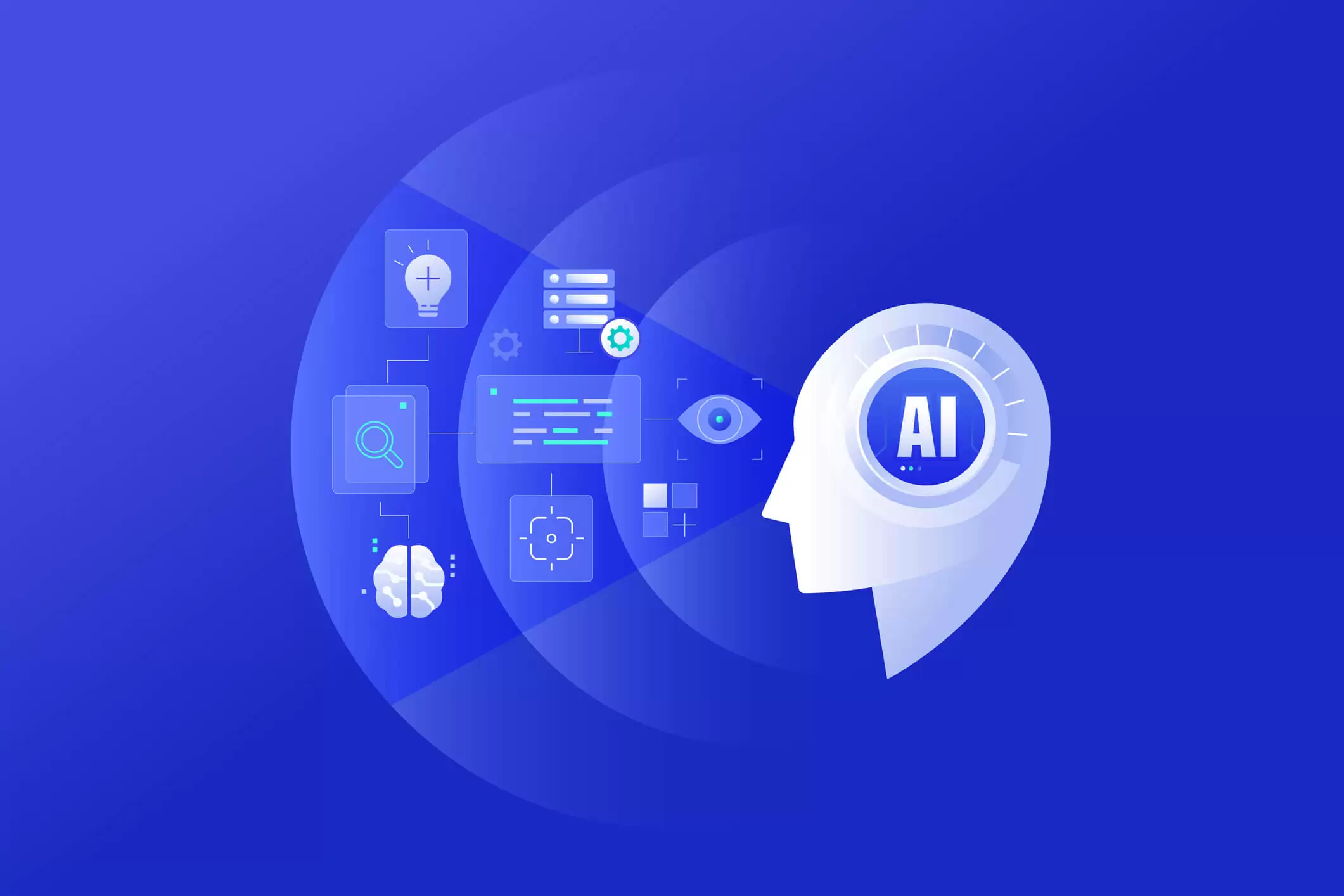
Higher education is entering a new era defined by proactive, intelligent digital helpers. Tech leaders such as Marc Benioff and Sam Altman have described 2025 as a pivotal year for AI agents, as colleges shift from basic chatbots to more advanced, autonomous AI systems. AI agents are not just tools; they are digital partners designed to support the entire student lifecycle.
AI agents are transforming how colleges recruit, support, and engage learners. Unlike static chatbots, these systems analyze context, adapt over time, and take initiative. Their capabilities include automating application nudges, answering complex questions, and supporting academic success. This marks a major technological leap for institutions aiming to do more with fewer resources.
In this article, we’ll define what AI agents are, explain how they differ from traditional digital assistants, and explore the growing role of agentic AI in higher education. We’ll also highlight practical benefits and examine why 2025 is a turning point for adoption.
Are you prepared for the next evolution of enrollment and student support?
What Is an AI Agent in Higher Education?
In higher education, an AI agent is a software-based digital colleague designed to carry out tasks and make decisions autonomously, much like a human team member. Unlike traditional rule-based chatbots or static analytics dashboards, AI agents are dynamic, context-aware, and capable of proactive engagement. They anticipate needs, analyze data, and take meaningful action without waiting for human prompts.
Key Capabilities of AI Agents in Higher Ed:
- Real-Time Data Analysis: AI agents continuously ingest data from various systems, such as student information systems (SIS), learning management systems (LMS), and CRMs, and analyze it instantly. For example, if a student hasn’t logged into their course portal in over a week, the agent can flag this as a concern before a human staff member might even notice.
- Complex Reasoning: While a basic chatbot might reply, “You missed your payment deadline,” an AI agent can infer that the student might be facing financial hardship. It reasons through that context and may recommend financial aid outreach or support services.
- Proactive Action: Rather than waiting for a student to reach out, an AI agent can send reminders, book appointments, or trigger alerts based on predefined conditions and patterns it observes. This proactive behavior is one of the defining features that separates agents from other digital tools.
- Human Collaboration: AI agents are not replacements for staff but digital teammates. They handle repetitive and data-heavy tasks, freeing up staff to focus on complex, high-touch interactions like one-on-one advising or sensitive student concerns.
Imagine a first-year student named Alex who begins missing classes and deadlines. An AI agent, let’s call it “Corey,” detects these signs, reviews Alex’s recent activity, and notices additional indicators such as a missed financial aid deadline and a recent visit to the counseling center. Corey logs this information and acts.
Corey sends Alex a supportive message suggesting tutoring and financial aid options, recommends an advising appointment, and even books a time. It also notifies the academic advisor and shares a detailed context summary, ensuring a more informed, empathetic meeting. Behind the scenes, the agent identifies other at-risk students based on similar patterns and launches personalized interventions.
This example illustrates the power of agentic AI in higher education in managing complex student workflows with speed, precision, and care. From recruitment and enrollment to retention and autonomous student support, AI agents are redefining digital service delivery across higher education.
AI Agents vs. Chatbots: How Are They Different?
As colleges explore digital tools to improve student support and enrollment outcomes, it’s critical to understand the difference between AI agents and traditional chatbots. While the two terms are sometimes used interchangeably, their capabilities and strategic value are markedly different.
Reactive vs. Proactive
Chatbots are reactive tools. They wait for a student to initiate a question and respond with a scripted answer, often drawn from an FAQ database. Their usefulness is limited to straightforward interactions like, “What’s the application deadline?” AI agents, by contrast, are proactive.
They can detect when something needs attention, such as a missing transcript or a disengaged student, and initiate outreach or action without being prompted.
Scripted Responses vs. Intelligent Actions
Chatbots operate within a narrow script. If a question falls outside their programmed flow, they may fail to respond meaningfully. AI agents go further. They are autonomous systems capable of analyzing context, making decisions, and completing tasks.
For example, if a student asks about uploading a transcript, a chatbot might share a link. An AI agent would identify the missing document, send a personalized reminder, check for completion, and escalate if necessary, driving the outcome rather than just responding.
Single-Channel vs. Omnichannel Engagement
Chatbots often live on a single webpage and lack memory of past conversations. AI agents work across platforms, web chat, SMS, email, and student portals, and retain context across all interactions. They recognize students, recall prior discussions, and tailor communications accordingly, enabling more seamless and personalized support.
FAQ Support vs. Lifecycle Engagement
Chatbots help with quick answers, but AI agents support multi-step processes and lifecycle touchpoints. In admissions, for instance, a chatbot might handle inquiries, but an AI agent can follow up on incomplete applications, suggest resources, and nurture leads through enrollment. In student services, chatbots may share library hours, while AI agents detect academic disengagement and initiate support outreach.
In short, chatbots answer questions. AI agents drive outcomes. As one expert noted, chatbots are like automated help desks, while AI agents function as full digital assistants embedded in institutional workflows. In an era of rising service expectations and limited staff capacity, this distinction matters more than ever. Institutions that embrace AI agents gain a powerful ally in delivering timely, personalized, and outcome-driven student experiences.
How Do AI Agents Benefit Colleges and Students?
The excitement around AI agents in higher education isn’t just about cool technology. It’s about solving real problems and creating tangible improvements for both institutions and learners. Here are some of the major benefits AI agents offer:
1. Enhanced Student Support: Personalized, Timely, 24/7
AI agents provide around-the-clock assistance, giving every student a digital personal assistant. Whether it’s midnight before an assignment is due or a weekend deadline looms, students can get timely help. More importantly, the support becomes proactive. For example, Georgia State University’s “Pounce” chatbot texts reminders to new students about critical steps like completing financial aid.
The result? Summer loss dropped from 19% to 9%, meaning hundreds more students showed up in the fall. Multiple surveys indicate that a significant share of students feel AI-powered tools help them learn more effectively, often citing faster access to personalized support.
2. Increased Efficiency and Staff Augmentation
AI agents act as force multipliers for campus teams. They handle thousands of repetitive inquiries, freeing staff for high-value work. Maryville University’s AI assistant “Max” answers thousands of student questions each month, resolving the majority without the need for human intervention.
Some institutions report up to 75% time savings on routine tasks. Agents send deadline reminders, track document submissions, and streamline follow-ups. This eases staff workload and ensures faster responses for students.
3. Improved Outcomes (Enrollment, Retention, and Success)
AI agents improve key metrics. Integrated AI systems have been linked to measurable gains in student engagement and retention, particularly when used to support proactive outreach and early intervention.
At Bethel University, a chatbot named “Riley” helps identify and guide prospective students to relevant resources, reducing the risk of drop-off. Since every 1% yield increase can represent hundreds of thousands in tuition revenue, tools that drive application completion and enrollment are essential.
4. Consistency, Accuracy, and Scalability
AI agents help deliver more consistent and accurate information across student-facing touchpoints. Unlike human staff who may interpret rules differently, agents follow uniform protocols. They scale effortlessly during peak periods.
When the University of Pretoria launched its chatbot, it handled 30,000+ queries in just months, easing pressure on staff and speeding up student responses. In crises or transitions, agents can quickly disseminate accurate updates to thousands.
5. More Engaging and Proactive Student Experience
AI agents make engagement feel more personalized. They nudge students with reminders and timely suggestions, reducing anxiety. For instance, an agent might prompt early tutoring or check in on disengaged students.
Nearly 48% of students report that chatbots improve their academic performance. For routine questions, many prefer AI over navigating office bureaucracy.
6. Addressing Staff Challenges and Burnout
With high student-to-staff ratios, burnout is common. AI agents ease this by managing low-level tasks, allowing staff to focus on complex support. Georgia Tech’s AI teaching assistant “Jill Watson” answered student questions so effectively that many didn’t realize she wasn’t human. The result was higher satisfaction and improved grades. Faculty benefit from fewer repetitive queries and more time for meaningful instruction.
7. Data-Driven Decision Making
AI agents generate actionable insights. For example, if hundreds of students ask how to change majors, administrators might simplify that process. Rising mental health-related queries might justify expanding counseling services. These agents serve students individually and help institutions see patterns and improve policies.
AI agents are not about replacing human support. Instead, they enhance it. They handle scale, speed, and consistency, while humans deliver empathy, strategy, and complex care. In the ideal model, AI handles the routine so people can focus on relationships, creating a stronger, more responsive higher education experience for all.
Why 2025 Is Called “The Year of the AI Agent”
AI in higher education is not new. Predictive analytics, early chatbots, and automated workflows have existed on campuses for years. So Why is 2025 considered the “Year of the AI Agent”?
The answer lies in a rare convergence of technological maturity, institutional urgency, and cultural readiness. Together, these forces have pushed AI agents out of experimentation and into real, scalable deployment across higher education.
From Generative AI Hype to Agentic Execution
The last few years have delivered dramatic advances in generative AI, particularly large language models capable of human-like reasoning and communication. By late 2024, however, many institutions were still grappling with a familiar challenge: impressive technology without clear operational value.
That changed as agentic AI frameworks emerged. Unlike standalone chatbots, AI agents can reason across systems, make decisions, and take action autonomously. By 2025, the standards, tooling, and governance models needed to deploy these agents had largely solidified. Technology leaders across industries began openly describing 2025 as the moment when AI moves from novelty to infrastructure, and higher education followed suit.
A Shift From Reactive to Proactive Campus Systems
Perhaps the most profound change is philosophical. Traditional campus technologies are reactive: staff respond to dashboards, alerts, or student inquiries after problems arise. AI agents invert that model.
In 2025, institutions are deploying systems that continuously monitor behavior, detect risk signals, and intervene before issues escalate. Instead of waiting for a student to ask for help, AI agents can proactively reach out with reminders, resources, or guidance. This shift, from responding to problems to preventing them, marks a fundamental evolution in how universities support students.
A Mature Ecosystem Ready for Scale
Another reason 2025 stands out is ecosystem readiness. Major CRM and LMS platforms now support AI agent integrations, while many universities have already launched institution-wide AI environments that allow teams to build custom tools safely and responsibly.
Equally important, AI literacy has improved dramatically. Faculty, administrators, and students now have a shared baseline understanding of AI, reducing resistance and accelerating adoption. The organizational “soil,” in other words, is finally fertile.
Urgency in a Challenging Higher Ed Landscape
The broader context cannot be ignored. Enrollment pressure, budget constraints, staffing shortages, and growing student support needs have created an acute demand for scalable solutions. AI agents offer a compelling return on investment: automating routine tasks, extending staff capacity, and directly supporting recruitment, retention, and student success.
Early results have reinforced this case, demonstrating that modest investments can yield outsized operational and experiential gains.
Momentum and Institutional Confidence
Finally, momentum matters. As respected associations, peer institutions, and sector leaders publicly endorse AI adoption, hesitation gives way to action. The conversation has shifted decisively, from “Should we use AI?” to “How do we implement it effectively and responsibly?”
Taken together, these forces explain why 2025 feels different. This is the year of AI execution in higher education. Agentic AI has moved from concept to practice, and institutions embracing it now are redefining what responsive, student-centered operations look like in the modern university.
Real-World Examples of AI Agents in Higher Ed
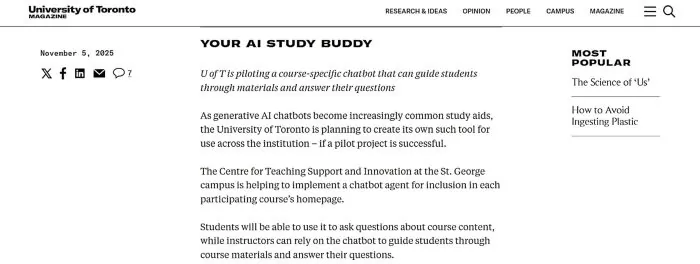
University of Toronto (Canada): U of T is integrating AI agents into autonomous student support and advising. A university-wide task force recommended deploying AI tools in these areas, and a pilot program is underway for a course-specific AI chatbot that lives on course websites. This “virtual tutor” agent can answer students’ questions about class materials and guide them through content.
Unlike public chatbots, U of T’s version runs on a secure platform with course-specific knowledge, protecting instructors’ content and student privacy. If successful, the AI tutor will be rolled out across the institution to enhance how students receive academic help outside of class.
Source: University of Toronto
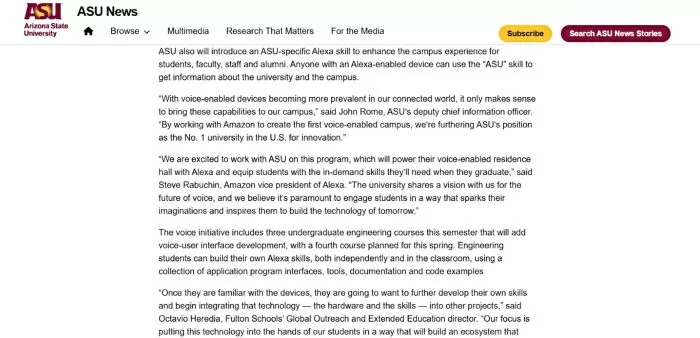
Arizona State University (USA): ASU has implemented AI-powered digital assistants – including a voice-activated campus chatbot through Amazon’s Alexa. In a first-of-its-kind program, ASU provided Echo Dot smart speakers to students in a high-tech dorm and launched an “ASU” Alexa skill that anyone can use to get campus information.
Students can ask the voice assistant about dining hall menus, library hours, campus events, and more. This AI agent offers on-demand answers via natural conversation, extending student engagement and support to a hands-free, 24/7 format.
Source: Arizona State University
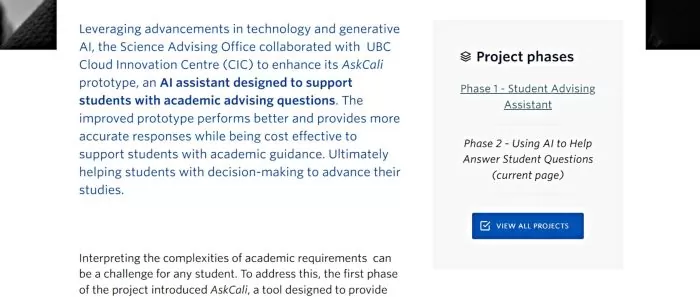
University of British Columbia (Canada): UBC is leveraging AI agents to enhance advising and student services. For example, the Faculty of Science piloted “AskCali,” an AI academic advising assistant that uses generative AI to answer students’ questions about course requirements and program planning at any time of day.
AskCali draws on UBC’s academic calendar and official documents to provide accurate, personalized guidance, helping students navigate complex requirements. UBC’s Okanagan campus has also deployed chatbots for departments like IT help and student services, reportedly handling the vast majority of routine inquiries and dramatically reducing wait times.
Source: University of British Columbia
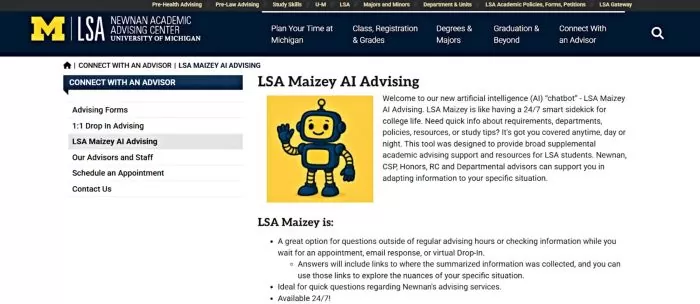
University of Michigan (USA): U–M has rolled out AI-driven assistants to support students in academics and campus life. Notably, the College of Literature, Science, and Arts introduced “LSA Maizey,” a 24/7 AI advising chatbot described as a “smart sidekick for college life.” Maizey answers questions about degree requirements, academic policies, registration, study strategies, and more – anytime, day or night. It provides links to official information and helps students find advising info outside of business hours.
This AI agent augments U–M’s human advisors by handling common queries and pointing students to the right resources instantly. (U–M has also developed a campus-wide assistant called “MiMaizey” for general questions like dining, events, and wayfinding, further personalizing the student experience)
Source: University of Michigan
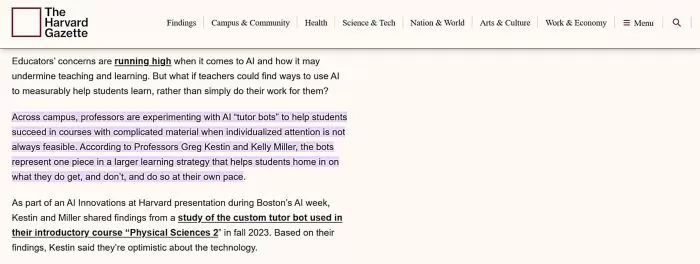
Harvard University (USA): Harvard is experimenting with autonomous AI tutors and assistants to improve learning and advising. In one pilot, Harvard faculty built a custom AI “tutor bot” for an introductory science course that allows students to get immediate help with difficult concepts outside of class.
Students could ask this bot unlimited questions at their own pace, without fear of judgment, and a study found it improved engagement and motivation in the course. Harvard’s IT department has also launched AI chat assistants (nicknamed “HUbot” and “PingPong”) to aid students with tech or academic questions, and Harvard Business School tested an AI teaching assistant in a finance course.
Source: Harvard University
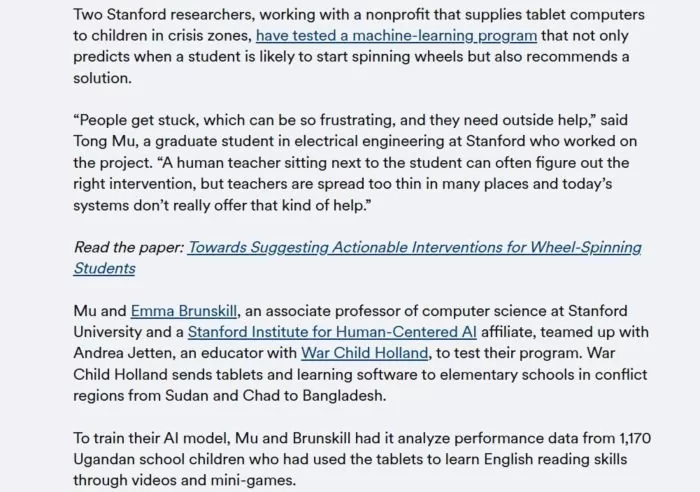
Stanford University (USA): Stanford has been a leader in using AI agents to support students academically. One example is a Stanford-developed AI system that monitors online learning platforms to detect when a student is struggling. Researchers created a machine-learning agent that predicts when a student will start “wheel-spinning” (getting stuck repeatedly on practice problems) and recommends targeted interventions to help the student overcome the obstacle.
Essentially, the AI acts like an autonomous tutor/coach in self-paced digital courses, flagging at-risk students and suggesting that instructors or the system intervene (for example, by reviewing an earlier concept). Beyond this, Stanford has trialed AI chatbots as virtual TAs in large classes (answering common questions on course forums) and used data-driven AI models to alert advisors about students who may need support.
Source: Stanford University
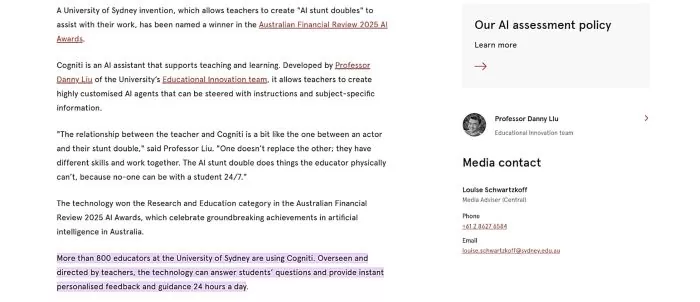
University of Sydney (Australia): The University of Sydney developed “Cogniti,” an AI platform that serves as an “AI stunt double” for instructors, essentially allowing teachers to clone their expertise into custom AI agents for their courses. More than 800 Sydney faculty are already using Cogniti to support their teaching.
These AI agents (designed by the educators themselves) can answer student questions, provide instant feedback on practice exercises, and offer guidance 24/7, in alignment with the instructor’s curriculum and guidelines.
For example, a speech pathology class uses a Cogniti bot that role-plays as a patient’s parent to help students practice clinical conversations. Cogniti won a national award for innovation, and it’s given students at Sydney access to personalized help at all hours – while letting instructors remain in control of the AI’s scope and knowledge.
Source: University of Sydney
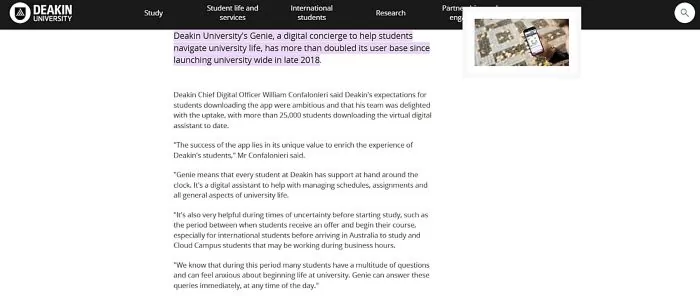
Deakin University (Australia): Deakin Genie is a pioneering digital assistant that has been serving Deakin students since late 2018. Branded as a “digital concierge,” Genie lives in the Deakin University mobile app and uses AI (natural-language processing with voice and text) to help students navigate university life. It can answer thousands of common questions (“When is my assignment due?”, “Where is the library?”), manage personal schedules and reminders, and even proactively prompt students to study or register for classes.
Genie’s rollout was phased; it started with pilot groups and went university-wide in 2018. Within the first year, its user base more than doubled, reaching over 25,000 student downloads by 2019. At peak times (such as the start of term), Genie handles up to 12,000 conversations per day, a volume equivalent to Deakin’s call center traffic. Top queries center on first-year needs: class timetables, assignment details, finding unit (course) resources, and key dates. The Genie team closely monitors performance and tracks whether Genie’s answers resolve the question or if a human staff follow-up is needed, continually updating Genie’s knowledge base and dialog flow.
This iterative improvement has paid off in high student satisfaction; many students treat Genie like a supportive “friend” always on hand. Genie is also context-aware: it knows who the student is (program, year, campus) and personalizes responses (“Your next class is…”, “Your assignment 2 is due next Monday”).
Source: Deakin University
Humans + AI Agents: A New Collaborative Workforce
As AI agents gain traction across higher education, one point deserves emphasis: their value lies not in replacing people, but in working alongside them. The most successful institutions view AI agents as tools that extend human capacity rather than diminish it.
The goal is a blended workforce in which routine, data-heavy tasks are automated, freeing faculty and staff to focus on what humans do best: empathy, judgment, creativity, and mentorship.
In practice, this collaboration is already taking shape across campus operations. Admissions offices are using AI agents to track application completeness and communicate with prospective students, while human counselors retain responsibility for final decisions and nuanced conversations.
Advising teams rely on agents to monitor engagement data and flag potential risks, but the advising itself remains a human-centered interaction and is strengthened by better insight and preparation rather than automated away.
This shift also requires a cultural adjustment. Institutions leading the way are investing in AI literacy and professional development to help staff understand how these tools work and how they can be applied responsibly. When employees are empowered to experiment and contribute ideas, AI adoption becomes collaborative rather than imposed, encouraging innovation from the ground up.
From Experimentation to Organizational Advantage
Human oversight remains essential to responsible AI deployment. AI agents operate most effectively within clear governance frameworks that prioritize data privacy, institutional policy alignment, and human oversight. For high-impact decisions, such as academic standing, financial aid determinations, or student well-being, humans stay firmly in the loop. The agent may analyze data or draft recommendations, but people make the final call.
Importantly, AI agents can actually strengthen the human touch. By helping staff prioritize outreach and monitor large student populations, they reduce the likelihood that students fall through the cracks. The result is a campus environment that is more responsive, more personalized, and ultimately more humane, where technology supports, rather than replaces, meaningful human connection.
Are you prepared for the next evolution of enrollment and student support?
Frequently Asked Questions
Question: What is an AI agent in higher education?
Answer: In higher education, an AI agent is a software-based digital colleague designed to carry out tasks and make decisions autonomously, much like a human team member. Unlike traditional rule-based chatbots or static analytics dashboards, AI agents are dynamic, context-aware, and capable of proactive engagement. They anticipate needs, analyze data, and take meaningful action without waiting for human prompts.
Question: How do AI agents benefit colleges and students?
Answer: The excitement around AI agents in higher education isn’t just about cool technology. It’s about solving real problems and creating tangible improvements for both institutions and learners. Here are some of the major benefits AI agents offer:
Question: Why is 2025 considered the “Year of the AI Agent”?
Answer: The answer lies in a rare convergence of technological maturity, institutional urgency, and cultural readiness. Together, these forces have pushed AI agents out of experimentation and into real, scalable deployment across higher education.